

World History from an Anthroposophical Perspective
and as the foundation of understanding the Spirit in Man
GA 233
27 December 1923, Dornach
Translated by Steiner Online Library
Fourth Lecture
[ 1 ] Yesterday, my task was to illustrate, using specific individuals as examples, how world-historical development unfolds. If one wishes to proceed in the direction of the spiritual sciences, one cannot present it any other way than by showing the sequence of events as reflected in the human being. For consider that only our age—for reasons we will discuss in the course of these lectures—is such that human beings feel isolated from the rest of the world as individual beings. All preceding ages, and indeed all future ages—this must be expressly emphasized—are such that human beings felt, and will continue to feel, themselves as members of the whole world, as belonging to the whole world. As I have often said: Just as a finger on a human being cannot be a being existing in and of itself, but only in relation to the human being—whereas, when separated from the human being, it is no longer the finger but perishes, becomes something entirely different, and is subject to laws entirely different from those governing the organism—just as the finger is only a finger in connection with the organism, so too is the human being only a being in any form—be it in the form of earthly life, or in the form of life between death and a new birth—in connection with the whole world. — But awareness of this did indeed exist in earlier times, will exist again later, and is merely clouded and obscured today because, as we shall hear, human beings needed this clouding and obscuring in order to be able to fully develop the experience of freedom within themselves. And the further back in time we go, the more we find that people had an awareness of their oneness with the cosmos.
[ 2 ] I have now presented two figures to you—one named Gilgamesh in the well-known epic, the other Eabani in the same epic—and I have shown you how these figures lived during the ancient Chaldean-Egyptian period in the manner in which people lived at that time, and how they then underwent a deepening of their experience through the Ephesian Mysteries. And I already pointed out yesterday how these same human beings were then placed within the course of world history in the figures of Aristotle and Alexander. But in order to fully understand what the course of Earth’s evolution was like during those times when the events I have described unfolded for these personalities, we must look even more closely at what such souls were able to take in during these three successive periods.
[ 3 ] I have already drawn your attention to how the personality hidden behind the name Gilgamesh sets out on a journey to the West and, after all, undergoes a kind of Western, post-Atlantean initiation. Now, in order to understand what comes later, let us form a picture of what such a late initiation was like. However, we must seek out this initiation at the very place where echoes of the ancient Atlantean initiation persisted for a long time. And this was the case with the Mystetians of Hybernia, of whom I have already spoken recently to my friends here in Dornach. But I must first recap some of what has been discussed so that we can fully understand what is at stake here.
[ 4 ] The Mysteries of Hybernia—the Irish Mysteries—have indeed existed for a long time. They were still in existence at the time of the establishment of Christianity, and they are the ones that, from a certain perspective, have most faithfully preserved the ancient wisdom teachings of the Atlantean people. Now I would like to give you an initial picture of the experiences of someone who was initiated into the Irish Mysteries in the post-Atlantean era. The person who was to receive this consecration, this initiation, had to undergo rigorous preparation at that time; indeed, the preparations for the Mysteries in ancient times were of extraordinary rigor. The individual actually had to be transformed inwardly—in the state of his soul and in his entire human constitution. Then, in the Mysteries of Hybernia, the individual was first prepared in such a way that he became attentive—through powerful inner experiences—to that which is deceptive in the existence surrounding him, in all the things that surround him to such an extent that he initially attributes existence to them based on sensory perception. Furthermore, human beings were made aware of all the difficulties and obstacles they face when striving for the truth—for the real truth. Human beings were made aware that, fundamentally, everything that surrounds us in the sensory world is an illusion; that the senses present an illusion; and that the truth is hidden behind the illusion—that, in fact, true being cannot be attained by human beings through sensory perception.
[ 5 ] Now you will say that this is a conviction you have always held throughout your long journey in anthroposophy. You know that very well, you will say. But the knowledge that a person can have in their present consciousness—even if only a little—of the illusory nature of the external sensory world is nothing at all compared to the inner upheavals, the inner tragedy, endured by the people who were being prepared at that time for the Hyberian initiation. For when one says to oneself theoretically, “Everything is Maya, everything is illusion,” one actually takes it very lightly. But the preparation of the Hybernian disciples was taken so far that they said to themselves: There is no human possibility of penetrating through the illusion and arriving at true, authentic being.
[ 6 ] The students were prepared by the fact that, out of desperation, so to speak, they initially found inner, psychological satisfaction in the illusion. They fell into a state of despair, believing that the illusory nature of things was so overwhelming, so powerful, that it was impossible to transcend the illusion at all. And in the lives of these students, there was a recurring sentiment: “Well, then one simply has to remain in the illusion”—but that means: “Then one must lose the ground beneath one’s feet, for one cannot stand firm on an illusion.”—Yes, people today can hardly imagine the rigor of the preparation in the ancient mysteries. People simply shy away from what inner development truly demands.
[ 7 ] And just as it was with Being and its illusory nature, so it was for these students with the quest for truth. And they came to understand everything that prevents human beings—through their emotions, through their dark, overwhelming sensations and feelings—from reaching the truth, everything that clouds the clear light of insight. So that they, too, reached a point where they said to themselves: If we cannot live in the truth, then we must simply live in error, in untruth! — It is, after all, tantamount to tearing one’s humanity out of oneself when one reaches a point in life where one despairs of Being and truth.
[ 8 ] All of this was intended to ensure that, by experiencing the opposite of what one is ultimately meant to achieve as a goal, one would approach that goal with a truly profound human sensibility. For whoever has not come to know what it means to live with error and illusion simply does not know how to appreciate being and truth. And the students of Hybernia should learn to appreciate truth and being.
[ 9 ] And then, once the students had gone through all this—once they had, so to speak, completed the polar opposite of what they were ultimately destined to achieve—they were led—and I must describe what happened next in the same figurative terms as were actually used in the Hybernian Mysteries at that time—into a kind of sanctuary containing two statues, statues of immense suggestive power. One of these statues, of gigantic size, was hollow inside; the outer surface surrounding the cavity—that is, the entire substance of which the statue was composed—was a thoroughly elastic material, so that wherever one pressed, one could push inward into the statue. But the moment one stopped pressing, the form would restore itself. The entire statue was crafted in such a way that the head was the most prominent feature, and when one stood facing it, one had the feeling that forces radiated from the head into the rest of the colossal body—for, of course, one could not see the hollow interior, did not perceive it, but only sensed it when one pressed. And one was compelled to press. One had the feeling that the entire body, apart from the head, was radiated by the forces of the head, that the head does everything in this statue.
[ 10 ] I readily admit that if a person today, in the midst of the mundane realities of life, were led before the statue, he would indeed perceive little more than an abstract concept. Certainly, but it is quite another thing to have experienced—with one’s whole being, with one’s mind, with one’s soul, with one’s blood, with one’s nerves—the power of illusion and the power of error, and then to experience the evocative force of such a gigantic figure.
[ 11 ] This statue had a masculine character. Next to it stood another one, which had a feminine character. It was not hollow. It was made of a material that was not elastic but malleable. If you pressed on it—and you were again urged to press on it—you destroyed the shape. A hole was dug into the body.
[ 12 ] But after the student had learned from one statue that, thanks to its elasticity, everything returned to its original shape, and after he had learned from the other statue that he had deformed it by pressing on it, he left the room—after doing something else, which I will discuss shortly— and he was not led back into that room until all the errors and deformations he had caused to the plastic, non-elastic statue—which had a feminine character—had been corrected. He was not led back in until the statue was intact. And through all these preparations—I can only describe the matter in broad strokes—that the student had undergone, he experienced an inner transformation in his entire being—in spirit, soul, and body—in the presence of the statue, which had a feminine character. This inner transformation had, of course, already been prepared within him earlier, but it manifested itself to the fullest extent through the suggestive effect of the statue itself. He felt within himself a sense of inner numbness, an inner, frosty numbness. And this frosty numbness affected him in such a way that he saw his soul filled with imaginings, and these imaginings were images of the earthly winter—images that depicted the earthly winter. Thus, the student was led to perceive the wintery quality from within, in his spirit.
[ 13 ] With the other statue, the male one, the student felt as if all the life he normally possessed throughout his entire body were flowing into his blood, as if his blood were being permeated by forces and pressing against his skin. So while standing before one statue he felt as if he were turning into a frosty skeleton, and before the other he felt as if his entire inner life were being consumed by heat and he were living within his stretched-out skin. And this experience of the whole human being, pressed against its surface, led the student to gain the insight to say to himself: You sense yourself, you feel yourself, you experience yourself as you would be if, of all things in the cosmos, only the sun were acting upon you. — And in this way, the student learned to recognize the cosmic influence of the sun in its distribution. He learned to recognize the relationship between the human being and the sun. And he learned to recognize that the only reason the human being is not, in reality, as he now felt himself to be under the suggestive influence of the sun statue is because other forces from other corners of the world modify this influence. In this way, the student learned to attune himself to the cosmos. And when the student felt the suggestive effect of the moon statue—that is, when he inwardly experienced the frosty stillness of winter and the wintry landscape—whereas with the sun statue he had experienced a summer landscape in his mind, as if generated from within himself—then he sensed what he would be like if only the moon’s influences were present.
[ 14 ] Look, in the present, what do we actually know about the world? We know that chicory is blue, that the rose is red, that the sky is blue, and so on. But these are not earth-shattering impressions. They merely describe the immediate surroundings of human life. Human beings must become sensory organs to a much greater degree—with their entire being—if they wish to come to know the mysteries of the universe. And it was precisely through the suggestive effect of the sun statue that their being was concentrated throughout their entire bloodstream. Human beings came to know themselves as solar beings by experiencing this suggestive effect within themselves. And human beings came to know themselves as lunar beings by experiencing the suggestive effect of the female statue. And then, based on these inner experiences, they could describe how the sun and moon affect human beings—just as today, based on what they perceive with their eyes, people can describe the effect of a rose, and based on what they hear with their ears, the effect of the note C-sharp, and so on. And so, even in the post-Atlantean era, the students of these mysteries experienced the human being’s integration into the cosmos. This became a direct experience for them.
[ 15 ] Well, what I have told you is a brief outline of what the disciples experienced in a truly magnificent way—right up into the first centuries of Christian development—as a cosmic experience within the Mysteries of Hybernia, as they were introduced to the experiences of the Sun and the Moon.
[ 16 ] The experiences the initiates had to undergo in the Ephesian Mysteries—the Ephesian Mysteries of Asia Minor—were of a completely different nature. In these Ephesian Mysteries, one experienced—with one’s whole being and in a particularly intense way—that which later found paradigmatic expression in the opening words of the Gospel of John: “In the beginning was the Word. And the Word was with God. And the Word was God.”
[ 17 ] In Ephesus, the student was not led before two statues, but before one—the statue known as the Artemis of Ephesus. And as the disciple identified with this statue, which was full of life and brimming with vitality everywhere, the disciple became one with the world-ether. With his entire inner experience and feeling, he rose above mere earthly life and entered into the experience of the world-ether. And the following became clear to him. First, he was taught what human language actually is. And through human language—that is, the human image, the human, image-like Logos in contrast to the world Logos, the cosmic Logos—it was made clear to him how the world Word weaves and surges creatively through the cosmos.
[ 18 ] Once again, I can only sketch out the matter. This is how it unfolded. The student was specifically encouraged to truly experience what happens when a person speaks, when they imprint the word upon the exhaled breath. The student was guided to experience how that which they bring to life through their own inner act takes place in the airy element, but that two other processes are connected to what happens in the airy element.
[ 19 ] Let us imagine that this is the exhalation (see drawing, right side, light blue with a red line), into which certain word formations spoken by human beings are imprinted. As this exhalation, formed into words, flows outward from our chest, the rhythmic vibration spreads downward into the entire aqueous, liquid element that permeates the human organism (light; water). So that when a person speaks, they experience these air rhythms at the level of their larynx and speech organs; but parallel to this speech, a rippling and undulating movement occurs throughout their fluid body. The fluid located below the speech region begins to vibrate, resonating within the human being. And this is essentially what it means to accompany what we speak with feeling. And if the watery element within the human being did not resonate along with it, speech would flow outward neutrally, indifferently; the human being would not empathize with what is spoken. Toward the top, however, toward the head, the element of warmth (red) rises, and it accompanies the words we imbue with our exhalation—the upward-flowing waves of warmth that penetrate our head and cause us to accompany the words with thoughts. So that when we speak, we are dealing with three elements: air, warmth, and water or fluid.
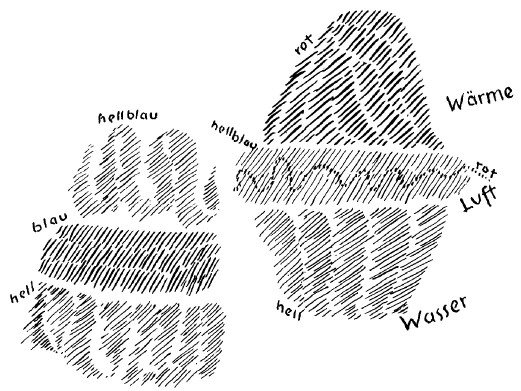
[ 20 ] This process—which alone provides an overall picture of what weaves and lives within human speech—was taken as the starting point by the student from Ephesus. And then it was made clear to him how this process taking place within the human being is a humanized cosmic process—that in a certain earlier epoch, the Earth itself functioned in such a way that within it, not the airy element but the watery, the liquid element (left side of the drawing, blue), that liquid element—which I spoke of yesterday as a volatile, liquid protein—was in such a wave-like motion. Just as the air is within the human being on a small scale when exhaling while speaking, so too was the volatile, liquid protein that once surrounded the Earth as an atmosphere. And this then transformed—just as the airy element here transforms into the heat element, into a kind of airy element (left, light blue), and below into a kind of earthy element (light)—so that, just as feelings arise in our bodies through the liquid element, so too did the earth formations, the earth forces, and all that which acts and undulates as forces within the earth come into being. And above this, within the airy element, arose what are the weaving cosmic thoughts that work creatively within the earthly realm.
[ 21 ] This was a majestic, overwhelming impression that a person in Ephesus would experience when it was pointed out to them that their language contains the microcosmic echo of what was once macrocosmic. And the student in Ephesus, as he spoke, felt—in the very experience of speaking—an insight into the workings of the World Word, how it once meaningfully moved the fluid, fleeting element, how it bordered above on the creative thoughts of the world and below on the emerging forces of the earth.
[ 22 ] Thus, the disciple immersed himself in the cosmic by learning to understand his own speech correctly: Within you is the human Logos. The human Logos acts through you during your time on Earth, and as a human being, you are the human Logos. For indeed, through that which flows downward in the fluid element, we are formed as human beings out of language; through that which flows upward, we have our human thoughts during our time on Earth. — But just as the most human aspect within you is the microcosmic Logos, so too was the Logos in the very beginning, and was with God, and was himself a God.
[ 23 ] This was thoroughly understood in Ephesus, because it was through man and in man himself.
[ 24 ] You see, when you consider a figure such as the one behind the name Gilgamesh, you cannot help but feel that he lived within the entire milieu, the entire environment that radiated from the Mysteries. For in earlier times, all culture, all civilization, was a radiance of the Mysteries. And when I mention Gilgamesh to you, although he was not initiated into the Mysteries of Erek itself while he was still in his homeland of Erek, he was nonetheless immersed in a civilization that was substantially permeated by what one could perceive through this connection to the cosmos. And then, during his journey westward, he experienced something that brought him into direct contact—not, however, with the Hybernian Mysteries themselves; he did not go that far—but, in a sense, with what was cultivated in a colony of the Hybernian Mysteries; as I told you, this colony was located in what is now Burgenland. This lived on in the soul of this Gilgamesh. It continued to develop during the life between death and rebirth that now followed, and it was during his next earthly life in Ephesus itself that the deepening of the soul took place.
[ 25 ] Well, for both of the personalities I have spoken of, such a deepening of the soul took place. In a sense, something—in reality, and indeed in a strong, intense reality—surged from general civilization toward the human souls of these personalities; something that, since Homeric times in Greece, had essentially been nothing more than a beautiful illusion.
[ 26 ] Especially over in Ephesus, at that very site where Heraclitus also lived and where so much of that ancient reality could still be sensed well into the later Greek period, right up into the 6th, 5th centuries of the pre-Christian era—it was precisely in Ephesus that one could still sense the full reality in which humanity once lived, when it was still in direct relationship with the divine-spiritual, when Asia was still only the lowest of the heavens, in which one was still connected to the higher heavens bordering it, because in Asia the nature spirits were experienced, above which were the Angeloi, Archangeloi, and so on, and above them the Exusiai and so on. And so one can say: While even in Greece itself the echoes of what had once been reality were only just beginning to take shape, and while that which had been reality was transforming into the images of heroic legends—in which one can still clearly discern that they point to primordial realities— while in Greece the dramatic element of primordial realities came to life in Aeschylus, in Ephesus it was actually still the case that, immersed in the deep darkness of the Mysteries, one sensed echoes of those ancient realities in which human beings lived in direct connection with the divine-spiritual world. And that is, after all, the essence of Greek culture: that the Greeks immersed themselves in myths closer to human experience, and in beauty and art closer to human experience—that is, they immersed themselves in the reflection of that which could once be experienced by human beings in connection with the cosmos.
[ 27 ] And now we must imagine how, just as this Greek civilization had reached its zenith on the one hand—having proudly rejected even that which, as in the Persian Wars, still sought to resurface from the old Asian reality—just as it had reached its zenith on the one hand, but on the other hand was already in decline—how this was experienced by individuals who clearly carried within their souls the echoes of what was once a divine-spiritual earthly reality in the spirit, soul, and body of human beings.
[ 28 ] And so we must imagine that Alexander the Great and Aristotle actually lived in a world that was not entirely in harmony with them—a world that was, in fact, tragic for them. What is peculiar is that in Alexander and Aristotle there lived individuals who had a different relationship to the spiritual realm than those around them—individuals who, although they did not care much for the Samothracian Mysteries, nevertheless felt in their souls a deep kinship with what took place in the Samothracian Mysteries involving the Cabiri. This was sensed for a long time and was still felt in the Middle Ages. And it must be said—though people today have entirely false notions about this—that even in the Middle Ages, well into the 13th and 14th centuries, certain individuals from all walks of life possessed a clear spiritual insight, at least regarding the region that was once called Asia in the ancient Near East. And the “Song of Alexander,” composed by a priest in the Middle Ages, is, after all, a remarkably significant document of the late Middle Ages. Compared to the distorted version of history that persists today regarding the events surrounding Alexander and Aristotle, what the priest Lamprecht composed as the “Song of Alexander” around the 12th century still appears as a magnificent conception—akin to the ancient one—of what took place under Alexander the Great.
[ 29 ] You need only keep the following in mind. In “The Song of Alexander” by Pastor Lamprecht, we have a wonderful description—a wonderful description of something like this: Every year, when spring comes and you go out into the forest and reach the edge of the woods, where flowers grow at the edge of the forest and where, at the same time, the sun is positioned so that the shadows of the forest trees fall upon the flowers growing at the forest’s edge—there you can see, in the shade of the forest trees in spring, the ethereal flower children emerging from the calyxes of the flowers, performing dances and round dances at the forest’s edge. — And one recognizes quite clearly that in this description by Pastor Lamprecht something of a real experience shines through—an experience that people of that time were still able to have; that they did not go out into the woods, to put it prosaically: “There is grass, there are flowers, there the trees begin—” but rather, as they approached the forest, when the sun stood behind the trees and the shadow fell over the flowers, the entire world of flower beings emerged from the flowers in the shade of the forest trees to meet them—beings that were there for them even before they entered the forest, where they would then perceive the other elemental spirits. But this dance of the flowers was what Father Lamprecht felt he particularly wanted to describe. And it is significant, after all, that when Father Lamprecht set out to describe Alexander’s campaigns, he interwove and infused this account—even in the 12th century, at the beginning of the 12th century—with descriptions of nature that encompassed the manifestation of the elemental realms throughout. The whole is underpinned by the awareness: If one wishes to describe what once took place in Macedonia, when Alexander’s campaigns into Asia began and when Alexander was taught by Aristotle—if one wishes to describe that—one cannot do so by describing the prosaic earth all around; rather, one can describe it only by adding to the prosaic earth the realms of the elemental beings.
[ 30 ] But you see, when you read a history book today—which is entirely appropriate for the present day—well, then you simply read: Alexander, against the advice of his teacher Aristotle—whom he disobeyed—imagined it was his mission to reconcile the barbarians with civilized people and to bring about, so to speak, a “middle-of-the-road” culture consisting of the civilized Greeks, the Hellenes, the Macedonians, and the barbarians. While this is true for our time, it is nonetheless trivial in the face of the truth—the real truth. And one gets the impression of something truly magnificent when one sees how the priest Lamprecht, in describing Alexander’s campaigns, assigns them an entirely different goal. And it seems as though what I have just described—the intrusion of the elemental realms of nature, of the spiritual aspect of nature into the physical aspect of nature—as though this were merely the introduction. For what is the goal of Alexander’s campaigns in Father Lamprecht’s “Song of Alexander”?
[ 31 ] Alexander reaches the gates of Paradise! Although this is expressed in the Christian terms of that time, it actually corresponds to a great extent—as I will explain further—to the truth. For Alexander’s campaigns were not undertaken merely to carry out conquests or—contrary to Aristotle’s advice—to reconcile the barbarians with the Hellenes; rather, they were imbued with a truly lofty spiritual goal and were driven by the spirit. And we then read in the writings of Father Lamprecht—who, one might say, some fifteen centuries after Alexander’s time, describes these campaigns with great devotion in his own way— we read that Alexander reaches the gates of Paradise but does not enter Paradise itself because, as Father Lamprecht believes, only those who possess true humility may enter Paradise. But Alexander, living in the pre-Christian era, could not yet possess true humility, for true humility could only be brought into humanity by Christianity. Nevertheless, if one interprets such things not in a narrow-minded but in a broad-minded sense, we see how the Christian priest Lamprecht senses something of the tragedy of the *Alexander-Züge*.
[ 32 ] Well, my intention in presenting this description of the Alexander Song was simply to draw your attention to the fact that it need not come as a surprise when one uses precisely this example of the Alexander campaigns to describe the preceding and subsequent periods of Western history in relation to the East. For the sentiment underlying this was, as you can see, not only present as a general sentiment until a relatively late period of the Middle Ages, but existed in such a concrete form that this Song of Alexander could come into being—a song that truly depicts, in a magnificently dramatic way, what actually unfolded through the two souls I have characterized for you. This particular aspect of Macedonian history points, on the one hand, far back into the past, and on the other, far into the future. And above all, one must bear in mind that a tragedy of world history hovers over everything found in Aristotle and Alexander. This tragedy of world history reveals itself even on the surface. It reveals itself in the fact that, due to the particular circumstances—the particular fateful circumstances of world history surrounding Aristotle—only the smallest portion of his writings made their way into the European West and were subsequently preserved by the Church. Essentially, these are only the logical works and those clothed in logic. But anyone who today delves into the few of Aristotle’s scientific writings that have survived will see in Aristotle just how profound his insight still was into the connection between the cosmos and humankind. I would like to draw your attention to just one thing here.
[ 33 ] Today, we also speak of the earth element, the water element, the air element, the fire or heat element, and then of the other one, the ether. How does Aristotle describe this? He describes the earth—the solid earth (see diagram, light-colored core)—the liquid earth, water (light red), the air (blue)—the whole permeated by fire and surrounded by fire (deep red). But for Aristotle, the earth extends all the way up to the moon. And from the cosmos, from the stars down to the moon—that is, no longer within the earthly realm, but up to the moon, as far as this point—from the zodiac, from the stars, the rest of the ether (light on the outside) extends spatially and cosmically. The ether extends down to the moon.
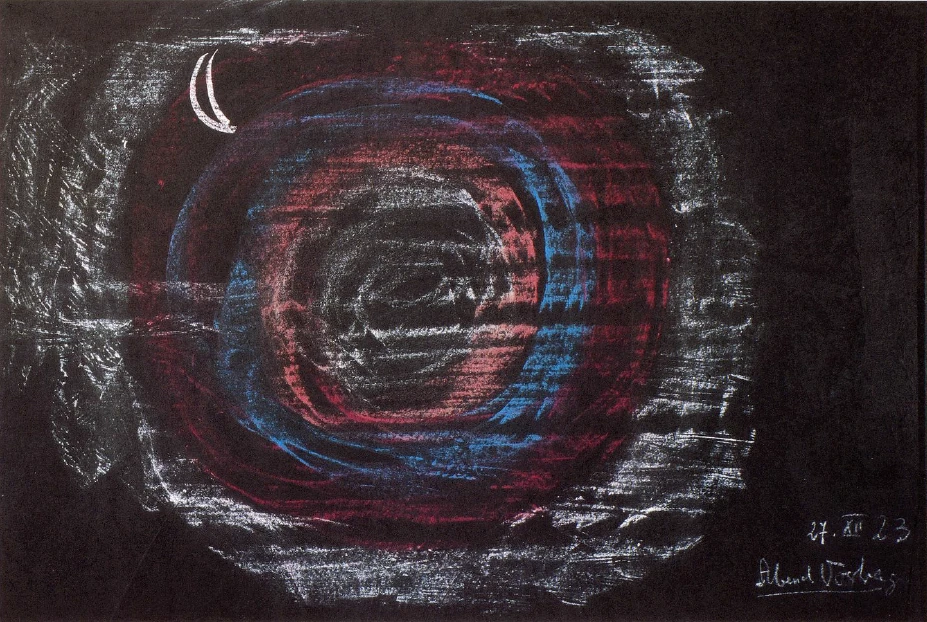
[ 34 ] Scholars still read this today in books written about Aristotle. Aristotle himself, however, told his student Alexander time and again: That ether which lies outside the earthly and warm realm—that is, the light ether, the chemical ether, the life ether—was once connected to the Earth. All of this extended down to the Earth. But when the Moon withdrew during the ancient evolution, the ether withdrew from the Earth. And—as Aristotle explained to his student Alexander—thus, what is outwardly a spatially lifeless world is, at first, not permeated by ether on Earth. But when, for example, spring approaches, the elemental spirits bring the ether from the lunar realm back into these beings—the plants, the animals, and human beings—for those beings that are coming into being, so that the Moon is the formative principle.
[ 35 ] When one stood before that one, the female figure in Hybernia, one felt very vividly how the ether does not actually belong to the Earth, but is brought down to Earth each year by the elemental spirits, in the amount necessary for the creation of beings.
[ 36 ] Aristotle, too, had profound insights into the relationship between humankind and the cosmos. His student Theophrastus did not allow the writings that dealt with this subject to reach the West. Some of these writings made their way back to the East, where there was still an appreciation for such matters. From there, they traveled through North Africa and Spain; via Jews and Arabs, they reached Western Europe and, as I will describe later, converged with the radiations—the civilizational radiations—of the Mysteries of Hybernia.
[ 37 ] But what I have described to you so far was, after all, only the starting point for the teachings Aristotle imparted to Alexander. These teachings were entirely concerned with inner experience. And if I were to present the matter, so to speak, in a somewhat sketchy manner, I would have to say the following: Through Aristotle, Alexander came to understand well that what exists out there in the world—the earth, water, air, and fire elements—also lives within the human being; that in this respect, the human being is a true microcosm; that within him, in his bones, the earth element lives; that in his blood circulation and in all that constitutes his vital fluids, are life-sap, the watery element lives; that within him the airy element is at work in breathing and the stimulation of breathing, and in speech; and that the fiery element lives in thought. Alexander still knew himself to be living within the elements of the world. But by feeling oneself to be living within the elements of the world, one also still felt one’s intimate kinship with the earth. Today, people travel east, west, north, and south: they do not sense everything that is actually rushing toward them, for they see only what their outer senses perceive, and they see only what the earthly substances within them perceive, not what the elements within them perceive. But Aristotle was able to teach Alexander: When you travel eastward on Earth, you move further and further into an element that dries you out. You move into the dry (see drawing).
[ 38 ] You shouldn’t imagine that when one travels toward Aisen, one dries up completely. Of course, these are subtle effects, but they are effects that Alexander certainly felt within himself, in accordance with Aristotle’s teachings. And in Macedonia he could say to himself: I have a certain degree of moisture within me; this moisture diminishes as I move eastward. — Thus, as he journeyed across the earth, he sensed the earth’s configuration, just as one senses—let’s say—when touching a person, running one’s hand over some part of their body, the difference between the nose, the eyes, and the mouth. Thus, a personality such as the one described was still able to perceive the difference between experiencing oneself as one moves deeper and deeper into the dry, and experiencing oneself as one moves toward the other side—toward the west—into the moist.
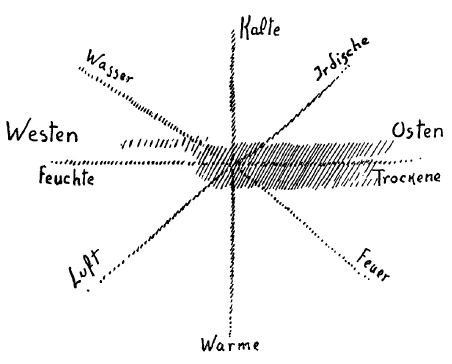
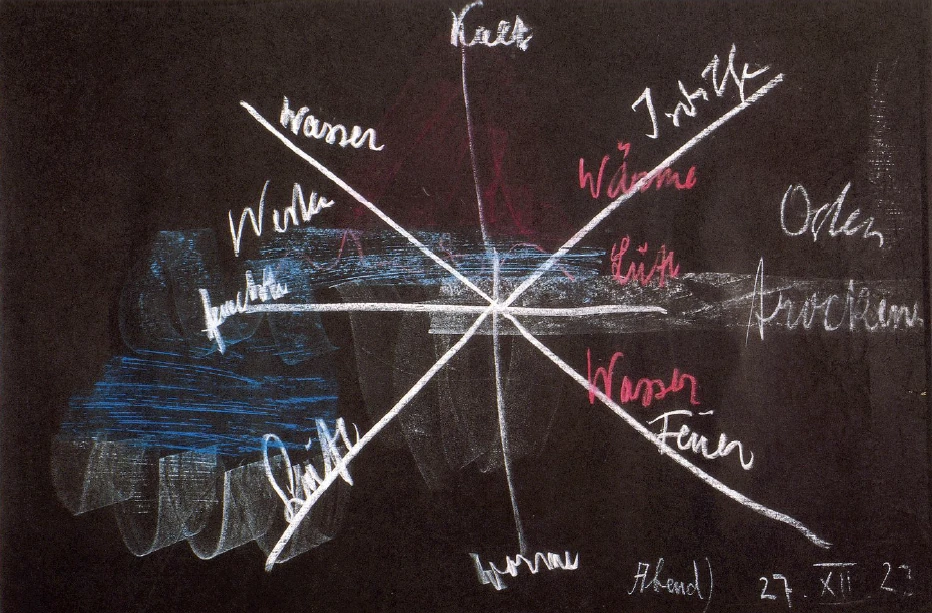
[ 39 ] People still experience these other distinctions today, albeit in a more general way. To the north, they experience the cold; to the south, the warmth and the fiery heat. But that interplay of damp cold—which one used to feel when traveling toward the northwest—people no longer sense. Aristotle vividly brought to life in Alexander what Gilgamesh had experienced when he undertook his journey westward. And the result was that, in the students’ immediate inner experience, they could perceive what is now experienced in the transitional zone between damp and cold toward the northwest: water. And it was by no means merely a possible, but a very real way of speaking for a man like Alexander, that he did not say: “The expedition is heading there, to the northwest”—but rather: “The expedition is heading there, where the element of water reigns supreme.” — In the intermediate zone between damp and warm lies the element where air reigns supreme. This is how it was taught in the ancient Greek-Chthonic mysteries, this is how it was taught in the ancient Samothracian mysteries, and this is how Aristotle taught it to his immediate disciple. And in the intermediate zone between cold and dry—that is, toward Siberia from Macedonia—the region of the Earth was experienced where the Earth itself, the earthly, held sway: the element of Earth, the solid. In the intermediate zone between warm and dry—that is, toward India—people experienced that region of the Earth where the element of fire prevailed. And so it was that Aristotle’s student pointed to the northwest and said: “There I sense the water spirits working upon the Earth.” — That he pointed to the southwest and said: “From there I sense the spirits of water.” That he pointed to the northeast and saw the spirits of the earth floating toward that direction in particular. That he pointed to the southeast, toward India, and saw the spirits of fire floating toward that direction or within their element.
[ 40 ] And you will sense that deep kinship with the natural and the moral when I now say, in conclusion, that the saying arose in Alexander: “I must throw myself out of the cold, damp element and into the fire, and set out on the march to India!” — That was a saying that was just as much rooted in the natural as it was in the moral, which is what we will discuss tomorrow. But I wanted to give you a vivid introduction to what was alive there. For in what was discussed between Alexander and Aristotle, you see reflected at the same time the entire turning point in the development of world history. Even in private instruction at that time, one could still speak of the great mysteries of the past. Then humanity began to embrace only the logical, the abstract, and the categories, while casting aside the rest. Thus, we are simultaneously pointing to a tremendous turning point in the development of world history, to a most crucial point in the entire course of European civilization in its connection with the East. More on that tomorrow.