

World History from an Anthroposophical Perspective
and as the foundation of understanding the Spirit in Man
GA 233
28 December 1923, Dornach
Translated by Steiner Online Library
Fifth Lecture
[ 1 ] Among the ancient mysteries, the one at Ephesus holds a very special place. Indeed, in discussing that element of development in Western history associated with the name of Alexander, I have also had to consider this mystery of Ephesus. One can only understand the meaning of both recent and ancient history by examining the transformation that the mystery tradition—from which all ancient civilizations originated—underwent as it spread from the East to the West, and thus first to Greece. And this transformation consists of the following.
[ 2 ] You see, when one looks into all the ancient mysteries of the East, one gets the impression everywhere that the mystery priests are able to reveal great, significant truths from their visions to their disciples. Indeed, the further back in time one goes, the more these wise priests are able, within the mysteries, to evoke the immediate presence of the gods themselves—the spiritual beings who govern the planetary worlds and the phenomena of the Earth—so that the gods were truly present.
[ 3 ] Man’s connection to the macrocosm was revealed in various mysteries in a similarly magnificent way, as I described to you yesterday regarding the mysteries of Hybernia and also regarding what Aristotle had to say to Alexander the Great. Above all, however, what was present in all the ancient Eastern mysteries was that the moral—the moral impulses—were not strictly separated from the natural impulses. When Aristotle directed Alexander toward the northwest, where the spirits of the water element reigned, what came from there was not merely a physical impulse—as the wind or other purely physical phenomena come from the northwest today—but moral impulses came along with the physical ones. The physical and the moral were one. This was possible because, through the insights imparted in these mysteries, human beings perceived the spirit of nature—and thus felt themselves to be one with all of nature. There is, for example, an aspect of humanity’s relationship to nature that lies precisely in the period that elapsed between the lifetime of Gilgamesh and the lifetime of that individuality into which he was reborn in his next incarnation near the Mystery of Ephesus. It is precisely in this period that we still find a vivid conception of the connection between humanity and the spiritual nature of the world. This connection is as follows. Through everything humanity came to know about the influence of the elemental spirits in nature, and about the influence of intelligent beings in planetary processes, humanity arrived at the conviction: Out there, spread out everywhere, is the plant world—the greening, sprouting, budding, and fruiting plant world. There I see the annual plants in the meadow and in the field, which grow in the spring and wither away again in the fall; there I see trees that have been growing for centuries, which develop bark and wood on the outside and reach far into the earth with their roots. All of that—what is rooted out there in the annual herbs and flowers, what grows with strong impulses deep into the earth—I once carried within me as a human being.
[ 4 ] You see, today people can sense when there is carbon dioxide in a room—carbon dioxide produced by people’s breathing: “I exhaled that carbon dioxide.” — People sense that they have breathed carbon dioxide into the room. Today, I would say, human beings are connected to the cosmos only to a very limited extent. In the airy aspect of their being—in the air that underlies breathing and the other atmospheric processes taking place within the organism—human beings are in a fully living connection with the greater world, with the macrocosm. They can look at the exhaled breath, at the carbon dioxide that was within them and is now outside. But just as a person today—though they do not actually do so, they could—looks at the exhaled carbon dioxide, so too did the person who was either initiated into the Eastern mysteries or had absorbed the wisdom that flowed outward from them, gaze upon the entire plant world. They said to themselves: I look back in the evolution of the worlds to an ancient solar age. Back then, I still carried the plants within me. And then I let them flow out into the vast circles of earthly existence. But when I still carried the plants within me, when I was still that Adam Kadmon who encompassed the entire Earth, including the plant world, the entire plant world was still something watery and airy.
[ 5 ] Humanity separated this plant world from itself. If you imagine that you were to attain the size of the entire Earth and then separate from within the plant realm—which now arises, passes away, grows, changes, and takes on various forms as it undergoes metamorphosis within the watery element—then you would recall in your mind how it once was. And that it was once like this—that is what those who had received their education in the Orient during the time of Gilgamesh, for example, told themselves. And when they looked at the growth of plants in the meadows, they said to themselves: We separated the plants at an earlier stage of our development, but the Earth has taken the plants in. The root-like aspect was first bestowed upon them by the earth, as was everything that is woody—that is, the tree-like nature of the plant realm. — But the general plant nature—that is what human beings separated from themselves, and that was taken up by the earth. Human beings felt a deep kinship with all things plant-like.
[ 6 ] Human beings did not feel the same kinship with the higher animal kingdom, for they knew that they could only work their way up to Earth by overcoming their animal nature and leaving the animals behind on their path of evolution. He brought the plants down to Earth with him, then handed them over to the Earth, so that the Earth took them into its bosom. For the plants on Earth, he became the mediator of the gods, the mediator between the gods and the Earth.
[ 7 ] That is why such people, who truly had that great experience—which can be depicted quite simply in a sketch (see drawing)—felt the following: A human being approaches the Earth from outer space (yellow). The number is irrelevant, since, as I said yesterday, human beings are interwoven with one another. He secretes everything plant-like, and the Earth absorbs the plant-like substance and gives it roots (dark green lines). — Thus the human being felt as if, through plant growth, he had, so to speak, encircled the Earth (red envelope) and as if the Earth had been grateful for this encircling and had absorbed what the human being could breathe into it in the form of watery, airy plant elements. And those who felt this way felt, in regard to bringing these plants to the earth, that they were intimately connected to the god, to the chief god of Mercury. Through this feeling that they themselves had brought the plants to the earth, they entered into a special relationship with the god Mercury.
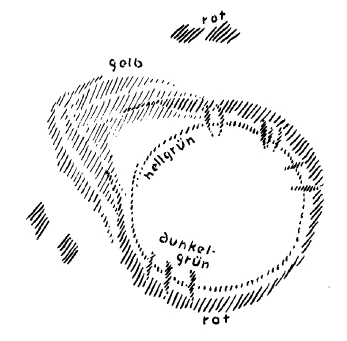
[ 8 ] In contrast, people felt a certain way about the animals: they could not bring them along to Earth; they had to set them apart; they had to free themselves from them, otherwise they would not have been able to develop the human form in the proper way. In a sense, the animals were pushed away, so that they were separated from humanity (red lines pointing outward) and then had to undergo their own evolution at a lower level than that of humanity itself. Thus, on the one hand, the ancient human—particularly during the Gilgamesh era and the period that followed—felt placed between the animal kingdom and the plant kingdom. In relation to the plant kingdom, he saw himself as the agent who, so to speak, sowed the earth on behalf of the gods. In relation to the animal kingdom, he felt as though he had cast it aside in order to become human without the burden of the animals, which had consequently atrophied. The entire Egyptian cult of animals, incidentally, is connected to this view. Much of the deep compassion found toward animals in Asia is connected to this. And it was indeed a magnificent view of nature that perceived the kinship of human beings with the plant world on the one hand, and with the animal world on the other. Toward the animal world, one felt a sense of liberation; toward the plant world, one felt an intimate kinship. As human beings, one perceived the plant world as a part of oneself, and one felt deep love for the earth, because the earth has taken in this part of humanity—which the plants represent—allowed it to take root within itself, and even covered it with bark in the trees using its own material. Everywhere, a moral dimension was present in the assessment of the physical environment. One approached the plants of the meadow and perceived in them not only natural growth, but also a moral relationship between humanity and that growth. One felt a moral relationship toward the animals as well: one had risen above them.
[ 9 ] Thus, a magnificent vision of the spiritual nature emanated from these mysteries over in the Orient. There were also mysteries in Greece, but they were characterized by a far less concrete vision of the spiritual nature. The Greek mysteries are magnificent, to be sure, but they differ quite significantly from the Eastern mysteries. In the Eastern mysteries, everything is such that through them, a person does not actually feel connected to the earth, but rather feels connected to the cosmos, to the universe. In Greece, too, the mystery tradition had initially reached the stage where people felt connected to the Earth. Therefore, what appeared or was experienced in the mysteries in the East was the essential spiritual world itself. One is indeed describing the absolute truth when one says: In the ancient Eastern mysteries, the gods themselves appeared among the priests who offered sacrifices and performed the prayers. — The mystery temples were at the same time the earthly abodes of the gods, where the gods bestowed upon humanity, through the priestly rites, the heavenly gifts they had to offer. In the Greek mysteries, only the images of the gods appeared—the likenesses, something like shadows; true, genuine images, but like shadows—no longer the divine beings, no longer the realities, but the shadows. Thus, the Greek had a completely different perception than those who belonged to the ancient Eastern culture. The Greeks had the sense that there are gods, but that human beings can only have images of these gods, just as one has images of experiences in one’s memory, and no longer the experiences themselves.
[ 10 ] That was the deep, fundamental feeling that emerged from the Greek mysteries: that people had the sense they possessed something like memories of the cosmos—not the appearance of the cosmos itself, but images of the cosmos; images of the gods, not the gods themselves; images of the processes on Saturn, the Sun, the Moon—no longer the living connection with what was real on Saturn, the Sun, and the Moon, just as a person has, for example, a real connection with their childhood. And it was precisely this real connection with the Sun, the Moon, and Saturn that the people of Eastern civilization derived from their mysteries. Thus, the Greek mystery tradition had a symbolic quality. It was the shadow spirits of the divine-spiritual reality that appeared. But this had brought about something else of great significance. For you see, there was still a difference between the Eastern mysteries and the Greek ones.
[ 11 ] In the Eastern mysteries, it was always the case that if one wanted to know anything about the magnificent, gigantic things one could experience there, one first had to wait for the right time. It was the case that one could only experience certain things if one performed the associated sacrificial rites—that is, the supersensory experiments, so to speak—in the fall; others in the spring; others at the height of summer; and others in the depths of winter. And again, it was possible that at any given time—recognized as the right one by a specific lunar constellation—sacrifices would be offered to certain gods. Then they would appear in the Mysteries. One would gain access to their revelations. Then one would have to wait, say, thirty years until the same opportunity arose again for a divine being to manifest itself in the Mysteries. For example, everything related to Saturn could only enter the realm of the Mysteries in some way every thirty years; everything related to the Moon, roughly every eighteen years, and so on. Thus, the priest-sages of the Eastern Mysteries received the magnificent, gigantic insights and visions they gained only in dependence on time, space, and all manner of factors. For example, one received entirely different revelations deep inside mountain caves, and different revelations on the mountain peaks. One received different revelations when one was somewhere deeper in Asia or on the coast, and so on. Thus, a certain dependence on space and time on Earth—that was precisely the characteristic feature of the mysteries of the East.
[ 12 ] In Greece, the great, gigantic realities had faded away. Images were still there. But one could now experience these images not depending on the season, the passage of the centuries, or the location; rather, one could experience them if, as a human being, one prepared oneself in the right way—by undertaking this or that spiritual exercise or making this or that personal sacrifice. Once one had reached a certain level of sacrifice and personal maturity, one could—precisely because one had achieved this as a human being—perceive the shadows of the great world events and world entities.
[ 13 ] This is the great shift in the nature of the mysteries from the ancient Orient to Greece: the ancient Oriental mysteries were subject to the conditions of earthly location and space, whereas the Greek mysteries were those in which the human being was considered in relation to what he offered to the gods. The god came, so to speak, in his shadow image, in his spectrum, when the human being had been deemed worthy through the preparations he had made, so that the god came to him in this spectrum. In this way, the Greek mysteries truly became the preparation for the new humanity.
[ 14 ] Now, right in the middle between the ancient Oriental and Greek mysteries stood that of Ephesus. It simply held a special place. For in Ephesus, those who received initiation there could still experience something of the gigantic, majestic truths of the ancient Orient. They were still touched by the inner sense and feeling of the connection between the human being and the macrocosm, and the divine-spiritual essence of the macrocosm. Oh, in Ephesus there was still much to perceive of what was supernatural. And the identification with Artemis, with the goddess of the Mystery of Ephesus, still brought that living connection: The plant world is yours; the earth has merely taken it in. You have overcome the animal world; you had to leave it behind. You must look upon the animals that had to be left behind on the path—so that you could become human—with as much compassion as possible. —This sense of oneness with the macrocosm was still passed down to the initiates of Ephesus through direct experiences, through the realities themselves.
[ 15 ] But in Ephesus, even as the first mystery to turn toward the West, there was independence from the seasons or the cycle of the centuries—in short, from place and time on earth. In Ephesus, what mattered was the spiritual exercises that a person undertook, the way in which they had prepared themselves through sacrifice and devotion to the gods. So that, in fact, the Mystery of Ephesus, on the one hand, still points back to the ancient East through the content of the mystery truths; and because it had already drawn closer to human development, to humanity itself, the Mystery of Ephesus was, in turn, already oriented toward Hellenism. It was, so to speak, the last mystery over there in the East where the ancient, gigantic truths still approached—and were still able to approach—humanity. For elsewhere in the East, the mysteries had already fallen into decadence.
[ 16 ] It is in the mysteries of the West that the ancient truths have endured the longest. One can still speak of Hybernia centuries after the emergence of Christianity. But I would like to say: The mysteries of Hybernia are, in essence, doubly mysterious. — For you see, what I told you yesterday about these two statues—one a sun statue, the other a moon statue, one male and one female—the mysteries surrounding these statues are such today that they are difficult to fathom even from the so-called Akashic Records. It is actually not at all difficult for someone trained in these matters to access the images of the Eastern mysteries and to draw these images from the astral light. But if one attempts to approach the mysteries of Hybernia—if one wishes to draw near to them in the astral light—one is initially struck by a kind of numbness. It repels one. Even in the Akashic records, these Irish, these Hybernian mysteries no longer allow themselves to be seen today, even though they have endured the longest in their original authenticity.
[ 17 ] Now consider this: It was the individuality inherent in Alexander the Great that was touched by the Hybernian Mysteries during the Gilgamesh era, during the westward migration as far as the region of present-day Burgenland. This human individuality lived on in a very ancient way during a time when there were still very strong echoes of the Atlantean era in the West. This was carried through by the soul state that flows between death and a new birth. Then the two friends, Eabani and Gilgamesh, found themselves once again in Ephesus, precisely to experience there, with great awareness, what had previously been experienced—more or less unconsciously or subconsciously—in connection with the divine-spiritual world during the Gilgamesh era. But during the Ephesian period, life was relatively calm—a time of digesting and processing what had been absorbed into their souls during earlier, more turbulent times.
[ 18 ] Now one must consider: Before these individualities reappeared during the decadence of the Greek era and the flourishing of the Macedonian era, what had befallen Greece! This Greece of ancient times, which essentially extended across the sea and also encompassed Ephesus, reaching deep into Asia Minor—this Greece still retained, in its shadows, the echoes of the ancient age of the gods. In the shadows, humanity’s connection to the spiritual world was indeed experienced. But Greek civilization gradually emerged from the shadows, and we see, step by step, how it evolved from what might be called a divine civilization into a purely earthly one.
[ 19 ] Oh, the most important aspects of historical development are not even touched upon in what is today considered purely materialistic, external history! This is, however, crucial to our overall understanding of Greek civilization, because by that time only a shadow remained in Greek civilization of the ancient divinity—in which human beings were connected to the supersensible worlds—as humanity gradually emerged from the world of the gods and came to make use of its own, entirely individual and personal spiritual faculties. This took place in stages. We can still see this in the dramas of Aeschylus, where what is still felt from the ancient age of the gods is now expressed in artistic form. But no sooner does Sophocles appear than humanity, so to speak, breaks away from this sense of oneness with the divine-spiritual existence. And then, something emerges that is linked to a name which, from a certain point of view, certainly cannot be highly enough esteemed; but there are, after all, different points of view in the world.
[ 20 ] You see, in ancient Greek times, there was truly no need to record history. Why would there be? After all, the living reflection of the significant past was right there. History was read in what was revealed in the Mysteries. There were the shadow figures, the living shadow figures. What, then, was there to write down as history? Then came the time when these shadow figures descended into the underworld, where human consciousness could no longer perceive them. That is when the urge to write down history first arose. That is when the first prose writer of history, Herodotus, emerged. And from that point on, one could name many others; the aim is always, so to speak, to tear humanity away from the divine-spiritual and place it in the purely earthly realm. Yet even so, during the Greek era, a radiance shone over this entire process of becoming earthly—a radiance that, as we shall hear tomorrow, did not pass on to the Roman era or to the Middle Ages. There was a radiance there. One could still sense it in the shadows—even in those fading in the twilight of Greek civilization—and feel that they were of divine origin.
[ 21 ] And in the midst of all that—like a refuge where one could find enlightenment about everything that existed in Greece, I would say, in fragments of culture—in the midst of all that stood Ephesus. Heraclitus, many of the greatest philosophers—including Plato and Pythagoras—all learned from Ephesus. Ephesus was truly the place that, to a certain extent, had preserved the ancient Eastern wisdom traditions. And even those individualities embodied in Aristotle and Alexander the Great were able to experience in Ephesus—somewhat later than Heraclitus—what remained of the ancient knowledge within the Eastern mysteries, which had been preserved as a legacy of the mystery of Ephesus. What lived in Ephesus as a mystery entity was intimately connected, in particular, with the soul of Alexander. And now one of those historical events took place which the trivial-minded assume to be an external coincidence, but which are in fact deeply, deeply rooted in the inner connections of human development.
[ 22 ] To grasp the significance of this historical event, let us reflect on the following. Remember that within the two souls—the soul of the one who would later become Aristotle and the soul of the one who would become Alexander the Great—there lived, first of all, what had been inwardly assimilated from time immemorial, and then what had become immensely valuable to them in Ephesus. I would say, all of Asia—but in the form in which it had become Greek in Ephesus—lived within both of them, especially in the soul of the one who later became Alexander the Great. Now imagine also the character—I have described him from the Gilgamesh era—and consider that in the living interaction between Alexander and Aristotle, the knowledge bound to the ancient Orient and to Ephesus was repeated, but repeated in the new form of knowledge. Just imagine that. Imagine what might have come to pass if that gigantic document—which actually lived within these souls with tremendous intensity—if that gigantic document, the Mystery of Ephesus, had been present; if, in other words, Alexander in his incarnation as Alexander had still encountered the Mystery of Ephesus! Just imagine that, and then appreciate the fact that on the very day Alexander was commanded to act, Herostratus threw the burning torch into the sanctuary of Ephesus, so that the Temple of Diana in Ephesus was burned down by the hand of a sacrilegious man on the very day Alexander was born. What was directly linked to his memorial documents was no longer to be found. It was no longer there; in essence, it now existed solely as a historical mission in the soul of Alexander and in that of his teacher Aristotle.
[ 23 ] And now connect what lived within them as a spiritual reality with what I showed yesterday—as arising, as it were, from the configuration of the Earth—in the mission of Alexander the Great. And now you will be able to understand that, with Ephesus, what was a real, genuine revelation of the divine-spiritual in the East was, as it were, wiped out. The other mysteries were, in essence, merely mysteries of decadence, in which traditions were preserved—albeit sometimes very vibrant traditions—and traditions that, in particularly gifted individuals, did indeed evoke clairvoyant powers. But the grandeur, the magnificence of ancient times was no longer there. With Ephesus, what had come over from Asia had been extinguished. Now appreciate the resolve in the soul of Alexander the Great: To this Orient, which has lost what it once had, it must at least be brought in the form in which it has been preserved as a shadow image in Greece! — Thus arose Alexander the Great’s idea to march into Asia, as far as it was possible to go, in order to restore to the East, in the form of a reflection within Greek culture, what it had lost.
[ 24 ] And now we see how, with this campaign of Alexander the Great, there is in fact—in a truly marvelous way—no cultural conquest; how there is no attempt to impose Hellenism on the Orientals in any external way; but rather, Alexander the Great not only adopts the customs of each land wherever he goes, but is also able everywhere to think from the hearts and minds of the people. When he arrives in Egypt, in Memphis, he is regarded as a liberator from all the spiritual bondage that had prevailed until then. He imbued the Persian Empire with a culture and a civilization that the Persians themselves had never been capable of achieving. He advanced as far as India. He conceived a plan to bring about a balance and harmonization between Hellenic and Eastern civilizations. He founded academies everywhere. The most significant ones for posterity are, of course, the academies he founded in Alexandria, in northern Egypt. But what is most important is that he founded academies, both large and small, throughout Asia, where the works of Aristotle—and the traditions of Aristotle—were subsequently cultivated. And this continued to have an impact in the Near East for centuries—so much so that, I would say, what Alexander inaugurated has been repeated ever since, albeit as a faint echo. Alexander first planted the knowledge of nature in Asia with a mighty thrust, all the way to India; it was only because of his early death that he was unable to reach Arabia—that was his main goal. All the way to India, all the way to Egypt—everywhere he transplanted what he had absorbed from Aristotle as knowledge of the spirit of nature. And he presented it everywhere in such a way that it could bear fruit, so that the people who were to receive it would feel it as their own, not as a foreign Hellenic concept being imposed upon them. Indeed, only a nature as fiery as that of Alexander the Great could have brought about what was accomplished there. For reinforcements kept coming. Many scholars of later times, in turn, traveled from Greece, and in particular it was one of the academies—besides Edessa, it was the Academy of Gondishapur—that, over the course of centuries, repeatedly received new waves of scholars from Greece.
[ 25 ] Then the monstrous act was carried out: that which had come from the East (it was depicted, with the two drawings overlapping; see original plate 8. Red from right to left, light spot)—which had been halted in Ephesus by Herostratus’s torch—was illuminated from behind by its shadow, which was in Greece, was backlit (light green from left to right) until the final act, when, under Eastern Roman tyranny, the Greek philosophical schools were closed in the 6th century A.D. and the last of the Greek philosophers fled to the Academy of Gondishapur.
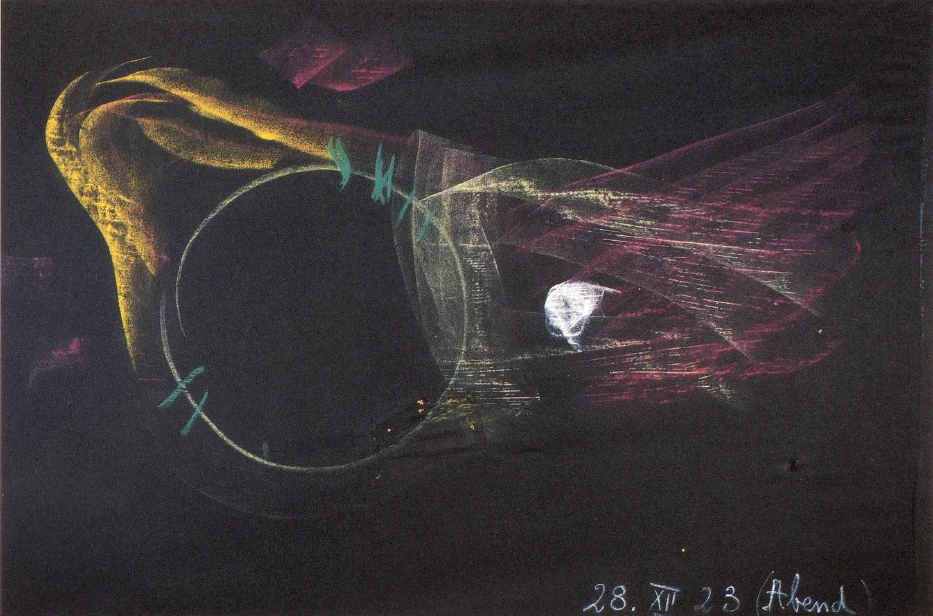
[ 26 ] It was this interplay between what had gone before and what remained behind. Thus, in this mission—albeit more or less unconsciously, but it was there nonetheless—the wave of civilizational life had, in a certain sense, arrived in Greece in a Luciferic manner, while in Asia it had remained behind in an Ahrimanic manner; in Ephesus, the balance was achieved. And since Ephesus had physically perished on his birthday, Alexander wanted to establish a spiritual Ephesus that would radiate its rays of sunlight across the Orient and the Occident. In a deeper sense, Alexander’s desire was rooted in the intention to establish a spiritual Ephesus extending across the Near East all the way to India, across Egyptian Africa, and across Eastern Europe.
[ 27 ] One cannot understand the historical development of Western civilization without this background. For soon after this happened—after an attempt had been made here to spread the ancient and venerable Ephesus over a wide area—what had once existed in Ephesus in bright, sweeping letters was, in essence, preserved in Alexandria, Egypt, albeit in faint characters. And after this revival of Ephesus had flourished, Roman culture—which is now an entirely different world, having nothing more to do with the Greek shadows, but retaining in human nature only the memories of those ancient times—began to assert itself further west. Therefore, the most significant turning point that can be studied in history is when, after the burning of Ephesus, Alexander is said to have founded a spiritual Ephesus, which is then pushed aside by what asserts itself further to the west—first as Roman civilization, then as Christianity, and so on. And one can only understand the development of humanity by telling oneself: Just as we are—with our way of comprehending through the intellect, with our way of acting out of the will, with our state of mind—so can we look back into ancient Rome. Then one understands everything. But one cannot look back to Greece, nor to the Orient. There one must look through the power of imagination; for this, spiritual vision is necessary.
[ 28 ] Yes, we may look southward even in the unfolding of history with our ordinary, sober, prosaic understanding, but not toward the East. For when we look toward the East, we must look into the realm of the imagination: in the distant background, the mighty mystery temples of ancient Asia from the post-Atlantean era, where the priest-sages explained to each of their disciples their connection to the divine-spiritual realm of the cosmos, where there was a civilization such as, as I have described to you, could have been conceived in the Gilgamesh era. Then, as we gaze upon these marvelous temples scattered across Asia, we must see how Ephesus stands in the foreground, still preserving much of what had already faded in the temples scattered across Asia—preserving much of it, yet having already passed into Hellenism. Already, in Ephesus, people no longer need to wait for the constellations and seasons—or for their own stages of life—to receive the revelations of the gods; rather, through what they offer in sacrifice when they are ready, and through their spiritual exercises, they can draw near to the gods, so that the gods may graciously come to them. And now, in a world reflected by this image—in the time of Heraclitus—we see the personalities of whom I have spoken to you being prepared; now, in 356, on the birthday of Alexander the Great, we see the flames blazing from the temple of Ephesus. Alexander the Great is born and finds his teacher, Aristotle. And it is as if, from these flames of fire rising to the heavens from Ephesus, a call were resounding for those who could understand: “Establish a spiritual Ephesus, where, in the vast expanses, the ancient physical Ephesus may stand as its focal point, as its center, in memory.”
[ 29 ] And so we see this image of ancient Asia with its mystery temples—Ephesus in the foreground, ablaze, along with its disciples—and, almost simultaneously, at a slightly later time, Alexander’s campaigns, which carried across to Asia what Greece could offer in the progress of humanity, so that what Asia had lost in reality came to Asia in this image.
[ 30 ] And as we look out over that vast expanse, letting our imagination be inspired by the immense scale of what unfolds before us, we look back on the true ancient period of history, which must be grasped imaginatively. And only then do we see rising in the foreground the Roman world, the world of the Middle Ages, the world that extends right up to our own time. And all other divisions—Antiquity, the Middle Ages, and the Modern Era, or whatever else these classifications may be called—essentially give rise only to false notions. This image alone, which I have now presented to you, can—if you explore it more deeply and ever more deeply—give you genuine insight into the mysteries that have emerged in the course of European history right up to the present day. More on that tomorrow.