

World History from an Anthroposophical Perspective
and as the foundation of understanding the Spirit in Man
GA 233
29 December 1923, Dornach
Translated by Steiner Online Library
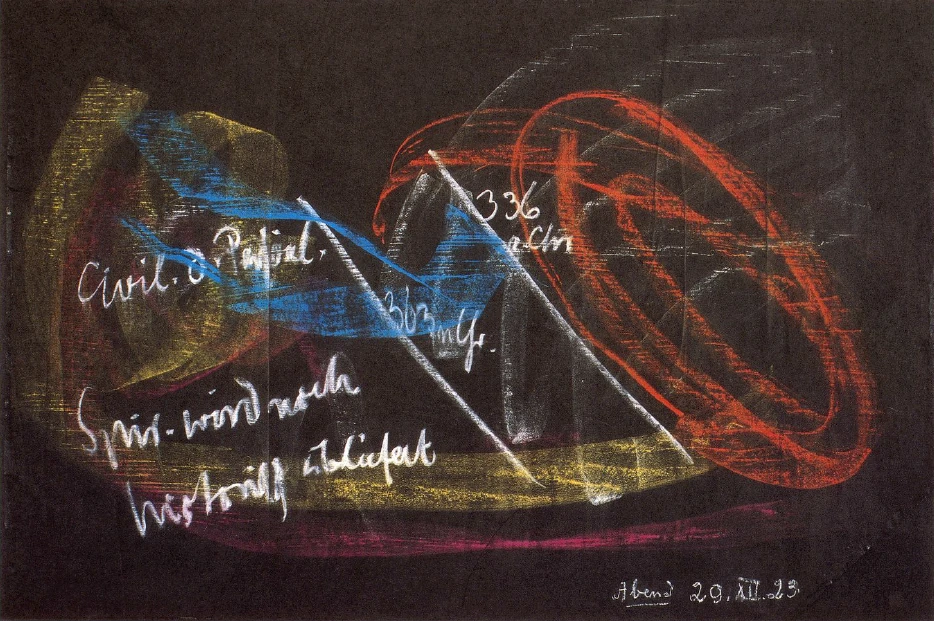
Sixth Lecture
[ 1 ] The period spanning three to four centuries before the Mystery of Golgotha and three to four centuries afterward—a span of six to eight centuries—is of particular importance for understanding the history of the West in its connection to the East. The essence of the events I have spoken of in recent days—which culminated in the emergence of Aristotelianism and Alexander’s campaigns from Macedonia into Asia—is that they mark a kind of conclusion for that civilization of the East which was still entirely steeped in the impulses of the mystery traditions.
[ 2 ] The final culmination, so to speak, of these still genuine, pure mystery impulses of the Orient was, of course, the sacrilegious burning of Ephesus. And we are then dealing with what remains, so to speak, for Europe, for Greece, of the mystery tradition—shadows, I would say, of the ancient, God-imbued civilization. And four centuries after the Mystery of Golgotha, we can see, so to speak, through another event, what still remained of the ruins of the mystery tradition. We can see this in Julian the Apostate. Julian the Apostate, the Roman emperor, was initiated in the 4th century into whatever it was possible to be initiated into at that time by one of the last hierophants of the Eleusinian Mysteries. This means that Julian the Apostate learned as much about the ancient divine mysteries of the East as could still be learned in the Eleusinian Mysteries in the 4th century A.D.
[ 3 ] This brings us to a specific point—the starting point of a certain era—the burning of Ephesus. The day of the burning of Ephesus is the birthday of Alexander the Great. At the end of this epoch, in the year 363, we find the day of the violent death of Julian the Apostate over in Asia. One might say: Right in the middle of this period lies the Mystery of Golgotha. And now let us take a look at how this period, which I have just defined, actually fits into the entire history of human development. We are now faced with the remarkable fact that, if we wish to look back beyond this period into the development of humanity, we must do something in our contemplation that is very similar to something else. Only, we often fail to bring the two things together,
[ 4 ] Do you remember how, in my book *Theosophy*, I was compelled to describe the worlds that are relevant to us: the physical world, bordering on it a transitional world, the world of souls, and then, as the world into which only the highest part of the human being can enter, the spirit realm. And if one looks beyond the specific characteristics of this spirit realm—which human beings currently pass through between death and a new birth—and instead considers the general characteristics of the spirit realm, then it is the case that, just as we must reorient our spiritual disposition to comprehend this spirit realm, so too must we reorient our spiritual disposition to comprehend what lies beyond that point in time. We must certainly not believe that we can understand what lies beyond the Fire of Ephesus using the concepts and ideas applicable to the world of today. We must develop other concepts and ideas that allow us to look upon people who still knew that, just as human beings are connected to the external air through the process of breathing, they are constantly connected to the gods through their souls.
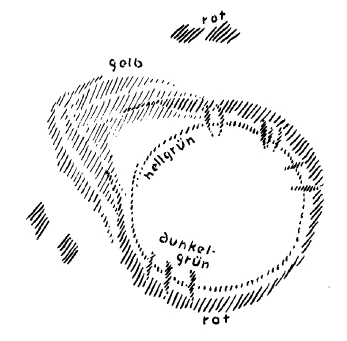
[ 5 ] And now, let us look at this world, which is, so to speak, an earthly Devachan, an earthly realm of spirits, for the physical world is of no use to this world. Then we have that interim period, for my purposes, from 356 B.C. to 363 A.D. And what lies beyond that? Beyond that, toward Asia on one side and toward Europe on the other, lies the world from which present-day humanity is just now emerging, just as ancient humanity emerged from the Eastern world, passing through the Greek world, and entered the Roman Empire (see illustration). For what has developed as civilization through the centuries of the Middle Ages right up to our own time is a civilization that has formed and unfolded apart from the actual inner essence of the mystery tradition—a civilization that has developed on the basis of what human beings can form with their concepts and ideas. In Greece, the groundwork had already been laid since Herodotus, who described historical facts in an external manner and no longer approached the spiritual—or at least did so only very inadequately. Then this developed more and more. But in Greece, something of the spirit of those shadow images that were meant to remind people of spiritual life still remained. In Rome, on the other hand, there begins that era to which present-day humanity is still related—an era whose spiritual disposition is entirely different from even that of ancient Greece. Only a figure such as Julian the Apostate feels something like an invincible longing for the ancient world, and he allows himself to be initiated into the Eleusinian Mysteries with a certain sincerity. But what he receives there no longer possesses any power of insight. And above all, he comes from a world that can no longer fully grasp, in the innermost depths of the soul, the traditions that existed within the mystery cults of the Orient.
[ 6 ] Humanity as we know it today would never have come into being if Greece and Rome had not followed in Asia’s footsteps. Today’s humanity is one built upon personality—upon the individual personality of each person. The Eastern personality—Eastern civilization—was not built upon the individual personality of each person. The individual felt himself to be a link in the ongoing divine process. The gods had their own purposes for the development of the Earth; the gods willed this or that; therefore, this or that came to pass here on Earth. The gods worked through the will of human beings as a source of inspiration. Everything that the powerful personalities I have referred to did in the East was inspired by the gods. The gods willed, and human beings acted. And the mysteries were precisely designed in earlier times to keep this divine will and human action on the right track.
[ 7 ] It was not until Ephesus that things had changed. There, as I told you, the initiates were no longer dependent on the cycle of the seasons but on their own maturity. There, the first glimmer of personality had appeared. It was also there that Aristotle and Alexander the Great, in earlier incarnations, had received the impulse of personality. But now came the era whose dawn is marked by the moment when Julian the Apostate felt his final longing to be a person of the mystery tradition of the Orient. Now comes the era in which the human soul undergoes a transformation quite different from what it was even in Greece.
[ 8 ] Imagine another person like this, who received his training, for example, in the Ephesian Mysteries. It was not because of the Ephesian Mysteries, but because he lived in that era that his soul was like this. You see, when a person today reflects—as they say—on what can they reflect? They can reflect on anything they have personally experienced since birth. Here is a person of a certain age; he reflects on what he experienced twenty or thirty years ago. This inner reflection of thought leads no further than into personal life. It was not so with people who, for example, were still part of the Ephesian civilization. If they had even a trace of the training that could be attained in Ephesus, then—as they reflected—the events of their pre-earthly existence and also the events that preceded Earth’s development in the various kingdoms of nature—lunar development, solar development—would emerge in their souls, just as memories of personal life emerge today. Then one could look within oneself and see the cosmic—the connection of the human being with the cosmic, as it were, the human being’s attachment to the cosmic. What lived in the human soul was self-remembrance.
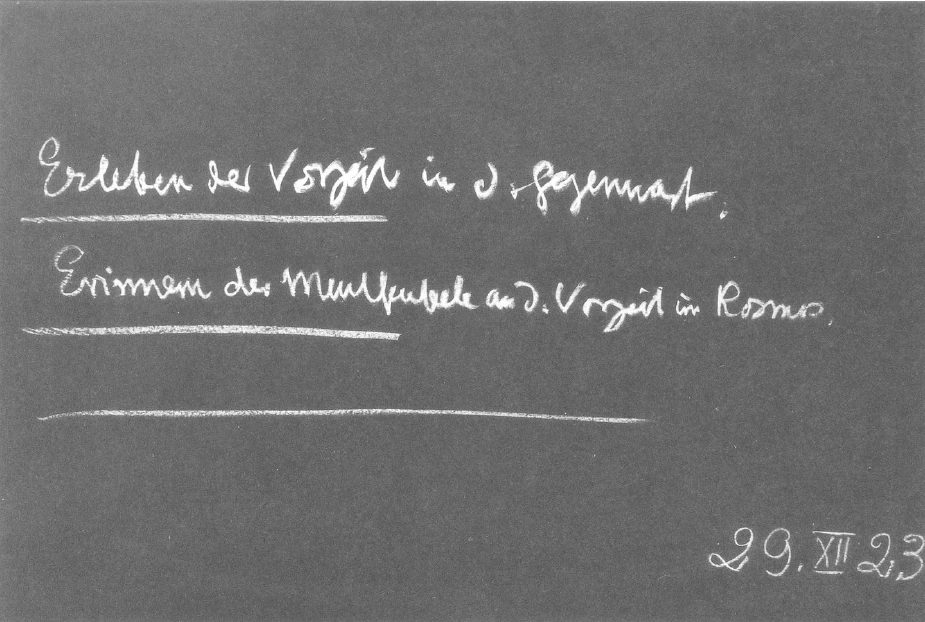
[ 9 ] So we can say: We have here an age—that age—in which one could experience the mysteries of the world in Ephesus. There was a remembrance within the human soul of ancient times in the cosmos. This remembrance was preceded by a genuine inner life within those ancient times. What remained of this was simply a glimpse into the past. In the era described by the Epic of Gilgamesh, we cannot speak of the human soul’s recollection of the cosmos’s past; rather, we must speak of an experience of the past in the present. — Now comes the period from Alexander to Julian the Apostate. Let us leave that aside for now. And then we come to the age from which Western civilization of the Middle Ages and the modern era grew. There was no longer a recollection by the human soul of the prehistoric past in the cosmos, no longer an experience of the prehistoric past in the present, but there was only tradition.
First: Experiencing the past in the present.
Second: The human soul’s recollection of the past in the cosmos.
Third: Tradition.
[ 10 ] It was possible to write down what had happened. History came into being. This history begins with the Roman era. Just imagine the enormous difference! Imagine the era lived through by the older Ephesian students. They had no need for history books. Writing down what had happened would have seemed ridiculous to them. For one had to reflect—reflect deeply enough—and then what had happened would rise up from the depths of consciousness. And there was no modern physician there to present this as psychoanalysis; rather, it was precisely the delight of the human soul to bring forth in this way, from a living memory, what had once been there.
[ 11 ] Then came the time when humanity as a whole had forgotten and was forced to make a makeshift record of what had happened. But while humanity had to allow what had once been a cosmic power of remembrance in the human soul to wither away, while humanity had to begin, in a rather amateurish way, to record world events, to write history, and so on, during that time personal memory—personal recollection—developed within the human being. — Every age has its own special mission, its own special task. — Here you have the other side of what I already outlined in the very first lectures: the emergence of historical memory. This historical memory had its earliest origins in Greece, but then developed through Roman-Latin culture into the Middle Ages and on into modern times. And the fact that the seeds of this culture of the individual had already been sown during the time of Julian the Apostate is evidenced by the fact that, fundamentally speaking, it was of no further use to Julian the Apostate that he had been initiated into the Eleusinian Mysteries.
[ 12 ] Now, then, comes the time when people in the West—from the 3rd and 4th centuries A.D. on through to the present day—live their earthly lives entirely outside the spiritual world; the time when they live in mere concepts and ideas, in abstractions. In Rome, even the gods become abstractions. A time arrives when humanity no longer knows anything of living in communion with the spiritual world. The Earth is no longer Asia, the lowest realm of the heavens; the Earth is a world unto itself, and the heavens are distant, dimmed in human perception. So that one can say: Human beings develop their personality under the influence of what came to the West as Roman culture.
[ 13 ] Just as the spiritual world—the realm of spirits that lies above—is bordered below by a world of souls, so too is this spiritual Eastern world bordered, in terms of time, by what constitutes Western civilization: a kind of world of souls. And this world of souls actually extends right into our own day. But most people today do not yet realize that a powerful transformation is indeed underway. Some of my friends who hear me speak often will know that I do not like to speak of an age as a transitional age, for every age is, in fact, a transitional age—namely, from what came before to what comes after. It simply depends on what the transition is from and to. But precisely what I have told you points to the fact that this transition is like moving from the spirit realm into the soul world, and only from there into the physical world. Oh, there have always been certain spiritual echoes in the civilization that has developed thus far! Even in materialism, certain spiritual echoes have revealed themselves. True materialism in all areas has only existed since the mid-19th century, and very few people yet understand its full significance. But it is present with immense force, and today we are in a transitional period toward a third world that is truly as different from the preceding one as the preceding Roman world was from the Oriental one.
[ 14 ] Well, I would say that, in a sense, a period of time has been omitted between Alexander and Julian, and the Mystery of Golgotha falls right in the middle of this period. This Mystery of Golgotha is no longer received by humanity in the same way as it was in the days when people understood the Mysteries; otherwise, people would have had entirely different conceptions of the Christ who lived in the human being Jesus of Nazareth. But only a few people—those contemporaries of the Mystery of Golgotha who were initiated into the Mysteries—still held such conceptions. The vast majority of Western humanity lacked the spiritual understanding necessary to grasp the Mystery of Golgotha. Therefore, the first way in which the Mystery of Golgotha took root on Earth was through external tradition, through oral transmission. Only in circles of initiates during the very earliest centuries was it possible to grasp spiritually what had taken place in the Mystery of Golgotha.
[ 15 ] But there was something else as well, which I have already mentioned to some of you in recent lectures. Over in Hybernia, in Ireland, there were echoes of the ancient Atlantean wisdom. In the Mysteries of Hybernia, which I outlined for you the day before yesterday, the two evocative figures offered the student the opportunity to perceive the world with the same clarity as the ancient Atlanteans did. And these Mysteries of Hybernia were strictly self-contained, shrouded in an atmosphere of immense solemnity. They existed in the centuries before the Mystery of Golgotha, and they also existed at the time of the Mystery of Golgotha. Over in Asia, the Mystery of Golgotha was taking place; in Jerusalem, the events unfolded that are traditionally recounted in the Gospels. But without any human mouth having conveyed a message, without any other connection having existed, the clairvoyants in the Mysteries of Hybernia knew, at the very moment the Mystery of Golgotha was tragically unfolding, that the actual Mystery of Golgotha was taking place in Palestine. In the mystery sites of Hybernia, the symbolic image unfolded simultaneously. There, people did not learn through tradition; there, they came to know the Mystery of Golgotha in a spiritual way. And while the greatest, most majestic event was taking place in Palestine in outward physical reality, those ritual acts had been performed in the Mysteries of Hybernia through which a living image of the Mystery of Golgotha existed there in the astral light.
[ 16 ] You can see how things are linked together, how, in fact, I would say, there is a kind of world narrative in which the ancient connection with the gods is fading.
[ 17 ] In the Orient, this ancient conception of the gods became corrupted after the burning of Ephesus. In Hybernia, it persisted until—though only in the post-Christian era—it disappeared there as well. And everything that radiates from the Mystery of Golgotha develops through tradition, through oral transmission. In the West, a civilization develops that relies solely on oral tradition—or, later, on external natural science, on a purely sensory study of nature—which, in the realm of nature, corresponds to mere tradition, whether written or oral, in the realm of history.
[ 18 ] So one can say: Here is the civilization of the personality. The spiritual aspect, the mystery of Golgotha, is still handed down historically, but is no longer perceived (see illustration, page 109). Just imagine this vividly—imagine how, in the period following Julian the Apostate, a culture spread that excluded the spiritual. It was not until the end of the 19th century, beginning in the late 1870s, that a new call, so to speak, reached humanity from spiritual heights. That era began which I have often characterized as the Michael Era. Today I wish to characterize it from the perspective that I say: That age has come in which human beings, if they wish to cling to the old materialism—and a large part of humanity wishes to cling to it for the time being—will then fall into terrible abysses. If human beings wish to cling to the old materialism, they will inevitably descend into the subhuman realm and will be unable to maintain themselves at the human level. But in order to maintain themselves at the human level, human beings must open their senses. It has been an absolute necessity since the end of the 19th century for human beings to open their senses to the spiritual revelations that have been available once again since then.
[ 19 ] Certain spiritual forces were at work that found, I might say, only their outward expression in the personality of Herostratus. Herostratus was, so to speak, the final sword brandished by certain spiritual forces from Asia. And when Herostratus hurled the burning torch into the temple at Ephesus, behind him—in a sense merely holding him up as the sword or as the extension of the burning torch—were demonic entities who, in essence, intended to prevent anything spiritual from passing over into this European civilization.
[ 20 ] Aristotle and Alexander the Great, you see, opposed this. For what actually happened? Through Alexander’s campaigns, what constituted Aristotle’s knowledge of nature was carried over to Asia, and a thorough understanding of nature spread everywhere. Alexander had founded academies everywhere—not only in Alexandria, in Egypt, but throughout Asia—where he established the ancient wisdom, so that this ancient wisdom was present there and was cultivated for a long time. Greek sages could come there at any time and found a place of refuge there. Natural science was carried to Asia by Alexander.
[ 21 ] At first, Europe could not, in all honesty, tolerate this deeper knowledge of nature. It wanted only external knowledge, external culture, external civilization. Therefore, from what was contained in Aristotelianism, his student Theophrastus selected what could be passed on to the West. But there was still an extraordinary amount contained therein. The West received Aristotle’s more logical writings. But this is precisely what is peculiar about Aristotle: even where he is abstract and logical, he reads differently than other writers. One need only try, through inner, spiritual experience grounded in meditation, to discern the difference between reading Plato and reading Aristotle. When a modern person with a genuine, true spiritual sensibility and a foundation of a certain kind of meditation reads Plato, after a while they feel as if their head were slightly higher than their physical head, as if they had stepped somewhat outside their physical organism. This is certainly the case for those who do not merely skim through Plato superficially.
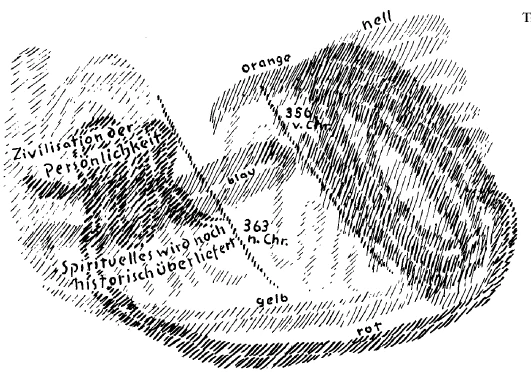
[ 22 ] With Aristotle, it is different. When reading Aristotle, one will never have the sensation of leaving one’s body. But if one reads Aristotle on the basis of a certain meditative preparation, then one will have the feeling that he is working directly within the physical human being. It is precisely through Aristotle that the physical human being makes progress. It is at work. It is not a logic that one merely observes, but a logic that works within. Aristotle is, after all, still a step above all the pedants who came after him and constructed logic out of Aristotle. Aristotle’s logical works are, in a certain sense, properly understood only when they are regarded as books for meditation. This gives rise to something remarkable. Just imagine: if Aristotle’s scientific writings had simply been transmitted from Macedonia to the West—to Central and Southern Europe—they would have been received in a way that would have been disastrous. Certainly, people would have absorbed some of it, but it would have had disastrous consequences. For what Aristotle—I have given an example of this—had to pass on to Alexander in the realm of natural science, for instance, had to be received by souls that had still been touched by the essence of the Ephesian era, the time preceding the burning of Ephesus. Such souls could only be found over in Asia or in Egyptian Africa. Thus, through Alexander’s campaigns, the knowledge and insight into the nature of being had passed over to Asia (it was further depicted in the illustration—see Plate IV; orange to the right), and in a weakened form it later came over to Europe via Spain through all manner of routes, but in a highly filtered, diluted state (yellow from right to left).
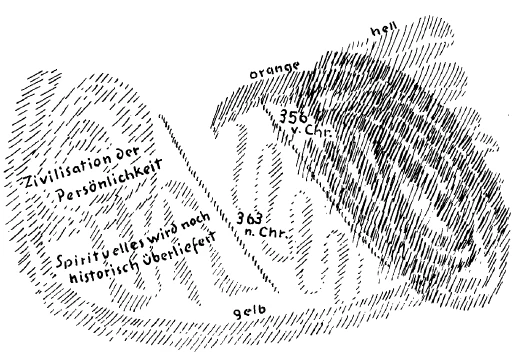
[ 23 ] But what had come over directly were Aristotle’s logical writings—Aristotle’s philosophy. And that lived on, lived on in medieval scholasticism.
[ 24 ] Yes, and now we have these two currents. At the root of Central European thought, we always have that which—I would say—continues to spread, albeit in an unsightly manner, among broad circles of even somewhat primitive people. Just look at how the seed that Alexander once carried over to Asia—which came to Europe in all sorts of ways, first via Arabia and so on, but then also by land through the Crusaders—how that lives on everywhere, though in an unattractive form, in hidden places. This is where people like Jakob Böhme, Paracelsus, and numerous others come in—those who take up what has reached the broad, primitive circles of Europe through such roundabout routes. We have conveyed a folk wisdom here—far more than is commonly believed. It lives on. And it sometimes flows into reservoirs such as Valentin Weigel, Paracelsus, Jakob Böhme, and many others whose names are mentioned far less frequently; it shines abundantly on what was—or is—Alexandrianism, which arrived in Europe only late, as seen in Basilius Valentinus and so on. A true alchemical wisdom thrived in monasteries, one that shed light not merely on certain transformations of matter, but on the innermost characteristics of human transformations themselves within the cosmos. And the recognized scholars concern themselves with an Aristotle who is, admittedly, distorted, filtered, and falsified; but this Aristotle—with whom Scholasticism and later science engage as philosophy—this Aristotle nevertheless becomes a blessing to the West. For it was not until the 19th century, when people no longer understood Aristotle, when Aristotle was studied merely as if one were supposed to read him, as if one were not supposed to practice him, as if he were not a book for meditation, it was not until the 19th century that people came to derive nothing more from Aristotle—not because he no longer works and lives within them, but because they merely study him; not because he is not a book of practice, but because he is an object of study. Right up until the 19th century, he was a book of practice. But you see, in the 19th century, everything is such that what used to be practice, what used to be skill, is transformed into abstract knowledge.
[ 25 ] In Greece—let us take this other line of thought, through which the matter is also characterized—in Greece, there is a belief that what a person possesses as insight still emerges from the whole human being. The teacher is the gymnast. From the whole human being in his physical movement—in which the gods are at work—arises what then, so to speak, wells up and becomes human insight. The gymnast is the teacher. In Rome, the rhetorician later takes the place of the gymnast. This is already somewhat abstracted from the whole human being, but at least there is still something there that is connected to a human activity in a part of the organism. How much is set in motion when we speak! How speech lives in our heart, in our lungs, in our diaphragm, and further down! It no longer lives as intensely throughout the whole human being as that which the gymnast brought about, but it does, after all, live in a large part of the human being. And thoughts are then merely an extract of what lives in speech. The rhetorician takes the place of the gymnast. The gymnast deals with the whole person. The rhetorician, however, deals only with that which, so to speak, already excludes the limbs and thus sends up from a part of the person into the head that which is insight. And the third stage, which only emerged in modern times, is the doctor, who trains nothing but the head and focuses solely on thoughts. It turned out that, even as late as the 19th century, professors of eloquence were still being appointed at certain universities, but they could no longer fulfill the duties of that professorship because it was no longer customary to place any value on speech—since everyone wanted only to think. The rhetoricians died out. Those who represented only the most trivial aspects of humanity—the doctors who represented nothing but the head—became the leaders of education.
[ 26 ] And that is indeed how it was during the time the real Aristotle lived: practice, asceticism, and spiritual exercises—all of which stemmed from Aristotle. And these two currents have even endured. Anyone who is not quite young and who consciously experienced what took place from the mid-19th century through to its final decades already knows, if they have traveled about in the manner in which, for example, Paracelsus traveled among the rural people, they already know that the last remnants of medieval folk knowledge—from which Jakob Böhme and Paracelsus drew—persisted well into the 1870s and 1880s. And finally, this, too, is true: particularly within certain religious orders and in the life of certain close-knit circles, a certain Aristotelianism of practice—of inner spiritual practice—survived right up into the last decades of the 19th century. And it is fair to say: On the one hand, one could still encounter the last vestiges of what had been carried from Aristotelianism to Asia by Alexander; on the other hand, what had come via the Near East, Africa, and Spain, and was revived in figures such as Basilius Valentinus and later thinkers as folk wisdom—from which Jakob Böhme, Paracelsus, and numerous others also drew upon. It also returned by other routes through the Crusaders. But it was there among the broad masses of the people, and one could still find it. Even in the last decades of the 19th century, one could still say: Thank God that there still lived on—albeit barely recognizable, albeit corrupted—the last vestiges of what had been carried over to Asia as ancient natural science through the campaigns of Alexander. What still lived on in a most remarkable way in primitive folklore—of ancient alchemy, of ancient knowledge, and of the interrelationships between natural substances and natural forces—these were the last echoes. Today they have died out; today they are no longer there, can no longer be found, and nothing can be recognized in them.
[ 27 ] Likewise, among certain individuals one had the opportunity to meet, there was Aristotelian intellectual training. Today, it no longer exists. What had been preserved was that which had been transmitted to the East at that time (continuation of the diagram; red from right to left), and that which had been transmitted to the West via a detour through Aristotle’s student Theophrastus (blue from the center to the left). But that which had been transmitted to the East had, in turn, returned. And one can say: In the 1870s and 1880s, it became possible to reconnect, through new, direct spiritual insight, with that which, in its final stages, tied in with the events I have described to you. This is a wonderful connection, for it shows that the Alexandrian movements and Aristotelianism were there to maintain the thread with the ancient spiritual tradition, to provide influences on what was to become material culture—influences that would last just long enough until new spiritual revelations were to come.
[ 28 ] You see, from this perspective, it really does appear that way, and it is true that apparent barrenness turns out to be extraordinarily significant in the historical development of humanity. It is easy to say that Alexander’s entire expedition to Asia and Egypt has nevertheless been swept away. It has not been swept away. One might say that Aristotelianism came to an end in the 19th century. It has not come to an end. Both currents have extended as far as it is possible to begin a new spiritual life.
[ 29 ] I have often told you in various places that this new spiritual life began to emerge in its earliest forms at the end of the 1870s and then grew more and more as the century drew to a close. Today we have the task of receiving the full flow of spiritual life, which, I would say, comes to us from on high. And so today we find ourselves in the midst of a true transition in humanity’s spiritual development. And if we do not become aware of these remarkable connections and this link to the past, then we are actually asleep in the face of the most important events unfolding around us in spiritual life. And how many people today are truly asleep in the face of the most essential events! But anthroposophy should exist to awaken people.
[ 30 ] And I believe that for all of you gathered here at this Christmas conference, there is a spark of a possible revival. You see, we are on the very eve of that day, and during this conference we will have to make our way right up to the anniversary of that sad event; we are on the eve of the day when the terrible flames blazed up and consumed the Goetheanum. And whatever the world may think about this fire that consumed the Goetheanum, in the development of the anthroposophical movement this fire signifies something immense. But one cannot fully grasp its depth unless one considers, on the one hand, how those physical flames flared up at that time, when, in a remarkable way —I will speak more about this in the coming days—the searing metallic elements from the organ pipes and other metallic objects blazed into the flames, giving rise to those remarkable hues of the flames. Then one had to carry that memory over into the past year. But this memory must be alive with the fact that the physical is Maya, that we must seek the truth from the physical flames in the spiritual fire that we must now kindle in our hearts and in our souls. The spiritually active Goetheanum should rise up within us in the physically burning Goetheanum.
[ 31 ] I do not believe that this can happen in the full sense of world history unless one sees, on the one hand, the Goetheanum—which has become so dear to us—blazing up in a terrible, gigantic flame, and in the background the other sacrilegious fire of Ephesus, where Herostratus threw in the torch, guided by demonic forces. By bringing together in our minds’ eye what is in the foreground and what is in the background, we may yet be able to form an image that can etch deeply enough into our hearts what we lost a year ago and what we must rebuild with all our strength.