

Mystery Sites of the Middle Ages
Rosicrucianism and the Modern Principle of Initiation
GA 233a
4 January 1924, Dornach
Translated by Steiner Online Library
First Lecture
[ 1 ] Following on from what I had to share with you during the course of our Christmas conference, I would like to use these three lectures—which will now be held in the evenings—to discuss some aspects of recent developments in the study of spiritual life. After all, this recent development in spiritual science is often discussed specifically under the name of Rosicrucianism and other occult terms, and I would like to describe to you here the inner nature of this exploration of spiritual life. To do so, it will be necessary for us to begin today by saying a few words about the entire nature of the ideas that took hold around the 9th, 10th, and 11th centuries A.D., gradually faded away—not until the end of the 18th century, in fact—and even persisted among a few stragglers into the 19th century. So today I do not wish to take a historical approach, but rather to present to your soul a synthesis of ideas that were inwardly experienced by certain individuals. People usually do not even consider how different the entire world of ideas was—even within a relatively short historical period—among those who counted themselves among the people of knowledge—how completely different it was from today. Today we speak of chemical substances—seventy or eighty chemical substances—and we don’t even realize that, in reality, we’re saying terribly little when we designate a substance as oxygen, nitrogen, and so on. For oxygen is, after all, merely something that exists under certain conditions—under specific conditions of thermal states and other conditions peculiar to earthly life. It is, after all, impossible for any reasonable person to associate the concept of reality with anything that, when the temperature is raised by so many degrees, is no longer present to the same extent or in the same way as it is precisely under the conditions in which human beings live as physical beings on Earth. And it was precisely such concepts, such ideas—the tendency to go beyond the relativity of existence toward a true existence—that formed the very foundation of scholarly life in the early and middle periods of the Middle Ages.
[ 2 ] I therefore mark the transition from the 9th to the 10th century A.D. because, prior to that, people’s entire worldview was still very spiritual. For example, it would never have occurred to a truly knowledgeable person of the 9th century to see in the concept of angels, archangels, or seraphim anything that did not correspond in reality—and I mean only in reality—to the physical human being whom one sees with one’s eyes. Among the wise, you will find that even in this period before the 10th century, people spoke of spiritual beings—the so-called intelligences of the cosmos—as beings one simply encounters, even though people knew these beings had long since passed out of the era in which they were part of humanity’s common worldview. But they knew that under certain special circumstances, the effect is still present. For example, one must by no means overlook the fact that numerous priests—Catholic priests—well into the 9th and 10th centuries, in the course of performing the Mass, were quite clearly aware that during this or that act of the Mass, they had encountered spiritual beings, the intelligences of the cosmos.
[ 3 ] But by the 9th and 10th centuries, the direct connection to the actual intelligences of the universe gradually faded from people’s consciousness, and more and more, only the awareness of the elements of the cosmos—the earthy, the liquid or watery, the airy, the warm, and the fiery—began to emerge. So that, just as people had previously spoken of cosmic intelligences that govern planetary movements, guide the planets past the fixed stars, and so on, they now spoke, I might say, of the immediate surroundings of the earthly realm. People spoke of the elements of earth, water, air, and fire. Chemical substances in the modern sense were not taken into account. It was not until much later that these came to be considered. But you see, you would be imagining something entirely wrong if you were to think that even in the 13th and 14th centuries—and indeed, in a certain sense, well into the 18th century—those in the know would have conceived of heat, air, water, and earth in the same way that people do today. Today, people speak of heat only as a state in which bodies exist. No one speaks anymore of an actual “heat-etheric” substance. But air and water—these have become, one might say, the most abstract concepts for people today, and it is indeed necessary to delve into the nature of how these concepts once were. And so today I would like to give you a picture of what the way of speaking among the “knowing ones” was like during the period in question.
[ 4 ] When I was writing my *Secret Science*, I was compelled to bring the Earth’s evolution at least somewhat into line with the prevailing ideas of the present day. In the 13th or 12th century, one could have approached it differently. For example, in a certain chapter of this *Secret Science*, the following would have been found. One would first have had to evoke a conception of the beings that can be described as the beings of the first hierarchy: Seraphim, Cherubim, Thrones. One would have characterized the Seraphim as beings in whom there is no subject and object, but in whom subject and object coincide; beings who would not say: “There are objects apart from me”—but rather: “The world is, and I am the world, and the world is I”; who know only themselves, and indeed in such a way that these beings, these Seraphim, know themselves through an experience of which human beings have only a faint afterglow when they, well, let’s say, undergo an experience that fills them with fervent enthusiasm.
[ 5 ] It is even difficult at times to explain to people today what ardent enthusiasm is, because even at the beginning of the 19th century, people understood it better than they do today. Back then, it still happened that this or that poem by this or that poet would be read aloud, and people would react with such enthusiasm—forgive me, but that’s how it was—that people today would say: “They’ve all gone mad!”—That’s how they were stirred, that’s how warmth took hold of them. Nowadays, you feel a chill, precisely when you’d expect people to be enthusiastic.
[ 6 ] And through this element of enthusiasm, which was particularly at home in Central and Eastern Europe—through this spiritual enthusiasm, as this element is raised to consciousness and becomes a unified element of consciousness—one must imagine the inner life of the Seraphim. And as a completely serene element in consciousness, radiant with light, such that thought immediately becomes light and illuminates everything—this is how one should imagine the element of consciousness of the Cherubim. And as the element that bears grace and sustains the world—the element of the Thrones.
[ 7 ] Well, that is just a rough sketch. I could go on talking about this for a long time. I just wanted to tell you, to begin with, that at that time people had attempted to characterize the Seraphim, Cherubim, and Thrones in terms of their essential qualities. Then one would have said: The choir of Seraphim, Cherubim, and Thrones works together, and it works together in such a way that the Thrones form a core (see drawing; center, reddish-purple); the Cherubim allow their own luminous essence to radiate from this core (yellow ring). The Seraphim envelop the whole in a mantle of inspiration that radiates far out into the cosmos (red envelope).
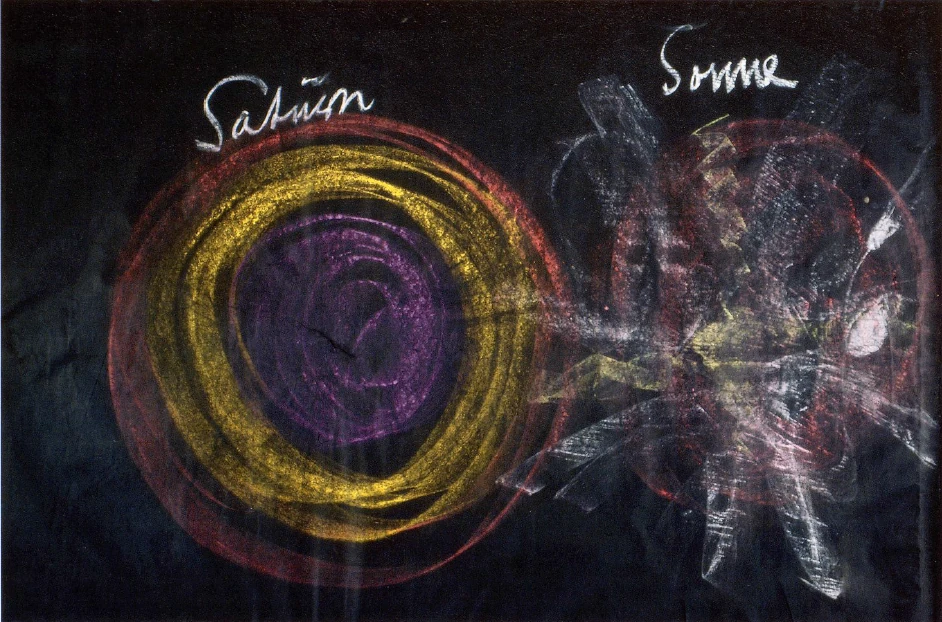
[ 8 ] But these are all beings in what I am drawing: in the center, the Thrones; surrounding them, the Cherubim; and in the outermost part here, the Seraphim. These are beings who float, act, think, and will within one another, who feel one another. These are essential beings. And if a being that possessed the corresponding capacity for sensation were now to travel through the space where, in this way, the Thrones have formed a core, the Cherubim a kind of outer circle, and the Seraphim a kind of outer boundary—if such a being were to enter the realm of this activity of the first hierarchy—it would have felt warmth in various degrees, warmth in different places, higher warmth here, deeper warmth there. All of this, however, is soul-spiritual—but so soul-spiritual that the soul experience is at the same time a physical experience in our senses; that is, when the being feels warmth in its soul, what you feel when you are in a heated room is truly present there. Such a combination of beings of the First Hierarchy once came into being in the universe, and this formed the Saturnian existence. The warmth is merely an expression of the fact that these beings are there. The warmth is nothing; it is merely an expression of the fact that these beings are there.
[ 9 ] I’d like to use an image here that might help clarify things a bit. Imagine you care about someone. You find their presence comforting. Now imagine someone comes along who is a terribly abstract person and says: “Actually, I’m not interested in that person; I’ll just ignore them. I’m only interested in the warmth they radiate.” — But he doesn’t say, “I’m only interested in the warmth they radiate”—rather, “I’m only interested in the warmth itself.” — Of course, he’s talking nonsense, as you can see, because once the person who radiates the warmth is gone, the warmth is gone too. The warmth is, in fact, only something that exists when the person is there. It is nothing in and of itself. The person must be there for the warmth to be there. Thus, the Seraphim, Cherubim, and Thrones must be there; otherwise, the warmth is not there either. The warmth is merely the manifestation of the Seraphim, Cherubim, and Thrones.
[ 10 ] You see, in the time I am speaking of, there was in fact—right down to the colored drawings—what I have just described to you. People spoke in such a way that when they spoke of the elements—the element of heat, for example—they actually meant the Cherubim, Seraphim, and Thrones. And that is the Saturnian existence.
[ 11 ] Then they went on, and they said to themselves: Only the Seraphim, Cherubim, and Thrones have the power to bring forth something like this, to place something like this in the cosmos. Only this highest hierarchy has the ability to place something like this into the cosmos. But because this highest hierarchy placed something like this into the cosmos at the very beginning of a world’s creation, evolution could continue. In a sense, the sons of the Seraphim, Cherubim, and Thrones were able to guide evolution forward. — And this then took place in such a way that the beings of the second hierarchy brought forth by the Seraphim, Cherubim, and Thrones—the Kyriotetes, Dynamis, and Exusiai—now entered this space, so to speak, which had been shaped here by the Seraphim, Cherubim, and Thrones in a Saturnian manner, formed with Saturnian warmth. Then the younger—cosmically younger, of course—beings entered. How did these cosmically younger beings act? While the Cherubim, Seraphim, and Thrones revealed themselves in the element of warmth, the beings of the second hierarchy revealed themselves in the element of light. Here (in the drawing, red background), the Saturnian aspect is dark and provides warmth. And within the dark, gloomy world of Saturnian existence arises that which can come into being through the Sons of the First Hierarchy—the Exusiai, Dynamis, and Kyriotetes.
[ 12 ] What arises within this Saturnian warmth arises because the penetration of the second hierarchy signifies an inner illumination. This inner illumination is linked to a condensation of warmth. It transforms the mere element of warmth into air. And on the one hand, we have the second hierarchy penetrating into the revelation of light. But you must now clearly imagine that, in reality, beings are penetrating. For a being with the corresponding capacity for perception, light penetrates. Light is what marks the paths of these beings. When light reaches a place, under certain conditions, shadow, darkness, and deep shadow arise. Through the penetration of the second hierarchy in the form of light, shadow also arose. What was this shadow? Air. And in fact, up until the 15th and 16th centuries, people knew what air was. Today, people know only that air consists of oxygen, nitrogen, and so on—which says little more than if, for example, someone were to say that a watch consists of glass and silver, which says absolutely nothing about the watch itself. Saying that air consists of oxygen and nitrogen says nothing at all about air as a cosmic phenomenon, but much is said about air when one knows: From the cosmos, air is the shadow of light. — So that now, with the penetration of the second hierarchy into the Saturnian warmth, we actually have the penetration of light (white rays) and the shadow of light, which is air (green serpentine lines). And where this arises, there is the sun. This is how one should actually have spoken in the 13th and 12th centuries.
[ 13 ] Now let us move on. Further development is now guided once again by the Sons of the Second Hierarchy—the Archai, Archangeloi, and Angeloi. These beings introduce something new into the luminous element, which was initially drawn in by the second hierarchy and which has brought with it its shadow—the airy darkness—not the indifferent, neutral darkness, the Saturnian darkness that was simply the absence of light, but the darkness that has brought forth the opposite of light. In addition to this development, the third hierarchy—the Archai, Archangeloi, and Angeloi—introduces, through its own nature, an element similar to our desires and our drives to attain something, to yearn for something.
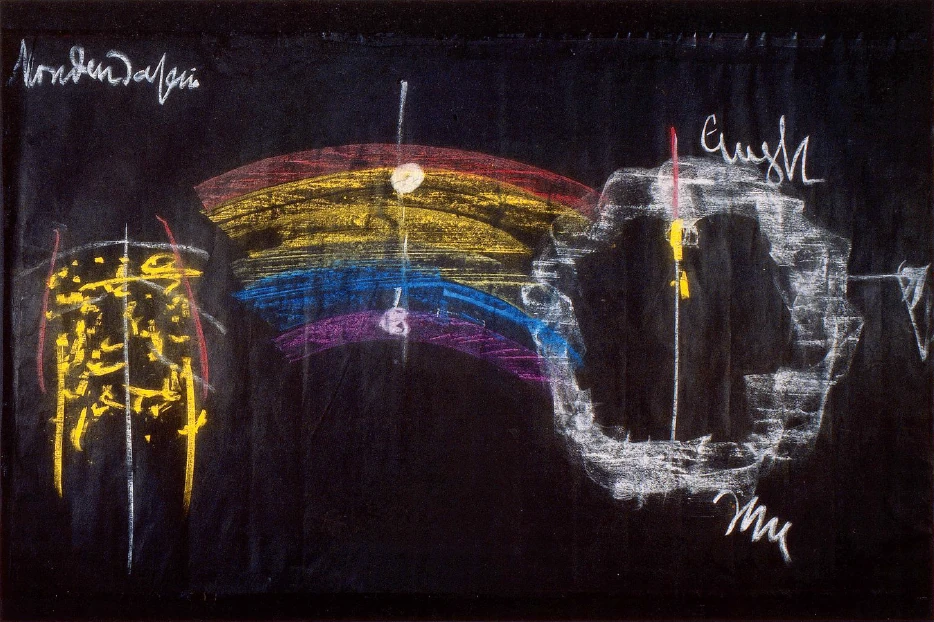
[ 14 ] This led to the following: it resulted in, let us say, an Archai or Angeloi being entering here (see Figure 5.17, the dot on the beam of light on the right) and encountering an element of light—I would say, a place of light. In this place of light, through its receptivity to this light, it received the urge, the desire for darkness. The Angeloi being carried the light into the darkness, or an Angeloi being carried the darkness into the light. These beings become the mediators, the messengers between light and darkness. And the result of this was that what had previously shone only in the light—and had cast its shadow, that dark, ethereal darkness—began to shimmer in all colors; light appeared in darkness, and darkness appeared in light. It is the third hierarchy that conjured forth color from light and darkness.
[ 15 ] You see, here, too, you have something—so to speak—of a historical and documentary nature to present to your soul. In Aristotle’s time, people still knew—when, I might say, they asked themselves within the context of the Mystery where colors came from—that the beings of the third hierarchy were involved. That is why Aristotle stated in his *Harmony of Colors* that color signifies an interplay of light and darkness. But this spiritual insight—that one must see behind warmth the beings of the first hierarchy, behind light and its shadow, darkness, the beings of the second hierarchy, and behind the colorful glimmer within a cosmic context the beings of the third hierarchy—was lost. And nothing remained but the unfortunate Newtonian theory of color, which the initiates had smiled at right up into the 18th century, and which then became the creed of those who are, after all, experts in physics.
[ 16 ] One really must know absolutely nothing about the spiritual world to be able to speak in the sense of this Newtonian theory of colors. And if one is still inwardly stirred by the spiritual world, as was the case with Goethe, then one resists it. One sets forth the truth, as he did, and rails terribly. For Goethe never railed as fiercely as he did on the occasion when he had to rail against Newton; he railed terribly against that nonsensical stuff. Such things are impossible to comprehend today, for the simple reason that today, anyone who does not acknowledge Newtonian color theory is considered a fool by physicists. But the situation is not such that, for example, in Goethe’s time, Goethe stood there all alone. Among those who spoke these things openly, he stood alone; but those in the know—even at the end of the 18th century—knew full well how color springs forth within the spiritual realm.
[ 17 ] But you see, the air is the shadow of light. And just as, when light appears, a dark shadow is present under certain conditions, so too, when color is present and this color acts as a reality—and it could do so as long as it penetrated the airy element— so when color radiates into the airy element, acts within the airy element—that is, is something in itself, not merely a reflection, not merely the reflected color, but a reality that radiates into the airy element—then, just as pressure gives rise to counterpressure under certain conditions, the liquid, the watery element arises from the real color. Just as the shadow of light is air, in a cosmic sense, so is water the reflection, the creation of color in the cosmos.
[ 18 ] You’ll say: I don’t understand that. — But just try, for once, to truly grasp color in its real sense. Red—well, do you believe that red, in its very essence, is really just the neutral surface as we usually perceive it? Red is, after all, something that assaults you. I’ve mentioned this many times. One wants to run away from red; it pushes one back. Blue-violet—one wants to chase after it, but it always runs away from you; it grows deeper and deeper. Everything lives in the colors. Colors are a world, and the soul feels so at home in the world of colors that it simply cannot do without movement when it follows the colors with its soul experience.
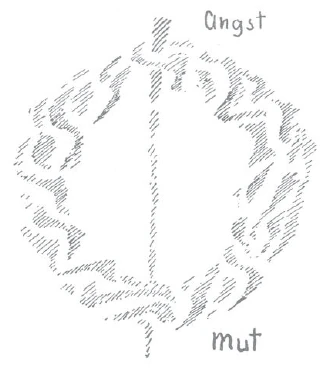
[ 19 ] You see, people today stare at the rainbow. If you look at the rainbow with just a little imagination, you’ll see elemental beings that are very active there. These elemental beings exhibit very strange phenomena. Here (at red and yellow), you can constantly see certain elemental beings emerging from the rainbow. They then move over this way. The moment they reach the lower end of the green, they are drawn in. You can see them disappear here (at green and blue). On the other side, they emerge again. To those who gaze at it with imagination, the entire rainbow reveals a streaming forth of the spiritual and a vanishing of the spiritual. It actually resembles something like a spiritual roller—wonderful. And at the same time, one notices in these spiritual beings that, as they emerge, they do so with great fear; as they enter, they do so with utterly invincible courage. When one looks at the red-yellow, fear flows out; when one looks at the blue-violet, one gets the feeling: everything there is alive with courage.
[ 20 ] Now imagine that it’s not just the rainbow that’s there, but if I draw a line here (see drawing, above) and the rainbow is positioned like this (rotated 90°), then the essences emerge from there and disappear there; here is fear, here is courage (see drawing on p. 22) . Courage, in turn, disappears. So now the eye would be focused: here is the rainbow; here are the red, yellow, and so on. The rainbow takes on a certain thickness. And you can already imagine that a watery element arises from it. And within this watery element live spiritual beings who are truly a kind of reflection of the beings of the third hierarchy.
[ 21 ] One could certainly say: If one is to approach the scholars of the 11th, 12th, and 13th centuries, one must understand such things. You can’t even understand the later thinkers anymore; you can’t understand Albertus Magnus if you read him with the knowledge people have today. You have to read him with a kind of knowledge that recognizes that such spiritual matters were still a reality for him; only then will you understand how he uses words and how he expresses himself.
[ 22 ] And in this way, air and water emerge as a reflection of the hierarchies. As the hierarchies themselves penetrate, the second hierarchy penetrates in the form of light, and the third hierarchy in the form of color. But with the formation of this, lunar existence is attained.
[ 23 ] And now comes the fourth hierarchy. I am explaining this as people thought in the 12th and 13th centuries. Now comes the fourth hierarchy. We don’t speak of it at all, but in the 12th and 13th centuries, people certainly did speak of this fourth hierarchy. What is this fourth hierarchy? It is the human being. The human being itself is the fourth hierarchy. But by no means was this fourth hierarchy understood to be what now walks about in the world as a two-legged, aging, most peculiar being; for to those who truly knew back then, the human being of today appeared precisely as a peculiar being. They spoke of the original human being before the Fall, who still existed in such a form that he had power over the Earth just as the Angeloi, Archangeloi, and Archai had power over the lunar realm, just as the second hierarchy had power over the solar realm, and the first hierarchy had power over the Saturnian realm. People spoke of human beings in their original earthly existence and could thus speak of humanity as the fourth hierarchy. And with this fourth hierarchy came—admittedly as a gift from the higher hierarchies, but as something that the higher hierarchies had first possessed as a treasure they guarded, something they did not need for themselves—life came. And life entered into the iridescent world that I have thus described to you in hints.
[ 24 ] You will say: Did things not have life before? My dear friends, you can learn how this is from human beings themselves. Your “I” and your astral body do not possess life, yet they do have a nature. The spiritual and the soul do not require life. Life begins only with your etheric body, and it is something external, like a covering. And so, too, it is only after the lunar existence, with the earthly existence, that life enters the realm of the evolution to which our Earth belongs. The world of shimmering colors was lived through. Not only did the angels, archangels, and so on now feel a longing to carry darkness into light and light into darkness, thereby bringing about the play of colors on the planet, but they also began to experience this play of colors inwardly, to make it their own. To experience, when darkness dominates the light within, a feeling of weakness, a feeling of lethargy; conversely, when light dominates darkness, a feeling of activity. For what happens when you walk? When you walk, it is precisely the case that light dominates the darkness within you; when you sit and are idle, darkness dominates the light. It is a spiritual interplay of colors, a spiritual shimmering of colors. A shimmering of colors, permeated and infused with life, emerged with the arrival of the fourth hierarchy, the human being. And in this moment of cosmic becoming, the forces that were stirring within this shimmering of colors began to take shape. The life that internally rounded out, smoothed, and defined the edges of the colors brought forth the solid crystalline form. And we are within earthly existence.
[ 25 ] Such things, as I have just described them to you, were in fact the fundamental truths of those medieval alchemists, occultists, Rosicrucians, and so on, who—though history today tells us little about them—flourished from the 9th and 10th centuries through the 14th, 15th centuries, and who still had their last stragglers—though these were always regarded as eccentrics—well into the 18th century, indeed right up to the beginning of the 19th century. But then these things were completely suppressed. And the modern worldview led to the following happening. Imagine this: here I have a person. I stop taking an interest in this person, simply take off their clothes, and hang them on a coat rack that has a head-shaped knob at the top—and I no longer care about the person. I go on to imagine: This is the person (see drawing on p. 25); what business is it of mine that something like that might be inside these clothes? This is the person (the clothes rack)! — Yes, you see, that is what happened with the elements of nature. One doesn’t care any further that behind heat or fire lies the first hierarchy, behind light and air the second hierarchy, behind the so-called chemical ether, color ether, and so on, and water the third hierarchy, and behind the elements of life and the earth the fourth hierarchy—or the human being. Just bring the clothes rack and hang the garments on it! Well, that’s the first act. The second act, however, begins in the Kantian manner! That’s where Kantianism begins; that’s where one starts—now that one has the clothes rack—with the clothes hanging on it—to philosophize about what the thing-in-itself of these clothes might be. And one comes to the conclusion that one actually cannot recognize this thing-in-itself of the clothes. Very astute! Of course, once you’ve removed the person first and are left with the clothes rack bearing the garments, you can philosophize about the clothes—and then you realize you’re engaging in rather charming speculations. After all, the clothes rack is right there, isn’t it, with the garments hanging from it, and so you philosophize—either in the Kantian manner: “You cannot know the thing-in-itself”—or in the Helmholtzian way, and then you think to yourself: These clothes—they can’t possibly have forms; well, there are just a bunch of tiny swirling dust particles, atoms inside, colliding with one another, and that’s how the clothes retain their shape.
[ 26 ] Yes, that is how thinking developed later on. But that is abstract, shadowy. Yet we live within this way of thinking, within this speculation, today; it is from this that we form our entire scientific worldview today. And even if we do not admit that we think atomistically, we are doing so all the more. For people will not be ready to admit for a long time yet that it is not necessary to imagine the whirling dance of atoms there, but rather to put the human being back into the picture. And that is precisely what the reestablishment of spiritual science must attempt to do.
[ 27 ] Today I wanted to present you with a number of examples of how people thought back then and what can actually be read in older writings, but which has since been forgotten. But because it has been forgotten, such interesting facts come to light: A modern Nordic chemist has reprinted a passage by Basilius Valentinus and interpreted it chemically in today’s terms. And of course he could say nothing else—because that is how it appears when one thinks of it chemically today, as if one were standing in a laboratory, equipped with retorts and other instruments and conducting modern experiments—he could say nothing other than that what is written by Basilius Valentinus is nonsense. But what Basilius Valentinus wrote is a piece of embryology, expressed precisely in symbolic form. It is a piece of embryology. If one simply applies today’s way of thinking, it appears to be nothing more than a laboratory experiment—but then it becomes nonsense. For in the laboratory—unless one happens to be Wagner, who, after all, still stands more on the standpoint of earlier centuries—one simply cannot carry out a piece of embryology.
[ 28 ] These things must be recognized once again today. And in connection with the great truths I was able to express during the Christmas Conference, I would also like to say a few more words about the fate of inner spiritual life over the last few centuries of world development.