

Anthroposophy
A Summary After Twenty-one Years
GA 234
2 February 1924, Dornach
Translate the original German text into any language:
Versions Available:
Anthroposophy: A Summary After Twenty-one Years, tr. SOL
Fünfter Vortrag
Fifth Lecture
[ 1 ] Es ist von mir ausgeführt worden, wie man den Menschen gliedern soll in den physischen Leib, den ätherischen Leib, den astralischen Leib, und wie man durch eine gewisse Übung der eigenen Erkenntniskräfte, der Kräfte des Gemütes und Willens, dahin kommen kann, eine tiefere Einsicht in diese Gliederung des Menschen zu erhalten. Diese Gliederung, die wir beim Menschen erblicken, finden wir auch draußen in der Welt. Nur müssen wir uns klar sein darüber, daß ein beträchtlicher Unterschied ist zwischen dem, was wir in der Welt finden außerhalb des Menschen, also in der außermenschlichen Welt, und in der Innenwelt des Menschen selbst.
[ 1 ] I have explained how the human being is to be divided into the physical body, the etheric body, and the astral body, and how, through a certain practice of one’s own powers of cognition—the powers of the mind and will—one can come to gain a deeper insight into this division of the human being. This division, which we observe in human beings, can also be found outside in the world. However, we must be clear that there is a considerable difference between what we find in the world outside of human beings—that is, in the non-human world—and what we find in the inner world of human beings themselves.
[ 2 ] Wenn wir zunächst die physische Welt betrachten, und wir können sie eigentlich nur betrachten in Anknüpfung an das feste, erdige Dasein, dann kommen wir dazu, verschiedene Stoffe zu unterscheiden. Ich brauche auf die Einzelheiten nicht einzugehen. Sie wissen ja, wenn der Anatom kommt und dasjenige, was vom lebenden Menschen übriggeblieben ist, nachdem dieser durch die Pforte des Todes gegangen ist, den Leichnam, untersucht, dann hat dieser Anatom nicht nötig — wenigstens glaubt er es nicht nötig zu haben, und innerhalb gewisser Grenzen hat er ein Recht zu diesem Glauben —, an irgend etwas anderes zu denken als an die irdischen Stoffe, die er auch findet im außermenschlichen Dasein. Er untersucht, was im außermenschlichen Dasein vorhanden ist an Salzen, an Säuren, an anderen zusammengesetzten oder einfachen Stoffen, er untersucht dann dasjenige, was der menschliche Organismus enthält. Und er findet sozusagen nicht nötig, seine physikalischen, seine chemischen Kenntnisse zu erweitern.
[ 2 ] If we first consider the physical world—and we can really only consider it in connection with solid, earthly existence—then we come to distinguish between various substances. I need not go into the details. You know, when the anatomist examines what remains of a living human being after that person has passed through the gate of death—the corpse—then this anatomist has no need—at least he does not believe it necessary, and within certain limits he is justified in this belief— to think of anything other than the earthly substances that he also finds in non-human existence. He examines what is present in non-human existence in terms of salts, acids, and other compound or simple substances; he then examines what the human organism contains. And he does not, so to speak, find it necessary to expand his knowledge of physics and chemistry.
[ 3 ] Der Unterschied tritt ja nur hervor, wenn man die Dinge mehr im Großen betrachtet, wenn man eben auf das aufmerksam wird, was ich so stark betont habe: daß dieser menschliche Organismus in seiner Gesamtzusammenfassung als Totalität nicht aufrechterhalten werden kann von der außermenschlichen Natur, sondern der Zerstörung unterliegt. So daß wir sagen können: im festen, erdigen Physischen finden wir nicht sehr viel Unterschied zunächst zwischen dem, was außermenschlich und dem, was innermenschlich ist. Größeren Unterschied aber müssen wir schon anerkennen in dem, was Ätherisches ist.
[ 3 ] The difference only becomes apparent when one considers things on a larger scale, when one becomes aware of what I have so strongly emphasized: that this human organism, taken as a whole—as a totality—cannot be sustained by nature outside of humanity, but is subject to destruction. So we can say: in the solid, earthly physical realm, we do not initially find much difference between what is non-human and what is human. However, we must acknowledge a greater difference in what is ethereal.
[ 4 ] Ich habe Sie ja aufmerksam darauf gemacht, wie das Ätherische eigentlich auf uns herunterblickt aus der außerirdischen Welt, und wie aus dem Ätherischen herein alles, ob es ein großer oder ein kleiner Tropfen ist, rund gemacht wird, kugelig gemacht wird (es wird gezeichnet). Und diese Tendenz, aus dem Kräftezusammenhang des Ätherischen heraus ein Kugeliges zu gestalten, erstreckt sich auch auf den Ätherleib des Menschen. Eigentlich haben wir fortwährend mit Bezug auf unseren Ätherleib damit zu kämpfen — natürlich geschieht das alles im Unterbewußten —, die Kugelform zu überwinden. Der menschliche Ätherleib, so wie er nun einmal ist, ist sehr angepaßt in seiner Form, in seiner Gestaltung dem menschlichen physischen Leib. Er hat nicht so feste Grenzen, er ist in sich beweglich; aber wir können in ihm auch unterscheiden eine Kopfpartie, eine Rumpfpartie, undeutlich die Gliedmaßenpartien, da verschwimmt der Ätherleib. So daß es so ist, daß wenn wir einen Arm bewegen, der Ätherleib, der sich sonst der Form des menschlichen Organismus anpaßt, nur etwas herausragt über denselben, während er nach unten auseinandergeht‘ Dieser Ätherleib hat aber durch das Universum, durch den Kosmos eigentlich die Tendenz, Kugelform anzunehmen. Gegen diese Kugelform muß eben dasjenige, was als höheres Wesen im Menschen ist, der astralische Mensch und der Ich-Mensch kämpfen. Das plastiziert heraus aus der Kugelform eben diese Form, die sich der menschlichen Gestalt anpaßt. So daß wir sagen können: Der Mensch stellt sich als Äthermensch in die allgemeine Ätherwelt so hinein, daß er in sich zusammenschließt eine Eigenform aus dem Ätherischen; während ringsherum alles Ätherische darnach trachtet, soweit Gestaltung in Betracht kommt, Kugeliges zu gestalten aus dem Flüssigen. Beim Menschen wird das Flüssige, wenn ich mich so ausdrücken darf, eben menschenähnlich, aber das geschieht durch innere Kräfte. Da arbeiten die inneren Kräfte den äußeren kosmischen Kräften entgegen.
[ 4 ] I have, after all, drawn your attention to how the etheric actually looks down upon us from the extraterrestrial world, and how everything entering from the etheric—whether it is a large or a small drop—is made round, made spherical (it is drawn). And this tendency to form a spherical shape out of the interplay of forces in the ethereal realm also extends to the human etheric body. In fact, with regard to our etheric body, we are constantly struggling—though of course all this takes place in the subconscious—to overcome the spherical form. The human etheric body, as it is, is very well adapted in its form and structure to the human physical body. It does not have such fixed boundaries; it is flexible in itself; but we can also distinguish within it a head region, a torso region, and, less clearly, the limb regions, where the etheric body becomes blurred. So it is that when we move an arm, the etheric body—which otherwise adapts to the form of the human organism—protrudes only slightly beyond it, while it spreads out downward. This etheric body, however, has a tendency, due to the universe and the cosmos, to assume a spherical shape. It is precisely against this spherical form that what is within the human being as a higher being—the astral human and the “I”-human—must struggle. It is this that sculpts out of the spherical form precisely that shape which adapts to the human form. So that we can say: The human being, as an etheric being, places itself within the general etheric world in such a way that it forms within itself a distinct shape out of the etheric; while all around, the etheric strives—insofar as formation is concerned—to shape spherical forms out of the fluid. In the human being, the fluid—if I may put it that way—becomes human-like, but this occurs through inner forces. Here, the inner forces work in opposition to the outer cosmic forces.
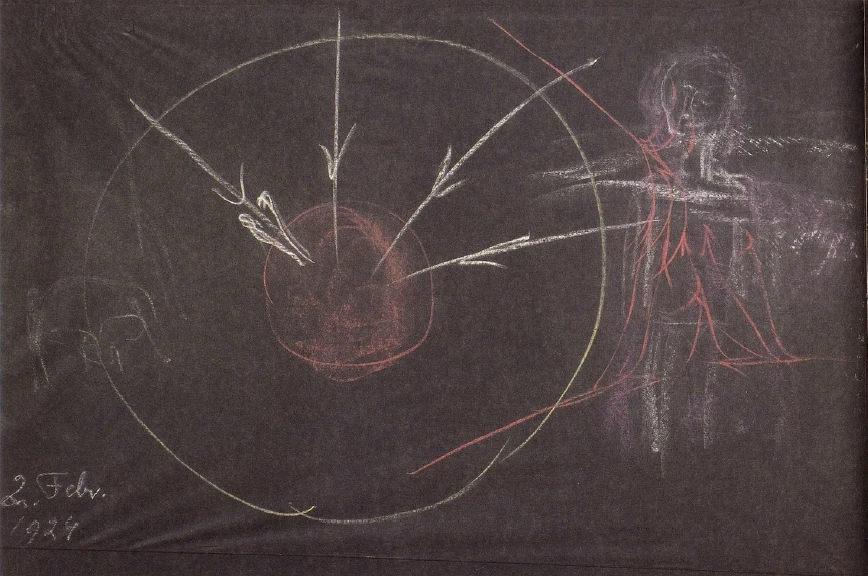
[ 5 ] Noch stärker ist dieses Entgegenarbeiten beim astralischen Menschen. Das Astralische kommt ja sozusagen wie aus dem Unbestimmten, wie ich Ihnen gestern angedeutet habe, hereingeströmt. Und dieses Astralische wirkt im außermenschlichen irdischen Dasein so herein strömend (siehe Pfeile im grünen Kreis), daß es aus der Erde heraus die Pflanzenform kraftet, die noch deutlich dieses Folgen dem Astralischen zeigt. Denn es sind ja die Astralkräfte, die die Pflanze aus der Erde herausholen. Die Pflanze selbst hat nur einen Ätherleib; aber die astralischen Kräfte sind es, die sie herausholen aus der Erde. Beim Menschen ist der astralische Leib außerordentlich kompliziert, und man nimmt ihn wirklich so wahr, wie ich ihn gestern dargestellt habe, als ein inneres Musikalisches, als ein wirbelndes Leben, als ein weben des Leben, als innere Regsamkeit und alles das, was, wenn ich mich so ausdrücken darf, gespürte, empfundene Musik ist; während man alles andere Astralische von außen radial einströmend findet. Und dieses radial Einströmende, das wird eben in die menschliche astralische Form verwandelt. Da kommen komplizierte Dinge zum Vorschein. (Es wird gezeichnet.)
[ 5 ] This counteracting force is even stronger in the astral human being. The astral, as I hinted to you yesterday, flows in, as it were, from the indeterminate. And this astral force flows into the non-human, earthly realm (see arrows in the green circle) in such a way that it shapes the plant form out of the earth, a form that still clearly reveals this dependence on the astral. For it is indeed the astral forces that draw the plant out of the earth. The plant itself has only an etheric body; but it is the astral forces that draw it out of the earth. In human beings, the astral body is extraordinarily complex, and one truly perceives it as I described it yesterday—as an inner musicality, as a swirling life, as a weaving of life, as inner activity, and as everything that, if I may put it this way, is music that is sensed and felt; whereas all other astral elements are found flowing in radially from the outside. And this radially inflowing energy is precisely what is transformed into the human astral form. This is where complex things come to light. (A drawing is made.)
[ 6 ] Sagen wir zum Beispiel, es ströme von einer Seite her ein Astralisches ein; die menschliche Wesenheit biegt dieses Astralische in der verschiedensten Form um, um es sich dienstbar zu machen und einzugliedern, so daß der Mensch sich seinen Astralleib aus den radial einströmenden Astralkräften erzwingt, könnte man sagen, durch seine eigene innere Wesenheit.
[ 6 ] Let us say, for example, that an astral force flows in from one side; the human being transforms this astral force in a wide variety of ways in order to make it serve him and incorporate it, so that the human being forces his astral body out of the radially inflowing astral forces—one might say—through his own inner being.
[ 7 ] Nun, sehen Sie, man kann aber doch sagen: Wenn man den seelisch-geistig geschärften Blick hinauswendet in den Kosmos, bekommt man schon die Auffassung des Ätherischen und man bekommt auch den Eindruck: das Ätherische ist dasjenige, was macht, daß wir von der Erde wegstreben; während wir durch die Schwere der Erde mit der Erde zusammengehalten werden, streben wir durch das Ätherische weg. Im Wegstrebenden ist eigentlich das Ätherische tätig. Sie brauchen dabei nur folgendes zu denken: das menschliche Gehirn ist ungefähr 1500 Gramm schwer. Eine Masse, die 1500 Gramm schwer ist, die auf die feinen Blutgefäße drücken würde, die unter dem Gehirn sind, würde diese ganz zerquetschen. Würde unser Gehirn wirklich seine 1500 Gramm Schwere haben im lebenden Menschen, könnten wir natürlich nicht die Blutgefäße, die unter dem Gehirn sind, haben. Aber innerhalb des lebenden Menschen wiegt ja das Gehirn höchstens 20 Gramm. Soviel wird, weil das Gehirn im Gehirnwasser schwimmt und um das Gewicht des verdrängten Wassers leichter wird, das Gehirn leichter, ungeheuer viel leichter; so wirkt das Gehirn eigentlich wegstrebend vom Menschen. Und in diesem Wegstreben wirkt das Ätherische. So daß man sagen kann: gerade am Gehirn veranschaulicht sich das, was da vorliegt, außerordentlich stark.
[ 7 ] Well, you see, one can certainly say this: When one turns one’s spiritually and mentally sharpened gaze out into the cosmos, one already gains an understanding of the ethereal, and one also gets the impression that the ethereal is what causes us to strive away from the Earth; while we are held together with the Earth by its gravity, we strive away through the ethereal. It is actually the ethereal that is at work in this striving away. You need only consider the following: the human brain weighs about 1,500 grams. A mass weighing 1,500 grams that were to press down on the delicate blood vessels beneath the brain would completely crush them. If our brain were to actually weigh 1,500 grams in a living human being, we naturally could not have the blood vessels that lie beneath the brain. But within a living human being, the brain weighs at most 20 grams. The reason for this is that the brain floats in cerebrospinal fluid and, by the weight of the displaced fluid, becomes lighter—immensely lighter; thus, the brain actually seems to be striving away from the human being. And it is the etheric that is at work in this striving away. So one can say: it is precisely in the brain that what is at work here is illustrated with extraordinary clarity.
[ 8 ] Sie haben das Gehirn im Gehirnwasser schwimmend. Dadurch vermindert sich sein Gewicht von 1500 Gramm auf etwa bloß 20 Gramm. Also bloß etwa 20 Gramm schwer ist unser Gehirn, nimmt also in seiner Wirksamkeit in außerordentlich geringem Maße an unserer physischen Leiblichkeit teil. Da findet das Ätherische ungeheuer viel Möglichkeit, hinaufzuwirken. Das Gewicht wirkt hinunter, aber das Gewicht wird aufgehoben. Im Gehirnwasser entwickelt sich vorzugsweise die Summe der ätherischen Kräfte, die uns weghebt von dem Irdischen. Wir würden ja, wenn wir unseren physischen Leib zu tragen hätten mit all seinen Schwerekräften, einen Sack haben, an dem wir zu schleppen hätten. Aber jedes Blutkörperchen schwimmt ja, verliert von seinem Gewicht.
[ 8 ] The brain floats in cerebrospinal fluid. This reduces its weight from 1,500 grams to only about 20 grams. So our brain weighs only about 20 grams; thus, in terms of its effectiveness, it participates in our physical body to an extraordinarily small degree. This leaves the etheric body with immense scope to exert its influence upward. Weight exerts a downward force, but that weight is counteracted. It is primarily within the cerebrospinal fluid that the sum of the etheric forces develops, lifting us away from the earthly realm. After all, if we had to carry our physical body with all its gravitational forces, we would have a sack that we would have to drag along. But every blood cell floats, losing some of its weight.
[ 9 ] Es ist eine alte Erkenntnis, diese von dem Gewichtsverlust im Flüssigen. Sie wissen ja, daß sie dem Archimedes im Altertum zugeschrieben worden ist. Er badete einmal und merkte, als er das Bein aus dem Badewasser herausstreckte, wieviel schwerer es ist, als wenn er das Bein im Badewasser drinnen hielt, und da rief er: Ich hab’s gefunden! Heureka! Ich hab’s gefunden! — Nämlich, daß jeder Körper im Flüssigen so viel leichter wird, als die Flüssigkeitsmasse beträgt, die er verdrängt. Wenn Sie also den Archimedes sich im Badewasser vorstellen, das physische Bein (es wird gezeichnet), und dann jenes Bein aus Wasser geformt, so wird das physische Bein so viel weniger schwer sein im Wasser, als dieses Wasserbein hier wiegt. Um das wird es leichter sein. Und so wird unser Gehirn im Gehirnwasser drinnen um so viel leichter, als die Gehirnflüssigkeit von der Größe des physischen Gehirns beträgt. Man nennt es in der Physik Auftrieb. Also in diesem Wegstreben durch das Flüssige wirkt das Ätherische, während das Astralische zunächst angeregt wird durch die Atmung, durch das Luftförmige, das in den menschlichen Organismus hereinkommt. Und indem das Luftförmige seinen Weg durchmacht durch den Menschen und in ungeheuer feinem, zerstiebtem Zustande im Haupte anlangt, wirkt in dieser Luftverteilung, Luftorganisierung, das Astralische.
[ 9 ] This is a long-established fact—the principle of weight loss in liquids. As you know, it was attributed to Archimedes in ancient times. He was taking a bath once and noticed, when he stuck his leg out of the bathwater, how much heavier it felt than when he kept his leg submerged in the bathwater, and so he cried out: “I’ve found it! Eureka! I’ve found it!” — Namely, that every body in a liquid becomes as much lighter as the mass of the liquid it displaces. So if you imagine Archimedes in the bathwater—his physical leg (it is drawn)—and then that leg formed of water, the physical leg will be as much lighter in the water as this “water leg” here weighs. It will be that much lighter. And so our brain, immersed in cerebrospinal fluid, becomes that much lighter than the mass of the cerebrospinal fluid corresponding to the size of the physical brain. In physics, this is called buoyancy. Thus, in this striving outward through the liquid, the etheric body is active, while the astral body is initially stimulated by breathing, by the airy substance that enters the human organism. And as the airy element makes its way through the human being and reaches the head in an immensely fine, atomized state, the astral aspect is active within this distribution and organization of air.
[ 10 ] So kann man wirklich in dem Stofflichen, in dem festen, erdigen Stofflichen das Physische sehen; in dem Flüssigen, namentlich wie seine Wirkung im Menschen ist, das Ätherische; in dem Luftförmigen schon das Astralische.
[ 10 ] Thus, one can truly see the physical in the material, in the solid, earthly material; the ethereal in the liquid, particularly in terms of its effect on human beings; and the astral in the airy.
[ 11 ] Es ist die Tragik des Materialismus, daß er nichts von der Materie weiß, wie sie in Wirklichkeit in den verschiedenen Gebieten des Daseins wirkt. Das ist gerade das Merkwürdige, daß der Materialismus so unwissend ist über die Materie. Er weiß gar nichts über die Wirkung der Materie, weil man darüber erst etwas erfährt, wenn man die in der Materie wirksame Geistigkeit, die die Kräfte darstellen, ins Auge fassen kann.
[ 11 ] The tragedy of materialism is that it knows nothing about matter as it actually operates in the various realms of existence. That is precisely what is so remarkable: that materialism is so ignorant about matter. It knows nothing at all about the effects of matter, because one can only learn about them when one is able to perceive the spirituality at work within matter—that is, the forces themselves.
[ 12 ] Und so ist es: Schreitet man durch die Meditation vor zu der imaginativen Erkenntnis, von der ich Ihnen schon gesprochen habe, so findet man in allem Wasserweben der Erde zugleich das Ätherische. Es ist vor einer wirklichen Erkenntnis kindisch, zu glauben, daß in alledem, was da webt — nehmen Sie das Meer, das Flußwasser, die aufsteigenden Nebel, die herabfallenden Wassertropfen, die sich formenden Wolken, nehmen Sie das alles zusammen —, zu glauben, daß da nur dasjenige enthalten ist, was der Physiker und der Chemiker vom Wasser wissen, es ist eigentlich kindisch gegenüber einer wirklichen Erkenntnis. Denn in alledem, was da draußen ist in dem mächtigen Tropfen der Wassererde, in demjenigen, was fortwährend aufsteigt in Dunstesform, sich zu Wolken formt, herunterkommt in Nebel und Regen, was sich sonst auf der Erde durch das Wasser zuträgt — das Wasser hat ja eine ungeheure Tätigkeit bei der Bildung der verschiedenen Erdstrukturen —, in alledem wirken die Ätherströmungen, das ÄÄtherweben, das sich einem enthüllt, wenn man das Denken so erkraftet hat, wie ich es auseinandergesetzt habe: in Bildern. Überall ist im Hintergrunde dieses Wasserwebens das Weben der Imagination, der Weltimagination, und — gewissermaßen von rückwärts kommend in diese Weltimagination — überall diese astralische Weltensphärenharmonie.
[ 12 ] And this is how it is: If one proceeds through meditation toward the imaginative insight of which I have already spoken to you, one finds the ethereal in all the water movements of the Earth. It is childish, in the face of true knowledge, to believe that in all that weaves—take the sea, the river water, the rising mists, the falling water droplets, the forming clouds, take all of that together—to believe that it contains only what physicists and chemists know about water, is actually childish in the face of true understanding. For in all that which is out there in the mighty drop of the water-earth, in that which continually rises in the form of vapor, forms itself into clouds, descends as mist and rain, and in all else that takes place on Earth through water—for water does indeed play an immense role in the formation of the various Earthly structures— in all of this, the etheric currents are at work—the weaving of the ether—which reveals itself to one when one has developed the power of thought in the way I have described: in images. Everywhere, in the background of this weaving of water, is the weaving of the imagination, the world imagination, and—coming, as it were, from behind into this world imagination—everywhere this astral harmony of the world spheres.
[ 13 ] Nun ist es aber so beim Menschen, daß man in ihm alle diese Verhältnisse ganz anders findet als außerhalb des Menschen. Wenn man ins Außermenschliche schaut mit dem in der Art geschärften Blick, wie ich es Ihnen angedeutet habe, da findet man sozusagen die Welt zunächst aufgebaut aus dem Physischen, unmittelbar an der Erde haftend; dem Ätherischen, das schon den Kosmos erfüllt; dem Astralischen, das da einströmt, wesenhaft einströmt. So daß man wirklich nicht etwa bloß ein allgemeines abstrakt astralisches Weben hat, sondern Wesen da hereinkommen, Wesen, die seelisch-geistig sind, so wie der Mensch auch in seinem Körper seelisch-geistig ist. Das schaut man.
[ 13 ] Now, however, the case with human beings is that all these relationships are found within them in a completely different way than outside of them. When one looks at the non-human world with the kind of sharpened gaze I have hinted at, one finds, so to speak, the world initially structured out of the physical, directly attached to the Earth; the etheric, which already fills the cosmos; the astral, which flows in—flows in as beings. So that one does not merely encounter a general, abstract astral weaving, but rather beings entering in—beings that are soul-spiritual, just as the human being is also soul-spiritual within his or her body. That is what one sees.
[ 14 ] Schaut man dann auf den Menschen zurück, so findet man auch im Menschen für dasjenige, was draußen ätherisch ist, entsprechend seinen Ätherleib. Aber dieser Ätherleib zeigt sich nicht so, daß Sie sagen können (es wird gezeichnet): da ist der physische Mensch, dann ist das der Ätherleib. Gewiß, man kann es so zeichnen, aber das ist nur ein festgehaltener Ausschnitt. Sie sehen niemals bloß den gegenwärtigen Ätherleib, sondern wenn Sie einen Menschen in bezug auf seinen Ätherleib betrachten, dann sehen Ste diesen Ausschnitt, den man zeichnen kann, angrenzend an dasjenige, was vorangeht. Sie sehen immer den ganzen Ätherleib bis zu der Geburt hin. Das Zeitliche ist ein Einheitliches. Sie können nicht, wenn Sie einen zwanzigjährigen Menschen vor sich haben, den zwanzigjährigen Ätherleib bloß sehen, sondern Sie sehen alles, was im Ätherleib geschehen ist bis zu der Geburt hin und noch etwas darüber hinaus. Da wird wirklich die Zeit zum Raum. So wie Sie, wenn Sie in eine Allee hineinschauen und die Bäume durch die Perspektive einander immer nähergerückt werden, so wie Sie also in die ganze Allee hineinsehen dem Raume nach: so schauen Sie den Ätherleib, wie er gegenwärtig ist, an, sehen aber zurück das ganze Gebilde, das ein zeitliches Gebilde ist. Der Ätherleib ist ein Zeitorganismus. Der physische Leib ist ein Raumesorganismus. Der physische Leib ist jetzt ja abgeschlossen. Der Ätherleib ist immer als Ganzes da, entsprechend der vergangenen Lebensdauer während dieses Lebens. Das ist eine Einheit. Daher könnten Sie eigentlich den ÄÄtherleib nur zeichnen oder malen, wenn Sie Wandelbilder malen könnten; nur mit einer größeren Geschwindigkeit müßten Sie malen. Was man als augenblickliche Gestaltung zeichnet oder malt, ist eben nur ein Durchschnitt, verhält sich dem ganzen Ätherleib gegenüber so, wie wenn Sie einem Baum den Stamm durchschneiden und dann zeichnen, was Sie da sehen im Durchschnitt. So ist es, wenn Sie den ÄÄtherleib in einem Schema zeichnen, eben nur ein Durchschnitt, denn der ganze Ätherleib ist ein zeitlicher Verlauf. Und man kommt, indem man diesen zeitlichen Verlauf überblickt, sogar etwas über die Geburt, ja sogar über die Empfängnis hinaus bis zu einem Punkte, wo man schaut, wie der Mensch heruntergestiegen ist aus seinem vorirdischen Dasein zu diesem jetzigen Erdendasein, und sich sozusagen als Letztes, das er durchgemacht hat, bevor er von einem Elternpaar konzipiert wurde, Substantialität aus dem allgemeinen Weltenäther herangezogen und zu seinem eigenen Ätherleib gebildet hat.
[ 14 ] If we then look back at the human being, we find within the human being, corresponding to what is etheric in the external world, the etheric body. But this etheric body does not manifest itself in such a way that you can say (as is often depicted): here is the physical human being, and there is the etheric body. Certainly, one can draw it that way, but that is only a captured snapshot. You never see merely the present etheric body; rather, when you observe a human being in relation to their etheric body, you see this snapshot—which can be drawn—adjacent to what precedes it. You always see the entire etheric body all the way back to birth. Time is a unified whole. When you have a twenty-year-old person before you, you cannot see merely the twenty-year-old etheric body; rather, you see everything that has taken place in the etheric body all the way back to birth and even a little beyond. There, time truly becomes space. Just as when you look down an avenue and the trees appear to draw closer and closer together due to perspective—just as you thus perceive the entire avenue in terms of space—so you look at the etheric body as it is in the present, but see back through the entire structure, which is a temporal structure. The etheric body is a temporal organism. The physical body is a spatial organism. The physical body is, of course, now complete. The etheric body is always present as a whole, corresponding to the duration of life lived so far in this lifetime. It is a unity. Therefore, you could actually only draw or paint the etheric body if you were able to paint changing images; you would simply have to paint at a faster pace. What one draws or paints as an instantaneous form is merely a cross-section; it relates to the entire etheric body in the same way as if you were to cut through the trunk of a tree and then draw what you see there as a cross-section. It is the same when you draw the etheric body in a diagram—it is merely a cross-section, for the entire etheric body is a temporal process. And by surveying this temporal progression, one even goes beyond birth, indeed beyond conception, to a point where one sees how the human being descended from his pre-earthly existence into this present earthly existence, and how, so to speak, as the final stage he underwent before being conceived by a pair of parents, drew substance from the general world ether and formed it into his own etheric body.
[ 15 ] So daß Sie also, sobald Sie vom Ätherleib sprechen, nicht anders sprechen können, als indem Sie das zeitliche Leben des Menschen bis über die Geburt hinaus überblicken. Das, was man als den Ätherleib in einem bestimmten Zeitmomente ansieht, ist nur eine Abstraktion; das Konkrete ist der zeitliche Verlauf.
[ 15 ] So, whenever you speak of the etheric body, you cannot help but consider the temporal life of the human being extending beyond birth. What is regarded as the etheric body at a specific moment in time is merely an abstraction; the concrete reality is the temporal course.
[ 16 ] Beim astralischen Leib ist es noch anders. Auf den astralischen Leib des Menschen kommt man in der Art, wie ich Ihnen das gestern gesagt habe.
[ 16 ] With the astral body, it is different. One approaches the human astral body in the way I described to you yesterday.
[ 17 ] Das kann ich Ihnen nur schematisch zeichnen. Es muß ja auch in der Zeichnung für Sie der Raum zur Zeit werden. Nehmen wir an, am 2. Februar 1924 betrachten Sie den astralischen Leib eines Menschen. Hier wäre der Mensch (es wird gezeichnet) und wir betrachten seinen astralischen Leib. Ja, es macht der Mensch diesen Eindruck: da ist sein physischer Leib, da ist sein Ätherleib, und da kann man auch seinen astralischen Leib betrachten. Es macht den Eindruck, wie ich es in meinem Buche «Theosophie» beschrieben habe. Es ist so. Aber kommt man zu der eigentlich inspirierten Erkenntnis, wie ich sie gestern beschrieben habe, die gegenüber dem leeren Bewußtsein auftritt, dann gelangt man zu folgender Einsicht. Dann sagt man sich: Dasjenige, was da als astralischer Leib im Menschen gesehen wird, das ist eigentlich nicht am 2. Februar 1924 vorhanden, sondern wenn der Mensch, dessen astralischen Leib man betrachtet, zwanzig Jahre alt geworden ist, so muß man die Zeit zurückverfolgen. Sie kommen dann hin, meinetwillen zu dem Januar 1904, und Sie bekommen die Einsicht: da eigentlich ist erst in Wirklichkeit dieser astralische Leib da, und weiter zurück ins Unbegrenzte, weiter zurück, da ist er eigentlich erst. Er ist gar nicht mitgegangen durch das Leben, er ist da geblieben. Hier ist nur eine Art Schein. — Es ist so, wie wenn Sie in eine Allee hineinschauen würden (es wird gezeichnet): da geht es weiter, es sind die letzten Bäume, sie sind sehr nahe; dahinten steht eine Lichtquelle. Ja, Sie können hier den Schein des Lichtes noch haben, aber die Lichtquelle ist doch dahinten, die ist nicht hervorspaziert, damit hier der Schein des Lichtes ist.
[ 17 ] I can only sketch this out for you schematically. After all, the drawing must also convey a sense of space and time to you. Let’s assume that on February 2, 1924, you are observing a person’s astral body. Here would be the person (it is drawn), and we are observing his astral body. Yes, the person gives this impression: there is his physical body, there is his etheric body, and there one can also observe his astral body. It gives the impression I described in my book Theosophy. That is how it is. But if one arrives at the truly inspired insight, as I described it yesterday, which arises in contrast to empty consciousness, then one arrives at the following realization. Then one says to oneself: What is seen there as the astral body in a human being is not actually present on February 2, 1924; rather, if the person whose astral body one is observing has reached the age of twenty, one must trace back in time. You then arrive—for the sake of argument—at January 1904, and you gain the insight: that is actually when this astral body first truly exists, and further back into infinity, further back—that is where it actually first exists. It has not accompanied the person through life at all; it has remained there. What we see here is merely a kind of illusion. — It is as if you were looking down an avenue (a sketch is drawn): it continues on; those are the last trees, they are very close; back there stands a light source. Yes, you can still see the glow of the light here, but the light source is back there after all; it has not stepped forward just so that the glow of the light might be here.
[ 18 ] So ist der astralische Leib auch da geblieben (es wird auf die Zeichnung verwiesen), wirft nur seinen Schein in das Leben herein. Der astralische Leib ist eigentlich in der geistigen Welt geblieben, ist nicht mitgegangen in die physische Welt. Wir stehen unserem astralischen Leibe nach immer vor unserer Empfängnis, vor unserer Geburt und Empfängnis in der geistigen Welt drinnen. Es ist so, wie wenn wir, wenn wir 1924 zwanzig Jahre alt geworden sind, eigentlich doch geistig noch lebten vor dem Jahre 1904, und nur einen Fühler vorgestreckt hätten in bezug auf den astralischen Leib.
[ 18 ] Thus, the astral body has also remained there (see the illustration), casting only its shadow into life. The astral body has actually remained in the spiritual world; it has not followed us into the physical world. In terms of our astral body, we are always in the spiritual world prior to our conception, prior to our birth and conception. It is as if, when we turned twenty in 1924, we were actually still living spiritually before the year 1904, and had merely extended a feeler with regard to the astral body.
[ 19 ] Sie werden sagen: Das ist eine schwierige Vorstellung. Schön, aber Sie wissen, es hat einmal einen spanischen König gegeben, dem hat man gezeigt, wie kompliziert das Weltengebäude ist. Da hat der spanische König gemeint, wenn er das Weltengebäude gemacht hätte, hätte er es einfacher gemacht. Das mag schon der Mensch denken, aber die Welt ist eben in Wirklichkeit nicht einfach, und der Mensch schon gar nicht, sondern man muß sich etwas anstrengen, um das zu erfassen, was der Mensch ist.
[ 19 ] You might say: That’s a difficult concept to grasp. Well, you know, there was once a Spanish king who was shown just how complicated the structure of the world is. The Spanish king remarked that if he had created the structure of the world, he would have made it simpler. People may well think that, but the world is simply not simple in reality—and human beings certainly aren’t either—so one has to make an effort to grasp what it means to be human.
[ 20 ] Sie schauen also, indem Sie nach dem astralischen Leib schauen, direkt in die geistige Welt hinein. Astralisches um sich haben Sie nur in der außermenschlichen Welt. Wenn Sie die Menschen anschauen, schauen Sie in die geistige Welt hinsichtlich ihrer astralischen Leiber hinein. Sie sehen direkt dasjenige, was der Mensch selber, bevor er auf die Erde heruntergestiegen ist, in der geistigen Welt durchgemacht hat.
[ 20 ] So, by looking at the astral body, you are looking directly into the spiritual world. You encounter the astral only in the non-human world. When you look at people, you are looking into the spiritual world through their astral bodies. You see directly what the person themselves experienced in the spiritual world before descending to Earth.
[ 21 ] Sie werden sagen: Aber mein astralischer Leib wirkt doch in mir. Das tut er auch, selbstverständlich tut er das; aber denken Sie sich, hier wäre irgendein Wesen (es wird gezeichnet), das hätte irgendwelche Stricke und würde durch diese Stricke, die mechanisch verbunden wären, etwas verrichten. Weit weg im Raume tritt die Wirkung von einem Wesen auf, das eben hier ist. So ist es hier mit der Zeit. Ihr astralischer Leib ist da geblieben, aber er streckt seine Wirkungen eben durch das ganze Leben aus. Wenn Sie also heute eine Wirkung Ihres astralischen Leibes beachten, so hat die ihren Ursprung in der Zeit, die längst vergangen ist, wo Sie, noch bevor Sie auf die Erde heruntergestiegen sind, in der geistigen Welt waren. Die Zeit wirkt da herein. Die Zeit ist, mit anderen Worten, da geblieben für das Geistige. Und derjenige, der glaubt, daß das Vergangene in dem, was in der Zeit wirklich lebt, nicht mehr da sei, der gleicht einem Menschen, der in einem Eisenbahnzug sitzen würde, fortführe, und einer sagte ihm: Du, das war doch eine schöne Gegend, die wir da Mitte unten durchfahren haben —, und der Mensch, der also einfältig wäre, würde sagen: Ja, schöne Gegend, aber sie ist ja verschwunden, sie ist ja gar nicht mehr da. — Solch ein Mensch würde also glauben, wenn er mit dem Eilzug vorübergefahren ist an einer Gegend, dann sei sie verschwunden, sei nicht mehr da. Geradeso gescheit ist es, wenn der Mensch glaubt, was in der Zeit vergangen ist, sei nicht mehr da. Es ist eben fortwährend da, es wirkt in ihn herein. Der 3. Januar 1904 in seinem geistigen Bestande ist noch da, geradeso wie das Räumliche da ist, wenn Sie durchgefahren sind; es ist da, und es ist so da, daß es hereinwirkt in die Gegenwart.
[ 21 ] You will say: But my astral body is at work within me. It is, of course; but imagine there were some being here (it is drawn) that had some kind of ropes and, through these ropes—which were mechanically connected—would perform some action. Far away in space, the effect of a being that is right here manifests itself. That is how it is here with time. Your astral body has remained there, but its effects extend throughout your entire life. So when you observe an effect of your astral body today, it has its origin in a time long past, when you were in the spiritual world, even before you descended to Earth. Time exerts its influence here. In other words, time has remained there for the spiritual realm. And anyone who believes that the past no longer exists in what truly lives in time is like a person sitting on a train as it speeds along, and someone says to him, “Hey, that was a beautiful area we just passed through down there”—and that person, who would be so simple-minded, would say: “Yes, a beautiful area, but it’s gone now; it’s not there at all anymore.” — Such a person would therefore believe that once he has passed through an area on an express train, it has vanished and is no longer there. It is just as sensible to believe that what has passed in time is no longer there. It is, in fact, constantly present; it exerts an influence upon him. January 3, 1904, in its spiritual essence, is still there, just as the physical landscape is still there after you have driven through it; it is there, and it is there in such a way that it exerts an influence on the present.
[ 22 ] So daß, wenn Sie Ihren astralischen Leib so beschreiben, wie ich es in meiner «Theosophie» getan habe, dann müssen Sie, um die Einsicht zu einer vollständigen zu machen, eben sich bewußt werden, daß das, was da wirkt, der Schein desjenigen ist, was eigentlich weit zurückliegend wirkt. Sie sind als Mensch wirklich ein Komet, der seinen Schweif weit zurück in die Vergangenheit erstreckt. Man kann nicht anders eine wirkliche Einsicht in die menschliche Wesenheit gewinnen als dadurch, daß man auf die neuen Begriffe kommt.
[ 22 ] So that, if you describe your astral body as I have done in my Theosophy, then—in order to make your understanding complete—you must realize that what is at work there is the appearance of that which is actually at work far in the past. As a human being, you are truly a comet whose tail extends far back into the past. One cannot gain a true understanding of the human being except by arriving at these new concepts.
[ 23 ] Die Menschen, die glauben, daß man mit denselben Begriffen, die man hier für die physische Welt hat, auch in die geistige Welt eintreten kann, die sollten Spiritisten werden, nicht Anthroposophen. Da, nicht wahr, versucht man alles Geistige, nur ein bißchen dünner, gerade auch in den gewöhnlichen Raum, wo die physischen Menschen herumgehen, hereinzuzaubern. Aber das ist eben kein Geistiges. Das sind nur feine Ausschwitzungen, selbst die Schrenck-Notzingschen Phantome sind nur feine Ausschwitzungen des Physischen, sehr dünne Ausschwitzungen, die noch in ihrer Gestaltung den Nachklang des Ätherischen haben. Es sind bloße Phantome; sie sind nicht ein wirklich Geistiges.
[ 23 ] People who believe that one can enter the spiritual world using the same concepts that apply here to the physical world should become spiritualists, not anthroposophists. There, don’t you see, people try to conjure up everything spiritual—just a little more ethereal—right into the ordinary space where physical human beings walk about. But that is not the spiritual at all. These are merely subtle emanations; even Schrenck-Notzing’s phantoms are merely subtle emanations of the physical—very thin emanations that still bear the echo of the etheric in their form. They are mere phantoms; they are not truly spiritual.
[ 24 ] Wenn Sie die Sache so betrachten, dann werden Sie sich sagen: In der außermenschlichen Natur sind die höheren Welten gegenwärtig. Beim Menschen kommen wir sogleich in die Zeit hinein, in seinen zeitlichen Verlauf, wenn wir die aufeinanderfolgenden Welten betrachten. Man kann aber beim Menschen auch noch weiterdringen in der Erkenntnis. Und da mündet die Erkenntnis ein in ein Element, von dem man heute in unserer philiströs-materialistischen Zeit nicht zugeben will, daß es auch ein Erkenntniselement sein kann.
[ 24 ] If you look at it this way, you will say to yourself: In nature beyond the human realm, the higher worlds are present. With human beings, we immediately enter into time—into the course of their existence—when we consider the successive worlds. But with human beings, one can penetrate even further into knowledge. And there, knowledge flows into an element that, in our philistine, materialistic age, people are unwilling to admit can also be an element of knowledge.
[ 25 ] Ich habe Ihnen als die erste Stufe der Erkenntnis diejenige vorgewiesen, die — nun ja, die groben, robusten physischen Dinge um uns herum erblickt durch die Sinne. Die zweite Art war die des erkrafteten Denkens, wo man die sich bewegenden Bilder der Welt in sich auffaßt. Die dritte Art war die inspirierte, wo man dasjenige wahrnimmt, was sich wesenhaft in diesen Bildern ausspricht, was hineintönt wie ein Sphärenmusikalisches, aber wesenhaft. Nimmt man das beim Menschen wahr, dieses wesenhaft Sphärische, dann wird man nicht bloß aus der Materie hinausgeführt, sondern aus der Gegenwart hinausgeführt in das vorirdische Leben des Menschen, in sein Dasein, das er gehabt hat als geistig-seelisches Wesen, bevor er auf die Erde herabgestiegen ist. Diese inspirierte Erkenntnis erlangt man, wenn man das leere Bewußtsein herstellt, nachdem man vorher das erkraftete Denken gehabt hat.
[ 25 ] As the first stage of knowledge, I have shown you the one that—well, perceives the coarse, robust physical things around us through the senses. The second kind was that of active thinking, in which one grasps the moving images of the world within oneself. The third kind was the inspired kind, in which one perceives what is essentially expressed in these images, what resounds within them like the music of the spheres, but in an essential way. If one perceives this essential, celestial quality in a human being, one is led not merely out of matter, but out of the present into the human being’s pre-earthly life—into the existence he had as a spiritual-soul being before he descended to Earth. One attains this inspired insight by establishing a state of empty consciousness after having previously engaged in vigorous thinking.
[ 26 ] Den weiteren Aufstieg in der Erkenntnis erlangt man dadurch, daß man die Kraft der Liebe zu einer Erkenntniskraft macht. Nur darf es nicht die triviale Liebe sein, von der allein in unserer materialistischen Zeit zumeist gesprochen wird, sondern es muß diejenige Liebe sein, die imstande ist, sich eins zu fühlen mit einem Wesen, das man selber nicht ist innerhalb der physischen Welt; also wirklich fühlen können das, was in dem anderen Wesen vorgeht, ebenso wie das, was in einem selbst vorgeht, ganz aus sich herausgehen können und wieder aufleben in dem anderen Wesen. Im gewöhnlichen Menschenleben bringt sich dieses Lieben nicht bis zu einem solchen Grade, der notwendig ist, um die Liebe zu einer Erkenntniskraft zu machen. Da muß man schon zuerst dieses leere Bewußtsein hergestellt haben, muß auch einige Erfahrungen mit dem leeren Bewußtsein gemacht haben. Ja, dann macht man etwas durch, was freilich viele Menschen nicht suchen, indem sie nach höherer Erkenntnis streben. Da macht man nämlich etwas durch, was man nennen könnte den Erkenntnisschmerz, das Erkenntnisleid.
[ 26 ] One attains further spiritual growth by transforming the power of love into a power of knowledge. However, it must not be the trivial kind of love that is most often spoken of in our materialistic age, but rather the kind of love that is capable of feeling at one with a being that one is not oneself within the physical world; that is, to be able to truly feel what is happening within the other being just as one feels what is happening within oneself, to be able to step completely outside of oneself and come alive again within the other being. In ordinary human life, this loving does not reach the degree necessary to transform love into a power of knowledge. To achieve this, one must first have established this empty consciousness and must also have had some experience with it. Yes, then one goes through something that, admittedly, many people do not seek when they strive for higher knowledge. For one goes through what one might call the pain of knowledge, the suffering of knowledge.
[ 27 ] Wenn der Mensch irgendwo eine Wunde hat, dann schmerzt ihn das. Warum? Weil sein geistiges Wesen dadurch, daß der physische Leib verletzt wird, an dieser Stelle den physischen Leib nicht richtig durchdringen kann. Aller Schmerz rührt davon her, daß man irgendwie den physischen Leib nicht durchdringen kann. Und wenn man an etwas Außerlichem Schmerz erlebt, so ist es auch aus dem Grunde, weil man sich damit nicht vereinigen kann. Hat man das leere Bewußstsein erlangt, in das eine ganz andere Welt als diejenige, an die man gewöhnt ist, hereinflutet, dann hat man für die Momente, in denen man diese inspirierte Erkenntnis hat, den ganzen physischen Menschen nicht, dann ist alles wund, dann schmerzt alles. Das muß man zunächst durchmachen. Man muß sozusagen das Verlassen des physischen Leibes als richtigen Schmerz, als richtiges Leid durchmachen, um zur inspirierten Erkenntnis zu gelangen, um dazu zu gelangen im unmittelbaren Anschauen, nicht bloß im Begreifen. Das Begreifen natürlich kann ganz schmerzlos vor sich gehen und sollte von den Menschen erlangt werden, indem sie eben auch nicht durch den Initiationsschmerz hindurchgehen. Aber um zu dem zu kommen, dasjenige bewußt zu erleben, was der Mensch eigentlich an sich hat aus dem vorgeburtlichen Dasein, was noch aus der geistigen Welt geblieben ist und in einen hereinwirkt, um dazu zu kommen, dazu gehört zunächst das Hinübergehen über den Abgrund des ganz allgemeinen, ich möchte sagen universellen Leides, universellen Schmerzes.
[ 27 ] When a person has a wound somewhere, it causes them pain. Why? Because when the physical body is injured, their spiritual being cannot properly penetrate the physical body at that point. All pain stems from the fact that, for some reason, one cannot penetrate the physical body. And when one experiences pain from something external, it is also for the reason that one cannot unite with it. Once one has attained that state of empty consciousness into which a world entirely different from the one to which one is accustomed floods in, then—for the moments in which one has this inspired insight—one no longer possesses one’s entire physical being; then everything is sore, then everything hurts. One must go through this first. One must, so to speak, experience the leaving of the physical body as true pain, as true suffering, in order to attain inspired insight—to attain it through direct perception, not merely through understanding. Understanding, of course, can take place entirely painlessly and should be attained by people precisely because they do not go through the pain of initiation. But in order to reach the point of consciously experiencing what a person actually possesses from their pre-birth existence—what has remained from the spiritual world and continues to work within them—in order to reach that point, one must first cross the abyss of the very general, I would say universal, suffering and universal pain.
[ 28 ] Und dann kann man die Erfahrung des Auflebens in einem ganz Andern haben, dann lernt man erst die höchstpotenzierte, die höchstgradige Liebe, die darinnen besteht, daß man wirklich nicht abstrakt sich selbst vergessen kann, sondern sich ganz außer acht lassen kann und ganz in das Andere hinüberkommen kann. Und wenn diese Liebe in Verbindung mit der höheren, inspirierten Erkenntnis auftritt, dann hat man eigentlich erst die Möglichkeit, mit all der Lebenswärme, mit all der Gemütsinnigkeit, mit all der Herzensinnigkeit, die natürlich etwas Seelisches ist, in das Geistige hineinzukommen. Und das muß man, wenn man weiterkommen will in der Erkenntnis. Die Liebe muß in diesem Sinne eine Erkenntniskraft werden. Denn wenn diese Liebe, die als Erkenntniskraft dann auftritt, eine gewisse Höhe erreicht hat, eine gewisse Intensität, dann kommen Sie hinüber durch Ihr vorirdisches Dasein in das vorige Erdenleben. Sie schlüpfen hinüber durch das Ganze, was Sie durchgemacht haben zwischen Ihrem letzten Tode und dem gegenwärtigen Erdenleben, in das frühere Erdenleben, in das, was man die vorhergehenden Inkarnationen nennt.
[ 28 ] And then one can experience coming alive in something entirely different; only then does one learn the most potent, the highest form of love, which consists in the fact that one cannot truly forget oneself in an abstract sense, but can set oneself completely aside and cross over entirely into the other. And when this love arises in conjunction with higher, inspired knowledge, only then do you truly have the opportunity to enter into the spiritual realm with all the warmth of life, with all the emotional depth, and with all the heartfelt sincerity—which is, of course, something of the soul. And this is necessary if you wish to progress in knowledge. In this sense, love must become a power of knowledge. For when this love—which then manifests as a power of knowledge—has reached a certain height, a certain intensity, you pass through your pre-earthly existence into your previous earthly life. You slip through everything you have experienced between your last death and your present earthly life, into your previous earthly life—into what are called your previous incarnations.
[ 29 ] Sehen Sie, dazumal sind Sie auch in einem physischen Leibe auf der Erde gewandelt, selbstverständlich. Aber von all dem, was da physischer Leib an Ihnen war, ist ja nichts geblieben; das ist alles in die Erdenelemente aufgesogen worden, von dem ist nichts da. Dasjenige, was Ihr innerstes Wesen war in der damaligen Zeit, das ist ganz geistig geworden, das lebt in Ihnen als ganz Geistiges.
[ 29 ] You see, back then you, too, walked the earth in a physical body, of course. But of all that was physical about you back then, nothing remains; it has all been absorbed into the elements of the Earth—nothing of it is left. That which was your innermost being at that time has become entirely spiritual; it lives within you as something entirely spiritual.
[ 30 ] Wahrhaftig, unser Ich wird, indem es durch die Pforte des Todes geht, durch die geistige Welt geht bis zu einem neuen Erdenleben, ganz geistig. Und wer glaubt, es mit ganz gewöhnlichen Kräften des alltäglichen Bewußtseins erringen zu können, der kann es nicht erringen. Man kann es nur erringen, wenn die Liebe in der Weise höchstgesteigert ist, wie ich es angeführt habe. Denn der, der wir waren im früheren Dasein, der ist ebenso außer uns, wie ein anderer Mensch in der Gegenwart außer uns ist. Derselbe Grad von Außensein haftet unserem Ich an. Gewiß, es wird dann unser Eigentum. Wir erleben es als uns selbst, aber wir müssen erst so lieben lernen, daß diese Liebe gar nichts Egoistisches hat. Es wäre ja etwas Furchtbares, wenn man in seine vorige Inkarnation sich verlieben würde im gewöhnlichen Sinne des Wortes. Es muß die Liebe im höchsten Sinne gesteigert werden, daß man eben diese vorige Inkarnation zugleich als etwas ganz anderes erleben kann. Und dann dringt man, wenn die Kraft der Erkenntnis durch das leere Bewußtsein aufsteigt zu der Kraft der Erkenntnis durch die höchstgesteigerte Liebe, dann gelangt man zu dem vierten Gliede der menschlichen Wesenheit, zu dem eigentlichen Ich.
[ 30 ] Truly, as our “I” passes through the gate of death and journeys through the spiritual world on its way to a new earthly life, it becomes entirely spiritual. And whoever believes they can attain this through the ordinary powers of everyday consciousness will not be able to attain it. One can achieve it only if love has been heightened to the highest degree, as I have described. For the person we were in a previous existence is just as separate from us as another person is separate from us in the present. The same degree of separateness attaches to our “I.” Certainly, it then becomes our own. We experience it as ourselves, but we must first learn to love in such a way that this love contains nothing selfish. It would indeed be a terrible thing if one were to fall in love with one’s previous incarnation in the ordinary sense of the word. Love must be elevated to its highest sense so that one can experience this very previous incarnation as something entirely different at the same time. And then, when the power of knowledge rises through empty consciousness to the power of knowledge through the highest form of love, one reaches the fourth member of the human being—the true “I.”
[ 31 ] Der Mensch hat seinen physischen Leib. Durch den lebt er in jedem Augenblick in der physischen Gegenwart der Erde. Der Mensch hat seinen Ätherleib. Durch den lebt er eigentlich fortdauernd bis ein Stückchen vor seine Geburt hin, wo er sich den Ätherleib gesammelt hat aus dem allgemeinen Weltenäther. Nun hat er seinen Astralleib. Durch den lebt er durch das ganze Dasein zwischen seinem vorigen Tode und diesem Heruntersteigen auf die Erde. Und dann hat er sein Ich. Da lebt er ins vorige Erdenleben hinein. So daß wir beim Menschen überall, wo wir von seiner Gliederung sprechen, sprechen müssen von seiner Ausdehnung in der Zeit. Wir tragen unser voriges IchBewußtsein unterbewußt in der Gegenwart in uns. Und wie tragen wir es in uns? Ja, wenn Sie das studieren wollen, wie wir es in uns tragen, dann müßten Sie aufmerksam werden darauf — und das ist auch der Weg dazu, an das Ich heranzukommen —, wie der Mensch nun hier in der physischen Welt nicht nur fester Leib ist, nicht nur ein flüssiger Mensch, ein luftförmiger Mensch, sondern wie der Mensch ja ein Wärmeorganismus ist. Primitiv, wenigstens sehr partiell weiß das schon jeder; wenn er Fieber mißt, so bekommt er verschiedene Fieberangaben, je nach den verschiedenen Stellen des Organismus, wo er mißt. Aber so ist es durch den ganzen menschlichen Organismus hindurch. Eine andere Temperatur haben Sie oben im Kopfe, eine andere in der großen Zehe, eine andere innerlich in der Leber, eine andere innerlich in der Lunge. Sie sind ja nicht nur das, was Sie in einem anatomischen Atlas in festen Konturen gezeichnet finden; Sie sind ein Flüssigkeitsorganismus, der in fortwährender Bewegung ist; Sie sind ein Luftorganismus, der Sie immerfort durchdringt, wie wenn Sie da immer ein mächtiges Symphonisches, Musikorganisches durchdränge. Und Sie sind bei alledem ein wogendes, warm-kalt Organisiertes, ein Wärmeorganismus, und in diesem Wärmeorganismus leben Sie selber drinnen. Das spüren Sie auch. Schließlich haben Sie nicht ein sehr starkes Bewußtsein davon, daß Sie, sagen wir, in einem Schienbein- oder in einem anderen Knochen leben, auch nicht ein starkes Bewußtsein davon, daß Sie in Ihrer Leber leben oder in den Säften Ihrer Gefäße. Aber daß Sie in Ihrer Wärme leben, davon haben Sie ein starkes Bewußtsein, wenn Sie das auch nicht differenzieren, wenn Sie auch nicht sagen: Da ist meine Wärmehand, da ist mein Wärmebein, da ist meine Wärmeleber und so weiter; aber es ist da, und ist es einmal gestört, ist nicht die menschlich angemessene Differenzierung im Wärmeorganismus vorhanden, dann spüren Sie es als Erkrankung, als Schmerz.
[ 31 ] Human beings have a physical body. Through it, they live at every moment in the physical presence of the Earth. Human beings have an etheric body. Through it, they actually live continuously back to a point just before their birth, where they gathered their etheric body from the universal ether. Now, human beings have an astral body. Through it, they live throughout the entire period between their previous death and this descent to Earth. And then they have their “I.” Through it, they live into their previous earthly life. Thus, whenever we speak of the structure of the human being, we must also speak of their extension in time. We carry our previous “I”-consciousness subconsciously within us in the present. And how do we carry it within us? Well, if you wish to study how we carry it within us, then you must become attentive to the fact—and this is also the path to approaching the “I”—that the human being here in the physical world is not merely a solid body, not merely a liquid being or an airy being, but is, in fact, a thermal organism. Everyone already knows this in a primitive, or at least very partial, sense; when you take a temperature, you get different readings depending on the various parts of the organism where you take the measurement. But this is true throughout the entire human organism. You have one temperature at the top of your head, another in your big toe, another internally in the liver, and another internally in the lungs. After all, you are not merely what you find depicted with fixed contours in an anatomical atlas; you are a fluid organism in constant motion; you are an air organism that continually permeates you, as if a mighty symphonic, musical force were constantly flowing through you. And in all of this, you are a surging, warm-and-cold organism—a thermal organism—and you yourself live within this thermal organism. You can feel that, too. After all, you do not have a very strong awareness that you live, let’s say, in your shinbone or in some other bone, nor do you have a strong awareness that you live in your liver or in the fluids of your blood vessels. But you have a strong awareness that you live within your warmth—even if you do not differentiate it, even if you do not say: “There is my warm hand, there is my warm leg, there is my warm liver,” and so on; but it is there, and once it is disrupted—once the humanly appropriate differentiation within the thermal organism is no longer present—then you perceive it as illness, as pain.
[ 32 ] Wenn man das Ätherische schaut, wenn man mit dem entwickelten Bewußtsein zur Bildhaftigkeit, zur Imagination gedrungen ist, dann hat man webende Bilder. Nimmt man das Astralische wahr, hat man die Weltensphärenmusik. Die dringt an einen heran, oder auch sie dringt aus uns heraus. Denn unser eigener Astralleib führt uns zurück in unser vorirdisches Dasein. Und gehen wir weiter zu jener Erkenntnis, die sich aufschwingt bis zur intensivsten Liebe, wo die Liebeskraft Erkenntniskraft wird, wo wir zunächst unser eigenes Dasein aus einem vorigen Erdenleben hereinfluten sehen in unser gegenwärtiges Erdenleben, so spüren wir dieses vorangehende Erdenleben in der normalen Differenzierung unseres Wärmeorganismus, in dem wir drinnen leben. Das ist die wirkliche Intuition. Da leben wir drinnen. Und wenn irgendein Impuls in uns aufsteigt, das oder jenes zu tun, so wirkt dies ja nicht nur, wie es im astralischen Leib ist, aus der geistigen Welt heraus, sondern von noch weiter zurück aus dem früheren Erdenleben. Das frühere Erdenleben wirkt in die Wärme Ihres Organismus herüber und erzeugt diesen oder jenen Impuls. Schauen wir in dem irdischfesten Menschen den physischen Leib, in dem flüssigen den ätherischen Leib, in dem luftförmigen den astralischen Leib, so schauen wir in dem Wärmemäßigen des Menschen das eigentliche Ich. Das Ich der gegenwärtigen Inkarnation ist nie fertig; das bildet sich. Das eigentliche, in den unterbewußten Tiefen wirkende Ich ist das des vorigen Erdenlebens. Und vor dem schauenden Bewußtsein nimmt sich ein Mensch, dem Sie gegenübertreten so aus, daß Sie sagen: Hier steht er; ich erblicke ihn zunächst so wie er dasteht, mit meinen äußeren Sinnen. Ich schaue dann das Ätherische, ich schaue das Astralische, dann aber hinter ihm den anderen Menschen, der er war in der vorigen Inkarnation.
[ 32 ] When one perceives the etheric realm, when one has advanced with developed consciousness to the realm of imagery and imagination, one experiences weaving images. When one perceives the astral realm, one experiences the music of the world spheres. It reaches out to us, or it also flows out from within us. For our own astral body leads us back to our pre-earthly existence. And if we proceed to that insight which soars up to the most intense love—where the power of love becomes the power of insight, where we first see our own existence from a previous earthly life flowing into our present earthly life—then we sense this preceding earthly life in the normal differentiation of our thermal organism, within which we live. That is true intuition. We live within it. And when any impulse arises within us to do this or that, it does not act merely—as is the case with the astral body—from the spiritual world, but from even further back, from a previous earthly life. The previous earthly life influences the warmth of your organism and generates this or that impulse. When we look at the physical body in the earthbound human being, the etheric body in the liquid one, and the astral body in the airy one, we see the true “I” in the warmth of the human being. The “I” of the present incarnation is never complete; it is still forming. The true “I,” active in the depths of the subconscious, is that of the previous earthly life. And to the observing consciousness, a person standing before you appears in such a way that you say: Here he stands; at first I perceive him just as he stands there, with my outer senses. I then perceive the etheric body, I perceive the astral body, but then, behind him, I perceive the other person he was in his previous incarnation.
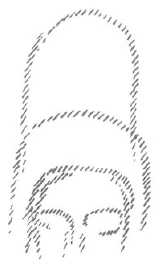
[ 33 ] In der Tat, je weiter dieses Bewußtsein ausgebildet wird, desto mehr erscheint — perspektivisch macht sich das so (es wird gezeichnet) — das menschliche Haupt der gegenwärtigen Inkarnation, etwas darüber das menschliche Haupt der vorigen Inkarnation, etwas darüber das menschliche Haupt der noch weiter zurückliegenden Inkarnation. In Zivilisationen, die von diesen Dingen durch ein instinktives Bewußtsein noch etwas geahnt haben, finden Sie Bilder, wo hinter dem deutlich gezeichneten Antlitz, das auf das gegenwärtige Erdenleben bezogen wird, ein anderes, etwas weniger deutlich gemaltes ist, und ein noch weniger deutlich gemaltes als drittes. Es gibt solche ägyptische Bilder. Derjenige, der erblickt, wie eigentlich hinter dem Menschen der Gegenwart der Mensch der vorigen Inkarnation und der weiter zurückliegenden Inkarnation aufsteigt, versteht solche Bilder. Und es ist erst eine Realität, von dem Ich zu sprechen als dem vierten Gliede der menschlichen Natur, wenn man zugleich das zeitliche Dasein zu den vorigen Inkarnationen zurückerweitert.
[ 33 ] In fact, the more this awareness is developed, the more it appears—in perspective, it looks like this (as depicted)—that the human head of the present incarnation is shown, slightly above it the human head of the previous incarnation, and slightly above that the human head of an incarnation even further back in time. In civilizations that still had some inkling of these things through an instinctive awareness, you will find images in which, behind the clearly depicted face—which relates to the present earthly life—there is another, somewhat less clearly painted face, and a third that is painted even less clearly. Such Egyptian images exist. The one who perceives how, in fact, behind the person of the present, the person of the previous incarnation and of the incarnation even further back emerges, understands such images. And it is only a reality to speak of the “I” as the fourth member of human nature when one simultaneously extends temporal existence back to the previous incarnations.
[ 34 ] Das alles wirkt im Wärmemenschen. Die Inspiration kommt noch an einen heran von außen oder von innen. In der Wärme steht man selber drinnen. Da ist die Intuition, die wahre Intuition. Ganz anders erlebt man die Wärme als irgend etwas anderes an sich.
[ 34 ] All of this takes effect within the person of warmth. Inspiration still comes to one from outside or from within. In warmth, one stands within oneself. There is intuition—true intuition. One experiences warmth quite differently than anything else in itself.
[ 35 ] Jetzt aber, wenn Sie das so betrachten, dann kommen Sie über eines hinaus, was gerade dem Menschen der Gegenwart, wenn er wirklich unbefangen mit seiner Seele zu Werke geht, ein großes Rätsel aufgeben sollte. Ich habe von diesem Rätsel gesprochen. Ich sagte, wir fühlen uns moralisch verbindlich gegenüber gewissen Impulsen, die uns rein geistig gegeben sind. Wir wollen sie ausführen. Wie das in die Knochen, in den Muskel schießt, wozu wir uns moralisch verbunden fühlen, das kann man zunächst nicht einsehen. Wenn man aber weiß, daß man sein Ich aus der vorigen Inkarnation, das schon ganz geistig geworden ist, in sich trägt, daß dieses Ich in die Wärme hereinwirkt, dann hat man den Übergang da in diesem Wärmemenschen. Auf dem Umwege durch das Ich der vorigen Inkarnation wirken die moralischen Impulse. Da bekommen Sie erst den Übergang vom Moralischen ins Physische. Wenn Sie bloß die gegenwärtige Natur betrachten und den Menschen als einen Ausschnitt aus der Natur, bekommen Sie diesen Übergang nicht.
[ 35 ] But now, when you look at it this way, you come to understand something that should pose a great mystery, especially to people today, if they truly set to work with an open mind and soul. I have spoken of this mystery. I said that we feel morally bound to certain impulses that are given to us purely spiritually. We want to act upon them. At first, it is difficult to understand how what we feel morally bound to penetrates right into our bones and muscles. But when one realizes that one carries within oneself the “I” from the previous incarnation—which has already become entirely spiritual—and that this “I” works its way into the warmth, then one finds the transition right there in this “warmth-being.” The moral impulses work through the detour of the “I” from the previous incarnation. Only then do you achieve the transition from the moral to the physical. If you merely observe present-day nature and view human beings as a segment of nature, you will not grasp this transition.
[ 36 ] Denn wenn Sie die gegenwärtige Natur betrachten, so können Sie folgendes sagen: Nun ja, da draußen ist die Natur; der Mensch nimmt ihre Stoffe auf, baut sich seinen Organismus auf — so naiv kindlich stellt man sich das vor —, ist also ein aus den Stoffen der Natur zusammengeschweißter Ausschnitt aus der Natur. Schön. Jetzt fühlt er aber plötzlich: es gibt moralische Impulse, und er soll sich danach richten. Er soll nur einen einzigen Schritt machen im Sinne dieser moralischen Impulse. Ich möchte wissen, wie dieser Ausschnitt aus der Natur das anfängt? Der Stein kann es nicht; das Kalzium kann es nicht; das Chlor kann es nicht; der Sauerstoff kann es nicht; der Stickstoff kann es nicht, alles das kann es nicht. Der Mensch, der aus dem zusammengeschweißt ist, soll es plötzlich können: er empfindet einen moralischen Impuls, und er soll sich danach richten, da er doch aus alledem zusammengeschweißt ist, was das nicht kann.
[ 36 ] For when you look at nature as it is today, you might say: Well, there’s nature out there; human beings take in its substances, build up their own organism—that’s how naively and childishly we imagine it—and are thus a segment of nature welded together from nature’s substances. Fine. But now he suddenly feels: there are moral impulses, and he is supposed to act in accordance with them. He is supposed to take just a single step in accordance with these moral impulses. I would like to know how this fragment of nature is supposed to begin doing that? The stone cannot do it; the calcium cannot do it; the chlorine cannot do it; the oxygen cannot do it; the nitrogen cannot do it—none of these can do it. The human being, who is forged from all of these elements, is suddenly supposed to be able to do it: he feels a moral impulse, and he is supposed to act in accordance with it, even though he is forged from all of these elements that cannot do so.
[ 37 ] Aber in alledem, was da zusammengeschweißt ist, entsteht etwas, namentlich auf dem Umwege durch den Schlaf, was durch den Tod geht, was immer geistiger und geistiger wird und ein nächstes Mal in den Leib hineingeht. Nun ist es in diesem auch schon darinnen, weil es aus der vorigen Inkarnation kommt. Das ist geistig geworden. Das wirkt in die Inkarnation hinein. Dasjenige, was jetzt aus den Stoffen der Erde zusammengeschweißt ist, wird in der nächsten Inkarnation in den Wärmemenschen hineinwirken. Da strömt das Moralische von einem Erdenleben des Menschen in das andere hinein.
[ 37 ] But within all that which is fused together there, something arises—namely, indirectly through sleep—that passes through death, becomes ever more spiritual, and enters the body again in the next life. Now it is already present within this body, because it comes from the previous incarnation. It has become spiritual. It exerts an influence on the current incarnation. That which is now fused together from the substances of the earth will exert an influence on the “heat-human” in the next incarnation. Thus, the moral aspect flows from one earthly life of the human being into the next.
[ 38 ] Da begreift man den Übergang von der physischen Natur zur geistigen, und wiederum zurück von der geistigen zur physischen. Mit einem Erdenleben kann man das nicht, wenn man sich nicht einer seelisch-geistigen Erkenntnisunredlichkeit hingibt oder sich über das Ganze hinweg betäubt.
[ 38 ] This is where one comprehends the transition from the physical to the spiritual realm, and again, back from the spiritual to the physical. One cannot achieve this in a single earthly life unless one surrenders to a sincere pursuit of spiritual and soul-related knowledge or numbs oneself to the whole of it.
[ 39 ] Sehen Sie, was man als die Elemente des Irdischen betrachten kann, das feste Irdische, das Flüssige, das Gas- oder Luftförmige, das Wärmeartige, das ist überall durchzogen von dem, was man bezeichnen kann als das Physische — da ist es unmittelbar es selber —, das Ätherische, das Astralische und das Ichmäßige. Und so bekommt man im Zusammenhange mit dem Weltendasein, mit dem Universum, die Gliederung des Menschen. Und man kann sich eine Vorstellung davon bilden, inwiefern der Mensch ein Ausschnitt ist aus der Zeit, nicht nur aus dem Raume. Aus dem Raume ist er es nur seiner physischen Körperlichkeit nach. Aber das Vergangene ist für die geistige Betrachtung ein fortdauerndes Gegenwärtiges. Die Gegenwart ist zu gleicher Zeit eine wirkliche Ewigkeit.
[ 39 ] You see, what can be regarded as the elements of the earthly realm—the solid, the liquid, the gaseous or airy, and the heat-like—is permeated everywhere by what can be described as the physical—where it is immediately present in its own right—the etheric, the astral, and the egoic. And thus, in connection with world existence, with the universe, one gains an understanding of the structure of the human being. And one can form a conception of the extent to which the human being is a segment of time, not merely of space. In terms of space, the human being is such only insofar as their physical body exists. But the past is, for spiritual contemplation, a continuous present. The present is, at the same time, a true eternity.
[ 40 ] Es ist dieses, was ich Ihnen da auseinandersetze, einmal Inhalt instinktiver Bewußtseinsformen der Menschen gewesen. Wenn wir alte Urkunden wirklich verstehen, so finden wir schon, wie in alten Urkunden ein Bewußtsein von dieser Viergliederigkeit des Menschen im Zusammenhange mit der Welt lebt. Aber durch viele Jahrhunderte hindurch ist diese Erkenntnis dem Menschen verlorengegangen. Er hätte sonst niemals seinen Intellekt ausbilden können, so wie er ihn jetzt hat. Aber nun sind wir wieder an dem Punkte in der Menschheitsentwickelung angelangt, wo wir wiederum vordringen müssen von dem Physischen aus zu dem wirklich Geistigen.
[ 40 ] What I am explaining to you here was once the content of people’s instinctive forms of consciousness. If we truly understand ancient documents, we will find that an awareness of this fourfold nature of the human being—in relation to the world—is already alive within them. But over the course of many centuries, this insight was lost to humankind. Otherwise, humankind would never have been able to develop its intellect as it now possesses it. But now we have once again reached the point in human development where we must once more advance from the physical to the truly spiritual.