

Anthroposophy
A Summary After Twenty-one Years
GA 234
3 February 1924, Dornach
Translate the original German text into any language:
Versions Available:
Anthroposophy: A Summary After Twenty-one Years, tr. SOL
Sechster Vortrag
Sixth Lecture
[ 1 ] Wenn man den Verlauf des menschlichen Erdenlebens betrachtet, so findet man ihn in einer Art von Rhythmus verlaufend, der sich ausdrückt in den Wechselzuständen zwischen Wachen und Schlafen. Unter den Gesichtspunkt des Wachens und Schlafens hat man zu rücken dasjenige, was in den letzten Vorträgen ausgeführt worden ist über die Gliederung des Menschen. Sehen wir uns einmal das, was dabei vorliegt, ich möchte sagen, mit dem gewöhnlichen Bewußtsein rein äußerlich an. Wir haben im wachenden Menschen den inneren Verlauf seiner Lebensprozesse, die aber im Unterbewußten oder Unbewußten verbleiben. Wir haben in diesem wachenden Menschen vorhanden das, was wir als die Sinneseindrücke kennen, jenes Verhältnis zu unserer irdischen und außerirdischen Umgebung, das durch die Sinneseindrücke vermittelt ist, und wir haben ferner im wachenden Menschen die Offenbarung seiner Willensnatur gegeben. Wir haben seine Bewegungsmöglichkeit als Ausdruck seiner Willensimpulse gegeben.
[ 1 ] When we consider the course of human life on Earth, we find that it unfolds in a kind of rhythm expressed in the alternating states of waking and sleeping. From the perspective of waking and sleeping, we must take into account what was explained in the previous lectures regarding the structure of the human being. Let us take a look at what is happening here—I would say—purely from the outside, with ordinary consciousness. In the waking human being, we have the inner course of their life processes, which, however, remain in the subconscious or unconscious. In this waking human being, we find what we know as sensory impressions—that relationship to our earthly and extraterrestrial surroundings mediated by sensory impressions—and we also find, in the waking human being, the manifestation of their volitional nature. We find their capacity for movement as an expression of their volitional impulses.
[ 2 ] Wenn wir den Menschen äußerlich betrachten, so finden wir, daß der innere Lebensprozeß, der im Unbewußten für den wachen Menschen verläuft, fortdauert während des Schlafes. Wir finden, daß während des Schlafes die Sinnestätigkeit und das auf ihr sich aufbauende Denken unterdrückt ist. Wir finden, daß unterdrückt ist das, was Offenbarung des Willens ist, und das, was beides miteinander verbindet, was gewissermaßen zwischen drinnensteht, das aktive Gefühlsleben.
[ 2 ] When we observe human beings from the outside, we find that the inner life process—which takes place in the unconscious while the person is awake—continues during sleep. We find that during sleep, sensory activity and the thinking that builds upon it are suppressed. We find that what is suppressed is the manifestation of the will, and that which connects the two—that which, so to speak, stands between them: the active emotional life.
[ 3 ] Wenn wir nun einfach unbefangen dieses, was so das gewöhnliche Bewußtsein ergibt, betrachten, ohne uns einzulassen in irgendwelche Vorurteile, so müssen wir uns doch sagen: Die als seelisch zu bezeichnenden Vorgänge und die Vorgänge, die zwischen dem Seelischen und der Außenwelt sich abspielen, die hören im Schlafe auf, höchstens daß aus dem Schlafe heraustönt dasjenige, was das Traumleben ist. Und wir dürfen ganz gewiß nicht annehmen, daß mit jedem Erwachen diese seelischen Prozesse gewissermaßen aus dem Nichts heraus neu geschaffen würden. Das wäre zweifellos auch für das gewöhnliche Bewußtsein ein ganz absurder Gedanke. Es bleibt nichts anderes übrig für das unbefangene Betrachten, als vorauszusetzen, daß alles, was im Menschen Träger ist der seelischen Vorgänge, auch während des Schlafes vorhanden ist. Dann aber müssen wir uns gestehen, daß dieses, was so Träger der seelischen Vorgänge ist, während des Schlafes nicht eingreift in den Menschen; daß also nicht eingreift in den Menschen dasjenige, was in seinen Sinnen hervorruft ein Bewußtsein von der Außenwelt, und was dieses Bewußtsein der Außenwelt aufrüttelt zum Denken; daß ebenfalls nicht eingreift das, was vom Willen aus den Körper in Bewegung setzt, und daß auch nicht eingreift das, was die gewöhnlichen organischen Prozesse zum Gefühl aufruft.
[ 3 ] If we now simply observe, with an open mind, what ordinary consciousness produces—without succumbing to any prejudices—we must nevertheless conclude: The processes that can be described as psychological, and the processes that take place between the psychological realm and the external world, cease during sleep—at most, what emerges from sleep is the phenomenon known as dreaming. And we certainly must not assume that with every awakening these psychological processes are, as it were, recreated out of nothing. That would undoubtedly be a completely absurd idea even for ordinary consciousness. Unbiased observation leaves us no choice but to assume that everything in the human being that serves as a vehicle for psychological processes is also present during sleep. But then we must admit that this very thing, which serves as the vehicle for psychological processes, does not intervene in the human being during sleep; that is to say, what does not intervene in the human being is that which evokes in the senses an awareness of the external world and which stirs this awareness of the external world into thought; that likewise, what sets the body in motion through the will does not intervene, nor does what evokes sensation through the ordinary organic processes.
[ 4 ] Wir werden uns ja bewußt während des Wachlebens, daß die Gedanken in unseren Organismus eingreifen, wenn man auch mit dem gewöhnlichen Bewußtsein nicht überschaut, wie der Gedanke, die Vorstellung gewissermaßen hinunterströmt in das Muskelsystem, in das Knochensystem und den Willen vermittelt. Aber wir sind uns bewußt dieses Eingreifens der seelischen Impulse in die Körperlichkeit, und wir müssen uns klar sein darüber, daß eben dieses Eingreifen der seelischen Impulse fehlt, während wir im Schlafe sind.
[ 4 ] We are, after all, aware during our waking life that thoughts intervene in our organism, even if our ordinary consciousness does not grasp how the thought, the mental image, so to speak, flows down into the muscular system, the skeletal system, and mediates the will. But we are aware of this interaction of mental impulses with the physical body, and we must be clear that it is precisely this interaction of mental impulses that is absent while we are asleep.
[ 5 ] Daraus schon können wir rein äußerlich sagen: der Schlaf nimmt eben von dem Menschenwesen etwas weg. Und es wird sich nur fragen, was der Schlaf von diesem Menschenwesen wegnimmt. Wenn wir zunächst auf das sehen, was wir als den physischen Menschenleib bezeichnet haben — er ist im Schlafe fortdauernd tätig, wie er tätig ist während des Wachens. Aber auch all diejenigen Vorgänge, welche wir gekennzeichnet haben als die des ätherischen Organismus, sie dauern fort während des Schlafes. Der Mensch wächst während des Schlafes. Der Mensch verrichtet innerlich diejenigen Tätigkeiten, die der Ernährung, der Verarbeitung der Ernährung angehören. Er atmet weiter und so fort. Das alles sind Tätigkeiten, die nicht dem physischen Leibe angehören können, denn sie hören eben auf, wenn der physische Leib Leichnam wird. Da wird der physische Leib von der äußeren Natur, von der Erdennatur in Anspruch genommen. Die wirkt zerstörend. Das, was zerstörend wirkt, überfällt den Menschen im Schlafe noch nicht. Es sind also die Gegenwirkungen da gegen das Auseinanderfallen des menschlichen physischen Leibes. So daß wir schon daraus rein äußerlich uns sagen müssen: der ätherische Organismus ist auch während des Schlafes vorhanden.
[ 5 ] From this alone, we can say, purely from an external perspective, that sleep takes something away from the human being. And the question then becomes: what does sleep take away from this human being? If we first consider what we have referred to as the physical human body—it remains constantly active during sleep, just as it is active while awake. But all those processes that we have identified as belonging to the etheric organism also continue during sleep. The human being grows during sleep. The human being carries out, internally, those activities that pertain to nutrition and the processing of food. He continues to breathe, and so on. All these are activities that cannot belong to the physical body, for they cease precisely when the physical body becomes a corpse. At that point, the physical body is claimed by external nature, by the nature of the earth. This exerts a destructive influence. That which has a destructive effect does not yet overtake the human being during sleep. Thus, there are counterforces at work against the disintegration of the human physical body. Consequently, even from this purely external observation, we must conclude that the etheric organism is also present during sleep.
[ 6 ] Wir wissen aus den vorangehenden Vorträgen, daß dieser ätherische Organismus durch Imagination zur wirklichen Erkenntnis gebracht werden kann. Man kann ihn im Bilde erleben, geradeso wie man durch die Sinneseindrücke den physischen Leib erlebt. Wir wissen auch, daß dasjenige, was man den astralischen Organismus nennen kann, durch Inspiration erlebt wird.
[ 6 ] We know from the previous lectures that this etheric organism can be brought to real understanding through imagination. One can experience it in the mind’s eye, just as one experiences the physical body through sensory impressions. We also know that what might be called the astral organism is experienced through inspiration.
[ 7 ] Wir wollen nun nicht bei Schlußfolgerungen stehen bleiben, das könnten wir ja auch, aber wir werden diese Schlußfolgerungen in bezug auf den astralischen Leib und die Ich-Organisation lieber machen, nachdem zuerst die wirkliche Beobachtung für das entwickelte Bewußtsein vor unsere Seele getreten ist.
[ 7 ] We do not wish to stop at conclusions—though we could—but we would rather draw these conclusions regarding the astral body and the “I”-organization only after the actual observation has first presented itself to our soul through developed consciousness.
[ 8 ] Wollen wir zunächst uns einmal vergegenwärtigen, wie wir sagen mußten, daß der astralische Leib im Menschen wirkt. Er wirkt durch das Mittel des Luftartigen, des Gasartigen im menschlichen Organismus. So daß wir in alledem, was im Menschen als Wirkung, als Impulse des Luftartigen vor sich geht, zunächst den astralischen Leib erkennen müssen.
[ 8 ] Let us first recall, as we had to say, how the astral body acts within the human being. It acts through the airy, gaseous elements in the human organism. Thus, in everything that takes place within the human being as an effect or as an impulse of the airy elements, we must first recognize the astral body.
[ 9 ] Nun wissen wir, daß das Allerwesentlichste in bezug auf diese Tätigkeit des astralischen Leibes in dem Luftartigen zunächst die Artmung ist, und wir wissen schon aus der gewöhnlichen Erfahrung, daß wir zu unterscheiden haben zwischen der Einatmung und der Ausatmung. Und wir wissen weiter, die Einatmung ist für uns das Belebende. Wir entnehmen der äußeren Luft das Belebende, indem wir einatmen. Aber wir wissen auch, wir geben an die äußere Luft das ab, was nun nicht das Belebende ist, sondern das Ertötende. Physisch gesprochen, wir nehmen den Sauerstoff auf, geben die Kohlensäure ab. Allein das interessiert uns dabei weniger. Es interessiert uns eben das Ergebnis der gewöhnlichen Erfahrung, daß wir das Belebende einatmen, das Ertötende ausatmen.
[ 9 ] We now know that, with regard to this activity of the astral body in the airy realm, breathing is the most essential aspect, and we already know from everyday experience that we must distinguish between inhalation and exhalation. And we also know that inhalation is what gives us life. We draw the life-giving element from the outside air when we inhale. But we also know that we release into the external air that which is not the life-giving element, but rather the life-destroying element. Physically speaking, we take in oxygen and release carbon dioxide. But that is of less interest to us here. What interests us is precisely the result of ordinary experience: that we inhale the life-giving element and exhale the life-destroying element.
[ 10 ] Nun handelt es sich darum, die höhere Erkenntnis, die da verläuft in Imagination, Inspiration und Intuition — das haben wir ja in den letzten Tagen besprochen —, also die inspirierte Erkenntnis, anzuwenden auf das Schlafleben und einmal wirklich zu prüfen: ist da etwas, das der Schlußfolgerung entspricht, die wir haben müssen, daß vom Menschen etwas herausgehoben wird?
[ 10 ] Now the task is to apply the higher form of knowledge—which manifests as imagination, inspiration, and intuition, as we have discussed in recent days—that is, inspired knowledge, to the life of sleep and to truly examine whether there is anything there that corresponds to the conclusion we must reach: that something is drawn out of the human being?
[ 11 ] Diese Frage kann nur dadurch beantwortet werden, daß man die andere aufwirft und zur Beantwortung bringt: Wenn so etwas da ist, was außerhalb des Menschen ist, wie verhält sich nun dieses außerhalb des Menschen Befindliche?
[ 11 ] This question can only be answered by raising another question and answering it: If there is such a thing that exists outside of human beings, how does this entity that exists outside of human beings behave?
[ 12 ] Nun, nehmen Sie einmal an, der Mensch habe es durch solche innerlichen Seelenübungen, wie ich sie charakterisiert habe, dazu gebracht, wirklich Inspiration zu haben, also in das leere Bewußtsein etwas hereinzubekommen. Er lebt in der Möglichkeit, inspirierte Erkenntnis zu haben. In diesem Augenblicke ist es ihm auch möglich, den Schlafzustand künstlich herbeizuführen, aber so, daß er nicht ein Schlafzustand ist, sondern daß er eben nun ein bewußter Zustand ist, der Zustand der Inspiration eben ist, wo die geistige Welt hereinflutet.
[ 12 ] Now, suppose a person has, through such inner spiritual exercises as I have described, managed to truly experience inspiration—that is, to bring something into their empty consciousness. They live with the possibility of having inspired insight. At that moment, it is also possible for them to artificially induce a state of sleep—but not in the sense of a normal sleep state; rather, it is now a conscious state, the very state of inspiration, into which the spiritual world pours in.
[ 13 ] Nun möchte ich ganz populär die Sache darstellen. Nehmen Sie an, derjenige, der ein solches inspiriertes Bewußtsein erlangt hat, ist imstande, gewissermaßen in einem Geistig-Musikalischen die Weltenwesen, die geistigen Weltenwesen in sich hereinsprechen zu fühlen. Dann wird er dabei, bei diesem inspirierten Erkennen, gewisse Erfahrungen machen. Aber er wird sich auch sagen: Ja, die Erfahrungen, die ich da mache, bewirken jetzt etwas sehr Eigentümliches; die bewirken, daß mir das, was ich vorausgesetzt habe, daß es während des Schlafes außerhalb des Menschen ist, nichts Unbekanntes mehr bleibt. Es ist wirklich so, daß man das, was da eintritt, mit folgendem vergleichen kann.
[ 13 ] Now I would like to explain this in very simple terms. Suppose that the person who has attained such an inspired consciousness is able, as it were, to feel the beings of the spiritual worlds—the spiritual beings—speaking into him through a spiritual-musical medium. Then, in the course of this inspired perception, he will have certain experiences. But they will also say to themselves: Yes, the experiences I am having here are now bringing about something very peculiar; they are causing what I had previously assumed to be outside the human being during sleep to no longer remain unknown to me. It is truly the case that what is happening there can be compared to the following.
[ 14 ] Nehmen Sie an, Sie haben vor zehn Jahren ein Erlebnis gehabt. Sie haben es vergessen. Und durch irgendeine Veranlassung kommen Sie dazu, an dieses Erlebnis vor zehn Jahren sich wieder zu erinnern. Es ist so, daß es außerhalb Ihres Bewußtseins war, daß Sie, nachdem Sie irgendwelche Gedächtnishilfe oder dergleichen angewendet haben, dieses Erlebnis vor zehn Jahren wiederum in Ihr Bewußtsein hereinbringen. Es ist nun darinnen. Da haben Sie etwas, was außerhalb Ihres Bewußtseins war, was aber doch mit Ihnen verbunden war, wieder in das Bewußtsein hereingebracht.
[ 14 ] Suppose you had an experience ten years ago. You forgot about it. And for some reason, you find yourself remembering that experience from ten years ago. The fact is that it was outside your consciousness; after using some kind of memory aid or the like, you have brought this experience from ten years ago back into your consciousness. It is now there. You have thus brought something that was outside your consciousness—but which was nevertheless connected to you—back into your consciousness.
[ 15 ] So geschieht es dem, der ein intimeres Bewußtsein hat und zur Inspiration kommt. Ihm fängt an das, was im Schlafe vor sich gegangen ist, aufzutauchen, wie sonst Erinnerungserlebnisse auftauchen. Nur daß die Erinnerungserlebnisse einmal da waren im Bewußtsein. Die Schlafeserlebnisse waren früher im Bewußtsein nicht da, aber sie kommen herein, so daß er eigentlich das Gefühl hat, er erinnert sich an etwas, was er allerdings in diesem Erdenleben nicht ganz bewußt erlebt hat, aber es kommt herein wie Erinnerungen; und man beginnt, wie man wieder verstehen lernt ein gehabtes Erlebnis durch die Erinnerung, so zu verstehen, was während des Schlafes sich vollzieht. Also in das inspirierte Bewußtsein hinein taucht das Erleben dessen, was außerhalb des Menschen während des Schlafes ist, einfach auf, und es wird ein Bekanntes aus einem Unbekannten. Und man lernt erkennen, was das, das da aus dem Menschen während des Schlafes herausschlüpft, nun während des Schlafes eigentlich tut.
[ 15 ] This is what happens to someone who has a more intimate consciousness and experiences inspiration. What took place during sleep begins to surface for them, just as memories usually do. The only difference is that memories were once present in consciousness. The sleep experiences were not previously present in consciousness, but they enter it, so that the person actually has the feeling of recalling something—which, admittedly, they did not experience fully consciously in this earthly life—but it enters like memories; and one begins, just as one learns to understand a past experience through memory, to understand what takes place during sleep. Thus, within the inspired consciousness, the experience of what lies outside the human being during sleep simply emerges, and the unknown becomes familiar. And one learns to recognize what that which slips out of the human being during sleep is actually doing during sleep.
[ 16 ] Wenn Sie in Sprache verwandeln würden, was Sie im Wachleben mit dem Atem erleben, so würden Sie sagen: Ich danke es dem Elemente, das ich einatme, daß ich innerlich mit Leben durchsetzt werde, und ich könnte es nimmermehr dem Elemente, das ich ausatme, verdanken, daß ich lebe, denn das ist etwas Tötendes.
[ 16 ] If you were to put into words what you experience with your breath in waking life, you would say: I thank the element I inhale for filling me with life from within, and I could never thank the element I exhale for my life, for that is something that kills.
[ 17 ] Sind Sie aber während des Schlafes außerhalb Ihres Leibes, wie wir es vorhin erschlossen haben, dann wird Ihnen die eigene Luft, die Sie ausatmen, gerade zu einem außerordentlich sympathischen Elemente. Sie haben das nicht beachtet, was mit der Ausatmungsluft erlebt werden kann, während Sie wachten, denn da haben Sie nur auf die Einatmungsluft geachtet, die das Belebende gibt, wenn Sie eben mit Ihrer Seele in Ihrem physischen Leibe drinnenstecken. Aber dasselbe, ja noch ein gehobeneres Gefühl haben Sie gegenüber der Luft, die Sie so meiden, wenn sie irgendwo angesammelt in einem Raume ist. Sie reden davon, daß Sie diese ausgeatmete Luft nicht mögen. Der physische Leib kann sie auch nicht während des Schlafes vertragen, aber das Seelisch-Geistige, das außerhalb des Leibes ist, das, ich möchte sagen, atmet gerade, physisch gesprochen, die ausgeatmete Kohlensäure ein. Es ist aber ein geistiger Vorgang. Es ist nicht ein Atmungsprozeß. Es ist ein Entgegennehmen des Eindruckes, den die ausgeatmete Luft macht. Aber nicht nur das. In dieser ausgeatmeten Luft bleiben Sie erstens auch während des Schlafes in Verbindung mit Ihrem physischen Leibe. Sie gehören dazu, weil Sie sich sagen: der atmet diese ertötende Luft aus, und das ist mein Leib. Sie sagen es unbewußt. Sie fühlen sich verbunden mit Ihrem Leibe dadurch, daß er Ihnen die Atmungsluft in diesem ertötenden Zustande zurückgibt. Sie fühlen sich ganz in der Atmosphäre, die Sie ausatmen.
[ 17 ] But if, as we deduced earlier, you are outside your body while sleeping, then the very air you exhale becomes an extraordinarily pleasant element for you. You have not paid attention to what can be experienced with the exhaled air while you were awake, for then you paid attention only to the inhaled air, which provides vitality when your soul is housed within your physical body. But you have the same—indeed, an even more elevated—feeling toward the air that you so avoid when it is gathered in a room. You say that you do not like this exhaled air. The physical body cannot tolerate it even during sleep, but the soul-spiritual aspect, which is outside the body—that, I would say, is actually inhaling, physically speaking, the exhaled carbon dioxide. But it is a spiritual process. It is not a breathing process. It is a reception of the impression made by the exhaled air. But not only that. In this exhaled air, you also remain connected to your physical body, even during sleep. You are part of it because you tell yourself: “This is the body exhaling this suffocating air, and that is my body.” You say this unconsciously. You feel connected to your body through the fact that it returns the exhaled air to you in this life-extinguishing state. You feel completely immersed in the atmosphere that you exhale.
[ 18 ] Das aber, was Sie da ausatmen, das trägt Ihnen die Geheimnisse Ihres Innenlebens fortwährend entgegen. Sie nehmen sie — allerdings für das gewöhnliche Bewußtsein, das im Schlafe ist, unbewußt — Ihrem Innenleben nach wahr. Es sprüht aus Ihnen die ausgeatmete Luft. Und diese ausgeatmete Luft erscheint Ihnen so, daß Sie sagen: Das bin ich ja selber, das ist meine innere Menschlichkeit, die aussprüht in das Weltenall. Und wie ein Sonnenhaftes erscheint Ihnen dasjenige, was Ihnen als ihr eigener Geist entgegenströmt in der ausgeatmeten Luft.
[ 18 ] But what you exhale there constantly reveals to you the mysteries of your inner life. You perceive them—albeit unconsciously, as far as your ordinary consciousness, which is asleep, is concerned—in accordance with your inner life. The exhaled air bursts forth from you. And this exhaled air appears to you in such a way that you say: “That is myself; that is my inner humanity, bursting forth into the universe.” And what flows back to you as your own spirit in the exhaled air appears to you as something sun-like.
[ 19 ] Und jetzt wissen Sie, daß der astralische Leib des Menschen, wenn er drinnen im menschlichen Leibe ist, sein Gefallen hat, wenn ich mich so ausdrücken darf, an der Einatmungsluft, und diese Einatmungsluft dazu verwendet im Unbewußten, die organischen Prozesse in Bewegung zu setzen, mit innerer Regsamkeit zu durchströmen. Jetzt wissen Sie aber auch, daß der astralische Leib einfach, während Sie schlafen, außerhalb des physischen Leibes ist und empfängt, gefühlsmäßig empfängt die Geheimnisse der eigenen menschlichen Wesenheit in der ausgeatmeten Luft.
[ 19 ] And now you know that when the human astral body is inside the physical body, it takes pleasure—if I may put it that way—in the inhaled air, and uses this inhaled air unconsciously to set the organic processes in motion and to flow through them with inner vitality. But now you also know that while you sleep, the astral body is simply outside the physical body and receives—intuitively receives—the mysteries of its own human being in the exhaled air.
[ 20 ] Während Sie sich hinaussprühend bewegen in den Kosmos, schaut die Seele unbewußt, erst in der Inspiration bewußt, auf dasjenige, was da ein innerlicher Prozeß ist.
[ 20 ] As you move outward into the cosmos, the soul unconsciously—and only becomes conscious of it upon inspiration—gazes upon that which is an inner process.
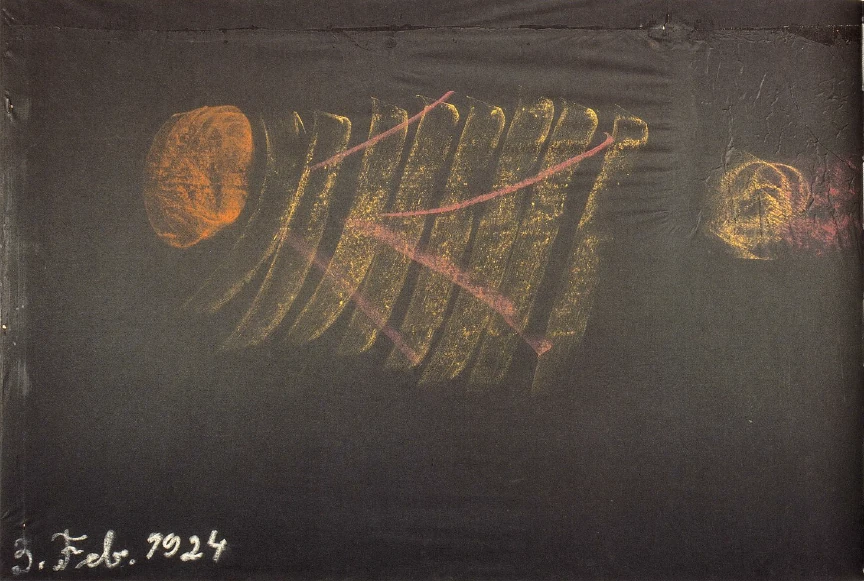
[ 21 ] Und es entsteht ferner ein merkwürdiger Eindruck. Es ist so, als ob aus einem Dunkel (es wird gezeichnet) sich abheben würde, was da dem schlafenden Menschen entgegenkommt, wie wenn dahinter ein Dunkles wäre, und in diesem Dunklen erscheint das — man kann es nicht anders sagen — als leuchtend, was Ausströmungsluft ist. Was da in dem Dunkel ist, das erkennt man seiner Wesenheit nach daran, daß einen dabei die täglichen Gedanken verlassen und einem in dem, was da herausflutet aus dem Menschen, gleichsam auftaucht das, was man die waltenden Weltgedanken nennen kann, die objektiven Gedanken, die schaffend sind. Das Dunkle, das aussprühende Helle, in dem treten allmählich auf die schaffenden Gedanken. Was da dunkel ist, das ist eine Finsternis, die sich über die gewöhnlichen alltäglichen Gedanken, wir können sagen, über die Gehirngedanken erstreckt. Da bekommt man sehr genau den Eindruck: Das, was man für das physische Erdenleben als das Wichtigste hält, das verdunkelt sich, sobald man aus dem physischen Leib heraußen ist, und man merkt viel intensiver, als man das voraussetzen kann im gewöhnlichen Bewußtsein, wie diese Gedanken von dem physischen Werkzeug, dem Gehirn, abhängig sind. Das Gehirn hält sozusagen wie an sich klebend diese Alltagsgedanken, die gewöhnlichen Gedanken zurück. Da draußen braucht man nicht mehr zu denken in demselben Sinne, wie man im Alltagsleben denkt. Denn da schaut man die Gedanken, die fluten durch das, als was man sich selber erscheint in der ausströmenden Atemluft. Und so merkt die inspirierte Erkenntnis, wie der astralische Leib während des Wachens im physischen Leib ist und die Verrichtungen, die er im physischen Leibe zu vollziehen hat, mit Hilfe der eingeatmeten Luft zu vollziehen beginnt; wie dieser astralische Leib, wenn er während des Schlafens außerhalb ist, entgegennimmt die Eindrücke des eigenen menschlichen Wesens. Während des Wachens ist diese Welt, die uns umgibt als Horizont, auf der wir stehen in der irdischen Umgebung, und das, was sich darüber wölbt als das Himmelsgewölbe, unsere Außenwelt; während des Schlafes wird das, was innerhalb unserer Haut ist, was sonst unsere Innenwelt ist, unsere Außenwelt. Nur daß wir zunächst das, was uns da entgegenströmt in der Atmungsluft, fühlen. Eine gefühlte Außenwelt haben wir zunächst.
[ 21 ] And a strange impression also arises. It is as if, out of a darkness (it is depicted), what comes toward the sleeping person were to stand out, as if there were a darkness behind it, and in this darkness it appears—one cannot put it any other way—as luminous, which is the outflowing air. What is there in the darkness can be recognized by its very nature in that one’s everyday thoughts abandon one, and in what flows out from the human being, so to speak, what one might call the ruling world-thoughts emerge—the objective thoughts that are creative. The darkness, the radiating light—within it, the creative thoughts gradually emerge. What is dark there is a darkness that extends over the ordinary, everyday thoughts—we might say, over the thoughts of the brain. One gets the very distinct impression that what is considered most important in physical earthly life becomes obscured as soon as one is outside the physical body, and one realizes much more intensely than one might assume in ordinary consciousness how dependent these thoughts are on the physical instrument, the brain. The brain, so to speak, holds back these everyday thoughts—the ordinary thoughts—as if they were clinging to it. Out there, one no longer needs to think in the same way as one does in everyday life. For there one observes the thoughts flooding through what one perceives as one’s own self in the exhaled breath. And so inspired insight perceives how the astral body is present within the physical body during wakefulness and begins to carry out the tasks it must perform in the physical body with the help of the inhaled air; how this astral body, when it is outside the physical body during sleep, receives the impressions of one’s own human being. During wakefulness, this world that surrounds us as a horizon—upon which we stand in our earthly surroundings—and that which arches above it as the vault of heaven, is our outer world; during sleep, that which is within our skin—which is otherwise our inner world—becomes our outer world. Except that at first we feel what flows toward us in the exhaled air. At first, we have a sensed external world.
[ 22 ] Des weiteren tritt aber noch etwas anderes ein. Unbewußt bleibt dem Menschen während des Wachens das, was sich anschließt an den Atmungsprozeß: der Zirkulationsprozeß, der Blutkreislaufprozeß. Er bleibt unbewußt während des Wachens. Der beginnt nun sehr bewußt zu werden während des Schlafes. Der beginnt wie eine ganz neue Welt aufzutauchen, und zwar wie eine Welt, die nun nicht bloß gefühlt wird, die man beginnt von einem anderen Gesichtspunkte aus zu verstehen, als man sonst mit dem gewöhnlichen Bewußtsein die äußeren Dinge versteht. Wie man hinsieht auf die äußeren Vorgänge der Natur während des Erdenlebens, so sieht man mit dem inspirierten Bewußtsein — aber der Wille als Lebensvorgang bleibt im Unbewußten bei jedem Schläfer vorhanden — auf diesen Zirkulationsprozeß. Jetzt lernt man erkennen, wie alles das, was wir durch den im gewöhnlichen Bewußtsein eben unbewußten Willen entwickeln, überall im Inneren einen Gegenprozeß hat.
[ 22 ] Furthermore, however, something else occurs. While awake, what is connected to the process of breathing—the process of circulation, the process of blood flow—remains unconscious to the person. It remains unconscious during wakefulness. This process, however, begins to become very conscious during sleep. It begins to emerge like an entirely new world—a world that is not merely felt, but one that one begins to understand from a different perspective than the one used to comprehend external things with ordinary consciousness. Just as one observes the external processes of nature during earthly life, so too does one observe—with inspired consciousness (though the will as a life process remains present in the unconscious of every sleeper)—this circulatory process. Now one learns to recognize how everything we develop through the will—which is unconscious in ordinary consciousness—has a corresponding process everywhere within.
[ 23 ] Wenn Sie irgendeinen Schritt machen, so findet nicht nur statt, daß Sie Ihren Körper bewußt an einen anderen Ort hintragen, sondern es findet auch das andere statt, daß ein wärmeartiger Prozeß, der Luftiges treibt, in Ihrem Inneren sich abspielt. Der ist der äußerste Ausläufer dessen, was dann gleichartig damit innerlich sich abspielt als die Stoffwechselprozesse überhaupt im Zusammenhange mit dem Blutkreislauf. Während Sie mit dem gewöhnlichen Bewußtsein außen die Ortsveränderung des Menschen bemerken als Äußerung seines Willens, schauen Sie jetzt auf sich zurück und finden lauter Vorgänge, die im Inneren des Menschen, das jetzt Ihre Welt ist, sich abspielen.
[ 23 ] When you take any step, it is not only the case that you consciously move your body to another place, but there is also another process taking place: a heat-like process that drives airy forces is occurring within you. This is the outermost manifestation of what is taking place internally in a manner analogous to the metabolic processes associated with blood circulation. While, with ordinary consciousness, you perceive a person’s change of location externally as an expression of their will, you now look inward and find a multitude of processes taking place within the human being—which is now your world.
[ 24 ] Dieser Prozeß, auf den Sie da hinschauen, ist dann wahrhaftig nicht so, wie ihn aus der gewöhnlichen Anatomie heraus der heutige Naturforscher oder Mediziner konstatiert, sondern der ist ein großartiger geistiger Prozeß, ein Prozeß, der ungeheuer viele Geheimnisse birgt, ein Prozeß, welcher schon bei sich selber zeigt, daß im Grunde genommen der eigentliche treibende Motor, der da im Inneren des Menschen wirkt, gar nicht das gegenwärtige Ich ist. Es ist ja ein bloßer Gedanke, was der Mensch sein Ich nennt im gewöhnlichen Leben. Aber was da im Menschen wirkt, das ist das Ich der vorigen Erdenleben. Und Sie schauen in diesem ganzen innerlichen Verlauf, namentlich von Wärmeprozessen, wie aus weit zurückliegenden Zeiten das reale Ich, das durch die Zeitentwickelung durchgegangen ist zwischen dem Tod und einer neuen Geburt, da drinnen wirkt, wie da ein ganz Geistiges drinnen wirkt, wie der geringste Stoffwechselprozeß und der stärkste Stoffwechselprozeß überall der Ausdruck dessen ist, was gerade höchste Wesenheit des Menschen ist.
[ 24 ] This process you are observing is truly not what today’s natural scientist or physician would describe based on conventional anatomy; rather, it is a magnificent spiritual process, a process that harbors an immense number of mysteries, a process that demonstrates in and of itself that, fundamentally speaking, the actual driving force at work within the human being is not the present “I” at all. After all, what a person calls their “I” in ordinary life is merely a thought. But what is at work within the human being is the “I” from previous earthly lives. And as you observe this entire inner process—particularly the thermal processes—you see how, from times long past, the real “I,” which has passed through the course of time between death and a new birth, is at work within; how something entirely spiritual is at work there; how the slightest metabolic process and the most powerful metabolic process are everywhere the expression of what is, in fact, the highest essence of the human being.
[ 25 ] Und Sie kommen darauf, daß das Ich seinen Schauplatz gewechselt hat. Es wirkte innen in der Verarbeitung des Atems aus den bloßen Atmungsentwickelungen. Aber dasjenige, was als Wärmeentwickelungen aus den Atmungsentwickelungen hervorgeholt wird, das schauen Sie dann von außen an, schauen das ganze wirksame Ich, schauen es, wie es von Urzeiten herauf als reales Ich des Menschen wirkt, den Menschen eigentlich organisiert.
[ 25 ] And you come to realize that the “I” has changed its setting. It was active internally in the processing of the breath, arising from the mere respiratory processes. But what is drawn out of the respiratory processes as heat processes—you then observe this from the outside; you observe the entire active “I,” seeing how it has been active since time immemorial as the real “I” of the human being, actually organizing the human being.
[ 26 ] Jetzt beginnen Sie zu wissen, daß tatsächlich während des Schlafes das Ich und der astralische Leib den menschlichen physischen und Ätherleib verlassen haben, außer ihnen sind und alles das, was sie sonst von innen erleben und treiben, nun von außen erleben und treiben. Dieses ist nun aber so, daß für das gewöhnliche Bewußtsein diese Ich-Organisation und diese astralische Organisation noch zu schwach sind, zu wenig entwickelt sind, um das bewußt mitzuerleben. Die Inspiration besteht eben nur darin, das Ich und den astralischen Leib so innerlich zu organisieren, daß sie das, was sonst nicht wahrnehmbar ist, wahrnehmen können.
[ 26 ] Now you are beginning to realize that, in fact, during sleep, the “I” and the astral body have left the human physical and etheric bodies, are outside of them, and now experience and carry out from the outside everything they would otherwise experience and carry out from within. However, the fact is that for ordinary consciousness, this “I” organization and this astral organization are still too weak and underdeveloped to consciously experience this. Inspiration consists precisely in organizing the “I” and the astral body internally in such a way that they can perceive what is otherwise imperceptible.
[ 27 ] So daß in der Tat gesagt werden muß: Durch die Inspiration werden wir auf das geführt, was im Menschen astralischer Leib ist, durch die Intuition auf dasjenige, was im Menschen Ich ist. Intuition und Inspiration werden während des Schlafes im Ich und astralischen Leib unterdrückt; aber wenn sie erweckt werden, dann schaut sich durch sie der Mensch von außen an. Und was ist denn schließlich dieses Von außen-Ansehen?
[ 27 ] So that, in fact, it must be said: Through inspiration we are led to what is the astral body in the human being; through intuition, to what is the “I” in the human being. Intuition and inspiration are suppressed in the “I” and the astral body during sleep; but when they are awakened, the human being looks at himself from the outside through them. And what, after all, is this “looking from the outside”?
[ 28 ] Erinnern Sie sich an das, was ich schon gesagt habe. Ich sagte Ihnen: da ist der Mensch in seiner gegenwärtigen Inkarnation. (Es wird gezeichnet, rechts Mitte.) Wenn er Imagination entwickelt, so schaut er seinen Ätherleib etwas vor die Geburt oder Empfängnis hingehend (gelb); aber sein astralischer Leib führt ihn durch Inspiration hinein in die ganze Zeit, die verflossen ist zwischen dem letzten Tode und dieser Geburt (rot). Und die Intuition führt ihn in das vorangehende Erdenleben zurück (gelb).
[ 28 ] Remember what I have already said. I told you: there is the human being in his present incarnation. (A drawing is shown, center right.) When he develops his power of imagination, he sees his etheric body extending somewhat beyond the time of birth or conception (yellow); but his astral body, through inspiration, leads him into the entire period that has elapsed between his last death and this birth (red). And intuition leads him back to his previous earthly life (yellow).
[ 29 ] Wenn Sie nun schlafen, so bedeutet das nichts anderes, als daß Sie das Bewußtsein, das sonst im physischen Leibe ist, zurück verlegen, zurückführen, daß Sie mit ihm zurückkehren. Der Schlaf ist also eigentlich ein Zurücklaufen in der Zeit zu dem, wovon ich Ihnen schon gesagt habe, daß es dem gewöhnlichen Bewußtsein als vergangen erscheint, aber doch da ist. Sie sehen, man muß auch da, wenn man wirklich zum Erfassen des Geistigen kommen will, die Begriffe ändern gegenüber den Begriffen, die man gewöhnt ist im physischen Leben zu verwenden. Man muß also eigentlich sich bewußt werden, daß der Schlaf jedesmal ein Zurückgehen ist in die Gefilde, die man durchgemacht hat im vorirdischen Dasein, oder sogar ein Zurückgehen ist in frühere Inkarnationen. Der Mensch erlebt tatsächlich während des Schlafes, nur kann er es nicht erfassen, dasjenige, was früheren Inkarnationen angehört, was er durchgemacht hat auch im vorirdischen Dasein.
[ 29 ] When you sleep, this means nothing other than that you shift your consciousness—which is otherwise in the physical body—back, that you return with it. Sleep is therefore actually a journey back in time to that which I have already told you appears to ordinary consciousness as the past, yet is still there. You see, if one truly wishes to grasp the spiritual, one must also change one’s concepts here, as opposed to the concepts one is accustomed to using in physical life. One must therefore actually become aware that sleep is always a return to the realms one has passed through in pre-earthly existence, or even a return to earlier incarnations. During sleep, a person actually experiences—though cannot grasp it—that which belongs to earlier incarnations, as well as what they have experienced in pre-earthly existence.
[ 30 ] Über den Zeitbegriff muß man eine völlige Begriffsmetamorphose durchmachen; der muß ein ganz anderer werden. Wenn man daher an jemanden die Frage stellt: Ja, wo ist er denn, wenn er schläft? — dann muß man sagen: Er ist eigentlich in seinem vorirdischen Dasein oder sogar zurückgekehrt zu früheren Erdenleben. — Populär ausgedrückt sagt man eben: Der Mensch ist außerhalb seines physischen und seines Ätherleibes. Das Reale dazu ist das, was ich Ihnen auseinandergesetzt habe. Das ist, was sich darstellt als der rhythmische Wechselzustand zwischen Wachen und Schlafen.
[ 30 ] We must undergo a complete conceptual metamorphosis regarding the concept of time; it must become something entirely different. Therefore, when one asks someone, “Well, where is he when he is asleep?”—one must say: He is actually in his pre-earthly existence or has even returned to earlier earthly lives. — To put it simply, one says: The person is outside of their physical and etheric bodies. The reality behind this is what I have explained to you. This is what manifests as the rhythmic alternation between waking and sleeping.
[ 31 ] Ganz andere Verhältnisse treten nun mit dem Tode des Menschen ein. Da ist zunächst das Auffälligste dieses, daß der Mensch innerhalb des irdischen Lebens seinen physischen Leib läßt, der nun auch von den Kräften der physischen Welt aufgenommen und eben zersprüht wird, zerstört wird. Der kann jetzt nicht Eindrücke hervorrufen, wie ich es Ihnen beschrieben habe als auftretend vor dem schlafenden Menschen durch die ausgeatmete Luft, denn der atmet nicht mehr aus. Der physische Leib ist sozusagen auch in seinen Verrichtungen für den eigentlichen Menschen nun verloren. Aber etwas ist nicht verloren, dem man sein Nichtverlorensein schon ansehen kann auch für das gewöhnliche Bewußtsein. Wir haben in unserem Seelenleben ein Denken, Fühlen und Wollen. Aber über dieses Denken, Fühlen und Wollen hinaus haben wir noch etwas ganz Besonderes. Das ist die Erinnerung. Wir denken nicht nur über dasjenige nach, was gegenwärtig vor uns oder um uns ist. Unser Inneres birgt Reste von dem, was wir durchlebt haben. In Gedanken tritt es wiederum auf, was wir durchlebt haben. Ja, über diese Erinnerung haben insbesondere die manchmal etwas merkwürdigen Leute der Welt, die man Psychologen nennt, ganz kuriose Gedanken entwickelt. Da sagen solche Seelenforscher etwa das Folgende: Der Mensch braucht seine Sinne; er nimmt dies oder jenes wahr, denkt darüber nach. Jetzt hat er den Gedanken. Er geht weg, vergißt das Ganze. Nach einiger Zeit hebt er das Ganze aus seinem Gedächtnis heraus. Die Erinnerung an das, was einmal da war, tritt ein. Man kann sich wieder vorstellen, was man sich in der Zwischenzeit nicht vorgestellt hat, was nicht mehr gegenwärtig ist, was vergangen ist. Deshalb, so meinen diese Leute, hat sich der Mensch eben eine Vorstellung, einen Gedanken gebildet an dem Erlebnis, der Gedanke ist irgendwo hinuntergegangen, ist da in irgendeinem Schrank, Kasten drinnen, und wenn man sich wieder erinnert, so kommt er aus diesem Schrank heraus. Entweder springt er frei heraus oder aber er wird herausgeholt.
[ 31 ] Entirely different circumstances arise with a person’s death. The most striking aspect of this is that, during earthly life, a person leaves behind their physical body, which is then absorbed by the forces of the physical world and, in effect, scattered and destroyed. It can no longer evoke impressions, as I have described to you, such as those that appear before a sleeping person through exhaled air, for the person no longer exhales. The physical body is, so to speak, now lost to the actual human being, even in its functions. But there is something that is not lost, something whose continued existence can be perceived even by ordinary consciousness. In our inner life, we have thinking, feeling, and willing. But beyond this thinking, feeling, and willing, we have something quite special. That is memory. We do not merely reflect on what is currently before us or around us. Our inner being holds remnants of what we have experienced. What we have lived through reappears in our thoughts. Indeed, the sometimes rather peculiar people of the world known as psychologists have developed some very curious ideas about this memory. Such researchers of the soul say, for example, the following: A person needs their senses; they perceive this or that and reflect on it. Now they have the thought. They walk away and forget the whole thing. After some time, they retrieve the whole thing from their memory. The memory of what was once there resurfaces. One can once again imagine what one had not imagined in the meantime—what is no longer present, what has passed. That is why, according to these people, a person has formed an idea, a thought, based on the experience; the thought has gone somewhere, is tucked away in some sort of closet or box, and when one remembers it again, it comes out of that closet. Either it springs out on its own, or it is brought out.
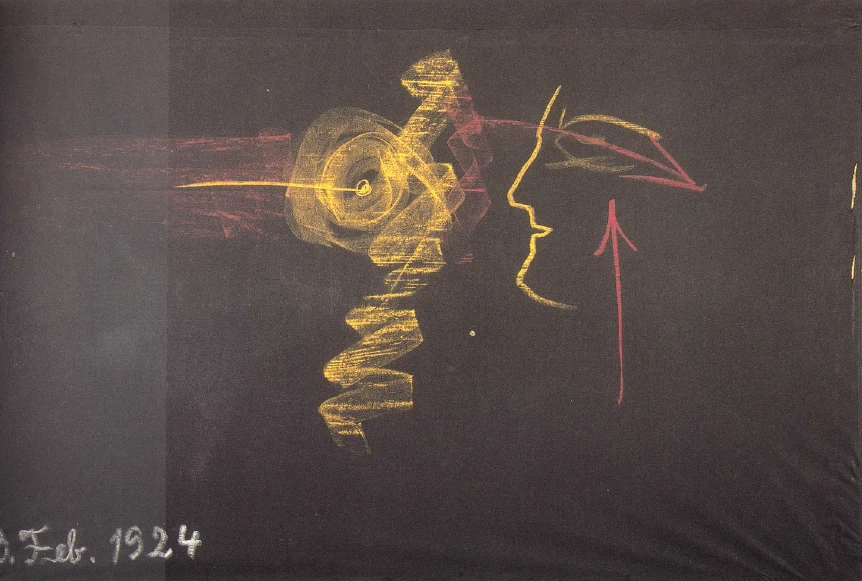
[ 32 ] Das, was so vorstellt, ist schon das Musterbild eines verworrenen Denkens. Denn dieser ganze Glaube, daß der Erinnerungsgedanke da irgendwo sitzt, wo er hervorgeholt werden kann, entspricht gar nicht dem Tatbestand, der eigentlich auftritt. Vergleichen Sie nur einmal eine unmittelbare Wahrnehmung, die Sie haben und an die Sie einen Gedanken anknüpfen, damit, wie eine Erinnerungsvorstellung, ein Erinnerungsgedanke auftaucht. Sie unterscheiden das ja gar nicht. Sie haben draußen einen Sinneseindruck, daran schließt sich ein Gedanke. Das, was hinter dem Sinneseindruck ist, was den Gedanken hervorruft, das nennen Sie ja gewöhnlich auch ein Unbekanntes. Der Gedanke, der aus dem Inneren aufsteigt als Erinnerungsgedanke, der ist ja gar nicht anders als der Gedanke, der außen an der Wahrnehmung auftritt. Das eine Mal haben Sie, wenn Sie den Menschen, schematisch gezeichnet, hier haben, seine Umgebung hier (gelb); der Gedanke tritt von außen auf, tritt an der Umgebung auf (roter Pfeil von links). Das andere Mal kommt er von innen. Da ist er ein Erinnerungsgedanke (Pfeil von unten). Die Richtung, von wo er herkommt, ist eine andere.
[ 32 ] What is presented in this way is already the quintessential example of confused thinking. For this entire belief—that the memory thought is located somewhere where it can be retrieved—does not correspond at all to what actually occurs. Just compare an immediate perception you have—to which you attach a thought—with the way a memory image or a memory thought arises. You don’t distinguish between the two at all. You have a sensory impression from the outside, and a thought follows from it. What lies behind the sensory impression—what gives rise to the thought—is what you usually call the unknown. The thought that arises from within as a memory thought is, after all, no different from the thought that arises externally in connection with perception. In one case—if you have the person depicted schematically here, with their surroundings here (yellow)—the thought arises from the outside, arising in connection with the surroundings (red arrow from the left). In the other case, it comes from within. There it is a memory thought (arrow from below). The direction from which it comes is different.
[ 33 ] Während wir etwas wahrnehmen, erleben, geht fortwährend unter der Vorstellung, unter dem Denken etwas vor sich. Es ist ja so: wir nehmen wahr denkend. Aber das Wahrnehmen, das geht auch in unseren Körper herein. Der Gedanke hebt sich nur ab. Es geht etwas in unseren Körper herein, und das nehmen wir nicht wahr. Das spielt sich ab, während wir darüber nachdenken, und das bewirkt einen Eindruck. Das ist nicht der Gedanke, der da hinuntergeht, sondern etwas ganz anderes. Aber dieses ganz andere ruft wiederum einen Vorgang hervor, den wir später wahrnehmen und über den wir uns den Erinnerungsgedanken so bilden, wie wir uns an der Außenwelt den Gedanken bilden. Der Gedanke ist immer gegenwärtig. Das zeigt schon eben die unbefangene Beobachtung, daß das so ist, daß da nicht der Gedanke irgendwo in einem Kästchen aufbewahrt wird, sondern es ist ein Vorgang, der sich abspielt und den wir dann auch mit der Erinnerung in einen Gedanken verwandeln, so wie wir die äußere Wahrnehmung in einen Gedanken verwandeln.
[ 33 ] While we perceive and experience something, something is constantly taking place beneath our imagination, beneath our thinking. The fact is: we perceive while thinking. But that perception also enters our body. The thought merely stands out. Something enters our body, and we do not perceive it. This takes place while we are thinking about it, and it creates an impression. It is not the thought that descends there, but something entirely different. But this entirely different thing, in turn, triggers a process that we later perceive and about which we form a memory, just as we form thoughts about the external world. The thought is always present. Impartial observation alone shows that this is the case—that the thought is not stored away somewhere in a little box, but rather is a process that unfolds and which we then transform into a thought through memory, just as we transform external perception into a thought.
[ 34 ] Ich muß Sie mit diesen Erwägungen belasten, weil Sie sonst nicht eigentlich zum Verständnis der Erinnerung kommen. Die Kinder wissen es, wenn auch nur halb bewußt, manchmal aber auch die Erwachsenen in besonderen Fällen, daß der Gedanke nicht recht hinuntergehen will. Wenn man daher etwas memorieren will, so nimmt man ganz andere Dinge zu Hilfe. Denken Sie doch nur einmal, manche nehmen das laute Sprechen zu Hilfe, manche machen ganz merkwürdige Gesten, wenn sie sich irgend etwas einbläuen. Es handelt sich wirklich darum, daß sich da, parallel laufend dem bloßen Vorstellungsprozef, ein ganz anderer Prozeß noch abspielt. Und das, woran wir uns da erinnern, ist eigentlich das wenigste von dem, was dabei in Betracht kommt.
[ 34 ] I must burden you with these considerations, because otherwise you won’t really be able to understand the process of memory. Children know—even if only half-consciously—and sometimes adults do as well in certain cases—that a thought just won’t quite sink in. Therefore, when one wants to memorize something, one turns to entirely different aids. Just think about it: some people use speaking aloud, while others make quite peculiar gestures when they’re trying to commit something to memory. The point is really that, running parallel to the mere process of imagination, an entirely different process is also taking place. And what we actually remember is, in fact, the least significant aspect of what is involved.
[ 35 ] Ich bitte Sie, wir gehen ja vom Aufwachen bis zum Einschlafen fortwährend durch die Welt; von allen Seiten her kommen die Eindrücke. Wir beachten zunächst wenige, aber sie beachten uns, und es prägt sich vieles, vieles, was dann nicht erinnert wird, ein. Da in den Tiefen unseres Wesens sitzt eine reiche Welt, von der wir nur einzelne Fetzen in die Gedanken heraufbekommen. Diese Welt, die ist eigentlich eingesperrt in uns, ist wie ein tiefes Meer in uns, und dasjenige, was Erinnerungsvorstellung ist, schlägt so wie einzelne Wellenschläge herauf. Aber es ist in uns. Sehen Sie, das, was in dieser Weise in uns ist, das hat uns nicht die physische Welt gegeben. Sie kann es uns auch nicht nehmen. Und wenn der physische Leib des Menschen abfällt, dann ist diese ganze Welt da, haftet an seinem Ätherleib. Unmittelbar nach dem Tode trägt der Mensch in der Tat alle seine Erlebnisse in seinem Ätherleibe wie eingeprägt in sich; gewissermaßen wie zusammengerollt trägt er sie in sich.
[ 35 ] Please understand: from the moment we wake up until we fall asleep, we are constantly moving through the world; impressions come at us from all sides. At first we notice only a few, but they notice us, and much, much more—things we later do not recall—is imprinted upon us. For deep within our being lies a rich world, from which we can bring only scattered fragments into our thoughts. This world, which is actually locked within us, is like a deep sea within us, and what we call memory surges up like individual waves. But it is within us. You see, what is within us in this way was not given to us by the physical world. Nor can it take it away from us. And when a person’s physical body is shed, this entire world remains, clinging to their etheric body. Immediately after death, a person indeed carries all their experiences within their etheric body as if imprinted there; in a sense, they carry them within themselves as if rolled up.
[ 36 ] Und das nächste, was der Mensch nun erlebt unmittelbar nach dem Tode, ist, daß nicht nur etwa die gewöhnlichen Erinnerungsfetzen, die sonst während des irdischen Bewußtseins auftreten, da sind, sondern daß alles da ist, was Eindruck macht auf den Menschen, daß der Mensch sein ganzes Erdenleben mit allem, was Eindruck gemacht hat, zunächst vor sich hat. Und der Mensch müßte im ewigen Anschauen dieses seines Erdenlebens bleiben, wenn jetzt nicht etwas anderes eintreten würde gegenüber dem Ätherleib, als durch die Erde und ihre Kräfte gegenüber dem physischen Leib eintritt. Die Elemente der Erde übernehmen den physischen Leib, zerstören ihn. Der Weltenäther, von dem ich Ihnen gesagt habe, er wirkt aus der Peripherie herein, er strahlt ein, der zerstrahlt dasjenige, was da eingeprägt ist, nach allen Seiten des Kosmos. So daß der Mensch als nächstes Erlebnis dieses hat: Während des Erdenlebens hat vieles, vieles auf mich Eindruck gemacht. Das ist alles in meinen Ätherleib eingetreten. Ich überschaue es, aber ich überschaue es immer undeutlicher. Wie wenn ich einen Baum sehen würde, der einen starken Eindruck auf mich gemacht hat während des Lebens. Ich sehe ihn zunächst in der Größe, in der er den Eindruck gemacht hat vom physischen Raum aus. Da wächst er. Da wird er größer, aber schattenhafter; da wird er immer größer, und er wächst ins Riesenhafte aus, wird immer größer und größer und immer schattenhafter und schattenhafter. Und so ist es: Ich habe einen physischen Menschen in seiner Gestalt kennengelernt, habe ihn unmittelbar nach dem Tode, so wie er sich mir eingeprägt hat in meinen Ätherleib, vor mir; da wächst er und wird immer schattenhafter und schattenhafter; alles wächst und wird schattenhafter und immer schattenhafter, bis es sich auswächst zum ganzen Kosmos und damit ganz schattenhaft wird, gänzlich verschwindet.
[ 36 ] And the next thing a person experiences immediately after death is that it is not merely the usual fragments of memory—which otherwise arise during earthly consciousness—that are present, but that everything that has made an impression on the person is there; that the person initially has their entire earthly life before them, along with everything that has made an impression. And the human being would have to remain in this eternal contemplation of his earthly life if something else were not now to occur in relation to the etheric body—just as occurs in relation to the physical body through the earth and its forces. The elements of the earth take over the physical body and destroy it. The world ether—which, as I have told you, acts from the periphery inward, radiating in—disperses what has been imprinted there in all directions throughout the cosmos. So that the human being’s next experience is this: During my earthly life, many, many things made an impression on me. All of that has entered my etheric body. I can make sense of it, but I find it increasingly difficult to do so. It is as if I were seeing a tree that made a strong impression on me during my life. At first I see it in the size in which it made that impression from physical space. There it grows. There it becomes larger, but more shadowy; there it grows ever larger, expanding into gigantic proportions, becoming larger and larger and ever more shadowy and shadowy. And so it is: I have come to know a physical human being in his form; immediately after death, I have him before me just as he has imprinted himself upon my etheric body; there he grows and becomes ever more shadowy and shadowy; everything grows and becomes more shadowy and ever more shadowy, until it expands into the entire cosmos and thereby becomes entirely shadowy, disappearing completely.
[ 37 ] Darüber vergehen einige Tage. Alles ist ins Riesenhafte übergegangen, schattenhaft geworden durch dieses Riesigwerden und dabei an Intensität abnehmend, vom Menschen als der zweite Leichnam abfallend. Aber das heißt eigentlich: vom Menschen durch den Kosmos weggenommen. Jetzt ist der Mensch in seinem Ich und in seinem astralischen Leibe. Und das, was sich seinem Ätherleib eingeprägt hatte, das ist jetzt im Kosmos drinnen, das ist in den Kosmos ausgeflossen. Und wir sehen das Wirken der Welt hinter den Kulissen unseres eigenen Daseins.
[ 37 ] A few days pass. Everything has taken on gigantic proportions, becoming shadowy as a result of this expansion and, in the process, diminishing in intensity, falling away from the human being as a second corpse. But what this actually means is: taken away from the human being by the cosmos. Now the human being is in his “I” and in his astral body. And that which had imprinted itself on his etheric body is now within the cosmos; it has flowed out into the cosmos. And we see the workings of the world behind the scenes of our own existence.
[ 38 ] Wir sind als Menschen hereingestellt in die Welt. Während wir das Erdenleben ablaufend haben, wirkt die ganze Welt auf uns ein. Wir rollen das, was da einwirkt, gewissermaßen zusammen. Die Welt gibt uns vieles. Wir halten es zusammen. In dem Augenblick, wo wir sterben, nimmt die Welt wieder an sich, was sie uns gegeben hat. Aber sie empfängt dadurch etwas Neues. Wir haben das alles in besonderer Weise erlebt. Das, was die Welt empfängt, ist etwas anderes, als sie uns gegeben hat. Sie nimmt unser ganzes Erleben auf. Sie prägt sich selbst in ihren eigenen Äther unser ganzes Leben ein.
[ 38 ] We are placed in the world as human beings. As we go through our earthly life, the entire world exerts an influence on us. We, so to speak, gather together what influences us. The world gives us many things. We hold them together. At the moment we die, the world takes back what it has given us. But in doing so, it receives something new. We have experienced all of this in a special way. What the world receives is something different from what it gave us. It takes in our entire experience. It imprints our whole life upon itself in its own ether.
[ 39 ] Und jetzt stehen wir in der Welt und sagen uns, indem wir dieses Erlebnis mit unserem Ätherleib zunächst nehmen: Wir sind wirklich nicht bloß für uns in der Welt, sondern die Welt hat etwas vor mit uns; die Welt hat uns hereingestellt, damit sie das, was in ihr ist, durch uns durchgehen lassen kann und es in der von uns veränderten Gestalt wiederum empfangen kann. Wir sind als Menschen nicht bloß für uns da, wir sind zum Beispiel in bezug auf unseren ätherischen Körper für die Welt da. Die Welt hat die Menschen nötig, weil sie dadurch mit ihrem eigenen Inhalte sich immer wieder neu und neu erfüllt. Es ist ein nicht Stoff- aber Gedankenwechsel zwischen der Welt und dem Menschen. Die Welt gibt ihre Weltengedanken an den menschlichen Ätherleib ab, und die Welt empfängt sie im durchmenschlichten Zustande wiederum zurück. Der Mensch ist nicht um seiner selbst allein, der Mensch ist um der Welten willen da.
[ 39 ] And now we stand in the world and say to ourselves, as we first take in this experience with our etheric body: We are truly not in the world merely for ourselves, but the world has a purpose for us; the world has placed us here so that it can allow what is within it to pass through us and receive it again in the form transformed by us. As human beings, we are not here merely for ourselves; for example, in relation to our etheric body, we are here for the world. The world needs human beings because through them it is continually filled anew with its own content. It is not an exchange of matter but of thought between the world and the human being. The world imparts its world-thoughts to the human etheric body, and the world receives them back again in a form humanized through the human being. The human being is not here for his own sake alone; the human being is here for the sake of the worlds.
[ 40 ] Nun, solch ein Gedanke darf nicht ein bloßer theoretisch-abstrakter Gedanke bleiben. Er kann es auch nicht. Man müßte nicht Mensch sein mit lebendigem Gefühl, sondern ein Wesen aus Papiermaché, wenn ein solcher Gedanke bloßer Gedanke bliebe, wobei ich nicht sagen will, daß nicht unsere Zivilisation wirklich dazu geeignet ist, den Menschen oftmals gegenüber solchen Dingen so gefühllos zu machen, wie wenn er aus Papiermaché wäre. Manchmal können einem schon die Zivilisationsmenschen der Gegenwart so erscheinen, als ob sie aus Papiermaché wären. Denn solch ein Gedanke, der verliert nicht das menschliche Fühlen und Empfinden mit der Welt, der tritt unmittelbar an dasjenige heran, wovon wir ausgegangen sind. Wir sind davon ausgegangen, daß wir sagten: Der Mensch fühlt sich in zweifacher Weise fremd der Welt gegenüber; auf der einen Seite in bezug auf die äußere Natur, von der er nur sagen kann, daß sie ihn zerstört seinem physischen Leibe nach, auf der anderen Seite innerlich in bezug auf sein Seelenleben, das aufglüht, aufsprüht, absprüht und so weiter, was eben für ihn zum Weltenrätsel wird. Jetzt beginnt aus einer geistigen Betrachtung heraus der Mensch zu fühlen: Er ist der Welt nicht bloß fremd, sondern die Welt gibt ihm, die Welt nimmt wiederum für sich etwas ab. Der Mensch beginnt sich innig verwandt zu fühlen mit der Welt. Die beiden Gedanken, die ich Ihnen gesagt habe, die die eigentlichen Weltengedanken sind: O Natur, du zerstörst nur meinen physischen Leib. Ich habe mit dir keine Verwandtschaft, trotz Denken, Fühlen und Wollen. In meinem Inneren, da glimmt es auf, da sprüht es ab. Ich habe meinem wirklichen Sein nach mit dir doch keine Verwandtschaft —, diese beiden Gedanken, die die Weltenrätsel in uns hervorzaubern, bekommen ein neues Gesicht, wenn wir jetzt beginnen, uns verwandt zu fühlen mit der Welt, uns zu fühlen wie ein Organisches, das in der Welt drinnen ist, das verwoben ist in den Weltenprozefßß. Und so ist der Beginn anthroposophischer Betrachtung der: Freundschaft zu schließen mit der Welt, Bekanntschaft zu schließen mit der Welt, die uns zunächst in der äußeren Betrachtung abgestoßen hat. Ein Menschlicherwerden ist die anthroposophische Erkenntnis. Und wer diese Gefühls-, diese Herzensnuance nicht aufnehmen kann in die anthroposophische Erkenntnis, der hat von der Anthroposophie nicht das Rechte. Denn die theoretische Anthroposophie ist eigentlich etwas, was man vergleichen könnte damit, daß man sagt: Jemand verlangt gar sehr, einen Menschen, den er einmal gekannt hat, oder der ihm durch irgend etwas anderes nahegetreten ist, kennenzulernen, und man reicht ihm eine Photographie. Er kann an der Photographie ja vielleicht seine Freude haben; aber warm kann er nicht werden, denn das Lebendige dieses Menschen tritt ihm nicht entgegen.
[ 40 ] Well, such a thought must not remain a mere theoretical and abstract idea. Nor can it. One would have to be not a human being with living feelings, but a creature made of papier-mâché, if such a thought were to remain a mere thought—though I do not mean to say that our civilization is not, in fact, capable of making people so insensitive to such things that they might as well be made of papier-mâché. Sometimes the civilized people of the present can indeed seem to us as if they were made of papier-mâché. For such a thought—which does not lose its human feeling and sensitivity toward the world—directly addresses the very point from which we began. We began by saying: Human beings feel alienated from the world in two ways; on the one hand, in relation to external nature, of which they can only say that it destroys them physically; on the other hand, inwardly, in relation to their inner life, which flares up, bursts forth, and so on—which becomes, for them, the mystery of the world. Now, through spiritual contemplation, human beings begin to feel: They are not merely alien to the world, but the world gives to them, and in turn the world takes something for itself. Human beings begin to feel a deep kinship with the world. The two thoughts I have mentioned to you—which are the very thoughts of the world—are: “O Nature, you destroy only my physical body. I have no kinship with you, despite my thinking, feeling, and willing.” “Within me, it glows; within me, it bursts forth.” According to my true being, I have no kinship with you after all—these two thoughts, which conjure up the mysteries of the world within us, take on a new aspect when we now begin to feel a kinship with the world, to feel like an organic being that is within the world, that is interwoven into the world’s processes. And so the starting point of anthroposophical contemplation is this: to befriend the world, to become acquainted with the world that initially repelled us in our external observation. Anthroposophical knowledge is a process of becoming human. And whoever cannot incorporate this nuance of feeling, this nuance of the heart, into anthroposophical knowledge has not grasped the true essence of anthroposophy. For theoretical anthroposophy is actually something that could be compared to the following: Someone is very eager to get to know a person they once knew, or who has become close to them through some other means, and you hand them a photograph. They may well take pleasure in the photograph; but they cannot feel warmth toward it, for the living essence of that person does not come to meet them.
[ 41 ] Dasjenige, was theoretische Anthroposophie ist, ist die Photographie dessen, was eigentlich die Anthroposophie sein will, und die will ein Lebendiges sein. Und sie will sich eigentlich der Worte, der Begriffe, der Ideen bedienen, um ein Lebendiges aus der geistigen Welt in die physische Welt herein erstrahlen zu lassen. Anthroposophie will nicht nur Erkenntnisse vermitteln, sie will Leben erwecken. Und sie kann dieses. Allerdings, um Leben zu fühlen, muß man selber Leben entgegenbringen.
[ 41 ] What theoretical anthroposophy is, is a photograph of what anthroposophy actually aspires to be—and it aspires to be something living. And it actually seeks to make use of words, concepts, and ideas in order to allow something living to shine forth from the spiritual world into the physical world. Anthroposophy does not merely seek to impart knowledge; it seeks to awaken life. And it is capable of doing so. However, in order to feel life, one must oneself respond to life with life.