

Anthroposophy
A Summary After Twenty-one Years
GA 234
3 February 1924, Dornach
Translated by Steiner Online Library
Sixth Lecture
[ 1 ] When we consider the course of human life on Earth, we find that it unfolds in a kind of rhythm expressed in the alternating states of waking and sleeping. From the perspective of waking and sleeping, we must take into account what was explained in the previous lectures regarding the structure of the human being. Let us take a look at what is happening here—I would say—purely from the outside, with ordinary consciousness. In the waking human being, we have the inner course of their life processes, which, however, remain in the subconscious or unconscious. In this waking human being, we find what we know as sensory impressions—that relationship to our earthly and extraterrestrial surroundings mediated by sensory impressions—and we also find, in the waking human being, the manifestation of their volitional nature. We find their capacity for movement as an expression of their volitional impulses.
[ 2 ] When we observe human beings from the outside, we find that the inner life process—which takes place in the unconscious while the person is awake—continues during sleep. We find that during sleep, sensory activity and the thinking that builds upon it are suppressed. We find that what is suppressed is the manifestation of the will, and that which connects the two—that which, so to speak, stands between them: the active emotional life.
[ 3 ] If we now simply observe, with an open mind, what ordinary consciousness produces—without succumbing to any prejudices—we must nevertheless conclude: The processes that can be described as psychological, and the processes that take place between the psychological realm and the external world, cease during sleep—at most, what emerges from sleep is the phenomenon known as dreaming. And we certainly must not assume that with every awakening these psychological processes are, as it were, recreated out of nothing. That would undoubtedly be a completely absurd idea even for ordinary consciousness. Unbiased observation leaves us no choice but to assume that everything in the human being that serves as a vehicle for psychological processes is also present during sleep. But then we must admit that this very thing, which serves as the vehicle for psychological processes, does not intervene in the human being during sleep; that is to say, what does not intervene in the human being is that which evokes in the senses an awareness of the external world and which stirs this awareness of the external world into thought; that likewise, what sets the body in motion through the will does not intervene, nor does what evokes sensation through the ordinary organic processes.
[ 4 ] We are, after all, aware during our waking life that thoughts intervene in our organism, even if our ordinary consciousness does not grasp how the thought, the mental image, so to speak, flows down into the muscular system, the skeletal system, and mediates the will. But we are aware of this interaction of mental impulses with the physical body, and we must be clear that it is precisely this interaction of mental impulses that is absent while we are asleep.
[ 5 ] From this alone, we can say, purely from an external perspective, that sleep takes something away from the human being. And the question then becomes: what does sleep take away from this human being? If we first consider what we have referred to as the physical human body—it remains constantly active during sleep, just as it is active while awake. But all those processes that we have identified as belonging to the etheric organism also continue during sleep. The human being grows during sleep. The human being carries out, internally, those activities that pertain to nutrition and the processing of food. He continues to breathe, and so on. All these are activities that cannot belong to the physical body, for they cease precisely when the physical body becomes a corpse. At that point, the physical body is claimed by external nature, by the nature of the earth. This exerts a destructive influence. That which has a destructive effect does not yet overtake the human being during sleep. Thus, there are counterforces at work against the disintegration of the human physical body. Consequently, even from this purely external observation, we must conclude that the etheric organism is also present during sleep.
[ 6 ] We know from the previous lectures that this etheric organism can be brought to real understanding through imagination. One can experience it in the mind’s eye, just as one experiences the physical body through sensory impressions. We also know that what might be called the astral organism is experienced through inspiration.
[ 7 ] We do not wish to stop at conclusions—though we could—but we would rather draw these conclusions regarding the astral body and the “I”-organization only after the actual observation has first presented itself to our soul through developed consciousness.
[ 8 ] Let us first recall, as we had to say, how the astral body acts within the human being. It acts through the airy, gaseous elements in the human organism. Thus, in everything that takes place within the human being as an effect or as an impulse of the airy elements, we must first recognize the astral body.
[ 9 ] We now know that, with regard to this activity of the astral body in the airy realm, breathing is the most essential aspect, and we already know from everyday experience that we must distinguish between inhalation and exhalation. And we also know that inhalation is what gives us life. We draw the life-giving element from the outside air when we inhale. But we also know that we release into the external air that which is not the life-giving element, but rather the life-destroying element. Physically speaking, we take in oxygen and release carbon dioxide. But that is of less interest to us here. What interests us is precisely the result of ordinary experience: that we inhale the life-giving element and exhale the life-destroying element.
[ 10 ] Now the task is to apply the higher form of knowledge—which manifests as imagination, inspiration, and intuition, as we have discussed in recent days—that is, inspired knowledge, to the life of sleep and to truly examine whether there is anything there that corresponds to the conclusion we must reach: that something is drawn out of the human being?
[ 11 ] This question can only be answered by raising another question and answering it: If there is such a thing that exists outside of human beings, how does this entity that exists outside of human beings behave?
[ 12 ] Now, suppose a person has, through such inner spiritual exercises as I have described, managed to truly experience inspiration—that is, to bring something into their empty consciousness. They live with the possibility of having inspired insight. At that moment, it is also possible for them to artificially induce a state of sleep—but not in the sense of a normal sleep state; rather, it is now a conscious state, the very state of inspiration, into which the spiritual world pours in.
[ 13 ] Now I would like to explain this in very simple terms. Suppose that the person who has attained such an inspired consciousness is able, as it were, to feel the beings of the spiritual worlds—the spiritual beings—speaking into him through a spiritual-musical medium. Then, in the course of this inspired perception, he will have certain experiences. But they will also say to themselves: Yes, the experiences I am having here are now bringing about something very peculiar; they are causing what I had previously assumed to be outside the human being during sleep to no longer remain unknown to me. It is truly the case that what is happening there can be compared to the following.
[ 14 ] Suppose you had an experience ten years ago. You forgot about it. And for some reason, you find yourself remembering that experience from ten years ago. The fact is that it was outside your consciousness; after using some kind of memory aid or the like, you have brought this experience from ten years ago back into your consciousness. It is now there. You have thus brought something that was outside your consciousness—but which was nevertheless connected to you—back into your consciousness.
[ 15 ] This is what happens to someone who has a more intimate consciousness and experiences inspiration. What took place during sleep begins to surface for them, just as memories usually do. The only difference is that memories were once present in consciousness. The sleep experiences were not previously present in consciousness, but they enter it, so that the person actually has the feeling of recalling something—which, admittedly, they did not experience fully consciously in this earthly life—but it enters like memories; and one begins, just as one learns to understand a past experience through memory, to understand what takes place during sleep. Thus, within the inspired consciousness, the experience of what lies outside the human being during sleep simply emerges, and the unknown becomes familiar. And one learns to recognize what that which slips out of the human being during sleep is actually doing during sleep.
[ 16 ] If you were to put into words what you experience with your breath in waking life, you would say: I thank the element I inhale for filling me with life from within, and I could never thank the element I exhale for my life, for that is something that kills.
[ 17 ] But if, as we deduced earlier, you are outside your body while sleeping, then the very air you exhale becomes an extraordinarily pleasant element for you. You have not paid attention to what can be experienced with the exhaled air while you were awake, for then you paid attention only to the inhaled air, which provides vitality when your soul is housed within your physical body. But you have the same—indeed, an even more elevated—feeling toward the air that you so avoid when it is gathered in a room. You say that you do not like this exhaled air. The physical body cannot tolerate it even during sleep, but the soul-spiritual aspect, which is outside the body—that, I would say, is actually inhaling, physically speaking, the exhaled carbon dioxide. But it is a spiritual process. It is not a breathing process. It is a reception of the impression made by the exhaled air. But not only that. In this exhaled air, you also remain connected to your physical body, even during sleep. You are part of it because you tell yourself: “This is the body exhaling this suffocating air, and that is my body.” You say this unconsciously. You feel connected to your body through the fact that it returns the exhaled air to you in this life-extinguishing state. You feel completely immersed in the atmosphere that you exhale.
[ 18 ] But what you exhale there constantly reveals to you the mysteries of your inner life. You perceive them—albeit unconsciously, as far as your ordinary consciousness, which is asleep, is concerned—in accordance with your inner life. The exhaled air bursts forth from you. And this exhaled air appears to you in such a way that you say: “That is myself; that is my inner humanity, bursting forth into the universe.” And what flows back to you as your own spirit in the exhaled air appears to you as something sun-like.
[ 19 ] And now you know that when the human astral body is inside the physical body, it takes pleasure—if I may put it that way—in the inhaled air, and uses this inhaled air unconsciously to set the organic processes in motion and to flow through them with inner vitality. But now you also know that while you sleep, the astral body is simply outside the physical body and receives—intuitively receives—the mysteries of its own human being in the exhaled air.
[ 20 ] As you move outward into the cosmos, the soul unconsciously—and only becomes conscious of it upon inspiration—gazes upon that which is an inner process.
[ 21 ] And a strange impression also arises. It is as if, out of a darkness (it is depicted), what comes toward the sleeping person were to stand out, as if there were a darkness behind it, and in this darkness it appears—one cannot put it any other way—as luminous, which is the outflowing air. What is there in the darkness can be recognized by its very nature in that one’s everyday thoughts abandon one, and in what flows out from the human being, so to speak, what one might call the ruling world-thoughts emerge—the objective thoughts that are creative. The darkness, the radiating light—within it, the creative thoughts gradually emerge. What is dark there is a darkness that extends over the ordinary, everyday thoughts—we might say, over the thoughts of the brain. One gets the very distinct impression that what is considered most important in physical earthly life becomes obscured as soon as one is outside the physical body, and one realizes much more intensely than one might assume in ordinary consciousness how dependent these thoughts are on the physical instrument, the brain. The brain, so to speak, holds back these everyday thoughts—the ordinary thoughts—as if they were clinging to it. Out there, one no longer needs to think in the same way as one does in everyday life. For there one observes the thoughts flooding through what one perceives as one’s own self in the exhaled breath. And so inspired insight perceives how the astral body is present within the physical body during wakefulness and begins to carry out the tasks it must perform in the physical body with the help of the inhaled air; how this astral body, when it is outside the physical body during sleep, receives the impressions of one’s own human being. During wakefulness, this world that surrounds us as a horizon—upon which we stand in our earthly surroundings—and that which arches above it as the vault of heaven, is our outer world; during sleep, that which is within our skin—which is otherwise our inner world—becomes our outer world. Except that at first we feel what flows toward us in the exhaled air. At first, we have a sensed external world.
[ 22 ] Furthermore, however, something else occurs. While awake, what is connected to the process of breathing—the process of circulation, the process of blood flow—remains unconscious to the person. It remains unconscious during wakefulness. This process, however, begins to become very conscious during sleep. It begins to emerge like an entirely new world—a world that is not merely felt, but one that one begins to understand from a different perspective than the one used to comprehend external things with ordinary consciousness. Just as one observes the external processes of nature during earthly life, so too does one observe—with inspired consciousness (though the will as a life process remains present in the unconscious of every sleeper)—this circulatory process. Now one learns to recognize how everything we develop through the will—which is unconscious in ordinary consciousness—has a corresponding process everywhere within.
[ 23 ] When you take any step, it is not only the case that you consciously move your body to another place, but there is also another process taking place: a heat-like process that drives airy forces is occurring within you. This is the outermost manifestation of what is taking place internally in a manner analogous to the metabolic processes associated with blood circulation. While, with ordinary consciousness, you perceive a person’s change of location externally as an expression of their will, you now look inward and find a multitude of processes taking place within the human being—which is now your world.
[ 24 ] This process you are observing is truly not what today’s natural scientist or physician would describe based on conventional anatomy; rather, it is a magnificent spiritual process, a process that harbors an immense number of mysteries, a process that demonstrates in and of itself that, fundamentally speaking, the actual driving force at work within the human being is not the present “I” at all. After all, what a person calls their “I” in ordinary life is merely a thought. But what is at work within the human being is the “I” from previous earthly lives. And as you observe this entire inner process—particularly the thermal processes—you see how, from times long past, the real “I,” which has passed through the course of time between death and a new birth, is at work within; how something entirely spiritual is at work there; how the slightest metabolic process and the most powerful metabolic process are everywhere the expression of what is, in fact, the highest essence of the human being.
[ 25 ] And you come to realize that the “I” has changed its setting. It was active internally in the processing of the breath, arising from the mere respiratory processes. But what is drawn out of the respiratory processes as heat processes—you then observe this from the outside; you observe the entire active “I,” seeing how it has been active since time immemorial as the real “I” of the human being, actually organizing the human being.
[ 26 ] Now you are beginning to realize that, in fact, during sleep, the “I” and the astral body have left the human physical and etheric bodies, are outside of them, and now experience and carry out from the outside everything they would otherwise experience and carry out from within. However, the fact is that for ordinary consciousness, this “I” organization and this astral organization are still too weak and underdeveloped to consciously experience this. Inspiration consists precisely in organizing the “I” and the astral body internally in such a way that they can perceive what is otherwise imperceptible.
[ 27 ] So that, in fact, it must be said: Through inspiration we are led to what is the astral body in the human being; through intuition, to what is the “I” in the human being. Intuition and inspiration are suppressed in the “I” and the astral body during sleep; but when they are awakened, the human being looks at himself from the outside through them. And what, after all, is this “looking from the outside”?
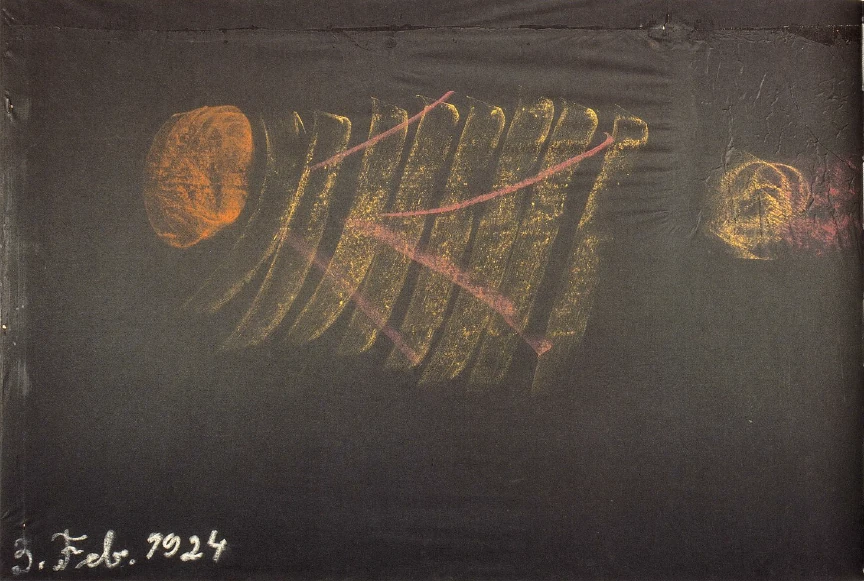
[ 28 ] Remember what I have already said. I told you: there is the human being in his present incarnation. (A drawing is shown, center right.) When he develops his power of imagination, he sees his etheric body extending somewhat beyond the time of birth or conception (yellow); but his astral body, through inspiration, leads him into the entire period that has elapsed between his last death and this birth (red). And intuition leads him back to his previous earthly life (yellow).
[ 29 ] When you sleep, this means nothing other than that you shift your consciousness—which is otherwise in the physical body—back, that you return with it. Sleep is therefore actually a journey back in time to that which I have already told you appears to ordinary consciousness as the past, yet is still there. You see, if one truly wishes to grasp the spiritual, one must also change one’s concepts here, as opposed to the concepts one is accustomed to using in physical life. One must therefore actually become aware that sleep is always a return to the realms one has passed through in pre-earthly existence, or even a return to earlier incarnations. During sleep, a person actually experiences—though cannot grasp it—that which belongs to earlier incarnations, as well as what they have experienced in pre-earthly existence.
[ 30 ] We must undergo a complete conceptual metamorphosis regarding the concept of time; it must become something entirely different. Therefore, when one asks someone, “Well, where is he when he is asleep?”—one must say: He is actually in his pre-earthly existence or has even returned to earlier earthly lives. — To put it simply, one says: The person is outside of their physical and etheric bodies. The reality behind this is what I have explained to you. This is what manifests as the rhythmic alternation between waking and sleeping.
[ 31 ] Entirely different circumstances arise with a person’s death. The most striking aspect of this is that, during earthly life, a person leaves behind their physical body, which is then absorbed by the forces of the physical world and, in effect, scattered and destroyed. It can no longer evoke impressions, as I have described to you, such as those that appear before a sleeping person through exhaled air, for the person no longer exhales. The physical body is, so to speak, now lost to the actual human being, even in its functions. But there is something that is not lost, something whose continued existence can be perceived even by ordinary consciousness. In our inner life, we have thinking, feeling, and willing. But beyond this thinking, feeling, and willing, we have something quite special. That is memory. We do not merely reflect on what is currently before us or around us. Our inner being holds remnants of what we have experienced. What we have lived through reappears in our thoughts. Indeed, the sometimes rather peculiar people of the world known as psychologists have developed some very curious ideas about this memory. Such researchers of the soul say, for example, the following: A person needs their senses; they perceive this or that and reflect on it. Now they have the thought. They walk away and forget the whole thing. After some time, they retrieve the whole thing from their memory. The memory of what was once there resurfaces. One can once again imagine what one had not imagined in the meantime—what is no longer present, what has passed. That is why, according to these people, a person has formed an idea, a thought, based on the experience; the thought has gone somewhere, is tucked away in some sort of closet or box, and when one remembers it again, it comes out of that closet. Either it springs out on its own, or it is brought out.
[ 32 ] What is presented in this way is already the quintessential example of confused thinking. For this entire belief—that the memory thought is located somewhere where it can be retrieved—does not correspond at all to what actually occurs. Just compare an immediate perception you have—to which you attach a thought—with the way a memory image or a memory thought arises. You don’t distinguish between the two at all. You have a sensory impression from the outside, and a thought follows from it. What lies behind the sensory impression—what gives rise to the thought—is what you usually call the unknown. The thought that arises from within as a memory thought is, after all, no different from the thought that arises externally in connection with perception. In one case—if you have the person depicted schematically here, with their surroundings here (yellow)—the thought arises from the outside, arising in connection with the surroundings (red arrow from the left). In the other case, it comes from within. There it is a memory thought (arrow from below). The direction from which it comes is different.
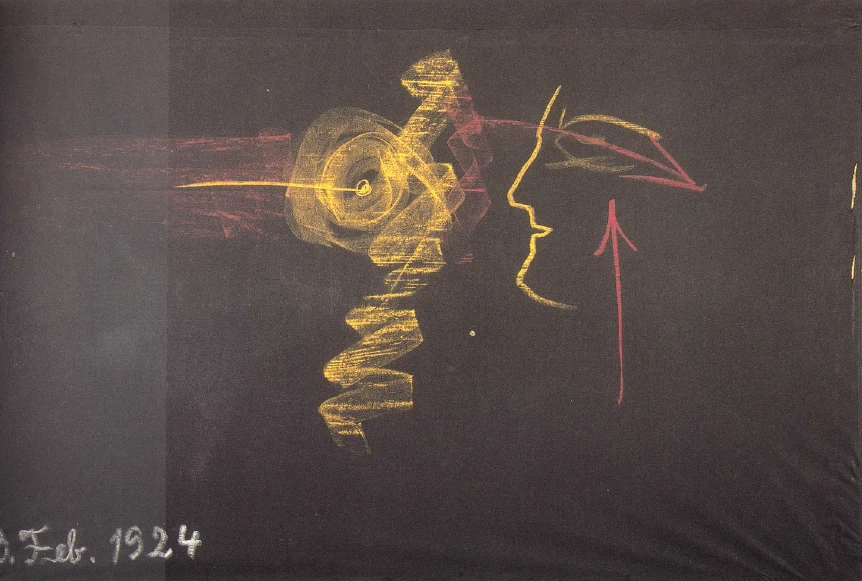
[ 33 ] While we perceive and experience something, something is constantly taking place beneath our imagination, beneath our thinking. The fact is: we perceive while thinking. But that perception also enters our body. The thought merely stands out. Something enters our body, and we do not perceive it. This takes place while we are thinking about it, and it creates an impression. It is not the thought that descends there, but something entirely different. But this entirely different thing, in turn, triggers a process that we later perceive and about which we form a memory, just as we form thoughts about the external world. The thought is always present. Impartial observation alone shows that this is the case—that the thought is not stored away somewhere in a little box, but rather is a process that unfolds and which we then transform into a thought through memory, just as we transform external perception into a thought.
[ 34 ] I must burden you with these considerations, because otherwise you won’t really be able to understand the process of memory. Children know—even if only half-consciously—and sometimes adults do as well in certain cases—that a thought just won’t quite sink in. Therefore, when one wants to memorize something, one turns to entirely different aids. Just think about it: some people use speaking aloud, while others make quite peculiar gestures when they’re trying to commit something to memory. The point is really that, running parallel to the mere process of imagination, an entirely different process is also taking place. And what we actually remember is, in fact, the least significant aspect of what is involved.
[ 35 ] Please understand: from the moment we wake up until we fall asleep, we are constantly moving through the world; impressions come at us from all sides. At first we notice only a few, but they notice us, and much, much more—things we later do not recall—is imprinted upon us. For deep within our being lies a rich world, from which we can bring only scattered fragments into our thoughts. This world, which is actually locked within us, is like a deep sea within us, and what we call memory surges up like individual waves. But it is within us. You see, what is within us in this way was not given to us by the physical world. Nor can it take it away from us. And when a person’s physical body is shed, this entire world remains, clinging to their etheric body. Immediately after death, a person indeed carries all their experiences within their etheric body as if imprinted there; in a sense, they carry them within themselves as if rolled up.
[ 36 ] And the next thing a person experiences immediately after death is that it is not merely the usual fragments of memory—which otherwise arise during earthly consciousness—that are present, but that everything that has made an impression on the person is there; that the person initially has their entire earthly life before them, along with everything that has made an impression. And the human being would have to remain in this eternal contemplation of his earthly life if something else were not now to occur in relation to the etheric body—just as occurs in relation to the physical body through the earth and its forces. The elements of the earth take over the physical body and destroy it. The world ether—which, as I have told you, acts from the periphery inward, radiating in—disperses what has been imprinted there in all directions throughout the cosmos. So that the human being’s next experience is this: During my earthly life, many, many things made an impression on me. All of that has entered my etheric body. I can make sense of it, but I find it increasingly difficult to do so. It is as if I were seeing a tree that made a strong impression on me during my life. At first I see it in the size in which it made that impression from physical space. There it grows. There it becomes larger, but more shadowy; there it grows ever larger, expanding into gigantic proportions, becoming larger and larger and ever more shadowy and shadowy. And so it is: I have come to know a physical human being in his form; immediately after death, I have him before me just as he has imprinted himself upon my etheric body; there he grows and becomes ever more shadowy and shadowy; everything grows and becomes more shadowy and ever more shadowy, until it expands into the entire cosmos and thereby becomes entirely shadowy, disappearing completely.
[ 37 ] A few days pass. Everything has taken on gigantic proportions, becoming shadowy as a result of this expansion and, in the process, diminishing in intensity, falling away from the human being as a second corpse. But what this actually means is: taken away from the human being by the cosmos. Now the human being is in his “I” and in his astral body. And that which had imprinted itself on his etheric body is now within the cosmos; it has flowed out into the cosmos. And we see the workings of the world behind the scenes of our own existence.
[ 38 ] We are placed in the world as human beings. As we go through our earthly life, the entire world exerts an influence on us. We, so to speak, gather together what influences us. The world gives us many things. We hold them together. At the moment we die, the world takes back what it has given us. But in doing so, it receives something new. We have experienced all of this in a special way. What the world receives is something different from what it gave us. It takes in our entire experience. It imprints our whole life upon itself in its own ether.
[ 39 ] And now we stand in the world and say to ourselves, as we first take in this experience with our etheric body: We are truly not in the world merely for ourselves, but the world has a purpose for us; the world has placed us here so that it can allow what is within it to pass through us and receive it again in the form transformed by us. As human beings, we are not here merely for ourselves; for example, in relation to our etheric body, we are here for the world. The world needs human beings because through them it is continually filled anew with its own content. It is not an exchange of matter but of thought between the world and the human being. The world imparts its world-thoughts to the human etheric body, and the world receives them back again in a form humanized through the human being. The human being is not here for his own sake alone; the human being is here for the sake of the worlds.
[ 40 ] Well, such a thought must not remain a mere theoretical and abstract idea. Nor can it. One would have to be not a human being with living feelings, but a creature made of papier-mâché, if such a thought were to remain a mere thought—though I do not mean to say that our civilization is not, in fact, capable of making people so insensitive to such things that they might as well be made of papier-mâché. Sometimes the civilized people of the present can indeed seem to us as if they were made of papier-mâché. For such a thought—which does not lose its human feeling and sensitivity toward the world—directly addresses the very point from which we began. We began by saying: Human beings feel alienated from the world in two ways; on the one hand, in relation to external nature, of which they can only say that it destroys them physically; on the other hand, inwardly, in relation to their inner life, which flares up, bursts forth, and so on—which becomes, for them, the mystery of the world. Now, through spiritual contemplation, human beings begin to feel: They are not merely alien to the world, but the world gives to them, and in turn the world takes something for itself. Human beings begin to feel a deep kinship with the world. The two thoughts I have mentioned to you—which are the very thoughts of the world—are: “O Nature, you destroy only my physical body. I have no kinship with you, despite my thinking, feeling, and willing.” “Within me, it glows; within me, it bursts forth.” According to my true being, I have no kinship with you after all—these two thoughts, which conjure up the mysteries of the world within us, take on a new aspect when we now begin to feel a kinship with the world, to feel like an organic being that is within the world, that is interwoven into the world’s processes. And so the starting point of anthroposophical contemplation is this: to befriend the world, to become acquainted with the world that initially repelled us in our external observation. Anthroposophical knowledge is a process of becoming human. And whoever cannot incorporate this nuance of feeling, this nuance of the heart, into anthroposophical knowledge has not grasped the true essence of anthroposophy. For theoretical anthroposophy is actually something that could be compared to the following: Someone is very eager to get to know a person they once knew, or who has become close to them through some other means, and you hand them a photograph. They may well take pleasure in the photograph; but they cannot feel warmth toward it, for the living essence of that person does not come to meet them.
[ 41 ] What theoretical anthroposophy is, is a photograph of what anthroposophy actually aspires to be—and it aspires to be something living. And it actually seeks to make use of words, concepts, and ideas in order to allow something living to shine forth from the spiritual world into the physical world. Anthroposophy does not merely seek to impart knowledge; it seeks to awaken life. And it is capable of doing so. However, in order to feel life, one must oneself respond to life with life.