

Anthroposophy
A Summary After Twenty-one Years
GA 234
2 February 1924, Dornach
Translated by Steiner Online Library
Fifth Lecture
[ 1 ] I have explained how the human being is to be divided into the physical body, the etheric body, and the astral body, and how, through a certain practice of one’s own powers of cognition—the powers of the mind and will—one can come to gain a deeper insight into this division of the human being. This division, which we observe in human beings, can also be found outside in the world. However, we must be clear that there is a considerable difference between what we find in the world outside of human beings—that is, in the non-human world—and what we find in the inner world of human beings themselves.
[ 2 ] If we first consider the physical world—and we can really only consider it in connection with solid, earthly existence—then we come to distinguish between various substances. I need not go into the details. You know, when the anatomist examines what remains of a living human being after that person has passed through the gate of death—the corpse—then this anatomist has no need—at least he does not believe it necessary, and within certain limits he is justified in this belief— to think of anything other than the earthly substances that he also finds in non-human existence. He examines what is present in non-human existence in terms of salts, acids, and other compound or simple substances; he then examines what the human organism contains. And he does not, so to speak, find it necessary to expand his knowledge of physics and chemistry.
[ 3 ] The difference only becomes apparent when one considers things on a larger scale, when one becomes aware of what I have so strongly emphasized: that this human organism, taken as a whole—as a totality—cannot be sustained by nature outside of humanity, but is subject to destruction. So we can say: in the solid, earthly physical realm, we do not initially find much difference between what is non-human and what is human. However, we must acknowledge a greater difference in what is ethereal.
[ 4 ] I have, after all, drawn your attention to how the etheric actually looks down upon us from the extraterrestrial world, and how everything entering from the etheric—whether it is a large or a small drop—is made round, made spherical (it is drawn). And this tendency to form a spherical shape out of the interplay of forces in the ethereal realm also extends to the human etheric body. In fact, with regard to our etheric body, we are constantly struggling—though of course all this takes place in the subconscious—to overcome the spherical form. The human etheric body, as it is, is very well adapted in its form and structure to the human physical body. It does not have such fixed boundaries; it is flexible in itself; but we can also distinguish within it a head region, a torso region, and, less clearly, the limb regions, where the etheric body becomes blurred. So it is that when we move an arm, the etheric body—which otherwise adapts to the form of the human organism—protrudes only slightly beyond it, while it spreads out downward. This etheric body, however, has a tendency, due to the universe and the cosmos, to assume a spherical shape. It is precisely against this spherical form that what is within the human being as a higher being—the astral human and the “I”-human—must struggle. It is this that sculpts out of the spherical form precisely that shape which adapts to the human form. So that we can say: The human being, as an etheric being, places itself within the general etheric world in such a way that it forms within itself a distinct shape out of the etheric; while all around, the etheric strives—insofar as formation is concerned—to shape spherical forms out of the fluid. In the human being, the fluid—if I may put it that way—becomes human-like, but this occurs through inner forces. Here, the inner forces work in opposition to the outer cosmic forces.
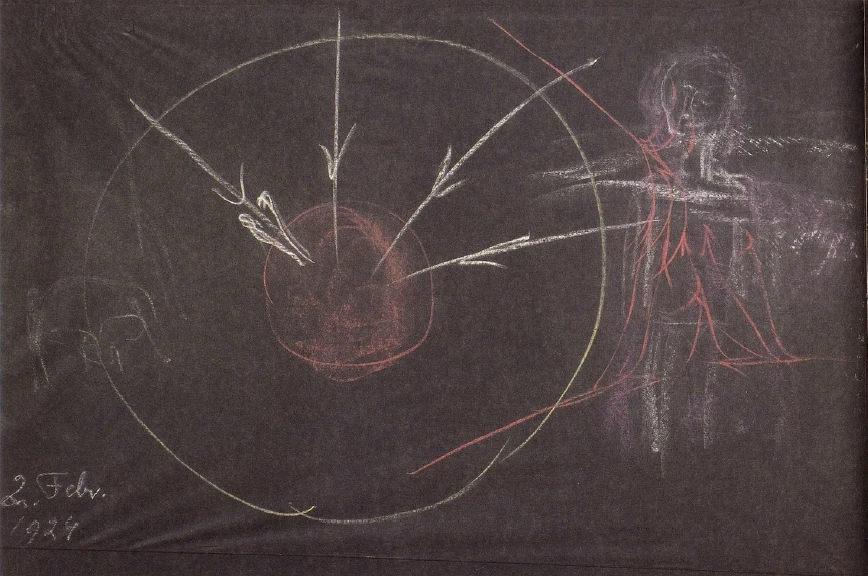
[ 5 ] This counteracting force is even stronger in the astral human being. The astral, as I hinted to you yesterday, flows in, as it were, from the indeterminate. And this astral force flows into the non-human, earthly realm (see arrows in the green circle) in such a way that it shapes the plant form out of the earth, a form that still clearly reveals this dependence on the astral. For it is indeed the astral forces that draw the plant out of the earth. The plant itself has only an etheric body; but it is the astral forces that draw it out of the earth. In human beings, the astral body is extraordinarily complex, and one truly perceives it as I described it yesterday—as an inner musicality, as a swirling life, as a weaving of life, as inner activity, and as everything that, if I may put it this way, is music that is sensed and felt; whereas all other astral elements are found flowing in radially from the outside. And this radially inflowing energy is precisely what is transformed into the human astral form. This is where complex things come to light. (A drawing is made.)
[ 6 ] Let us say, for example, that an astral force flows in from one side; the human being transforms this astral force in a wide variety of ways in order to make it serve him and incorporate it, so that the human being forces his astral body out of the radially inflowing astral forces—one might say—through his own inner being.
[ 7 ] Well, you see, one can certainly say this: When one turns one’s spiritually and mentally sharpened gaze out into the cosmos, one already gains an understanding of the ethereal, and one also gets the impression that the ethereal is what causes us to strive away from the Earth; while we are held together with the Earth by its gravity, we strive away through the ethereal. It is actually the ethereal that is at work in this striving away. You need only consider the following: the human brain weighs about 1,500 grams. A mass weighing 1,500 grams that were to press down on the delicate blood vessels beneath the brain would completely crush them. If our brain were to actually weigh 1,500 grams in a living human being, we naturally could not have the blood vessels that lie beneath the brain. But within a living human being, the brain weighs at most 20 grams. The reason for this is that the brain floats in cerebrospinal fluid and, by the weight of the displaced fluid, becomes lighter—immensely lighter; thus, the brain actually seems to be striving away from the human being. And it is the etheric that is at work in this striving away. So one can say: it is precisely in the brain that what is at work here is illustrated with extraordinary clarity.
[ 8 ] The brain floats in cerebrospinal fluid. This reduces its weight from 1,500 grams to only about 20 grams. So our brain weighs only about 20 grams; thus, in terms of its effectiveness, it participates in our physical body to an extraordinarily small degree. This leaves the etheric body with immense scope to exert its influence upward. Weight exerts a downward force, but that weight is counteracted. It is primarily within the cerebrospinal fluid that the sum of the etheric forces develops, lifting us away from the earthly realm. After all, if we had to carry our physical body with all its gravitational forces, we would have a sack that we would have to drag along. But every blood cell floats, losing some of its weight.
[ 9 ] This is a long-established fact—the principle of weight loss in liquids. As you know, it was attributed to Archimedes in ancient times. He was taking a bath once and noticed, when he stuck his leg out of the bathwater, how much heavier it felt than when he kept his leg submerged in the bathwater, and so he cried out: “I’ve found it! Eureka! I’ve found it!” — Namely, that every body in a liquid becomes as much lighter as the mass of the liquid it displaces. So if you imagine Archimedes in the bathwater—his physical leg (it is drawn)—and then that leg formed of water, the physical leg will be as much lighter in the water as this “water leg” here weighs. It will be that much lighter. And so our brain, immersed in cerebrospinal fluid, becomes that much lighter than the mass of the cerebrospinal fluid corresponding to the size of the physical brain. In physics, this is called buoyancy. Thus, in this striving outward through the liquid, the etheric body is active, while the astral body is initially stimulated by breathing, by the airy substance that enters the human organism. And as the airy element makes its way through the human being and reaches the head in an immensely fine, atomized state, the astral aspect is active within this distribution and organization of air.
[ 10 ] Thus, one can truly see the physical in the material, in the solid, earthly material; the ethereal in the liquid, particularly in terms of its effect on human beings; and the astral in the airy.
[ 11 ] The tragedy of materialism is that it knows nothing about matter as it actually operates in the various realms of existence. That is precisely what is so remarkable: that materialism is so ignorant about matter. It knows nothing at all about the effects of matter, because one can only learn about them when one is able to perceive the spirituality at work within matter—that is, the forces themselves.
[ 12 ] And this is how it is: If one proceeds through meditation toward the imaginative insight of which I have already spoken to you, one finds the ethereal in all the water movements of the Earth. It is childish, in the face of true knowledge, to believe that in all that weaves—take the sea, the river water, the rising mists, the falling water droplets, the forming clouds, take all of that together—to believe that it contains only what physicists and chemists know about water, is actually childish in the face of true understanding. For in all that which is out there in the mighty drop of the water-earth, in that which continually rises in the form of vapor, forms itself into clouds, descends as mist and rain, and in all else that takes place on Earth through water—for water does indeed play an immense role in the formation of the various Earthly structures— in all of this, the etheric currents are at work—the weaving of the ether—which reveals itself to one when one has developed the power of thought in the way I have described: in images. Everywhere, in the background of this weaving of water, is the weaving of the imagination, the world imagination, and—coming, as it were, from behind into this world imagination—everywhere this astral harmony of the world spheres.
[ 13 ] Now, however, the case with human beings is that all these relationships are found within them in a completely different way than outside of them. When one looks at the non-human world with the kind of sharpened gaze I have hinted at, one finds, so to speak, the world initially structured out of the physical, directly attached to the Earth; the etheric, which already fills the cosmos; the astral, which flows in—flows in as beings. So that one does not merely encounter a general, abstract astral weaving, but rather beings entering in—beings that are soul-spiritual, just as the human being is also soul-spiritual within his or her body. That is what one sees.
[ 14 ] If we then look back at the human being, we find within the human being, corresponding to what is etheric in the external world, the etheric body. But this etheric body does not manifest itself in such a way that you can say (as is often depicted): here is the physical human being, and there is the etheric body. Certainly, one can draw it that way, but that is only a captured snapshot. You never see merely the present etheric body; rather, when you observe a human being in relation to their etheric body, you see this snapshot—which can be drawn—adjacent to what precedes it. You always see the entire etheric body all the way back to birth. Time is a unified whole. When you have a twenty-year-old person before you, you cannot see merely the twenty-year-old etheric body; rather, you see everything that has taken place in the etheric body all the way back to birth and even a little beyond. There, time truly becomes space. Just as when you look down an avenue and the trees appear to draw closer and closer together due to perspective—just as you thus perceive the entire avenue in terms of space—so you look at the etheric body as it is in the present, but see back through the entire structure, which is a temporal structure. The etheric body is a temporal organism. The physical body is a spatial organism. The physical body is, of course, now complete. The etheric body is always present as a whole, corresponding to the duration of life lived so far in this lifetime. It is a unity. Therefore, you could actually only draw or paint the etheric body if you were able to paint changing images; you would simply have to paint at a faster pace. What one draws or paints as an instantaneous form is merely a cross-section; it relates to the entire etheric body in the same way as if you were to cut through the trunk of a tree and then draw what you see there as a cross-section. It is the same when you draw the etheric body in a diagram—it is merely a cross-section, for the entire etheric body is a temporal process. And by surveying this temporal progression, one even goes beyond birth, indeed beyond conception, to a point where one sees how the human being descended from his pre-earthly existence into this present earthly existence, and how, so to speak, as the final stage he underwent before being conceived by a pair of parents, drew substance from the general world ether and formed it into his own etheric body.
[ 15 ] So, whenever you speak of the etheric body, you cannot help but consider the temporal life of the human being extending beyond birth. What is regarded as the etheric body at a specific moment in time is merely an abstraction; the concrete reality is the temporal course.
[ 16 ] With the astral body, it is different. One approaches the human astral body in the way I described to you yesterday.
[ 17 ] I can only sketch this out for you schematically. After all, the drawing must also convey a sense of space and time to you. Let’s assume that on February 2, 1924, you are observing a person’s astral body. Here would be the person (it is drawn), and we are observing his astral body. Yes, the person gives this impression: there is his physical body, there is his etheric body, and there one can also observe his astral body. It gives the impression I described in my book Theosophy. That is how it is. But if one arrives at the truly inspired insight, as I described it yesterday, which arises in contrast to empty consciousness, then one arrives at the following realization. Then one says to oneself: What is seen there as the astral body in a human being is not actually present on February 2, 1924; rather, if the person whose astral body one is observing has reached the age of twenty, one must trace back in time. You then arrive—for the sake of argument—at January 1904, and you gain the insight: that is actually when this astral body first truly exists, and further back into infinity, further back—that is where it actually first exists. It has not accompanied the person through life at all; it has remained there. What we see here is merely a kind of illusion. — It is as if you were looking down an avenue (a sketch is drawn): it continues on; those are the last trees, they are very close; back there stands a light source. Yes, you can still see the glow of the light here, but the light source is back there after all; it has not stepped forward just so that the glow of the light might be here.
[ 18 ] Thus, the astral body has also remained there (see the illustration), casting only its shadow into life. The astral body has actually remained in the spiritual world; it has not followed us into the physical world. In terms of our astral body, we are always in the spiritual world prior to our conception, prior to our birth and conception. It is as if, when we turned twenty in 1924, we were actually still living spiritually before the year 1904, and had merely extended a feeler with regard to the astral body.
[ 19 ] You might say: That’s a difficult concept to grasp. Well, you know, there was once a Spanish king who was shown just how complicated the structure of the world is. The Spanish king remarked that if he had created the structure of the world, he would have made it simpler. People may well think that, but the world is simply not simple in reality—and human beings certainly aren’t either—so one has to make an effort to grasp what it means to be human.
[ 20 ] So, by looking at the astral body, you are looking directly into the spiritual world. You encounter the astral only in the non-human world. When you look at people, you are looking into the spiritual world through their astral bodies. You see directly what the person themselves experienced in the spiritual world before descending to Earth.
[ 21 ] You will say: But my astral body is at work within me. It is, of course; but imagine there were some being here (it is drawn) that had some kind of ropes and, through these ropes—which were mechanically connected—would perform some action. Far away in space, the effect of a being that is right here manifests itself. That is how it is here with time. Your astral body has remained there, but its effects extend throughout your entire life. So when you observe an effect of your astral body today, it has its origin in a time long past, when you were in the spiritual world, even before you descended to Earth. Time exerts its influence here. In other words, time has remained there for the spiritual realm. And anyone who believes that the past no longer exists in what truly lives in time is like a person sitting on a train as it speeds along, and someone says to him, “Hey, that was a beautiful area we just passed through down there”—and that person, who would be so simple-minded, would say: “Yes, a beautiful area, but it’s gone now; it’s not there at all anymore.” — Such a person would therefore believe that once he has passed through an area on an express train, it has vanished and is no longer there. It is just as sensible to believe that what has passed in time is no longer there. It is, in fact, constantly present; it exerts an influence upon him. January 3, 1904, in its spiritual essence, is still there, just as the physical landscape is still there after you have driven through it; it is there, and it is there in such a way that it exerts an influence on the present.
[ 22 ] So that, if you describe your astral body as I have done in my Theosophy, then—in order to make your understanding complete—you must realize that what is at work there is the appearance of that which is actually at work far in the past. As a human being, you are truly a comet whose tail extends far back into the past. One cannot gain a true understanding of the human being except by arriving at these new concepts.
[ 23 ] People who believe that one can enter the spiritual world using the same concepts that apply here to the physical world should become spiritualists, not anthroposophists. There, don’t you see, people try to conjure up everything spiritual—just a little more ethereal—right into the ordinary space where physical human beings walk about. But that is not the spiritual at all. These are merely subtle emanations; even Schrenck-Notzing’s phantoms are merely subtle emanations of the physical—very thin emanations that still bear the echo of the etheric in their form. They are mere phantoms; they are not truly spiritual.
[ 24 ] If you look at it this way, you will say to yourself: In nature beyond the human realm, the higher worlds are present. With human beings, we immediately enter into time—into the course of their existence—when we consider the successive worlds. But with human beings, one can penetrate even further into knowledge. And there, knowledge flows into an element that, in our philistine, materialistic age, people are unwilling to admit can also be an element of knowledge.
[ 25 ] As the first stage of knowledge, I have shown you the one that—well, perceives the coarse, robust physical things around us through the senses. The second kind was that of active thinking, in which one grasps the moving images of the world within oneself. The third kind was the inspired kind, in which one perceives what is essentially expressed in these images, what resounds within them like the music of the spheres, but in an essential way. If one perceives this essential, celestial quality in a human being, one is led not merely out of matter, but out of the present into the human being’s pre-earthly life—into the existence he had as a spiritual-soul being before he descended to Earth. One attains this inspired insight by establishing a state of empty consciousness after having previously engaged in vigorous thinking.
[ 26 ] One attains further spiritual growth by transforming the power of love into a power of knowledge. However, it must not be the trivial kind of love that is most often spoken of in our materialistic age, but rather the kind of love that is capable of feeling at one with a being that one is not oneself within the physical world; that is, to be able to truly feel what is happening within the other being just as one feels what is happening within oneself, to be able to step completely outside of oneself and come alive again within the other being. In ordinary human life, this loving does not reach the degree necessary to transform love into a power of knowledge. To achieve this, one must first have established this empty consciousness and must also have had some experience with it. Yes, then one goes through something that, admittedly, many people do not seek when they strive for higher knowledge. For one goes through what one might call the pain of knowledge, the suffering of knowledge.
[ 27 ] When a person has a wound somewhere, it causes them pain. Why? Because when the physical body is injured, their spiritual being cannot properly penetrate the physical body at that point. All pain stems from the fact that, for some reason, one cannot penetrate the physical body. And when one experiences pain from something external, it is also for the reason that one cannot unite with it. Once one has attained that state of empty consciousness into which a world entirely different from the one to which one is accustomed floods in, then—for the moments in which one has this inspired insight—one no longer possesses one’s entire physical being; then everything is sore, then everything hurts. One must go through this first. One must, so to speak, experience the leaving of the physical body as true pain, as true suffering, in order to attain inspired insight—to attain it through direct perception, not merely through understanding. Understanding, of course, can take place entirely painlessly and should be attained by people precisely because they do not go through the pain of initiation. But in order to reach the point of consciously experiencing what a person actually possesses from their pre-birth existence—what has remained from the spiritual world and continues to work within them—in order to reach that point, one must first cross the abyss of the very general, I would say universal, suffering and universal pain.
[ 28 ] And then one can experience coming alive in something entirely different; only then does one learn the most potent, the highest form of love, which consists in the fact that one cannot truly forget oneself in an abstract sense, but can set oneself completely aside and cross over entirely into the other. And when this love arises in conjunction with higher, inspired knowledge, only then do you truly have the opportunity to enter into the spiritual realm with all the warmth of life, with all the emotional depth, and with all the heartfelt sincerity—which is, of course, something of the soul. And this is necessary if you wish to progress in knowledge. In this sense, love must become a power of knowledge. For when this love—which then manifests as a power of knowledge—has reached a certain height, a certain intensity, you pass through your pre-earthly existence into your previous earthly life. You slip through everything you have experienced between your last death and your present earthly life, into your previous earthly life—into what are called your previous incarnations.
[ 29 ] You see, back then you, too, walked the earth in a physical body, of course. But of all that was physical about you back then, nothing remains; it has all been absorbed into the elements of the Earth—nothing of it is left. That which was your innermost being at that time has become entirely spiritual; it lives within you as something entirely spiritual.
[ 30 ] Truly, as our “I” passes through the gate of death and journeys through the spiritual world on its way to a new earthly life, it becomes entirely spiritual. And whoever believes they can attain this through the ordinary powers of everyday consciousness will not be able to attain it. One can achieve it only if love has been heightened to the highest degree, as I have described. For the person we were in a previous existence is just as separate from us as another person is separate from us in the present. The same degree of separateness attaches to our “I.” Certainly, it then becomes our own. We experience it as ourselves, but we must first learn to love in such a way that this love contains nothing selfish. It would indeed be a terrible thing if one were to fall in love with one’s previous incarnation in the ordinary sense of the word. Love must be elevated to its highest sense so that one can experience this very previous incarnation as something entirely different at the same time. And then, when the power of knowledge rises through empty consciousness to the power of knowledge through the highest form of love, one reaches the fourth member of the human being—the true “I.”
[ 31 ] Human beings have a physical body. Through it, they live at every moment in the physical presence of the Earth. Human beings have an etheric body. Through it, they actually live continuously back to a point just before their birth, where they gathered their etheric body from the universal ether. Now, human beings have an astral body. Through it, they live throughout the entire period between their previous death and this descent to Earth. And then they have their “I.” Through it, they live into their previous earthly life. Thus, whenever we speak of the structure of the human being, we must also speak of their extension in time. We carry our previous “I”-consciousness subconsciously within us in the present. And how do we carry it within us? Well, if you wish to study how we carry it within us, then you must become attentive to the fact—and this is also the path to approaching the “I”—that the human being here in the physical world is not merely a solid body, not merely a liquid being or an airy being, but is, in fact, a thermal organism. Everyone already knows this in a primitive, or at least very partial, sense; when you take a temperature, you get different readings depending on the various parts of the organism where you take the measurement. But this is true throughout the entire human organism. You have one temperature at the top of your head, another in your big toe, another internally in the liver, and another internally in the lungs. After all, you are not merely what you find depicted with fixed contours in an anatomical atlas; you are a fluid organism in constant motion; you are an air organism that continually permeates you, as if a mighty symphonic, musical force were constantly flowing through you. And in all of this, you are a surging, warm-and-cold organism—a thermal organism—and you yourself live within this thermal organism. You can feel that, too. After all, you do not have a very strong awareness that you live, let’s say, in your shinbone or in some other bone, nor do you have a strong awareness that you live in your liver or in the fluids of your blood vessels. But you have a strong awareness that you live within your warmth—even if you do not differentiate it, even if you do not say: “There is my warm hand, there is my warm leg, there is my warm liver,” and so on; but it is there, and once it is disrupted—once the humanly appropriate differentiation within the thermal organism is no longer present—then you perceive it as illness, as pain.
[ 32 ] When one perceives the etheric realm, when one has advanced with developed consciousness to the realm of imagery and imagination, one experiences weaving images. When one perceives the astral realm, one experiences the music of the world spheres. It reaches out to us, or it also flows out from within us. For our own astral body leads us back to our pre-earthly existence. And if we proceed to that insight which soars up to the most intense love—where the power of love becomes the power of insight, where we first see our own existence from a previous earthly life flowing into our present earthly life—then we sense this preceding earthly life in the normal differentiation of our thermal organism, within which we live. That is true intuition. We live within it. And when any impulse arises within us to do this or that, it does not act merely—as is the case with the astral body—from the spiritual world, but from even further back, from a previous earthly life. The previous earthly life influences the warmth of your organism and generates this or that impulse. When we look at the physical body in the earthbound human being, the etheric body in the liquid one, and the astral body in the airy one, we see the true “I” in the warmth of the human being. The “I” of the present incarnation is never complete; it is still forming. The true “I,” active in the depths of the subconscious, is that of the previous earthly life. And to the observing consciousness, a person standing before you appears in such a way that you say: Here he stands; at first I perceive him just as he stands there, with my outer senses. I then perceive the etheric body, I perceive the astral body, but then, behind him, I perceive the other person he was in his previous incarnation.
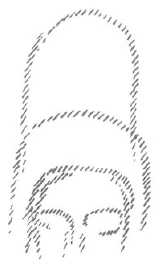
[ 33 ] In fact, the more this awareness is developed, the more it appears—in perspective, it looks like this (as depicted)—that the human head of the present incarnation is shown, slightly above it the human head of the previous incarnation, and slightly above that the human head of an incarnation even further back in time. In civilizations that still had some inkling of these things through an instinctive awareness, you will find images in which, behind the clearly depicted face—which relates to the present earthly life—there is another, somewhat less clearly painted face, and a third that is painted even less clearly. Such Egyptian images exist. The one who perceives how, in fact, behind the person of the present, the person of the previous incarnation and of the incarnation even further back emerges, understands such images. And it is only a reality to speak of the “I” as the fourth member of human nature when one simultaneously extends temporal existence back to the previous incarnations.
[ 34 ] All of this takes effect within the person of warmth. Inspiration still comes to one from outside or from within. In warmth, one stands within oneself. There is intuition—true intuition. One experiences warmth quite differently than anything else in itself.
[ 35 ] But now, when you look at it this way, you come to understand something that should pose a great mystery, especially to people today, if they truly set to work with an open mind and soul. I have spoken of this mystery. I said that we feel morally bound to certain impulses that are given to us purely spiritually. We want to act upon them. At first, it is difficult to understand how what we feel morally bound to penetrates right into our bones and muscles. But when one realizes that one carries within oneself the “I” from the previous incarnation—which has already become entirely spiritual—and that this “I” works its way into the warmth, then one finds the transition right there in this “warmth-being.” The moral impulses work through the detour of the “I” from the previous incarnation. Only then do you achieve the transition from the moral to the physical. If you merely observe present-day nature and view human beings as a segment of nature, you will not grasp this transition.
[ 36 ] For when you look at nature as it is today, you might say: Well, there’s nature out there; human beings take in its substances, build up their own organism—that’s how naively and childishly we imagine it—and are thus a segment of nature welded together from nature’s substances. Fine. But now he suddenly feels: there are moral impulses, and he is supposed to act in accordance with them. He is supposed to take just a single step in accordance with these moral impulses. I would like to know how this fragment of nature is supposed to begin doing that? The stone cannot do it; the calcium cannot do it; the chlorine cannot do it; the oxygen cannot do it; the nitrogen cannot do it—none of these can do it. The human being, who is forged from all of these elements, is suddenly supposed to be able to do it: he feels a moral impulse, and he is supposed to act in accordance with it, even though he is forged from all of these elements that cannot do so.
[ 37 ] But within all that which is fused together there, something arises—namely, indirectly through sleep—that passes through death, becomes ever more spiritual, and enters the body again in the next life. Now it is already present within this body, because it comes from the previous incarnation. It has become spiritual. It exerts an influence on the current incarnation. That which is now fused together from the substances of the earth will exert an influence on the “heat-human” in the next incarnation. Thus, the moral aspect flows from one earthly life of the human being into the next.
[ 38 ] This is where one comprehends the transition from the physical to the spiritual realm, and again, back from the spiritual to the physical. One cannot achieve this in a single earthly life unless one surrenders to a sincere pursuit of spiritual and soul-related knowledge or numbs oneself to the whole of it.
[ 39 ] You see, what can be regarded as the elements of the earthly realm—the solid, the liquid, the gaseous or airy, and the heat-like—is permeated everywhere by what can be described as the physical—where it is immediately present in its own right—the etheric, the astral, and the egoic. And thus, in connection with world existence, with the universe, one gains an understanding of the structure of the human being. And one can form a conception of the extent to which the human being is a segment of time, not merely of space. In terms of space, the human being is such only insofar as their physical body exists. But the past is, for spiritual contemplation, a continuous present. The present is, at the same time, a true eternity.
[ 40 ] What I am explaining to you here was once the content of people’s instinctive forms of consciousness. If we truly understand ancient documents, we will find that an awareness of this fourfold nature of the human being—in relation to the world—is already alive within them. But over the course of many centuries, this insight was lost to humankind. Otherwise, humankind would never have been able to develop its intellect as it now possesses it. But now we have once again reached the point in human development where we must once more advance from the physical to the truly spiritual.