

Anthroposophy
A Summary After Twenty-one Years
GA 234
1 February 1924, Dornach
Translated by Steiner Online Library
Fourth Lecture
[ 1 ] Today, I will continue in a certain direction with the more fundamental reflections I have recently begun. In the first lecture of this series, I pointed out how the truly inner, heartfelt need to find—or at least to seek—the soul’s paths to the spiritual world arises in human beings from two sources. One source is that which comes from nature; the other is that which comes from inner experience and inner experiences.
[ 2 ] Today, let us once again consider these two aspects of human life in a very basic way, so that we may then see how impulses actually operate in the subconscious, driving people from there into everything they strive for in terms of knowledge—arising from the needs of their lives—as well as their artistic and religious pursuits, and so on. I would like to say that you can quite easily observe the contrast I am referring to here within yourselves at any moment.
[ 3 ] Consider a very simple fact: You look at yourself—at any part of your body. You look at your hand. You look at your hand in exactly the same way—in terms of the act of looking and the act of recognizing—as you would look at any crystal, any plant, or anything else in nature.
[ 4 ] By observing this aspect of your physical being and carrying this perspective with you through life, you will discover precisely that—I would say—tragic element that permeates the entire human experience, the one I have been speaking of. You will find that what you see there will one day become a corpse, will become something of which one must say: If external nature absorbs it, then this external nature simply does not have the ability, does not have the power, to do anything with it other than destroy it. The moment a human being has become a corpse within the physical world, and this corpse is surrendered to the elements in whatever form, there is no longer any question of the human form being infused into all that substantial substance which you can observe in yourself—that which this human form is capable of sustaining.
[ 5 ] Take all the forces of nature that you can make the subject matter of any external science; all these forces of nature are capable solely of destroying humanity, never of building it up. Any unbiased observation—one drawn not from theory but from the experiences of life—leads one to say: We look around us at nature as we understand it—we will not speak here of what cannot initially be grasped through external perception—we look at nature insofar as it can be understood. Yes, as humanity, we have in recent times become so proud of regarding what we gain through our insight into nature as the sum of the laws of nature; we feel immensely advanced because we have come to know so many laws of nature. Talking about progress is, in fact, entirely justified. But the fact remains that, in their mode of operation, all these laws of nature have only one possibility: to destroy human beings, never to educate them. Human insight, after all, initially offers no possibility of gaining anything else from looking out into the world other than these laws of nature that destroy human beings.
[ 6 ] Now let us look within ourselves. We experience what we call our inner life: our thinking, which can indeed stand before our soul with considerable clarity; we experience our feeling, which stands before our soul with less clarity; and our willing—well, that stands before the soul in complete obscurity. For, to begin with, no one with ordinary consciousness can say that they have any insight into how any intention to grasp an object works its way down through this entire complex organism of muscles and nerves to ultimately move the arms and legs. That which works its way into our organism—starting from the thought and continuing until the moment we see the object lifted again—is shrouded in complete darkness. But an indefinable impulse works back within us, rising up, telling us: I want this. — Through this, we also attribute the act of willing to ourselves. And so, when we look within ourselves, we say of our inner life: Well, yes, we carry within us thinking, feeling, and willing.
[ 7 ] But now comes the other side, which, in a certain sense, leads back into the tragic. We see that with every sleep, this entire inner life of the human being subsides, and each time upon waking, it arises anew. So that, if we wish to use a comparison, we can very well say that this inner life is like a flame that I light and then extinguish again.
[ 8 ] But we see more than that. We see that certain forms of destruction in our organism also destroy this inner life. We also see that this inner life depends on the physical development of this organism. In a small child, it exists in a dreamlike state. It gradually becomes clearer and clearer. But this becoming clearer is, of course, entirely connected with the development of the physical organism. And as one grows old, it becomes weaker again. The life of the soul is connected with the development and decline of the organism. We thus see how it flares up and then fades away.
[ 9 ] As certain as we are that what we call “soul life” certainly has a life of its own, an existence of its own, yet is dependent in its manifestations on the physical organism—this is not all we can say about this soul life. Rather, this spiritual life has an aspect that must be of particular value to human beings in life, for their entire humanity and human dignity actually depend on this aspect. That is the moral aspect.
[ 10 ] No matter how far we explore nature, we cannot derive moral laws from it. Moral laws must be experienced entirely within the soul. But it must also be possible to follow them within the soul. It must therefore be a process that takes place solely within the soul. And we must regard it as a kind of moral ideal that we, as human beings, can also follow moral principles that are not imposed upon us. As long as we have to say: What our drives, instincts, passions, emotions, and so on impose upon us is within us—well, a human being must do this or that; a human being cannot become an abstract being who merely follows moral laws. But morality truly begins only when these emotions, drives, instincts, passions, outbursts of temperament, and so on are brought under the control of what corresponds to a purely psychological engagement with the moral laws grasped purely intellectually.
[ 11 ] The moment we become truly aware of our human dignity and feel that we cannot be like a being driven solely by necessity, we actually rise into a world that is entirely different from the natural world.
[ 12 ] And what is so unsettling—what, as long as human development has existed, has always led us to strive beyond the immediately visible life—actually stems—even though subconscious and unconscious factors play a role—from these laws: that, on the one hand, we view ourselves as physical beings, but see this physical being as belonging to a nature that can only destroy it; that, on the other hand, we experience ourselves inwardly as a spiritual being; yet this spiritual being, which flares up and then fades, is nevertheless connected to what is most precious to us—our moral essence.
[ 13 ] And it is due solely to a profound dishonesty in our civilization that people, caught up in a terrible illusion, simply ignore the polar opposition that exists between observing the external and experiencing the internal. If one takes stock of oneself without being constrained by those threads, those meshes, into which we are forced today by our education—because this education tends toward a very specific goal—if one rises a little above this constraint, then one immediately comes to say to oneself: You, human being, carry within you your inner life, your thinking, your feeling, your willing. This is connected to the world that must be most precious to you of all things, to the moral world, perhaps to that with which this moral world is in turn connected—to the religious source of all being. But what you experience as your inner life, as this inner struggle—where is it while you sleep?
[ 14 ] Of course, one can philosophize about these things in a speculative way or engage in fantastical philosophy. Then one might say: Human beings have a secure foundation in their “I”—that is, in ordinary self-consciousness—a line of thought that begins with Saint Augustine, continues through Descartes, and takes on a somewhat coquettish expression in contemporary Bergsonism—but every instance of sleep refutes this. For from the moment we fall asleep until the moment we wake up, time passes for us. When we look back on it while awake, the “I” is simply not there as an experience within that time. It is erased. And what is erased there is connected to what is most valuable, to the moral dimension of our lives.
[ 15 ] So we must say: That of which we are brutally convinced exists—our body—has most certainly arisen from nature. But nature has only the power to destroy it, to scatter it to the winds. That which we experience on the other hand—our own inner life—slips away from us with every sleep; it depends on every rise and fall of our physical being. As soon as one rises even slightly above the predicament into which modern civilized humanity has been placed by its upbringing, one immediately realizes that—no matter how many subconscious or unconscious elements may be at play—every religious, every artistic, indeed every higher human aspiration throughout the entire course of human development hinges on these opposites.
[ 16 ] Certainly, millions upon millions of people do not realize this. But is it really necessary for a person to fully understand what becomes a mystery of life for them? If people were to live solely on what they understand, they would soon die. The greater part of life simply flows in what rises from obscure, subconscious depths into the general mood of life. And we must not say that only those who can formulate the mysteries of life in an intellectually clear way and present them to us on a silver platter—first mystery of life, second mystery of life, and so on—are the ones who experience them. Such people are to be trusted even in the smallest of matters. What stirs deep down there—those are the mysteries of life that are simply experienced. — Here comes a person. He has this or that to say—perhaps something very mundane—but he speaks in such a way that he is by no means pleased with the prospect of achieving anything for life through his words. He wants something, yet he doesn’t want it. He cannot make up his mind. He does not feel quite at ease with his own thoughts. Indeed, where does this come from? Because he lacks certainty in the subconscious depths of his being regarding the very foundation of the human being and human dignity. He senses the mysteries of life. And what he feels arises precisely from the polar opposition I have described: That, on the one hand, one cannot cling to physicality, and on the other hand, cannot cling to spirituality as one experiences it; for spirituality continually reveals itself as something that flares up and dies down, and physicality reveals itself as that which originates from nature, yet can only be destroyed by nature.
[ 17 ] And so the human being stands there. On the one hand, he looks outward at his physical body. His physical body is a constant mystery to him. On the other hand, he looks at his soul-spiritual nature, and this soul-spiritual nature is a constant mystery to him. And the greatest mystery of all is this: When I truly feel a moral impulse and must set my legs in motion to do something to realize this moral impulse, I find myself in a position to move my body out of that moral impulse. I have a moral impulse—let’s say the impulse of goodwill. At first, it is truly experienced purely in the soul. How this impulse of goodwill, which is experienced purely in the soul, descends into the physical realm is something ordinary consciousness cannot fathom. How does a moral impulse come to set bones in motion through muscles? One might regard such an inquiry as theoretical. One might say, “Let’s leave that to the philosophers; they’ll think it through.” Modern civilization usually leaves this question to the thinkers, and then either scorns or at least disregards what the thinkers say. Well, this only satisfies the human mind, not the human heart; the human heart feels a nervous restlessness and fails to attain any joy in life, sense of security, foundation for life, and so on. Based on the kind of thinking that humanity has adopted since the first third of the 15th century—which has achieved such magnificent successes in the field of external natural science—one simply cannot contribute anything toward somehow penetrating these two things: the mystery of the human physical body and the mystery of human soul experiences. And it is precisely out of a clear insight into this that anthroposophy arises and says to itself: Certainly, thinking, as it has developed in humanity, is powerless in the face of reality; no matter how much we may think, we cannot, with our thinking, intervene in the slightest in external natural processes. But with our mere thinking, we cannot intervene in our own organism of the will either. One need only thoroughly experience the utter powerlessness of this thinking, and then one will already receive the impulse to go beyond this ordinary thinking.
[ 18 ] But one cannot escape through fantasy, nor can one begin to reflect on the world from any other starting point than thought itself. Yet this very thought is unsuitable. The point is that one simply arrives, through the necessities of life, at a way—starting from this thinking—through which this thinking drills deeper into Being, into reality. And this path is offered only through what you will find described, for example, in my book How Does One Attain Knowledge of the Higher Worlds? as meditation.
[ 19 ] Today we want to merely sketch this out in our minds, for we wish, so to speak, to provide a very basic outline of an anthroposophical edifice. We want to begin again with what we began twenty years ago. We can say: Meditation consists precisely in experiencing thinking in a different way than one usually does. Today, people experience thinking in such a way that they allow themselves to be stimulated from the outside; they surrender to external reality. And as they see, hear, touch, and so on, they notice how, in a sense, the absorption of external impressions continues in thought within their experience. One remains passive in one’s thoughts. One surrenders to the world, and thoughts come to one. In this way, one never makes any progress. The point is to begin to experience thinking. One does this by taking a simple, manageable thought, allowing this easily graspable thought to be present in one’s consciousness, and concentrating one’s entire consciousness on this manageable thought.
[ 20 ] It doesn’t matter at all what this thought means to the outside world. What matters is simply that you focus your consciousness on this one thought, disregarding all other experiences. I say it must be a simple, straightforward thought. You see, I was once asked by a very learned man how to meditate. I gave him a terribly simple thought. I told him it didn’t matter whether the thought had any external reality. He should think: Wisdom is in the light. — He should use all the power of his soul, over and over again, to think: “Wisdom is in the light.” — Whether that is true or false is irrelevant. It matters just as little whether something is a matter of world-shaking importance or a mere game when we strain our arm to set it in motion and set it in motion again and again. In doing so, we strengthen the muscles of our arm. We strengthen our thinking by exerting ourselves to perform this activity again and again, regardless of what the thought means. If we exert ourselves mentally, time and again, to bring it into our consciousness and concentrate our entire inner life upon it, we strengthen our inner life just as we strengthen the muscular power of our arm when we concentrate it, time and again, on the same activity. But we must have a thought that is easily grasped. For if we do not have one, we are exposed to all manner of intrusions from our own psyche. One would hardly believe how powerful the suggestive force is that arises from memories of life and the like. The moment one grasps even a slightly more complex thought, demonic forces immediately arise from all directions, suggesting this or that into one’s consciousness. One can only be certain that one is living in meditation with complete composure—the same composure with which one otherwise approaches life—if one is a fully conscious person, if one actually has a completely clear and straightforward thought in which nothing else can be contained except what one is mentally experiencing.
[ 21 ] If you set up meditation this way, all sorts of people might say: “You’re succumbing to autosuggestion or something like that”—which is, of course, all nonsense. It simply depends on whether you manage to have a clear, focused thought or whether you have a thought that is somehow influenced by subconscious impulses. Now, however—as I have often said—it depends on a person’s abilities; for some it takes a long time, for others a short time. But through such concentration, a person comes to strengthen their inner life—insofar as it is a thinking inner life—and to develop it within themselves. And the result, after some time, is precisely this: that the person no longer experiences their thinking as they do in ordinary consciousness. In ordinary consciousness, a person experiences their thoughts as being powerless. They are simply thoughts. Through such concentration, a person comes to truly experience thoughts as an inner being—just as they experience the tension in their muscles or the reaching out to grasp an object. Thinking becomes a reality within them. Precisely by developing themselves more and more, they experience a second person within themselves, of whom they previously knew nothing.
[ 22 ] And then comes the moment for human beings when they say to themselves: Well, I am the kind of person who can first look at myself from the outside, just as one looks at things in nature. I sense my muscle tensions very vaguely within myself, but I don’t really know how my thoughts shoot down into these muscle tensions. But when a person, as I have described, intensifies their thinking, they feel, as it were, this strengthened thinking flowing, streaming, and pulsing within their being. They feel a second human being within themselves. But this is, of course, an abstract concept at first. The main point is that the moment one feels this second person within oneself, extraterrestrial things begin to affect one in the same way that only earthly things had affected one before. I mean things that are spatially extraterrestrial. The moment you feel how thought becomes inner life, the moment you feel it flowing like your breaths when you are attentive to them—at that very moment, you add something new to your entire humanity. Before that, for example, you feel: I am standing on my feet. Down there is the ground. The ground supports me. If it weren’t there and if the Earth didn’t provide me with a ground, I would have to sink into the abyss. I am standing on something.
[ 23 ] Later, once you have strengthened your thinking within yourself and feel the second human being within you, from the moment you take a special interest in this second human being, the things that surround you in the earthly world will no longer interest you as strongly as before. It is not as if you were becoming a dreamer or a daydreamer. You do not become one if you advance to such levels of insight in an inwardly clear and honest way. You can quite easily return to the world of ordinary life with all its practical aspects. You do not become a fantasist who says: “Oh, I have come to know the spiritual world; the earthly world is inferior, insubstantial—I will concern myself only with the spiritual world from now on.” On a true spiritual path, you do not become that way; rather, you learn to appreciate external life all the more when you return to it. And the moments when one steps out of that life in the way I have described—and when one’s interest is drawn to the second self that one has discovered within—cannot be sustained for long anyway; for if they are sustained with inner honesty, it requires great strength, and this strength can only be maintained all at once for a certain period of time, which is generally not very long.
[ 24 ] But this shift of interest toward the second human is connected to the fact that one’s spatial surroundings on Earth begin to become just as valuable as what is down here on Earth. One knows that the earth sustains one. One knows that the earth provides, from its various natural realms, the substances one must eat so that the body continually receives, through food, the nourishment it needs. One knows how one is connected in this way to earthly nature. Just as one must go into the garden to pick a few heads of cabbage, then cook them so you can eat them—just as what is out there in the garden is necessary, and just as it is connected to what you are first and foremost as a physical human being—so you now learn to recognize what the sun’s rays are to you, what the moonlight is to you, and what all that sparkling starlight around the Earth is to you. And one gradually gains the ability to think about what is spatially around the Earth—in relation to the second human being—in the same way one previously thought about one’s first physical body and one’s physical earthly surroundings.
[ 25 ] And one tells oneself: What you carry within you—your muscles, bones, lungs, liver, and so on—is connected to the head of cabbage or the pheasant and so on that are out there in the world. But what you now carry within you as a second human being—what you have brought into your consciousness through the intensification of your thinking—is connected to the sun and the moon, to the entire twinkling of the stars; it is connected to the Earth’s spatial surroundings. One becomes familiar—actually, more familiar—with the Earth’s spatial surroundings than one is, as an ordinary person (unless one happens to be a food safety specialist or something of that sort), with the earthly environment. One truly gains a second world—initially, a second world in a spatial sense.
[ 26 ] One learns to regard oneself as an inhabitant of the world of the stars just as one previously regarded oneself as an inhabitant of Earth. Previously, one did not view oneself as an inhabitant of the starry world; for science that does not extend to the realm of thought fails to instill in a person the awareness that, in relation to another person, one has the same connection to the Earth’s physical environment as one has, as a physical human being, to the physical Earth. It does not know this. It calculates; but what even the calculations of astrophysics and the like bring to light—all of that merely yields things that are actually of no concern to human beings, things that at most satisfy their curiosity. After all, what significance does it have for human beings—for what they experience inwardly—if one knows, as one might imagine—though it is not yet accurate—that the spiral nebula arose in the “Hunting Dogs” constellation or continues to evolve in its current forms even today? It is, after all, none of their business. Human beings stand in relation to the world of the stars just as any incorporeal being—coming from somewhere else and staying on Earth—would stand in relation to the earthly world: a being that needs no food or the like, does not need to stand on the ground, and so on. But in fact, human beings are transformed from mere citizens of the Earth into citizens of the world when they develop their thinking in this way.
[ 27 ] And now a very specific content of consciousness arises. A content of consciousness arises that can be characterized as follows. We tell ourselves: The fact that there are cabbages, that there is grain out there—that is good for us; it builds up our physical body—if I may use this expression, which is not entirely accurate, in accordance with the common, trivial view; it builds up our physical body. And I observe a certain connection between what exists out there in the various kingdoms of nature and my physical body.
[ 28 ] But with this strengthened thinking, I begin to observe a similar connection between my second self, which lives within me, and that which surrounds us in outer space. Ultimately, one says to oneself: When I go out at night and rely only on my ordinary eyes, I see nothing. When I go outside during the day, the sunlight—the light from beyond Earth—makes all objects visible to me. At first, I know nothing. If I limit myself solely to Earth, I know: there is a head of cabbage here, and a quartz crystal there. I see both through the sunlight, but on Earth I am interested only in the difference between the head of cabbage and the quartz crystal.
[ 29 ] Now I am beginning to realize: I myself, as a second human being, am made of that which makes the head of cabbage and the quartz crystal visible to me. This is a truly significant leap that one takes in one’s consciousness. It is a complete metamorphosis of consciousness. And from that point on, one begins to say to oneself: When you stand on Earth, you see the physical world connected to your physical self; when you strengthen your thinking, and just as the physical world of Earth was previously a world that concerns you, so too does the extraterrestrial, spatial existence become a world that concerns you— namely you and the human being you have only just discovered within yourself—then you attribute your second existence to the cosmic ether—just as you attribute the origin of your physical body to the physical Earth—through whose effects earthly things first become visible. And you now speak from your own experience, saying that you have your physical body and you have your etheric body. Of course, it does not constitute true insight merely to systematize and conceive of the human being as consisting of various parts; rather, true insight arises only when one grasps the entire metamorphosis of consciousness that results from truly discovering such a second human being within oneself.
[ 30 ] I reach out with my physical arm, and my physical hand grasps an object. In a sense, I feel the current that is grasping it. Through this strengthening of thought, one feels the thought—as it is now mobile within itself—also bringing about a kind of groping within the human being, a kind of groping that now also lives within an organism, within the etheric organism, within the finer supersensible organism, which is just as present as the physical organism, only it is not connected to the earthly but to the extraterrestrial.
[ 31 ] Now comes the moment when one is compelled—I would say—to descend another step; for at first, through the kind of imaginative thinking I have described, one comes to feel this inner sensing of a second human being within oneself, and also comes to see this in connection with the vastness of the world-ether—though you should not imagine anything by these words other than what I have just spoken of, without drawing any additional content from elsewhere. But in order to proceed, one is now compelled to return once more to ordinary consciousness,
[ 32 ] Well, you see, when we think of the human physical body in the way I have just described, it stands to reason that we should ask ourselves: What is the relationship between this human physical body and its surroundings? It undoubtedly has a relationship to the physical environment of the Earth, but what kind?
[ 33 ] When we look at a corpse—which is, after all, a faithful representation of the physical human being even during life—we see, in sharp contours, the liver, spleen, kidneys, heart, lungs, bones, muscles, and nerve tracts. You can draw these; they have sharp contours. In this respect, they resemble solid objects, things that exist in fixed forms. But there is a specific reason for these sharp contours in the human organism. There is actually nothing more deceptive than the textbooks on anatomy or physiology available today, for people come to the conclusion: here is a liver, there is the heart, and so on; they see all of this with sharp contours and imagine that these sharp contours are essential. People already imagine the human organism as a conglomerate of solid things. It is not like that at all—at most 10 percent; the remaining 90 percent of the human organism is not solid, but fluid or even gaseous. A human being is at least 90 percent a column of water when alive. So one can say: In terms of their physical body, human beings certainly belong to the solid earth—to what the ancient thinkers specifically called the earth—but then begins that which is fluid within the human being. We will not arrive at a reasonable understanding of the human being—even in the external sciences—until we once again distinguish the solid human being from the liquid human being, that inner surging and weaving in which it truly looks as if one were in a small sea.
[ 34 ] But the earthly realm exerts a real influence on human beings only in relation to what is solid within them. For even out in nature, you can see how, where the liquid begins, an inner creative force immediately arises that acts with a very high degree of uniformity.
[ 35 ] If you take all the liquid on our Earth—its water—it is a single large drop. When water is free to take shape, it becomes drop-shaped; everywhere, liquid takes on a drop-like form.
[ 36 ] That which is earthy and solid—as we say today—appears in specific forms that can be recognized as distinct shapes. The liquid always tends to become drop-like and take on a spherical shape.
[ 37 ] And where does that come from? Well, if you study a drop—whether it is small or as large as the earth—you will find everywhere that the drop is a reflection of the entire universe. Of course, by today’s conventional standards, this is incorrect, but at first glance—and we will see in due course how this impression is indeed justified—it is correct at first glance: the universe appears to us as a hollow sphere into which we are looking.
[ 38 ] Every drop, whether small or large, appears to us as a reflection of the universe itself. Whether you consider a raindrop or all the water on Earth, you will see an image of the universe on its surface. For as soon as one enters the realm of the liquid, one can no longer explain this liquid through earthly forces alone. If you observe—or contemplate with awareness—the endless efforts to explain the spherical shape of the Earth’s waters solely through earthly forces, you will find how futile these efforts are. The spherical shape of the Earth’s waters cannot be explained by Earth’s gravitational force and so on. The spherical shape of the Earth’s waters is not explained by gravitational force, but by external pressure. This leads us immediately to recognize, even in the external natural world, that we must go beyond the earthly realm to explain the nature of the liquid. And from there, you will now come to understand how it is with human beings.
[ 39 ] As long as you focus on what is solid in human beings, you can remain within the earthly realm if you wish to understand its form. The moment you approach its fluid aspect, you need the second human being active within that fluidity, whom you reach through empowered thinking.
[ 40 ] Now we have returned to the earthly realm. We find the solid in the human being. We explain this with our ordinary thoughts. We cannot understand what is fluid in the human being based on its form unless we actively think within ourselves of this second human being, whom we sense within ourselves through intensified thinking as the human etheric body.
[ 41 ] And so we can say: The physical human being acts in the solid, the etheric human being acts in the liquid. The etheric human being is, of course, still something independent; but its means of acting is the liquid.
[ 42 ] And now the task is to move forward. Do you think we have truly come this far—to the point of experiencing this empowered thinking inwardly, that is, to experience the etheric human, this second human? This requires that we develop a strong inner impulsiveness.
[ 43 ] Well, as you know, if you make a little effort, you can not only stimulate your own thinking but even force yourself to stop thinking. You can stop thinking. The body takes care of that. When you get tired and fall asleep, you stop thinking. Well, it becomes more difficult to deliberately erase what you have instilled within yourself with all your effort—this energized thinking, the result of meditation. An ordinary, powerless thought is relatively easy to erase. One is already more deeply attached, inwardly and spiritually, to what one has developed within oneself as this energized thinking. One must then be able to gain a stronger force in order to suggest it away again. But then something special occurs.
[ 44 ] If you have ordinary thinking, well, it is stimulated by your surroundings or by memories of your surroundings. When you follow any train of thought, the world is still there. You fall asleep, and it is still there. But you have just lifted yourself out of this world of visibility through your energized thinking. You have connected yourself with the extraterrestrial spatial environment. You are now observing the relationship of the stars to yourself, just as you used to observe the relationship of objects in the natural world around you. You have now established a relationship with all of that. Now you can suppress it. But by suppressing it, the external world is also absent, for you have just turned your attention to this energized consciousness. The external world is not there. You arrive at what might be called empty consciousness. Ordinary consciousness experiences the emptiness of consciousness only in sleep; but then it is unconsciousness.
[ 45 ] But that is precisely what one achieves at this point: remaining fully conscious, having no external sensory impressions, and yet not sleeping—merely staying awake. But one does not merely remain awake. Now, when one contrasts this empty consciousness with the indeterminate—the indeterminate that is everywhere—the true spiritual world begins to penetrate. One says: There it comes. Whereas before one looked out only into the extraterrestrial physical environment—which is actually the etheric environment—and saw the spatial, now something new, the true spiritual, comes in from all sides through this cosmic realm, as if from indefinite distances. The spiritual enters first from the end of the world when one goes through this process I have described.
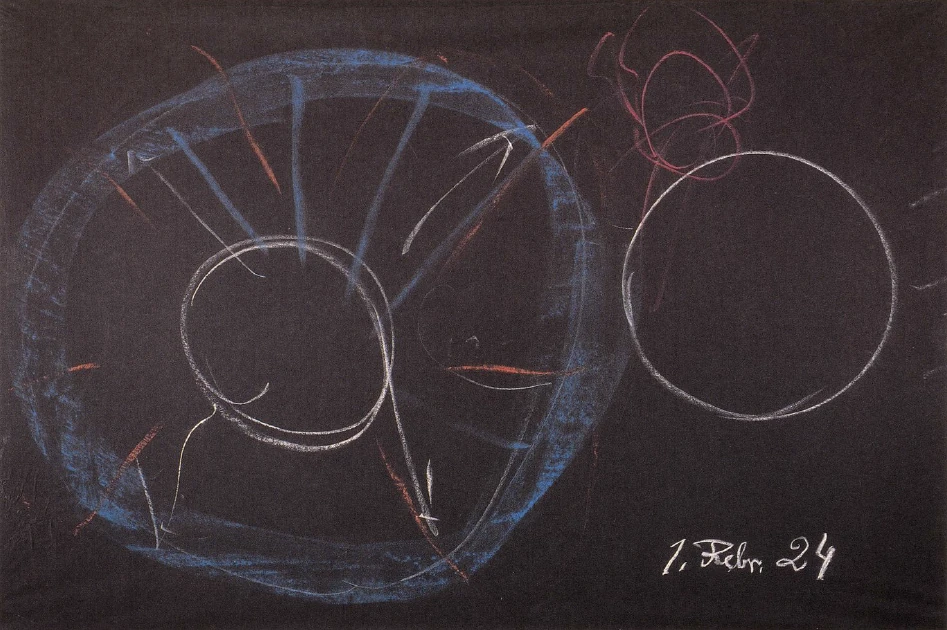
[ 46 ] And now a third element is added to the earlier metamorphosis of consciousness. Now one says to oneself: You carry your physical body and your etheric body—which you have grasped through intensified thinking—and you carry something else as well—please note, I am speaking of the world of appearances; we will see in the coming days to what extent this is justified. When we speak of the etheric (blue): it comes from this world of space, but what lies beyond it (reddish) comes in from the indefinite. One also loses the awareness that it comes from the spatial realm; it permeates one like a third human being. It flows in through the ether of the cosmos, permeating one like a third human being. And one rightly begins to speak of this through experience: one had the first human being, the physical human being; the second human being, the etheric human being; the third human being, the astral human being—don’t take offense at the words; you know, of course, that you shouldn’t— one carries the astral human, the third human, within oneself. It comes from the spiritual realm, not merely from the etheric. One can speak of the astral body, of the astral human.
[ 47 ] And now we move on. Now we say to ourselves: I inhale, I use my breath for my inner organization, I exhale. — Is it really true that what people imagine to be a mixture, a blend of oxygen and nitrogen, comes and goes?
[ 48 ] Look at what comes and goes—according to the views of our present civilization, it is composed of physical oxygen, nitrogen, and a few other elements. But the one who comes to this—I would say, emerging from empty consciousness, this approaching experience of the spiritual through the ether—experiences in the act of inhalation that which is formed not merely from the ether, but from something beyond the ether, from the spiritual. And one gradually learns to recognize a spiritual influence within the human being through the breathing process. One learns to say to oneself with insight: You have a physical body. It interacts with the solid; that is its medium. You have your etheric body. It interacts with the liquid. Because you are a human being—not merely a solid human or a liquid human—but because you carry within you your airy human, that which is air-like and gaseous, the third human, the astral human, can intervene. Through this substantial aspect on Earth, through the airy aspect, the astral human intervenes.
[ 49 ] Ordinary thinking can never grasp what constitutes the fluid organization within the human being—an organization that, while possessing an inner life that is just as regular, also leads a life that is constantly changing and constantly evolving; what is, in this sense, the “fluid human being” can only be grasped through strengthened thinking: With ordinary thinking, we perceive the physical human being as having defined contours. And because our anatomy and physiology deal only with the ordinary human being, they account for 10 percent of the human being. But what the human being is as a “fluid human” is in constant motion; it never reveals a fixed contour. Here it is one way, there another; here long, there short. What is in constant motion cannot be grasped with calculative, defined concepts; it is grasped with concepts that are themselves in motion—that are images. You grasp the etheric human within the fluid human through images.
[ 50 ] And the third human being, the astral human being, who acts within the etheric human being—you can grasp this only if you perceive it not merely through images, but in yet another way. For if you go farther and farther in your meditation—and by this I mean the Western process of meditation—then, from a certain point in your exercises onward, you will notice that your breath becomes something musically perceptible within you. You experience your breath as inner music. You experience yourself as interwoven and permeated by inner music. The third human being—who is physically the air-human and spiritually the astral human—you experience as an inner musical quality. It is there that you grasp the breath.
[ 51 ] The Eastern meditator did this directly by concentrating on his breathing, making his breathing irregular, and introducing yogic breathing in order to understand how the breath weaves and lives within the human being. In this way, he worked directly toward grasping this third human being.
[ 52 ] And so we come to what this third human being is, and can say for now: By deepening our insight, by strengthening our insight, we come to distinguish, first of all, in the human being: the physical body, which lives on Earth in solid forms and is also connected to the earthly realms; the second, the liquid human being, in whom, however, a constantly moving etheric element lives, which can only be grasped in images—but images that are moving images, moving sculpture; the third human being, the astral human, whose physical image is reflected in everything that the inhalation current does. It enters, takes hold of the inner organization, spreads out, works, transforms itself, and flows out again. This is a wondrous process of becoming. It cannot be drawn—at most symbolically, but not in reality. You can no more draw this than you can draw the notes of a violin. You can do so symbolically, but you must direct your musical ear toward it so that you hear it inwardly. You must direct not the hearing of external sounds, but your inner musical hearing toward it. You must hear the weaving of the breath inwardly. You must hear the human astral body inwardly. It is the third human being. It is the human being we perceive when we advance toward empty consciousness and allow this empty consciousness to be filled by that which is inspired into us.
[ 53 ] Well, language is truly wiser than humans are, because language dates back to primeval times. There is a profound reason why breathing was once called “inspiration”; indeed, the words of our language convey much more than we perceive in them today with our abstract consciousness.
[ 54 ] These are the things that initially led us to the three aspects of human nature: the physical body, the etheric body, and astral body—which manifest through the air-human, the liquid-human, and the solid-human, and which find their physical counterparts in the forms of the solid-human, in the ever-changing shapes of the liquid-human, and in what permeates the human being as an inner music experienced through feeling. The most beautiful reflection of this inner music is, of course, the nervous system. It is built first and foremost from the astral body, from this inner music. That is why the nervous system exhibits this marvelous structure at a certain point (it is drawn): the spinal cord, from which the various strands branch out. All of this together forms a marvelous, musical structure that is constantly at work within the human being, working its way up into the head.
[ 55 ] An ancient wisdom, still alive in Greek culture, sensed within the human being this marvelous instrument that exists there, for the air we breathe rises all the way up through the spinal cord. The air we inhale enters the spinal canal and rises toward the brain. This music is truly being performed, though it remains unconscious to the human being. He finds only that which is reflected upward in his consciousness. There it is the lyre of Apollo, this inner musical instrument that the instinctive primordial wisdom within the human being still recognized. I have drawn attention to these things before, but now I would like to provide a summary of what has been developed within our society over the course of twenty years.
[ 56 ] Tomorrow I will move on to the fourth aspect of human nature—the actual “I” organization—in order to then show how these various aspects of human nature are connected to human life on Earth and to humanity’s so-called “eternal life” beyond Earth or in the afterlife.