Anthroposophy
A Summary After Twenty-one Years
GA 234
19 January 1924, Dornach
Translated by Steiner Online Library
First Lecture
[ 1 ] My dear friends, as I now attempt to provide a kind of introduction to anthroposophy itself, I intend to do so in such a way that it also serves, as far as possible, as a guide to how anthroposophy can be presented to the world today. But I would still like to preface this with a few introductory remarks. It is usually not sufficiently taken into account that the spiritual is a living reality; and that which is alive must also be grasped in its full vitality. We simply must not—by feeling ourselves to be the bearers of the anthroposophical movement within the Anthroposophical Society—assume, as it were, the hypothesis that the anthroposophical movement begins anew every day. It has been in existence for more than two decades, and the world has taken a stance toward it. Therefore, in any way we relate to the world in the anthroposophical sense, there must be this sense that we are dealing with something toward which the world has taken a stance; this sense must be present in the background. If one lacks this feeling and thinks one is simply representing anthroposophy in an absolute sense—just as one might have done two decades ago—then one will continue further and further down the path of casting this anthroposophy in a negative light before the world. And that has already happened all too often. On the one hand, this must be brought to an end, and on the other hand, our Christmas Conference should mark a new beginning. This conference must not remain without effect, as I have already indicated in various ways.
[ 2 ] Certainly, not every member of the Anthroposophical Society can be expected to, so to speak, give themselves new impetus in some way if their state of mind does not allow for it. Everyone has the right to continue—I would say—to be a participating member who takes things in and is content simply to take them in. But anyone who wishes to participate in representing anthroposophy to the world in any form cannot ignore what I have explained. In this regard, the fullest truth must prevail in the future—not only in words, but in deeds.
[ 3 ] Well, my dear friends, I will be offering such introductory remarks more often. Let us now begin by providing a kind of introduction to the anthroposophical worldview.
[ 4 ] Anyone who wishes to speak about anthroposophy must assume that, first and foremost, what they wish to say is, in the final analysis, nothing other than what the heart of their listener is already saying through itself. Throughout the world, no science of initiation or initiation rites has ever intended anything other than to give voice to what, in essence, the hearts of those who wish to hear it are already saying of their own accord. Thus, in the most eminent sense, the fundamental tone of anthroposophical presentation must be to address the deepest heartfelt need of those people who require anthroposophy.
[ 5 ] When one looks today at those people who rise above the surface of life, one sees that the ancient, timeless feelings within every human soul have been renewed. One sees that people today have profound questions in their subconscious—questions that cannot even be formulated into clear thoughts, let alone find an answer through what is available in the civilized world. But these questions do exist. And they are deeply present in a large number of people. In fact, they are present in all truly thinking people of the present day. Yet when one puts these questions into words, it seems at first as if they were far-fetched, and yet they are so close. They are in the very immediate vicinity of the human soul, of thinking people.
[ 6 ] Two questions can be posed initially from the entire scope of the mysteries that weigh heavily on people today. The first question arises for the human soul when it looks upon its own human existence and the world around it. The human soul sees the human being entering earthly existence through birth. It sees life unfolding between birth—or conception—and physical death. It sees this life unfolding with the most diverse inner and outer experiences. And this human soul also sees nature outside, all the abundance of impressions that come to the human being and that gradually fill the human soul.
[ 7 ] And so this human soul stands there in the human body and observes one thing above all else: Nature actually absorbs everything that the human soul perceives during its physical earthly existence. When a person has passed through the gate of death, nature, through some element—whether cremated or buried, for there is not such a great difference—nature, through some element, absorbs the human physical body. But what does nature do with this physical body? It destroys it. The human soul does not usually observe the paths taken by the individual substances of this physical human body; but if one reflects on those places where a peculiar form of burial takes place, then this striking observation of what nature does with all that is physically and sensually human—once a person has passed through the gate of death—becomes, so to speak, more profound. There are, after all, underground vaults where human corpses are stored, locked away, yet kept exposed to the air. They dry out. And what do we find after some time? After some time, these corpses take on a distorted human form, consisting of carbonated lime that has already disintegrated within itself. And if one shakes this mass of carbonated lime—which mimics the human form in a distorted way—even just a little, it crumbles into dust.
[ 8 ] This gives a profound sense of what comes over the soul when it considers what actually happens to that through which everything a human being accomplishes between birth and death. And the human being then looks to nature, which provides him with the knowledge from which he actually draws everything he calls insight, and says to himself: This nature, which brings forth from its bosom the most wondrous crystallization; this nature, which conjures up from within itself the sprouting, budding plants every spring; this nature, which sustains the bark-clad trees for decades; this nature, which fills the earth with animal kingdoms of the most diverse kinds, from the largest animals down to the tiniest bacilli; this nature, which sends up into the clouds what it carries within itself as water; this nature, upon which shines down that which, in a certain sense, flows down from the stars; this nature—it relates to what the human being carries within itself between birth and death in such a way that it destroys it until it is completely reduced to dust. For human beings, nature with its laws is the destroyer. One stands before the human form; this human form, which one beholds with all the wonder it possesses—and it does possess wonder, for it is more perfect than all other forms to be found on Earth—this human form stands there. And on the other side stands Nature with its stones, its plants, its animals, its clouds, its rivers and mountains, with all that radiates down from the sea of stars, all the light and warmth that streams down from the sun to the Earth; and this Nature, in accordance with its own laws, does not tolerate the human form. That which stands as a human being, when surrendered to nature, is scattered to the winds. The human being sees this. He does not form ideas about it, but it lies deep within his soul. Every time a human being is confronted with the sight of death, it settles deep within his soul. For it is not out of mere selfish sentiment, nor out of a mere superficial hope of continuing to live after death, that a question takes shape once again deep within the mind, subconsciously—a question that holds infinite significance in the soul, one that determines the soul’s happiness and unhappiness, even if it is not articulated. And everything that, in the consciousness of human beings on earth, may fatefully signify happiness and unhappiness is, in the final analysis, trivial compared to the uncertainty of feeling that arises from the sight of death. For there the question arises: Where does this human form come from? I look at the wonderfully formed crystal; I look at the forms of the plants; I look at the forms of the animals; I watch as the rivers roll across the earth; I see the mountains; I see all that speaks from the clouds, all that speaks down from the stars. “I see all of this,” says the human being, “but the human form cannot come from any of it, for all of this possesses only forces of destruction, forces that dissolve the human form itself.”
[ 9 ] And so the anxious question arises in the human mind, in the human heart: Where, then, is the world from which the human form comes? Where is it, this world? — The sight of death gives rise to the anxious question: Where is the world, this other world, from which the human form comes?
[ 10 ] Do not say, my dear friends, that you have not yet heard this question phrased in this way. If one listens to what people entrust to language from the depths of their minds, one does not hear this question phrased in this way. When one stands before people, and they voice the lamentations of their hearts—they sometimes voice the lamentations of their hearts by seizing upon some trifle of life and making all sorts of reflections on this trifle, which they weave as a nuance into the whole question of their destiny—whoever understands this language of the heart hears the heart speaking from the subconscious: What is this other world from which the human form comes, since the human being of this world does not belong here with his form?
[ 11 ] And so the world stands before humanity—the world it beholds, the world it observes, the world it perceives, the world upon which it bases its science, the world that provides the foundation for the effects of its art, the world that gives it the reasons for its religious veneration—this world stands before humanity, and humanity stands upon the earth and feels deep within its soul: I do not belong to this world; there must be another that has conjured me forth from its bosom in my present form. To which world do I belong? — This is the cry that rises from the hearts of people today. This is the all-encompassing question. And if people are dissatisfied with what today’s sciences offer them, it is because they ask this question in the depths of their souls, and the sciences are far from even touching upon it in any way: To which world does humanity actually belong? — for it is not the visible world.
[ 12 ] My dear friends, I know for certain: What I have spoken to you, I did not speak it myself; I have merely given words to what the hearts speak. And that is what matters. For it cannot be a matter of presenting people with something that is unknown to their own souls—though that might create a sensation—but rather, it is a matter, and can only be a matter, of putting into words what human souls express through themselves. Whatever a person observes in themselves, whatever they observe in their fellow human beings—insofar as it is visible—does not belong to the rest of the visible world. Not a single finger—as a person might say to themselves—that I have on my hand belongs to this world of the visible, for this world of the visible carries within itself only the forces of destruction for every finger.
[ 13 ] And so, at first, human beings stand before the great unknown. But they stand before this unknown in that they must regard themselves as part of it. In other words, with regard to everything that human beings are not, there is spiritual light all around them; the moment a person looks back upon themselves, the whole world darkens and becomes gloomy, and the person gropes in the darkness, carrying the mystery of their own being through that darkness. And so it is when a person views themselves from the outside, when they find themselves standing within nature as an external being. As a human being, they cannot approach this world.
[ 14 ] And once again, it is not the mind, but the depths of the unconscious that give rise to questions—sub-questions to this general question I have just discussed. As a person contemplates his physical existence—which is his instrument between birth and death—he knows: Without this physical world, I cannot live this existence between birth and death at all, for I must continually draw upon this existence of the visible world. Every bite I take into my mouth, every sip of water, comes from this world of the visible, to which I do not actually belong. I cannot live in physical existence without it. If I have just taken a bite of a substance that must, of course, belong to this visible world, and if, immediately after taking that bite, I pass through the gate of death, at that very moment what that bite is within me belongs to the forces of destruction of this visible world. And since it does not belong to the forces of destruction within me, my being—my very own being—must protect it from them. But nowhere out there in the visible world can this very own being be found. What, then, do I do with the bite of food I take into my mouth, what do I do with the sip of water I take into my mouth, through my own being? Who am I, then, who receives and transforms the substances of nature? Who am I, then? That is the second question, the sub-question that arises from the first.
[ 15 ] I do not merely walk through the darkness by placing myself in relation to the visible world; I act in the darkness, without knowing who is acting, without knowing what the being is that I call my self. I am completely devoted to the visible world; but I do not belong to it.
[ 16 ] This sets human beings apart from the visible world. It makes them see themselves as belonging to an entirely different world. And there looms the anxious, profound question: Where is the world to which I belong? — And the more human civilization has advanced, the more people have learned to think deeply, the more this question has become a source of anxiety. And today it lies deep within people’s hearts. Insofar as they belong to the civilized world, people are actually divided into only two groups with regard to this question. Some suppress it, stifle it, refuse to bring it into the light, yet suffer from it as if from a terrible longing to solve this human enigma; others numb themselves in the face of this question, telling themselves all sorts of things about external existence in order to numb themselves. And by numbing themselves, they eradicate within themselves the firm sense of their own being. A feeling of nothingness takes hold of their souls. And this feeling of nothingness lies today in the subconscious of countless people.
[ 17 ] This is the one aspect that raises a major question along with the sub-question mentioned. It arises when a person looks at themselves from the outside and perceives—even if only very faintly and subconsciously—their relationship to the world as a human being between birth and death.
[ 18 ] But another question arises when a person looks within themselves. There lies the other pole of human existence. That is where thoughts reside. They reflect external nature. Through their thoughts, people represent external nature. People develop sensations and feelings about external nature. A person acts upon the external world through their will. At first, a person looks back into their own inner world. The surging currents of thought, feeling, and will stand before their soul. Thus, with their soul, they stand present within that inner world. Added to this are memories of past experiences—memories of things seen in earlier times of their present earthly existence. All of this fills the soul. What is it?
[ 19 ] Now, a person does not form clear ideas about what he actually holds within himself; but the subconscious forms these ideas. A single migraine, which drives away thoughts, immediately turns a person’s inner world into a mystery. And every state of sleep turns it into a mystery when a person lies motionless and lacks the ability to communicate with the outside world through their senses. A person feels that their physical body must be active; only then do thoughts, feelings, and impulses of will arise in their soul. But the stone I have just been looking at, which may have this or that crystalline form—I turn away from it, and after a while I turn back to it—it has remained just as it is. My thought rises up, presents itself as an image in the soul, and then fades back down again. It is perceived as infinitely more valuable than the muscles and bones that a person carries within, yet it is something fleeting; it is a mere image. It is less than a picture I have hanging on the wall; for the picture I have hanging on the wall remains for a time, until it decays due to its physical nature. The thought flies by. A thought is an image that is constantly arising and passing away, a fluctuating image that comes and goes, an image that finds its fulfillment in its very existence as an image. And yet, when a person looks into the depths of their soul, they find nothing but these mental images. They can say nothing other than: their soul consists of these mental images.
[ 20 ] Once again I look at the stone. It is out there in space. It remains. I imagine it now; I imagine it in an hour; I imagine it in two hours. The thought keeps disappearing in between; it must always be renewed. The stone remains out there. What sustains the stone from hour to hour? What causes the thought to fluctuate from hour to hour? What sustains and preserves the stone from hour to hour? What repeatedly destroys the thought, so that it must be rekindled anew by the external sight? What is it that sustains the stone? One says: It is. Being is attributed to it. — Being is not attributed to the thought. The thought can grasp the color of the stone; the thought can grasp the shape of the stone; but it cannot grasp that by which the stone is preserved. That remains outside. The mere image enters the soul.
[ 21 ] And so it is with all things in the external world in relation to the human soul. Human beings can look into this human soul—into their own inner being. The whole of nature is reflected in this human soul. But his soul contains only fluctuating images that, in a sense, strip away the surfaces of things; yet the inner essence of things does not penetrate these images. I move through the world with my ideas. Everywhere I strip away the surface of things, but what things truly are remains outside. I carry my soul through this world that surrounds me, but this world remains outside. And the outer world, in its true being, cannot reach what lies within. And when a person stands before the world that surrounds him in the face of death, he must say to himself: I do not belong to this world, for I cannot penetrate it; my being belongs to another world; I cannot penetrate this world as long as I live in my physical body. And if, after my death, my body were to attempt to penetrate this outer world, it could not do so, for then every step it took would mean destruction for it. Out there lies the world. If a human being penetrates it, the world destroys him; it does not tolerate him within itself with his true nature. But if the outer world were to attempt to penetrate the human soul, it could not do so either. Thoughts are images that exist outside the essence, the being of things. The being of stones, the being of plants, the being of animals, the being of stars and clouds—none of this enters the human soul. A world surrounds human beings that cannot approach their soul, that remains outside.
[ 22 ] On the one hand, human beings—as becomes clear to them in the face of death—remain outside of nature. On the other hand, nature remains outside their soul. Human beings regard it as something external. The anxious question of another world must arise within them. Human beings look to what is most intimate and familiar to them within their own inner selves. They look to every thought, every idea, every sensation, every feeling, every impulse of the will: the nature in which they live does not penetrate any of these; they do not possess it.
[ 23 ] There is a sharp boundary between humanity and nature. Humanity cannot approach nature without being destroyed. Nature cannot enter into the innermost being of humankind without becoming an illusion. By projecting itself into nature, humankind has nothing to imagine but utter annihilation. By looking within and asking, “How does nature relate to my soul?”—humankind has nothing but the insubstantial illusion of nature within its soul.
[ 24 ] But because human beings carry within themselves this reflection of minerals, plants, animals, stars, suns, clouds, mountains, and rivers—and because they carry within their memory the reflection of all the experiences they have had with these realms of external nature—human beings, by experiencing all of this as their surging inner life, have their own sense of being rising up within this surging flow.
[ 25 ] And what is it like, then? How does a person experience this sense of being? They experience it, for example, in the following way. Perhaps this can only be expressed through an image. Look out at a vast sea. The waves rise and fall. A wave here, a wave there—waves everywhere, arising from the water surging upward. Suddenly, one’s gaze is captivated by a particular wave. For this one particular wave reveals that something is alive within it—that it is not merely the churning sea, that something is alive behind this wave. But the water envelops this living thing on all sides. One knows only that something lives inside this wave, yet one sees nothing in this wave other than the water that envelops this life. The wave looks like the other waves. Only from the intensity of its rise, from the force with which it stands there, does one have the feeling that something special lives within it. This wave subsides again. It reappears in another spot; once more, the water of the wave conceals that which animates it from within. So it is with the inner life of the human being. Ideas, thoughts, feelings, and impulses of the will surge up; waves everywhere. One of these waves surfaces in a thought, in a decision of the will, in a feeling. The “I” is there within. But the thoughts, or the feelings, or the impulses of the will—like the water in the wave—conceal what is alive. They conceal that which lies within as the “I.” And the human being does not know what he himself is. For everything that reveals itself to him at the very point where he knows only this: “Here my self surges up, here my own being surges up”—all that which reveals itself to him is merely an illusion. The illusion in the soul obscures the Being, which is certainly there, which the human being senses and experiences inwardly. But the illusion covers it up, just as the water of a wave covers a living being rising from the unknown depths of the sea. And the human being feels his own true essence veiled by the illusory constructs of his own soul. And it is as if a person were constantly trying to cling to his being, as if he wanted to grasp it somewhere. He knows it is there. But the moment he tries to grasp it, it slips away from him again, rushing away from him. Human beings are unable to grasp, amid the surging waves of their soul, what they know—that they are beings who exist. And when human beings then come to realize that this surging, illusory life of the soul has something to do with that other world that appears before their imagination when they look out into nature—then, then a truly terrifying mystery arises. The mystery of nature is at least one that is, so to speak, present in experience. The mystery of one’s own soul is not present in experience, because it lives of its own accord, because it is, so to speak, a living mystery, because in response to humanity’s enduring question—“What am I?”—it sets before them that which is mere illusion.
[ 26 ] When a person looks within, they become aware that their inner self continually gives them this answer: “I show you only a reflection of yourself; and if you derive yourself from a spiritual existence, I show you a reflection of that spiritual existence in the life of your soul.”
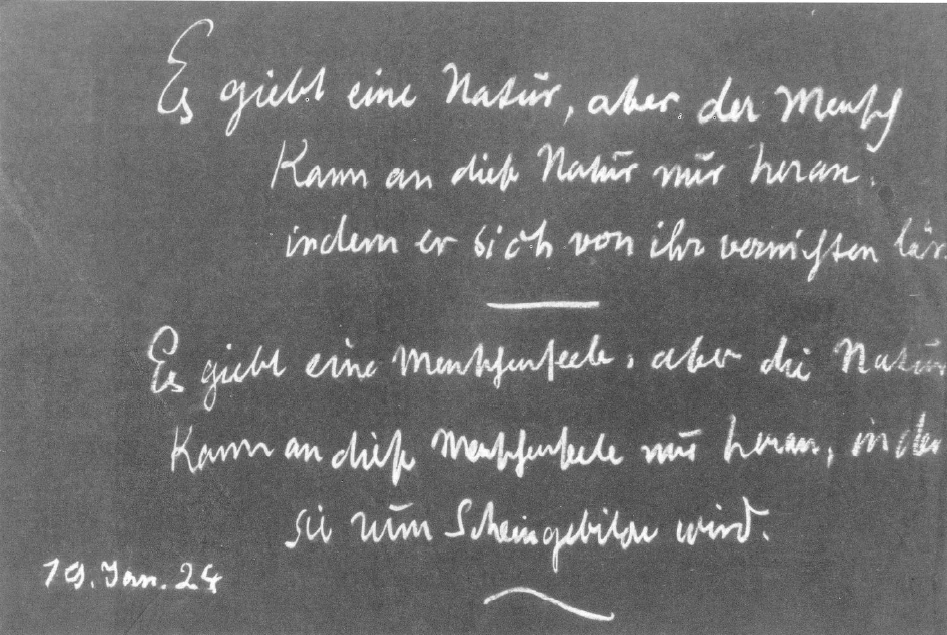
[ 27 ] And so probing questions approach human life today from two sides. One question arises from the fact that human beings become aware (inscription on the panel):
[ 28 ] There is a nature, but man / can only approach this nature / by allowing himself to be destroyed by it.
[ 29 ] The other (inscription on the plaque):
[ 30 ] There is a human soul, but nature / can only approach this human soul by / becoming an illusion.
[ 31 ] These two insights live on in the subconscious of people today.
[ 32 ] And now man turns his attention to that which lives, carried over from ancient times into our present. There stands the unknown nature that is humanity’s destroyer; there stands the illusory construct of the human soul, to which this nature cannot be brought, even though humanity can only fulfill its physical existence by borrowing from this nature. There stands humanity, so to speak, in a double darkness. And the question arises: Where is the other world to which I belong?
[ 33 ] And the historical tradition rises up. There was once a science that spoke of this unknown world. We turn back to ancient times. We feel a deep sense of awe for what ancient times sought to convey scientifically about this other world, which lies within nature everywhere. But if one knows how to approach nature correctly, this other world reveals itself to the human gaze.
[ 34 ] But modern thinking has abandoned this ancient science. It no longer holds true. It has been handed down, but it no longer holds true. People can no longer trust that what people in ancient times scientifically explored about the world will provide an answer today to their anxious question, which springs from these two subconscious facts. A second force reveals itself to humanity: art.
[ 35 ] But once again, one thing becomes evident in art. Art reveals how artistic expression emerges from ancient times: the spiritualization of physical matter. Through tradition, human beings can receive much of what has been preserved from ancient artistic spiritualization. But precisely when a genuine artistic nature resides in his subconscious, he feels unsatisfied today because he can no longer master what even Raphael himself conjured into the human, earthly form as a reflection of another world to which human beings belong with their true being. Where, then, is the artist today who knows how to treat physical, earthly substance in such a stylized way that this physical, earthly substance reflects that other world to which human beings actually belong?
[ 36 ] The third element that has been traditionally preserved from ancient times is religion. It directs human feeling and piety toward that other world. This religion once arose because human beings received the revelations of nature, which is actually so distant from them. And when we cast our spiritual gaze back thousands of years, we encounter people who also felt: There is a nature, but human beings can only approach this nature by allowing themselves to be destroyed by it. Yes, even people thousands of years ago felt this in the depths of their souls; but they looked on—and this was still the case even among the Egyptians—at the corpse, which, as it were, enters a kind of cosmic Moloch within outer nature and is destroyed as a corpse. They looked on; but they saw that the human soul, too, passes through the very same gate behind which the human corpse is destroyed. Those ancient Egyptians would never have created their mummies if people, gazing into the soul in ancient times, had not seen that the soul, too, passes through the very same gate through which the physical body passes—beyond which the physical bodies are destroyed. But the soul goes further. These people of ancient times sensed how this soul grows larger and larger and ascends into the cosmos. And then they saw that which had vanished into the earth, into the elements; they saw it returning once more from the vastness of the cosmos, from the stars; they saw the human soul vanish in death, first beyond the gate of death, then beyond that gate they saw this human soul on its way to the other world, and they saw it return again from the stars. That was the ancient religion: a revelation of the cosmos. A revelation of the cosmos at the hour of death, a revelation of the cosmos at the hour of birth. The words have been preserved. The faith has been preserved. But does what it contains still have any relevance to the world?
[ 37 ] It has been preserved in otherworldly literature—religious, otherworldly literature and tradition. It stands apart from the world itself. And people of today’s civilization can no longer see any connection between what has been handed down to them religiously and what is now the anxious question. For he looks out into nature and, as he gazes upon death, sees only the human physical body passing through the gate of death and falling prey to destruction beyond death. Then he sees the human form entering through birth. And he must ask himself: Where does it come from? Everywhere I look, I see nothing from which it comes. For he no longer sees it coming from the stars, just as he no longer has the vision to perceive it beyond the gate of death. And religion has become an empty word. In civilization, people are surrounded by what ancient times possessed as science, as art, and as religion. But the science of the ancients has been abandoned. The art of the ancients is no longer experienced in its inner essence, and what stands in its place as a substitute is that which human beings cannot raise up from physical substance to the point where the spiritual shines forth within the physical matter.
[ 38 ] And what remains from ancient times is religion, but religion has no connection to the world. Despite religion, the world remains a mystery to humankind. Then humankind looks within. It hears the voice of conscience speaking. In ancient times, the voice of conscience was the voice of that God who guided the soul through the realms where the physical body is destroyed, who guided the soul and gave it form for earthly life: it was this same God who then spoke within the soul as the voice of conscience. Now, even the voice of conscience has become external. Moral laws are no longer traced back to divine impulses. Human beings look first to history. They look to what has remained to them from ancient times. They can only have a sense that the ancients perceived the two great questions of existence differently than you do today; therefore, they were able to provide themselves with answers in a certain way. You can no longer provide yourself with answers. The mysteries hover before you, devastating to you, because after death they promise you only your own destruction, and because in life they reveal to your soul only an illusion.
[ 39 ] This, then, is how human beings view the world today. And it is from this feeling that the questions arise which anthroposophy is meant to answer. Hearts speak from these two feelings. And the hearts ask: Where is the understanding of the world that does justice to these feelings?
[ 40 ] Anthroposophy aspires to be this understanding of the world. And it seeks to speak about the world and humanity in such a way that there may once again be something that can be understood by modern consciousness, just as ancient science, ancient art, and ancient religion were understood by the consciousness of the past. Anthroposophy has its immense task through the voice of the human heart itself. It is nothing other than the longing of people today. It must live on because it is the longing of people today. That, my dear friends, is what anthroposophy aims to be. It corresponds to what human beings most ardently long for in their outer and inner lives. And the question arises: Can such a worldview exist today? It is up to the Anthroposophical Society to provide the world with this answer. The Anthroposophical Society must find the way to let people’s hearts speak from their deepest longings. Then these human hearts will also feel the deepest longing for the answers.