Anthroposophy
A Summary After Twenty-one Years
GA 234
20 January 1924, Dornach
Translated by Steiner Online Library
Second Lecture
[ 1 ] Yesterday I pointed out how human beings can view themselves from two perspectives, and how the mystery of the world and the mystery of humanity approach human beings from these two perspectives. If we look once more at what emerged for us yesterday, we see, on the one hand, that which is initially perceived in the same way as the external physical world. We see the human physical body. We call it the physical body because it stands before us through our physical senses just as the external physical world does. But at the same time, we must bear in mind the immense difference between this very physical human body and the external physical world. And we were able to perceive this immense difference yesterday in the fact that at the very moment when a human being, passing through the gate of death, must surrender the physical body to the elements of the external physical world—at that very moment, this physical body is destroyed by external nature. External nature, therefore, treats the human physical body not with its constructive forces, but with its destructive forces. And we must therefore seek what gives the human physical body its form—from birth or conception until death—entirely outside the physical world. We must speak of a world that is, at first glance, different—one that builds up this physical human body—for external physical nature cannot build it up; it can only destroy it.
[ 2 ] But on the other hand, there are two things that bring this physical human body into a very close relationship with nature. On the one hand, this physical human body requires substances for its constitution—as building materials, so to speak, although this is speaking in a figurative sense—it requires the substances of external nature, or at least we can say that it requires the intake of the substances of external nature.
[ 3 ] And yet, whether we consider the excretions that result, or the fact that the entire physical body of a human being confronts us after death as a corpse—when we observe what this physical body reveals outwardly—it is, once again, the substances of the external physical world; for wherever we observe this physical body—whether in the individual excretions or in the shedding of the entire physical body at death—it presents itself to us as revealing the very same substances that we also find in the external physical world. Thus we must say: Whatever takes place within this human being—the beginning and end of the inner processes, the inner occurrences—are related to the external physical world.
[ 4 ] But materialistic science draws a conclusion from the fact just mentioned that simply cannot be drawn. If, on the one hand, we see that human beings take in the substances of the external physical world through eating, drinking, or breathing, and that through exhalation, excretion, or at death, returns these substances to the external world as substances that correspond to those of the external world, we can only say that we are dealing here with a beginning and an end. What takes place in the human physical body in between is not thereby determined.
[ 5 ] People speak so lightly of the blood that flows within the human body. But has anyone ever examined this blood within a living human organism? That is simply not possible by physical means. Therefore, one cannot readily draw the materialistic conclusion that whatever enters the body and whatever leaves it is also present within the human organism.
[ 6 ] But in any case, we see that as soon as the intake of external physical substances begins—say, in the mouth, for example—a transformation takes place immediately. We need only put a grain of salt in our mouth; it must be dissolved immediately. A transformation occurs at once. The inner nature of the human physical body is not the same as external nature. It transforms what it takes in and then transforms it back again. Thus, within the human physical organism, we must seek something that, in its initial stage of taking in physical substances, is similar to external nature, and that, in its output, is similar to external nature. But in between lies that which has yet to be recognized in the human being.
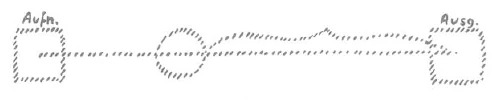
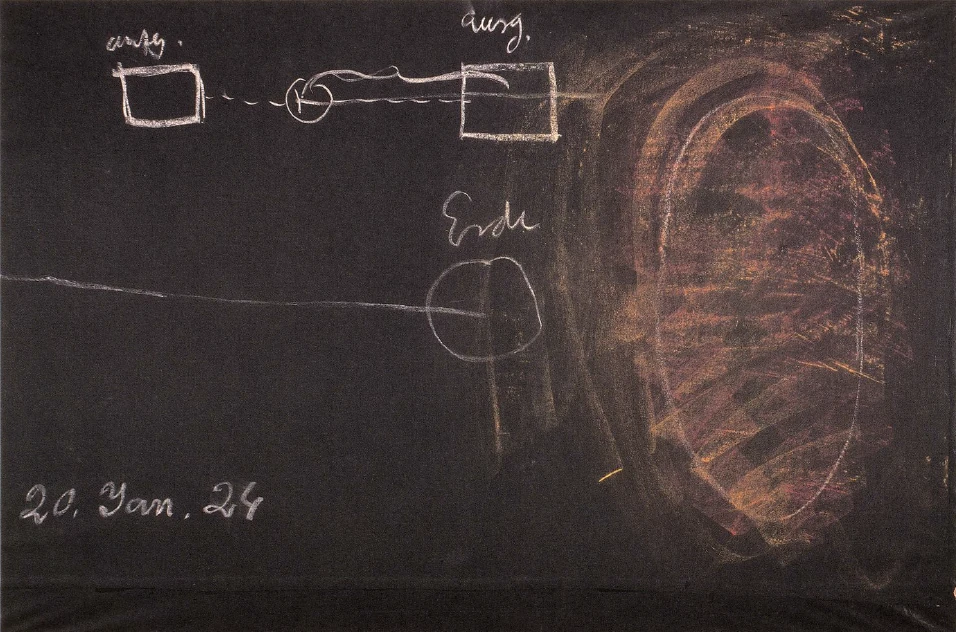
[ 7 ] Try to visualize schematically what I have said (see diagram). We have what the human physical organism takes in, and we have what it gives out—including what it gives out through its entire body. In between lie the processes that take place within the human organism between intake and output. We cannot say anything at all about the relationship between the human being and external nature based on what the human physical organism takes in. For one might say this: If it is indeed the case that external physical nature destroys, dissolves, and disperses the human body, then the human being, in relation to his own organism, pays this back to external nature. He also dissolves everything he receives from external nature. So if we begin with the organs through which the human being takes in physical matter, we do not arrive at a relationship to external nature, for these organs are destroyed by external nature. We arrive at a relationship between the human being and external nature only when we look at what the human being excretes. With regard to the form that the human being brings into physical life, nature is a destroyer; but with regard to what the human being excretes, nature takes in what the human organism provides. Thus, at the end of its life, the human physical organism becomes quite unlike itself, yet very similar to external nature. The human physical organism only becomes similar to external nature through excretion.
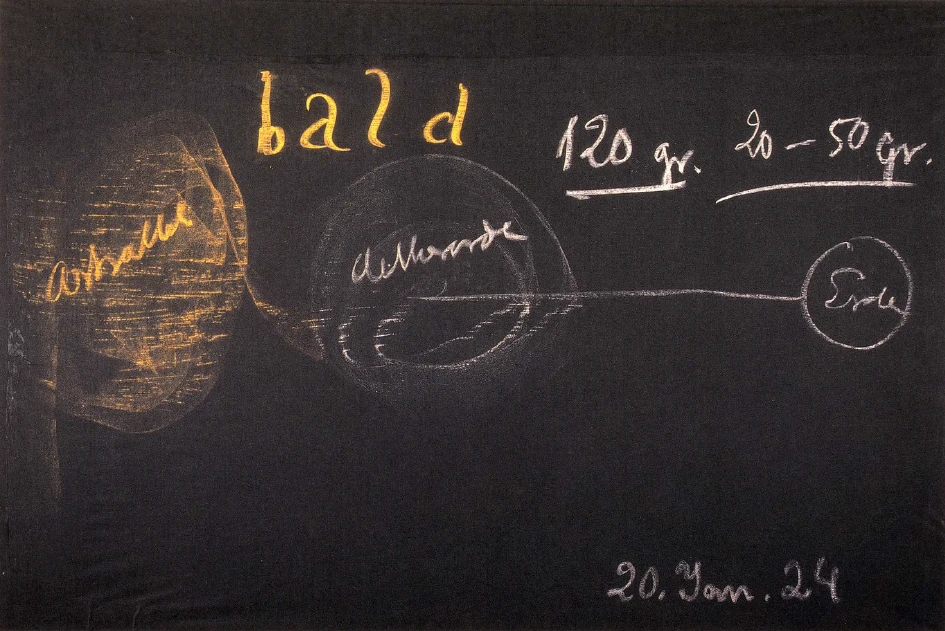
[ 8 ] If you consider this, you will say to yourself: Out in nature are the substances of the various kingdoms of nature. Today they are simply as they have become; but they certainly have not always been this way. Even physical science admits that, if one goes back in time and examines the Earth’s past states, they are quite different from what they are today; thus, what surrounds us out there in the kingdoms of nature has only recently become what it is today. And when we look at the human physical body, we must say to ourselves: The human physical body first destroys what it takes in within itself, transforms it—we will come to the point that it actually destroys it, but let us say for now that it transforms it—in any case, it must bring it to a certain state from which it can then carry it on to the physical nature we see today. That is to say, if you imagine, on the one hand, a starting point somewhere within the human organism where substances begin to develop all the way through to excretions, and then imagine the Earth (see drawing), then the Earth must, over a long period of time, somehow revert to a state in which it once was—and which is now the interior of the human physical organism. You must say: Somewhere in the past, the entire Earth must have been in a state that corresponds to what is found today within the human being. And in the brief span of time during which something organically interwoven within the human organism is transformed into excretions, the internal processes of the human organism repeat what the Earth itself has accomplished over the course of long periods of time.
[ 9 ] We therefore look at the external natural world and say to ourselves: What is the external natural world today was once quite different. But if we want to look at the state in which this external natural world once was and find something similar, then we must look within our own organism. The beginning of the Earth is still there. Every time we eat, the food we consume undergoes a transformation within us that brings it into a state in which the entire Earth once existed. And over the course of long periods of time, the Earth has continued to develop, becoming what it is today. What exists within the human being is the state of the food consumed, which develops all the way through to excretion. To put it briefly, this development over a short period of time encapsulates the entire process of the Earth.
[ 10 ] You see, one can look toward the vernal equinox, where the sun rises every spring. It shifts; it moves forward. In ancient times—let’s say during the Egyptian period—the vernal equinox was in the constellation of Taurus. It has moved through the constellations of Taurus and Aries, and today it is in the constellation of Pisces. And this vernal equinox keeps moving farther and farther. It moves in a circle. After some time, it must return again. The vernal equinox completes a circuit of the celestial sphere in 25,920 years. The sun traverses this circuit every day. It rises, it sets, and in doing so follows the same path as the vernal equinox. We view the long period of 25,920 years as the orbital period of the vernal equinox. We view the short period from sunrise to sunset until it returns again to the point of sunrise—we view a twenty-four-hour period. During that time, the Sun traverses the same circle in a short time.
[ 11 ] So it is with the human physical organism. Over the course of many years, the Earth has consisted of substances that are the same as those we carry within us when we have reached a certain stage of digestion—precisely the midpoint between ingestion and excretion, where ingestion transforms into excretion; at that point, we carry within us the Earth’s origin. In a short time, we bring it to the point of excretion. There we are similar to the Earth. There, the substances, in the form they have today, are handed over to the Earth. Through our process of nutrition in the physical body, we do something similar to what the Sun does in its orbit around the vernal equinox. We may therefore look out upon the physical Earth and say: Today, this physical Earth has arrived at laws that dissolve the form of our physical organism. But this Earth must once have been in a state where laws were at work that today bring our physical organism to the point where food is, precisely when it is in the middle, between intake and excretion. That is to say, we carry within us the laws of the Earth’s beginnings. We are repeating what once existed on Earth.
[ 12 ] Well, we can say this: If we view our physical organism as that which takes in external substances and in turn expels them in the form of external substances, then this physical organism is, in a certain sense, organized for the intake and excretion of today’s substances; but within itself it carries something that was present at the beginning of the Earth, something the Earth no longer has today, something that has disappeared from it, for the Earth possesses the end products, but not the initial products. We therefore carry within us something that we must seek in very, very ancient times within the constitution of the Earth. And what we thus carry within us—which the Earth as a whole no longer possesses—is that which elevates the human being above physical earthly existence. This is what leads the human being to say to themselves: I have preserved the beginning of the Earth within me. By entering physical existence through birth, I always carry within me something that the Earth does not have today, but which it possessed millions of years ago.
[ 13 ] You can see from this that when we refer to human beings as a “small world,” we cannot merely take into account what the world around us is like today; rather, we must look beyond the present state of affairs and delve into the periods of evolution, and that in order to understand human beings, we must consider ancient conditions on Earth.
[ 14 ] That which still exists in human beings in this way—which the Earth no longer possesses—can nevertheless manifest itself to human observation. And this happens when a person turns to what might be called meditation. We are accustomed to simply allowing the images through which we perceive the external world to arise within us, and to representing the external world through these images. And in recent centuries, human beings have become so accustomed to representing only the external world that they never get around to becoming inwardly aware that they, too, can freely form images from within. Freely forming such images from within is what meditation means: permeating one’s consciousness with images that do not come from external nature, with images drawn from within, while paying particular attention to the force that drives these images forth. One then comes to feel how there truly is a second human being within the human being, how something can truly become inwardly perceptible within the human being—something experienced in the same way as, for example, the muscular strength with which one extends an arm—one experiences this muscular strength within the human being. When one thinks, one usually experiences nothing; but through meditation, it is possible to strengthen the power of thought—the power by which one forms thoughts—in such a way that one experiences it inwardly just as one experiences muscular strength when extending one’s arm. And meditation is successful when one can finally say to oneself: I am actually quite passive in my ordinary thinking. I let things happen to me. I let nature fill me up with thoughts. But I no longer want to let myself be filled up with thoughts; instead, I bring into my consciousness the thoughts I want to have, and I move from one thought to the next solely through the power of inner thinking itself. — Then thinking becomes stronger and stronger, just as muscular strength increases when one uses one’s arm. Eventually one realizes that this thinking is just as much a straining, a feeling one’s way, an inner experience as the experience of muscular strength. Once a person has experienced themselves inwardly to the point where they feel their thinking within themselves—just as one otherwise feels only inner muscular strength—then what they initially carry within themselves as a repetition of an old earthly state immediately comes to the forefront of their consciousness. He learns to recognize the force that transforms the food he has eaten within his physical body and then transforms it back again. And as he comes to experience within himself this higher human being—who is as real as the physical human being is—he simultaneously comes to view the external things of the world through this empowered thinking as well.
[ 15 ] Now, my dear friends, imagine this: with such a strengthened thought, I look at a stone—let’s say a cube of salt or a quartz crystal. I look at a stone with this inner strength. It is as if I were encountering a person: haven’t I seen this person before? Seeing him before me again brings back memories of experiences I had with him ten or twenty years ago. In the meantime, he had been in Australia or somewhere else, as far as I’m concerned. The being that now steps before me as a human being conjures up the experience I had with him ten or twenty years ago. When I look at a salt cube or a quartz crystal with this energized thinking, I immediately see before me what this salt cube or quartz crystal once was, as if the memory of the Earth’s primordial state were unfolding. Back then, however, this salt cube was not hexahedral—that is, it did not have six faces—but everything existed within a undulating, weaving sea of stone worlds. The primordial state of the Earth emerges in this way, just as a memory arises in relation to the objects before us.
[ 16 ] And then I look back at the human being, and the very same impression I otherwise have of the Earth’s primordial state presents itself to me in a second human being that the human carries within. And the very same impression presents itself to me when I look not at stones, but at plants. And I am led, with some justification, to speak of an etheric body alongside the physical body. The Earth was once ether. From the ether, it became what it is today in its inorganic, lifeless forms. The plant still carries within itself what was once an ancient state of the Earth. And so do I: as a second human being, as the etheric body of the human being.
[ 17 ] Everything I am describing to you can become the object of observation for thinking that has been strengthened. So that we can say: If a person makes an effort to cultivate this active thinking, then he looks at himself, at the plant, and, as he looks at the minerals—recalling the ancient times that the minerals evoke—he perceives the etheric beyond the physical. But what, then, can one learn from what one encounters in such higher observation? From this, one knows that the Earth was once in an etheric state, that the ether has remained, that it still permeates plants and animals today—for one perceives it in them as well—and that it permeates human beings.
[ 18 ] But now another aspect comes into play. We perceive minerals as devoid of ether. We perceive plants as endowed with ether. But at the same time, we learn to see the ether everywhere. It is still there today. It fills the space of the universe. It simply does not participate in the outer mineral nature. It is everywhere. And when I simply pick up the piece of chalk, I notice that all sorts of things are happening in the ether. Oh, it is a complex process, a complex sequence of events, when I pick up the piece of chalk. My arm and my hand pick up the chalk. What my hand is doing there is the unfolding of a force within me. This force within me is present during the waking state; during the sleeping state, it is not present. If I observe what the ether does—the transformation of food described above—it is present throughout both the waking and sleeping states. At first glance, if one were to be superficial, one might doubt this in the case of humans, but not in the case of snakes, for they sleep in order to digest. But what happens when I raise my arm can only occur in the waking state. The etheric body does not assist me in this lifting. Yet even when I merely lift a piece of chalk, I must overcome etheric forces; I must act into the ether. But my own etheric body cannot do this. I must therefore carry within me a third human being who can do so.
[ 19 ] At first glance, I cannot find this third kind of human being in anything similar out there in nature. This third kind of human being—who can move, who can lift things, who can lift his own limbs—I cannot find him in external nature. But external nature, in which ether is everywhere present, does indeed enter into a relationship with this—let’s say—“human of power,” with this human being into whom the human being himself pours the power of his will.
[ 20 ] At first, one can perceive this unfolding of inner forces only within oneself through an inner experience. But if one continues the meditation—if one does not merely engage in the inner process of creating one’s own mental images and moving from one to the next in order to strengthen one’s thinking, but rather, after having attained such powerful thinking, lets it go inwardly and empties one’s consciousness completely—then one achieves something special. Yes, when one frees oneself from the ordinary thoughts that one passively acquires, one falls asleep. The moment a person no longer perceives, no longer thinks, they fall asleep, because ordinary consciousness is, after all, passively acquired. If it is not there, they fall asleep. But when one develops the powers through which one sees the etheric, one has an inwardly strengthened human being. One feels the powers of thought just as one otherwise feels muscular strength. If one then suggests this strengthened human being away again, one does not fall asleep; instead, one exposes one’s empty consciousness to the world. Then that which the human being senses when moving their arms, when walking, and when exercising their will objectively enters into the human being. In the world of space, what acts as forces within the human being cannot be found anywhere. But it enters into space when one creates empty consciousness in the way I have described. Then one also objectively discovers this third human being within the human being. If one then looks out again into the external natural world, one realizes: Yes, the human being has an etheric body; animals have an etheric body; plants have an etheric body. Minerals do not. They merely remind us of the primordial earth ether. But ether is everywhere. Wherever one looks, wherever one goes, ether is everywhere. But it denies itself. Why? Because it does not reveal itself as ether.
[ 21 ] You see, when you approach plants with the meditative consciousness I described at the beginning, you have an etheric image. When you approach a human being, you have an etheric image. But when you approach the general ether in the world, it is as if you were swimming in the sea: there is nothing but ether everywhere. It does not produce an image; but it does produce an image the moment I simply raise the chalk: then an image appears in the etheric realm where my third being develops its power.
[ 22 ] Imagine this scene: The chalk is lying there at first; my hand grasps the chalk and picks it up. I can, of course, recreate the whole thing in my mind as a series of snapshots. What unfolds there has a counterpart in the ether. But this counterpart in the ether is only seen at the moment when I can perceive through empty consciousness—when I can perceive the third human being, not the second, etheric human being, but the third human being. This means that the general world ether does not act as ether; it acts like the third human being.
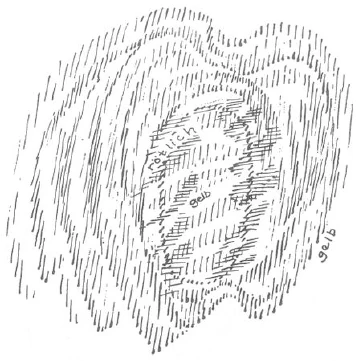
[ 23 ] And I can say: First I have the physical body (oval), then the etheric body, which I perceive through meditative consciousness (yellow), and then the third human being—I call him the astral human (reddish). But all around me, everywhere, I have what was the second element in the world, the world ether (yellow). This world ether is, at first, like an indefinite sea of ether. Now, the moment I radiate anything that comes from my third human being into this ether, it responds to me as if it were identical to my third human being; it does not respond to me etherically, but rather astral. Thus, through my own activity, I unleash something throughout the vast sea of ether that is similar to my own third human being.
[ 24 ] Now, when I ask myself: What is it, then, that I am unleashing there? What is it, then, that serves as a counter-image in the etheric realm? I pick up the chalk; my hand moves from bottom to top. The etheric image moves from top to bottom. It is the correct counterpart. It is actually an astral image, but it is merely an image. Yet that through which this image is evoked is the real human being of today. If I now learn, through what I have said earlier, to look back at Earth’s evolution, and if I learn to apply what has been briefly repeated in the manner I have described to the great process of evolution, then the following becomes clear to me:
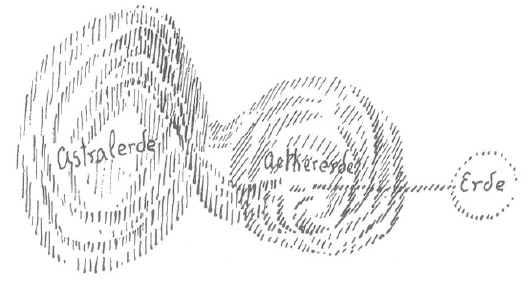
[ 25 ] I have the current state of the Earth (see drawing). I go back to an etheric Earth. In it, I do not yet find that which is unleashed through me into the surrounding ether. I must go back even further and arrive at an even earlier state of the Earth, in which the Earth was like my own astral body, in which the Earth was astral, in which the Earth was a being, just as my third human self is. And this being—I must seek it in times long past, in times far more distant than those in which the Earth was an etheric Earth. But as I go back so far in the course of time, it is really no different from when I see a distant object in space—let us say a light that shines all the way here. (A drawing is made.) It is there; it shines all the way here, forms images, and extends all the way here. Here I have left it; here I have only time instead of space. That which is like my own astral body existed in ancient times, but it is still there. Time has not ceased to exist; it is still there. And just as the light shines from space all the way here, so does that which lies in a time long past continue to influence the present. So, essentially, the entire course of time’s development is still present. What once was has not disappeared, if it is something like that which, in the outer ether, resembles my own astral body.
[ 26 ] So I arrive at something that exists in the mind and transforms time into space. And it is no different than when I correspond from afar via a telegraph for my own sake; in this way, by picking up the chalk and creating an image in the ether, I correspond with that which has long since passed for external perception.
[ 27 ] We see how human beings are placed in the world in a way that is quite different from what it initially appears to be. But we also understand why the mysteries of the world arise for human beings. Human beings sense within themselves—even if they do not realize it—and indeed, not even science today fully grasps this—that they possess an ethereal element which transforms food and then transforms it back again. They do not find this in stones; rather, in ancient times, stones still existed as a general ether. But at work within this general ether is that which lies even further back in time. Human beings thus already carry an ancient past within themselves in two ways, as we can see: a more recent past in their etheric body and a past reaching even further back in their astral body.
[ 28 ] When people today confront nature, they usually focus only on the inanimate. They perceive life in plants only by applying to the plants the substances and the laws governing those substances that they have investigated in the laboratory. They leave out the process of growth; they pay no attention to growth or to the life within plants. Modern science, after all, views plants just as someone who picks up a book and merely looks at the shapes of the letters without reading them. This is how modern science views all things in the world.
[ 29 ] Yes, basically, when you open a book like that and can’t read, the shapes must seem very mysterious to you. You really can’t understand why there’s a shape that looks exactly like this: b, a, then one like this: l, and one like this: d right away. What are they doing next to each other? It really is a mystery. It’s a mystery of the world. — What I have presented to you as a way of looking at things is a process of learning to read the world and human beings. And through this process of learning to read, one gradually comes closer to solving the mysteries.
[ 30 ] You see, my dear friends, today I simply wanted to give you a general outline of the human thought process through which one can find a way out of the state of despair in which humanity finds itself, and which I described to you yesterday. We will examine, step by step, how one can delve deeper and deeper by observing the phenomena out in the world and within human beings.
[ 31 ] But this ultimately involves lines of thought that are completely unfamiliar to people today. And what is the usual reaction? The usual reaction is that people say: “I don’t understand that.” — But what does that mean: “I don’t understand that”? It means nothing other than: “It doesn’t agree with what I was taught in school, and I’ve been conditioned to think the way I was instructed in school.”
[ 32 ] But the school is based on true science, isn’t it? Yes, but this “true science”! Anyone who’s gotten a little older, like me, has witnessed all sorts of things in this regard. For example, we’ve seen that for that process I’ve alluded to here today—the intake of food and its transformation within the human organism—various elements are necessary. They list them: proteins, sugars and starches, fats, water, and salts—these are essential for humans. Now they’re conducting experiments.
[ 33 ] If you go back about twenty years, experiments showed that a person had to consume at least 120 grams of protein a day; otherwise, they couldn’t survive. That was science twenty years ago. What is science today? Today, science tells us that 20 to 50 grams is sufficient. That is science today. Back then, science held that if you didn’t get the 120 grams, you would become sick and malnourished. Today, science tells us that consuming more than 50 grams is not beneficial, but 20 grams is sufficient. And if one consumes more, putrefactive substances form in the intestines, subjecting the body to a kind of self-poisoning. It is therefore harmful to consume more than 50 grams of protein. That is science today.
[ 34 ] But this isn’t just science—it’s life itself. Just think back twenty years, when it was considered scientific fact that one needed at least 120 grams of protein; people were told: “You simply have to eat foods that provide you with 120 grams of protein.” — One would then also have to assume that people could afford all of that. This ties into the national economy. Back then, it was carefully explained how it is impossible to obtain these 120 grams of protein through a plant-based diet, for example. Today we know that the necessary amount of protein is provided by any diet; for if a person simply eats enough potatoes—and they don’t even need to eat much—and eats them with a little butter, that provides the necessary amount of protein. It is now absolutely scientifically certain that this is the case. And there’s another aspect to this: If a person fills up on 120 grams of protein, their appetite becomes highly unreliable. But if they stick to a diet that provides them with 20 grams of protein, and it does happen once in a while that they eat a meal that doesn’t contain those 20 grams—which would leave them undernourished—then it no longer tastes good to them. Their instinct becomes reliable again. Well, of course, there are still malnourished people. That stems from other factors; in any case, it certainly isn’t due to insufficient protein. But there are undoubtedly countless people who, because they overfeed on protein, suffer from self-poisoning and all sorts of other problems.
[ 35 ] I don’t want to discuss the nature of infectious diseases right now, but a person is most susceptible to so-called infection when they consume 120 grams of protein. That is when they are most susceptible to diphtheria or even smallpox. If they consume only 20 grams, they are very difficult to infect.
[ 36 ] So, according to science back then, you needed so much protein that you would poison yourself and expose yourself to every possible infection. That was science twenty years ago! Yes, you see, what people generally think tends to be in line with scientific thinking; but when you look at what was considered scientific on very important matters just a short time ago and what is considered scientific today, you come to realize that this “scientific” view has been fundamentally shaken.
[ 37 ] This is something one must also take to heart when something like anthroposophy emerges—something that directs human thinking, the entire human sensibility, and the entire state of the soul in a different direction than the one that is currently the norm. So I just wanted to point out, so to speak, something that at first appears to be a guide to entering into a different way of feeling and a different way of thinking.