Esoteric Considerations of Karmic Connections
Volume I
GA 235
15 March 1924, Dornach
Translated by Steiner Online Library
Ninth Lecture
[ 1 ] We are discussing karma, the paths of human destiny, and in the last lecture we examined fateful connections that may well be capable of shedding some light on the way in which destiny operates throughout the various earthly lives. I have decided—even though this naturally required a careful decision—to speak about such details of karmic connections, and I would like to continue a little further with these reflections.
[ 2 ] You will have noticed that, in discussing karmic connections, it has become necessary to address certain details in a person’s life and nature that one might otherwise overlook. For example, I have shown you such a detail in the way physical characteristics from one incarnation carry over into a certain soul state in the next incarnation, as in the case of Dühring. It is indeed the case that when one approaches the spiritual worlds in relation to the human being, on the one hand, everything spiritual loses its abstractness; it becomes powerful and exerts an impulsive effect. In contrast, the physical—that which is also expressed physically in the human being—loses its, yes, one might actually say, materiality; it takes on a spiritual significance and occupies a certain place within the entire context of human life.
[ 3 ] How does fate actually work? Fate works in such a way that it operates from within the whole unity of the human being. What a person seeks out in life out of a karmic impulse—and what then takes shape as destiny—is due to the fact that the forces of destiny, which pass from life to life, influence the subtle composition of the blood and determine that they regulate nervous activity internally, while also stimulating the soul-instinctive receptivity to this or that. And one does not easily penetrate the inner workings of fateful, karmic connections unless one—speaking, of course, always from the perspective of the soul’s eye—has an interest in the individual expressions of a person’s life. Indeed, for karmic observation, it is just as important to take an interest in a hand gesture as in a brilliant intellectual gift. It is equally important to be able to observe—naturally also from the spiritual perspective, in terms of the astral body and the I—how a person sits down, just as it is important to observe, let us say, how they fulfill their moral obligations. It is just as important whether a person frowns readily or only slightly as it is whether they are pious or impious. Indeed, much of what seems insignificant in ordinary life is extraordinarily important when one begins to consider destiny as it weaves itself from one earthly life to the next, and much of what seems particularly important in this or that person turns out to be of lesser significance.
[ 4 ] Now, in everyday life, it’s not so easy—let’s say, for example—to pay attention to physical peculiarities. They’re there, and one must have trained oneself to do so—of course, without being hurtful to one’s fellow human beings; and it is hurtful when one observes one’s fellow human beings solely for the sake of observing them. That should never actually be the case; rather, everything done in this direction should arise quite naturally. But once one has trained one’s attention, even in everyday life, specific peculiarities emerge for each person—minor details that are of the utmost significance for karmic observation. Yet one can only truly observe people in relation to their karmic connections in a profound way if one can point out significant peculiarities.
[ 5 ] Decades ago, the philosopher Eduard von Hartmann was an extraordinarily interesting figure to me, both in terms of his inner spiritual life and his outer life. I had a deep interest in this philosopher in particular. But when I now consider his life—in a way that leads to a karmic perspective—I must present to my soul what is valuable in this regard in roughly the following manner. I must tell myself that Eduard von Hartmann, the philosopher of the unconscious, actually made an impact on philosophy in a manner that was, at first, explosive. It is indeed true that such an explosive influence in the spiritual realm was met with great apathy by the people of the 19th century—please forgive me if I sound critical, but I do not mean it in a negative way. The people of the 19th century—and, of course, those of the dawning 20th century as well—simply cannot be roused from their apathy when it comes to what actually stirs the world from within. Enthusiasm is, in fact, scarcely to be found in any profound sense in this age of ours, which is so intellectually apathetic.
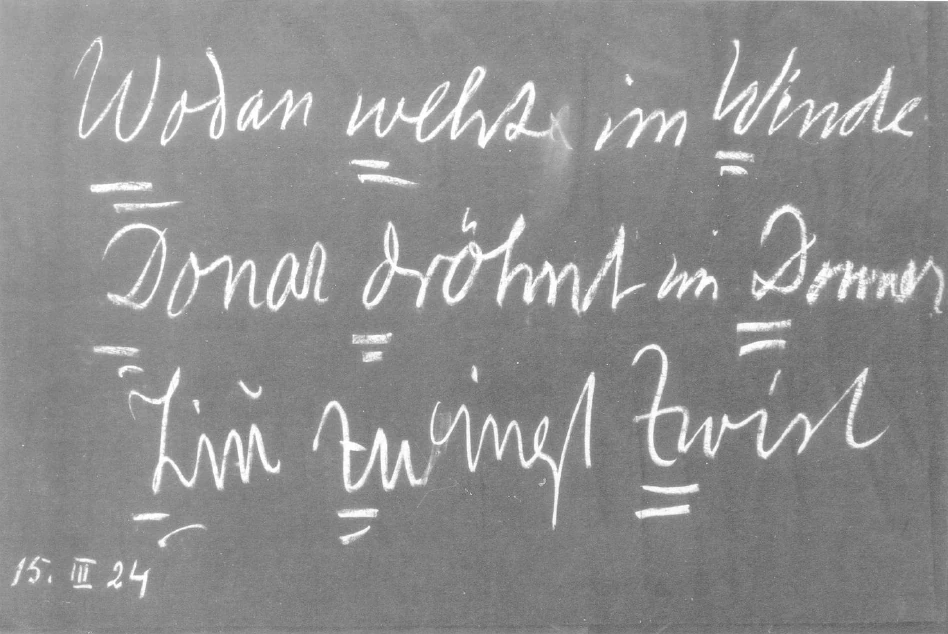
[ 6 ] For example, I once had to describe a historical fact in another lecture series during that time: the clash between the Roman world and the northern Germanic world during the Migration Period, at a time when Christianity was spreading northward from the southern, Greco-Latin regions. One need only properly visualize these physical ancestors of the Central European and Southern European worlds to get a sense of just how much human impulsiveness once existed in the world. It was indeed the case that the various Germanic tribes encountered by the Romans in the first centuries of the Christian era experienced a very lively connection with the spiritual forces of nature. These people related to the spiritual realm in a completely different way. For the most part, they were still deeply imbued with an instinctive inclination toward the spiritual. And while today we usually speak with a certain phlegmatic detachment, so that one word simply follows another as if it were nothing at all when we speak, these people poured what they had experienced right into their language. For them, the blowing of the wind was just as much a physical gesture of a spiritual, soulful expression as when a person moves his arm. They perceived this blowing of the wind, the flickering of the light in the blowing wind, as an expression of Wodan. And when they incorporated these facts into language, when they embedded these things in language, they imbued language with the character of what they had experienced. If we were to express it in modern language: Wodan blows in the wind—as it was also said in the ancient language, the blowing pours forth through language as well—take this shared experience, which trembles and surges right into the language! When a person then looks up, perceives the thunder rumbling from the clouds, and behind this gesture—behind this natural gesture of thunder—discerns the corresponding spiritual essence and gives expression to the whole: “Thunder or Donar roars in the thunder”—there, what resounded in a similar way in the ancient language has been poured into modern language. And then, just as these people sensed the spiritual in the forces of nature and expressed it in their language, so too, when they went into battle, did they express the helping deity who lived within their limbs, who lived in their very demeanor. And there they had their shield, their mighty shield, and there, one might say, they stormed forward with words, holding the shield aloft. And the very fact that they—whether a good spirit or a demonic one—rushed into the language, which in turn, in a mighty clash, grew muffled and soared and became powerful, also expressed what they intended as they charged forward: “Ziu compels strife!” Spoken from behind the shield, with all the fury and zeal of battle, it created a storm! You must imagine this coming from thousands of throats at once, addressed to the shields. In the early centuries, when the South came into contact with Central Europe, it was not so much what appeared outwardly in battle that was truly effective, but rather this mighty roar that surged against the Romans. In those early days, a hopeless fear would seize the peoples approaching from the south. Their knees trembled at the cry of “Ziu zwingt Zwist,” which a thousand throats roared from behind the shields.
[ 7 ] And so one really must say: Certainly, these people are back, but they have become phlegmatic! Quite a few of them used to roar back then and have now become phlegmatic—phlegmatic to the highest degree—having adopted the inner spiritual attitude of the 19th and 20th centuries. But if those fellows were to rise up—the ones who roared back then in their state of mind at the time—they would even put a pointed cap on their present-day incarnations and say: That phlegmatic quality in people—which cannot be roused—belongs under the pointed cap, under the nightcap; it actually belongs in bed, not on the stage of human action!
[ 8 ] I say this simply to illustrate how little inclination there was to grasp something as explosive as what Eduard von Hartmann presented in his Philosophy of the Unconscious. To begin with, he naturally spoke of how everything that is conscious in human beings—conscious thinking—is of little significance compared to what reigns and weaves unconsciously within human beings and unconsciously in nature—that which cannot be brought to consciousness and never penetrates into consciousness. Eduard von Hartmann knew nothing of clairvoyant imagination or intuition; he did not know that the unconscious can penetrate human cognition. Thus, he simply pointed out how what is truly essential remains in the unconscious. But it was precisely from these underlying assumptions that he arrived at the view that the world in which we live is the worst conceivable one. And he took pessimism further than Schopenhauer, concluding that the pinnacle of cultural development must actually consist in destroying this entire earthly evolution one day—destroying it as quickly as possible. He merely said that he did not want to insist that it be done tomorrow, because then there would not be enough time to implement everything necessary to truly destroy the Earth to such an extent that no human civilization—which, after all, is worthless on Earth—would remain. And he dreamed—as described in The Philosophy of the Unconscious—of how humans would come to invent a great machine that they could lower deep enough into the Earth so that this machine would cause a mighty explosion and the entire Earth would explode outward, shattering into outer space.
[ 9 ] Certainly, there were some people who were enthusiastic about this “philosophy of the unconscious.” But when they speak of such a thing, you don’t see that they are moved by it with their whole being. Something like that can be said! It is indeed something powerful when something like that can be said! People say it as if they were merely stating a fact, and that is precisely what is so appalling.
[ 10 ] But that is exactly what happened; such a philosopher did exist. And then this philosopher examined the matters of human morality on Earth. And this work on the “Phenomenology of Moral Consciousness” was, in fact, what interested me most deeply. He also wrote a work on religious consciousness, a treatise on aesthetics, and many other works. And all of that was, at first—especially when one couldn’t quite follow along—something extraordinarily interesting.
[ 11 ] Now, of course, one might well be curious to know what the fateful connection is with such a person. At first, one might be tempted to delve deeply into his philosophy. One might try to deduce something about their past earthly lives from their philosophical ideas. But one will find nothing there. Yet it was precisely such a personality that interested me—to the highest degree.
[ 12 ] And you see, when one has—I would say—occultism in one’s very being, then the inspiration to look at things in the right way arises. And here we have a fact: Eduard von Hartmann was initially a soldier, an officer. In Kürschner’s address book, alongside his “Dr. phil.” and so on, “First Lieutenant” always appeared as part of his description, right up until his death. Eduard von Hartmann was initially a Prussian officer, and he is said to have been a very good officer.
[ 13 ] You see, from a certain point on, this struck me as far more essential—in terms of the interconnections of human destinies—than the details of his philosophy. The details of his philosophy—well, there one tends, doesn’t one, to accept this or that, to refute this or that. But that’s nothing particularly significant; anyone who has studied a little philosophy can do that. Nothing particularly special comes of it either. But to ask oneself: How is it that there was a Prussian officer—a good officer—who paid little, very little attention to philosophy during his time in the military, but was more concerned with saber drills—how is it that he, of all people, became a representative philosopher of his age? And how did he come to be that?
[ 14 ] Yes, you see, my dear friends, he came to be this way because he developed a knee condition due to an illness, was forced to retire, and suffered from this knee condition for the rest of his life. At times he was completely unable to walk, forced to keep his legs stretched out, to walk very little, to sit—to sit on a sofa. And so, having absorbed the education of his time, he wrote one philosophical work after another. Hartmann’s philosophy, after all, fills an entire library. So he wrote a great deal.
[ 15 ] But as I observed his personality, I came to realize one day the very special significance of his knee ailment—the onset of his knee ailment. I was far more interested in the fact that the man had developed a knee ailment at a certain age than I was in his transcendental realism, or in his statement: “First there was the religion of the Father, then the religion of the Son, and in the future there will be the religion of the Spirit.”—These are witty remarks, but they were more or less to be found on every street corner in the witty 19th century. But the fact that someone becomes a philosopher as a result of developing a knee ailment while serving as a lieutenant—that is a very significant fact. And as long as one cannot trace things back to such origins, as long as one allows oneself to be blinded by what appears to be the most striking aspect, one will not be able to grasp the karmic connections.
[ 16 ] And when I was able to correctly connect the knee ailment with the whole personality, a view opened up to me of what had actually occurred in this personality as a matter of destiny. Then I was able to go back. It was not from Eduard von Hartmann’s head, but from his knee that I found the path to his earlier incarnations. With other people, it starts with the nose, and so on. As a rule, it is not what one considers most important for earthly life between birth and death.
[ 17 ] Well, what is this connection? You see, the human being, as he presents himself in earthly life, is in fact—as I have repeatedly pointed out—already a threefold being, even as a physical being. He has his nervous-sensory system, which is concentrated mainly in the head but extends throughout the entire human being. They have their rhythmic system, which manifests particularly clearly as the rhythm of breathing and blood circulation, but which in turn extends throughout the entire human being and expresses itself in everything; and they have their motor system—the system of the limbs, which is connected to metabolism—that is related to metabolic consumption, the replenishment of substances, and so on. The human being is a threefold being.
[ 18 ] And then, when considering the whole context of life, one realizes: in the cycle of births and deaths, what one regards as most important in each earthly life—the head—is of relatively little significance soon after death. The head, which in the physical realm is the most human part of a person, also exhausts its essence quite completely in the physical realm; whereas for the rest of the human organism—which is inferior in the physical realm—the higher aspect lies precisely in the spiritual realm. In the head, the human being is most physical and least spiritual. In contrast, the human being is more spiritual in the other parts of their organism—in the rhythmic system and in the limb system. The human being is most spiritual in the motor system, in the activity of their limbs.
[ 19 ] And now it is the case that what constitutes a person’s intellectual gifts is lost relatively soon after death. In contrast, that part of the spiritual-soul life in the unconscious which belongs to the lower organizations becomes particularly important between death and a new birth. But while it is generally the case that, from one earthly life into the next, the organization located outside the head—in terms of its form and spiritual content—becomes the head of the next incarnation, what is volitional in the human head does indeed affect the limbs in particular in the next incarnation. Whoever is sluggish in thought in one incarnation will certainly not become a sprinter in the next; rather, the sluggishness of thought is transferred into the slowness of the limbs, just as, conversely, the slowness of the limbs in the present incarnation finds expression in the sluggish, slow thinking of the next incarnation.
[ 20 ] Thus there is a metamorphosis, an interaction between the three different aspects of the human being as it passes from one earthly life to the next, from one incarnation to the next.
[ 21 ] What I am telling you here, I am not telling you as a theory, but rather based on the facts of life. You see, once—I would say—when there was this intention to focus particularly on Eduard von Hartmann’s knee ailment, I was drawn to his earlier incarnation, in which he had suffered a sort of sunstroke at a certain moment in his life. This sunstroke—which was initially the fateful cause that, in the next earthly life, manifested itself metamorphically as weakness in the knee—was, in other words, a mental breakdown. One day he could no longer think; he had a kind of paralysis of the brain. This manifested itself in the next incarnation as paralysis of one of his limbs. And this fateful outcome—developing cerebral paralysis—arose from the following: This individual was, after all, one of those who joined the Crusades to the East and fought in Asia against the Turks and the Asians, yet at the same time came to admire the Asians immensely. After this individual had absorbed with admiration all the magnificent spirituality in the Orient that the Crusaders encountered—after this individual had taken all of this in—he became aware of a person with whom he instinctively felt he had had some connection in an earlier life. And what now had to be settled between this incarnation and the earlier one was a moral matter. The carryover of the sunstroke into the knee ailment between the two incarnations seems at first to be merely a physical matter; but whenever fate is involved, it always traces the matter back to a moral cause—in this case, to the fact that from an even earlier incarnation, this individuality carried within itself the impulse of a fierce, furious struggle against a person whom it now encountered. And in the blazing heat of the sun, the pursuit of this adversary began. It was unjust. It backfired on the individual who was doing the pursuing, as the blazing sunlight paralyzed the brain. And what was to happen in that struggle, my dear friends, stemmed from the fact that in an earlier incarnation this individual had been particularly wise—wise to the highest degree. Now one gained insight into an even earlier incarnation, in which a special intelligence had been present. And the adversary whom this individuality had confronted during the Crusades—this adversary had, in an earlier incarnation, been cornered by this intelligent individuality and had suffered a setback. This established the moral connection; this provided the impulse for the battle, and so on. It then came down to the moral aspect, in that the forces that developed there were rooted in that earlier incarnation.
[ 22 ] Thus, one finds three successive incarnations of a single individuality: an extraordinarily intelligent, wise personality in very ancient times—that is one incarnation. Followed by a crusader who, at a certain point in time—as a result of what his very intelligence had brought about—suffers a cerebral paralysis, and his intelligence is extinguished, even though this intelligence had previously inspired immense admiration for Eastern civilization. Third incarnation: a Prussian officer who, due to a knee ailment, is forced to retire; now unsure of what to do, he turns to philosophy and writes the most impressive “Philosophy of the Unconscious,” which grew entirely out of the civilization of the second half of the 19th century.
[ 23 ] Well, once you have that kind of connection, things that were completely obscure before suddenly become clear. You see, whenever I read Hartmann—even though I wasn’t aware of these connections as a young man—I always had the feeling: Yes, there’s something clever in there. — But when I read a page, I’d think: “Yes, there’s something incredibly insightful here, but the insight isn’t on this page.” I always wanted to turn the page and look on the back to see if that’s where the insight was. It wasn’t the insight of today; it was the insight of yesterday or the day before.
[ 24 ] It only dawned on me when I realized: this intelligence, this particular wisdom, dates back two incarnations and continues to have an effect. Only then does an immense light shine upon this entire body of literature—this Hartmann literature, which fills an entire library—when one realizes that the wisdom from a much earlier incarnation continues to have an effect.
[ 25 ] And when you got to know Hartmann personally, when you spoke with him, you really did get the feeling: behind him is someone who still isn’t speaking; but then there’s a third person behind him who is actually providing the inspiration. For listening to him was sometimes enough to drive one to despair: there was an officer speaking about philosophy—without enthusiasm, indifferently, with a certain harshness—about the highest truths. Only then could one realize how things actually stand, when one knew: behind him lies the wisdom of two previous incarnations.
[ 26 ] Certainly, it may even seem irreverent to tell such things this way, but they are not meant to be irreverent; rather, I am convinced that it can be very valuable for every person to have such connections in their own life, even in the event that someone has to say to themselves: In my third-to-last incarnation, I was actually a truly terrible person! — It can be immensely beneficial for one’s life if one can say to oneself: I was a truly terrible person. — Once, in some incarnation—no, not even in some incarnation—one was, in fact, a truly terrible person under all circumstances! With these matters, you see, as is usually the case in society—with the exception of those present—the current incarnations are always excluded.
[ 27 ] Well, I was also deeply interested—because my life has truly led me to this figure—in the fateful connection with Friedrich Nietzsche. The problem of Nietzsche: I have examined it from every angle; I have, after all, written and spoken quite a bit about Nietzsche and considered this Friedrich Nietzsche from every perspective.
[ 28 ] It was, after all, a strange twist of fate. I saw him only once in my life, in the 1890s in Naumburg, when he was already severely mentally ill. In the afternoon, around half past two, the nurse led me into his room. He was lying on the reclining bed, impassive, with one eye that was unable to perceive that someone was standing before him; with that remarkable, artistically beautiful forehead that was particularly striking. Even though his eye was unresponsive, one still had the feeling that one was not standing before a madman, but rather a human being who had been working intensely in his soul all morning, had eaten lunch, and had now lain down to rest—to reflect, half-dreaming, on what had been worked out in his soul that morning. From a spiritual perspective, there was actually a physical body and an etheric body, particularly with regard to the upper parts of the human being, for the soul-spiritual aspect was in fact already outside; it was still suspended from the body as if by a thick thread. In essence, a kind of death had already taken place, but a death that could not fully take hold because the physical constitution was so healthy that the astral body and the “I,” which were striving to escape, were still being held in place by the immensely healthy metabolic and rhythmic organization—even as the nervous-sensory system lay completely destroyed and could no longer sustain the astral body and the “I.” So one had the wondrous impression: the real Nietzsche is actually hovering above his head. There he was. And down below was already something that, from the soul’s perspective, could have been a corpse—and was not a corpse only because it was still clinging with all its might to the soul, but only for the lower parts of the human being, thanks to the extraordinarily healthy metabolic and rhythmic organization.
[ 29 ] Seeing something like this can certainly draw one’s attention to the fateful connections in the deepest sense. However, in this case, these fateful connections were illuminated—I would say—in a different light. One could not proceed from any single suffering aspect or the like, but was instead led back to the whole spiritual individuality of Friedrich Nietzsche.
[ 30 ] In this biography of Nietzsche, there are, in fact, three distinct periods that must be clearly separated from one another. The first period begins when, as a very young man, he wrote The Birth of Tragedy from the Spirit of Music, inspired by the emergence of music from the Greek mystery cults, and then deriving tragedy from music itself. Then, stemming from the same mood, came the following four works: David Friedrich Strauss: The Confessor and the Writer, Schopenhauer as Educator, On the Use and Abuse of History for Life, and Richard Wagner in Bayreuth. This was in 1876—The Birth of Tragedy from the Spirit of Music was written in 1871—Richard Wagner in Bayreuth, an enthusiastic hymn to Richard Wagner, is in fact perhaps the best work ever written by a follower of Richard Wagner.
[ 31 ] A second phase in Nietzsche’s life begins. He writes his two-volume work Human, All Too Human, as well as the treatises Dawn and The Gay Science.
[ 32 ] Nietzsche, who in his early writings up to 1876 was an idealist in the highest sense—wishing to elevate everything to the level of an ideal—bids farewell to all idealism in this second phase of his life. He mocks ideals. He realizes: When people set ideals for themselves, it is because they are weak in life. If someone can’t accomplish anything in life, he says, life is worthless; one must pursue an ideal. And so Nietzsche takes aim at individual ideals, putting them, as he says, “on ice,” by interpreting that which represents the divine in nature as something all-too-human, even petty. In this respect, Nietzsche is a Voltairean; he even dedicated a work to Voltaire. Here, Nietzsche is a thoroughgoing rationalist and intellectualist. And this phase lasts roughly until the years 1882–1883. Then begins the final phase of his life, in which he develops ideas such as the return of the same, and in which he shapes Zarathustra as an ideal of humanity. It is then that he writes Thus Spoke Zarathustra in a hymnal style.
[ 33 ] There he takes out his notes on Wagner again. It is, after all, something most peculiar! Once one has become familiar with Nietzsche’s working methods, they present themselves in a strange light. Read the essay “Richard Wagner in Bayreuth” today: it is an enthusiastic hymn, magnificent and brilliantly inspiring, in praise of Richard Wagner. In his later years, the book The Case of Wagner appears: everything that could possibly be said against Wagner is contained in this work.
[ 34 ] People say, if they want to be trite: Nietzsche simply changed his tune; he changed his mind. Anyone familiar with Nietzsche’s manuscripts wouldn’t say that. For if Nietzsche wrote a few pages in his book Richard Wagner in Bayreuth as an enthusiastic hymn to Wagner, he also immediately wrote down everything he had against it—contrary to what he himself had said. Then he would write another enthusiastic ode, and again, he would write down what he objected to. The entire “Wagner Affair” had actually already been written as early as 1876. He simply set it aside, suppressed it, and printed only what constituted his enthusiastic ode. He, so to speak, merely took his old notes and interspersed them with a few sharp sentences.
[ 35 ] But he did, after all, have a tendency in this final phase of his life to rail against precisely what he had, so to speak, set aside in the early period of his life. It is likely that if the manuscripts he had set aside—deemed not quite in keeping with the book Richard Wagner in Bayreuth—had been destroyed in a fire, there would have been no “Wagner Affair.”
[ 36 ] You see, if one traces these three epochs, they are all, in turn, permeated by a unifying character. And even the last work—that is, at least the last printed work, The Twilight of the Idols, or: How to Philosophize with a Hammer—where everything, I would say, is shown from its other side, even this last work bears something of the fundamental character of Nietzsche’s entire intellectual world. It’s just that Nietzsche, in his old age—when he actually writes this—becomes imaginative and vivid. For example, he wants to characterize Michelet, the French writer Michelet. The characterization he offers is apt: enthusiasm that takes off its coat while it is still enthusiastic. It captures a certain aspect of Michelet quite excellently. Similar things like this are found in this Twilight of the Idols—vividly.
[ 37 ] Well, once one has this terribly unsettling image of Nietzsche’s individuality hovering above his physicality, one is compelled to say to oneself, looking at his writings: Yes, they actually give the impression that Nietzsche was never fully present in his human physicality when he wrote his sentences, as if he had always—for he did not write while sitting, but while walking, especially while hiking—been somehow outside his own body. You will have this impression most strongly in certain passages of the fourth part of Thus Spoke Zarathustra, where you will have the direct feeling: one does not write this when the body is in control; one writes this only when the body is no longer in control, but when one is with the soul outside the body.
[ 38 ] One gets the feeling that, in his intellectual work, Nietzsche always left his body behind. And this was ultimately reflected in his lifestyle as well. In particular, he liked to take chloral to put himself in a certain frame of mind—a frame of mind independent of the physical. Certainly, this longing to become, in his state of mind, independent of the physical was also prompted by the fact that his body was often ill—for example, he suffered from a persistent headache and the like.
[ 39 ] But all of this paints a consistent picture of Nietzsche in his late-19th-century incarnation, which ultimately led to madness, so that in the end he no longer knew who he was at all. For there are letters to Georg Brandes in which Nietzsche signs himself either “The Crucified One”—that is, he regards himself as the Crucified One—or he looks at himself as if he were a person objectively separate from himself, imagines himself as a god strolling along the Po River, and signs himself “Dionysus.” This separation from the body, when produced mentally, then emerges as something that is particularly characteristic of this personality, of this incarnation of this individuality.
[ 40 ] And if one now immerses oneself in this imaginatively and inwardly, one is led back to an incarnation that is not very far in the past. It is, after all, a distinctive feature of many such personalities—who appear in a particularly representative capacity—that their incarnations are generally not very far in the past, but rather lie relatively close to the present, especially in more recent times. And lo and behold, one arrives at an incarnation of Nietzsche, in which this individual was a Franciscan—an ascetic Franciscan who engaged in intense self-mortification of the body. Now we have the mystery. Our gaze falls upon a man in the characteristic Franciscan habit, lying for hours before the altar, praying until his knees are raw from sliding on them, begging for mercy, mortifying himself terribly. Through pain—especially self-inflicted pain—one becomes very strongly attuned to one’s physical body. One becomes particularly aware of the physical body when suffering pain, because the astral body longs especially strongly for the aching body and seeks to penetrate it. This intense focus on preparing the body for salvation in one incarnation had the effect that the soul no longer wished to be in the body in the next incarnation.
[ 41 ] You see, in characteristic cases, there are fateful connections. One might also say here: they actually unfold differently than one usually supposes. One cannot speculate about successive earthly lives. As a rule, one arrives at the wrong conclusion. But when one arrives at the right one, it sheds light on life in the most profound sense.
[ 42 ] And precisely because a proper examination of this matter can help us see karma in its true light, I have not hesitated—despite its questionable aspects—to present to you specific karmic connections that I believe can already shed a strong light on the very nature of human karma and human destiny. Well, we’ll continue tomorrow.