Esoteric Considerations of Karmic Connections
Volume I
GA 235
16 March 1924, Dornach
Translated by Steiner Online Library
Tenth Lecture
[ 1 ] In my recent exploration of karmic connections, I have generally started with specific individuals whom you may encounter in more recent times, and then attempted to trace the path back to previous earthly lives. Today, to supplement the concrete examples of karmic connections, I would like to proceed in the opposite direction: starting with certain historical figures from the past, and then tracing a path from these historical figures back to later times—either to later periods in history or through their lives up to the present. In a sense, I would like to present a historical account of certain connections interwoven with karmic considerations.
[ 2 ] If one traces the development of Christianity from its origins on earth and onward into Europe, and if one follows the various paths that Christian impulses have taken, one encounters another religious current which, although it is less noticed today, has exerted an extraordinarily profound influence, I would say, just beneath the surface of external historical events, on European civilization. It is what is known as Islam—the Muslim religion that arose a little more than half a millennium after the founding of Christianity—along with everything connected to the life that was linked to the emergence of this Muslim religion.
[ 3 ] We see, first of all, how Muhammad established a form of monotheism, a form of religion that, like Judaism, looks up in a strict sense to a single, all-encompassing deity. There is a single God whom Muhammad also seeks to proclaim. This is something that emanates from Arabia like a powerful impulse and spreads far and wide—across Asia, through Africa, and into Europe via Spain.
[ 4 ] Anyone who looks at contemporary civilization today will still misjudge many aspects of it if they fail to consider how — precisely through the indirect influence of Arab traditions — everything that ultimately found its driving force in the deeds of Muhammad has contributed to European civilization, even though the form of religious sentiment associated with it did not, in fact, find its way into Europe.
[ 5 ] If one looks at the religious form in which Islam emerged in its Arab form, one first encounters rigid monotheism—the almighty, unitary deity—which contains an element of fatalism within religious life. Human destiny is predetermined from the outset. Humans must submit to this fate, or at least acknowledge their submission to it. That is the religious form. Yet this Arabism—let us call it that—has also brought about something quite different. It is remarkable that, on the one hand, this Arabism spreads in a thoroughly warlike manner, causing unease among peoples due to the bellicose nature of Arabism. On the other hand, however, it is also highly remarkable to what extent Arabism served as a bearer of civilization for almost the entire first millennium following the founding of Islam. If we look, for example, at the period during which Charlemagne, let’s say, exerted his greatest influence within Europe, we find over in Asia, at the court in Baghdad, a marvelous civilization—in fact, a magnificent intellectual life. One might say that while Charlemagne, coming from primitive beginnings—he was, after all, only just learning to write, and even then rather poorly—while he was attempting to spread a certain very rudimentary education from those primitive beginnings, we see a highly developed intellectual culture over in Asia, in Baghdad.
[ 6 ] We can even see how a tremendous respect for this intellectual culture persisted right into the era of Charlemagne. We see in that era—it is, after all, the time when Charlemagne, as they say, reigned; his reign is generally dated from 768 to 814—we see, from 786 to 809, Harun al-Rashid in Baghdad, at the helm of a magnificent civilization. We see Harun al-Rashid, the man so fervently praised by poets, who was the center of a wide circle in the sciences and arts, who was himself a highly educated man, and whose entourage did not consist merely of primitive figures like Zinhard, who was associated with Charlemagne, but who in fact gathered around him brilliant luminaries in the sciences and arts. We see Harun al-Rashid over in Asia not so much dominating a great civilization—let’s not say that—but rather inspiring it.
[ 7 ] And we see how this intellectual culture—whose soul is Harun al-Rashid—incorporates that which has spread in a continuous stream from Aristotelianism across to Asia. Aristotelian philosophy and Aristotelian natural science have also found their way to Asia. It was reinterpreted through an Eastern lens, with Eastern imagination and Eastern perspectives. We find it exerting an influence throughout the Near East, extending almost beyond the Indian border, and we find it adapted in such a way that, for example, a vast and extensive medical system was cultivated at the court of Harun al-Rashid.
[ 8 ] We see, in a profoundly philosophical way, that which had been established by Muhammad with a kind of religious fervor, and we see it come to the fore in a magnificently intense and compelling way among the scholars, poets, naturalists, and physicians who lived at the court of Harun al-Rashid.
[ 9 ] Mathematics was cultivated there, and so was geography. Unfortunately, this is emphasized far too little in the context of European history, and people usually overlook what was happening over in Asia, focusing instead on the primitiveness of, say, Charlemagne’s Frankish court.
[ 10 ] And when we consider what had, in fact, developed directly out of Islam, we are presented with a remarkable picture. Islam was founded in Mecca and continued in Medina. It spread northward into the regions of Damascus, Baghdad, and so on, throughout the Near East. We see it reigning in the manner I have just described. This, so to speak, is one line along which Islam spread—from Arabia to the north, across Asia Minor. The Arabs are constantly besieging Constantinople. They are knocking at the gates of Europe. They want, so to speak, to push their momentum through Eastern Europe toward the heart of Europe.
[ 11 ] And on the other hand, we have Arabism, spreading through North Africa all the way to Spain. In a sense, it reaches across Spain to encompass Europe from the other side. We are indeed faced with the curious situation that, as if at a cultural crossroads, Europe is to be encompassed by Arabism.
[ 12 ] On the one hand, we have Christianity in its Roman form spreading from Rome, from the south; and, originating in Greece, that which later—let’s say—manifests itself in Wulfila’s Bible translation and so on; we have that in the middle. And, as if at a fork in the road, this European Christian civilization encompasses Islam. And everything that is recounted in European history about Charlemagne’s efforts to promote Christianity must be viewed in this light: while Charlemagne did much to spread and promote Christianity in the heart of Europe, at the same time, over in Asia, there existed that mighty cultural center I spoke of—the cultural center of Harun al-Rashid.
[ 13 ] If one considers this matter purely from an external, historical perspective, what is it that one encounters? What we see is that wars are waged along the line stretching from North Africa to the Iberian Peninsula; that the adherents of Arabism cross over from Spain; and that they are repelled by the representatives of European Christianity—by Charles Martel and by Charlemagne himself. One then learns later that, in a sense, Turkish culture—which adopts the religious form of Islam—pours over the expanse of Mohammedanism, effectively obliterating everything that constitutes such a high culture as that which Harun al-Rashid had inspired.
[ 14 ] So one can actually see that, through the resistance of the warlike European-Christian population, the trends we have just discussed gradually died out. And as we approach the end of the first millennium, the Turkish threats in Europe certainly remain, but they no longer have much to do with what is meant here; for from that point on, there is no longer any talk of the spread of Arabism.
[ 15 ] If one were to consider only the purely external history, one might come to the conclusion: Well, the Europeans have simply repelled Arabism. Battles such as the Battle of Tours and Poitiers and so on took place; the Arabs were defeated on the other side—the Constantinople side—and one might believe that Arabism had thus actually disappeared from world history.
[ 16 ] But on the other hand, if one delves deeply into what prevails, particularly in European scientific culture—and in many respects also in artistic culture—one does indeed encounter Arabism, though as if buried, as if secretly poured into Christianity.
[ 17 ] Where does this come from? Yes, you see, my dear friends, things unfold differently within spiritual life than they do outwardly in the ordinary events of world history. Beneath the surface of ordinary historical life lie the truly great currents in which the individualities of the people who lived in a particular epoch have been active, and which then reappear again and again as they are reborn into an entirely different linguistic community, into entirely different schools of thought—but with the same fundamental patterns of their activity. What they previously unfolded in magnificent ways during one epoch—because the conditions for such movement existed—they must bring into being in later epochs amid great hindrances and obstacles. They must be content with many things that seem small compared to what they achieved on a grand scale in their earlier epochs, but in terms of the fundamental disposition of the soul, the fundamental mood of the soul, it is the same thing that human individualities carry over from one epoch to the next. It’s just that we don’t always recognize what is being carried over, because we too easily imagine that a subsequent earthly life must look very similar to a previous one. There are even people who believe that a musician must return as a musician, a philosopher as a philosopher, a gardener as a gardener, and so on. That is simply not the case. The forces that are carried over from one earthly life to the next lie in deeper layers of the human soul life.
[ 18 ] And when one considers this, one comes to the conclusion that Arabism has not, after all, died out. Some time ago, I was able to demonstrate to you here, using the examples of Friedrich Theodor Vischer and Schubert, how the emergence of individualities actually allows what was worked on and accomplished in an earlier epoch to continue in a completely different form in a later era.
[ 19 ] Well, Arabism is by no means actually extinct; rather, individuals who were deeply rooted in Arabism live within European civilization because they were simply born among Europeans and even went on to become leading figures, as was possible in Europe in later times.
[ 20 ] It is easier to proceed from a historical figure in order to rediscover them than to take the reverse path, which I have described in recent lectures, where one traces back from later incarnations to earlier ones. Now, when one contemplates the individuality of Harun al-Rashid, when one gets to know it inwardly—as they say, in the astral light—and comes to understand how it existed as a spiritual individuality in its time, in the 9th century; when one contemplates what it still was behind the scenes of world history—what had just begun to unfold with that radiance I have described on the surface of history, then one traces the course of time—and finds such an individuality as Harun al-Rashid was, having passed through death, participating, as it were, looking down from the spiritual world upon what is happening on Earth: the outward eradication of Arabism, fatefully participating in this eradication from the other side. One finds how such an individuality passes through the spiritual world and reappears, perhaps not in such splendor, but with a state of soul that already bears a typical resemblance to the one that existed before.
[ 21 ] And so we do indeed see Harun al-Rashid reemerging in the history of European intellectual life. And he appears as a figure who is once again widely known—he appears as Lord Bacon of Verulam. I have discussed this Lord Bacon in a wide variety of contexts. Everything that was, in a certain sense, practical impulsiveness in Harun al-Rashid—which he transmitted to those around him—Lord Bacon transmits in a more abstract form—because we are in the age of abstraction—to the individual sciences. Just as Harun al-Rashid is a universal spirit by virtue of having united the individual, specialized minds around him, so Lord Bacon—with his inspirer behind him, of course, but he is precisely the kind of person who can be inspired in this way—is a figure capable of exerting a universal influence.
[ 22 ] And when, armed with this knowledge of a historical karmic connection, one now turns one’s attention back to Lord Bacon and his writings, one discovers the reason why they actually sound so un-Christian and so strongly Arabic. Indeed, it is only in these writings of Lord Bacon that one discovers the true Arabic nuance. And one will also find explanations for various aspects of Lord Bacon’s character—who, after all, endured so many trials—if one views Lord Bacon as the reincarnation of Harun al-Rashid. It was from a way of life—a cultural way of life—that prevailed at the court of Harun al-Rashid in Baghdad, before which even Charlemagne rightly bowed, that what later became an abstract scholar in Lord Bacon emerged. But once again, people have bowed before Lord Bacon. And one might say that anyone who studies the way European civilization behaved toward Harun al-Rashid in the 8th and 9th centuries, and then studies the way European scholarship behaves toward Lord Bacon, will get the impression that people have simply turned around. During Harun al-Rashid’s time, they looked toward the East; then, in Central Europe, they turned around and looked toward the West, toward Lord Bacon.
[ 23 ] And so, from age to age, human individuality itself carries forward that which may have faded from historical life as visibly as Arabism did. But it lives on—it lives on in its fundamental spirit. And just as a subsequent human life differs in its outward aspects from the preceding one, so too does what appears historically through such a personality differ accordingly.
[ 24 ] If you open the history books, you will find that 711 marks a particularly important event in the conflict between Europe and the Arab expansion sweeping across Spain. Tarik, the Arab commander, crossed over from Africa. He arrived at the very spot that took its name from him: Gebel al-Tarik, later called Gibraltar. The Battle of Jerez de la Frontera took place in 711—a significant Arab advance against Spain at the beginning of the 8th century. There were indeed battles in which the fortunes of war swung back and forth between the peoples who had crossed over from Africa into Spain—the ancient inhabitants who had been there from earlier times and the Arabs now advancing upon them. And even back then, there existed in Spain a profound respect for the culture—as we would say today—of the advancing Arabs. Naturally, people in Europe did not want to submit to them; but the culture they brought with them was, in a certain sense, a reflection of what later flourished in such splendid splendor under Harun al-Rashid. In a man like Tariq, we still see the state of mind that seeks to give full expression, in the heat of battle, to what is inherent in Arab culture. Outwardly, one sees the storm of war. Yet it is precisely along this path of war that great cultural movements and profound cultural content emerge. After all, an immense amount was established in Spain—both artistically and scientifically—through these Arabs. Many remnants of this Arab culture lived on in European intellectual life; Spanish history would soon cease to play its role in Western Europe.
[ 25 ] In Western Europe, however—and first and foremost in Spain itself—we see how the fortunes of war ebb and flow, how the fighting continues from Spain onward; and we can still see, even in figures like Spinoza, how deeply Arab culture has influenced the region. One cannot understand Spinoza unless one recognizes his roots in Arabism. We see how this spreads over to England. But there it dries up; there it comes to an end. As we leaf through the accounts of the military conflicts between Europe and the Arabs, moving further through history, we find that it dries up. But beneath the surface of history, it does not dry up; rather, it spreads throughout intellectual life. And again, this Tarik carries within the undertone of historical development that which he—one might say—originally brought into Spain on the stormy wings of war. The Arabs certainly did not merely want to kill people on their warlike campaigns; rather, they wanted to spread Arabism. They had cultural missions. Now, what a figure like Tarik brought to Spain at the beginning of the 8th century—he carries this with him as he passes through the gate of death; it experiences, once again, an outward historical decline in the regions of Western Europe, and reemerges in the 19th century, giving Arabism a modern form, in the person of Charles Darwin.
[ 26 ] All of a sudden, one finds a light shed on what would otherwise—I might say—have been historically shot from the hip, when one traces in this way the transmission of history—which exists in a completely different form—from an earlier time to a later one.
[ 27 ] It may seem paradoxical at first, but the more you delve into the concrete facts, the more that paradox will fade. Just try reading Darwin with the perspective sharpened by these considerations, and you’ll notice: Good grief, Darwin is actually writing about things that Tarik might have seen on his way to Europe. — It is precisely in these small details that you’ll sense how one life flows into another.
[ 28 ] And you see, what has been practiced with extraordinary intensity in the Near East since time immemorial is astronomy in the form of astrology; but one must not equate the astrology of that time with the amateurish nonsense that was later practiced as astrology, that is practiced as astrology today; rather, one must be able to form a concept of the profound insights into the spiritual structure of the universe that existed in those times, and which were expressed in a very special way among the Arabs in particular, when they were Muslims, as they continued the dynasty founded by Muhammad in a wide variety of ways. It was precisely astronomy and astrology in their ancient forms that were cultivated there.
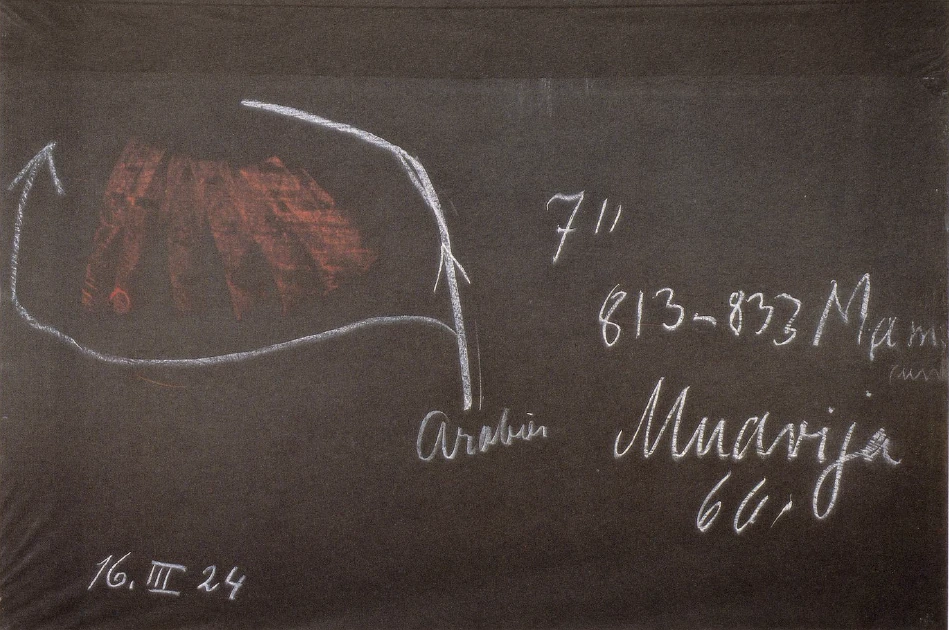
[ 29 ] And so, as the capital is moved from Damascus to Baghdad, we see Mamun ruling in the 9th century. During the 15th year of al-Ma’mun’s reign—all of whom, after all, were successors of the Prophet—we see astrology being cultivated in a manner that later found its way, in an amateurish form, into all sorts of treatises in Europe. These works were discovered later. They made their way over during the Crusades, but were terribly distorted. Yet it was actually a magnificent thing. And if we investigate among those figures who are not named in history but who lived in Baghdad during Mamun’s reign (813–833), specifically engaging in astrological and astronomical studies, we find a brilliant figure who was deeply familiar with Mamun—the name is not recorded historically, and it is irrelevant— a figure who was held in the highest esteem, who was always consulted whenever it came to interpreting the stars. And many decisions were made over there in public life based on what such luminaries—such as this scholar at al-Ma’mun’s court—were able to discern from the stars.
[ 30 ] And again, if one traces the path along which the spirit of this scholar from the court of al-Ma'mun in Baghdad continued to develop—if one follows this path—one is led all the way to the modern astronomer Laplace. And so, once again, one of the figures who lived at the court of Caliph al-Ma'mun appears in Laplace.
[ 31 ] One might say that the major influences—and also the minor ones (though I need not list them all)—that have flowed from this fork in the road into Europe after the external historical development had already dried up show us how Arabism lives on in a spiritual sense, how this fork in the road continues here.
[ 32 ] As you know, my dear friends, Muhammad himself founded the headquarters of Islam, Medina, which later became the seat of his successors. Later, as I have already mentioned, this seat of power was moved to Damascus. And we then see how this seat of power is transferred from Medina to Damascus; we see how, from Damascus through Asia Minor to the gates of Europe, all the way to Constantinople, the generals of Muhammad’s successors stormed forward, carrying on the storming wings of war that which they had indeed allowed to be enriched by the religious life of Muhammad—significant cultural elements—but which was interwoven with precisely what had come over in the wake of Alexander, what had come from Aristotelianism from Greece, from Macedonia, and from all manner of cultural centers to Asia.
[ 33 ] And something strange happens here as well. Here, the Turkish invasion completely wipes out everything that had swept in from Arab culture. The Crusaders then find only vestiges, only remnants—but not dominant cultural currents; the Turks wipe those out. What spreads through Africa and Spain into the West propagates, so to speak, in a state of cultural and civilizational tranquility; there, one repeatedly finds points of connection. Mamun’s scholar, Harun al-Rashid himself, and Tariq—as souls, they found the possibility of connecting what they carried within their souls to what was already there, for in the soul, once it has passed through the gate of death, there always remains a certain power of assimilation for the realms in which one has been active. Even if this can be altered by other impulses of fate, it nevertheless continues to have an effect. If it is altered, it continues to manifest as longings and the like. But precisely because the Arab world believed in a strict determinism, when the opportunity arose to continue in a spiritual manner what was initially intended to be driven by warlike impulses, the possibility also arose to carry these spiritual currents, particularly to France and England. Laplace, Darwin, Bacon, and many similar minds could be cited as examples in this regard.
[ 34 ] But here [in the East], everything was blunted, I would say; in the East, Arabism could only knock on the gates of Europe in a very limited way and could not make any further headway there. Then those individuals who had passed through the gate of death, after having worked in this region here, experienced something like being pushed back, like being unable to proceed further. Their earthly work was shattered. This even caused a certain paralysis of the soul’s life between death and a new birth. And here we have something particularly interesting.
[ 35 ] We see how, soon after the Prophet’s death, the seat of power is moved from Medina to Damascus; how the generals of the Prophet’s successors march up there; but how they are repeatedly repelled; and how they do not achieve the same success here as they do over to the west. And so we see very soon that one of the Prophet’s successors, in 661, is Muawiya. Muawiya, one of the Prophet’s successors, rules in Damascus and is fully immersed in that state of mind which, on the one hand, grows out of the monotheism of Arabism, but also out of the determinism that has increasingly become fatalism. But even back then, Greek philosophy—Aristotelianism—which had come over from Asia, was already dominant, albeit, I would say, in a more mystical way, in a more inward way. And Muawiya, who on the one hand sent his generals as far as Constantinople, but on the other hand also made some attempts toward Africa—though he achieved nothing of note there—was at the same time a man of insight, yet a man who, outwardly speaking, did not achieve much, not even in the intellectual realms.
[ 36 ] As you can see, he reigned not long after Muhammad. He was therefore still fully immersed in Islam as the truly religious element of Arabism. He is one of the representatives of Islam of that time, but one who is just emerging from the rigid religious form of Islam and growing into that way of thinking which, having shed its religious form, subsequently emerged in the scientific and aesthetic-scientific traditions of the West.
[ 37 ] Muawiya, living in the first century after Muhammad, is indeed a representative spirit—a spirit who no longer thinks like Muhammad, who is guided only by Muhammad’s inspiration, who has not yet shed the actual religious core of Islam, but has nevertheless already transformed it into a form of thought, into a logical form. And he certainly belongs, above all, to those who now wanted to cross over to Europe with all their zeal, who wanted to advance toward the West with all their zeal. Anyone who traces the military campaigns and the forces deployed that were active precisely under Muawiya will see: this desire to advance toward the West at that time was coupled with an immensely powerful driving force that had merely been blunted.
[ 38 ] When such a spirit passes through the gate of death and continues to live, that driving force naturally lives on as well; and as one follows the path further, one is struck above all by the impression that: This process continues throughout the life between death and a new birth, as much of what has remained as longing takes shape as far-reaching plans for a future life; but these are far-reaching plans that do not take on a very concrete form. Because everything has been dulled, they do not take on a concrete form.
[ 39 ] Well, I admit, I always find myself asking the question: Should I, or shouldn’t I? But I think it doesn’t help at all to talk about these things only in abstract terms. And so all considerations must be set aside in order to speak, in concrete cases, about the things that are actually there. Let the world take the matter as best it can. There are inner spiritual necessities for the spread of anthroposophy. One submits to what is, so to speak, stirred within one out of these spiritual necessities and does not pursue any outward “opportunism”: opportunism has, after all, done the Anthroposophical Society ample harm; it should not be pursued any further in the future. And even if things should seem quite paradoxical, they should simply be stated plainly in the future.
[ 40 ] If one traces the history of Muawiya—who was, after all, one of the Prophet’s immediate successors—as he continues to flow through the undercurrent and resurfaces, one finds Woodrow Wilson.
[ 41 ] And in a deeply moving way, the present and the past come together. Suddenly, a connection emerges between the present and the past. And then, when you look—as it were, I would say—at the sea of events, of historical events, where the wave of Muawiya emerges, where the wave of Woodrow Wilson emerges, you see how the undercurrent continues through the sea, and how the same current is present there.
[ 42 ] And only then, I think, does history become comprehensible—when one sees how what is actually happening is carried over from one era to the next. Look for the whole—I would say, already abstract, bull-like nature of the Fourteen Points—it is, of course, not the contemplation of the Fourteen Points that served as the starting point— but now that the matter is before us, look for this bull-like way of devoting oneself to these abstract Fourteen Points; seek it out in the configuration of the soul, and then ask yourself whether such a configuration of the soul, in such intensity, could have been found anywhere other than in a successor of Muhammad! And take the fatalism that had already taken shape in Muawiya, and transpose it into the age of modern abstraction, and feel the similarity to the Muslim view: Allah has revealed it; Allah will bring it about—the only salvation! —and try to correctly understand some of the words that came from the bearer of the Fourteen Points: you will find, cum grano salis, an almost literal correspondence.
[ 43 ] Thus, simply by observing human beings, we can already speak of a re-embodiment of ideas. Only then can the unfolding of history truly be understood.