Esoteric Considerations of Karmic Connections
Volume I
GA 235
23 March 1924, Dornach
Translated by Steiner Online Library
Twelfth Lecture
[ 1 ] Well, my dear friends, yesterday I described a number of individuals to you, and in such a description—so that things can at least be verified in terms of their outward appearances—one must, of course, choose more well-known figures. I have therefore described a number of better-known figures, focusing specifically on those character traits that offer the spiritual scientist the opportunity to provide clues for tracing karmic connections. And this time—we will, of course, discuss these matters in detail and from various angles time and again—I have chosen such personalities through whom I can address a very specific problem, a problem that I have encountered within society. I would like to formulate this problem—which, as I said, has been raised by others from within society—in a very matter-of-fact way.
[ 2 ] The point is that it is pointed out at every opportunity—rightly so, of course—that in ancient times there were initiated individuals, individuals of great wisdom, at a high stage of development, and so on, and that this then raises the question: Yes, if human life is cyclical, where are these once-initiated individuals now, in the present? Are they not to be found among the people of the present, among those who, so to speak, happen to be experiencing their reincarnation at this time?
[ 3 ] That is why I have chosen examples like these, which allow me to discuss this question at the same time. You see, I have presented you with the image—as far as we need it for now—of the Italian hero of freedom, Garibaldi, and I believe that if you take what I discussed yesterday and add to it everything you surely know in abundance about this figure, you will find an extraordinary amount of mystery in this figure alone—much that raises major, significant questions.
[ 4 ] Let’s just take the few examples I cited yesterday—which you even found amusing at times—such as meeting a life partner through binoculars, or learning of a death sentence upon seeing one’s name in print for the first time. There is also something else striking about Garibaldi: the life partner he found in the manner described, and who stood by his side in such a heroic way—as I described yesterday—was indeed his life partner for many years. So through the telescope he was able to see something very good. Later she passed away, and he did, in fact, marry a second time—this time not through a telescope, for such a thing, even if you are Garibaldi, is something you probably only do once in a lifetime—but this time in a completely ordinary, bourgeois manner, just as it is customary, isn’t it, among respectable citizens. But for Garibaldi, that marriage lasted only one day! So you see, there is also this second striking aspect to Garibaldi’s relationship with ordinary bourgeois circumstances in this world.
[ 5 ] But there is something else. The things I am describing to you here are such that they certainly enable those accustomed to such occult investigations—I would say—to use them to gain such strong clues that they can then, through clairvoyance, truly look back into a past life or a number of past lives. But there is something else that presents itself above all as a major problem.
[ 6 ] You see, Garibaldi was actually, in his convictions—as I already examined yesterday—a Republican, a Republican through and through. But he was so committed to the liberation of Italy that he did not actually set out to make Italy a republic, but rather to make it a kingdom under Victor Emmanuel. There is something extraordinarily striking about this. When you look at Garibaldi as a whole and consider this, there is something extraordinarily striking about it. On the one hand, there was Victor Emmanuel, who, as king, could naturally only stand at the head of the liberated Italian state.
[ 7 ] On the other hand, there was Mazzini, who was also closely associated with Garibaldi—they were friends—and who for a time had stood at the very head of an Italian republic that was supposed to have been established there; he, for his part, wanted only to advocate for the founding of an Italian republic.
[ 8 ] And the karmic circumstances surrounding Garibaldi do not become clear at all unless one first recognizes a certain connection. And this connection is as follows. Over the course of just a few years—Garibaldi, as you know, was born in Nice in 1807—four men were born, one might say, within a radius of a few square miles, who would go on to have a significant interconnection in the further course of European history. So Garibaldi was born in Nice at the beginning of the 19th century. Mazzini was born in Genoa, not far from there. Cavour was born in Turin, not far from Genoa, and Victor Emmanuel, a member of the House of Savoy, was born not far from Turin either. They were quite close to one another in terms of the years and locations of their births. And it is these four men who, together—even if not with shared convictions, nor even with consistent treatment of one another—laid the foundation for what would later become modern Italy.
[ 9 ] In a sense, the outward course of history itself simply leads one to say: These four figures are brought together—clearly brought together—to represent a shared destiny not only for themselves but for the world.
[ 10 ] The most significant among them is, without a doubt, Garibaldi himself. When one considers all human circumstances, Garibaldi is the most significant of them all. But Garibaldi’s intellect manifests itself in a primal way. Mazzini’s intellect is one cultivated through philosophy, Cavour’s is one cultivated through law, and Victor Emmanuel’s intellect—well… So the most significant among them is indeed Garibaldi, all human circumstances considered, and there is something about him that manifests with elemental force, so that one cannot easily analyze such an intellect as a psychologist. One cannot be a psychologist when one does not actually know: Where do these things come from, when viewed from the standpoint of the personal psychology of an earthly life?
[ 11 ] Now I return to the question: Where are the initiates of the past? For people will say, of course, that they are not here. Yes, my dear friends, if today there were a greater possibility—and I must speak somewhat paradoxically here—that people would either be born at the age of seventeen or eighteen, so that they would already be seventeen or eighteen years old, descend from the spiritual world, and somehow find seventeen- or eighteen-year-old bodies—I am, of course, speaking somewhat paradoxically— or if at least people were spared from having to go through the school system as it is constituted today, then you would find that the initiates of old could appear among people today. But just as it is not possible for initiates, under ordinary earthly conditions, to sustain themselves with a piece of ice when they need bread, it is equally impossible to manifest the wisdom of ancient times directly, in the form one might expect, in a body that has been educated—in the sense that modern civilization entails—up to the age of seventeen or eighteen. This is not possible anywhere in the world; at least not where civilization prevails. After all, there are factors at play that lie entirely outside the field of vision of today’s educated person.
[ 12 ] If, as is customary today, one must acquire our current reading and writing skills starting at the ages of six or seven, it is such an ordeal for the soul—which, by its very nature, seeks to develop in its own unique way—that—well, I can only say what I have already stated in my autobiography: I owe the removal of many an obstacle to the fact that, at the age of twelve, I could not write orthographically—indeed, I could not even write neatly at all. I mentioned this in my autobiography, for the ability to write as is required today stifles certain human idiosyncrasies.
[ 13 ] One really has to speak in such paradoxical terms. It is, after all, a truth. There’s nothing to be done about it; it is a truth. And so it happens that highly developed individuals of the past can actually be recognized in their rebirth only by those who look at those manifestations of human nature that, through today’s civilization, reveal themselves more behind the human being than within the human being.
[ 14 ] And in this regard, Garibaldi in particular is an extraordinarily striking example. What did civilized people—including Cavour, or at least Cavour’s followers—think of Garibaldi? They saw him as a twisted oddball, a strange fellow with whom it was simply impossible to reason. That is precisely what one must also take into account, for there was indeed much in his conclusions—and in the way he spoke to people who are, shall we say, obsessed with modern civilization—that was, at the very least, illogical. In fact, there was much that was illogical about this figure even in his outward appearance. Many things simply did not fit together.
[ 15 ] And only those who, so to speak, look beyond a personality—who look at what was able to enter the body in earlier earthly lives and what, in this earthly life, could not enter the body because the present civilization renders the bodies unsuitable—only those who can see this can form a conception of what such a personality actually is. Others don’t even consider this, for the most important aspect of such a personality actually lies beyond the expressions that can be made in an outward manner. A good-natured—though those present are, of course, always an exception—a good-natured philistine, let’s say, who simply expresses himself as he has learned to do, in whom one thus sees a reflection of his schooling and other learning and upbringing—such a person can indeed be “photographed” in terms of his moral and spiritual nature. He is right there. But a person who comes from ancient times with a soul of profound wisdom—so that this soul cannot express itself through the body—cannot be judged by what emerges from his body through the means of today’s civilization. This is especially true of Garibaldi. In a sense—and I mean this only as a metaphor—one must view the matter as certain spiritualist photographs do, behind which a phantom becomes visible; this is how such a personality appears: first, in terms of their civic worth, and behind that—like something spiritual, like a spiritual image—that which cannot enter the body. |
[ 16 ] If one takes all this into account—especially if one allows oneself to be guided in one’s observation by the things I have specifically pointed out to you—then one’s gaze does indeed turn back to Garibaldi’s life as that of a true initiate, who simply expresses himself outwardly in a completely different way because he cannot fully enter into the body. And ultimately, these things will not seem quite so astonishing to you once you take into account precisely these characteristics that I have highlighted. One must be somewhat detached from what one has been taught today; one must be somewhat “detached from the earth” when, through a telescope, one places oneself within bourgeois circumstances—which is otherwise not customary—and similar things. It is something that, in these characteristics, points beyond the ordinary immersion in these bourgeois circumstances.
[ 17 ] Thus, through Garibaldi, we are led back to a life of initiation—and specifically to a life of initiation, my dear friends, within a mystery such as the one I described here a few months ago as originating in Ireland. I have described the Irish mysteries to you, originating in Ireland, but it is to be found in a branch not even very far from here, namely in Alsace, in present-day Alsace; there we find Garibaldi himself initiated to a certain degree. Indeed, it is quite certain that between this incarnation—which we must place around the 9th century A.D.—and the last one in the 19th century, there is no other in between; rather, there is a long sojourn in the spiritual world in between. This is what reveals itself as the mystery of this personality.
[ 18 ] This figure absorbed what I have described to you as the treasures of Hybernia’s wisdom to a very high degree. He was still on the island of Ireland, the site of the mysteries there, and personally led the colony that later came to Europe.
[ 19 ] Of course, just as, let’s say, whatever is reflected through any mirror glass is altered according to the shape of the mirror, so what existed at that time in a realm that encompassed the physical world and the spiritual world above it—and within which such an initiate was active in the manner I described months ago—was expressed in the way that it could develop in the 19th century from a certain standpoint of civilization. And one must get used to the fact that when encountering a philosopher, a poet, or an artist from a bygone age, one should not seek in them a philosopher, poet, or artist of the present age. Circumstances do not, of course, alter a person’s individuality. This individuality passes from one earthly life to the next. But the way in which these individualities can express themselves depends on what is possible in a given age. Let me interject an example that might illustrate this to you.
[ 20 ] Ernst Haeckel is, of course, also a widely known figure. Ernst Haeckel is known as an enthusiastic proponent of a certain form of materialistic monism—enthusiastic, one might even say, to the point of fanaticism. I need not present any characteristics of him here, for he is, after all, well known. But if one is led back from this personality to his previous incarnation, one finds the pope who, having been the monk Hildebrand, became Gregory VII.
[ 21 ] I am presenting this example to you so that you may see how differently the same individuality can manifest itself outwardly depending on the cultural conditions of a particular era. One would not readily think to see in the representative of 19th-century materialistic monism the reincarnation of Pope Gregory VII. But these matters—how one expresses oneself through the external means of civilization on the physical plane—are of far less importance to the spiritual world than one might think. Behind the personality of Haeckel and behind the personality of the monk Hildebrand lies something that is much more alike, much more similar, than the ways in which they differ—even though one seeks to bring Catholicism to power in the most extreme manner, while the other combats Catholicism in the most extreme manner. For the spiritual world, this is not such a great difference. In the spiritual world, what matters are entirely different human backgrounds than these things, which, after all, have significance only in the physical world. So you need not be surprised, my dear friends, if Garibaldi can be seen as a true initiate from an earlier age—as I said, from the 9th century—and if this found expression in the 19th century in a way that could only have been expressed in the 19th century. For what is important for the way a person relates to the world is what temperament they have and how they manifest their character traits.
[ 22 ] Yes, if what was the essence of Garibaldi’s soul in an earlier incarnation had manifested itself in the 19th century with Garibaldi’s temperament, then he would simply have been a madman to the people of the 19th century. He would have been regarded as a madman, as insane. What he was able to manifest is precisely what he became in his outer life.
[ 23 ] But now, as soon as one is headed in a certain direction, illuminating explanations of other karmic connections immediately come to mind. The other three I told you about—who were brought together with him again in roughly the same decade in one spot on Earth—these other three were his disciples at that time; note well, his disciples, gathered from all corners of the world: one from far to the north, another from far to the east, and the third from far to the west; gathered from all corners of the Earth, they were his disciples.
[ 24 ] Now, in the Irish mysteries in particular, there was a very specific obligation associated with a certain degree of initiation. This obligation stipulated that the initiate must continue to guide his disciples in all his future earthly lives and must not abandon them. So if, due to their particular karmic circumstances, they happen to appear in earthly life at the same time as him, this means that he must experience their fate together with them, and that their type of karma must be settled alongside his own. Had Garibaldi not been connected, as the teacher of Viktor Emanuel—his former student—to the individuality that was Viktor Emanuel, then Garibaldi would simply have become a republican who would also have founded the Italian Republic. But behind these purely abstract, principled matters lies the living human life that passes from one earthly existence to the next. Behind this lies the old initiate’s obligation toward his students. And that is why this contradiction exists. According to the concepts and ideas that Garibaldi embraced in the 19th century, he naturally became a Republican. What else could he have become? I have known so many Republicans who were loyal servants of some prince or another. They were Republicans at heart, simply because during a certain period of the 19th century—a time long since passed, but back when I was a boy—virtually everyone who considered themselves reasonable was a Republican. They said, “Of course we’re Republicans; we just can’t show it to the outside world.” But deep down, they were all Republicans. Of course, Garibaldi was one who showed it to the outside world as well, but he didn’t see it through. And all those who were even enthusiastic about him could not understand why he did not see it through. Why not? Because he could not let go of Victor Emmanuel—who was karmically linked to him, as I have described—in the way I have described. He simply had to support him. And that was the only way he could support him,
[ 25 ] Likewise, the other two—Cavour and Mazzini—were karmically linked to him, and he could only do exactly what they were capable of accomplishing. Thus, whatever could emerge from all four of them was the only thing he could accomplish. He could not follow his own path unilaterally.
[ 26 ] And it is precisely from such a profoundly significant fact, my dear friends, that you can see how many things that one encounters in life can actually only be explained by looking at their occult background.
[ 27 ] Haven’t you also met people who, at some point in their lives, do something that is actually inexplicable to you? You wouldn’t have expected that of them. You simply can’t explain it based on their character. Nor can it be explained by his character. If he were to follow his own nature, he would do something else entirely. You may well be right about that. But there is another person living right alongside him, to whom he is karmically connected in the way I described for Garibaldi. Why does he do what he does? Life can only truly be explained in light of these occult underlying forces. Thus, we are led back through this very personality—one might even say—into the Hybernian Mysteries. This may seem paradoxical, but the fact is that when one looks at the spiritual realm, what one encounters in outward earthly life is often an illusion.
[ 28 ] And there are some people whom one often sees in everyday life, with whom one often spends time in everyday life: If one could tell them all the things one can learn from them, if one were to look beyond them to their individuality, they would be extremely surprised; they would truly be extremely surprised. For what a person expresses is, especially in the present age and for the reasons I have stated, only the very smallest fraction of what a person actually is based on their previous earthly life. There are many mysteries hidden within the things I am speaking of now.
[ 29 ] And take the second figure, whom I briefly characterized yesterday: Lessing, who, toward the end of his life, himself proclaimed the doctrine of repeated earthly lives. In his case, one is taken far, far back—all the way to that Greek antiquity in which the ancient Greek mysteries were still in full bloom. There, Lessing was an initiate. Once again, it was the case that he could not fully immerse himself in the physical body during the 18th century. Then, in a repetition of this earlier earthly life in ancient Greece, he was a member of the Dominican Order in the 13th century, an outstanding scholastic who had absorbed conceptual precision; and then, in the 18th century, he actually became the first journalist in Central Europe.
[ 30 ] But really, both the drama of tolerance Nathan the Wise, as well as, in particular, something like the Hamburg Dramaturgy—just read certain chapters—and then The Education of the Human Race—they can only be understood if one assumes that all three incarnations of this personality worked on them: the ancient Greek initiate—please read Lessing’s beautiful treatise “How the Ancients Conceived of Death”—then the scholastic educated in medieval Aristotelianism, and the one who, with all of this weighing on his soul, has now grown into the civilization of the 18th century. And even a certain fact that is extraordinarily striking becomes clearly apparent when one considers what I have said.
[ 31 ] It is indeed strange that Lessing’s entire life seems to one as if it were a quest. He himself expressed this character of his nature—his spiritual nature—by uttering the famous saying that is quoted over and over again—albeit in a philistine interpretation, for all philistines who do not wish to strive for anything specific parrot it after him—: “And if God were to hold the whole, complete truth in his right hand, and the eternal quest for truth in his left, I would fall down before him and say: Father, give me what you have in your left hand.”—Lessing could say that; but when a philistine parrots it, it is, of course, something appalling. But what is important is that his entire life was precisely a search, an intense search, which—if one is honest—must be expressed by saying: One actually stumbles upon many of Lessing’s statements; one stumbles precisely upon the most brilliant ones, but people simply don’t dare to stumble because Lessing is presented in history and literature textbooks as a giant. In truth, one does stumble—or rather, one impales oneself on them. It’s just that people don’t admit it to themselves. Of course, one must then get to know Lessing himself. For if, for example, one picks up Erich Schmidt’s two-volume book on Lessing, one is not impaled by the sentences—even when Erich Schmidt quotes them verbatim. They are still, in terms of wording, Lessing’s sentences, but what comes before or after them takes the edge off them.
[ 32 ] And this seeker does not actually get around to writing The Education of the Human Race—which concludes with the idea of repeated earthly lives—until the very end of his earthly life. Why is that?
[ 33 ] Yes, you see, you have to understand something like this by considering another fact that I have also discussed before. I discussed “The Chemical Wedding of Christian Rosenkreutz” in the former journal Das Reich, published by our friend Bernus, and pointed out that a seventeen- or eighteen-year-old boy had written down “The Chemical Wedding of Christian Rosenkreutz.” The boy understood nothing—absolutely nothing—of it. There is external evidence for this. He wrote down this Chemical Wedding all the way to the very last page, which, of course, isn’t even there. It isn’t there even today, but he wrote down the Chemical Wedding—and understood nothing of it. If he had understood anything of it, he would surely have come to understand it in later years. But the boy grew up to become a stalwart Swabian pastor from Württemberg who—one might even say—wrote devotional and theological works of below-average quality, works that are far removed from having anything in common with the content of The Chemical Wedding of Christian Rosenkreutz. The fact that the future Swabian pastor did not write down this “Alchemical Wedding” with his soul is proven by the course of his life. For this is a thoroughly inspired work.
[ 34 ] So one is not always dealing with a person’s personality when a spirit expresses itself through a human being. However, there is a certain difference between the stalwart Swabian pastor Valentin Andreae, who wrote those philistine theological treatises, and Lessing. If Lessing—had he merely been transported to the 18th century—had been Valentin Andreae, he might also have written a fine treatise in his youth on the education of the human race, based on the idea of repeated earthly lives. But he was not Valentin Andreae; he was Lessing—that Lessing who had no visions, and, as they say, not even any dreams. He sent the inspirer away—unconsciously, of course. If the inspirer had tried to approach him in his youth, he would have said: “Go away; I have nothing to do with you.”—He followed his ordinary human path of education in the 18th century. And as a result, it was only in his very old age that he became mature enough to understand what had always been within him throughout his life as Lessing. It was as if Valentin Andreae, too, had sent the Inspirer away and had not written trivial theological edifying texts, but had waited until old age and then consciously written The Chemical Wedding of Christian Rosenkreutz.
[ 35 ] This is how individual earthly lives are linked together. And the time must eventually come when one becomes fully aware that this is truly the case. If one takes a single human life—be it that of Goethe, Lessing, Spencer, Shakespeare, or Darwin—and considers what has emerged from that human life, it is as if one were to pluck a flower from its stem and believe it can exist on its own. Such an individual earthly life cannot be explained in and of itself; one must find the explanation precisely in the context of repeated earthly lives.
[ 36 ] It is interesting to examine the lives of the two figures I spoke of last yesterday: Lord Byron on the one hand, and—please forgive me for getting personal here—my geometry teacher on the other. They had only the structure of the foot in common, but this structure is nonetheless extraordinarily noteworthy. If one traces this foot structure in an occult manner, it leads one to conclude that, in a similar way to how I explained it for Eduard von Hartmann, it points to the particular nature of the head in a previous earthly life. And certainly, one can only describe such things as they present themselves to one’s inner vision; I have already said this on another occasion. After all, there can be no external logical proofs for these things in the ordinary sense. If one now traces the lives of these two people, their earthly lives in the 19th century do indeed appear somewhat out of place. For there is, first of all, a contradiction to something I mentioned here a few weeks ago: that in certain cycles, those who were once contemporaries incarnate again as contemporaries. Of course, there are exceptions to everything. It is not possible to treat things according to a “set formula”—not even on the physical plane—unless one wishes to become the “F” in the formula oneself. But when it comes to the spiritual world, my dear friends, this is certainly not possible. There are rules there, but no rigid formulas. Everything is individual.
[ 37 ] And so, with these two figures in particular, one is transported back to a shared earthly life that they led together. I would never have found Byron in this earlier earthly life if I hadn’t found my geometry teacher at his side. Byron was a genius; this geometry teacher wasn’t even a genius in his own way. He wasn’t a genius at all, but he was an excellent geometer—the best I’ve ever met in my life—because he was a true geometer.
[ 38 ] Really—isn’t it true that with a painter, you know there’s something one-sided about him; with a musician, you know he’s one-sided. For people are really only significant if they are one-sided; but a geometer in our time is, as a rule, not one-sided. A geometer knows all of mathematics and, whenever he constructs something geometric, always knows how to set up the equations for these things as well. He knows the mathematical and computational aspects of it.
[ 39 ] This geometry teacher I’m about to tell you about was an excellent geometer, but not a mathematician at all. He knew absolutely nothing about analytical geometry, for example. He knew absolutely nothing about analytical geometry—that is, the mathematical geometry that deals with equations; in that area, he did the most childish things.
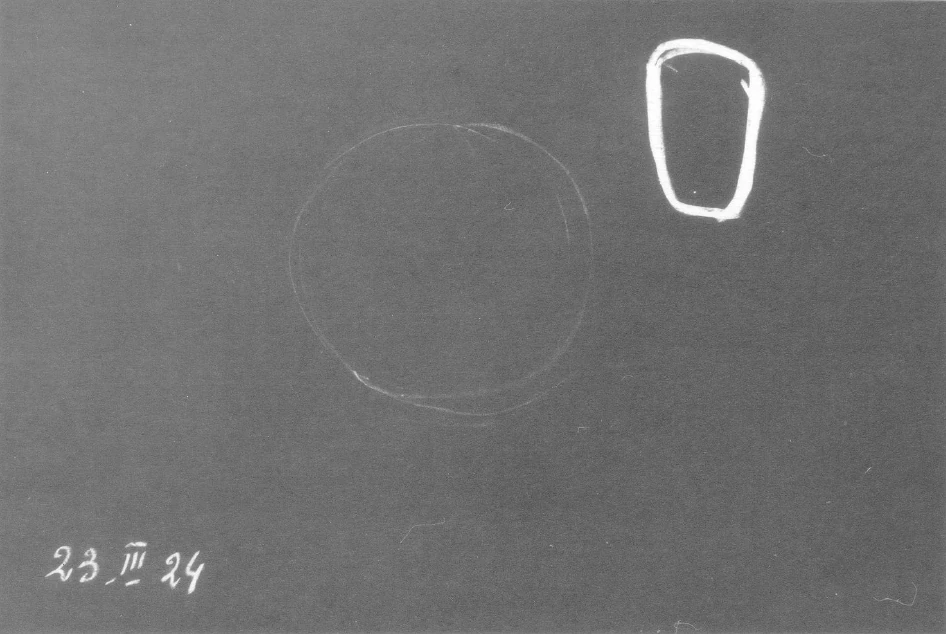
[ 40 ] It was actually quite amusing once. The man was so thoroughly a constructor that he arrived at the conclusion—through constructive methods—that a circle is the geometric locus of constant ratios. He discovered this constructively, and since no one before him had discovered it constructively, he considered himself the discoverer of the concept. And we boys—who, of course, insofar as we weren’t exactly philistines, had a fair bit of exuberance—we boys knew: our analytical geometry textbook clearly stated that if you set up such an equation, you get a circle. And of course we took that as an opportunity to stop calling the circle a circle and instead name it after our geometry teacher: we called it the N.-N. line—I won’t mention the name. Truly, he possessed the brilliant single-mindedness of the constructive geometer. That was also what was so significant, so striking about him. People of the present age are, after all, impossible to pin down; they aren’t so distinctive—there are so many slippery characters among them. But he wasn’t a slippery character; he was a man with sharp edges, even in his outward appearance. He had a face that was roughly square in shape, a very interesting head, completely square, with nothing rounded about it. Truly, one could study the characteristics of a rectangle—its structural properties—in this man’s face. That was very interesting.
[ 41 ] This figure now stands right beside Byron in one’s imagination, and one is transported back to the very ancient times of Eastern Europe, roughly one or two centuries before the Crusades.
[ 42 ] I once told you a story—those who were there will remember—that when the Roman Emperor Constantine founded Constantinople, he had the Palladium of Rome, which had been brought from Asia, from Troy to Rome, transferred from Rome to Constantinople. This was done with tremendous pomp and ceremony. For this Palladium was regarded as a special relic, as something that bestows power upon whoever possesses it. And so people in Rome were indeed convinced that, as long as the Palladium lay beneath a column in Rome in an important location, the very power of Rome rested there; they were convinced that this power had been brought over from the once-mighty Troy, which had only just been destroyed by the Greeks.
[ 43 ] Constantine, who was keen to transfer Roman power to Constantinople, had this Palladium transported to Constantinople with tremendous pomp—initially in complete secrecy, of course—had it sunk into the ground, walled over, and had the site covered with a column originating from Egypt, beneath which the Palladium lay. He then had this old column restored and placed an ancient statue of Apollo on top of it, which had been altered to resemble Emperor Constantine as he appeared at that time. Then he had nails taken from the cross of Christ. From these, he made a radiant crown for the statue—which was an old statue of Apollo but was meant to represent him. And so the Palladium had been moved to Constantinople.
[ 44 ] There is a legend that took shape in a curious way at a later date, but which is actually very, very old. It was merely revived and reshaped later on, drawing on the will of Peter the Great, but it dates back to very ancient times: namely, that the Palladium would one day come from Constantinople further to the northeast. From this arose the belief in later Russia that the Palladium had to be transferred from the capital, Constantinople, to Russia. Then everything associated with it—which had been corrupted only under Turkish rule—would pass into the dominion of Eastern Europe.
[ 45 ] Well, these two figures, these two individuals, became acquainted with this legend in ancient times—as I said, one or two centuries before the Crusades, though I couldn’t determine the exact date—and they were the ones who set out from what is now Russia to Constantinople in order to acquire the Palladium there by some means and bring it to Eastern Europe.
[ 46 ] It never came to that. It couldn’t have come to that, after all, because the palladium was safely kept, and it could not be taken from those who knew where it was kept. But an immense pain took hold of these two people. And what entered them like a ray—paralyzing their minds at that time—manifested itself in one of them, Lord Byron, in such a way that, much like Achilles, who was vulnerable at the heel, he had a defective foot, but in return possessed the genius of the head, which simply served as a counterbalance to the paralysis in his earlier earthly life; and that the other, because of his paralyzed head, now also had the defective foot—the clubfoot. But, you see, people usually don’t realize that a person doesn’t have geometry or mathematics just in their head. If you didn’t walk out the angle with your feet, your mind wouldn’t have that visual understanding. You wouldn’t have any grasp of geometry at all if you didn’t walk and reach out with geometry. All of this emerges from the mind and manifests in the imagination. And someone who has a foot like my geometry teacher’s possesses a strong capacity for attention, enabling them to reproduce in their mind the geometric constitution of the motor organism, of the limb system.
[ 47 ] And when one delved into this geometry teacher—into his entire intellectual makeup—one was left with a profound impression of him as a human being. And truly, there was something enchanting about him when he went about everything as a geometric designer, as if the rest of the world simply didn’t exist. He was an immensely free person, and just being around him—one only had to look closely—something came to mind, as if an inner magical power had once taken hold of him and led him to this particular one-sidedness.
[ 48 ] Well, in the case of Lord Byron—I only mentioned the second one because I otherwise would not have been able to get to know Lord Byron if he hadn’t set me on that path—you can really see karma at work. He once came from the East to retrieve the Palladium. When he was born in the West, he set out to help bring about freedom—the spiritual Palladium—in the 19th century. And he goes, drawn by the same region of the Earth—or at least the same direction—that he once followed from the other side. There is something truly moving about seeing how one and the same individuality comes to the same location on Earth from one side in one earthly life and from the other side in another earthly life; in one earthly life called by that which was deeply immersed in myth according to the views of that time, in the other earthly life drawn to that which the Age of Enlightenment had brought forth as the great ideal. There is something tremendously moving about this.
[ 49 ] And what is truly shocking are the things that emerge from karmic connections. They are always shocking. And we will come to know many more shocking, startling, and paradoxical things in this area. For today, I simply wanted to present to you what can truly help you understand just how strange the connections between earlier and later earthly lives can be within the human condition.