

Esoteric Considerations of Karmic Connections
Volume II
GA 236
4 June 1924, Dornach
Translate the original German text into any language:
Versions Available:
Esoteric Considerations of Karmic Connections, tr. SOL
Vierzehnter Vortrag
Fourteenth Lecture
[ 1 ] Wenn wir die Wirkungsweise des Karma betrachten, so müssen wir ins Auge fassen, wie das menschliche Ich, das ja die eigentliche Wesenheit, die innerste Wesenheit des Menschen darstellt, gewissermaßen drei Werkzeuge hat, durch die es sich darlebt in der Welt: den physischen Leib, den ätherischen Leib und den astralischen Leib. Der Mensch trägt eigentlich den physischen Leib, den ätherischen Leib und den astralischen Leib an sich. Er ist keiner dieser Leiber, denn er ist im eigentlichen Sinne das Ich. Und das Ich ist es auch, welches Karma erleidet und Karma bildet.
[ 1 ] When we consider how karma works, we must take into account how the human “I”—which, after all, represents the true essence, the innermost essence of the human being—has, so to speak, three instruments through which it lives out its existence in the world: the physical body, the etheric body, and the astral body. Human beings actually bear the physical body, the etheric body, and the astral body within themselves. They are none of these bodies, for they are, in the true sense, the “I.” And it is also the “I” that undergoes karma and creates karma.
[ 2 ] Nun handelt es sich aber darum, daß man das Verhältnis des Menschen als des Ich-Wesens zu diesen drei, ich möchte sagen, werkzeuglichen Gestaltungen, zu dem physischen, dem ätherischen und dem Astralleib, in Betracht ziehen kann, um gerade daraus Grundlagen für das Wesen des Karma zu erlangen. Und man wird mit Bezug auf das Karma einen Gesichtspunkt für die Betrachtung des Physischen, des Ätherischen, des Astralischen im Menschen gewinnen, wenn man folgendes berücksichtigt.
[ 2 ] The point here, however, is that one can consider the relationship of the human being—as an “I”-being—to these three, I might say, instrumental forms—the physical, etheric, and astral bodies—in order to derive from them the foundations for the nature of karma. And with regard to karma, one will gain a perspective for considering the physical, etheric, and astral aspects of the human being by taking the following into account.
[ 3 ] Physisches, wie wir es sehen im mineralischen Reiche, Ätherisches, wie wir es wirksam finden im pflanzlichen Reiche, Astralisches, wie wir es auch wirksam finden im tierischen Reiche, wir finden das alles im Umkreise des Menschen auf der Erde. Wir haben im Kosmos rings um die Erde, ich möchte sagen, jenes Weltenall, nach dem sich die Erde nach allen Seiten fortsetzt. Wir spüren schon eine gewisse Verwandtschaft dessen, was auf der Erde vorgeht, mit dem, was in dem Umkreise des Kosmos vorgeht. Aber die Frage entsteht doch für die Geisteswissenschaft: Ist diese Verwandtschaft, ich möchte sagen, so trivial, wie sie die heutige naturwissenschaftliche Weltanschauung vorstellt?
[ 3 ] The physical realm, as we see it in the mineral kingdom; the etheric realm, as we find it at work in the plant kingdom; the astral realm, as we also find it at work in the animal kingdom—we find all of this in the sphere surrounding human beings on Earth. In the cosmos surrounding the Earth—I would say, that vast expanse of the universe into which the Earth extends in all directions— We already sense a certain kinship between what takes place on Earth and what takes place within the cosmos. But the question arises for spiritual science: Is this kinship, I might say, as trivial as today’s scientific worldview portrays it?
[ 4 ] Die heutige naturwissenschaftliche Weltanschauung untersucht, was auf der Erde lebt und auch nicht lebt, nach den physischen Eigenschaften. Sie untersucht dann die Sterne, die Sonne, Mond und so weiter, und sie findet ja — und ist besonders stolz darauf, das gefunden zu haben —, daß eigentlich diese Weltenkörper im Grunde genommen dasselbe seien wie die Erde.
[ 4 ] Today’s scientific worldview examines what lives and what does not live on Earth based on physical properties. It then examines the stars, the Sun, the Moon, and so on, and it finds—and is particularly proud of this discovery—that these celestial bodies are, in essence, the same as the Earth.
[ 5 ] Zu dieser Anschauung kommt man aber nur durch eine Erkenntnis, die nirgends den Menschen selber erfaßt, die eigentlich nur das Außermenschliche erfaßt. In dem Augenblicke, wo man den Menschen als drinnenstehend im Weltenall wirklich erfaßt, in dem Augenblicke kann man ja die Beziehungen finden zwischen den einzelnen menschlichen werkzeuglichen Gliedern, dem physischen Leib, dem ätherischen Leib, dem Astralleib, und den entsprechenden Entitäten, dem entsprechenden Wesenhaften im Kosmos.
[ 5 ] However, one arrives at this view only through a form of knowledge that does not grasp human beings themselves at all, but rather grasps only what lies beyond the human. At the very moment when one truly grasps human beings as being situated within the universe, at that very moment one can indeed discover the relationships between the individual human constituent parts—the physical body, the etheric body, and the astral body—and the corresponding entities, the corresponding essential forces in the cosmos.
[ 6 ] Nun finden wir für den ätherischen Leib des Menschen draußen im Kosmos überall den Weltenäther. Gewiß, der ätherische Leib des Menschen hat eine bestimmte menschliche Gestaltung, er hat in sich gewisse Bewegungsformen und so weiter, die anders sind als beim Weltenäther. Aber immerhin ist es durchaus so, daß der Weltenäther gleichartig mit dem ist, was im menschlichen ätherischen Leib sich findet. Ebenso können wir von einer Ähnlichkeit desjenigen sprechen, was im menschlichen astralischen Leibe sich findet, und einem gewissen Astralischen, das draußen im Kosmos durch alle Dinge und alle Wesen hindurch wirkt. Dabei kommen wir nun auf etwas außerordentlich Wichtiges, auf etwas, was in seiner Wesenheit dem heutigen Menschen eigentlich ganz fremd ist.
[ 6 ] Now, we find the world ether everywhere in the cosmos surrounding the human etheric body. Certainly, the human etheric body has a specific human form; it possesses certain patterns of movement and so on that differ from those of the world ether. But it is nonetheless true that the world ether is of the same nature as what is found in the human etheric body. Similarly, we can speak of a similarity between what is found in the human astral body and a certain astral quality that works through all things and all beings out in the cosmos. This brings us to something extraordinarily important—something that is, in its very nature, actually quite foreign to modern human beings.
[ 7 ] Gehen wir von einer schematischen Vorstellung aus: Wir denken uns auf der Erde den Menschen mit seinem ätherischen Leibe (siehe Zeichnung, Mitte), dann im Umkreise der Erde den Weltenäther (gelb), der von einerlei Art ist mit dem menschlichen Äther. Nun haben wir auch im Menschen den astralischen Leib (dunkle Schraffierung innerhalb des Gelben). Im kosmischen Umkreis ist auch Astralität, aber wo soll man sie finden? Wo ist sie? Sie ist schon zu finden, nur muß man darauf kommen, was im Kosmos die Astralität verrät, was sie offenbart: Irgendwo, muß man sagen, ist die Astralität. Aber ist die Astralität im Kosmos ganz unsichtbar, ganz unwahrnehmbar, oder ist sie doch irgendwie wahrnehmbar? Natürlich, an sich ist auch der Äther für physische Sinne zunächst unwahrnehmbar. Wenn Sie, wenn ich mich so ausdrücken darf, ein kleines Stück Äther anschauen, so sehen Sie mit den physischen Sinnen nichts, Sie sehen einfach durch; es ist der Äther wie nichts. Wenn Sie aber den gesamten Umkreis des Äthers ins Auge fassen, so ist der Grund, warum Sie den blauen Himmel sehen, der eigentlich ja auch nicht da ist, der, daß Sie da das Ende des Äthers wahrnehmen. Sie nehmen also den Äther wahr als Blau des Himmels. Die Wahrnehmung der Bläue des Himmels ist richtig die Wahrnehmung des Äthers. So daß wir schon sagen können: Indem wir die Bläue des Himmels wahrnehmen (siehe Zeichnung, blau), nehmen wir den Äther um uns herum wahr.
[ 7 ] Let us start with a schematic concept: Imagine a human being on Earth with his etheric body (see drawing, center), and then, surrounding the Earth, the world ether (yellow), which is of the same nature as the human ether. Now, within the human being, we also have the astral body (dark hatching within the yellow). There is also astrality in the cosmic sphere, but where is it to be found? Where is it? It can indeed be found; one simply has to figure out what in the cosmos reveals astrality, what makes it manifest: Somewhere, one must say, astrality exists. But is astrality in the cosmos completely invisible, completely imperceptible, or is it somehow perceptible after all? Of course, in and of itself, the ether is also initially imperceptible to the physical senses. If you—if I may put it this way—look at a small piece of ether, you see nothing with your physical senses; you simply see right through it; the ether is like nothing. But if you take in the entire expanse of the ether, the reason you see the blue sky—which, strictly speaking, isn’t actually there—is that you are perceiving the edge of the ether. So you perceive the ether as the blue of the sky. The perception of the blue of the sky is, in fact, the perception of the ether. So we can already say: By perceiving the blue of the sky (see drawing, blue), we perceive the ether around us.
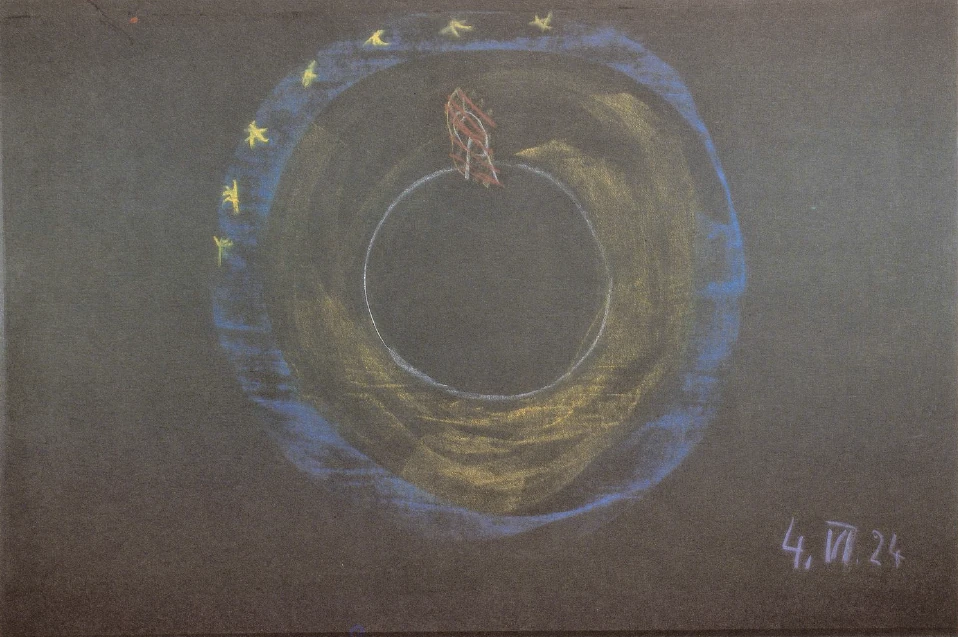
[ 8 ] Wir sehen zunächst durch den Äther durch. Das läßt er sich gefallen zunächst, aber er macht sich doch selber wahrnehmbar in der Bläue des Himmels. Das Dasein der Bläue des Himmels wird daher für die Wahrnehmung des Menschen in der richtigen Weise ausgedrückt, wenn man sagt: Der Äther ist zwar nicht wahrnehmbar, aber er erhebt sich zur Wahrnehmbarkeit wegen der großen Majestät, mit der er sich im Weltenall hinstellt, indem er sich kundgibt, offenbart in der Himmelsbläue.
[ 8 ] At first, we see right through the ether. It puts up with this at first, but it does make itself perceptible in the blue of the sky. The existence of the blue of the sky is therefore expressed correctly for human perception when one says: Although the ether is not perceptible, it rises to the level of perceptibility because of the great majesty with which it stands in the universe, making itself known and revealing itself in the blue of the sky.
[ 9 ] In der physischen Wissenschaft denkt man materialistisch über die Himmelsbläue nach. Nun ist es für die physische Wissenschaft schwer, über die Himmelsbläue in vernünftiger Weise nachzudenken, einfach aus dem Grunde, weil ja die physische Wissenschaft sich klar sein muß: Dort ist nichts vom Physischen, wo die Bläue des Himmels ist. Aber immerhin, man renkt sich den Verstand aus, um zu erklären, wie Lichtstrahlen auf eine besondere Weise gebrochen werden und reflektiert werden, um diese Bläue des Himmels hervorzurufen. Aber hier beginnt eben bereits das Walten des Übersinnlichen. Und im Kosmos ist es so, daß schon das Übersinnliche wahrnehmbar wird, nur muß man ausfindig machen, wo es wahrnehmbar wird.
[ 9 ] In the physical sciences, people take a materialistic approach to thinking about the blue of the sky. Now, it is difficult for the physical sciences to think about the blue of the sky in a reasonable way, simply because the physical sciences must be clear on this point: there is nothing physical where the blue of the sky is. Nevertheless, scientists rack their brains to explain how light rays are refracted and reflected in a particular way to produce this blue of the sky. But this is precisely where the influence of the supersensible begins. And in the cosmos, the supersensible is already perceptible; one merely has to discover where it becomes perceptible.
[ 10 ] Der Äther wird also durch die Himmelsbläue wahrnehmbar. Nun ist irgendwo das Astralische des Kosmos. Der Äther guckt durch die Himmelsbläue in die Sinnlichkeit herein. Wo guckt denn das Astralische des Kosmos in die Sichtbarkeit, in die Wahrnehmbarkeit herein?
[ 10 ] The ether is thus perceptible through the blue of the sky. Now, somewhere out there lies the astral realm of the cosmos. The ether peeks into the sensory world through the blue of the sky. Where, then, does the astral realm of the cosmos peek into the visible world, into the realm of perception?
[ 11 ] Sehen Sie, in Wirklichkeit ist jeder Stern, den wir am Himmel glänzen sehen, ein Einlaßtor für das Astralische, so daß überall, wo Sterne hereinglänzen, das Astralische hereinglänzt. Sehen Sie also den gestirnten Himmel in seiner Mannigfaltigkeit — da die Sterne in Gruppen gehäuft, dort mehr zerstreut, voneinandergestellt —, dann müssen Sie sich sagen: In dieser wunderbaren Leuchtekonfiguration macht sich der unsichtbare, der übersinnliche Astralleib des Kosmos sichtbar. Daher darf man auch nicht die Sternenwelt ungeistig ansehen. Hinaufschauen in die Sternenwelt und von brennenden Gaswelten zu reden, das ist geradeso — verzeihen Sie den paradoxen Vergleich, aber er ist absolut bis aufs i-Tüpfelchen stimmend —, wie wenn Sie aus Liebe jemand streichelt und die Finger etwas auseinanderhält beim Streicheln, und Sie sagen: Das, was Sie da spüren im Streicheln, das sind kleine Bänder, die Ihnen über die Backe gelegt werden. Ebensowenig wie Ihnen kleine Bänder über die Backe gelegt werden beim Streicheln, ebensowenig sind da oben diejenigen Wesenhaftigkeiten, von denen die Physik spricht; sondern der Astralleib des Weltenalls, der übt fortwährend seine Einflüsse, so wie das Streicheln auf Ihrer Backe, auf die Ätherorganisation aus.
[ 11 ] You see, in reality, every star we see shining in the sky is a gateway to the astral realm, so that wherever stars shine, the astral realm shines through. So when you look at the starry sky in all its diversity—with stars clustered together in some places, more scattered in others, set apart from one another—you must say to yourself: In this wondrous configuration of light, the invisible, supersensible astral body of the cosmos makes itself visible. That is why one must not view the world of the stars in a non-spiritual way. Looking up at the starry world and speaking of burning gas giants is just like—forgive the paradoxical comparison, but it is absolutely accurate down to the last detail—someone caressing you out of love while keeping their fingers slightly apart as they stroke you, and you say: “What you feel in that caress are little ribbons being placed across your cheek.” Just as little as little ribbons are placed across your cheek when you are being caressed, so too are the entities of which physics speaks not actually present up there; rather, it is the astral body of the universe that continually exerts its influence—just like the caress on your cheek—upon the etheric organization.
[ 12 ] Nur ist er auf sehr starke Dauer organisiert. Daher dauert das Halten eines Sternes, was immer ein Beeinflussen des Weltenäthers von seiten der astralischen Welt ist, länger als das Streicheln. Das Streicheln würde der Mensch nicht so lange aushalten, aber es ist eben so, daß das im Weltenall länger dauert, weil im Weltenall gleich Riesenmaße auftreten. So daß also in dem Sternenhimmel eine Seelenäußerung des Weltenastralischen zu sehen ist.
[ 12 ] However, it is organized to last for a very long time. Therefore, holding a star—which is always an influence on the world ether from the astral world—takes longer than a caress. A human being could not endure the caress for so long, but the fact is that it lasts longer in the universe because gigantic scales are at play there. Thus, the starry sky reveals a soulful expression of the astral realm of the universe.
[ 13 ] Es ist damit zu gleicher Zeit ungeheures, und zwar sogar seelisches Leben, wirklich seelisches Leben, in den Kosmos hineingebracht. Denken Sie doch nur einmal, wie tot der Kosmos ist, wenn man da hiinausschaut und nur brennende Gaskörper sieht, die leuchten! Denken Sie sich, wie lebendig das alles wird, wenn man weiß: Diese Sterne sind der Ausdruck der Liebe, mit der der astralische Kosmos auf den ätherischen Kosmos wirkt! Das ist ein ganz richtiger Ausdruck.
[ 13 ] At the same time, an immense life—indeed, a spiritual life, a truly spiritual life—is thus brought into the cosmos. Just think for a moment how lifeless the cosmos is when you look out into it and see only burning gaseous bodies that glow! Imagine how alive it all becomes when you realize: These stars are the expression of the love with which the astral cosmos acts upon the etheric cosmos! That is a perfectly accurate description.
[ 14 ] Aber nun denken Sie an die rätselhaften, nur durch physische Dinge, bei denen man ja eigentlich doch nichts begreift, erklärten Vorgänge des Aufleuchtens gewisser Sterne zu bestimmten Zeiten. Sterne, die noch nicht da waren, sie leuchten auf, sie verschwinden wiederum. Also auch kurzes Streicheln ist im Weltenall vorhanden. In Epochen, in denen, ich möchte sagen, die Götter hereinwirken wollen aus der astralischen Welt in die ätherische Welt, da sieht man solche aufleuchtenden und gleich wiederum sich abdämpfenden Sterne.
[ 14 ] But now consider the mysterious phenomena of certain stars flaring up at specific times—phenomena explained solely by physical phenomena that we actually do not understand at all. Stars that were not yet there flare up, and then they disappear again. Thus, even a fleeting touch exists in the universe. In epochs when, I would say, the gods wish to exert their influence from the astral world into the etheric world, one sees such stars that flare up and then immediately dim again.
[ 15 ] So haben wir in uns durch unseren astralischen Leib Wohlbefinden in der mannigfaltigsten Art; so haben wir im Kosmos durch den astralischen Leib die Konfiguration des Sternenhimmels. Kein Wunder daher, daß eine alte instinktiv hellsehende Wissenschaft dieses dritte menschliche Glied den astralischen Leib genannt hat, denn es ist von gleicher Art mit dem, was sich in den Sternen offenbart. Nur das Ich finden wir in diesem Umkreis nicht sich offenbarend. Warum? Nun, warum das so ist, das finden wir gerade heraus, wenn wir darauf hinsehen, daß dieses Ich des Menschen, so wie es sich auf der Erde — also in dem Kosmos, der eigentlich eine dreigliedrige Welt ist, eine physische, eine ätherische, eine astralische —, so wie es sich da äußert, ja immer die Wiederholung früherer Erdenleben ist. Und es ist immer wieder im Leben zwischen dem Tode und einer neuen Geburt drinnen.
[ 15 ] Thus, through our astral body, we experience well-being within ourselves in the most diverse ways; thus, through the astral body, we perceive the configuration of the starry sky in the cosmos. No wonder, then, that an ancient, instinctively clairvoyant science called this third human member the astral body, for it is of the same nature as what is revealed in the stars. Only the “I” do we find does not reveal itself within this sphere. Why? Well, we discover precisely why this is the case when we consider that this human “I,” as it manifests itself on Earth—that is, in the cosmos, which is actually a threefold world consisting of a physical, an etheric, and an astral realm—is always a repetition of earlier earthly lives. And it is always present in the life between death and a new birth.
[ 16 ] Da aber, wenn man es beobachtet, hat für dieses Ich die ätherische Welt, die wir im Umkreise der irdischen haben, keine Bedeutung; der ätherische Leib wird ja bald nach dem Tode abgelegt. Nur die astralische Welt, die durch die Sterne hereinschaut, die hat für das Ich in dem Leben zwischen Tod und neuer Geburt eine Bedeutung. Und in dieser Welt, die da hereinscheint durch die Sterne, in dieser Welt leben dann die Wesen der höheren Hierarchien, mit denen der Mensch zwischen dem Tod und einer neuen Geburt sein Karma formt.
[ 16 ] But if one observes it closely, the etheric world—which surrounds our earthly world—has no significance for this “I”; after all, the etheric body is shed shortly after death. Only the astral world, which shines in through the stars, has significance for the “I” in the life between death and a new birth. And in this world, which shines in through the stars—in this world—live the beings of the higher hierarchies, with whom the human being shapes his or her karma between death and a new birth.
[ 17 ] Aber wenn wir dieses Ich betrachten in seinem aufeinanderfolgenden Sich-Entwickeln durch Leben zwischen Geburt und Tod und zwischen Tod und neuer Geburt, so können wir ja gar nicht im Raume bleiben. Zwei Erdenleben, die aufeinanderfolgen, können ja nicht in demselben Raume sein, also auch nicht in dem Weltenall, das auf Gleichzeitigkeit, auf Räumlichkeit angewiesen ist. Da kommen wir aus dem Raume heraus, kommen in die Zeit hinein. Und in der Tat, man kommt aus dem Raume heraus, man kommt in den reinen Zeitenfluß, wenn man das Ich in den aufeinanderfolgenden Erdenleben betrachtet.
[ 17 ] But when we consider this “I” in its successive unfolding through life between birth and death and between death and rebirth, we cannot possibly remain within space. Two successive earthly lives cannot exist in the same space, and therefore cannot exist in the universe, which is based on simultaneity and spatiality. Thus, we step out of space and into time. And indeed, one steps out of space and into the pure flow of time when one observes the “I” in its successive earthly lives.
[ 18 ] Nun denken Sie aber: Im Raume ist ja natürlich auch die Zeit vorhanden; aber man hat gar keine Mittel, um innerhalb des Raumes die Zeit als solche zu erleben. Man hat keine Mittel. Man muß die Zeit immer durch den Raum und seine Vorgänge erleben. Sie schauen, wenn Sie die Zeit erleben wollen, zum Beispiel die Uhr an, oder schauen meinetwillen auch den Sonnengang an, die Uhr ist ja nur ein irdisches Abbild des Sonnenganges. Aber was sehen Sie denn da? Sie sehen Zeigerstellungen oder Sonnenorte: Räumliches. Dadurch, daß sich die Orte der Zeiger oder der Sonne ändern, also dadurch, das Räumliches in Veränderung vor Ihnen steht, haben Sie eine Ahnung von der Zeit. Aber da im Raum ist ja eigentlich nichts von der Zeit. Da sind nur verschiedene räumliche Anordnungen, verschiedene Zeigerstellungen, verschiedene Sonnenorte. Die Zeit erleben Sie erst im seelischen Erleben. Da aber erleben Sie die Zeit wirklich, und da kommen Sie auch aus dem Raum heraus. Da ist die Zeit eine Realität. Die Zeit ist innerhalb der Erde gar keine Realität.
[ 18 ] But now consider this: Time is, of course, also present within space; yet we have no means whatsoever to experience time as such within space. There is no way. One must always experience time through space and its processes. If you want to experience time, for example, you look at a clock, or—for my sake—you might also observe the sun’s path; after all, the clock is merely an earthly representation of the sun’s path. But what do you actually see there? You see the positions of the hands or the sun’s location: spatial phenomena. Because the positions of the hands or the sun change—that is, because spatial phenomena are changing before your eyes—you gain a sense of time. But there is actually nothing of time within space itself. There are only various spatial arrangements, various positions of the hands, various locations of the sun. You only experience time through spiritual experience. But there you truly experience time, and there you also step out of space. There, time is a reality. Time is not a reality at all within the Earth.
[ 19 ] Was muß man denn daher erleben, wenn man aus dem Raum, in dem man zwischen Geburt und Tod lebt, eintreten will in die Raumlosigkeit, in der man zwischen dem Tod und einer neuen Geburt lebt, was muß man erleben? Ja, meine lieben Freunde, man muß sterben! Und nehmen Sie nur in aller Schärfe, nehmen Sie in aller Tiefe dieses, daß man auf der Erde die Zeit nur durch den Raum erlebt, durch Raumorte, durch Stellungen von räumlichen Dingen, daß man die Zeit auf der Erde gar nicht in ihrer Wirklichkeit erlebt, dann werden Sie ja im Grunde ein anderes Wort finden für etwas, was da ist, wenn Sie sagen: Um in die Zeit als Wirklichkeit hineinzukommen, muß man aus dem Raume heraus, alles Räumliche wegschaffen — und das heißt: sterben!
[ 19 ] What, then, must one experience if one wishes to pass from the space in which one lives between birth and death into the spacelessness in which one lives between death and a new birth—what must one experience? Yes, my dear friends, one must die! And if you take this to heart—if you grasp it in all its depth—that on Earth we experience time only through space, through spatial locations, through the positions of spatial objects, that we do not experience time on Earth in its true reality at all, then you will, in essence, find another word for what is there when you say: To enter time as reality, one must step out of space, remove everything spatial—and that means: to die!
[ 20 ] Nun haben wir den Blick hinzuwenden auf diese kosmische Welt, die uns im Umkreis des Irdischen umgibt, mit der wir ähnlich sind durch unseren ÄÄtherleib, mit der wir ähnlich sind durch unseren astralischen Leib, und wir schauen auf das Geistige dieser kosmischen Welt. Es hat Völker gegeben, Menschengruppen gegeben, die haben nur auf das Geistige dieser räumlich-kosmischen Welt hingeschaut. Da verging ihnen die Möglichkeit, Gedanken zu haben über die wiederholten Erdenleben. Denn Gedanken über die wiederholten Erdenleben hatten nur diejenigen Menschen und Menschengruppen, welche die Zeit in ihrer Reinheit, in ihrer Raumlosigkeit vorstellen konnten. Und wenn wir dasjenige aussondern, was wir als irdische Welt und ihre Umgebung, kurz, als unseren Kosmos, als unser Universum haben, und das Geistige davon erblicken, so haben wir ungefähr dasjenige, von dem wir sagen können: Es muß da sein, damit wir als irdische Menschen in unser Dasein hereintreten können. Es muß da sein.
[ 20 ] Now we must turn our gaze to this cosmic world that surrounds us within the sphere of the earthly realm—a world to which we are akin through our etheric body and through our astral body—and we look upon the spiritual aspect of this cosmic world. There have been peoples, groups of people, who looked only toward the spiritual aspect of this spatial-cosmic world. Thus they lost the ability to think about repeated earthly lives. For thoughts about repeated earthly lives were held only by those people and groups of people who could conceive of time in its purity, in its spacelessness. And when we set aside what we regard as the earthly world and its surroundings—in short, as our cosmos, as our universe—and perceive the spiritual aspect of it, we are left with roughly that which we can say must exist so that we, as earthly human beings, can enter into our existence. It must exist.
[ 21 ] Ja, in dieser Vorstellung: All das, was ich jetzt charakterisiert habe, muß da sein, damit wir als Erdenmenschen in das irdische Dasein hereintreten können —, liegt ungeheuer viel. Es liegt namentlich dann ungeheuer viel darinnen, wenn wir das Geistige von alldem, was so charakterisiert ist, vorstellen. Und wenn wir dieses Geistige in dieser, ich möchte sagen, Abgeschlossenheit in sich, in dieser Reinheit in sich vorstellen, dann haben wir ungefähr das, was diejenigen Völker, die sich auf die Anschauung des Raumes beschränkt haben, Gott genannt haben.
[ 21 ] Yes, there is an immense amount at stake in this concept: everything I have just described must be present so that we, as earthly human beings, can enter into earthly existence—. There is, in particular, an immense amount involved when we conceive of the spiritual aspect of all that has been described. And when we conceive of this spiritual aspect in this—I would say—self-contained state, in this purity within itself, then we have roughly what those peoples who have limited themselves to a conception of space have called God.
[ 22 ] Diese Völker haben wenigstens in ihren Weisheitslehren empfunden, daß der Kosmos durchwallt und durchwebt ist von einem Göttlichen, und daß von diesem Göttlichen dasjenige unterschieden werden kann, was auf der Erde selber in unserer Umgebung in der physischen Welt ist. Dann kann das, was sich als das Ätherische offenbart in diesem Kosmischen, Göttlichen, Geistigen, das uns in der Bläue des Himmels anblickt, unterschieden werden; es kann weiterhin das Astralische in diesem Göttlichen, das uns durch die Konfiguration des Sternenhimmels anblickt, unterschieden werden.
[ 22 ] These peoples have sensed, at least in their wisdom teachings, that the cosmos is permeated and interwoven by a Divine presence, and that what is present on Earth itself—in our surroundings in the physical world—can be distinguished from this Divine. Then what reveals itself as the etheric within this cosmic, divine, and spiritual realm—which gazes upon us from the blue of the sky—can be distinguished; furthermore, the astral within this divine realm—which gazes upon us through the configuration of the starry sky—can be distinguished.
[ 23 ] Versetzen wir uns so recht in die Situation, daß wir auf der Erde stehend als Menschen im Weltenall, uns sagen: Wir Menschen haben den physischen Leib — wo ist das Physische im Weltenall? Da komme ich zurück auf das, was ich schon angedeutet habe. Die physische Wissenschaft möchte im Weltenall alles dasjenige suchen, was auch auf Erden ist. Aber die eigentliche physische Organisation ist nicht im Weltenall. Der Mensch fängt an mit der physischen Organisation, hat dann die ätherische, dann die astralische; das Weltenall fängt gleich mit der ätherischen Organisation an. Da draußen ist nirgends das Physische. Das Physische ist nur auf der Erde, und es ist einfach Phantastik, vom Physischen im Weltenall zu sprechen. Im Weltenall ist das Ätherische, und dann das Astralische. Was es als drittes noch hat, wird noch heute vor unsere Seelen hintreten. Aber die Dreigliederung des außerirdischen Kosmos ist anders als die Dreigliederung des Kosmos, zu dem wir die Erde dazurechnen.
[ 23 ] Let us really put ourselves in the situation where, standing on Earth as human beings in the universe, we say to ourselves: We humans have a physical body—where is the physical in the universe? This brings me back to what I have already hinted at. Physical science seeks to find in the universe everything that also exists on Earth. But the actual physical organization is not present in the universe. Human beings begin with the physical organization, then have the etheric, and then the astral; the universe, however, begins directly with the etheric organization. Out there, the physical is nowhere to be found. The physical realm exists only on Earth, and it is simply fanciful to speak of the physical in the universe. In the universe there is the etheric, and then the astral. What it has as a third element will be revealed to our souls today. But the threefold structure of the extraterrestrial cosmos is different from the threefold structure of the cosmos to which we count the Earth as belonging.
[ 24 ] Wenn wir uns aber mit einer solchen Empfindung hinstellen auf die Erde, wenn wir empfinden das Physische unseres unmittelbaren Erdenwohnortes, empfinden das Ätherische, das auf der Erde ist und im Weltenall, und von der Erde und aus dem Weltenall zusammenwirkt als Ätherisches, wenn wir schauen auf das Astralische, welches durch die Sterne auf die Erde herunterglänzt, am intensivsten aus dem Sonnenstern herunterglänzt, wenn wir auf all das hinschauen und uns die Majestät dieses Weltengedankens vor die Seele stellen, dann finden wir es wohl berechtigt, daß in jenen Zeiten, in denen aus einem mehr instinktiven Hellsehen heraus nicht nur Abstraktionen gedacht worden sind, sondern die Majestät von Vorstellungen empfunden werden konnte, den Menschen begreiflich gemacht worden ist: Solch einen majestätischen Gedanken in seiner Fülle, man kann ihn nicht immerfort denken; man muß ihn einmal ins Auge fassen, in seiner ganzen ungeheuren Glorie auf die Seele einwirken lassen und dann ihn im Inneren des Menschen — ohne durch das Bewußtsein ihn zu verderben, zu korrumpieren — wirken lassen. Und wenn wir nachdenken, durch was das alte instinktive Hellsehen eine solche Gesinnung wahrgemacht hat, so bleibt uns in der gegenwärtigen Zeit von alldem, was da zusammengeflossen ist, um diesen Gedanken wahrzumachen innerhalb der Menschheit, die Einsetzung des Weihnachtsfestes.
[ 24 ] But when we stand upon the Earth with such a feeling, when we perceive the physical aspect of our immediate earthly dwelling place, perceive the etheric that is upon the Earth and in the universe, and that works together from the Earth and from the universe as the etheric, when we look upon the astral, which shines down upon the Earth through the stars, shining down most intensely from the Sun, when we look upon all this and bring the majesty of this cosmic thought before our soul, then we find it quite justified that in those times, when—out of a more instinctive clairvoyance—not only abstractions were conceived but the majesty of ideas could be sensed, it was made comprehensible to human beings: Such a majestic idea in its fullness—one cannot think it ceaselessly; one must first take it in, allow it to affect the soul in all its immense glory, and then let it work within the human being—without spoiling or corrupting it through consciousness. And when we reflect on what enabled the ancient, instinctive clairvoyance to bring such a mindset to life, what remains for us in the present day—of all that converged to bring this idea to life within humanity—is the institution of the Christmas festival.
[ 25 ] Wenn der Mensch in der Weihnachtsnacht sich vorstellt, wie er auf Erden steht mit seinem physischen, mit seinem ätherischen, mit seinem astralischen Leib, verwandt ist mit dem dreigliedrigen Kosmos, der ihm in seinem Ätherischen in der Bläue des Himmels so majestätisch, aber auch so zauberisch-magisch in der Nacht erscheint, wie er gegenübersteht dem Astralischen des Weltenalls in den hereinglänzenden Sternen: dann empfindet er in dieser Heiligkeit des Umkreises im Zusammenhange mit dem, was im Irdischen ist, wie er in die Räumlichkeit hereinversetzt ist mit seinem eigentlichen Ich-Wesen. Und dann darf er anschauen das Weihnachtsmysterium, das geborene Kind, den Menschheitsrepräsentanten auf der Erde, der, insofern er seine Kindheit antritt, in diese Räumlichkeit hereingeboren wird. Und er sagt, wenn er den Weihnachtsgedanken in seiner Fülle und in dieser seiner Majestät im Anblicke des zu Weihnachten geborenen Kindes erblickt: Ex deo nascimur. — Aus dem Göttlichen bin ich geboren, dem Göttlichen, das den Raum durchwellt und durchwebt.
[ 25 ] When, on Christmas Eve, a person imagines himself standing on Earth with his physical, etheric, and astral bodies, connected to the threefold cosmos—which appears so majestic in its etheric aspect against the blue of the sky, yet also so enchantingly magical in the night, and how it stands in contrast to the astral realm of the universe as reflected in the shining stars—then, in the sacredness of this surrounding environment and in connection with what exists on Earth, they sense how they are placed within this spatial reality with their true I-being. And then he may behold the Christmas mystery, the newborn child, the representative of humanity on Earth, who—as he enters childhood—is born into this spatial reality. And he says, when he beholds the Christmas thought in its fullness and in all its majesty as he gazes upon the child born at Christmas: Ex deo nascimur. — I am born of the Divine, the Divine that ripples through and weaves through space.
[ 26 ] Aber dann, wenn der Mensch dieses empfunden hat, sich innerlich durchdrungen hat damit, dann kann er sich erinnern an dasjenige, was ihm als Wahrheit über den Sinn der Erde durch Anthroposophie aufgegangen ist. Dieses Kind, zu dem wir hinblicken, ist ja die äußere Umhüllung desjenigen, was eben hineingeboren wird in den Raum. Und woraus wird es geboren, um hineingeboren zu werden in den Raum? Das kann nach unseren heutigen Ausführungen nur die Zeit sein. Aus der Zeit heraus wird es geboren.
[ 26 ] But then, once a person has felt this and let it sink deep into their inner being, they can recall what has dawned on them as the truth about the meaning of the Earth through anthroposophy. This child we are looking at is, after all, the outer shell of that which is just being born into space. And from what is it born, in order to be born into space? According to our discussion today, this can only be time. It is born out of time.
[ 27 ] Und wenn wir dann das Leben dieses Kindes verfolgen, seine Durchgeistigung mit der Christus-Wesenheit, dann kommen wir darauf: von der Sonne kommt dieses Wesen, dieses Christus-Wesen. Und wir blikken jetzt zur Sonne hinauf und sagen uns: Indem wir zur Sonne hinaufblicken, müssen wir an dem Sonnenschein die für das Räumliche verborgene Zeit erblicken. Im Inneren der Sonne ist die Zeit. Und aus dieser im Inneren der Sonne webenden Zeit heraus ist der Christus in den Raum hineingekommen auf die Erde. Und was haben wir nun in dem Christus auf der Erde? Wir haben in dem Christus auf der Erde dasjenige, was sich von außerhalb des Raumes mit der Erde verbindet, was von außerhalb kommt.
[ 27 ] And when we then trace the life of this child—its spiritualization through the Christ-essence—we come to realize: this being, this Christ-essence, comes from the sun. And now we look up at the sun and say to ourselves: As we look up at the sun, we must perceive in the sunlight the time that is hidden from the spatial realm. Time is within the sun. And out of this time weaving within the sun, the Christ has entered into space and come to Earth. And what do we now have in the Christ on Earth? In the Christ on Earth, we have that which connects with the Earth from outside of space, that which comes from outside.
[ 28 ] Nun denken Sie einmal, wie sich uns die Vorstellung des Weltenalls gegenüber der gewöhnlichen Vorstellung verwandelt, wenn wir all das wirklich nehmen, was wir jetzt vor unsere Seele haben hintreten lassen! Da haben wir im Weltenall die Sonne mit alldem, was uns zunächst im Verein mit der Sonne im Universum, im Kosmos erscheint, dasjenige, was eingeschlossen ist innerhalb der Bläue des Himmels, die Sternenwelt. Da haben wir auch irgendwo die Erde mit der Menschheit. Aber indem wir von der Erde zur Sonne hinaufschauen, blicken wir zugleich in den Fluß der Zeit hinein.
[ 28 ] Now just think how our conception of the universe changes compared to the ordinary conception when we truly take to heart all that we have now allowed to come before our soul! There, in the universe, we have the Sun along with everything that initially appears to us in connection with the Sun—in the universe, in the cosmos—that which is enclosed within the blue of the sky: the world of the stars. There, too, somewhere, we have the Earth with humanity. But as we look up from the Earth toward the Sun, we are simultaneously gazing into the flow of time.
[ 29 ] Daraus folgt jetzt etwas sehr Bedeutsames. Es folgt das, daß der Mensch zur Sonne nur dann richtig blickt, wenn er, indem er auch meinetwillen nur im Geistigen zur Sonne aufblickt, den Raum vergißt und nur auf die Zeit Rücksicht nimmt. Die Sonne strahlt damit nicht nur das Licht aus, sondern den Raum selber. Und wenn wir in die Sonne schauen, schauen wir aus dem Raume heraus. Deshalb ist die Sonne dieser ausgezeichnete Stern, weil man durch sie aus dem Raum herausschaut. Aber aus diesem Außerhalb-des-Raumes ist der Christus zu den Menschen gekommen. Der Mensch war, als das Christentum auf Erden durch den Christus begründet wurde, allzulange schon in dem bloßen Ex deo nascimur. Er war ihm verwandt geworden. Er hatte die Zeit völlig verloren. Er war zu einem völligen Raumwesen geworden.
[ 29 ] This leads to something very significant. It follows that a person can only truly gaze at the sun when, by looking up at the sun—even if, for my sake, only in the spiritual realm—he forgets space and takes only time into account. The sun thus radiates not only light, but space itself. And when we look at the sun, we are looking out of space. That is why the sun is this extraordinary star: because through it we look out of space. But it was from this “outside of space” that Christ came to humanity. When Christianity was founded on earth through Christ, humanity had already been stuck for far too long in the mere “ex deo nascimur.” It had become akin to it. It had completely lost track of time. It had become a purely spatial being.
[ 30 ] Wir verstehen so schwer mit dem heutigen zivilisatorischen Bewußtsein die alten Überlieferungen, weil diese eigentlich überall mit dem Raum rechnen und nicht mit dem Zeitlichen, mit dem Zeitlichen nur wie mit einem Anhängsel des Räumlichen.
[ 30 ] It is so difficult for us, with our modern civilizational consciousness, to understand the ancient traditions because they actually deal with space everywhere and not with time—they treat time merely as an appendage of space.
[ 31 ] Da kam der Christus und brachte den Menschen wiederum das Zeitliche. Und indem sich das Menschenherz, die Menschenseele, der Menschengeist mit dem Christus verbinden, gewinnen sie wiederum den Strom der Zeit von Ewigkeit zu Ewigkeit. Was können wir Menschen anderes tun als, wenn wir sterben, also aus der Raumeswelt hinausgehen, uns anklammern an dasjenige, was uns dann wieder die Zeit gibt, da die Menschheit zur Zeit des Mysteriums von Golgatha so stark Raumeswesen geworden ist, daß ihr die Zeit abhanden gekommen war! Der Christus hat den Menschen wiederum die Zeit gebracht.
[ 31 ] Then the Christ came and restored the temporal realm to humanity. And as the human heart, the human soul, and the human spirit unite with the Christ, they regain the flow of time from eternity to eternity. What else can we humans do but, when we die—that is, when we leave the world of space—cling to that which then restores time to us, since humanity had become so deeply rooted in the world of space at the time of the Mystery of Golgotha that it had lost touch with time! Christ has restored time to humanity.
[ 32 ] Und wollen die Menschen beim Hinausgehen aus dem Raum nicht auch mit ihrer Seele ersterben, dann müssen sie in dem Christus sterben. Wir können immerhin Raumesmenschen sein, dann können wir sagen: Ex deo nascimur. — Dann können wir zu dem Kinde hinblicken, das aus der Zeit heraus in den Raum dringt, um mit den Menschen den Christus zu vereinigen.
[ 32 ] And if people do not wish their souls to die first as they leave this world, then they must die in Christ. We can, after all, be beings of space; then we can say: Ex deo nascimur. — Then we can look upon the Child who emerges from time into space to unite Christ with humanity.
[ 33 ] Aber wir können nicht an die Grenze des irdischen Lebens, an das Sterben denken seit dem Mysterium von Golgatha, wenn wir nicht den Verlust der Zeit mit dem Verlust des Christus büßen wollen, wenn wir nicht hereingebannt werden wollen in den Raum und als Gespenst im Raume bleiben wollen. Da müssen wir in dem Christus sterben. Da müssen wir uns durchdringen mit dem Mysterium von Golgatha. Da müssen wir zu dem Ex deo nascimur das In Christo morimur dazufinden. Da müssen wir zu dem Weihnachtsgedanken den Ostergedanken hinzubringen.
[ 33 ] But since the Mystery of Golgotha, we cannot think of the limits of earthly life—of dying—unless we wish to atone for the loss of time with the loss of Christ, unless we wish to be bound within space and remain there as a ghost. There we must die in Christ. There we must imbue ourselves with the Mystery of Golgotha. There we must add the “In Christo morimur” to the “Ex deo nascimur.” There we must bring the thought of Easter to the thought of Christmas.
[ 34 ] Und so läßt das Ex deo nascimur den Weihnachtsgedanken vor unsere Seele treten, so läßt das In Christo morimur den Ostergedanken vor unsere Seele treten.
[ 34 ] And just as “Ex deo nascimur” brings the spirit of Christmas to our hearts, so “In Christo morimur” brings the spirit of Easter to our hearts.
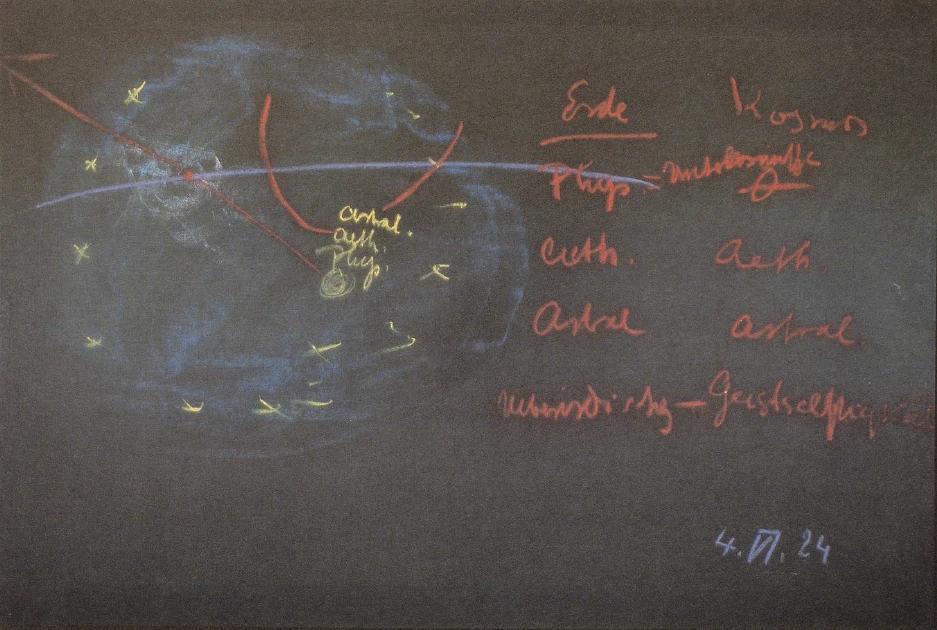
[ 35 ] Wir können sagen: Auf der Erde hat der Mensch sein Physisches, sein Ätherisches, sein Astralisches. Das Ätherische ist auch draußen im Kosmos; das Astralische ist auch draußen in dem Kosmos (siehe Zeichnung Seite 248, rot); das Physische ist allein auf der Erde, es gibt draußen im Kosmos kein Physisches. So müssen wir sagen: Erde: Physisches, Ätherisches, Astralisches; Kosmos: das Physische ist nicht da, aber das Ätherische und das Astralische.
[ 35 ] We can say: On Earth, human beings have their physical, etheric, and astral bodies. The etheric body also exists out there in the cosmos; the astral body also exists out there in the cosmos (see illustration on page 248, in red); the physical body exists only on Earth—there is no physical body out there in the cosmos. Thus, we must say: Earth: physical, etheric, astral; cosmos: the physical body is not there, but the etheric and astral bodies are.
[ 36 ] Dreigegliedert ist aber auch der Kosmos. Was er unten nicht hat, das setzt er oben an. Bei ihm ist das Ätherische das Unterste; auf der Erde ist das Physische das Unterste. Auf der Erde ist das Astralische das Höchste; im Kosmos ist das Höchste dasjenige, was ja der Mensch heute nur in Rudimenten in sich hat, dasjenige, woraus einmal gewoben sein wird sein Geistselbst. Wir können sagen: Im Kosmos ist die Geistselbstigkeit als drittes.
[ 36 ] But the cosmos, too, is divided into three parts. What it lacks below, it places above. In the cosmos, the ethereal is the lowest; on Earth, the physical is the lowest. On Earth, the astral is the highest; in the cosmos, the highest is that which human beings today possess only in rudimentary form—that from which their spiritual self will one day be woven. We can say: In the cosmos, the spiritual self is the third element.
[ 37 ] Und jetzt erscheinen uns die Sterne als die Äußerungen von irgend etwas. Ich vergleiche sie mit dem Streicheln; die Geistselbstigkeit, die dahinter ist, ist das streichelnde Wesen. Nur daß da das streichelnde Wesen nicht eine Einheit ist, sondern die ganze Welt der Hierarchien. Schaue ich einen Menschen an seiner Gestalt nach, schaue ich seine Augen, die mir entgegenleuchten, höre ich seine Stimme, so ist das die Außerung des Menschen. Schaue ich in die Weltenweiten hinauf, schaue ich auf die Sterne, so sind es die Äußerungen der Hierarchien, die Empfindung erregenden Lebensäußerungen der Hierarchien. Schaue ich in die Unendlichkeit des blauen Weltenfirmaments hinein, so sehe ich nach außen sich offenbaren deren ätherischen Leib, der aber das Unterste ist für diese ganze hierarchische Welt.
[ 37 ] And now the stars appear to us as the manifestations of something. I compare them to a caress; the spiritual selfhood behind them is the caressing being. Except that the caressing being is not a single entity, but the entire world of the hierarchies. When I look at a person’s form, when I look into their eyes that shine back at me, when I hear their voice—that is the expression of the human being. When I look up into the vastness of the cosmos, when I look at the stars, these are the manifestations of the hierarchies—the life-expressions of the hierarchies that stir the senses. When I gaze into the infinity of the blue celestial firmament, I see their ethereal body revealing itself outwardly; yet this body is the lowest level of this entire hierarchical world.
[ 38 ] Dann aber ahnen wir, wenn wir in den Kosmos und seine Weiten hinausschauen, etwas, was nun über das Irdische hinausgeht, so wie die Erde mit ihren physischen Substanzen und Kräften unter das Kosmische hinuntergeht. Und die Erde hat ein Unterkosmisches im Physischen, der Kosmos hat ein Überirdisches in der Geistselbstigkeit.
[ 38 ] But then, when we look out into the cosmos and its vastness, we sense something that now transcends the earthly realm, just as the Earth, with its physical substances and forces, extends down into the cosmic realm. And the Earth has a sub-cosmic aspect within the physical realm, while the cosmos has a super-earthly aspect in its spiritual autonomy.
| Erde | Kosmos |
| Physisches-Unterkosmisches Ätherisches Astralisches |
Ätherisches Astralisches Überirdisches-Geistselbstigkeit |
| Earth | Cosmos |
| Physical-Subcosmic Etheric Astral |
Etheric Astral Supraterrestrial-Spiritual Selfhood |
[ 39 ] Die physische Wissenschaft spricht von einer Bewegung der Sonne. Sie kann das. Denn man kann ja innerhalb des Raumesbildes, das uns als Kosmos umgibt, an gewissen Erscheinungen sehen, daß die Sonne in Bewegung ist. Aber es ist eben nur das in den Raum hereinragende Abbild der Sonnenbewegung. Und wenn man von der wirklichen Sonne spricht, so ist es einfach ein Unsinn, zu sagen, die Sonne bewegt sich im Raume. Weil der Raum von der Sonne ausgestrahlt wird! Die Sonne strahlt nicht nur das Licht aus, die Sonne macht auch den Raum. Und die Bewegung der Sonne selber ist nur innerhalb des Raumes eine räumliche; außerhalb des Raumes ist sie eine zeitliche. Das, was da von der Sonne erscheint, daß sie dem Sternbilde des Herkules zueilt, das ist nur ein Abbild einer zeitlichen Entwickelung des Sonnenwesens.
[ 39 ] Physical science speaks of the Sun’s motion. It is entitled to do so. For within the spatial image that surrounds us as the cosmos, certain phenomena do indeed show that the Sun is in motion. But this is merely the image of the Sun’s motion projecting into space. And when one speaks of the real Sun, it is simply nonsense to say that the Sun moves through space. Because space is radiated by the Sun! The Sun not only radiates light; the Sun also creates space. And the Sun’s own movement is spatial only within space; outside of space, it is temporal. What appears to be happening with the Sun—that it is rushing toward the constellation of Hercules—is merely a reflection of a temporal development of the solar being.
[ 40 ] Ja, seinen intimen Jüngern hat der Christus gesagt: Sehet hin auf das Leben der Erde. Es ist verwandt mit dem Leben des Kosmos. Insofern ihr schaut auf die Erde und den umliegenden Kosmos, ist es der Vater, der dieses Weltenall durchlebt. Der Vatergott ist der Gott des Raumes. Ich aber habe euch zu künden, daß ich von der Sonne gekommen bin, von der Zeit, von der Zeit, die den Menschen nur aufnimmt, wenn er stirbt. Ich habe euch mich selbst gebracht aus der Zeit heraus. Nehmet ihr mich auf, sagte der Christus, so nehmet ihr die Zeit auf und verfallt nicht dem Raume. Aber da müßt ihr auch den Übergang finden von der einen Dreiheit — dem Physischen, Ätherischen, Astralischen — zu der anderen Dreiheit: dem Ätherischen, Astralischen bis zu der Geistselbstigkeit. Die Geistselbstigkeit ist ebensowenig im Irdischen zu finden, wie das Physisch-Irdische im Kosmos zu finden ist. Aber ich bringe euch von ihm die Botschaft, denn ich bin aus der Sonne.
[ 40 ] Yes, Christ said to his closest disciples: Look upon the life of the earth. It is akin to the life of the cosmos. Insofar as you look upon the earth and the surrounding cosmos, it is the Father who lives through this universe. God the Father is the God of space. But I have come to tell you that I have come from the sun, from time—the time that only receives a person when he dies. I have brought myself to you from outside of time. “If you receive me,” said the Christ, “you receive time and do not succumb to space. But there you must also find the transition from one trinity—the physical, etheric, and astral—to the other trinity: the etheric and astral, up to spiritual selfhood.” Spiritual selfhood is just as little to be found in the earthly realm as the physical-earthly realm is to be found in the cosmos. But I bring you the message from it, for I am from the Sun.
[ 41 ] Ja, die Sonne hat einen dreifachen Aspekt. Lebt man innerhalb der Sonne und sieht von der Sonne auf die Erde (siehe Zeichnung, rot), so hat man Physisches, Ätherisches, Astralisches zu sehen. Oder man schaut auf dasjenige, was in der Sonne selber ist, dann hat man fortwährend zu sehen Geistselbstigkeit. Man sieht Physisches, wenn man sich an die Erde erinnert oder hinschaut auf sie. Schaut man weg, so blickt man nach der anderen Seite auf die Geistselbstigkeit. Man pendelt hin und her zwischen dem Physischen und der Geistselbstigkeit. Stabil bleibt dazwischen nur das Ätherische und das Astralische. Sieht man aber hinaus in das Weltenall, dann verschwindet das Irdische vollständig. Ätherisches, Astralisches und Geistselbstigkeit ist da. Das wird Euer Anblick sein, wenn Ihr in die Sonnenzeit kommt zwischen dem Tod und einer neuen Geburt.
[ 41 ] Yes, the Sun has a threefold aspect. If one lives within the Sun and looks down from the Sun toward the Earth (see drawing, red), one sees the physical, the etheric, and the astral. Or if one looks at what is within the Sun itself, one constantly perceives spiritual selfhood. One perceives the physical realm when one remembers the Earth or looks toward it. If one looks away, one gazes in the other direction toward spiritual selfhood. One oscillates back and forth between the physical and spiritual selfhood. Only the etheric and the astral remain stable in between. But if one looks out into the universe, then the earthly disappears completely. The etheric, the astral, and spiritual selfhood are there. This will be your vision when you enter the solar period between death and a new birth.
[ 42 ] Man stelle sich also vor, der Mensch kapsele sich ganz ein mit seiner Seelenverfassung in dem Erdenwesen: er kann das Göttliche empfinden, denn aus dem Göttlichen heraus ist er geboren. Ex deo nascimur.
[ 42 ] So imagine that a person were to completely immerse himself in his inner state within his earthly being: he can perceive the Divine, for he is born of the Divine. Ex deo nascimur.
[ 43 ] Stellen wir uns vor, er kapsele sich nicht bloß innerhalb der Raumeswelt ein, sondern er nehme an den Christus, der aus der Zeitenwelt in die Raumeswelt hereingekommen ist und die Zeit selber in den Raum der Erde gebracht hat. Damit überwindet er im Tode den Tod. Ex deo nascimur. In Christo morimur.
[ 43 ] Let us imagine that he does not merely enclose himself within the world of space, but rather accepts the Christ who entered the world of space from the world of time and brought time itself into the space of the Earth. In this way, he overcomes death through death. Ex deo nascimur. In Christo morimur.
[ 44 ] Aber der Christus bringt die Botschaft: Dann, wenn der Raum überwunden ist und man die Sonne als den Schöpfer des Raumes kennenlernt, in der Sonne sich fühlt durch den Christus, in die lebendige Sonne sich hineinversetzt fühlt, dann verschwindet das PhysischIrdische; das Ätherische, das Astralische ist da. Das Ätherische lebt auf, jetzt nicht als Himmelsbläue, sondern als hellrötliche Erglänzung des Kosmos. Und aus diesem Hellrötlichen glänzen nicht die Sterne herunter, sondern die Sterne berühren uns mit ihren Liebewirkungen. Und der Mensch kann sich fühlen — wenn er sich in all das wirklich hineinversetzt — stehend auf der Erde, das Physische abgestreift, das Ätherische da, ihn durchstrahlend und ausstrahlend als das Lilarötliche; die Sterne nicht glänzende Punkte, sondern Liebesstrahlungen wie das menschliche Liebestreicheln.
[ 44 ] But Christ brings the message: When space is overcome and one comes to know the sun as the creator of space, feels oneself within the sun through Christ, feels oneself transported into the living sun—then the physical-earthly realm disappears; the etheric and the astral are present. The etheric realm comes to life, not as the blue of the sky, but as a bright reddish radiance of the cosmos. And from this bright red, the stars do not simply shine down upon us; rather, the stars touch us with their loving influence. And the human being can feel—if he truly immerses himself in all of this—standing on the earth, the physical shed, the etheric present, radiating through him and emanating from him as a lilac-red glow; the stars not as shining points, but as rays of love like the caress of human love.
[ 45 ] Aber indem man dieses empfindet, das Göttliche in sich, das göttliche Weltenfeuer als das Wesen des Menschen aus ihm herausflammend, sich fühlend im ätherischen Weltenall, erlebend die Geistesäußerungen im astralischen Welten-Erstrahlen: dann bringt das hervor in dem Menschen das innere Erleben des Geist-Erstrahlenden, zu dem der Mensch berufen ist im Weltenall.
[ 45 ] But by sensing this—the divine within oneself, the divine world-fire blazing forth from within as the essence of the human being, feeling oneself in the etheric universe, experiencing the manifestations of the Spirit in the astral radiance of the universe—this brings about within the human being the inner experience of the radiant Spirit, to which the human being is called in the universe.
[ 46 ] Als diejenigen, denen Christus das verkündet hatte, genügend lange sich durchdrungen hatten von diesem Gedanken, da empfanden sie die Wirkung dieses Gedankens in den feurigen Zungen des Pfingstfestes. Da empfanden sie das Sterben durch das Abfallen und Abtropfen des Physischen der Erde. Da empfanden sie aber: das ist nicht der Tod, sondern für das Physische der Erde geht die Geistselbstigkeit des Universums auf: Per spiritum sanctum reviviscimus.
[ 46 ] Once those to whom Christ had proclaimed this had allowed this thought to sink in for a sufficient length of time, they felt the effect of this thought in the fiery tongues of Pentecost. There they experienced dying through the shedding and draining away of the physical aspect of the earth. But there they also realized: this is not death, but rather, for the physical aspect of the earth, the spiritual self-existence of the universe dawns: Per spiritum sanctum reviviscimus.
[ 47 ] So kann man hinblicken auf diese Dreigliederung der einen Jahreshälfte: Weihnachtsgedanke — Ex deo nascimur; Ostergedanke — In Christo morimur; Pfingstgedanke — Per spiritum sanctum reviviscimus.
[ 47 ] Thus, we can consider this threefold division of the first half of the year: the Christmas theme — Ex deo nascimur; the Easter theme — In Christo morimur; the Pentecost theme — Per spiritum sanctum reviviscimus.
[ 48 ] Und es bleibt die andere Hälfte des Jahres. Versteht man sie ebenso, so geht für den Menschen auch wiederum die andere Seite seines Lebens auf. Versteht man jene Beziehung des Physischen zum Seelischen des Menschen und zum Überphysischen, welche die Freiheit in sich schließt, deren der Erdenmensch teilhaftig wird auf der Erde, dann versteht man in den Zusammenhängen zwischen Weihnachts-, Oster- und Pfingstfest den freien Menschen auf der Erde. Und versteht man ihn aus diesen drei Gedanken, dem Weihnachtsgedanken, dem Ostergedanken und dem Pfingstgedanken heraus, und läßt sich dadurch auffordern, das übrige Jahr zu verstehen, so tritt die andere Hälfte des menschlichen Lebens auf, die ich Ihnen andeutete dadurch, daß ich sagte: Blickt man hin auf das menschliche Schicksal — die Hierarchien erscheinen dahinter, die Arbeit, das Weben der Hierarchien. Deshalb ist es so groß, wirklich in ein menschliches Schicksal hineinzublicken, weil man sieht, wie die ganzen Hierarchien dahinterstehen.
[ 48 ] And there remains the other half of the year. If one understands this as well, then the other side of human life also opens up. If one understands that relationship between the physical, the soul, and the supersensible aspects of the human being—a relationship that encompasses the freedom of which the earthly human being partakes on Earth—then one understands the free human being on Earth within the context of the festivals of Christmas, Easter, and Pentecost. And if one understands this from these three ideas—the idea of Christmas, the idea of Easter, and the idea of Pentecost—and allows oneself to be inspired thereby to understand the rest of the year, then the other half of human life emerges, which I hinted at to you when I said: If one looks at human destiny—the hierarchies appear behind it, the work, the weaving of the hierarchies. That is why it is so profound to truly look into a human destiny, because one sees how the entire hierarchies stand behind it.
[ 49 ] Aber es ist ja im Grunde genommen die Sprache der Sterne, die uns aus dem Weihnachts-, Oster- und Pfingstgedanken entgegentönt: aus dem Weihnachtsgedanken, insofern die Erde ein Stern im Weltenall ist, aus dem Ostergedanken, insofern uns der glänzendste Stern, die Sonne, seine Gnadengaben gibt, aus dem Pfingstgedanken, indem uns dasjenige, was jenseits der Sterne verborgen ist, in die Seele hereinleuchtet und in den feurigen Zungen wiederum herausleuchtet aus der Seele.
[ 49 ] But, after all, it is the language of the stars that resonates with us through the themes of Christmas, Easter, and Pentecost: from the spirit of Christmas, insofar as the Earth is a star in the universe; from the spirit of Easter, insofar as the brightest star, the Sun, bestows its gifts of grace upon us; from the spirit of Pentecost, in that what lies hidden beyond the stars shines into our souls and, in turn, shines forth from our souls in fiery tongues.
[ 50 ] Wenn Sie das, was in dieser Art nun von dem Vater, dem Träger des Weihnachtsgedankens, der aber den Sohn schickt, damit der Ostergedanke voll werde, und dann von diesem Sohne, der wiederum die Kunde von dem Geist bringt, damit im Pfingstgedanken das menschliche Leben auf Erden sich in Dreiheit vollende, wenn Sie dieses ausmeditieren, wenn Sie darüber recht nachdenken, dann bekommen Sie zu all den geschilderten Grundlagen, die ich Ihnen zum Begreifen des Karma gegeben habe, eine Empfindungsgrundlage.
[ 50 ] If you meditate on what is conveyed in this way by the Father—the bearer of the Christmas message, who nevertheless sends the Son so that the Easter message may be fulfilled— and then from this Son, who in turn brings the message of the Spirit so that human life on earth may be fulfilled in the Trinity through the spirit of Pentecost—if you meditate on this, if you reflect deeply on it, then you will gain a foundation of feeling to complement all the principles I have described to help you understand karma.
[ 51 ] Versuchen Sie es einmal, den Weihnachts-, Oster- und Pfingstgedanken, so gewendet, wie wir ihn heute gewendet haben, so recht auf menschliches Gefühl, auf menschliche Empfindung wirken zu lassen. Versuchen Sie das, vertiefen Sie diese Ihre Empfindung. Und wenn wir nach meiner Reise, die ich nun genötigt bin, gerade zu Pfingsten wegen des Landwirtschaftlichen Kursus zu unternehmen, wiederum zusammenkommen, dann bringen Sie diese Empfindung, die fortleben soll als der warme, der feurige Pfingstgedanke, mit, und dann werden wir über das Karma weitersprechen können.
[ 51 ] Try, for once, to let the ideas of Christmas, Easter, and Pentecost—as we have interpreted them today—truly take effect on human feelings and human sensibilities. Try this; deepen this feeling of yours. And when we meet again after my trip—which I am now compelled to undertake right at Pentecost because of the agricultural course—bring with you this feeling, which should live on as the warm, fiery spirit of Pentecost, and then we will be able to continue our discussion of karma.
[ 52 ] So aber wird Ihr Verständnis recht befruchtet sein durch das, was der Pfingstgedanke ist. Wie einstmals von der Einsetzung des Pfingstfestes bei der ersten Feier des Pfingstfestes aus jedem der Jünger etwas geleuchtet hat, so sollte eigentlich der Pfingstgedanke wieder lebendig werden auch für anthroposophisches Verständnis.
[ 52 ] In this way, however, your understanding will be truly enriched by the essence of the Pentecost idea. Just as, long ago, the institution of the Feast of Pentecost caused a light to shine from within each of the disciples during the first celebration of that feast, so too should the idea of Pentecost be brought back to life for anthroposophical understanding as well.
[ 53 ] Es sollte etwas leuchtend werden aus Ihren Seelen heraus. Deshalb gab ich Ihnen als Pfingstempfindung mit für die weitere Fortsetzung der Karmagedanken, die für die andere Hälfte des Jahres sind, dasjenige, was ich heute über den Zusammenhang von Weihnachts-, Oster- und Pfingstgedanken zu sagen habe.
[ 53 ] Something radiant should emerge from your souls. That is why, as a Pentecost reflection to help you continue the karmic thoughts intended for the second half of the year, I am sharing with you today what I have to say about the connection between the thoughts of Christmas, Easter, and Pentecost.