

Esoteric Considerations of Karmic Connections
Volume II
GA 236
4 June 1924, Dornach
Translated by Steiner Online Library
Fourteenth Lecture
[ 1 ] When we consider how karma works, we must take into account how the human “I”—which, after all, represents the true essence, the innermost essence of the human being—has, so to speak, three instruments through which it lives out its existence in the world: the physical body, the etheric body, and the astral body. Human beings actually bear the physical body, the etheric body, and the astral body within themselves. They are none of these bodies, for they are, in the true sense, the “I.” And it is also the “I” that undergoes karma and creates karma.
[ 2 ] The point here, however, is that one can consider the relationship of the human being—as an “I”-being—to these three, I might say, instrumental forms—the physical, etheric, and astral bodies—in order to derive from them the foundations for the nature of karma. And with regard to karma, one will gain a perspective for considering the physical, etheric, and astral aspects of the human being by taking the following into account.
[ 3 ] The physical realm, as we see it in the mineral kingdom; the etheric realm, as we find it at work in the plant kingdom; the astral realm, as we also find it at work in the animal kingdom—we find all of this in the sphere surrounding human beings on Earth. In the cosmos surrounding the Earth—I would say, that vast expanse of the universe into which the Earth extends in all directions— We already sense a certain kinship between what takes place on Earth and what takes place within the cosmos. But the question arises for spiritual science: Is this kinship, I might say, as trivial as today’s scientific worldview portrays it?
[ 4 ] Today’s scientific worldview examines what lives and what does not live on Earth based on physical properties. It then examines the stars, the Sun, the Moon, and so on, and it finds—and is particularly proud of this discovery—that these celestial bodies are, in essence, the same as the Earth.
[ 5 ] However, one arrives at this view only through a form of knowledge that does not grasp human beings themselves at all, but rather grasps only what lies beyond the human. At the very moment when one truly grasps human beings as being situated within the universe, at that very moment one can indeed discover the relationships between the individual human constituent parts—the physical body, the etheric body, and the astral body—and the corresponding entities, the corresponding essential forces in the cosmos.
[ 6 ] Now, we find the world ether everywhere in the cosmos surrounding the human etheric body. Certainly, the human etheric body has a specific human form; it possesses certain patterns of movement and so on that differ from those of the world ether. But it is nonetheless true that the world ether is of the same nature as what is found in the human etheric body. Similarly, we can speak of a similarity between what is found in the human astral body and a certain astral quality that works through all things and all beings out in the cosmos. This brings us to something extraordinarily important—something that is, in its very nature, actually quite foreign to modern human beings.
[ 7 ] Let us start with a schematic concept: Imagine a human being on Earth with his etheric body (see drawing, center), and then, surrounding the Earth, the world ether (yellow), which is of the same nature as the human ether. Now, within the human being, we also have the astral body (dark hatching within the yellow). There is also astrality in the cosmic sphere, but where is it to be found? Where is it? It can indeed be found; one simply has to figure out what in the cosmos reveals astrality, what makes it manifest: Somewhere, one must say, astrality exists. But is astrality in the cosmos completely invisible, completely imperceptible, or is it somehow perceptible after all? Of course, in and of itself, the ether is also initially imperceptible to the physical senses. If you—if I may put it this way—look at a small piece of ether, you see nothing with your physical senses; you simply see right through it; the ether is like nothing. But if you take in the entire expanse of the ether, the reason you see the blue sky—which, strictly speaking, isn’t actually there—is that you are perceiving the edge of the ether. So you perceive the ether as the blue of the sky. The perception of the blue of the sky is, in fact, the perception of the ether. So we can already say: By perceiving the blue of the sky (see drawing, blue), we perceive the ether around us.
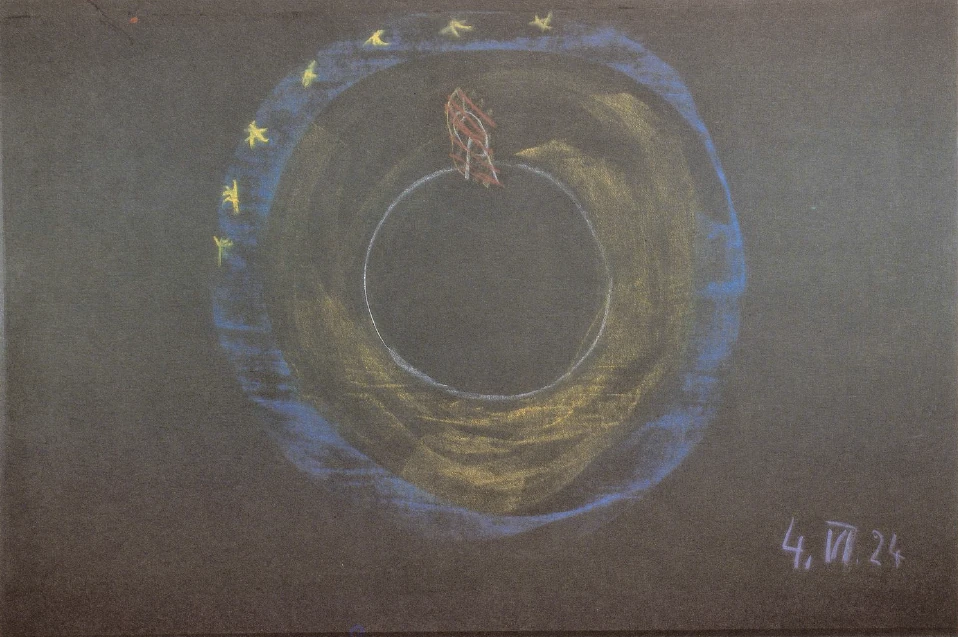
[ 8 ] At first, we see right through the ether. It puts up with this at first, but it does make itself perceptible in the blue of the sky. The existence of the blue of the sky is therefore expressed correctly for human perception when one says: Although the ether is not perceptible, it rises to the level of perceptibility because of the great majesty with which it stands in the universe, making itself known and revealing itself in the blue of the sky.
[ 9 ] In the physical sciences, people take a materialistic approach to thinking about the blue of the sky. Now, it is difficult for the physical sciences to think about the blue of the sky in a reasonable way, simply because the physical sciences must be clear on this point: there is nothing physical where the blue of the sky is. Nevertheless, scientists rack their brains to explain how light rays are refracted and reflected in a particular way to produce this blue of the sky. But this is precisely where the influence of the supersensible begins. And in the cosmos, the supersensible is already perceptible; one merely has to discover where it becomes perceptible.
[ 10 ] The ether is thus perceptible through the blue of the sky. Now, somewhere out there lies the astral realm of the cosmos. The ether peeks into the sensory world through the blue of the sky. Where, then, does the astral realm of the cosmos peek into the visible world, into the realm of perception?
[ 11 ] You see, in reality, every star we see shining in the sky is a gateway to the astral realm, so that wherever stars shine, the astral realm shines through. So when you look at the starry sky in all its diversity—with stars clustered together in some places, more scattered in others, set apart from one another—you must say to yourself: In this wondrous configuration of light, the invisible, supersensible astral body of the cosmos makes itself visible. That is why one must not view the world of the stars in a non-spiritual way. Looking up at the starry world and speaking of burning gas giants is just like—forgive the paradoxical comparison, but it is absolutely accurate down to the last detail—someone caressing you out of love while keeping their fingers slightly apart as they stroke you, and you say: “What you feel in that caress are little ribbons being placed across your cheek.” Just as little as little ribbons are placed across your cheek when you are being caressed, so too are the entities of which physics speaks not actually present up there; rather, it is the astral body of the universe that continually exerts its influence—just like the caress on your cheek—upon the etheric organization.
[ 12 ] However, it is organized to last for a very long time. Therefore, holding a star—which is always an influence on the world ether from the astral world—takes longer than a caress. A human being could not endure the caress for so long, but the fact is that it lasts longer in the universe because gigantic scales are at play there. Thus, the starry sky reveals a soulful expression of the astral realm of the universe.
[ 13 ] At the same time, an immense life—indeed, a spiritual life, a truly spiritual life—is thus brought into the cosmos. Just think for a moment how lifeless the cosmos is when you look out into it and see only burning gaseous bodies that glow! Imagine how alive it all becomes when you realize: These stars are the expression of the love with which the astral cosmos acts upon the etheric cosmos! That is a perfectly accurate description.
[ 14 ] But now consider the mysterious phenomena of certain stars flaring up at specific times—phenomena explained solely by physical phenomena that we actually do not understand at all. Stars that were not yet there flare up, and then they disappear again. Thus, even a fleeting touch exists in the universe. In epochs when, I would say, the gods wish to exert their influence from the astral world into the etheric world, one sees such stars that flare up and then immediately dim again.
[ 15 ] Thus, through our astral body, we experience well-being within ourselves in the most diverse ways; thus, through the astral body, we perceive the configuration of the starry sky in the cosmos. No wonder, then, that an ancient, instinctively clairvoyant science called this third human member the astral body, for it is of the same nature as what is revealed in the stars. Only the “I” do we find does not reveal itself within this sphere. Why? Well, we discover precisely why this is the case when we consider that this human “I,” as it manifests itself on Earth—that is, in the cosmos, which is actually a threefold world consisting of a physical, an etheric, and an astral realm—is always a repetition of earlier earthly lives. And it is always present in the life between death and a new birth.
[ 16 ] But if one observes it closely, the etheric world—which surrounds our earthly world—has no significance for this “I”; after all, the etheric body is shed shortly after death. Only the astral world, which shines in through the stars, has significance for the “I” in the life between death and a new birth. And in this world, which shines in through the stars—in this world—live the beings of the higher hierarchies, with whom the human being shapes his or her karma between death and a new birth.
[ 17 ] But when we consider this “I” in its successive unfolding through life between birth and death and between death and rebirth, we cannot possibly remain within space. Two successive earthly lives cannot exist in the same space, and therefore cannot exist in the universe, which is based on simultaneity and spatiality. Thus, we step out of space and into time. And indeed, one steps out of space and into the pure flow of time when one observes the “I” in its successive earthly lives.
[ 18 ] But now consider this: Time is, of course, also present within space; yet we have no means whatsoever to experience time as such within space. There is no way. One must always experience time through space and its processes. If you want to experience time, for example, you look at a clock, or—for my sake—you might also observe the sun’s path; after all, the clock is merely an earthly representation of the sun’s path. But what do you actually see there? You see the positions of the hands or the sun’s location: spatial phenomena. Because the positions of the hands or the sun change—that is, because spatial phenomena are changing before your eyes—you gain a sense of time. But there is actually nothing of time within space itself. There are only various spatial arrangements, various positions of the hands, various locations of the sun. You only experience time through spiritual experience. But there you truly experience time, and there you also step out of space. There, time is a reality. Time is not a reality at all within the Earth.
[ 19 ] What, then, must one experience if one wishes to pass from the space in which one lives between birth and death into the spacelessness in which one lives between death and a new birth—what must one experience? Yes, my dear friends, one must die! And if you take this to heart—if you grasp it in all its depth—that on Earth we experience time only through space, through spatial locations, through the positions of spatial objects, that we do not experience time on Earth in its true reality at all, then you will, in essence, find another word for what is there when you say: To enter time as reality, one must step out of space, remove everything spatial—and that means: to die!
[ 20 ] Now we must turn our gaze to this cosmic world that surrounds us within the sphere of the earthly realm—a world to which we are akin through our etheric body and through our astral body—and we look upon the spiritual aspect of this cosmic world. There have been peoples, groups of people, who looked only toward the spiritual aspect of this spatial-cosmic world. Thus they lost the ability to think about repeated earthly lives. For thoughts about repeated earthly lives were held only by those people and groups of people who could conceive of time in its purity, in its spacelessness. And when we set aside what we regard as the earthly world and its surroundings—in short, as our cosmos, as our universe—and perceive the spiritual aspect of it, we are left with roughly that which we can say must exist so that we, as earthly human beings, can enter into our existence. It must exist.
[ 21 ] Yes, there is an immense amount at stake in this concept: everything I have just described must be present so that we, as earthly human beings, can enter into earthly existence—. There is, in particular, an immense amount involved when we conceive of the spiritual aspect of all that has been described. And when we conceive of this spiritual aspect in this—I would say—self-contained state, in this purity within itself, then we have roughly what those peoples who have limited themselves to a conception of space have called God.
[ 22 ] These peoples have sensed, at least in their wisdom teachings, that the cosmos is permeated and interwoven by a Divine presence, and that what is present on Earth itself—in our surroundings in the physical world—can be distinguished from this Divine. Then what reveals itself as the etheric within this cosmic, divine, and spiritual realm—which gazes upon us from the blue of the sky—can be distinguished; furthermore, the astral within this divine realm—which gazes upon us through the configuration of the starry sky—can be distinguished.
[ 23 ] Let us really put ourselves in the situation where, standing on Earth as human beings in the universe, we say to ourselves: We humans have a physical body—where is the physical in the universe? This brings me back to what I have already hinted at. Physical science seeks to find in the universe everything that also exists on Earth. But the actual physical organization is not present in the universe. Human beings begin with the physical organization, then have the etheric, and then the astral; the universe, however, begins directly with the etheric organization. Out there, the physical is nowhere to be found. The physical realm exists only on Earth, and it is simply fanciful to speak of the physical in the universe. In the universe there is the etheric, and then the astral. What it has as a third element will be revealed to our souls today. But the threefold structure of the extraterrestrial cosmos is different from the threefold structure of the cosmos to which we count the Earth as belonging.
[ 24 ] But when we stand upon the Earth with such a feeling, when we perceive the physical aspect of our immediate earthly dwelling place, perceive the etheric that is upon the Earth and in the universe, and that works together from the Earth and from the universe as the etheric, when we look upon the astral, which shines down upon the Earth through the stars, shining down most intensely from the Sun, when we look upon all this and bring the majesty of this cosmic thought before our soul, then we find it quite justified that in those times, when—out of a more instinctive clairvoyance—not only abstractions were conceived but the majesty of ideas could be sensed, it was made comprehensible to human beings: Such a majestic idea in its fullness—one cannot think it ceaselessly; one must first take it in, allow it to affect the soul in all its immense glory, and then let it work within the human being—without spoiling or corrupting it through consciousness. And when we reflect on what enabled the ancient, instinctive clairvoyance to bring such a mindset to life, what remains for us in the present day—of all that converged to bring this idea to life within humanity—is the institution of the Christmas festival.
[ 25 ] When, on Christmas Eve, a person imagines himself standing on Earth with his physical, etheric, and astral bodies, connected to the threefold cosmos—which appears so majestic in its etheric aspect against the blue of the sky, yet also so enchantingly magical in the night, and how it stands in contrast to the astral realm of the universe as reflected in the shining stars—then, in the sacredness of this surrounding environment and in connection with what exists on Earth, they sense how they are placed within this spatial reality with their true I-being. And then he may behold the Christmas mystery, the newborn child, the representative of humanity on Earth, who—as he enters childhood—is born into this spatial reality. And he says, when he beholds the Christmas thought in its fullness and in all its majesty as he gazes upon the child born at Christmas: Ex deo nascimur. — I am born of the Divine, the Divine that ripples through and weaves through space.
[ 26 ] But then, once a person has felt this and let it sink deep into their inner being, they can recall what has dawned on them as the truth about the meaning of the Earth through anthroposophy. This child we are looking at is, after all, the outer shell of that which is just being born into space. And from what is it born, in order to be born into space? According to our discussion today, this can only be time. It is born out of time.
[ 27 ] And when we then trace the life of this child—its spiritualization through the Christ-essence—we come to realize: this being, this Christ-essence, comes from the sun. And now we look up at the sun and say to ourselves: As we look up at the sun, we must perceive in the sunlight the time that is hidden from the spatial realm. Time is within the sun. And out of this time weaving within the sun, the Christ has entered into space and come to Earth. And what do we now have in the Christ on Earth? In the Christ on Earth, we have that which connects with the Earth from outside of space, that which comes from outside.
[ 28 ] Now just think how our conception of the universe changes compared to the ordinary conception when we truly take to heart all that we have now allowed to come before our soul! There, in the universe, we have the Sun along with everything that initially appears to us in connection with the Sun—in the universe, in the cosmos—that which is enclosed within the blue of the sky: the world of the stars. There, too, somewhere, we have the Earth with humanity. But as we look up from the Earth toward the Sun, we are simultaneously gazing into the flow of time.
[ 29 ] This leads to something very significant. It follows that a person can only truly gaze at the sun when, by looking up at the sun—even if, for my sake, only in the spiritual realm—he forgets space and takes only time into account. The sun thus radiates not only light, but space itself. And when we look at the sun, we are looking out of space. That is why the sun is this extraordinary star: because through it we look out of space. But it was from this “outside of space” that Christ came to humanity. When Christianity was founded on earth through Christ, humanity had already been stuck for far too long in the mere “ex deo nascimur.” It had become akin to it. It had completely lost track of time. It had become a purely spatial being.
[ 30 ] It is so difficult for us, with our modern civilizational consciousness, to understand the ancient traditions because they actually deal with space everywhere and not with time—they treat time merely as an appendage of space.
[ 31 ] Then the Christ came and restored the temporal realm to humanity. And as the human heart, the human soul, and the human spirit unite with the Christ, they regain the flow of time from eternity to eternity. What else can we humans do but, when we die—that is, when we leave the world of space—cling to that which then restores time to us, since humanity had become so deeply rooted in the world of space at the time of the Mystery of Golgotha that it had lost touch with time! Christ has restored time to humanity.
[ 32 ] And if people do not wish their souls to die first as they leave this world, then they must die in Christ. We can, after all, be beings of space; then we can say: Ex deo nascimur. — Then we can look upon the Child who emerges from time into space to unite Christ with humanity.
[ 33 ] But since the Mystery of Golgotha, we cannot think of the limits of earthly life—of dying—unless we wish to atone for the loss of time with the loss of Christ, unless we wish to be bound within space and remain there as a ghost. There we must die in Christ. There we must imbue ourselves with the Mystery of Golgotha. There we must add the “In Christo morimur” to the “Ex deo nascimur.” There we must bring the thought of Easter to the thought of Christmas.
[ 34 ] And just as “Ex deo nascimur” brings the spirit of Christmas to our hearts, so “In Christo morimur” brings the spirit of Easter to our hearts.
[ 35 ] We can say: On Earth, human beings have their physical, etheric, and astral bodies. The etheric body also exists out there in the cosmos; the astral body also exists out there in the cosmos (see illustration on page 248, in red); the physical body exists only on Earth—there is no physical body out there in the cosmos. Thus, we must say: Earth: physical, etheric, astral; cosmos: the physical body is not there, but the etheric and astral bodies are.
[ 36 ] But the cosmos, too, is divided into three parts. What it lacks below, it places above. In the cosmos, the ethereal is the lowest; on Earth, the physical is the lowest. On Earth, the astral is the highest; in the cosmos, the highest is that which human beings today possess only in rudimentary form—that from which their spiritual self will one day be woven. We can say: In the cosmos, the spiritual self is the third element.
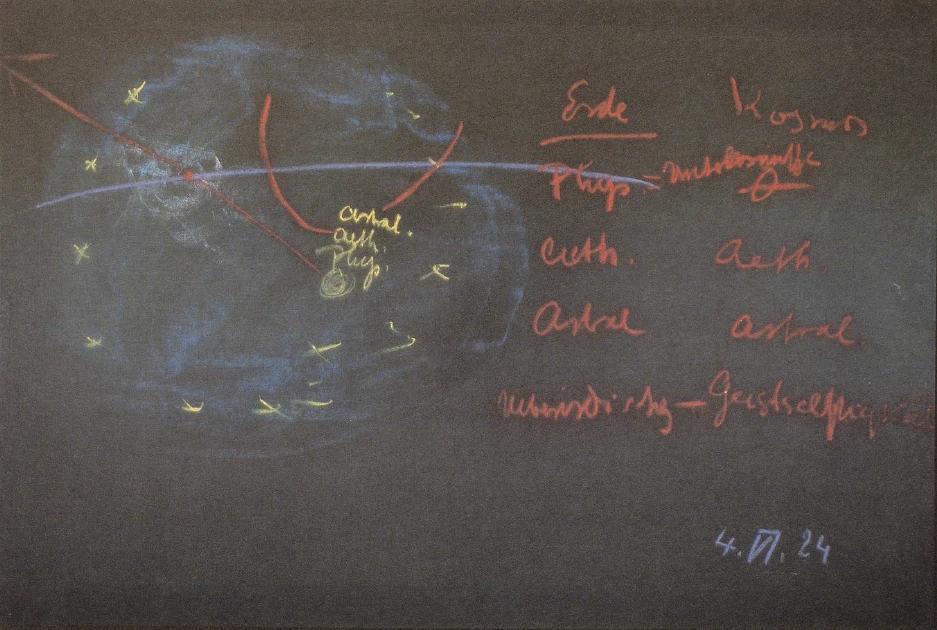
[ 37 ] And now the stars appear to us as the manifestations of something. I compare them to a caress; the spiritual selfhood behind them is the caressing being. Except that the caressing being is not a single entity, but the entire world of the hierarchies. When I look at a person’s form, when I look into their eyes that shine back at me, when I hear their voice—that is the expression of the human being. When I look up into the vastness of the cosmos, when I look at the stars, these are the manifestations of the hierarchies—the life-expressions of the hierarchies that stir the senses. When I gaze into the infinity of the blue celestial firmament, I see their ethereal body revealing itself outwardly; yet this body is the lowest level of this entire hierarchical world.
[ 38 ] But then, when we look out into the cosmos and its vastness, we sense something that now transcends the earthly realm, just as the Earth, with its physical substances and forces, extends down into the cosmic realm. And the Earth has a sub-cosmic aspect within the physical realm, while the cosmos has a super-earthly aspect in its spiritual autonomy.
| Earth | Cosmos |
| Physical-Subcosmic Etheric Astral |
Etheric Astral Supraterrestrial-Spiritual Selfhood |
[ 39 ] Physical science speaks of the Sun’s motion. It is entitled to do so. For within the spatial image that surrounds us as the cosmos, certain phenomena do indeed show that the Sun is in motion. But this is merely the image of the Sun’s motion projecting into space. And when one speaks of the real Sun, it is simply nonsense to say that the Sun moves through space. Because space is radiated by the Sun! The Sun not only radiates light; the Sun also creates space. And the Sun’s own movement is spatial only within space; outside of space, it is temporal. What appears to be happening with the Sun—that it is rushing toward the constellation of Hercules—is merely a reflection of a temporal development of the solar being.
[ 40 ] Yes, Christ said to his closest disciples: Look upon the life of the earth. It is akin to the life of the cosmos. Insofar as you look upon the earth and the surrounding cosmos, it is the Father who lives through this universe. God the Father is the God of space. But I have come to tell you that I have come from the sun, from time—the time that only receives a person when he dies. I have brought myself to you from outside of time. “If you receive me,” said the Christ, “you receive time and do not succumb to space. But there you must also find the transition from one trinity—the physical, etheric, and astral—to the other trinity: the etheric and astral, up to spiritual selfhood.” Spiritual selfhood is just as little to be found in the earthly realm as the physical-earthly realm is to be found in the cosmos. But I bring you the message from it, for I am from the Sun.
[ 41 ] Yes, the Sun has a threefold aspect. If one lives within the Sun and looks down from the Sun toward the Earth (see drawing, red), one sees the physical, the etheric, and the astral. Or if one looks at what is within the Sun itself, one constantly perceives spiritual selfhood. One perceives the physical realm when one remembers the Earth or looks toward it. If one looks away, one gazes in the other direction toward spiritual selfhood. One oscillates back and forth between the physical and spiritual selfhood. Only the etheric and the astral remain stable in between. But if one looks out into the universe, then the earthly disappears completely. The etheric, the astral, and spiritual selfhood are there. This will be your vision when you enter the solar period between death and a new birth.
[ 42 ] So imagine that a person were to completely immerse himself in his inner state within his earthly being: he can perceive the Divine, for he is born of the Divine. Ex deo nascimur.
[ 43 ] Let us imagine that he does not merely enclose himself within the world of space, but rather accepts the Christ who entered the world of space from the world of time and brought time itself into the space of the Earth. In this way, he overcomes death through death. Ex deo nascimur. In Christo morimur.
[ 44 ] But Christ brings the message: When space is overcome and one comes to know the sun as the creator of space, feels oneself within the sun through Christ, feels oneself transported into the living sun—then the physical-earthly realm disappears; the etheric and the astral are present. The etheric realm comes to life, not as the blue of the sky, but as a bright reddish radiance of the cosmos. And from this bright red, the stars do not simply shine down upon us; rather, the stars touch us with their loving influence. And the human being can feel—if he truly immerses himself in all of this—standing on the earth, the physical shed, the etheric present, radiating through him and emanating from him as a lilac-red glow; the stars not as shining points, but as rays of love like the caress of human love.
[ 45 ] But by sensing this—the divine within oneself, the divine world-fire blazing forth from within as the essence of the human being, feeling oneself in the etheric universe, experiencing the manifestations of the Spirit in the astral radiance of the universe—this brings about within the human being the inner experience of the radiant Spirit, to which the human being is called in the universe.
[ 46 ] Once those to whom Christ had proclaimed this had allowed this thought to sink in for a sufficient length of time, they felt the effect of this thought in the fiery tongues of Pentecost. There they experienced dying through the shedding and draining away of the physical aspect of the earth. But there they also realized: this is not death, but rather, for the physical aspect of the earth, the spiritual self-existence of the universe dawns: Per spiritum sanctum reviviscimus.
[ 47 ] Thus, we can consider this threefold division of the first half of the year: the Christmas theme — Ex deo nascimur; the Easter theme — In Christo morimur; the Pentecost theme — Per spiritum sanctum reviviscimus.
[ 48 ] And there remains the other half of the year. If one understands this as well, then the other side of human life also opens up. If one understands that relationship between the physical, the soul, and the supersensible aspects of the human being—a relationship that encompasses the freedom of which the earthly human being partakes on Earth—then one understands the free human being on Earth within the context of the festivals of Christmas, Easter, and Pentecost. And if one understands this from these three ideas—the idea of Christmas, the idea of Easter, and the idea of Pentecost—and allows oneself to be inspired thereby to understand the rest of the year, then the other half of human life emerges, which I hinted at to you when I said: If one looks at human destiny—the hierarchies appear behind it, the work, the weaving of the hierarchies. That is why it is so profound to truly look into a human destiny, because one sees how the entire hierarchies stand behind it.
[ 49 ] But, after all, it is the language of the stars that resonates with us through the themes of Christmas, Easter, and Pentecost: from the spirit of Christmas, insofar as the Earth is a star in the universe; from the spirit of Easter, insofar as the brightest star, the Sun, bestows its gifts of grace upon us; from the spirit of Pentecost, in that what lies hidden beyond the stars shines into our souls and, in turn, shines forth from our souls in fiery tongues.
[ 50 ] If you meditate on what is conveyed in this way by the Father—the bearer of the Christmas message, who nevertheless sends the Son so that the Easter message may be fulfilled— and then from this Son, who in turn brings the message of the Spirit so that human life on earth may be fulfilled in the Trinity through the spirit of Pentecost—if you meditate on this, if you reflect deeply on it, then you will gain a foundation of feeling to complement all the principles I have described to help you understand karma.
[ 51 ] Try, for once, to let the ideas of Christmas, Easter, and Pentecost—as we have interpreted them today—truly take effect on human feelings and human sensibilities. Try this; deepen this feeling of yours. And when we meet again after my trip—which I am now compelled to undertake right at Pentecost because of the agricultural course—bring with you this feeling, which should live on as the warm, fiery spirit of Pentecost, and then we will be able to continue our discussion of karma.
[ 52 ] In this way, however, your understanding will be truly enriched by the essence of the Pentecost idea. Just as, long ago, the institution of the Feast of Pentecost caused a light to shine from within each of the disciples during the first celebration of that feast, so too should the idea of Pentecost be brought back to life for anthroposophical understanding as well.
[ 53 ] Something radiant should emerge from your souls. That is why, as a Pentecost reflection to help you continue the karmic thoughts intended for the second half of the year, I am sharing with you today what I have to say about the connection between the thoughts of Christmas, Easter, and Pentecost.