

Esoteric Considerations of Karmic Connections
Volume II
GA 236
30 May 1924, Dornach
Translated by Steiner Online Library
Thirteenth Lecture
[ 1 ] Examining the karmic connections in human life does indeed require a complete understanding of the laws governing the world, which are more or less unfamiliar to people today. For the point is that the karmic connections, which extend from one earthly life into the next, are influenced by laws of a spiritual nature—so spiritual, in fact, that one already misunderstands them if one even remotely considers that this causality is in any way similar to what we otherwise find in the world when we speak of cause and effect.
[ 2 ] One must first gain a very precise understanding of what is taking place within the human being, behind ordinary consciousness, if one wishes to grasp what karmic connections are. And an understanding of what lies beyond ordinary consciousness can really only be gained by observing the human being as it presents itself to supersensible knowledge, to the knowledge of initiation.
[ 3 ] Let us therefore—specifically to build on certain points that were touched upon in the previous lectures here, and which, when further elaborated, will lead to a complete understanding of karma— let us consider today how, as a human being ascends to imaginative, inspired, and intuitive knowledge, they increasingly gain the ability to see how they themselves, as a human being, are actually situated within the entire cosmos.
[ 4 ] It has often been emphasized—even in public lectures—that through this imaginative insight, a panorama of one’s present earthly life unfolds before a person; that a person surveys their life in powerful images; and that in doing so, they perceive precisely what ordinary memory cannot provide.
[ 5 ] One might say: In this overview, which arises from the striving for imaginative knowledge, the human being is initially entirely within his physical and etheric bodies. It is only through the appropriate exercises that he becomes completely independent of everything that conveys impressions from the physical body. Through imaginative insight, the human being thus becomes independent of sensory impressions and of intellectual knowledge. In this process of insight, the human being lives solely in the etheric body. This is how the human being experiences this tableau of memories.
[ 6 ] So we can say: Human beings live in the supersensible realm, but they live there in such a way that they have separated themselves inwardly from their physical body. You see, this imaginative insight would actually not be nearly as difficult to attain as is indeed the case for most people, if there were a greater inclination to break through the inner bond between the entire soul life and the physical body.
[ 7 ] Of course, it is relatively easy to break through what is linked to immediate sensory perception. But just consider that human beings, with their physical bodies, are also connected through the state of soul they acquire during their earthly lives. After all, when we are in certain states of mind regarding the physical plane, we are also dependent on the physical body. States of mind are certainly conditioned by the physical body as well. When a person attributes this or that to their abilities, their talents, or their other inner states of mind, all of this is connected to their experience within the physical body. One must free oneself from all of this if one wishes to attain true imaginative insight. If one becomes truly free for even a single minute, one already knows what imaginative insight is, and then the tableau of life gradually opens up.
[ 8 ] Now you must consider this difference between “being connected to the physical body and thereby being inside the physical body” and “not being connected to the physical body and yet being trapped inside the physical body.” That is a difference, and that is precisely what constitutes imaginative insight: remaining trapped within the physical body, never leaving it, yet becoming independent of it.
[ 9 ] If you yourself remain in your physical body with your soul-spiritual life, then you fill it, even if you are not connected to it. You fill it. I would like to draw a diagram of this.
[ 10 ] Let us consider the ordinary daily state of human life. Let us assume that this is the physical body (see drawing a, outer, light-colored), that this is the etheric body (purple), and that this is the spiritual-soul aspect (yellow). Now, the situation is as follows: The human being is connected everywhere—through muscles, bones, and nerves—from the etheric body to the physical body. These connections exist everywhere, from the etheric body to the physical body. So imagine, to provide a comparison: You have a porous clay vessel and pour a liquid into it; the liquid fills the pores of this porous clay vessel. The liquid has thus seeped into the porous clay vessel.
[ 11 ] Now, however, it may also be the case that you do not have a porous “clay vessel,” but rather one that does not absorb any of the liquid at all; in that case, the liquid will simply be inside the clay vessel, having no connection whatsoever with the interior of the vessel’s walls themselves. In the same way, in imaginative perception, the human being is inside his or her body, but the etheric body does not penetrate into the muscles, bones, and so on. So I can draw it like this: physical body (see drawing b); but the etheric body now remains separate, and within it lies the human being’s spiritual-soul aspect. It is only within the human being that the etheric body is set apart. The consequence of this setting-apart must naturally come to perception when one returns to the former state. Therefore, it is only natural that when a person truly strives to emerge from their physical body yet remains inside it—as is the case with imaginative insight—they not only become fatigued but also feel heavy, and they then feel their physical body strongly because they must, after all, crawl back into it.
[ 12 ] This is true of imaginative cognition, but not of inspired cognition. Inspired perception, which occurs when consciousness is empty, as I have explained to you, causes the human being to be outside their physical body with their spiritual-soul aspect. This, then (drawing c), is the spiritual-soul aspect outside the physical and etheric bodies.
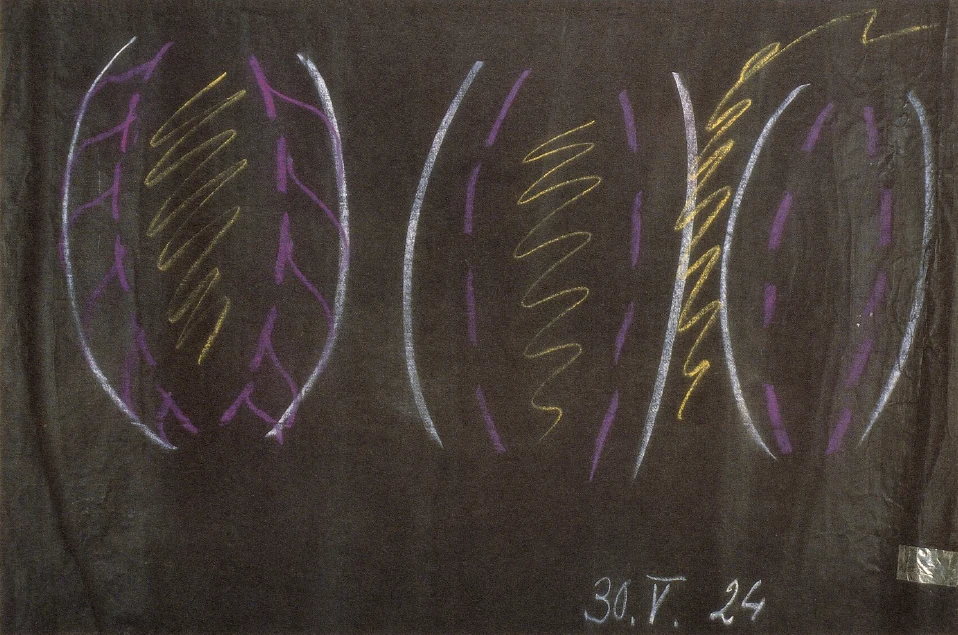
[ 13 ] The external configuration must therefore be as it is during sleep. The human being must be able to place his ego and his astral body completely outside the etheric body. Only then does inspired insight arise.
[ 14 ] But when a person returns once more to their physical and etheric bodies, they realize that there is something within these bodies—that these physical and etheric bodies are not at all as one normally perceives them, but that there is something within them. This is very important. And it is very important because, in fact, knowing this defines the entire process of initiation.
[ 15 ] At first, one does indeed find it somewhat difficult to return to the physical body after the inspiration, because one actually has the feeling of immersing oneself in something entirely different from what one is usually contained within—namely, one’s physical and etheric bodies.
[ 16 ] Now, remember that I told you yesterday: When you look back and have that tableau of memories, and then erase that tableau through inspired insight—that is, when you are in a state of inspired insight—you perceive, within that state of inspired insight, what is inside the physical body. For when one erases the tableau of memories for the period from birth to the age of seven, up to the time of the change of teeth, one perceives that an angelic being was present within this physical body. One truly perceives a third hierarchy within a being. So the fact of the matter is this: One emerges from one’s physical body, returns once more to this physical body as one’s human dwelling, and lo and behold, one encounters one’s angel within it when looking back on the period from birth to the age of seven.
[ 17 ] You see, such facts were already known at one time in the course of human development—and were known in various ways at different times through ancient, instinctive clairvoyance—and people took such facts into account in certain aspects of human life.
[ 18 ] In the old days, people were certainly aware that naming was based on spiritual realities. Today, people are generally indifferent to what names their children are given. For some, the only consideration is that the name sounds nice and so on. Sometimes there is even a certain degree of frivolity involved in naming. People simply like the name. There were times in the past when naming was connected to a relationship—one that people imagined—between the child and the spiritual world. Take, for example, an era in which a prophetic being named Elisha was revered: in that era, certain female children were named Elizabeth, which means “the house of Elisha.” This expressed the idea that the child was brought into the world with the intention of securing the grace of that particular prophet. And so names were given with this intention in mind.
[ 19 ] Why? Because it was known that when a person is outside their body and returns to it, they actually become a vessel—they see themselves as the vessel of spiritual beings. And the entire idea that children in particular are protected by their angels is based on the fact that during initiation, when one looks back on this period from birth to the age of seven, one experiences what I characterized yesterday by saying: If one erases this period from the tableau of memories, the hierarchy of the Angeloi—or rather, the lunar activities—shines through. — As I said yesterday: This is somewhat shifted, but we will come to discuss all of this. — So one then sees this at the same time as something that lies within the human being.
[ 20 ] And again, if one looks back, for example, at the period from the seventh to the fourteenth year, and then returns to one’s body, one finds an archangelic presence. This archangelic presence is, of course, also present from birth until the seventh year. One simply does not perceive it when looking back only at the period from birth to the seventh year of life. And so it is that, upon this return from outside the body into the body, one becomes aware: All the beings of the higher hierarchies are indeed present within. However, one can only arrive at this kind of self-knowledge—that the body is the bearer of the beings of the higher hierarchies—by first being outside the body and then returning to it.
[ 21 ] But this, in turn, can only be understood in connection with another fact. You see, there are many stars in the world, and I have told you that these stars are merely the outward signs of colonies of gods. Colonies of spiritual beings actually exist where the outward sign of the star twinkles. But you must not imagine that these gods are present with their consciousness only, say, on Venus or in the Sun or on Mercury or in Sirius and so on; rather, they are primarily there. There, so to speak, is the center of their being. But all spiritual beings in the cosmos who have anything to do with Earth cannot possibly exist in the universe in such a way that one could say they inhabit only Mars or Venus. As paradoxical as it may sound to you, I must say: The divine beings that belong to Earth—and who are inhabitants of Mars, Venus, Jupiter, and so on, as well as the inhabitants of the Sun—would be blind if they inhabited only the Sun, Mars, or Jupiter. They would be as blind as we are when we have no eyes. They would be there, they would act—just as we can walk and reach out even if we have no eyes—but they would not see—in a divine sense, of course—they would not perceive what is happening in the cosmos through a certain faculty of perception. But this must lead you to ask yourselves, my dear friends: Where is the eye, the faculty of perception of the gods? Where is it? — And you see, this faculty of perception of the gods is, among other things, the Moon, our neighbor in the cosmos. All the divine beings of the Sun, Mercury, Mars, Jupiter, and Saturn have their eye in the Moon. They are simultaneously in the Moon.
[ 22 ] And now consider what has actually been said about the things discussed here as examples. Take just this one fact: It has been said that the Moon was once part of the Earth and only separated from it over the course of time. At that time, then, the eye of the gods was connected to the Earth; the gods gazed out upon the cosmos from the Earth. That is why the great primordial teachers were able to impart to humanity the wisdom they brought to it. For while they lived on Earth, they gazed out into the cosmos with the eye of the gods, because the Moon was within the Earth. And when the Moon departed, they were still able to retain the memory for a time; from that memory, they could see what had been beheld through the eye of humanity; they were able to instruct the gods, but then they had to make their way to the Moon and establish a colony of their own—where the Primordial Teachers now reside—so that they might see with the eye of the gods.
[ 23 ] Consider another point: Yahweh ruled the Jewish heart and soul from the Moon, and those among humanity’s great primordial teachers who still participated in the cult of Yahweh and the teachings of Yahweh had connected themselves directly with Yahweh on the Moon in order to gaze out into the cosmos through his eye. The Moon will once again unite with the Earth. Then, once more, human beings on Earth will have the opportunity to gaze out into the cosmos through the eye of the gods. Then they will have a natural way of looking out into the cosmos. All of this, you see, are facts that alone can teach humanity the true nature of the universe. For only when one views the world in this way does one look upon the Moon in the proper manner.
[ 24 ] And now we also learn the reason why freedom, in particular, can develop on Earth. As long as the Moon was connected to the Earth, and as long as the ancient Primordial Teachers instructed humanity from their memory, and as long as the teachings of the ancient Primordial Teachers were still preserved in the Mysteries—which, after all, lasted well into the 14th century A.D.—all wisdom was that which was beheld through the eyes of the gods. It is only since the period I have indicated to you—1413—that the Earth has been rendered entirely incapable of seeing with the eyes of the gods. Thus, with the development of the conscious soul, the possibility of developing freedom for human beings begins.
[ 25 ] But in reality, human beings are on Earth only in terms of their sensory perception and in terms of everything that constitutes intellectual knowledge, for these are connected to the sensory-physical body. — In truth, the situation is this: When we imagine a human being (drawing on page 228), he stands out above the hierarchies that dwell above him only in relation to his senses and his intellectual knowledge—I would therefore have to place the red above the sense of warmth and everything (red)—, whereas with regard to everything that lies beyond his intellect, he is filled with the third hierarchy (light green). With regard to everything that lies beyond his feeling, he is filled with the second hierarchy (chest, orange); for everything that lies beyond his willing, with the first hierarchy (torso, yellow).
[ 26 ] So we are actually within the hierarchies and only protrude from the world of hierarchies with our sense organs and our intellect. As human beings, we are truly like people swimming, with only our heads protruding slightly above the surface. In this way, we protrude from the ocean of hierarchical influences with our senses and our intellect.
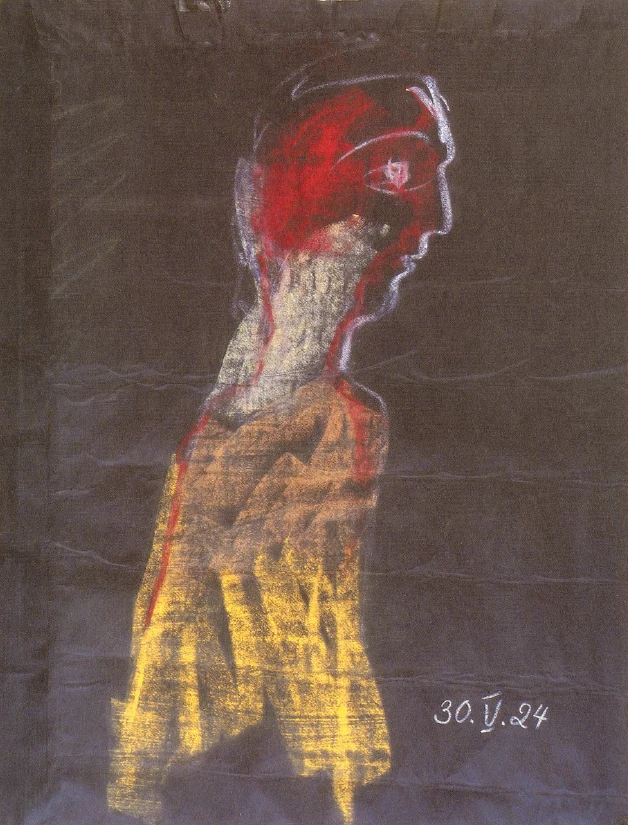
[ 27 ] You find all of this when you return to the body from the state of out-of-body perception. There you discover how the human being is the house of the gods.
[ 28 ] But this leads you to another conclusion, my dear friends: When the gods wish to gaze upon the cosmos, they look through the Moon. If the gods still wish to observe the cosmos from Earth today—which presents a completely different perspective—then they must look through human beings. And the human race is the other eye of the gods.
[ 29 ] In ancient times, human beings were naturally able to see through the eyes of the gods because the Moon was united with the Earth. They will be able to do so again when the Moon is reunited with the Earth. Through initiation—by becoming aware, as one returns to the body, that these are indeed gods, and by making this acquaintance with the gods—one learns to view the world through the human eye. Thus, initiation provides the very same thing that the use of the moon’s eye once provided to the gods.
[ 30 ] Everything we do with our ordinary consciousness—the intentions we carry out through it—depends on us; but our karma is shaped and formed by the hierarchies within us. So there you have the true architects of an entirely different world order—a world order that arises from the moral-spiritual realm. This is the other side of the human being, the side of the hierarchies.
[ 31 ] As long as one remains within imaginative insight and looks back on one’s own earthly life, one is completely convinced that, as a human being, one is a unity; one is also completely convinced that certain actions in life are free because one performs them out of the unity of human nature. One also does not yet perceive much of one’s karma through mere imaginative insight. When inspired insight sets in and one returns once more to the body, one feels divided into a world of countless hierarchies. One returns to one’s body and at first does not know who one is. Is one the angel, or is one this being from the hierarchy of the Dynamis, Exusiai, and so on? One is divided into a world of beings. One is stunned by the multiplicity of one’s being, for one is one with all these beings.
[ 32 ] Through the appropriate exercises, a person must then become strong enough to assert their unity in the face of this. But then one also sees—and this is, after all, the aftereffect of life between death and a new birth—how karma is shaped by the interaction of so many beings that are within one. Countless beings are indeed involved in shaping karma; countless divine beings are at work there. So one can truly say: The human being experiences an earthly life only in relation to intellectual and sensory activity. In relation to emotional and volitional activity, the human being shares in the life of the gods. Indeed, even with regard to a more distant, hidden activity of thought, human beings share in the life of the gods: with regard to a hidden activity of thought, the life of the Angeloi, Archangeloi, and Archai; with regard to what is hidden in the life of feeling, the life of the Exusiai, Dynamis, and Kyriotetes; with regard to the will, human beings share in the life of the Cherubim, Seraphim, and Thrones. What is called human destiny is therefore a divine matter and must also be treated as such.
[ 33 ] But what does that mean for life on earth? In fact, if a person does not take the trouble to develop a certain serenity—especially with regard to his fate—if he resents his fate, if he is, naturally enough, dissatisfied with his fate, if he meddles with his fate through subjective decisions, then human beings are, in effect, as if they were constantly interfering with the gods as they shape their fate. One can truly live one’s fate only when one can accept life with serenity. And sensing how fate works—that is precisely one of the things linked to the severe trials of human nature. And if a person can truly come to take their destiny seriously, then it is precisely from the experience of their destiny that they will be able to draw the greatest motivation and absorb the strongest impulses to live in harmony with the spiritual world. And then the person will first gain a sense—a sense derived from life itself—of how the interconnections of destiny work.
[ 34 ] Modern people have, in many ways, lost this subtlety and delicacy of feeling. Their feelings are coarse. But suppose a person, with a more sensitive disposition, were to take the time to reflect inwardly on the relationship they once had with someone who, in their youth, served as a role model, teacher, or something of that nature. It is not exclusively the case that people must look back on those who were their teachers with nothing but contempt; rather, there are certainly possibilities and instances where people look back with a certain inner satisfaction on those who were their educators and role models. In such cases, this act of looking back can deepen in a certain way within one’s intimate inner experience. One might recall, for example, how one felt between the ages of seven and fourteen: whatever that revered teacher’s authority did, one felt one had to do the same—one simply couldn’t help but do it. Or one might feel, when that revered teacher teaches something or says something, as if one had already heard it, as if it were merely a repetition. It is even one of life’s most beautiful achievements when one can view such things as a repetition. And then it occurs to you: There must be something underlying this. And here, using common sense, you can say: Of course, there can be nothing underlying this in this life. Common sense then points you to past earthly lives. In this way, many people are also led by their common sense to past earthly lives.
[ 35 ] Well, what does it mean when one can look back on a teacher or an educator in this way? It means this, my dear friends: In this life, a person has been given this educator by fate. After all, it is a matter of karma to be given a teacher by fate. This points back to a previous earthly life.
[ 36 ] As a rule—as occult observation shows—it is not the case that in this earlier earthly life the teacher was already the teacher of the person in question, but rather that he stood in a completely different relationship to him. One absorbs thoughts when one is faced with a teacher or an educator—even if only symbolically— in proper pedagogy, one absorbs precisely those thoughts and ideas. When this is the case, it generally points back to a previous earthly relationship, in which one absorbed not thoughts but feelings from the person in question—a relationship in which one had less opportunity to absorb thoughts than to absorb feelings from that person, feelings that can be conveyed through life in the most diverse ways. We can characterize the same process for both the present and a subsequent earthly life.
[ 37 ] Let’s suppose that someone, in this earthly life, has the opportunity to feel deep, heartfelt sympathy for this or that person—someone with whom they do not currently have a close relationship, whom they merely encounter, but who is immensely appealing to them. It may then be the case that these feelings of sympathy, which are developed in the present earthly life, lead to the person who develops them having, in a subsequent earthly life, the person for whom they feel this sympathy as their teacher or mentor.
[ 38 ] And what, objectively speaking, actually happened there? When one develops emotional sympathies toward someone, it depends on what the entities of the second hierarchy—the entities of the Exusiai, Dynamis, and Kyriotetes—unfold for that person within and around them.
[ 39 ] If, then, in the next life, influence occurs not through the medium of feelings but through the medium of thoughts and ideas, then the beings of the second hierarchy have handed over what they did in a previous life to the beings of the third hierarchy—to the Angels, Archangels, and Archai—and these now work within the human being.
[ 40 ] So, you see, the following is true: When our karma evolves from one earthly life to the next, this means that deeds—actual deeds—pass from one hierarchy to another, and that something immensely significant is taking place in the cosmos, in the spiritual cosmos.
[ 41 ] So, in a sense, when we look at human destiny, it is as if we were looking through a veil at the vast unfolding of world events. If we truly bring this to mind, it can make a very strong impression on us indeed. You really just need to imagine it in a very heartfelt way.
[ 42 ] Imagine that you are surveying the fateful life of a person. One should truly not view a person’s fateful life with indifference, for by looking at a person’s fate, one is actually observing a flow of actions that pours from the highest hierarchy down to the lowest, and from the lowest back up to the highest. When one looks at a person’s destiny, one is observing a process of weaving, working, and living in accordance with the order of the hierarchies. Fundamentally, one should regard a person’s destiny with immense inner reverence, with deep inner awe, because by contemplating a person’s destiny, one stands before the entire world of the gods.
[ 43 ] That is actually what I wanted to convey when I wrote my Mysteries, in which you will always find images of events taking place in earthly life, as well as images of events taking place in the spiritual worlds. And in my Mysteries I have also illustrated how not only the higher hierarchies, but also the elemental beings, and how the Ahrimanic and Luciferic forces intermingle in the life and weaving of deeds—which flow from above to below and from below to above—when the destiny of the human being is fulfilled.
[ 44 ] Think of the scenes that unfold for Strader and Capesius in the supernatural realm, where they appear as entirely different forms of being, yet are the same. That is, after all, merely the other side that truly resides within human beings—that which belongs to the world of the gods, and not to the world of earthly realms, minerals, animals, plants, mountains, clouds, trees, and so on. To gaze upon the fates of human beings with sacred reverence—that, too, is something we must make our own, something that our time must make its own. When one reads biographies written by today’s materialistically minded people, it is actually appalling, for they are written without any sacred reverence for the fate of the person for whom the biography is written. Biographers should actually know that by intervening in a human life—even if only descriptively—they are intervening in an invisible way in all hierarchies.
[ 45 ] Through such considerations, we arrive at the emotional aspect of anthroposophy; we become aware of how everything that comes to us as anthroposophical must also touch our feelings, how we not only learn something but are also inspired to develop feelings about the world—feelings that truly bring us into human life for the first time. And without being guided toward such feelings, we cannot truly comprehend the laws that permeate human karma. The cosmic form of karma and the individual consideration of karmic connections