Esoteric Considerations of Karmic Connections
Volume II
GA 236
22 June 1924, Dornach
Translated by Steiner Online Library
Fifteenth Lecture
[ 1 ] Reflections on karmic questions are, after all, not so easy to undertake, and in discussing what pertains to human karma, a strong sense of responsibility is—or at least must be—fundamentally at work. For this indeed involves looking into the deepest interconnections of existence in the world. For within karma, within the course of karma, those things and processes take place that actually underlie the other phenomena of the world, even natural phenomena. Thus, without an understanding of the course of karma in the world and in human evolution, it is essentially impossible to understand why external nature unfolds before us in the form that it does. We have presented examples of a certain course of karma. I have carefully selected these examples so that they stand in such a way that, as we now seek to transition to the consideration of individual karma, we can build upon what has been presented through these examples.
[ 2 ] Now I would like to make an introductory general remark here, if only because there will be friends present today—and likely in the upcoming lectures as well—who were not here during the discussions and lectures that have taken place over the past weeks and months specifically regarding karma. The point is always to realize just how seriously everything connected with our Christmas Conference must be taken. We should truly be deeply aware that, in essence, this Christmas Conference marked a complete reestablishment of the Anthroposophical Society. And it should certainly be the case that we do not fall back into old habits—not even into old patterns of thought—in the face of the profound changes that have occurred in the recent approach to the anthroposophical body of wisdom. For we must also be clear that what has been said, particularly in the reflections that have been held here since the Christmas Conference, cannot be presented by anyone else to this or that audience in any other way—except, at most, if the texts are available, by reading aloud the exact wording spoken here.
[ 3 ] This cannot be freely reproduced at this time. If it were reproduced, I would have to object. For the point is really that, when dealing with these difficult and serious matters, every word and every sentence spoken here must be carefully weighed so that the manner in which these matters must be defined becomes clear. So if anyone intends to convey the matters discussed here to any audience in a different form, they would first have to contact me and ask whether that is possible. In the future, a unified spirit—a truly unified spirit—must take hold of the entire anthroposophical movement. Otherwise, we will certainly fall into the very errors into which a number of our members have fallen—those who believed they had to approach the anthroposophical body of wisdom scientifically—and we have indeed been able to experience how much harm, how much harm to the anthroposophical movement, has actually been—I say this in quotation marks—“accomplished.”
[ 4 ] Of course, the conditions I am discussing here do not include strictly confidential communications; but even in such cases, the person making them should be fully aware of his or her responsibility. For it begins precisely at the moment when one speaks as we are speaking now from this place; it is precisely there, in the most eminent sense, that what I must describe as a sense of responsibility toward communications from the spiritual world begins. It is, of course, difficult to speak about these things here at all. But the very limitations of our facilities do not allow for anything other than what is currently being done. It is difficult to speak about these things, for in fact these lectures should only be given to audiences who are present from the beginning to the end of a lecture series. Anyone who arrives later will, of course, have difficulty understanding.
[ 5 ] Now, one can certainly address this by ensuring that our friends are fully aware that such difficulties exist. Then everything is fine, as long as there is full awareness. But that is not always the case. And the right way of thinking cannot take hold regarding these matters—which are the most delicate within our anthroposophical movement—if, on the other hand, as has been the case since the Christmas Conference, the old habits that existed in the past continue to persist: jealousy, mutual resentment, and so on. For the development of anthroposophy, a certain attitude, a certain seriousness, is absolutely essential.
[ 6 ] I used to raise such issues in the past, when I was not yet a member of the Executive Council, in my capacity as a teacher. But now I must present them in such a way that they truly reflect what must be brought to life within the Anthroposophical Society, emanating from the Executive Council at the Goetheanum.
[ 7 ] Well, I think the words I have spoken can be understood. After all, they were spoken precisely to instill the necessary seriousness in the hearts of our friends in the face of a lecture series such as the one we are facing here.
[ 8 ] Karma is, after all, something that is directly at work in all human experience, yet it remains hidden behind external experiences in all that must be counted among the unconscious and subconscious aspects of the human soul. When one reads a biography—provided that the reading is done with genuine inner engagement in what is being recounted—reading a biography should evoke very particular feelings in the reader. If I were to describe what one might come to realize while reading a biography, it would be this: Anyone who follows a biography with genuine attention will have to say to themselves: Time and again, a biography contains glimpses of life events that are not actually grounded in a continuous narrative progression. When one has a biography before one, one actually has a person’s life before one only in a certain way. A person’s life is not shaped solely by the facts they experience while awake—that is: first day—now comes the night; second day—now comes the night; third day—now comes the night, and so on—but the fact is that we can only perceive superficially what happened on those days, unless we are writing a humanities-based biography, which, under certain circumstances, is actually a complete impossibility in today’s civilization. So we include in the biography what happened on those days while the person about whom we are writing the biography was awake.
[ 9 ] But what actually shapes life, what gives life its form, what instills in life its fateful impulses—that is not visible in the events of the day; it plays out as impulses in the spiritual world between the events of the day, when the human being is himself within this spiritual world from the moment he falls asleep until he wakes up. In real life, these sleep impulses are certainly present; when we recount biographies, they are not included. What, then, does it mean to recount a biography?
[ 10 ] In relation to human life, it actually means nothing less than, for example, taking Raphael’s Sistine Madonna, hanging it on the wall, covering certain areas with white paper so that they are no longer visible, and leaving only certain areas exposed. Anyone looking at it must surely get the feeling: I need to see something else here if this is to be a complete work.
[ 11 ] Anyone who reads a biography with an open mind should actually have this feeling. Of course, in the context of today’s civilization, this can only be hinted at in a certain way, but that is precisely what should happen. It should be hinted at in that way. It should be hinted that impulses are constantly at work in human life, impulses that, in a sense, arise from the most impersonal aspects of soul-spiritual experience. Then, if at least that happens, my dear friends, then we will gradually train ourselves to feel that karma must speak through a biography. It would, of course, be abstract to say that in a biography one recounts some scene from a person’s life and then says: “Well, that comes from a previous earthly life; that’s how it was then, and that’s how it’s manifesting itself now.” — That would, of course, be abstract. Most people would probably find that very sensational, but in truth it would not achieve any higher spirituality than is achieved through our philistine biographies, as they are written in the present age; for everything accomplished in this field in the present age is the work of philistines.
[ 12 ] Now, one can draw closer to what is meant to take root in the soul by, I might say, developing a certain love for people’s diary-like entries. Although diary-like entries can indeed be written in a very philistine manner, if they are not written or read thoughtlessly, anyone who is not a philistine themselves will, in the diary-like entries of even a philistine—as one day transitions into the next—experience feelings that already come close to sensing karma, those fateful connections.
[ 13 ] I have met quite a few people—and their number is by no means small—who considered themselves capable of writing a biography of Goethe. One could say that, without realizing it, these people feel capable of writing a biography of Goethe. For the difficulty grows in proportion to one’s insight into the interconnections of existence, and especially into the karmic interconnections of existence.
[ 14 ] In your inner experience, simply take in everything I have presented here. Take in what I have presented here during that hour when I expressly asked you not to understand me intellectually, but to take these things into your heart, and when I speak again, to receive the following lecture from the heart. Remember that I said this because one cannot truly feel karma if one attempts to approach it solely through the intellect. Anyone who is not moved by the various karmic connections presented here cannot contemplate karma at all, nor can they progress to an individual contemplation of these karmic connections.
[ 15 ] And so let us find the transition from our previous reflections to what might now lead us to say, in regard to an event in a person’s life: “In this, karma expresses itself in a certain way.”
[ 16 ] When I consider what I went through during the seven years in Weimar that I worked at the Goethe and Schiller Archive, and everything I experienced there in relation to Goethe—and as I’m writing this outline of my life, I’m now faced with the task of reflecting on all of this—then, with regard to the question of karma, I say to myself: One of the most difficult questions in any account is to describe what Goethe went through in his soul between the years 1792 and 1800. Writing this chapter in a Goethe biography—or even just thinking it through, viewing it in such a way that one finds karma at work within it—is truly among the most difficult tasks of all.
[ 17 ] Now, we must first consider how karma manifests itself in a person’s life—not merely from an occult perspective, but from a higher, spiritual perspective. Between falling asleep and waking up, a person lives outside of their physical and etheric bodies, within their I and their astral body. With the “I” and the astral body, they live in the spiritual world. Simply surveying these facts—which take place during the transition from falling asleep to waking up—in a truly objective manner is, in turn, one of the most difficult tasks in spiritual scientific research. For, you see, what happens there presents itself in the following way. I will outline it briefly today.
[ 18 ] When you take into account everything that has come before your soul in anthroposophy so far, you will feel that these things give the impression of being comprehensible. But discovering them requires extraordinarily difficult research in the spiritual sciences.
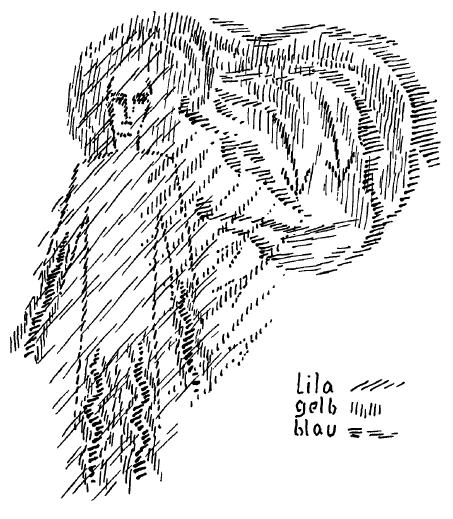
[ 19 ] If I were to sketch a kind of diagram of the human being, we would first see, within the outline I have drawn, what constitutes the human physical body. Within this physical body live the etheric body (see diagram, purple) and the astral body (yellow). And within it lives the “I.”
[ 20 ] Let us now consider a person falling asleep. What I have described here remains in bed. What happens to the astral body and to the “I”? The astral body and the “I”—which I will again sketch out briefly—pass through the person’s head and, in fact, through the entire sensory system; that is, in a certain sense, they emerge from the whole body, but mainly from the head, and are then, schematically speaking, outside the person. So that we can say, if we set aside the “I” for the moment: When a person falls asleep, the astral body leaves the person through the head. In fact, it leaves through every sensory organ. Since the sensory organs are mainly concentrated in the head, the bulk of the astral body passes out through the head. But in a certain sense—because, for example, the sense of warmth is distributed everywhere, as is the sense of pressure— radiations do emanate in all directions, following faintly behind; yet the overall impression is that the astral body exits through the person’s head as they fall asleep. Likewise, the “I”—which, to put it in spatial terms, is somewhat larger than the astral body and not entirely enclosed within—leaves the person. This is the person falling asleep.
[ 21 ] But let us now consider the person who is waking up. When we observe the person waking up, we find that the astral body first approaches the person through the limbs—specifically, through the fingertips and toes—and in this way gradually spreads throughout the person via the limbs. So it comes precisely from the other side. The “I” also comes from the other side, except that the “I” does not now enclose the astral body in this way; rather, as it returns, it is more fully enclosed by the astral body (blue).
[ 22 ] We wake up, and as we wake up, the astral body and the “I” flow into us through the tips of our fingers and the tips of our toes. It actually takes them the entire day to fill the person completely all the way up to the head; and once they have reached the head, the moment has already arrived when they leave the person again. From this you can see that the “I” and the astral body are, in fact, always in a state of flow.
[ 23 ] Now you might ask: Yes, but then—if it’s only been half an hour since we woke up—our astral body, and by that I always mean the “I” as well, extends only this far (to the wrists)—we haven’t gotten any further with it yet—and down to the ankles.
[ 24 ] That’s true. If someone—let’s assume he’s such a decent person—wakes up at seven o’clock at the latest and stays awake, then by half past seven his astral body will only extend to his ankles and perhaps to his wrists. And so it goes on slowly until evening.
[ 25 ] You might say: Yes, but how is it, then, that we wake up as a whole person? After all, we have the feeling that we’ve awakened immediately as a whole human being—and yet, in reality, at a quarter past seven, only our fingers and toes have awakened, and so on; and by noon, for most people—that is, for decent people—they haven’t progressed any further than being inside their astral body, as if in a sitz bath. — That’s how it is.
[ 26 ] And the question that may be raised here must be answered by pointing out that different laws govern the spiritual world than those of the physical world. In the physical world, a body is only where it actually is. That is not the case in the spiritual world. In the spiritual world, even if our astral body has initially occupied only the tips of our toes and fingers, it is already active throughout the entire body. That is what is remarkable. One can already sense it; as soon as it arrives, one can feel it throughout the entire body. But its reality, its actual substance, spreads only slowly. An extraordinary great deal hinges on this phenomenon and our understanding of it. Above all, much depends on it with regard to the assessment of the human organism in its healthy and diseased states. You must bear in mind: Throughout the entire period of sleep, what lies there in bed—which is not the human being but only the physical and etheric bodies—is a kind of plant-mineral activity, albeit within a human organism. This activity can be normal or abnormal, healthy or pathological.
[ 27 ] When the astral body begins to emerge from the limbs, the unhealthy manifestations become a very special kind of perception, especially during the morning hours. Therefore, when assessing illnesses, it is immensely important to ascertain the patient’s feelings upon waking, when their astral body pushes up what is unhealthy within them.
[ 28 ] But let’s continue. When we fall asleep, we step out of our physical and etheric bodies—along with our “I” and our astral body—and enter the spiritual world. The aftereffects of what we have experienced during the day remain. But our thoughts do not remain in the form in which we think them, nor in the form of words. None of that remains. I would say that they cling to this astral body like remnants as it goes out into the spiritual world.
[ 29 ] And as soon as this astral body leaves the human being, karma immediately begins to take shape, albeit initially only in a symbolic sense. Karma begins to take shape. The good and evil we have done during the day—which we initially perceive through our familiar concepts—begins immediately, as soon as we fall asleep, to be transformed into the karmic current of development. And this continues for a while after we fall asleep. During this time, this transformation into karma overshadows everything else that happens to us during sleep.
[ 30 ] But then, as one continues to sleep (see illustration on page 259, arrows), the person begins to sink first into the experiences belonging to a previous earthly life, then into those belonging to the second-to-last earthly life, then into those belonging to the third-to-last, and so on. And when the person is about to awaken, they have also passed through their very first individual earthly life. There they enter the stage of experience where they are not yet separated from the general universe, where they are still part of it, and where one cannot yet speak of an individual earthly life. And only when they have reached this point can they return to their physical organization, to their etheric organization.
[ 31 ] Now another question arises—a rather significant one: But what if we just take a short nap, an afternoon nap for example—what then? Or even if, for example, we briefly nod off during a lecture—but are actually asleep—and the whole thing lasts only two or three minutes, perhaps just one minute or half a minute? In that case, if it is true sleep, we were in the spiritual world for half a minute, between falling asleep and waking up.
[ 32 ] You see, my dear friends, this very brief nap—even during a lecture—is exactly the same as a night’s sleep for a dormouse—a human dormouse, that is.
[ 33 ] The fact is that the moment a person falls asleep—even for the briefest of naps—the entire sleep is a single unit, and the astral body acts as an unconscious prophet, surveying the entire sleep until awakening, naturally from a perspective. The more distant details may be unclear, just as when someone who is nearsighted looks down an avenue and cannot see the trees at the far end. In the same way, the astral body, in the unconscious—figuratively speaking—can be nearsighted. It does not see all the way back to where the first individual earthly lives begin. These are specific details. But on the whole, the situation is such that even during the shortest nap, we pass through all our earthly lives with tremendous, breakneck speed. This is something extraordinarily significant. Of course, the details become very, very indistinct; but if someone falls asleep during a lecture, the lecturer—or those watching alongside them—has the whole scene before them. Consider this: the entire course of earthly evolution, along with everything the person in question has experienced in their previous lives—all of that is right before them. It is only because it happens at breakneck speed when someone dozes off during a lecture that it appears indistinct, with one scene rapidly flowing into the next; yet it is still there. From this, however, you can see that karma is actually always present. It is there. It is, so to speak, recorded in the chronicle of the worlds. And every time a person sleeps, they have the opportunity to engage with this karma. This is one of the great mysteries of existence.
[ 34 ] You see, the person who can view these things impartially from the standpoint of the science of initiation looks, on the one hand, with immense devotion—I would say, a devotion born of insight—toward that which can live in human memory, toward the memories that can arise down there in the soul. These memories speak only of the earthly life just experienced, but nevertheless, a human “I” lives within these memories. And if these memories were not there—as I have hinted at in earlier lectures—the human “I” would not actually be fully present. Down there, there is something that can evoke these memories within us again and again.
[ 35 ] But as we interact with the external world through our senses and our mind, we form ideas—concepts of the external world—that are meant to provide us with images of what is out there.
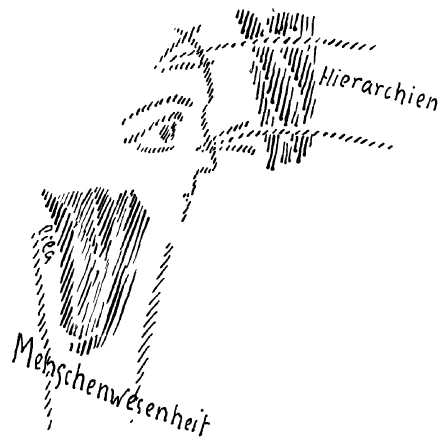
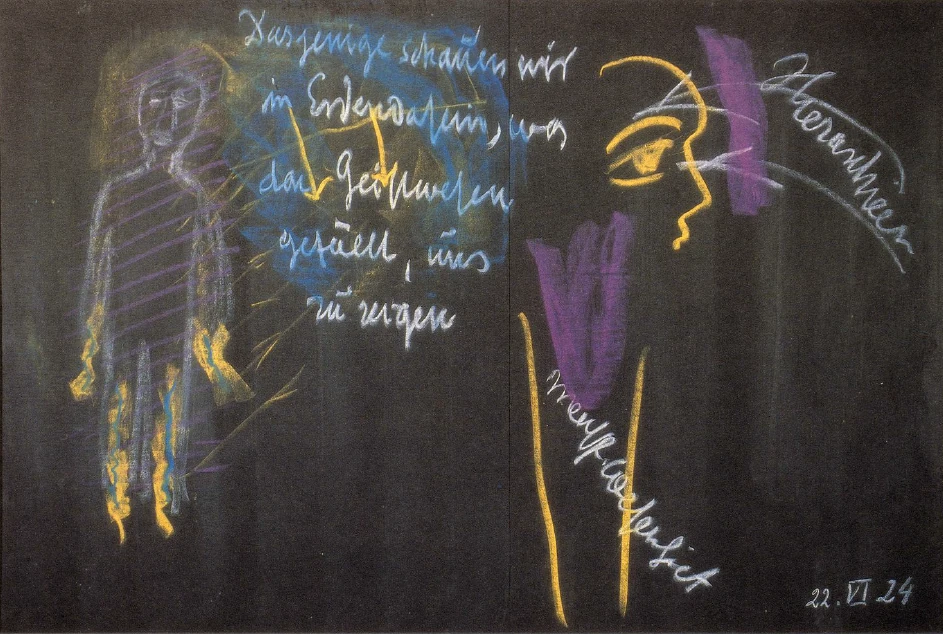
[ 36 ] Once again, we can illustrate this schematically by saying: Here, the human being looks out into the world (see drawing). Images arise in his thoughts (purple), in which what he sees in the external world is represented to him. There, the human being lives within their body. Thoughts arise from within the body, containing their own store of memories. When we look at our store of memories, we say to ourselves: It represents, as best it can according to our mental, soul, and physical constitution, what we have experienced in this earthly existence.
[ 37 ] But let’s now take a look at what’s written on the other side. We usually do not consider that what is written on the other side is, in fact, only a certain snapshot of earthly existence—initially of the earthly and heavenly surroundings. If someone is born in Danzig, their eyes and other senses are drawn to different events and different things than if they were born in Hamburg or Constantinople. But this continues throughout one’s entire life. We can say that the world offers us the most diverse perspectives, and no two people’s perspectives are the same—even if they are born in the same village and die in the same village, that is, even if they are close to one another. The perspective they have on life is entirely different for one person than for another.
[ 38 ] And let’s just take a moment to realize what that actually means. The world presents us with a certain part of itself—the part we see. We never see the rest; we never perceive it. It is immensely significant to direct our thoughts in this direction—how the world presents a person with a sum of impressions on which he relies in the experiences of his life. Those who do not think deeply will quickly come to terms with such a matter. Those who think deeply will not come to terms with it so quickly. For as they reflect on this, they tell themselves something quite special. They say to themselves: This confuses me so much that at first I can’t even find a way to express it. At first, I can’t even put into words what is before me. For how am I to find the right words to express that the cosmos, the world, offers each person only a fragment that is more or less coherent—thus defining people in this way? How am I to express that?
[ 39 ] Of course, when I describe things as abstractly as I am doing now, I am presenting the next set of facts. But that doesn’t really tell us anything yet. It doesn’t actually convey anything specific. I first have to truly articulate the facts—I have to formulate them. How, then, should I describe what is actually happening here?
[ 40 ] You see, we will arrive at a way of phrasing this, a way of expressing it, when we turn our attention once more to memory. What is it, then, that emerges from the depths of our being when we recall something? What comes up there? That which our human being has experienced. Down there is our human being; somewhere where we cannot grasp it, there is our human being. It radiates upward into the thought of memory. It radiates upward from within us into our consciousness. What is it that radiates in there? After all, the human being is so small at first when all of this radiates upward, and everything in the cosmos besides the human being is so large, so enormous! But these fragments are always coming in. And the fact of the matter is nothing other than this: thoughts arise.
[ 41 ] We know only because we have experienced these things that they stem from our experiences. Thoughts also enter in, in exactly the same way as our memories, but they come from outside. How do they enter? Down there is the human being—here is the entire world of hierarchies (see illustration on page 264). You see, my dear friends, this is a sense of grandeur that comes to us when, through the science of initiation, we begin to say to ourselves: These aspects of world knowledge are spread out around us, and behind everything that makes an impression from the outside, the hierarchies live as truly as the individual human being lives behind what emerges as memories.
[ 42 ] And just as it depends on how vividly the experience was lived—whether we recall something from memory, whether there is now a reason for one particular thought to surface from memory while another does not, or none of the others do, and so on—so it is here as well. Anyone who comes to recognize this fact knows: When this one appears, it is a being from the hierarchy of the Angeloi; when another appears, it is a being from the hierarchy of the Exusiai, and so on.
[ 43 ] This brings us to the following statement: In our earthly existence, we see whatever the spiritual beings choose to show us (see illustration on page 264).
[ 44 ] As a certain part of the world is revealed to us during our earthly existence, we come to recognize that this very part—chosen from the infinite array of possibilities contained within the cosmos—has been selected by certain members of the Hierarchies to be shown to us from our birth until our death. One person is shown this, another that. Whether one is shown one thing or the other is a matter for the Hierarchies to decide.
[ 45 ] The Hierarchies remember, just as we human beings do. What forms the basis for the Hierarchies’ memory? The basis for the Hierarchies’ memory is their looking back on our previous earthly lives. They look back. Depending on what they perceive from our previous earthly lives, they present the corresponding aspect of the cosmos to our souls. Even in what we see of the world lies karma, bestowed upon us by the world of the Hierarchies.
[ 46 ] Memories within us of our brief present earthly life in our human memory; memories of the hierarchies outside us of all that human beings have ever done; the emergence of these memories; the imprinting of these memories in the form of what human beings initially perceive of the cosmos; the shaping of human karma—a thought of shattering clarity; for it teaches us that the entire cosmos stands in the service of the work of the hierarchies in relation to human beings.
[ 47 ] From this perspective, why does the cosmos exist? So that the gods have a means within the cosmos to bring the first form of karma to humankind. Why are there stars? Why are there clouds? Why are there the sun and the moon? Why are there animals on Earth? Why are there plants on Earth? Why are there rocks on Earth? Why are there rivers, streams, and brooks? Why are there rocks and mountains? Why does everything that surrounds us in the cosmos exist? All of this serves as a resource for the gods to reveal to us the first form of our karma, depending on the deeds we have performed. The world is the storehouse for the gods’ demonstrations of karma.
[ 48 ] This is how we are placed in the world, and this is how we can develop a relationship with the true mysteries of our existence in relation to the world. And this is how we will discover how to navigate through the various forms of karma.
[ 49 ] I would like to say: First, cosmic karma comes to us. It will become more and more individual. We will find karma at work in its innermost essence.
[ 50 ] Shedding light on these mysteries of existence was already part of the intentions of the Christmas Conference, and it likely already came to the fore in the very spirit of the conference, touching the souls of the friends gathered there at the time. The entire structure of the Anthroposophical Society, my dear friends, was a risk back then. For in this hall, where the Christmas Conference took place and was intended to lay the foundation for the reorganization of the Anthroposophical Society, there loomed a real and significant dilemma: Will it be possible to truly draw forth from the spiritual worlds—if the Christmas Conference is to have a lasting effect—and to communicate it? Or will the sources that must underlie the exploration of the spiritual world dry up? But this inner crisis within the anthroposophical movement had to be present and fully acknowledged. Both of these possibilities had to be faced head-on.
[ 51 ] Today we can say: In the spiritual world, the decision has been made that, especially since that Christmas Conference, the sources of the spiritual world have been opened up more than before; thus, the foundations are in place—if they are understood by the Society—to essentially deepen the anthroposophical movement.
[ 52 ] And it can truly be seen—as I already mentioned last Friday—that wherever this more esoteric tone, which has prevailed in all our anthroposophical work since Christmas, is now emerging in various places, it can be seen everywhere that hearts are responding to this more esoteric tone.
[ 53 ] But I would also like everything I alluded to in my closing remarks to be understood correctly. It simply had to be said at some point, and I have, in fact, already said it in various places.