

Esoteric Considerations of Karmic Connections
Volume II
GA 236
27 April 1924, Dornach
Translated by Steiner Online Library
Fifth Lecture
[ 1 ] We have now examined a series of interconnected developments in destiny that can shed light on and clarify our understanding of the historical life of humanity. The reflections we have undertaken were intended to show how, from previous Earth periods, what people experience, develop, and assimilate in those earlier periods is carried forward by the people themselves into later Earth epochs. And connections have become apparent to us, so that we can understand what is done by human beings—I would say, in a leading role—as stemming from causes in the moral sense that have been laid down by human beings themselves over the course of time.
[ 2 ] But it is not only this—I would say—causal connection that can come to the forefront of our consciousness through such reflections focused on karma; rather, many things that initially appear unclear or incomprehensible to an external view of the world can also be illuminated.
[ 3 ] But if one wishes to keep pace with the great transformation that will be necessary in the near future with regard to the feelings and thoughts of the human mind—if civilization is to move upward rather than downward— then it is precisely necessary to first develop, so to speak, a sense for that which is incomprehensible under ordinary circumstances—and whose comprehension requires insight into deeper human and cosmic relationships. Anyone who finds everything comprehensible naturally has no need to understand these or those deeper causes. But this sense of everything being comprehensible is only apparent, for to find everything in the world comprehensible actually means nothing more than being superficial in one’s approach to everything. For to the ordinary consciousness, most things are, in fact, incomprehensible in reality. And to pause in wonder before the incomprehensibilities of even the most mundane existence—that is, in essence, only the beginning of a genuine quest for knowledge.
[ 4 ] That is precisely what has so often been the subject of sighs from this lectern: that within anthroposophical circles there might be enthusiasm for the search, enthusiasm for what is inherent in the anthroposophical endeavor. And this enthusiasm must truly begin with perceiving the marvelous in everyday life as something truly marvelous. Then, as I said, one will be tempted to delve into the causes, into the deeper forces that underlie the existence surrounding us. For human beings, these states of wonder at the everyday environment can arise from historical reflections, but also from what can be observed in the present. In historical reflections, we must often pause before historical events that are reported to us from the past and that appear as if, here and there, human life truly descended into absurdity.
[ 5 ] Well, human life remains meaningless if we view it solely by focusing on a historical event without asking: How do certain human characters emerge from this historical event, and how do they manifest themselves when they appear in their later reincarnations? — If we do not ask this, then certain historical events also appear completely meaningless—meaningless because they are not fulfilled, because they lose their meaning if they cannot be lived out, if they do not become further soul impulses in a subsequent earthly life, if they do not find balance and then continue to have an effect in subsequent earthly lives.
[ 6 ] There is certainly a historical absurdity inherent in the emergence of a figure such as Nero, the Roman Caesar Nero. He has not yet been discussed within the anthroposophical movement.
[ 7 ] Just take to heart everything that is historically reported about the Roman emperor Nero. In the face of a figure such as Nero, life seems like something one could simply mock with complete impunity—as if one could deride it, as if there were no consequences whatsoever when someone acts with utter frivolity while occupying a position of authority.
[ 8 ] Isn’t it true that one would have to be utterly callous to witness what Nero is doing and still fail to ask oneself: What will actually become of such a soul that, like Nero, mocks the entire world and regards the lives of other people—the very existence of nearly an entire city—as something with which he can play? —What an artist is lost to me! — As is well known, this is the saying attributed to Nero, and it at least corresponds to his mindset. Thus, even in a self-confession, the utmost frivolity, the utmost will to destroy and destructive impulse—but in such a way that this soul takes pleasure in it.
[ 9 ] Well, everything that could make an impression on people is simply pushed aside. Only, so to speak, world-destroying rays emanate from the personality. And we ask ourselves: What will become of such a soul?
[ 10 ] One must be clear about this: Everything that is, so to speak, dumped onto the world radiates back into the life between death and a new birth. This must, in a sense, be unloaded back onto the soul itself; for everything that has been destroyed by such a soul is now present in the life between death and a new birth. Now, a few centuries—or a relatively short time—later, Nero returned to the world in an insignificant existence, where at first only that which had been his destructive fury—which he had unleashed against the sovereignty, acting out of his own will because he so desired—was balanced out; and in this, the rage—one might say, the enthusiasm—for that destructive fury was at work. In a subsequent earthly life, some aspect of this matter was already being balanced out, and the same soul-individuality now found itself in a position where it also had to destroy, but had to do so in a subordinate position, subject to orders. And there, this soul had to experience what it is like to act not out of free will, not in a state of sovereignty.
[ 11 ] Now, when it comes to such matters, it is truly a matter of viewing them without emotion, of viewing them entirely objectively. Such a fate, I would say—for even being as cruel as Nero, as destructive as Nero, is indeed a fate—is, in a sense, a pitiful fate. There’s no need to harbor resentment or to level harsh criticism; if one did, one wouldn’t experience the things necessary to understand the matter as it unfolds, for it’s only possible to gain insight into all the things discussed here by looking at them objectively—not by accusing, but by simply understanding human fates. But these things do speak for themselves quite clearly, if one only has the insight to understand them. And the fact that Nero’s fate came to the forefront of my mind was truly attributable to an apparent coincidence. But it was just an apparent coincidence that this fate of Nero once came to the forefront of my mind with such particular intensity.
[ 12 ] You see, once a deeply shocking event had taken place—an event I will speak of shortly, one that had a profoundly shocking effect throughout the region in question—I happened to be visiting Karl Julius Schröer, a figure I have mentioned frequently in my autobiography. And when I arrived there, he, like many people, was deeply shaken by what had happened. And he spoke—in a way that at first seemed unprompted—as if from the dark depths of his soul, the word “Nero.” One might have thought it was entirely unprompted. But it later became quite clear that what had actually been spoken through a human mouth was something drawn from the Akashic Records. The matter was as follows:
[ 13 ] The Austrian Crown Prince Rudolf had, after all, been celebrated as a brilliant figure and was regarded as someone who inspired great hopes for the time when he would eventually ascend to the throne. Even though people knew all sorts of things about Crown Prince Rudolf, everything they knew was viewed as—well, things that were actually almost to be expected of a “grand seigneur.” In any case, no one thought that this could lead to significant, tragic conflicts. And so it came as an immense surprise—a terrible surprise—when word spread in Vienna that Crown Prince Rudolf had died under very mysterious circumstances near Heiligenkreuz Abbey, close to Baden near Vienna. More and more details came to light, and at first people spoke of an accident; indeed, the “accident” was even officially reported.
[ 14 ] Then, after the accident had already been officially reported, it became known that Crown Prince Rudolf had gone out to his hunting estate there accompanied by Baroness Vetsera, and that he had met his death together with her.
[ 15 ] The details have become so well known that there is probably no need to recount them here. Everything that followed unfolded in such a way that no one familiar with the circumstances could have doubted, once the facts became known, that Crown Prince Rudolf had committed suicide. For one thing, the circumstances were such that, after the official bulletin had been issued stating that an accident had occurred, Hungarian Prime Minister Koloman Tisza was the first to challenge this version and obtained a promise from the Austrian Emperor himself that they would not stand by an incorrect statement. Koloman Tisza did not want to present this account to the Hungarian people and made this point forcefully. But then a man emerged from the medical board—who was actually one of the bravest Viennese doctors at the time and who was also supposed to conduct the postmortem examination—and he said he would not sign anything that was not substantiated by objective facts.
[ 16 ] Well, the objective facts did indeed point to suicide. The suicide was then officially acknowledged, confirming what had been said earlier, and if there were nothing else to go on but the fact that in a family as deeply Catholic as the Austrian imperial family, the suicide had been acknowledged, then this fact alone would mean that one really cannot doubt it. So anyone who can objectively assess the facts will not doubt it.
[ 17 ] But one must ask: How is it possible that anyone with such a brilliant future ahead of him would resort to suicide, given circumstances that could undoubtedly have been easily concealed in such a situation? — There is, of course, no doubt that there is no objective reason—I mean, no objective reason, no reason objectively necessitated by external circumstances—for a crown prince to shoot himself over a love affair.
[ 18 ] There was also no external, objective reason; rather, the fact was that here was a person who stood in direct line of succession to the throne yet considered life to be utterly worthless, and this naturally manifested itself in a psychopathological manner. But psychopathology must first be understood in this case as well; for psychopathology is, after all, something connected to fate. And the fundamental fact at work in the soul is nevertheless that someone for whom the very brightest prospects seemed to beckon found life completely worthless.
[ 19 ] This, my dear friends, is simply one of those facts in life that one must find incomprehensible. And no matter how much has been written or spoken about these matters, only those who say to themselves: “From the perspective of this single human life—the life of Crown Prince Rudolf of Austria—neither the suicide nor the preceding psychopathology, as a cause of the suicide, can be explained.” If one wishes to understand, there must be something else underlying it.
[ 20 ] And now imagine the soul of Nero—after it has passed through the other process I spoke of—coming over into this very self-destructive heir to the throne, who draws the logical conclusion through his suicide: then the circumstances are simply reversed. Then you have within the soul a tendency—originating from earlier earthly lives—that, during the passage through the time between death and a new birth, sees in direct vision that it has actually emitted only destructive forces, and that must also experience this reversal in a splendid way, I would say.
[ 21 ] How is this reversal experienced? It is experienced precisely because a life that outwardly contains everything of value is reflected inwardly in such a way that the bearer of this life considers it so worthless that he takes his own life. In addition, the soul becomes ill, half-mad. Furthermore, the soul seeks external entanglements through a corresponding love affair and so on. But all of this is merely the consequence of the soul’s striving—I would say, to direct toward itself all the arrows that this soul had previously turned toward the world. And when we look into the inner workings of such circumstances, we see an immense tragedy unfolding—but a just tragedy, an extraordinarily just tragedy. And the two images come together for us.
[ 22 ] I have often said: It is the little things that underlie the matters which, in truth and in all seriousness, make research in such fields possible. Many factors in life must come into play.
[ 23 ] As I said, just as this event—which had such a shocking effect at the time—was unfolding, I was on my way to Schröer’s. I didn’t go there because of this event; I was simply on my way to Schröer’s. He was, so to speak, the first person I spoke to about this matter. He said, completely out of the blue, “Nero”—so that I actually had to ask myself: Why is he thinking of Nero right now?—He immediately began the conversation with “Nero.” The word “Nero” shook me at the time. But it shook me all the more because the word “Nero” was spoken under a particular impression, for two days earlier—as has also become widely known—there had been a soirée at the home of the then German ambassador in Vienna, Prince Reuss. The Austrian Crown Prince was also present there, as was Schröer, and Schröer had observed how the Crown Prince behaved at that time, two days before the catastrophe. And this peculiar behavior two days before the catastrophe at that soirée—which Schröer described in very dramatic terms—and then the subsequent suicide two days later: this, in connection with the fact that the word “Nero” had been uttered, was something that had such an effect that one could say to oneself: Now there is a reason to look into these matters. — But why did I even look into so many things that came from Schröer’s mouth? It’s not as if anything Schröer said—who, of course, couldn’t have known such things—was simply taken by me as an omen or something like that. But some things, especially those that seemed to come out of the blue, were important to me—important because of something that once came to light in a strange way.
[ 24 ] I got into a conversation with Schröer about phrenology, and Schröer said—not in a humorous way, but with a certain inner seriousness with which he spoke about such things—one could tell how serious he was by the elevated language he used even in everyday conversation when he wanted to say something with complete seriousness—Schröer said: I was once examined by a phrenologist; he felt my head and found that protrusion up there, about which he then said: ‘There, right there, is the theosophist within you!’ — People didn’t talk about anthroposophy back then, since this was in the 1880s; so this doesn’t refer to me, it refers to Schröer. He examined him and said: “There sits the theosophist.”
[ 25 ] Well, it was indeed the case that, outwardly, Schröer was anything but a theosophist; that is quite clear from my biography of him. But precisely when he spoke of things that actually fell outside the context of what he was saying, it was precisely then that his remarks were sometimes extraordinarily profound. So that these two things could indeed come together: that he uttered the word “Nero,” and that, through this outward affirmation of his theosophy, he had to be regarded as someone to whom one listens, whose unmotivated remarks one examines, so to speak.
[ 26 ] And so it really did come to pass that the investigation into Nero’s fate shed light on what was to come—on the fate of Mayerling—and it was discovered that the Austrian Crown Prince Rudolf was indeed the reincarnation of Nero.
[ 27 ] This investigation, which took a long time—because one has to be very careful in such matters—was particularly difficult for me, because I was, of course, constantly misled by all sorts of people—believe it or not, it’s true—who claimed Nero for themselves and defended this view with great fanaticism. So, naturally, the subjective power emanating from such “reborn Nerons” had to be countered first. One had to fight one’s way through the thicket.
[ 28 ] But you may find, my dear friends, that what I am telling you here now is in fact much more important, because it encompasses a historical fact—namely, Nero—and that, as things unfold, this is far more important to understand than, say, the disaster at Mayerling. For now one sees how such things—which at first, one might say, appear outrageous, such as the existence of Nero—play out with complete cosmic justice, how cosmic justice is truly fulfilled, and how injustice returns—but in such a way that the individual is placed within the process of redressing that injustice. And that is the immense power of karma.
[ 29 ] And then something else may become apparent when such an injustice has been balanced out through individual earthly lives, as it will likely already have been balanced out here. For one must now understand that part of this atonement involves—just imagine—the complete fulfillment arising from a life that considers itself worthless—so very worthless that this life initially relinquished a great empire (and Austria was, after all, still a great empire at that time)—and surrendered its rule over a great empire! This act of self-sacrifice under such circumstances, and afterward—after passing through the gate of death—to continue living in immediate spiritual perception, certainly fulfills in a profound way what one might call the justice of fate: that is, the redress of injustice.
[ 30 ] But on the other hand, if we set aside this aspect for now, there was indeed an immense power within Nero. This power must not be lost to humanity; it must be purified. We have already discussed this purification.
[ 31 ] Once such a soul has been purified, it will carry that purified power forward in a healing way into subsequent earthly epochs. And precisely when we perceive karma as a just balance, we will never fail to see how karma acts as a test upon human beings—acting as a test even when they approach life in some outrageous manner. Just compensation does occur, but human forces are not lost. Rather, when what a human life has wrought is lived through in accordance with just compensation, it may, under certain circumstances, be transformed into a force for good. Therefore, a fate such as the one described today is indeed deeply moving,
[ 32 ] And with that, my dear friends, we have arrived directly at a consideration of what can be called good and evil in the light of karma: good and evil, happiness and misfortune, joy and suffering, as human beings see them entering and illuminating their own individual lives.
[ 33 ] When it comes to perceiving a person’s moral situation, earlier epochs on Earth—earlier historical epochs—were far more receptive than humanity today. Humanity today is, in fact, not at all receptive to the question of destiny. Certainly, one occasionally encounters a person who senses the influence of fate; but a true understanding of the great questions of fate remains, for today’s civilization—which regards individual earthly life as something self-contained—something extraordinarily obscure and incomprehensible. Things just happen. A misfortune befalls you, and people talk about the fact that a misfortune has befallen you, but they don’t think any further about it. In particular, one does not give it further thought when some outwardly seemingly quite good person, who has done nothing wrong whatsoever, is ruined by something that seems to come from outside—like a coincidence—or perhaps is not even ruined, but must suffer terribly from a horrific injury or the like. One does not reflect on how something like this can happen to a so-called innocent human life.
[ 34 ] Well, humanity was not always so unresponsive and insensitive to the question of fate. One need not go very far back in time to find that people sensed that the blows of fate came from other worlds, and that even what one creates for oneself as fate comes from other worlds.
[ 35 ] Where did that come from? It stemmed from the fact that in earlier eras, people not only possessed instinctive clairvoyance, and when that instinctive clairvoyance was no longer present, traditions had been passed down regarding the findings of that instinctive clairvoyance—no, but the external structures were also such that people did not actually need to view the world as superficially and banally as it is viewed today in this materialistic age. After all, there is much talk today about the harmfulness of the purely external, materialistic, and naturalistic view of nature, which has ultimately taken hold in all circles, including the most diverse expressions of religious life. For religions, too, have become materialistic. External civilization no longer really wants to know anything about a spiritual world in any field, and people speak of the need to combat such ideas theoretically. But that is not the most important thing; the theoretical refutation of materialistic views does not matter all that much. Rather, the most important thing is that, through this worldview—which has indeed brought freedom to humanity and seeks to continue bringing freedom, and which constitutes a transitional period in the history of human development—even that which in earlier epochs served as a remedy for humanity’s external, sensory perception has been lost.
[ 36 ] Of course, during the early centuries of Greek history—it did take quite a long time—the Greeks, too, saw the external world of appearances in the nature around them. They looked at nature just as people do today. They saw nature somewhat differently, since the senses, too, had undergone a process of development, but that is not the point here. The Greeks, however, had a remedy for the harm that arises organically within a person simply from looking out at nature.
[ 37 ] We don’t just become physiologically farsighted in old age when we spend a lot of time looking out into nature; rather, simply by looking out into nature, our soul takes on a certain configuration. It actually looks into nature and perceives it in such a way that not all of our visual needs are satisfied. Unsatisfied visual needs remain. And in fact, this applies to all of our senses—seeing, hearing, feeling, and so on; it is the same for them: certain aspects of perception remain unsatisfied when one merely looks out into nature. And merely looking out into nature is roughly like a person wanting to live their entire physical life without eating enough. If a person wanted to live without eating enough, they would naturally deteriorate more and more in the physical sense. But if a person only ever looks out at nature, they deteriorate spiritually in terms of perception. They suffer spiritual emaciation in their sensory world. This was known in the ancient mystery teachings: that one suffers spiritual emaciation in one’s sensory world.
[ 38 ] But people also knew what compensated for this depletion. One knew that if one looked at temple architecture—at the balance between the supporting and the supported elements—or, as in the Orient, at the forms that actually represented moral concepts in external sculpture; if one looked at what the forms of architecture presented to the eye, to perception in general, or what architecture itself then truly presented in a musical way—that therein lies the remedy for the wasting away of the senses when they look out merely into nature. And when the Greek was led into his temple, where he saw the supporting and the supported—the columns, the architrave above them, and so on—when he perceived the inner mechanics and dynamics that confronted him there, then his gaze was brought to a close. In nature, on the other hand, the human being stares out; the gaze actually extends into infinity, and one never reaches an end. After all, one can pursue the natural sciences endlessly for any problem: it just goes on and on. But the gaze comes to a close when one is faced with any genuine work of architecture that aims to capture this gaze, to denaturalize it. You see, there you have the one thing that existed in ancient times: this capturing of the outward gaze.
[ 39 ] And again, a person’s current introspection does not actually manage to penetrate deep into the human inner being. In fact, when a person today tries to practice self-knowledge, what they see is a seething mass of all kinds of sensations and external impressions. There is nothing clear there at all. In a sense, a person cannot grasp their inner self. They cannot reach their inner self because they lack the power to grasp it inwardly in a spiritual, imagery-filled way—as they would need to do if they truly wanted to reach their inner self.
[ 40 ] This is where the cult, which truly approaches people with fervor, has an effect. But everything of a cult-like nature—not just what is outwardly cult-like, but the understanding of the world through images—has the effect of leading a person into their inner self. As long as one tries to attain self-knowledge by turning inward with abstract concepts and ideas, it will not work. As soon as one immerses oneself inwardly with images that make one’s soul experiences concrete, one enters this inner realm. There, one finds oneself within.
[ 41 ] How often, then, have I had to say: A person must meditate through images in order to truly enter into their inner self. This is, after all, something that is now discussed at length even in public lectures.
[ 42 ] And so, when we look back at early humanity, we see this in those early humans: On the one hand, his gaze and his perception of the outside world are, in a sense, enclosed and contained by architecture (see drawing); inwardly, his gaze is contained by the fact that he imagines his inner life as it can then be presented to him externally in the images of religious ritual (blue).
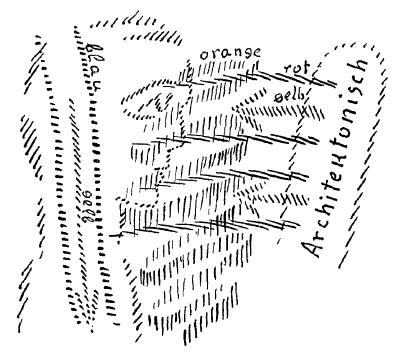
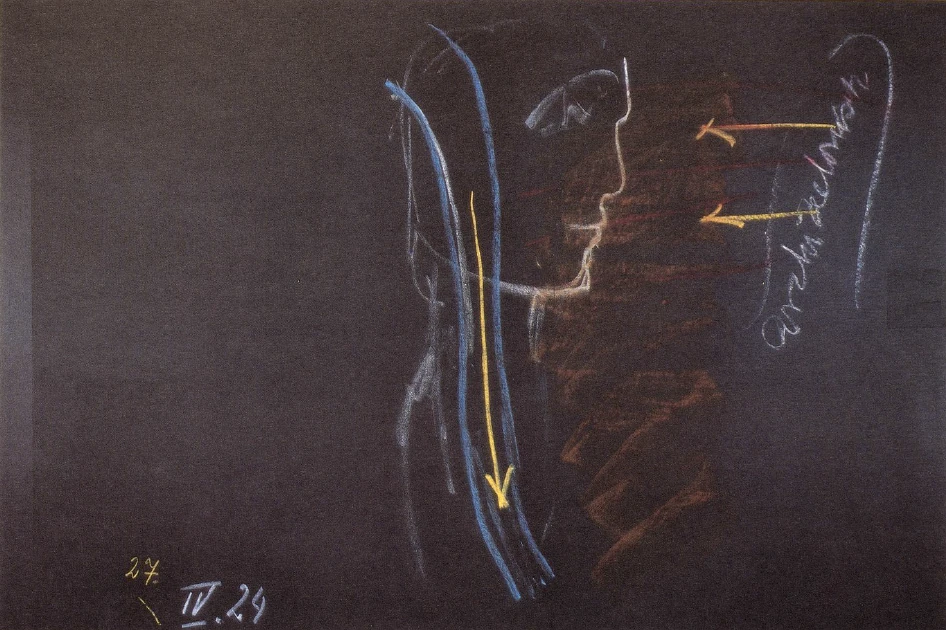
[ 43 ] On the one hand, one descends into one’s inner self; on the other hand, by looking outward, one encounters what is present in architecture—in temple architecture, in church architecture. These two aspects come together in a remarkable way. Between what lives within and what the gaze is drawn back to here, there is a middle ground (orange) that people in their ordinary consciousness do not see at all, because today they do not allow their outward gaze to be captured by a genuine, internalized architecture, and because they do not allow their inner vision to be captured by the imaginative or the pictorial. But what lies in between: Walk through life with this—walk with an inner insight deepened by imagination and with a sensibility healed by external architectural forms that are truly built from the human—then you will gain the sense that older people once had for the blows of fate. If one cultivates what lies between these two—between the sense of what is truly architectural and the sense of what is truly symbolic and inward-turning—then one finds the receptivity to the blows of fate. One perceives what happens as coming from previous earthly lives. This, in turn, serves as an introduction to further reflections on karma that are to be undertaken in the near future and that will then also include “good and evil” in these reflections on karma. But you see, the point is really that thinking within the anthroposophical movement must be grounded in reality. The architecture appropriate for modern people today—the kind that could properly capture their gaze and gradually guide their naturalistic way of seeing, which obscures and darkens their perception of karma, into a more contemplative perspective—existed out there in a certain form. And the fact that, within these forms, anthroposophical discussions were once again taking place provided the inner insight. And among all the other things that have already been emphasized, it was precisely this Goetheanum—this Goetheanum building, with the way in which anthroposophy would have been cultivated more and more within it—that represented the education in karmic vision. This education in karmic vision must find its way into modern civilization.
[ 44 ] But the enemies of what must find its way into this modern civilization naturally want to see what, in the genuine, true sense, nurtures human beings—what is necessary for civilization—burned to the ground. And so it is possible to gain insight into the deeper connections there as well. But let us hope that soon, in the very same place, forms that awaken karmic insights will once again stand before us!
[ 45 ] That is what I wanted to say today—especially today, when so many friends from abroad are still here following our Easter event—as my closing remarks. Karmic Reflections on Individual Human Life