

Esoteric Considerations of Karmic Connections
Volume II
GA 236
4 May 1924, Dornach
Translated by Steiner Online Library
Sixth Lecture
[ 1 ] Now that we have examined a series of karmic connections that took place in the historical development of humanity, and now that we have seen through these observations how one thing or another flows from one earthly life into the next, we will now proceed to examine these karmic connections from yet another perspective—a perspective that, I would say, leads even more directly into human life itself. For the contemplation of karma actually has real value only insofar as it can flow into our living ethos, into our entire life and soul constitution, so that as we place ourselves in the world as human beings, we can experience, through karmic contemplation, both a strengthening and a deepening of life. Life, after all, holds many mysteries, and not all of life’s mysteries can be viewed in such a way that they remain unsolved. For this would gradually tear the human being away from his own essence. Without familiarity with the mysteries of the human being himself, he would spend his existence like an unconscious being. But it is the task of human beings to become ever more conscious. They can do this only if they are truly able, to a certain degree, to see through everything that is actually connected to them, their soul, and their spirit. And since karma is an integral part of our entire life and existence, it goes without saying that karmic reflections are direct reflections on the foundation of our human life.
[ 2 ] However, it is actually extremely difficult for the current state of human consciousness to apply karmic considerations directly to life. For any even moderately valid consideration of karma in the life that surrounds us—in the life in which we ourselves are immersed—requires that we be able to view life much, much more objectively than is possible for a consciousness that arises from the current conditions of life and the current conditions of education.
[ 3 ] There are simply so many aspects of the current conditions of life into which human beings are born that obscure karmic connections, rendering them invisible, so that it is extremely difficult to even begin to grasp what makes life comprehensible in terms of karma and destiny.
[ 4 ] People today are, in fact, so ill-suited to detaching themselves from their own selves and devoting themselves to something else. People today live to an extraordinary degree within themselves. And the peculiar thing is that today, precisely when people strive toward the spiritual, when they take in spiritual matters, they run a very high risk of thereby living even more within themselves. Let us just consider for a moment, my dear friends, how this often applies to immersing oneself in anthroposophical life. Many who have joined the anthroposophical movement in the course of their lives may say to themselves: When I was still on the outside, I had this or that relationship to life in which I was absorbed, which I accepted as something intimately connected to me. I valued this or that; I believed that this or that was necessary for life. I also had friends with whom I could form close bonds through our shared ways of life, through what everyday life brought. Now I have entered into anthroposophy. With that, much of that has actually ceased entirely. I have stepped out of those old contexts; at least, those old contexts are no longer as valuable to me as they used to be. Some of the things I used to enjoy doing have even become repulsive to me. I no longer regard them as something with which I actually wish to be connected.
[ 5 ] But when a person, after engaging in such reflection, thinks further about what has actually taken its place for him, he finds very easily that his selfishness has not actually diminished. I do not mean to say this in a reproachful tone—or even with the slightest hint of reproach—but simply to state it as a fact that a person can easily observe in themselves: In fact, their selfishness has increased! In fact, they now pay much more attention to the nature of their inner self, their disposition. In fact, they now ask themselves this question much more often than they did before: What kind of impression does the other person make on me?
[ 6 ] In the past, he accepted what the person next to him was doing as a matter of course. Now he no longer does so. Now he asks himself what impression it makes on him. Or, he used to be part of a certain context in life that made perfect sense to him. He fulfilled his duties and so on. Now these duties repulse him; now he wants to break free from them because he believes they are not intellectual enough, and so on. Thus, the very pursuit of intellectual growth within anthroposophy can very easily lead to a kind of egoism—to taking oneself much, much more seriously than one did before.
[ 7 ] The whole matter, however, rests on the fact that in such a case, the interests of life have not expanded outward, but rather have turned inward. I have often mentioned that the person who truly grows into—who truly grows into—anthroposophical life does not take any less interest in external life, but rather, precisely through anthroposophy, takes much more interest in this external life, so that all other beings begin to become infinitely more interesting to him and to take on much greater value. But for this to happen, it is necessary not to withdraw from external life, but to see the spiritual within external life.
[ 8 ] Certainly, things then come to light that one hadn’t noticed before. But one must also have the courage to notice them and not overlook them. For a karmic view of life, it is absolutely necessary to acquire a certain ability to step outside of oneself and enter into the other person. This is, of course, particularly difficult when the other person becomes an instrument for karmic balances in life that are unpleasant or perhaps even painful. But unless one can step outside of oneself even in the face of things that are unpleasant and painful, a karmic—a truly valid karmic—view of life is actually impossible. For just consider the conditions that exist in the world for karma to arise.
[ 9 ] We are living out a particular human life. In this human life, we do, think, and feel various things. We form relationships with people, and within these relationships, various events unfold. We think, feel, desire, and do things that require karmic balance. We enter into relationships with people, the consequences of which lead to events that, in turn, require karmic balance. Just consider a human life on Earth from this perspective, and then realize that at the end of this earthly life, the human being passes through the gate of death into the spiritual world.
[ 10 ] He now lives within the spiritual world. The spiritual world is not like the physical world. In the physical world, you stand apart from other people. You stand apart even from those to whom you have already drawn close as human beings. After all, in the physical world, there is at least air between two people, and each has their own skin. So people in the physical world, no matter how close they get to one another, can, in a certain sense, maintain a sense of distance within themselves.
[ 11 ] But that is not possible once you have passed through the gate of death and are living in the spiritual world. Consider a striking example. You have done something to another person that requires karmic compensation. You continue to live within that person after both of you have passed through the gate of death. You do not, after all, live within the other person through your own good will or inner perfection—that is, not merely within yourself, but truly within the other person—but rather, you live, if I may put it that way, by necessity within the other person.
[ 12 ] Suppose Person A and Person B pass through the gate of death. They then find themselves in the spiritual world. B and A stand facing each other in the spiritual world. Yes, then—just as here B lived within himself and A lived within himself—A lives just as much within B as within himself, and B lives just as much within A as within himself. After all, in the spiritual world, people live entirely within one another, sustained precisely by those forces that have been stored up during their earthly lives. After death, we do not enter into relationships with just any people, but precisely with those with whom relationships—whether good or evil—have developed. But it is these relationships that enable us to live not only within ourselves but also within the other.
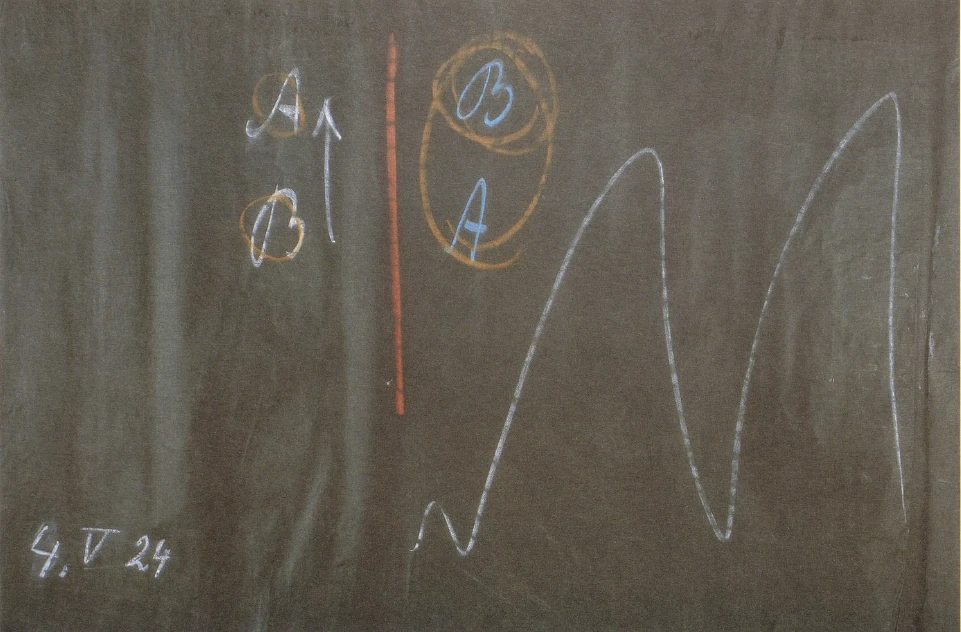
[ 13 ] Now imagine that you have wronged someone, or let’s say that B has wronged A, which calls for karmic balance. As B now passes through the gate of death, he lives on after death—during his passage through the world between death and a new birth—within A. He experiences within A exactly what he inflicted upon A. And in this life outside of himself, he brings about the karmic compensation. So what is to happen in karmic balance in a future earthly life through Person A—you yourself bring that about through your continued existence within Person A. Only by Person A then descending once more into the physical earthly world does he make what you have actually placed within him his own deed. And in the next earthly life, he will then confront you with what you actually intend to inflict upon yourself through him.
[ 14 ] So if, in a future earthly life, I suffer harm at the hands of another person as karmic compensation, it is because, while I was within that person during the time between death and a new birth, I myself placed that harm within him, bit by bit. It was not his deed at all; rather, it only becomes his deed again when he descends into earthly life. Thus, the conditions of karma in the course of the world are those that exist through the intertwined lives of karmically connected people in the time between death and a new birth.
[ 15 ] Well, when we consider ordinary earthly life, we don’t actually see very deeply into it. Basically, we are consciously aware of very little about other people. For example, we hardly notice any difference in how others behave toward us. We encounter someone in life; let’s say they behave in a certain way. Now, we’ll hardly notice that a person can actually behave toward us in a certain way and that there may be very different motives and impulses behind this behavior within them. A person may behave hostilely toward me. This hostile behavior may stem from the fact that my very presence irritates them, that they are attuned to something entirely different in human nature than what I offer them. As a result, I am treated by them in a certain way. But this treatment may be such that it is only somehow balanced out karmically in the next life. It may be something entirely primordial, something not at all conditioned by previous earthly lives.
[ 16 ] On the other hand, I may receive a very similar—perhaps even the same—treatment from a person in whom I have, bit by bit, planted the consequences of that treatment during the life between death and a new birth.
[ 17 ] The ability to distinguish between two such approaches that appear identical on the surface is extremely underdeveloped in people today. Otherwise, something would emerge in life that today, in essence, hardly ever appears, but which must emerge again so that the ethos of life can become much purer and moral sensibility can become much stronger. Something simply must reemerge in life that was part of human sensibility in earlier times—times not so long ago—namely, the feeling toward one person that “he hates you and does this or that out of hatred for you,” and the feeling toward another person that “he must do something against you because he simply cannot help himself.” The first person could act differently; the second simply cannot—he is inwardly predestined to behave this way.
[ 18 ] This feeling, which can be subtly discerned in the realities of life, must in turn become more universal. This feeling will add many nuances to life that are extraordinarily important.
[ 19 ] And there is another point to consider. You will readily admit that human beings enter into relationships with other people, and that these relationships involve various factors that do not interest them in the same way as the relationships themselves. I want to construct a very striking example. Suppose you join a society—I don’t mean the Anthroposophical Society; I’m excluding that for reasons that will become clear in the course of these lectures on karma—but suppose you join a society. The reason you join this society may lie in the fact that you have a karmic connection with one or two people, perhaps even just a single person in this society. But by joining this society, in order to come as close to the person in question as your karmic relationships require, you must take on everything else the society has to offer. While only the relationship to this one person is karmically significant, you take on everything else that comes your way in this society through the people you meet there and so on.
[ 20 ] The point is that we must also realize: Life presents itself to us in such a way that it has relationships with us that are nuanced in the most diverse ways—ranging from the most indifferent relationships to the most significant ones in the deepest sense, which exist side by side.
[ 21 ] But there is another factor to consider here. The fact is that external life is, in many ways, Maya—the great illusion. So it may be—and I’m again constructing a hypothetical scenario—that you enter a social circle, but the relationship with that one person, which is karmically well-founded, turns out to be very difficult. You must first establish relationships with all sorts of other people in order to get close to that one person. So you pass through all sorts of other people in order to get close to that one person. In doing so, you enter into relationships with other people who—I would say—prove to be extraordinarily influential from a robust perspective on life; indeed, they assert themselves strongly and are very present, whereas perhaps the relationship you ultimately reach—the one that may be karmically significant—unfolds gently, quietly, unnoticed, or almost unnoticed.

[ 22 ] So it may indeed be the case that, in the context of a particular life, what is karmically significant appears like a small hill next to giant mountains that, however, are of little significance. Yet it is only through a spiritually enlightened perspective that the small hill reveals its true significance. It is indeed true that the events that occur in our lives cause us many, many deceptions. As a rule, we do not know how to evaluate them properly if we consider only this one earthly life. Only when we view other earthly lives against this backdrop can we correctly assess the events of this one earthly life.
[ 23 ] For example, I’d just like to mention one thing. Isn’t it true that some strange personalities have appeared in our time? Aside from those I’ve already presented to you in terms of karma, there have been all sorts of highly unusual personalities here and there. And an external observation often does not lead us into the karmic connections at all; rather, it is only an observation that can address the defining moments of a life that does so. And then, I would say, those facts emerge with the utmost clarity—facts that draw our attention to how illusory external life actually is in many respects when we do not view it from a spiritual perspective. I recently cited an example here that may have struck you as very strange—the example of an alchemist, an old alchemist from the school of Basilius Valentinus, who reappeared as Frank Wedekind.
[ 24 ] What led me to observe this strange karma—the starting point isn’t always significant; but if that starting point has led to inner clarity, then of course things turn out differently —the fact that I have hardly ever seen hands like those of Frank Wedekind, and that I then once saw Frank Wedekind perform with those hands in Munich, saw him act in his own play Hidalla. The whole apparent chaos of this play—which is, of course, a horror for a philistine mind, as I mentioned recently—in connection with the impression I had of his hands from earlier times, this is precisely what brought to light the alchemical work he had performed. And it was precisely on the basis of Hidalla, in connection with these remarkable hands, that this earlier incarnation emerged—one that could then be traced further.
[ 25 ] There you see that one must develop an eye for what can be extraordinarily significant about a being—a human being, in particular. There are people for whom the face is the defining feature. But there are also people for whom it is not the face at all, but rather, for example, the hands; and one cannot discern anything from the face, only something from the hands. If one moves from the individual to the general, using precisely the example I just gave, then one will, I would say, be able to grasp the matter with one’s own hands. This was particularly true of alchemists of this sort in the Middle Ages, who had to acquire extraordinary dexterity with their hands.
[ 26 ] In previous lectures here, I have explained how nothing remains of what a person has as a head. But what a person has in the rest of their organism is then expressed in the head. But when a person is a child, the entire development of the human being proceeds from the head. In particular, such expressive organs as the hands are formed according to the most intimate impulses of the head. Thus, one can almost expect that in someone who has worked in the manner of alchemists, something particularly characteristic will appear either in the hands or in the feet. But all of this is meant only to illustrate how important it is to regard this or that as significant, and to regard as insignificant something that often appears in the sensory world as the most vivid, the most essential, the greatest, and so on.
[ 27 ] In our time, I said, all sorts of remarkable personalities have emerged who stand out without one being able to fully grasp the context. The challenge, then, is to be able to focus—especially with such personalities—on what is striking and significant about them. For example, the fact that someone becomes a great artist is something that need not be determined even in the slightest by their karma. But what they actually do in this art, how they conduct themselves in this art—that is something that is specifically determined by karma. Thus, for example, things that—I would say—actually make life poetic reveal themselves precisely when viewed from a karmic perspective.
[ 28 ] You see, one can look back on a person’s past earthly lives. At certain moments, they stand in stark contrast to the present life, serving as a most remarkable illustration. But one cannot come to terms with these things if one relies on the usual conditions of understanding and perceiving life. For life becomes a reality in an entirely different sense when one seriously engages with karmic considerations.
[ 29 ] Here’s an example. I’ll start by telling it in very simple terms. I was walking down the street, and an image came to mind—the image of a shipwrecked man. The ship he had come from was far away, but sinking. He was in a lifeboat, heading toward a moderately sized island. While he was still in doubt as to whether he would reach the island in time to save himself, he kept his gaze strangely fixed—I am describing a scene—on the bubbling, foaming waves, so that one got the feeling: he still finds meaning in looking at the waves, even though he is actually on the verge of going under at any moment, A soul that has been shaken to its core, yet—in that very shaking, that is, in a disembodied way—remains deeply connected to nature.
[ 30 ] The very same path—on which I had this image before my eyes, one that had absolutely no connection to its surroundings—led me into that art exhibition, where I saw Böcklin’s “Isle of the Dead” for the very first time.
[ 31 ] I mention this simply so that you can see that one’s approach to life must broaden when one grapples with these matters. It is not a matter of merely looking at what one might now feel or imagine with regard to Böcklin when one has the opportunity to begin observing his karma from his “Island of the Dead” while standing right in front of it. It doesn’t have to be that way at all; rather, under certain circumstances, if one wants to know what one is dealing with, one must go back to what one previously saw as if prophetically and connect it to that.
[ 32 ] And so, when you encounter someone in life, it is also important to identify karmic connections, not merely to consider what one is experiencing at that very moment upon encountering them, but it can be enlightening to see how what one has previously experienced in the innermost depths of one’s soul—and which only later becomes clear—is connected to what one subsequently sees in them, or perceives from them or through them.
[ 33 ] It is precisely that which brings light to karma that casts its shadows—or its lights—ahead. If one does not have a sense of these intimate aspects of life—which sometimes require not only connecting the future with the past, but conversely viewing the past as something that sheds light on the future—if one does not view life through this intimacy, one will not easily develop that inner vitality of the soul that is necessary to immerse oneself in karmic connections.
[ 34 ] One might even say: When particularly significant karmic events occur in a person’s life, if they are external events, they are such that they are connected to certain internal events that may have preceded them by years. One really must adopt such a broader perspective on life. For consider the following: When you look at the human mind as it exists in ordinary consciousness, it relates only to the past. The mind is truly an Epimetheus; it relates only to the past. But when you look at human feeling—how it derives its nuances from the depths of the soul—you come upon remarkable mysteries of life. One might say that from what a person thinks, one can gauge very little about the course of their life; from what they feel, one can gauge a great deal. And when you consider such a life—let’s say Goethe’s—and ask yourself: How might Goethe have felt, say, in 1790?—then, through the distinctive character of Goethe’s feelings in 1790, you gain insight into all the later nuances of his life, for they lie there in embryonic form within the feelings of that year. As soon as we descend into the depths of the human soul, we essentially perceive—not in the details, of course, but in the nuances—the person’s later life in its entirety. And the person himself could gain much insight into his own life if he paid more attention to the inexplicable nuances of feeling that are not caused by external factors but arise from within.
[ 35 ] However, people will become particularly accustomed to this kind of awareness when they engage with all the things I have mentioned today—and will continue to mention—as important for a view of life that seeks to become attuned to karmic connections, whether these are karmic connections in one’s own life or, just as importantly, in the lives of those close to us. You see, when one wishes to consider karma, it really comes down to seeing through a person in a certain way. As long as the ordinary physical human being remains in one’s field of vision—standing there opaque—and as long as one initially looks only at their physiognomy, at the way they carry themselves, at the way they speak, or even at the way they think —which, after all, is usually just a stereotypical reflection of how they were raised and what they have experienced—as long as one looks only at all of that, the karmic motivation simply does not appear when one observes them. This karmic motivation only appears when the person becomes, in a certain sense, transparent.
[ 36 ] But when a person becomes transparent, it happens at first in such a way that one actually has the feeling they are floating in the air. At first, one stops believing that the person is walking or moving their arms and hands: one loses sight of those, so to speak, first. Please understand me correctly, my dear friends: in everyday life, what a person does with their arms and legs is extraordinarily important. But that loses its significance when one wishes to look at what lies deeper within a person. Take this to its very extreme. If you can look beyond what a person accomplishes with his arms and hands, you will see him, as it were, floating—I ask you not to imagine this in a purely spatial or figurative sense, but rather in a way that is true to life—so you will see him, as it were, floating, that is, do not attach any importance to the journeys they have made, to the paths they have taken, to what they do with their legs; do not attach any importance to the external work they perform with their arms, but look instead at their disposition, at their temperament, at everything in which arms and legs play no part: that is the first insight you can gain into a person. Imagine you have some object here; at first you see nothing but this object. (A drawing is made.) Good. But then something is drawn on it. Now let’s erase that again. It is the same with a person: when you attain this first level of insight, when you look beyond the person in their daily life, when you look beyond their arms and legs. So you must tear them away from the contexts into which they have been drawn through the movements of their arms and legs. When you then look at them, something about them becomes transparent. What was previously obscured by the activity of the arms and legs—you can then see right through them.
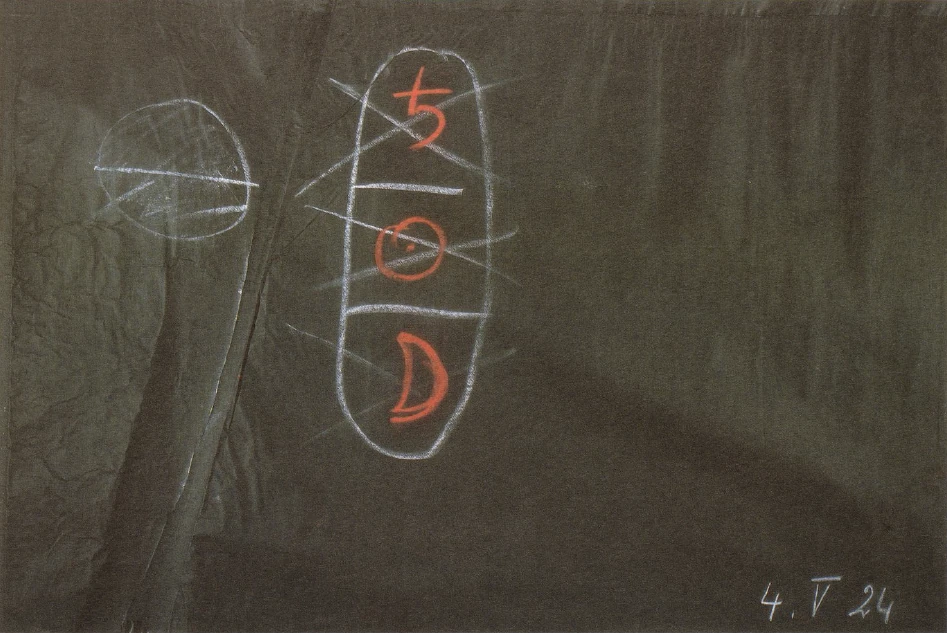
[ 37 ] But what do you see then? Then you begin to realize that the moon appears behind the human being. I will draw a schematic diagram of the threefold human being; let’s assume that this part here (see drawing, elliptical outline, divided into three parts) first becomes transparent; we’ll ignore the arms and legs. Then the human being no longer appears to us as so separated from the universe as he otherwise does, but rather he begins to reveal the Moon behind him, along with all the impulses that act upon the human being from the Moon. We begin to say: Yes, the human being has a certain imagination—developed or undeveloped—but he can’t help that. The forces of the Moon are at work behind it. They are merely obscured from us by what arises from the activity of his arms and legs. (The lower part is crossed out.) Now that is gone, and against this background the creative Moon appears to us. (The Moon is drawn.)
[ 38 ] We move on. We try to make human beings even more transparent, and we also set aside those aspects. Let’s say we set aside—or rather, we suggest to ourselves that we set aside—what makes a person emotional, what endows them with a certain temperament, what are, in fact, the more spiritual expressions of everyday life. Then even more disappears from the human being; the human being becomes even more transparent. And we can go further; we can disregard everything that is in the human being by virtue of having senses. So earlier, you disregarded everything that is in the human being by virtue of having arms and legs. Now you ask yourself, what remains of the human being when I disregard the fact that he has perceived something through his senses? What remains is a certain way of thinking, a certain impulsiveness in his thinking, a certain direction in his life. But in return, the entire rhythmic system—the human chest—becomes transparent to you. Now even this is gone, and in the background you see everything that consists of solar impulses (see drawing, center). You look right through the human being and are actually looking at the sun when you disregard everything that the human being has perceived through their senses. You can do this for yourself. You can ask yourself: What do I have through my senses? — If you disregard these, you see right through yourself and perceive yourself as a solar being. And if you now also disregard their thoughts and their way of thinking, then the head disappears as well. The entire human being is gone. You see right through and ultimately see Saturn in the background. But at that very moment, the human being’s karma—or your own karma—lies before you. For at the moment when you observe the effects of Saturn in the human being, when the human being has become completely transparent to you, and you view them to such an extent that you see them against the backdrop of the entire planetary system—against the backdrop of the Moon, the Sun, and Saturn—at that very moment, the human being’s karma lies before you. And when we speak of practical karma exercises—I have already mentioned that I wanted to do this right at the beginning of the founding of the Anthroposophical Society, though it did not succeed at that time—we must actually begin this way; we must say: The point is that, in ourselves or in others, we must first set aside everything that defines us in life simply because we are beings endowed with arms and legs. We must think beyond that.
[ 39 ] So, whatever you have ever gained from being beings endowed with arms and legs—you must set that aside. Now you will say: Yes, but we fulfill our karma precisely by having arms and legs! That is exactly the point! As long as you focus on your arms and legs, you do not see what you fulfill by having them. You will only see what you fulfill by having arms and legs when you stop focusing on them. But when you recognize in the activity of the arms and legs that which emanates from lunar impulses, then the point is that we must go further and look beyond what a person takes in through their senses—what they hold in their soul through their senses, whether in ourselves or in others. We see him as a solar being; we see the solar impulse within him. And then it is a matter of looking beyond the fact that he has a certain way of thinking, a certain orientation of the soul, and so on. Then we see how he is a Saturnian being.
[ 40 ] When we reach that point, we will once again have the human being before us, but now as a spirit. Now the legs move, now the arms work—but spiritually—and they show us once more what they are doing; yet they show it to us according to the powers that govern them. And that is something one must indeed experience.
[ 41 ] If I do even the slightest thing—if I pick up the chalk here—as long as I merely perceive this fact: “picking up the chalk,” I know nothing of karma. I must do away with all of that. I must bring it to the point where it can recreate itself for me once more in the image, where it appears within the image. Not through the strength that now lies in my muscles—nothing can be explained by that—but in the image that then takes its place, what emerges is that which, from previous incarnations, causes the hand to move to pick up the chalk.
[ 42 ] And this is what happens when, in the manner described, I gradually strip away the visible human being and see behind him his lunar impulses, his solar impulses, and his Saturnian impulses. Then the image of the human being comes back to me from the cosmos. But this is not the human being in his present incarnation; it is the human being in one of his previous incarnations—or in a few previous incarnations. I must first reach the point where the human being I see walking around here beside me becomes transparent to me—increasingly transparent—as I look beyond his entire life. Then, in the same place, but emerging from the far reaches of the cosmos, the human being appears as he once was in earlier earthly lives.
[ 43 ] What has been said about these connections may not yet be entirely clear or understandable to you today. Today, I also wanted to begin by outlining what we will be addressing in the near future, as we are about to embark on an increasingly detailed examination of the nature of karma as it flows through human life from one earthly existence to the next.