

Esoteric Considerations of Karmic Connections
Volume II
GA 236
9 May 1924, Dornach
Translated by Steiner Online Library
Seventh Lecture
[ 1 ] Today we will begin to discuss the inner workings of the soul that can lead a person to gradually develop insights and thoughts about karma. These thoughts and insights can only arise when a person is able to view experiences that have a karmic cause in the light of karma.
[ 2 ] Now, when we look around at our human surroundings, we actually see only what is caused in the physical world in a physical way by physical forces. And even when we do see something in the physical world that is not caused by physical forces, we perceive it through external physical substances, external physical objects of perception. Certainly, when a person does something out of their own will, this is not caused by physical forces or physical causes, for in many respects it arises from the person’s free will. But everything we see externally is, after all, entirely absorbed into physical-sensory phenomena within the world that we observe in this way. Within the entire scope of what we can observe in this way, the karmic connection of an experience we ourselves are going through cannot become clear to us. For the entire picture of this karmic connection lies precisely in the spiritual world; it is actually inscribed in what is the etheric world—which then underlies the astral outer world, or the world of spiritual beings that dwell in this astral outer world. None of this is seen when we direct our senses solely toward the physical world.
[ 3 ] Everything we perceive in the physical world is, after all, perceived through our senses. These senses function without us being able to do much about it. Our eyes receive impressions of light and color without us being able to do much about it. At most—and even then, only half-involuntarily—we can direct our eyes in a certain direction; we can look at something, or we can look away. There is a great deal of the unconscious involved in this, but at least a small measure of consciousness. And then there is what the eye must do internally in order to see a color—this immensely wise, magnificent inner activity that takes place whenever we see anything—which we as human beings could never accomplish if we were to try to do it consciously. That would be out of the question. All of this must first take place unconsciously, because it is far too wise for a human being to be able to contribute to it in any way.
[ 4 ] In order to gain a proper perspective on human knowledge, one must first come to fully grasp all the wise arrangements that exist in the world—arrangements that human beings cannot bring about. If human beings think only of what they are capable of, they actually block off all paths to knowledge, Fundamentally, the path to knowledge begins by humbly realizing all that we cannot do and yet must occur in the existence of the world. The eye, the ear, and even the other sense organs are, after all, such wise, such profoundly designed structures that human beings will have to study for a long time to gain even the slightest inkling of them during their earthly existence. One must truly bring this to mind with full awareness. But the observation of the spiritual cannot take place so unconsciously. In earlier periods of human development, this was also the case for the observation of the spiritual; there was an instinctive clairvoyance. This is what has faded away in the course of human development.
[ 5 ] Humanity must now consciously develop a perspective on the universe that enables people to perceive the spiritual realm. And the spiritual realm must be perceived if we are to understand the karmic connections underlying any experience we have.
[ 6 ] Now, when it comes to observing karma, it is essential that we begin—at least for the purpose of observation—by becoming attentive to what can happen within us to bring these karmic connections into our awareness. We must then make a small effort to bring these observations into consciousness. We must do more for this than we do, for example, for the eye to bring color into consciousness. My dear friends, what one must learn first can be summed up in a single word: wait. One must be able to wait for the inner experiences.
[ 7 ] I have spoken before about this ability to wait. It was around the year 1889—I will also have to recount this in my “Life Story”—when the inner, spiritual structure of Goethe’s “Fairy Tale of the Green Snake and the Beautiful Lily” first came to me. And that was the first time, so to speak, that the vision of a larger, broader context—one broader than that presented in the fairy tale itself—came to me. But I also knew at the time: whatever I might one day be able to do with this context, I cannot yet do with it now. And so what was revealed to me at that time solely through the inspiration of the fairy tale simply remained within my soul.
[ 8 ] Then it emerged once more, in 1896, seven years later, but still not in a form that could be shaped. Then again, seven years after that, around 1903. Even then, although it appeared with great clarity and in coherent contexts, it still could not be given form. It was not until I conceived my first Mystery Play, The Gate of Initiation—again, seven years later—that it appeared in a form that allowed it to be rendered in a fully three-dimensional way.
[ 9 ] Such things, then, require genuine patience—letting them mature. One must use one’s own experiences to transition to what else exists in the world. Once the seed of a plant is present, one simply cannot have the plant just yet. You have to place the seed in the right conditions, you have to help it grow, and you have to wait until the seed becomes a flower and then fruit. And that is how one must also handle the experiences one goes through. One must not take the stance that just because one has some experience, just because it is there at the moment, one feels a thrill about it and then forgets it. Anyone who deals with experiences in this way—wanting them only as present moments—will be able to do very little to truly enter the spiritual world for observation. One must be able to wait; one must be able to let the experiences mature within the soul.
[ 10 ] Now, there is indeed a possibility of relatively rapid maturation in one’s understanding of karmic connections if, with patience, one tries inwardly and energetically over a longer period of time to allow that which otherwise takes place—which is there but is not properly grasped and simply fades away in life—to play out in one’s consciousness, and increasingly so. That is, after all, how it is with events. What does a person do with the events, with the experiences that come their way in the course of the day? They actually experience them in a half-observing way. You can get a sense of how experiences are half-observed if you ever—and I advise you to do this—sit down in the afternoon or evening and ask yourself: What did I actually experience today at half past nine in the morning? — But now try, in every detail, to bring such an experience to mind as if it were simply there again—say, for my sake, at half past seven in the evening—as if it were standing right there, as if you were mentally and artistically reenacting it before yourself. You’ll see how much you’re missing, how much you failed to observe, and how difficult it becomes. If you pick up a pen or a pencil to write this down, you’ll very soon start biting into the pencil or the pen, because the details simply won’t come to mind and you’ll eventually want to bite them out of the pencil.
[ 11 ] Yes, but what matters first and foremost is to set oneself the task of bringing an experience one has had into sharp focus in one’s mind—not while it is happening, but afterward—as if one were trying to paint it mentally, to bring it before one’s mind in such a way that, for example, if there is something in the experience where someone spoke, you make it completely concrete in your mind: the sound of their voice, the way they skillfully or clumsily chose their words, and so on—strongly, energetically, concisely—to bring what you experienced into a vivid image. When you transform such a daily experience into an image in this way, then the following night—when the astral body has left the etheric body and the physical body—the astral body engages with this image. It is, in fact, the very bearer of this image; it now shapes this image outside the body. It takes it with it when it goes out on the first night. It shapes it out there, outside the physical and etheric bodies.
[ 12 ] So we have the first point; let’s examine these stages very carefully: The sleeping astral body, in addition to the physical and etheric bodies, shapes the image of the experience. Where does it do this? It does so in the outer ether. After all, it is now in the outer etheric world.
[ 13 ] Now imagine a person: his physical body and his etheric body are lying in bed, while his astral body is outside. Let us leave the “I” aside for now. Out there is the astral body, recreating the image that one has formed; but it does so in the outer ether. As a result, the following happens.
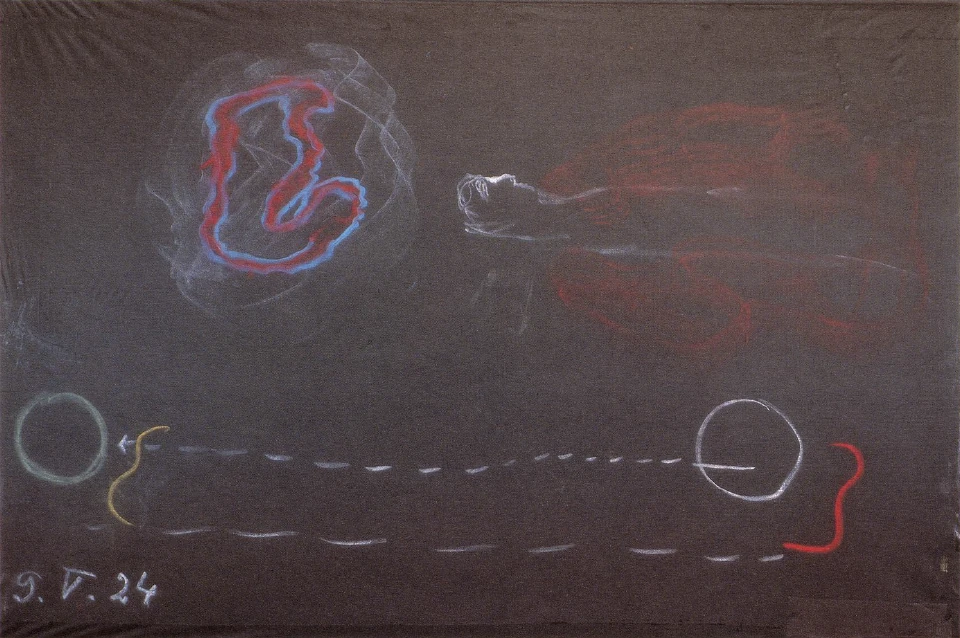
[ 14 ] Imagine that the astral body is out there (see drawing, yellow). Now it forms this image out there, which I will draw in red—it is, of course, all schematic. It forms this image. All of this takes place in the outer ether; the outer ether, which, as it were, encrusts with its own substance that which is formed as an image within the astral body. So the outer ether forms the etheric form (blue) everywhere here as an image so sharply perceived by the spiritual eye.
[ 15 ] Now, in the morning, you return to the physical and etheric bodies, bringing with you what has been substantiated from the outer ether. In other words: the sleeping astral body forms the image of the experience alongside the physical and etheric bodies; the outer ether incorporates its own substance into this image.
[ 16 ] You can imagine that this makes the image stronger and that now, when the astral body returns in the morning with this more substantialized image, it can make an impression on the etheric body within the human being. With what originates as forces from the outer ether, it now makes an impression on the human etheric body. So the second point is: The image is imprinted on the human etheric body by the astral body.
[ 17 ] These are the events: the first day, the first night (see diagram on page 124). Now we are approaching the second day. During the second day, while you are fully awake and engaged with the other trifles of life, the following occurs below the level of consciousness, in the unconscious: the image settles into the etheric body. And the following night, if it is undisturbed—that is, once the astral body has left the physical body again—the etheric body elaborates this image. Thus, on the second night, the image is elaborated by the person’s own etheric body. So, secondly: the image is imprinted on the person’s etheric body by the astral body, and the etheric body elaborates the image the following night.
[ 18 ] So we have: the second day and the second night (see diagram).
[ 19 ] Now, if you go through with this—if you truly do not reject the idea of continuing to dwell on the image you formed the previous day—and you may continue to dwell on it for a reason I will explain in a moment—if you do not reject the idea of continuing to dwell on this image, then you will simply continue to live with this image.
[ 20 ] What does it mean to engage with it? You see, if you really make an effort to form such an image clearly, to work it out in a vivid, three-dimensional way with characteristic, strong lines on the very first day after you’ve had the experience, then you’ve already exerted mental effort. Something like that requires mental effort. Forgive me, this is not meant to be a dig—those present are, of course, always exempt from all such things—but it must be said: Most people do not know what mental effort actually is, for mental effort—true mental effort—takes place only through the activity of the soul. If you simply let the world work its way upon you, letting your thoughts run their course without taking hold of them, then you are not exerting yourself mentally. Becoming tired does not mean you have exerted yourself mentally. You must not imagine, when you grow tired of something, that you have exerted yourself mentally. You can, for example, also become tired while reading. But if you are not actively participating in the reading process yourself—if you merely let the book’s thoughts take effect on you—then you are not exerting yourself. On the contrary, the person who has truly exerted themselves mentally—who has exerted themselves out of the soul’s inner activity—will then pick up a book, and indeed a very interesting one; then they sleep off the mental exertion of reading in the very best way. But of course, one can fall asleep over a book if one has become tired. This feeling of tiredness is not at all a sign of mental exertion.
[ 21 ] One sign of mental exertion, however, is that you feel your brain is worn out, just as you feel when you’ve been lifting things repeatedly: the arm muscles have been strained. Ordinary thinking does not affect the brain in this way. Well, that’s exactly what happens, and you’ll even notice it when you do this for the first time, and when you do it a second, third, or tenth time: you’ll get a mild headache. It’s not that you get tired or fall asleep—on the contrary: you can’t fall asleep; rather, you’re much more likely to get a mild headache from it. You just shouldn’t view this headache as something to be dreaded, but rather as a sign that you’ve been straining your mind.
[ 22 ] Well, that will stay with you—it will stay with you until you fall asleep. In the morning, if you really did that the day before, you’ll wake up with the feeling: There’s something inside me! I’m not quite sure what it is, but there’s something inside me—something wants something from me. Yes, it’s not as if it’s insignificant that I created this image yesterday—it actually means something: This image has transformed. This image is causing me to have completely different feelings today than I’ve actually had up until now; the image is evoking very specific feelings in me.
[ 23 ] That remains with you the next day as the lingering inner experience of the image you have formed. And what you feel there—what you can’t shake off all day—is evidence that the image is now descending, as I have described here, into the etheric body, and that the etheric body is absorbing it.
[ 24 ] Now, when you wake up the next morning—that is, when you slip back into your body after these two days here (see diagram)—you will likely find that this image has been somewhat reshaped and transformed. You’ll find it again—precisely as you wake up on the third “day,” you’ll find it within yourself; it will seem to you like a very real dream. But it has undergone a change; it hasn’t remained the same—it’s something different. It will take on manifold forms until it is different. It will present itself to you as if there were somehow spiritual beings who are now bringing you this experience. And you get the distinct impression: Yes, this experience that I had, that I’ve visualized for myself—it was actually bestowed upon me. — If it was an experience involving a person, then after all this has happened, one has the feeling: Actually, one did not just experience it through that person, but it was bestowed upon one. There are others—spiritual forces are at play—who have bestowed it upon one.
[ 25 ] Now the next day arrives. On the following day, the image is carried down from the etheric body into the physical body. On the following day, the etheric body imprints this image upon the physical body—specifically, upon the nervous processes and the blood processes. On the third day, the image is imprinted into the physical body. So we must say, thirdly: The image is imprinted from the etheric body into the human physical body.
[ 26 ] And now the next night comes; so during the day—while you are once again going about the usual trifles of life—this important process takes place down there, whereby this image is carried down into your physical body. This occurs in the subconscious. Then, when the next night comes, this image is processed in the physical body. For the image is spiritualized within the physical body. First, during the day, this image is brought down into the blood and nervous processes, but at night it is spiritualized. Those who can see this observe how the physical body now processes this image, but it appears as a spiritually transformed image. One could say: The physical body works out the image during the following night.
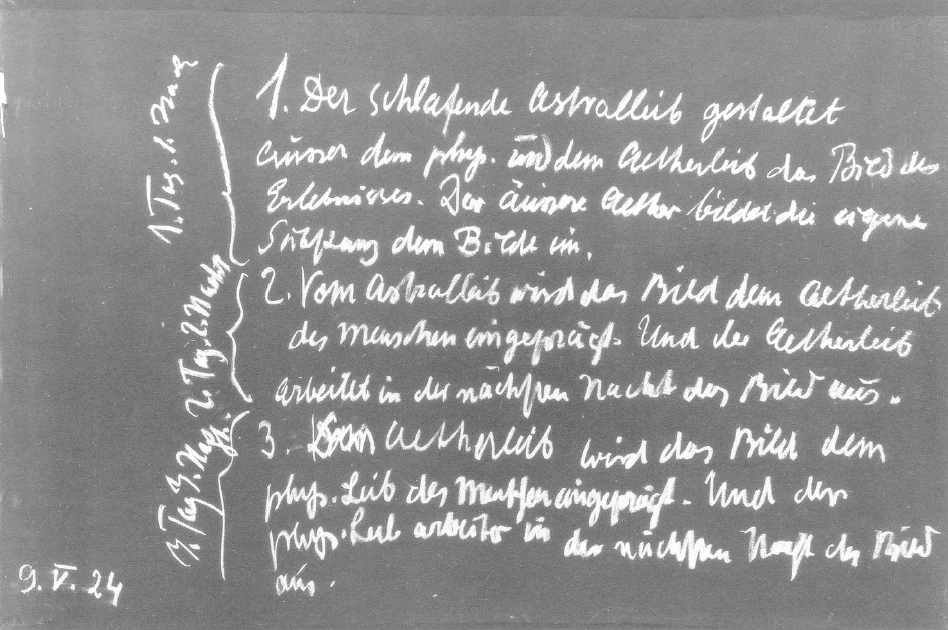
[ 27 ] First Day
First Night
(1. The sleeping astral body, along with the physical and etheric bodies, shapes the image of the experience. The outer ether incorporates its own substance into the image.
[ 28 ] Second Day
Second Night
2. The image is imprinted from the astral body onto the human etheric body. And the etheric body elaborates the image during the following night.
[ 29 ] Third Day
Third Night
3. The image is imprinted from the etheric body onto the human physical body. And the human physical body is imprinted. And the physical body works out the image during the following night.
[ 30 ] This is something you simply have to imagine quite clearly. The physical body actually works out this image mentally. It spiritualizes it. So that, once you have truly gone through all of this, what happens is that simply, when a person is now active, the physical body works out the whole thing—but not in such a way that it remains inside the physical body. A transformation arises everywhere from within the physical body—a powerful, magnified transformation of the image. And when you stand up, this image is there—you are actually floating inside it; it is actually like a kind of cloud in which you are immersed. You stand up with this image.

[ 31 ] So this is the third day and the third night. With this image, which has been completely transformed, you crawl out of bed on the fourth day. Enclosed in this cloud (see drawing, red), you stand up. And if you actually formed the image with the necessary strength on the first day, and if you were attentive to what your feelings told you on the second day, then you will now notice: Your will is sitting inside this current image. Your will is sitting inside it, but this will cannot express itself fully; it is as if it were bound. It is actually—to put it somewhat extremely—as if one had resolved—just as an incredibly daring sprinter resolves to perform some daring feat—to say: “I’m running, I’m running down to Oberdornach right now; I can already picture it, I have it within me.” It is my will, but at the very moment when I want to set off, when my will is at its strongest, someone ties me up so that I stand there stiffly—my will is fully developed, but I cannot carry it out. That is roughly how the process works.
[ 32 ] When this experience then develops to the point where one feels as if in a vise—for it is a feeling of being in a vise after the third night—when one wakes up again and feels as if in a vise, the will completely bound through and through, then, if one can become aware of this, this will is transformed: this will becomes seeing. It can do nothing, but it leads to one seeing something. It becomes the soul’s eye, and the image with which one has awakened—this image becomes concrete. And that is then the event from the previous earthly life, or from a previous earthly life, which in turn caused what one had sketched out in the image on the first day. Through this transformation, mediated by feeling and will, one receives the image of the causative event from a previous earthly life.
[ 33 ] When described, all these things seem a bit jarring. That is hardly surprising, since they are completely unfamiliar to people today.
[ 34 ] But people in earlier cultural epochs were not entirely unfamiliar with this. It’s just that, in the eyes of today’s so-called intelligent people, they were foolish throughout their entire lives. Yet these foolish people in earlier cultural epochs had already had these experiences. Modern humans merely obscure all of this with their intellect, which makes them intelligent but not exactly wise.
[ 35 ] Well, I’ll say, it does sound a bit tumultuous when you tell the story that way. But you have to use words like that. Since these things are completely unknown today, if you were to describe them more gently, they wouldn’t come across as particularly distinctive at all. They have to come across as distinctive. But the entire experience, from beginning to end, as I have described it over those three days—this entire experience—must unfold in an inner, intimate way, with complete calm and serenity. For so-called occult experiences—and these certainly are such—do not unfold in a way that allows one to boast about them. If one begins to boast about them, they cease immediately. They must truly unfold in inner peace and serenity. And it is best if, at first, no one at all notices anything about such a sequence of experiences except the one who is having them.
[ 36 ] Now, you shouldn’t think that this will work right off the bat. You always see this: When something like this is described, people like it. That’s perfectly understandable—it’s wonderful! Just think of all the things you can learn! And with tremendous diligence, people throw themselves into it. They start out: it doesn’t work. Now you’re already getting quite discouraged. Then they might try it a few more times—and it still doesn’t work. But in fact, once you’ve tried it about forty-nine times—or someone else sixty-nine times—it works on the fiftieth or seventieth try. For what all these things are really about is that you first acquire a kind of spiritual habit. To begin with, you have to immerse yourself in these things. Acquiring habits of the soul. But this is something that should be carefully observed in the Anthroposophical Society, which, since the Christmas Conference, is now meant to be a full expression of the anthroposophical movement. Indeed, a great deal has been given within the Anthroposophical Society. One can almost feel a bit dizzy when one sees all these cycles that have been printed, one after another. But nevertheless, time and again, individual people come forward asking about specific details. In most cases, this is not at all necessary, for if what is written in the cycles is truly internalized, most questions answer themselves in a much more certain way. One just has to have the patience for it—truly, just the patience for it. It is also true that much of what is already available in anthroposophical literature can work within the soul. And we in the current esoteric executive committee will certainly have the heart for what is to come, and time will indeed be filled with what is meant to happen. But on the other hand, regarding much of what people want to know, it must be pointed out that there are indeed old cycles, old courses that have been left behind—courses that, after they were held, some people still care about only to the extent that they now want a “new” one. They simply leave the old ones behind. These matters are such that they are closely connected to what I must discuss today.
[ 37 ] One does not attain inner continuity in pursuing what germinates and bears fruit in the soul if one is always rushing from one new thing to the next; rather, it is truly a matter of allowing things to mature within the soul. One must completely break the habit of what is, in many respects, common practice today. One must accustom oneself to an inner, active work of the soul, to a work in the spirit. This is what then helps one to bring about such things as I have just explained today—to have, after the third day, the inner state of soul necessary for any experience that one wishes to understand karmically. And this is how one must proceed in general if one wishes to recognize the spiritual. One must tell oneself from the very beginning: The very first moment one approaches this spiritual realm in thought is merely the beginning. And if one expects an immediate result or outcome, that is completely impossible—one must be able to wait. Isn’t it true that if I have an experience today that is karmically caused by a previous earthly life, we can schematically depict it like this: This is me; this is my experience, today’s experience (see diagram, white, red). That is caused by a completely different personality with the same “I” in a previous earthly life (green, yellow). There it is. It has long since ceased to belong to my personality, but it is recorded in the etheric world, or rather in the astral world that lies behind the etheric world. Now I must first go back, retrace my steps.
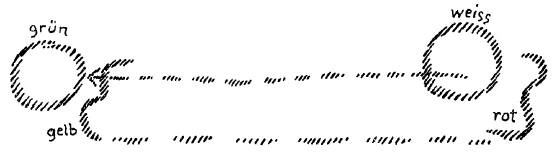
[ 38 ] I told you: At first, it seems to me as if someone were actually bringing the experience to me. That is especially true on the second day. But after the third day, those who brought it to me—these spiritual beings—withdraw, and then I become aware of it as my own, something I laid the foundation for in a previous earthly life. And because this is no longer present within me—since it is something I must contemplate from my previous earthly life—I feel, as I stand within it, as if I were bound. This bondage only ceases again once I have examined the matter, formed a picture of what took place in my previous earthly life, and then look back once more at the event—which I have not lost sight of throughout the three days—and look back again; then I become free once more as I return, for now I can move with the effect. If I’m merely immersed in the cause, I cannot move with the cause. So I step back into a previous earthly life, am as if bound by the cause, and only when I enter this earthly life does the matter resolve itself again.
[ 39 ] Let’s take an example. Suppose someone experiences, at a certain time on a certain day, a friend saying something to him that isn’t entirely pleasant; perhaps he hadn’t expected it. So the friend says something to him that isn’t entirely pleasant. Now, they put themselves in the position of what they were going through while listening to what the friend said; they form a vivid picture of what they went through: how they experienced a slight shock, how they felt a little annoyed, perhaps even hurt, and so on. There is an inner process at work here, and that inner process must be brought into the picture.
[ 40 ] Now one lets the three days pass. On the second day, one goes around saying: “This image I formed in my mind yesterday had a strange effect on me.” All day today I’ve had a sort of sourness inside me, something that’s unsettling me inwardly—something like what emanates from this image, which wasn’t there before. At the end of the whole process, on the morning of the third day, I get up, and this feeling—which I sense clearly comes from this image—captivates me. Now I remain within this captivation. Then this event from my previous earthly life becomes clear to me: I see it before me. I turn to that experience, which is still very fresh, still fully present. Then the sense of being held captive ceases again, and I say to myself: Aha, so that’s how it was in my previous earthly life! That’s what caused it: now the effect is alive. I can live with that again; now the matter is back.
[ 41 ] All of this must be practiced over and over again, because usually the thread breaks on the very first stroke, even on the very first day. Then nothing comes of it.
[ 42 ] It’s especially good to let things unfold side by side—not to dwell on a single event, but to bring a number of the day’s experiences into focus in this way. You’ll say: “Then I’ll have to live with a whole range of feelings the next day.” — But you can handle that, too. It doesn’t hurt at all. Just give it a try; they go together quite well. And then, how often will I be bound after the third day? — That doesn’t hurt either. None of it matters. Things will sort themselves out again. Whatever belongs to a previous earthly existence and is connected to the present one will naturally return to it.
[ 43 ] But it doesn’t happen right away on the first try; the thread breaks. You have to be patient and do it over and over again. Then you feel something growing stronger within your soul. Then you feel that something is awakening in your soul, and you actually say to yourself: Until now, you were filled only with blood; you felt the blood and your breath pulsing within you. Now there is something else inside, something beyond the blood; you are filled with something else.
[ 44 ] You may even get the feeling that you are filled with something about which you can say quite clearly: It is like metal that has turned into air. You actually sense something like metal; you feel it within yourself. There’s no other way to describe it—that’s just how it is. You feel as if you’re permeated by metal, your entire body permeated, just as one might say of certain waters one drinks that they taste metallic; that’s actually how your whole body feels—as if it were internally permeated by metal, as if it were permeated by something finely substantial, which is, however, actually a spiritual entity.
[ 45 ] You feel this when you come across something that has, of course, always been there within you, but which you are only now becoming aware of. And then you regain your courage when you feel something like that. Because if the thread keeps breaking and things go back to the way they used to be—you’d like to grasp a karmic connection somewhere, but it breaks off—you might lose your courage. But when you feel this inner fulfillment, you regain your courage and tell yourself: It’ll all work out.
[ 46 ] But, my dear friends, these things must be experienced with complete composure and calm. Anyone who cannot experience them with composure and calm, anyone who gets agitated or emotional, casts an inner fog over what should actually be happening, and nothing comes of it.
[ 47 ] One could say the following: There are certain people out there in the world today who know anthroposophy only by hearsay, who may not have read anything at all, or who have read only what its opponents have written. It’s actually quite amusing: Some of these critical writings—they appear, indeed they really do spring up out of the ground like mushrooms—cite sources, but among the sources they cite, there are no writings of mine at all, only critical literature. People admit that they don’t actually consult the sources at all, but that they are familiar only with the opponents’ literature. Such things exist today. So these people out there talk about it and say: “Oh, the anthroposophists are crazy!” — Well, the one thing you must not be, if you want to achieve anything at all in the spiritual world, is precisely being crazy. In fact, you must not be even a little bit crazy if you want to achieve anything in the spiritual world. And even being a little bit crazy is already an obstacle to achieving anything. That is precisely what you must avoid. One must even avoid the slightest “quirk” or a touch of capriciousness. For all of that—this surrendering to the moods of the day, to the whims, to the quirks of the day—all of that creates nothing but obstacles and hindrances on the path to making any progress in the spiritual world. One has no choice but to maintain a completely steady mind and a completely steady heart if one wishes to make progress in the field of anthroposophy. With fanaticism—which is, after all, the beginning of madness—nothing at all can be accomplished.
[ 48 ] All these things, as strange as they may sound—as I have recounted them again today, for example—must be experienced in the light of absolute composure, of absolute sanity of mind and heart. And if they are experienced correctly—truly—nothing can pull one more surely out of even the slightest bit of everyday madness than anthroposophy itself. All forms of madness would be healed by anthroposophy if one were to truly devote oneself to it with intensity. So if someone were even to set out to be mad precisely through anthroposophy, that would most certainly be an attempt using unsuitable means.
[ 49 ] But I am not saying this as a joke; rather, I say it because it must also be an integral part of the mindset of spiritual scientific endeavor. One must approach the matter in the way I have just described—half-ironically—if one is to tackle it in the right way with the right orientation. One must remain as level-headed as possible; then one will approach it with the right attitude. But one must at least strive for this, and strive for it especially in the face of life’s little eccentricities.
[ 50 ] I was once friends with a very intelligent philosophy professor—who has long since passed away—who used to say at every opportunity: “We all have a bit of a quirk, after all!” — He meant that all people have a bit of a quirk. But he was a very intelligent man—I always believed that there was something more to it with him: that he wasn’t making this claim entirely without reason! He never became an anthroposophist.
[ 51 ] Well, let's continue this discussion tomorrow.