

Esoteric Considerations of Karmic Connections
Volume II
GA 237
4 August 1924, Dornach
Translated by Steiner Online Library
Tenth Lecture
[ 1 ] What should be evoked as a feeling is that the individual within the anthroposophical movement should sense something of the unique karmic position that the very impulse toward the anthroposophical cause bestows upon a person. We must admit, after all, that in the ordinary course of life, people are largely unaware of their karma, and that they approach life as if the events that become their experiences were simply the result of chance sequences. Little attention is paid to the fact that what we encounter in our earthly life from birth to death is precisely this fateful, karmic connection. And when it is noticed, people immediately believe that it expresses something fatalistic, something that calls human freedom into question, and the like.
[ 2 ] I have often spoken of how it is precisely the intensive examination of karmic connections that sheds the proper light on the essence of freedom. And so, when we take a closer look at these karmic connections, we need not fear that we might thereby lose an unbiased insight into the nature of human freedom. I have described to you the matters related both to the past earthly lives of those who enter the Michael Community and to the life between death and a new birth. You can see from this that for such people—that is, essentially for all of you—it is karmically essential that the spiritual play a major, significant role in the entire inner structure of the soul.
[ 3 ] In our materialistic age, a person from virtually any educational or social background can honestly come to something like anthroposophy—otherwise, their coming to it is simply insincere—only if they have a karmic impulse within them that drives them toward the spiritual. This karmic impulse is the synthesis of everything that was experienced in the manner I have described prior to the descent into this earthly life.
[ 4 ] However, the fact that human beings are so strongly connected to spiritual impulses that act directly upon their souls leads them, in a less intense way than is the case with other human beings, to adapt themselves to their outer physicality as they descend from the spiritual into the physical worlds. One might say: All those who immersed themselves in the Michael current in the manner described were required to enter the physical body with a certain reserve. And this is entirely rooted in the karma of anthroposophical souls.
[ 5 ] In those who, out of an inner impulse, consciously and anxiously keep their distance from anthroposophy today, one finds everywhere a complete fixation on physical corporeality. In those who today turn toward the spiritual life that anthroposophy seeks to offer, one finds a looser relationship—at least on the part of the astral body and the “I” organization—toward the physical and etheric organizations.
[ 6 ] But this means that a person then finds it harder to cope with life, simply because they have more options to choose from than others, because they easily outgrow what others are just growing into. Just consider how strongly some people today are defined by what they have become through the external circumstances of their lives, and the fact is that—even though it is sometimes the case in a curious way—there can be no doubt whatsoever that they fit into those circumstances. One sees a civil servant, a commercial councilor, a construction manager, a factory owner, and so on: they are what they are with absolute matter-of-factness. Certainly, even among them it happens that they say: “It seems as if I were born for something better, or at least for something different”—but they do not mean it all that seriously. Compare this with the endless difficulties faced by those who are driven by an inner urge into the spirituality of anthroposophy. Perhaps nowhere else is this evident so strikingly, so remarkably intensely, as among young people—and especially among the very youngest.
[ 7 ] You see, if one considers, in particular, the older Waldorf students—those in the upper grades of the Waldorf school—one finds that both male and female students progress relatively quickly along their spiritual -psychic development, they progress relatively quickly; yet this does not make it easier for even these young people—but in many cases more difficult, because it is more complex—to grasp life inwardly. The possibilities become broader; the possibilities become greater. And while in the ordinary course of life today it is not an overly great task—barring certain exceptions—for those who stand by the side of growing youth as educators and teachers to find ways and means to offer guidance in the right way—this guidance becomes all the more difficult precisely when, as in the Waldorf school, children are guided forward, because the universal human qualities come more to the fore, and because the breadth of perspective they acquire presents a greater array of possibilities before the eye of the soul.
[ 8 ] That is why it is so essential for Waldorf teachers—once they have been led to this profession by their karma—to cultivate for themselves a broad perspective, an understanding of the world, a sense of the world, and a broad outlook. All the specific pedagogical measures are, after all, far less important at this point than precisely this breadth of vision. And one can certainly say: The very karma of such a teacher also reveals how the sum of possibilities becomes great—much greater than usual. Such a young person or child presents the teacher not with specific puzzles, but with manifold ones, differentiated in every direction. The best way to foster an understanding of all the karmic preconditions that actually exist and that draw people toward anthroposophy is not to speak in pedantically defined terms, but rather to hint at such things and to characterize the atmosphere in which anthroposophists live out their lives and develop.
[ 8 ] That is why it is so essential for Waldorf teachers—once they have been led to this profession by their karma—to cultivate for themselves a broad perspective, an understanding of the world, a sense of the world, and a broad outlook. All the specific pedagogical measures are, after all, far less important at this point than precisely this breadth of vision. And one can certainly say: The very karma of such a teacher also reveals how the sum of possibilities becomes great—much greater than usual. Such a young person or child presents the teacher not with specific puzzles, but with manifold ones, differentiated in every direction. The best way to foster an understanding of all the karmic preconditions that actually exist and that draw people toward anthroposophy is not to speak in pedantically defined terms, but rather to hint at such things and to characterize the atmosphere in which anthroposophists live out their lives and develop.
[ 9 ] All of this, however, makes it necessary for the anthroposophist to take into account a prerequisite—one that is particularly strongly developed in him—regarding his karma. One could cite a wide variety of examples, and we will yet cite many more regarding the reasons why one character or another, one temperament or another, is drawn to anthroposophy by those events in the spiritual world that I have mentioned; but all these impulses that drive individual anthroposophists toward anthroposophy have something like a counter-image that is more strongly imprinted by the World Spirit than is the case with other people.
[ 11 ] This is, in fact, written in the karma of every anthroposophist: Become a person of initiative, and observe how—if, due to physical obstacles or other challenges that stand in your way, you fail to find the center of your being through initiative—your suffering and joy ultimately depend on whether or not you find this personal initiative! — This is something that should always stand before the soul of the anthroposophist as if in golden letters: that initiative lies within his karma, and that much of what he encounters in life depends on the extent to which he can willfully become aware of this initiative.
[ 12 ] Consider that this actually says an extraordinary amount; for at the same time, there is an extraordinary amount in the present that can mislead us with regard to everything that can direct and guide our judgment. And without a clear judgment about the circumstances of life, initiative cannot emerge from the depths of the soul. But what leads us to a clear judgment about life, especially in the present?
[ 13 ] Well, my dear friends, let us consider one of the most important characteristics of our time, and let us try to answer the question of how we can gain some clarity regarding one of the most important aspects of our present-day lives. You will see: what I am about to say is something like Columbus’s egg. But with Columbus’s egg, it’s a matter of figuring out how to position it so that it stands upright, and what I’m about to discuss will also be a matter of figuring out the solution.
[ 14 ] We live in an age of materialism. Everything that fatefully unfolds around us and within us is, after all, shaped by this materialism on the one hand and by intellectualism—which is, for the time being, scattered everywhere—on the other. Yesterday I characterized this intellectualism in terms of journalism and the urge to discuss world affairs at every public gathering. One must realize just how strongly people today are influenced by these two currents of our time. For it is almost as impossible to escape these currents of intellectualism and materialism as it is impossible to avoid getting wet without an umbrella when it rains. It is simply all around us.
[ 15 ] Just think about it for a moment: There are simply certain things we cannot know—things we are supposed to know—unless we read them in the newspaper; there are certain things we cannot learn—things we are supposed to learn—unless we learn them in the spirit of materialism. How is anyone supposed to become a doctor today if they don’t want to “absorb” materialism in the process! They have no choice but to embrace materialism; they must do so as a matter of course. And if they simply don’t want to embrace materialism, then they cannot become a true doctor in today’s world. So we are constantly exposed to this. But this plays an exceptionally strong role in karma.
[ 16 ] But all of this is, after all, tailor-made to undermine initiative in people’s souls! Every public assembly one attends has, as a public assembly, only one purpose: to undermine the initiative of individual people—with the exception of those who speak there and serve as leaders. Every newspaper can fulfill its purpose only if it creates a “mood”—that is, if it undermines the initiative of the individual.
[ 17 ] We must pay attention to these things and realize that, fundamentally, what a person experiences as their ordinary consciousness is really just a very small little room. Everything that takes place around a person in the way I have just described has an enormous influence on the subconscious. And finally, we have no choice—if I may put it that way—but to be contemporaries as well as human beings. Some believe that one can be “merely human” in any given age, but that also leads to ruin; one must also be a contemporary. Of course, it is bad if one is nothing but a contemporary, but one must also be a contemporary—that is, one must have a sense of what is happening in the present.
[ 18 ] However, some anthroposophists’ minds are torn away from a living sense of what is happening in the present, as they are eager to dwell in the timeless. In this regard, one can indeed have the strangest experiences in conversations with anthroposophists. For example, they know quite well who Lycurgus was, but at times they can seem so unfamiliar with their contemporaries that it is simply touching.
[ 19 ] This is precisely because—since the capacity for initiative is present—the person who is so disposed and has been placed in the world in this way by his karma is, in fact, always—forgive the comparison—like a bee that has a stinger but is afraid to sting at the right moment. Initiative is the stinger; but one is afraid to sting. One is afraid, in particular, of stinging the Ahrimanic. One does not fear that the Ahrimanic will be harmed in any way by this, but one fears that the stinger will strike and then rebound, piercing one’s own body. That is roughly the nature of this fear. And so the initiative is held back by a general fear of life. One must simply see through these things.
[ 20 ] Because we encounter materialism everywhere—both theoretically and practically—and because materialism is so powerful, we are led astray in our initiative. And if an anthroposophist has a sense for this, he will be led astray and pushed back by theoretical and practical materialism everywhere, right down to the most intense impulses of his will. But this shapes karma in a peculiar way. And if you observe yourself closely, you will experience something of this in your life from morning to night. And from this must then arise the general feeling: How can I prove, both theoretically and practically, that materialism is false? — And that is indeed the impulse that now exists in the minds of so many anthroposophists: to prove, in some way, the falsity of materialism. This is the riddle of life that has been set before many of us, both theoretically and practically: How does one go about proving the falsity of materialism?
[ 21 ] The person who has gone through a school of study and become a scholar—and there are certainly examples of this in the Anthroposophical Society—feels, once he has awakened to anthroposophy, an immense urge to refute materialism, to combat materialism, and to say everything possible against materialism. Now he begins to fight against materialism, to refute it, perhaps believing that precisely through this he is truly part of the Michaelic current. Yes, most of the time this is not very successful, and one can certainly say: The things that are said against materialism are very often said out of the best of intentions, but they . . . do not really succeed; they make no impression on those who are materialists, whether in a theoretical or practical sense. Why is that? That is precisely what prevents clarity of judgment.
[ 22 ] So here stands the anthroposophist, who—in order not to get stuck with his initiative—wants clarity about what the materialists are putting up against him. He wants to find the fallacy of materialism in every aspect, and as a rule, he doesn’t find much. He believes he is refuting materialism—but it keeps rearing its head. Where does this come from?
[ 23 ] Now here comes what I would call the egg of Columbus. Where does this come from, my dear friends?
[ 24 ] You see, it stems from the fact that materialism is indeed true—as I have said many times before—that materialism is not wrong, but right! That is where it comes from. And the anthroposophist should learn in a special way that materialism is right. He should learn it in this way: that materialism is right, but applies only to physical corporeality. Other people who are materialists know only physical corporeality, or at least believe they know it. That is the error; the error does not lie in materialism itself. When one learns anatomy, physiology, or practical life in a materialistic way, one comes to know the truth, but it applies only to the physical realm. And this acknowledgment must come from the very depths of the human being: that materialism is right in its own domain, and that it is precisely the brilliance of modern times to have found the truth in the realm of materialism. But the matter also has its practical side, its practical-karmic side,
[ 25 ] Now, as part of their karma, an anthroposophist may find themselves coming to the realization: “Here I am living with people whom karma itself has brought me together with—as I spoke of yesterday—here I am living with people who know only materialism, who know only what is true about physical life; they cannot come to understand anthroposophy precisely because they are misled by the very truth of what they know.”
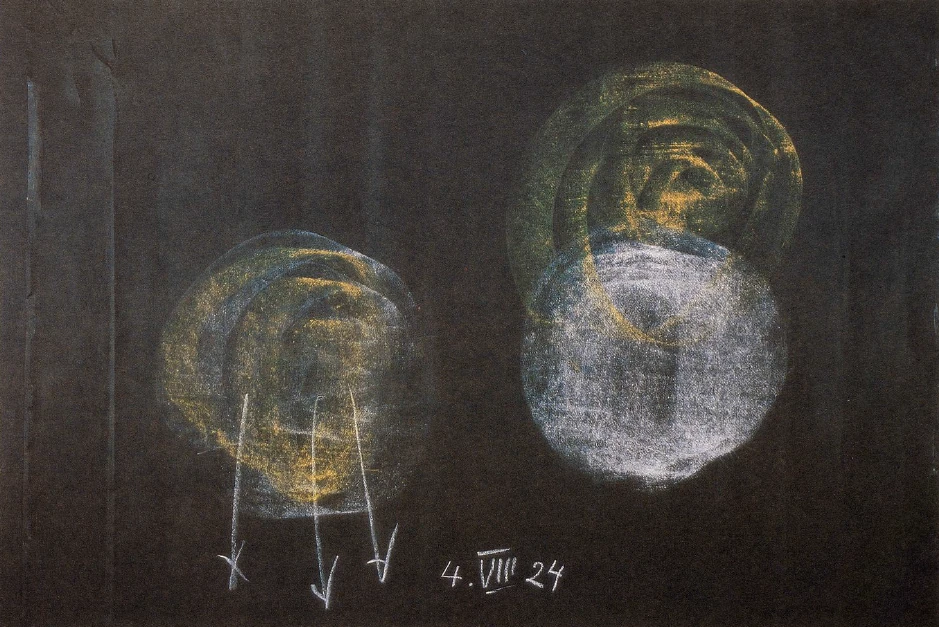
[ 26 ] Today, in the Michael era, we live with our souls immersed in the intellectuality that has fallen away from Michael. When Michael himself administered the cosmic intelligence, things were different. Back then, the cosmic intelligence repeatedly tore the soul free from what existed as materialism. Of course, there have been materialists in other ages as well, but not as they are in our age. In other ages, a materialist was someone who was rooted—with his “I” and his astral body—in his physical and etheric bodies; he felt his physical body (see illustration on the right, light-colored). But that which Michael administered as cosmic intelligence would in turn tear the soul away (yellow). Today we live alongside people—often karmically connected to them—in whom the situation is as follows: They have a physical body; but because cosmic intelligence has been lost to Michael and lives, so to speak, individually and personally within human beings, the “I”—the entire spiritual-soul aspect—remains within the physical body (see drawing on the left). They stand beside us, with their spiritual-soul aspect deeply submerged within their physical body. But this is how we must view it in accordance with the truth when we stand beside non-spiritual people. And this mere act of standing beside non-spiritual people must not merely evoke sympathy and antipathy in the ordinary sense; rather, it must have something deeply moving about it. And it can be deeply moving, my dear friends! And if one wishes to experience the profound impact of standing alongside true materialists in this sense, then one must look to those materialists who are often highly gifted, who may also have quite good impulses arising from certain instincts, but who are unable to attain spirituality.
[ 27 ] What is truly shocking becomes apparent when one considers the great talents and noble human qualities found among materialists. For there can be no question that anyone who, in this age of great decisions, does not find their way to spiritualism will suffer damage to their soul life that extends into their next incarnations. They certainly do. And we should actually—in addition to the fact that today, due to their karma, a number of people feel an inner urge toward spirituality while others cannot approach this spirituality—we should find something deeply moving, something that touches our souls deeply, in the sight of this contrast, in the karmic coexistence with such people as I have characterized them. Only then can we come to terms with our own karma; otherwise, we cannot. For if we take into account everything I have just said about what I might now call “Michaelism,” we will find that the “Michaelites” are indeed deeply moved in their souls by a force that seeks to work from the spiritual into the whole human being, including the physical body.
[ 28 ] Yesterday I characterized it by saying: These people shed the racial aspect—that which, arising from natural existence, gives a person their distinctive character, making them this or that individual. And as the human being, in this earthly incarnation in which he is now becoming an anthroposophist, is seized by the spiritual, he is prepared to no longer be defined by such external characteristics, but rather to be as he was in his present incarnation. One day the Spirit will reveal to these people—let us be aware of this in all humility—how it can shape physiognomy and form the human being.
[ 29 ] This has never before been demonstrated in world history. Until now, people have formed their physiognomies from their folk traditions, from the physical realm. Even today, we can still tell from people’s physiognomies—especially when they are young, before they have been scarred by life’s sorrows or by its joys and exaltations, the divine aspects of life—where they come from. One day there will be people whose physiognomy will reveal only what they were like in their previous incarnation, having advanced toward spirituality there. Then the others will stand beside them—and what will karma mean then? Then karma will have shed its ordinary karmic affinities.
[ 30 ] In this regard, it is precisely those who know how to take life seriously who will be able to tell you: You were—or still are—karmically connected to many who cannot find their way into spirituality. And alongside perhaps some kindred spirits, one nevertheless feels a deep sense of alienation—a sense that is entirely justified: the karmic connection that otherwise plays out in life falls away; it disappears. And what remains, I would say, between someone standing out there in the realm of materialism and a person standing in the realm of spirituality—karmically speaking, nothing else remains—but this does remain—is that the former must look at the latter, that he becomes particularly attentive to him. And we can look toward a time in the future when those who, in the course of the 20th century, have increasingly turned toward spirituality will stand alongside others with whom they lived in karmic connection in a previous earthly life. Karmic affinities and karmic kinships will have little effect in this future; but what remains of these karmic kinships is that those standing in the realm of materialism will have to look toward those standing in the realm of spirituality. Today’s materialists will have to look toward today’s spiritualists in the future. That will be what remains of karma.
[ 31 ] Yet another shocking fact, my dear friends! And what is the point of this? Oh, it is part of a wise, divine plan for the universe. How can materialists be convinced of anything today? Only by seeing it with their own eyes, only by being able to touch it with their own hands. Those who stand in the camp of materialism will see with their own eyes and be able to touch with their own hands those with whom they were formerly karmically connected—in their physiognomy, in their entire expression—what the spirit is; for it has now become a creative force in physiognomy. Thus it will be proven before their eyes, demonstrated in human beings, how the spirit is a creative force in the world. And it will be part of the karma of the anthroposophists to demonstrate to those who today stand in the realm of materialism that the spirit exists, and that the spirit manifests itself in human beings through the decrees of the gods.
[ 32 ] But precisely in order to get there, it is necessary that we not face intellectualism with vague, nebulous activity—that we not go out without an umbrella. What I mean is this: We are, in fact, exposed to what I have called the two currents—the talk and the writing. I said: just as one gets wet when going out without an umbrella in the rain, so too does this happen to people—we simply cannot help it. In our “tenderest youth,” when we are twenty to twenty-four years old, we must study materialistic works—which we must study at some point anyway. Yes, in this tender age of twenty to twenty-four, it is indeed the case that when we study these things, we are still thoroughly prepared inwardly for materialism—through the structure of the sentences, through the vivid formulation of the phrases. We can resist it; it doesn’t matter—we are nevertheless prepared by it.
[ 33 ] That is precisely why it is necessary not to rely solely on formalities. Today, one cannot protect a person from being exposed to intellectualistic materialism. For if one were to write non-materialistic books on botany or anatomy today, it would not work; the context of life does not allow for it. But the point is that one must not grasp these things merely in a formal sense, but rather in reality. One must understand that, because Michael no longer draws the soul-spiritual out of the physical-bodily as he did in the past, Ahriman is able to exert his influence on the soul-spiritual that resides within the physical body. And precisely when this soul-spiritual aspect is gifted but still trapped within the physical body, it becomes particularly vulnerable to Ahriman; it can be especially exposed to him. And it is precisely in the most gifted human beings that Ahriman finds his prey, in order to snatch intelligence away from Michael, to carry it away from Michael. This is where what plays a much greater role in our time than is generally believed comes into play. The Ahrimanic spirits cannot incarnate, but they can incorporate—temporarily penetrate human souls and permeate human bodies. Then the brilliant, the dazzling, the towering spirit of an Ahrimanic intelligence is stronger than what is within the individual human being—much, much stronger. Then, no matter how intelligent the individual may be, no matter how much the individual may have learned: when the physical body is completely taken over by this acquired knowledge, an Ahrimanic spirit can incorporate itself into it for a time. Then it is Ahriman who looks out of his eyes; it is Ahriman who moves his fingers; then it is Ahriman who blows his nose; then it is Ahriman who walks.
[ 34 ] Anthroposophists must not shy away from such insights. For only this can reveal intellectualism in its true nature to the soul. Ahriman is a great, a towering intelligence, and Ahriman seeks to achieve a pervasive influence through Earth’s evolution. He seizes every opportunity where the spiritual somehow penetrates so deeply into a human being’s physical body that the physical is strongly grasped, so that consciousness is, in a certain sense, dimmed by this strong grasping of the body by the spirit. And then it happens—it has indeed become possible in our time—that a brilliant spirit dwells within a human being but towers above the human personality. Then such a spirit, which is within a human personality and towers above it, can work on Earth, working just as human beings work.
[ 35 ] This is what Ahriman strives for first and foremost; he strives for it with great intensity. I have told you about the reappearance on Earth of those who are now drawing near to spirituality, who are entirely sincere and deeply committed; this will take place at the end of the century. But it is precisely this time that the Ahrimanic spirits wish to exploit most strongly, because people are so captivated by the intellect that has taken hold of them, because people are so incredibly clever. After all, people are already afraid today of encountering a clever person! But one must constantly harbor this fear, for almost everyone is clever, so that one can never escape the fear of people’s cleverness. And the fact is that this cleverness, which is being cultivated, is exploited by Ahriman. If, in addition, the bodies are particularly suited to having their consciousness clouded, then it happens that Ahriman himself appears incarnated in human form. It has been proven that Ahriman has already appeared in this way twice as a writer. For anyone who wishes to view life as an anthroposophist with clarity and sharpness, it will be a matter of utmost importance not to make any mistakes in this case either.
[ 36 ] For, my dear friends, what good does it do if someone publishes a book somewhere and puts his name on it, even though he is not the author at all? The true author is then mistaken for someone else. If Ahriman is the author of any book, how could it possibly lead to salvation if one fails to realize who the real author is—if one mistakes a human being for the author, when in fact it is Ahriman who, through his brilliant gift, immerses himself so completely in everything that he can transform himself into the style of a human being! How can it be for the good if Ahriman is the writer and one confuses this with a human work? To acquire discernment in this area—that is what is so absolutely necessary, my dear friends.
[ 37 ] I wanted to begin by addressing this in order to draw attention, in general terms, to a phenomenon that is taking place in our time. In next Friday’s lecture, I will then discuss such phenomena in greater detail.