

Esoteric Considerations of Karmic Connections
Volume II
GA 237
8 August 1924, Dornach
Translated by Steiner Online Library
Eleventh Lecture
[ 1 ] For a long time now, we have been speaking about karmic relationships connected with the anthroposophical movement, with the Anthroposophical Society, and with the individual personalities who sincerely feel the inner urge to follow their life path within the anthroposophical movement. And although there will still be much to say about these karmic relationships after my return from England, I would like—precisely today, in the final hour before my departure for England on a journey that will last the remainder of August—to offer a few concluding remarks that will help round out the thoughts I have been able to share with you in these karmic reflections.
[ 2 ] You have all noticed, my dear friends, how the karma of the individual anthroposophist has undergone manifold forms of shaping in past earthly lives and between death and a new birth. And especially in the last two hours, we have already been able to hint at the significance this can have for the karma of the individual anthroposophist. We have seen that this karma of the anthroposophist is connected with the entire development that the Michael principle has undergone over long, long periods of time. We have seen, initially in a more abstract way, how the Michael realm has lost what might be called the administration of cosmic intelligence. It was indeed the case in earlier times that people, as I said, did not attribute the intelligent being to themselves, but rather derived everything they expressed in intelligent forms from the inspiration of higher powers. And those knowledgeable in this field knew that it was those higher powers that were then designated, in Christian terminology, as the Michaelic powers. Now I have identified the 8th and 9th centuries as the period in the development of civilized humanity during which cosmic intelligence gradually descended to Earth, taking shape, so to speak, in drop-like forms that then continued to live on in individual human souls as personal intelligence. And I have also hinted to you how the perspective on cosmic intelligence—that is, on the ancient Michaelic administration—has been preserved, both traditionally and out of a certain insight. If we look at the scholars—who were in many respects quite outstanding—who, drawing on Arabism and on what, originating with Alexander’s campaigns, flourished in Asia as Aristotelianism, were then permeated by the mysticism of the Orient, and— I would say, made them intelligent; when we look at all that was carried over from there through Africa to Spain and took effect there as Moorish wisdom through such an outstanding personality as Averroes, then we find in the teachings of these Moorish-Spanish scholars a distinct reflection of the views that point toward cosmic intelligence.
[ 3 ] Let us try to clearly illustrate how this was conceived. To this end, I would like to sketch out what these Moorish scholars taught their students in Spain during the 10th, 11th, and 12th centuries—at the same time that, in other parts of Europe, institutions such as the School of Chartres, about which I have told you at length, were flourishing.
[ 4 ] In Spain, Moorish scholars—above all a figure such as Averroes—taught how intelligence reigns everywhere, how the entire world, the cosmos, is filled with all-pervading intelligence. People down here on Earth have various qualities, but they do not possess their own, personal intelligence. Rather, every time a human being acts on Earth, a drop of intelligence, a ray of intelligence, emanates from the universal intelligence, descends, as it were, into the person’s head and body, and fills them, so that when a human being walks the Earth, they possess something like a part of the universal cosmic intelligence. When the person then dies and passes through the gate of death, what they possessed as intelligence returns to the general intelligence; it flows back. Thus, whatever thoughts, concepts, and ideas a person possesses during their life between birth and death flow back into the general reservoir of universal intelligence, and one cannot say that what a person carries in their soul as particularly valuable—their intelligence—is subject to personal immortality.
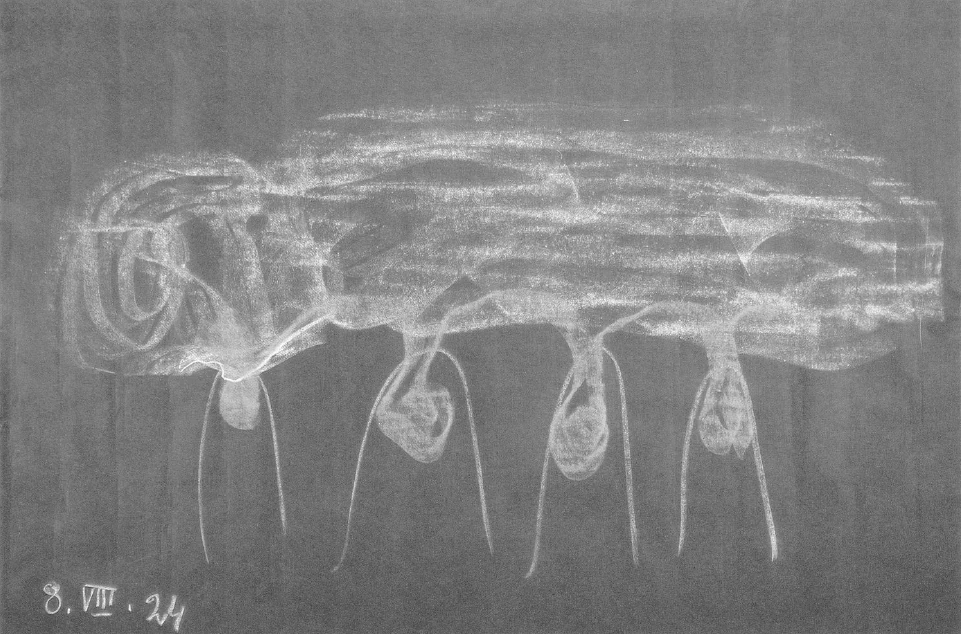
[ 5 ] This was also certainly taught by the Spanish-Moorish scholars: that human beings do not possess personal immortality. They continue to live, but—as the scholars said—the most important thing about them is that they can develop intelligent knowledge during their lifetime. However, this does not extend beyond their physical existence. Therefore, one cannot say that the intelligent being possesses personal immortality. You see, that was—I would say—the fervor of the struggle among the scholastics within the Dominican Order, the fervor to assert the personal immortality of human beings. At that time, it could not have played out any other way than for these Dominicans to assert: Human beings are personally immortal, and what Averroes teaches is heresy. We must express this differently today. But for that time, it is understandable that a person who did not accept personal immortality—such as Averroes in Spain—was declared a heretic. Today we must view the matter in accordance with reality. We must say: In the sense that the human being has become immortal in terms of his conscious soul, he has only attained this immortality—this enduring consciousness of personality—after passing through the gate of death, ever since the time when a conscious soul took up residence in the earthly human being. So if Aristotle or Alexander had been asked what they thought about immortality, how would they have answered? The exact words don’t matter, but if they had been asked and had answered using Christian terminology, they would have said: Our soul is received by Michael, and we live on in the community of Michael. — Or they would have expressed it in cosmological terms; precisely from a community such as that of Alexander or Aristotle, one would have said—and indeed did say—in cosmological terms: The human soul is intelligent on Earth, but this intelligence is a drop from the abundance of what Michael pours forth like an intelligent rain that floods over humanity. And this rain emanates from the sun; the sun, in turn, takes the human soul back into its own being, and the human soul, which exists between birth and death, radiates down from the sun onto the earth. One would have sought Michael’s dominion on the sun. That is how one would have answered cosmologically.
[ 6 ] This concept came to Asia, returned from Asia, and was still flourishing as a belief among the Moors in Spain at the time when the Scholastics began advocating for personal immortality. We need not say, as the Scholastics did, “It is an error”—but rather we must say: The evolution of humanity has brought about individual, personal immortality, and it was in the Scholasticism of the Dominicans that this personal immortality was first emphasized. — And an old truth, which was no longer true for that era in relation to the development of the human race, was taught at the universities run by the Moors in Spain. Today we must not only be tolerant toward our contemporaries; we must also be tolerant toward those who have perpetuated old teachings. That was not possible at that time; it is therefore important that we remind ourselves of this again and again: What the Dominican scholastics called personal immortality has actually only been a truth since the conscious soul slowly and gradually entered into humanity.
[ 7 ] One can also, I would say, describe this in a very imaginative way. If a person dies today who truly had the opportunity during their earthly life to imbue their soul with intelligence—with true intelligence—then they pass through the gate of death and look back on their earthly life, which existed as an independent earthly life. In earlier centuries, after passing through the gate of death, a person would look back on their earthly life—seeing how the etheric body dissolves into the cosmos, how they then pass through the realm of the soul, and how they relive the events in reverse order. Then they could say to themselves: “This is how Michael administers, through the Sun, that which was mine.”—That is precisely the great difference. However, one can only assess such a development by looking behind the scenes of existence and observing the spiritual reality behind the material world. What matters is that one views the external events in human history as they are shaped from within the spiritual world.
[ 8 ] Now you must once again immerse yourselves in everything I have said. Immerse yourselves in the fact that, with the 9th century A.D., the crisis is unfolding: the cosmic intelligence is descending among the people of Earth. This is an objective fact; it is what is taking place. And now place yourself within the solar sphere, which Michael and his followers administered as I have described, by perceiving Christ’s departure from the Sun and his transition to Earth in the Mystery of Golgotha, and by reliving how, little by little, the cosmic intelligence descends more and more, becoming individual human knowledge. An important event that made a deep impression, especially on those who belong to Michael—I referred to them last time as “Michaelites”—an important event of a truly remarkable nature was the one I have already described in earlier contexts as it unfolded within the course of Earth’s civilizational development. But now it must be characterized as it appears from the perspective of the Michaelites themselves, from the Sun—as one sees it when looking down from the realm of Michael onto the Earth.
[ 9 ] This important, this significant event took place in the year 869. It was the Eighth Ecumenical Council in Constantinople, where it was dogmatically declared: The ancient view of trichotomy—that human beings consist of body, soul, and spirit—was heretical; human beings have only body and soul, except that the soul possesses certain spiritual qualities. While, in the objective realm, intelligence was being transferred to individual human beings, it was decreed on earth—in such a definitive manner that no one within European civilization dared to contradict it—that the trichotomy was false and heretical. One was not permitted to speak of human beings as having body, soul, and spirit; rather, one was allowed to speak only of body and soul, and to ascribe spiritual qualities and powers to the soul. With this, something had happened on Earth about which one could only say in the Michael Realms: Now the conviction will take hold in the souls of human beings that the spiritual is a quality of the soul, that the spiritual is not the Divine that reigns in the course of human development. “Look down upon the Earth”—these are the words of Michael—“there the consciousness of the spirit is fading.” But, my dear friends, this fading of the consciousness of the spirit was precisely connected to what we wish to discuss primarily today.
[ 10 ] I just said a moment ago that so far I have only described in abstract terms how the development of the Michael Kingdom has taken place behind the scenes of earthly existence. I said that the cosmic intelligence had descended to individual human beings. But that is only an abstraction, my dear friends. What, then, is intelligence? Of course, when one ascends to the higher realms, one must not imagine that one can grasp intelligence there in the same way one grasps trees and bushes here in the physical world. What is this “intelligence”? Such generalities do not, of course, exist in reality. Intelligence consists of the mutual rules of conduct within the higher hierarchies. What they do, how they relate to one another, how they are toward one another—that is cosmic intelligence. And since we, as human beings, must naturally focus on the realm closest to us, cosmic intelligence becomes concrete for us as the sum of beings from the hierarchy of the Angeloi. When we speak in concrete terms, we cannot speak of a sum of intelligence, but rather of a sum of Angeloi; that is the reality. The fact that the Church Fathers debated in the year 869 whether one should speak of a “Spirit” was the result of a number of Angeloi beings separating themselves from the Michael Realm, to which they had previously belonged, and adopting the view that they now had to deal solely with earthly powers, that they had to carry out the guidance of human beings solely through earthly powers. So you see what kind of event this really is! Angels are the beings who guide human beings from one earthly life to the next. They are the beings closest to us in the spiritual world; they accompany us on our journey through the life between death and rebirth and point us back toward earthly life; they weave the individual earthly lives into a coherent chain of humanity’s total life. A number of angelic beings entrusted with this task, who were formerly united with the Michael Realm, broke away and left the Michael Realm. Such an action could not possibly leave the fate of human beings unaffected. For who, naturally, is primarily involved in how karma unfolds, and how earthly deeds, thoughts, and feelings are processed between death and rebirth? It is the Angeloi beings! Now, when these Angeloi beings assume an entirely different position in the cosmos—when they, so to speak, leave the Solar Realm and, instead of being celestial angels, become terrestrial angels—what must happen then? There is indeed a great mystery underlying the entire development of Europe, hidden behind the outward facts. Certain Angeloi, however, have remained in the Michael Realm. In that great school of learning at the beginning of the 15th century, there were also such Angeloi beings who belonged to the people who were in the Michael Realm at that time. Among all the human souls who lived in the Michael Realm—of whom I have spoken—were Angeloi beings who remained in the Michael Realm. But the others were the ones who left, who identified with what was earthly.
[ 11 ] Now you might say: Yes, but how is it, actually, that a number of Michael angels suddenly decide to leave this Michael realm? It doesn’t occur to the others to leave! — I must admit, this is one of the most difficult questions one can raise regarding the recent development of humanity. It is, in essence, a question that, when one engages with it, must stir all of a person’s inner forces into activity. It is a question that is deeply and intimately connected with the whole of human life.
[ 12 ] You see, there is indeed a cosmic fact underlying this. You know from the lectures I have given here from this very spot: Everything that is referred to as a physical planet is a gathering of spiritual beings. When one looks up at a star, what appears physically is only the outer shell; in reality, one is dealing with an assembly of spiritual beings. Now there is a certain contrast—which has always existed ever since the Earth began to evolve—between the intelligences of all the planets and the solar intelligence. On the one hand, there is the solar intelligence; on the other hand, there are the planetary intelligences. And it has always been the case that the solar intelligence was primarily under the rule of Michael, while the other planetary intelligences were under the rule of the other archangels. So we say (it is written on the board):
[ 13 ] Solar Intelligence
Michael
[ 14 ] Planetary Intelligences
Mercury: Raphael
Venus: Anael
Mars: Samael
Jupiter: Zachariel
Moon: Gabriel
Saturn: Oriphiel
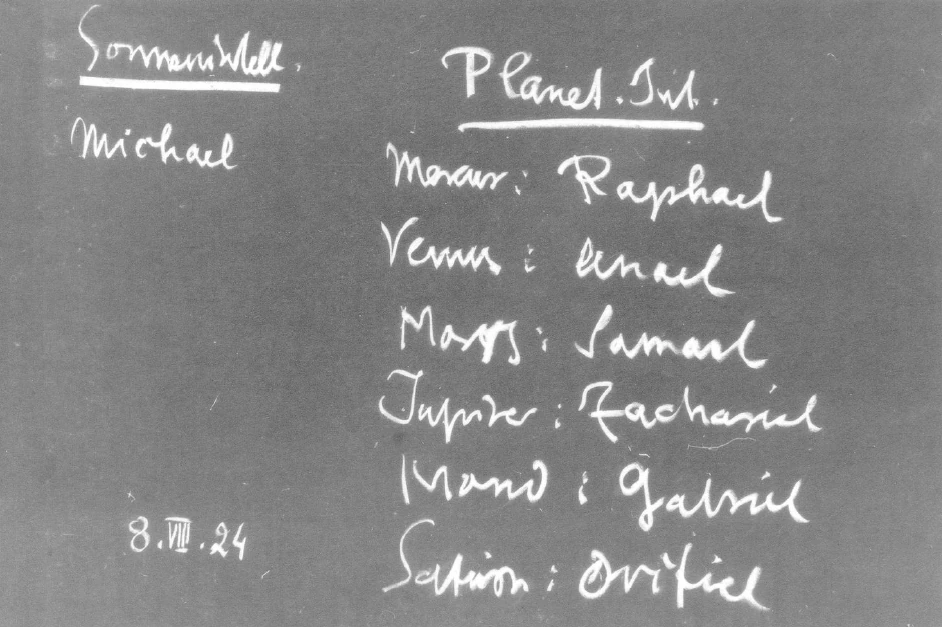
[ 15 ] But it has always been the case, my dear friends, that one could not say Michael alone administers the solar intelligence. Rather, the entire cosmic intelligence is manifested in the solar intelligence and in the planetary intelligences: Mercury, Venus, Mars, and so on. Cosmic intelligence is co-administered by the individual beings of the Archangeloi hierarchy, but Michael always presides over them all, so that the entire cosmic intelligence is administered by Michael. Of course, every human being was also a human being in the past, when Michael administered the cosmic intelligence and when only a ray entered into each individual human being, so that the human being could still feel like a human being on Earth and the individual human being was not merely a vessel for the general cosmic intelligence. But this originates from the Sun; all human intelligence originates from Michael in the Sun.
[ 16 ] It was only as these centuries dawned—the 8th, 9th, and 10th centuries—that the planetary intelligences took into account the fact that the Earth had changed and that the Sun, too, had changed. Yes, what is happening out there—what astronomers describe—is only the outer appearance. You know: About every eleven years we have a sunspot cycle; the Sun shines on Earth in such a way that certain areas are dark, that certain areas are spotted. It wasn’t always like that. In very ancient times, the Sun shone down as a uniform disk; there were no sunspots. And after thousands and thousands of years, the Sun will have significantly more spots than it does today; it will become increasingly spotted. This is always the outward manifestation of the fact that the Michael Force—the cosmic force of intelligence—is steadily diminishing. The increase in sunspots due to cosmic evolution reveals the Sun’s decline; the Sun’s growing materialization and aging within the cosmos become increasingly evident. And upon the appearance of a sufficiently large number of sunspots, the other planetary intelligences recognized that they no longer wished to be ruled by the Sun. They resolved to ensure that the Earth would no longer be dependent on the Sun, but rather directly on the entire cosmos. This is accomplished through the planetary decrees of the Archangels. Specifically, under the leadership of Oriphiel, this emancipation of the planetary intelligence from the solar intelligence is taking place. It was a complete separation of world powers that had previously been united. The solar intelligence of Michael and the planetary intelligences gradually came into cosmic opposition with one another.
[ 17 ] Yes, even if we attribute a completely different kind of soul power—a different inner constitution—to the beings of the hierarchy of the Angeloi, we must also attribute to them decisions and reflections on what is happening. After all, we humans do not make decisions any differently than by observing the events unfolding externally, letting the facts speak for themselves, and acting in one way or another under the influence of those facts. The only difference is that for us, between birth and death, earthly facts are decisive. For the beings of the hierarchy of the Angeloi, decisive facts are such as the fact that a division is taking place within planetary life. One group turned toward earthly intelligence and, at the same time, toward planetary intelligence; the other group remained faithful to the Michael Sphere in order to carry into the future what Michael administers as the Eternal. This is now a decisive factor: whether Michael is able to carry what is eternal in his work into the future, now that all power lies with humanity, now that what appears in the physical sun is growing darker and gradually disappearing.
[ 18 ] Thus, prompted by cosmic events, we see a division among the Angeloi who were formerly united with Michael. But these beings are, in fact, part of the karmic development. And now consider the whole process as it unfolds in the life between death and rebirth. It is not the case that every human soul can act alone, nor can every angel who guides human beings act alone; rather, the hierarchy of the angels works together. Karma is lived out through this cooperation. Of course, when I am connected to people in one earthly life, and we carry this forward into the next life, then the angel of one person must come together with the angel of another. There must be a collaboration, and this was often the case. This is the immensely shattering—I would say crushing—event that took place on Earth during the Ecumenical Council of 869. It is the signal for something immense that is happening up there in the spiritual world. That is what is shattering—if one maintains one’s composure, sustaining oneself through the proper use of cosmic intelligence in the face of such overwhelming interconnections of facts—the profoundly significant event that has already occurred and is occurring more and more: that the Angelos of one human soul, which had previously been karmically connected to another human soul, did not unite with the Angelos of that other human soul. One Angelos of the two karmically connected human souls remained with Michael; the other descended to Earth. What had to happen there? In the period between the founding of Christianity and the Age of Consciousness—which was marked most notably by the 9th century, by the year 869—disorder had to enter into the karma of humankind! With this, one of the most significant statements that can possibly be made regarding the recent history of humankind has been uttered. Disorder has entered the karma of modern humanity. In the years that followed, not all experiences were properly incorporated into karma. And the chaos of recent history—which brings ever more social and other forms of chaos, as well as cultural chaos, into recent history, preventing any goal from being achieved—is the disorder that has been introduced into karma because a schism occurred within the hierarchy of the Angeloi belonging to Michael.
[ 19 ] And now we can speak of something connected with the karma of the Anthroposophical Society—something of immense significance, something that, I would say, provides the proper nuance. For everything that can ultimately be characterized on the basis of external circumstances does not exhaust what is taking place in the spiritual realm behind the scenes. The thoughts one selects from earthly circumstances are weak and feeble. After such preparations, one must turn to what characterizes the purely spiritual.
[ 20 ] One must say: Certainly, everything that has honestly brought souls together in the Anthroposophical Society through an inner spiritual impulse is, of course, true. But how is it that there are also forces at work that cause people today to come together under purely spiritual principles that are otherwise foreign to the modern world? Where do the forces of coming together lie? They lie in the fact that, through the advent of Michael’s reign—through the Michaelic Age in which we live—with Michael’s entry into earthly dominion and the replacement of Gabriel’s reign by Michael’s, Michael brings with him the power intended to restore karmic balance in those who have followed him. So we can say: What unites the members of the Anthroposophical Society? What unites them is that they are to set their karma right! If, in the course of their life, someone notices that they are entering into relationships here or there that are not in accordance with their inner impulse—relationships that perhaps in some way fall outside of what constitutes true harmony within the human being between good and evil—on the one hand—and, on the other hand, there is always an impulse within them to move forward with anthroposophy: then what is at work here is that the person is once again striving back toward karma, toward true karma, toward living out true karma. This is the cosmic ray that pours forth clearly for the discerning through the anthroposophical movement: the restoration of the truth of karma. You see, much of what constitutes both the destiny of the individual within the Anthroposophical Society and the destiny of the Society as a whole is connected to this. Naturally, for it all flows into one another.
[ 21 ] Now we must consider the following: You see, the people who are connected to beings from the hierarchy of the Angeloi—those who have remained in the Michael Realm—find it difficult to find forms of intelligence that correspond to what they are meant to comprehend. They strive, after all, to maintain their personal intelligence in such a way that it can be connected to the veneration of Michael. Those souls of whom I have spoken—who took part in those preparations in the 15th and 19th centuries—come down to Earth, still clinging to the deepest longing for Michael and his sphere. Nevertheless, according to the principles of human development, they are to assimilate individual personal intelligence. This creates a conflict, but one that must be resolved through spiritual development, through the convergence of individual activity with what the spiritual worlds bring down in the present age of intelligence. The others, whose angels fell—which is naturally connected to karma, for the angel falls when it is linked to human karma that corresponds to it—these others absorb personal intelligence as a matter of course, quite naturally; but in return, it also works automatically within them, acting through their physicality. It works in such a way that these people think—think intelligently—but they are not engaged in the process. This was the great dispute that played out for a long time between the Dominicans and the Franciscans. The Dominicans could not conceive of the principle of personal intelligence in any way other than with the utmost fidelity to the sphere of Michael. The Franciscans, the followers of Duns Scotus—not Scotus Erigena—became complete nominalists. They said: Intelligence is nothing more than a sum of words. Everything that took place in the discussions among people—all of it—is in fact a reflection of the powerful battles taking place between one host of angels and another host of angels.
[ 22 ] You see, the fact is that the beings from the hierarchy of the Angeloi, who have now united with the earthly principle, have actually been living on Earth since around the 9th or 10th century. And that, my dear friends, is what is so shocking: Materialism is on the rise on Earth, and it is precisely the most advanced, the most intelligent people who deny the spiritual, who begin to mock the idea that spiritual beings might be present in their surroundings just as physical human beings are. In this age when materialism is spreading, more and more angels are descending and living on Earth. They are taking part. It is precisely they who, at certain times when human consciousness is clouded, incarnate and work on Earth. A large number of angelic beings hold back, but those whose angelic karma brings them closest to the Ahrimanic forces do not hold back; they incarnate in human beings, immersing themselves in humanity at certain times.
[ 23 ] Then what I described in the previous lecture arises from the fact that I said: There is now such a person on Earth; he possesses human gifts and human intelligence, which he lives out—perhaps even brilliantly—but for a certain period, when his consciousness is clouded, an Ahrimanic angelic intelligence takes up residence within him. This phenomenon can then occur: There is a person who appears to be an ordinary human being and who writes this or that out of his humanity. Now the Ahrimanic can approach the human being precisely through that which is absorbed today in intelligent forms. One must assert one’s personality if one is not to be overwhelmed today by all that I have alluded to in the course of these lectures. And that is why Ahriman can appear as a writer. He naturally makes use of an angelic being. He is capable of writing. And now that we are gathered together for our Christmas Conference, such matters should not be passed over in silence. That is why I would like to add the following:
[ 24 ] You see, it was possible to take a different stance toward one of the most brilliant writers of recent times—one of the greatest writers—before his final works were published. When I wrote my book, Nietzsche, a Fighter Against His Time, the public was still dealing with the dazzling writer who had elevated human capabilities to the highest level. Only then did people become familiar with what Nietzsche wrote during his period of decline. Above all, there are two works, The Antichrist and Ecce Homo: these are two works written not by Nietzsche, but by Ahriman—an Ahrimanic spirit incarnated within Nietzsche. It was there that Ahriman first appeared on earth as a writer. He will continue to do so. Nietzsche was shattered by it. Consider the impulses one faces when confronted with those ideas that lived within Nietzsche at the time when, out of that spirit, he wrote those brilliant but diabolical works, The Antichrist and Ecce Homo—intelligent works! I have spoken of Ahriman’s great, all-encompassing intelligence. With regard to what is magnificent and dazzling, one does not disparage a work by calling it “Ahrimanic,” as simple-minded people might think, not knowing what greatness can be found in Ahriman. One neither criticizes nor praises when speaking of Ahriman; very much on Earth depends on him. Whoever has bled—I mean spiritually—as I did when I first read Nietzsche’s treatise The Will to Power, which was then published in such a way that people could not form a proper conception of it, and whoever at the same time can look into the realms that, ever since Michael’s reign began in the 1880s, are separated from the physical realms of the earth by only a very thin wall—who knows how this realm borders directly on the physical realm, so that one can say, it is a realm similar to the one a person passes through after death; whoever looks into the efforts being made in this direction knows how they find impulsive expression in works such as Ecce Homo and The Antichrist. One need only think of the Ahrimanic remarks found in The Antichrist. I do not know whether this passage appears the same way in the more recent editions. There is a passage where he writes about Jesus—I am not quoting verbatim—and says that Renan describes Jesus as a genius. Nietzsche does not regard him as a genius; he says: “Speaking with the rigor of a physiologist, a quite different word would be appropriate here...” In my edition of Nietzsche’s works, there are three dots at this point; I don’t know if it’s the same in newer editions. In the manuscript, the word “Idiot” is written out in full here. The fact that Jesus is described as an “Idiot” is the hand of Ahriman. And there are many other passages of this kind there. And who could possibly believe that there isn’t something hidden there in Nietzsche—who, at the very same time he was writing these things, was experiencing stirrings in his soul to convert to Catholicism—it happened in parallel; you must not forget that—who could believe that there isn’t a deep mystery concealed there? The Antichrist—with what words does it conclude? With the words—I cannot quote them verbatim—: “I would like to write it on every wall, and I have writing materials with letters that shine far and wide; I would like to write on every wall what Christianity is: Christianity is the greatest curse of humanity!”—That is how the book concludes. There is certainly a problem here. One must simply see how this entire realm—separated from our own by only a thin wall, where all the spiritual struggles at the end of the Kali Yuga took place—extending slightly beyond the Kali Yuga—how this realm seeks to enter the physical realm of the Earth.
[ 25 ] These are the things one must look at if one wants to understand how humanity can actually relate to what must occur in civilization with the dawn of the Michael Age. During the transition from the Kali Yuga—the transition from the dark age to the age of light—one really had to be immersed in a spiritual-physical vividness if one wanted to characterize it, as I did in the preface to my book Mysticism at the Dawn of Modern Spiritual Life, the attitude one must have toward the spiritual and the material. It is indeed the case that one would like to draw upon every possible means to characterize this magnificent transition that is taking place as the dawn of the Michael Age. And one must feel oneself immersed in everything that constitutes the anthroposophical movement. For all this magnificence, this greatness, initially plays itself out within human karma, which has already fallen into disorder. When one considers how universal truth lies in karmic interrelationships, and how the world is such that even within these general karmic interrelationships exceptions have been able to intervene over the course of centuries, and how the demand arises to bring cosmic exceptions back into line with their rules: then one will sense something—because that is the task, the mission of the anthroposophical movement—of the great significance and scope of the anthroposophical movement.
[ 26 ] This, my dear friends, should rest in your souls when you say to yourselves: Those who, based on this distinction, feel the urge today to enter into anthroposophical life will, as the 20th century draws to a close, be called upon once more to achieve the greatest possible expansion of the anthroposophical movement at its culmination. But this can only happen if these things can live within us, if the vision of what reaches down from the cosmic-spiritual into the earthly-physical can live, if even into earthly intelligence, into human perception, the recognition of the significance of Michael can reach.
[ 27 ] This impulse must be the very soul of the anthroposophical endeavor; the soul itself must desire to be at the very heart of the anthroposophical movement. In this way, we will find the means not only to preserve thoughts of great significance in our souls for some time, but also to bring them to life; so that through these thoughts the souls may continue to develop in an anthroposophical way, so that the soul may truly become what it is meant to be through the unconscious urge to come to anthroposophy—so that the soul may be seized by the mission of anthroposophy. In order to allow this sense of being seized to take effect within you in a moment of quiet, I have spoken these earnest words to you in this final hour. We will continue them when we meet again. When we gather in the first days of September, we will resume these reflections. In the meantime, I would like to have laid upon all your hearts precisely what I had to speak about this evening in connection with the karma of individual anthroposophists and the Anthroposophical Society.