Esoteric Considerations of Karmic Connections
Volume VI
GA 240
12 August 1924, Torquay
Translated by Steiner Online Library
The Deepening of Christianity Through the Solar Powers of Michael I
[ 1 ] Today is the first time since the Christmas Conference at the Goetheanum that I have had the opportunity to speak to you again. And before we embark on further discussions, it is necessary to address what relates to the impulse that entered the anthroposophical movement through the last Christmas Conference at the Goetheanum. We had the pleasure, during that Christmas Conference, of welcoming a number of members of the English National Society to Dornach, above all our dear, long-standing friend Mr. Collison, the chairman here in England. And I would like to take this opportunity to renew the greeting I extended to him at that time in Dornach as the representative of the English National Society.
[ 2 ] What has been introduced into the Anthroposophical Society as an impulse through the Christmas Conference is indeed meant to represent something profound, so that many things about which a word or two had been said in a characterizing way before the Christmas Conference must now be discussed in the opposite sense. Indeed, a difficult time has come for this Society, even internally in the occult sense, particularly because in the postwar period, a wide variety of initiatives were attempted from various quarters from within the bosom of the Anthroposophical Society, and it has become necessary to bring about a kind of renewal for the Society.
[ 3 ] For me personally—and I think it’s okay to mention this here—this renewal was linked to something very, very meaningful.
[ 4 ] Some time before Christmas, a question arose in my mind, after I had long intended to reestablish the society in a certain way for Christmas—or at least in a new form.
[ 5 ] I was faced with the necessity of deciding to do what I had, for good reasons, refused to do at the time when the Anthroposophical Society had split off from the Theosophical Society. At that time, I assumed that if I withdrew from all administrative matters and from all leadership of the Society in order to remain solely in the teaching profession, certain things would be less difficult to manage than if the teacher were to hold an administrative office at the same time.
[ 6 ] But these things, which were taken for granted back then—in 1912 and 1913, when the Anthroposophical Society was separated from the Theosophical Society—simply did not come to pass. The conditions did not materialize within the Anthroposophical Society. And so it became necessary for me to seriously consider the question of whether or not I should assume the presidency of the Anthroposophical Society. — And I recognized the necessity of assuming this presidency.
[ 7 ] However, I would like to emphasize very strongly—even among our dear English friends—something that is absolutely essential to highlight in connection with that decision to assume the presidency of the Anthroposophical Society. To carry this out was an absolute risk for the entire movement, for it meant facing a very specific possibility.
[ 8 ] The anthroposophical movement is based on the fact that real revelations regarding the content of spiritual knowledge flow down from the spiritual world. If one wishes to carry out the work of the anthroposophical movement, one cannot rely solely on human effort. One must be open to what flows down from the spiritual worlds. The laws of the spiritual worlds are very specific and inviolable. They must be strictly observed.
[ 9 ] And it is difficult to reconcile what an external office demands in our present age—even that of the chairperson of the Anthroposophical Society—with the occult duties toward the revelations of the spiritual world. So that even back then, one had to ask oneself the question: Will the spiritual powers that have blessed the Anthroposophical Society thus far—with what can flow down from them—will these spiritual powers continue, I might say, to bless the anthroposophical movement in this way?
[ 10 ] You can certainly appreciate the full significance of such a possibility. One would have to face the possibility that the spiritual powers might have said: “That is not possible; an external office cannot be accepted.”
[ 11 ] Now, today, it can truly be said—I would say in the presence of all the spiritual powers associated with the anthroposophical movement—that the connections existing between the spiritual worlds and the revelations that are to flow through the anthroposophical movement have become more intimate, more profound, abundant than was previously the case; that is to say, of the two possible outcomes that could have occurred, the one that is as favorable as possible for the further progress of the anthroposophical movement has indeed come to pass. One may say: Ever since the founding of the Anthroposophical Society at the Goetheanum, those spiritual powers from whom we receive our revelations have been looking down upon us with full benevolence—and with even greater benevolence than was previously the case. Thus, in this regard, a heavy burden has been lifted from the Anthroposophical Society for quite some time now.
[ 12 ] I had to emphasize many times before this Christmas conference at the Goetheanum that a distinction must be made between the anthroposophical movement, which embodies a spiritual current as it is reflected on Earth, and the Anthroposophical Society, which is simply a society that was administered in an external manner by electing its officials or appointing them in some other way.
[ 13 ] Since Christmas, the opposite must be said. It is no longer possible to distinguish the anthroposophical movement from the Anthroposophical Society. They are one and the same: for with my becoming chairman of the Society, the anthroposophical movement has become one with the Anthroposophical Society.
[ 14 ] This made it necessary that, at Christmas in Dornach, a board of directors was not appointed in the external, exoteric sense of the term, but rather a board was appointed that is to be regarded as an esoteric board—one that is accountable only to the spiritual powers for what it does, one that was not elected but rather formed. All the things that usually take place at founding meetings unfolded differently at Christmas. And this executive committee is what I would like to call an “initiative committee”—a committee that sees its tasks in what it does. For this reason, no bylaws were drafted at the Christmas conference in the usual sense; rather, it was simply stated what kind of relationship should exist from person to person—between the executive committee and other members, among the individual members themselves, and so on. What the executive board intends to do is set forth in that document—which is not a bylaw, but has merely taken the form of a bylaw, and is actually a narrative of what we intend to do. Everything was simply different from what is usually the case in associations.
[ 15 ] And this is the essential point: an esoteric element has now entered the entire Anthroposophical Society. The entire movement, as it now flows through the Society, must have an esoteric character.
[ 16 ] This must be taken very seriously. The Executive Council at the Goetheanum will be guided solely by the impulses of purely human activity emanating from the spiritual world. It is not Paragraph 1, Paragraph 2, and so on, but that which is true spiritual life that is to be promoted—unreservedly, without any other ulterior motive.
[ 17 ] You see, I would like to mention one seemingly quite insignificant detail in this regard. Membership certificates for all members have been and continue to be renewed. Since we now have twelve thousand members worldwide, twelve thousand membership certificates had to be issued. All of them must now be signed by me personally. Of course, some have suggested that we could simply have a stamp made and press it onto the certificates. But in the anthroposophical movement, everything is to have a directly individual, human character from now on. That is why I must adhere to this principle even in such a small matter. Each membership certificate must be laid out before my eyes; I must read the name and sign my own name beneath it: In this way, a small but genuine human connection is established with each individual member. It would, of course, be easier to have someone else stamp the twelve thousand membership certificates, but that is not to be done.
[ 18 ] This is meant, I would say, to symbolically suggest that, in the future, what will matter most is what prevails in society as a human quality.
[ 19 ] If you show understanding toward the Executive Council at the Goetheanum in this way, then you will see—of course, everything will proceed slowly; you must be patient, my dear friends, but even if it does proceed slowly—every single one of the Christmas intentions will be carried out little by little. But we must also meet the Executive Council at the Goetheanum with understanding; it cannot take the fifth step before the second, nor even the second before the first, and even if it has only reached half a step so far, it will work out; the time will come when it will have reached the fifth step as well. For if things are to be managed in a human way, one cannot remain at the abstract level; one must enter into the concrete in every respect.
[ 20 ] And so the anthroposophical movement will truly take on a new character. It will be esoteric in spirit, no longer seeking the esoteric in outward appearances. Certain truths will be esoteric—truths that can be proclaimed only within the movement, because only those who actively participate in everything that takes place within the Society will be able to truly internalize such truths. But we will no longer seal these cycles off from the outside world, as has been the case until now. The cycles will not be sold through bookstores, but anyone who wishes to have them will be able to obtain them. However, as has already been indicated, we will draw a spiritual line: We will say that we cannot accept any objections or criticism whatsoever except from those who stand on the same ground as the cycles do. Let people say whatever they want in the future; in the occult, one works with the positive, not the negative.
[ 21 ] All these things must be understood step by step. Once they are understood, a whole new dynamic will enter the anthroposophical movement. Then people will understand how the Executive Council at the Goetheanum feels accountable solely to the nature of the spiritual world; but people throughout the entire Society will also feel connected to this Executive Council.
[ 22 ] And then, perhaps, this new development will make it possible to achieve what the anthroposophical movement must achieve if it is to become what I will describe here, drawing from the innermost depths of spiritual life, in the course of these lectures.
[ 23 ] I would like to use this brief introduction to set the stage for the lectures I am to deliver here before you, and once this has been translated, I will begin the actual discussions. 1Rudolf Steiner paused here, and the English translation followed. These pauses are indicated in this volume by a larger space in the text.
[ 24 ] Over the centuries, humanity has come to pay less and less attention to the spiritual world. We are right to say that the last few centuries have ushered in a materialistic age, that this materialistic age has taken hold not only of human thought but also of human will and human action, and that life as a whole has gradually come under the influence of materialism. And we then become aware within the Anthroposophical Society that it seeks to be the awakener of forces that will lead people out once again from their attachment to the material—to that which denies the spiritual.
[ 25 ] However, if the anthroposophical movement is to become the necessary impulse within the overall development of humanity, then everything—the teachings and the treasures of wisdom that have been flowing through the anthroposophical movement for years now—must be taken with the utmost seriousness. Then, for example, we must seriously consider the question: How does the modern human being live in the world?
[ 26 ] He becomes part of life through birth by adopting the traits inherited from his parents and ancestors, by being raised according to the views that are already customary in the present, and by becoming conscious—or, so to speak, awakening—to external life at a certain point in his life. Then he also turns his attention to the views, thoughts, actions, impulses, and so on that exist in his surroundings. He tries to understand himself as a member of his nation, tries to understand himself as a member of present-day humanity, and so on.
[ 27 ] In the anthroposophical movement, we embrace this radiant, fiery truth: Just as we sit here, so are we in this life—in the repetition of previous earthly lives. We bring with us into this present life the results of our earlier earthly lives. And we should actually feel not only that we are looking back on what we are within our present nation, within present-day humanity, but we should feel as though we are tentatively approaching this life, having passed through a series of earthly lives and, in other lives between death and a new birth, having worked on our selves, on our “I,” on our individuality, to make ourselves what we are today.
[ 28 ] But just how far is human everyday consciousness actually from taking this completely seriously: “Yes, I have lived through previous earthly lives; I take these previous earthly lives into account!” But one will not be able to do this for oneself unless one views all of life from the perspective of karma—the shaping of destiny that extends from one earthly life to the next. Above all, however, the historical life of humanity must be viewed from this perspective. We must then say to ourselves: Here or there, a significant figure has appeared who has had a profound impact on humanity. Do we truly understand them, however, if we merely see them being born at a specific point in time, passing through an earthly life, and consider them only in terms of the experiences they had in that one earthly life? Must we not rather, if we wish to take seriously the teachings flowing through the anthroposophical movement, say to ourselves: We are looking at a personality who, in their present or previous earthly life, represents the repetition of earlier earthly lives, and we cannot understand them unless we perceive them as they present themselves—with the results of their earlier earthly lives.
[ 29 ] But if we take such a view, such a perspective, seriously, we must adopt a completely different approach to history than the one that is generally accepted today. Today, people recount the facts of the various epochs in the historical development of humanity. We focus on a statesman, a painter, or some other significant figure. We recount what they have done on Earth since their birth. But we do not seriously consider the matter in this way: This person exists; past earthly lives shine into this person’s present existence. Yet we will only understand history when we realize: What happens in a later epoch is, in fact, carried over by human beings themselves from earlier epochs into the later ones. The people who live today or who lived centuries ago have also lived in earlier times and carry over into more recent times what they thought and experienced in those ancient times. One must look at this connection.
[ 30 ] How, for example, are we to understand the following, which has had such a profound impact on our time? On the one hand, for nearly two millennia we have had what was established through the Mystery of Golgotha; we have seen the Christ impulse at work, weaving its way through modern civilization in Europe and the West. But within that same life—through which this Christian impulse flows, warming the heart and enlightening the spirit—we also find another element. We find there everything that even our children learn in elementary school from modern science, everything we absorb as part of our modern education every morning as we read the newspaper over coffee. Take, for example, today’s view of humanity: everything that science brings into public life, what art often accomplishes, what other branches of life accomplish—take all of that—one cannot say that it is permeated by the Christ impulse. It runs parallel to the Christ impulse. Indeed, many people are even very keen not to let the Christ impulse flow into anatomy, physiology, biology, or history, but rather to keep all of that separate.
[ 31 ] Where does this come from? As long as we merely say: Here is this figure, he comes across as a scientist, he received such-and-such an education, he grew up, conducted this or that scientific research—as long as we merely say: ‘Here is a statesman; he received this or that education; he represented this or that liberal or conservative outlook in his political actions’—as long as we do that, we do not understand how the same contemporary civilization can, on the one hand, be imbued with the Christian impulse and, on the other hand, with something that need not have anything to do with Christianity at all. Where does this come from? We will understand such a thing when we look at the repeated earthly lives of the leading figures. Then we will understand how people carry over into later earthly epochs from earlier civilizations what they have absorbed in their previous earthly lives in terms of thoughts and impulses of the will.
[ 32 ] We see personalities emerge in what has become influential in our age. Let us take, for example, a personality who has become extraordinarily influential in recent times in regard to external life—namely, everything influenced by science: Lord Bacon, Bacon of Verulam. This figure emerges, and we come to know his life. We consider this figure within the context of Christian civilization. Nothing in the external writings of Bacon of Verulam suggests Christian impulses. He might just as well have emerged from a non-Christian civilization. What he says about Christianity seems very superficial compared to what is actually in his heart. We observe this characteristic trait in him as a scientist, as a philosopher, and as a statesman.
[ 33 ] Or let’s consider a figure like Darwin. What about Darwin’s Christianity—he was a good Christian—but what does Darwin’s Christianity have to do, in the slightest, with what Darwin thought about the origin of animals and humans? Nothing at all. There is a completely different impulse at work here than the Christian impulse. We won’t get anywhere unless we ask ourselves: What about past earthly lives—say, in the case of Bacon of Verulam or Darwin? What did they carry over from their past earthly lives into this one?
[ 34 ] From now on, if the Anthroposophical Society is to retain its true purpose, this question of repeated earthly lives must not be raised merely in the abstract. The fact that we know we live repeatedly on Earth, that this or that aspect of our being carries over from one earthly life into the next—these considerations are certainly very beautiful, but they are relatively harmless, for they amount only to a general profession of faith. The matter only begins in earnest when we look at a specific human being and when we understand his or her concrete life in some later age in light of his or her concrete life in earlier ages.
[ 35 ] Let us now begin with such reflections; let us first consider a historical perspective in order to take our examination of karma completely seriously, so that we can view the progress of human development in terms of civilization and all that humanity does, in such a way that we can perceive how people carry over from one era into the next what they have taken up in earlier times.
[ 36 ] We see Bacon of Verulam emerge in one era, let’s say, and later we see Darwin emerge: we see something similar in them. If one takes a superficial approach, one studies how Bacon and Darwin arrived at their views. If one wishes to go deeper, one discovers how they introduce into Christian civilization something that, at first glance, cannot be understood as coming from Christian civilization at all. The question must arise when we look back: Must not Bacon, must not Darwin have had a previous earthly life?
[ 37 ] From these earlier earthly lives, they have carried over what we perceive from their later earthly lives. Only then do we understand them historically, when we understand them individually. For history dissolves—when one takes karma seriously—into human deeds, into the currents of human life flowing from distant pasts into the present and onward into the future.
[ 38 ] From now on, I would say, we should no longer speak of these things in a reserved manner; we should speak of them as they are in spiritual life, so that the outer world of history and nature appears before us in such a way that what flows behind it as a spiritual reality is revealed within this outer world of history and nature.
[ 39 ] Under any circumstances, people will initially find it easier to raise and address questions such as those I have just alluded to here than to come to terms with the spiritual and physical worlds in which we live. For you see, just as one thinks about the matters of ordinary life and makes decisions regarding them, one cannot make decisions regarding such matters. And in order to familiarize you with all the underlying factors relevant to such questions, I would like to conclude today’s first reflection on these matters—before we move on to answering the questions: Who was Bacon in his previous life? Who was Darwin in his previous life?—with a sort of personal remark, which is nevertheless intended to be entirely objective.
[ 40 ] My life story is, after all, being recounted by me in the current issues of Goetheanum. But in a text intended for a wider audience, it is not possible to present everything that is relevant, and here and there, of course, further explanation is necessary for those who seriously wish to find their way into the spiritual world within our movement. And so today, before I proceed in the next lecture to answer questions such as the one raised here, I would like to make this personal, individual remark.
[ 41 ] You see, if one lived through the period from the 1860s to the present, as I myself have, then one lived during the time I have often described to you as the era in which the Michael era began in human civilization, following the Gabriel era that had lasted for three and a half centuries. The Michael era—that is, the infusion of the sun-like Michael impulse into the entire civilization as humanity progressed—began at the end of the 1870s. If one lived during the time immediately following the onset of the Michael influence, and lived with such youthful companions that back then—that is, in the 1880s and 1890s, when the Michael era began to assert itself behind the scenes of external events—one had to develop one’s emotional or intellectual soul — as you know, this is developed between the ages of twenty-eight and thirty-five — then, if one truly lived within this soul of feeling and understanding, one lived outside the physical world. It is in the soul of feeling and understanding, when one experiences oneself consciously, that a human being is most fully outside the physical world.
[ 42 ] We divide the human being into the physical body, the etheric body, and the sensory body. Through the physical body, the human being is clearly situated within the physical world. Through the etheric body, the human being also lives in the outer world, and through the sensory body, the human being likewise lives intensely in the outer world. In the soul of sensation, they still live within it. But a person can live entirely outside the outer world if they live fully and consciously within the soul of understanding or the soul of feeling—before the awakening of the soul of consciousness, which, after all, awakens in the thirty-fifth year—that is, if they live fully and consciously within the soul of understanding or the soul of feeling. One can enter fully into the realm of the soul there. That is why, back then—in the 1880s and 1890s—the opportunity existed for someone with the predisposition to do so to live, with their intellectual or emotional soul, more or less outside the physical world.
[ 43 ] What does that mean? It means that by living outside the physical world with the intellectual or emotional soul, one could live in the region, in the sphere, into which Michael himself entered earthly life.
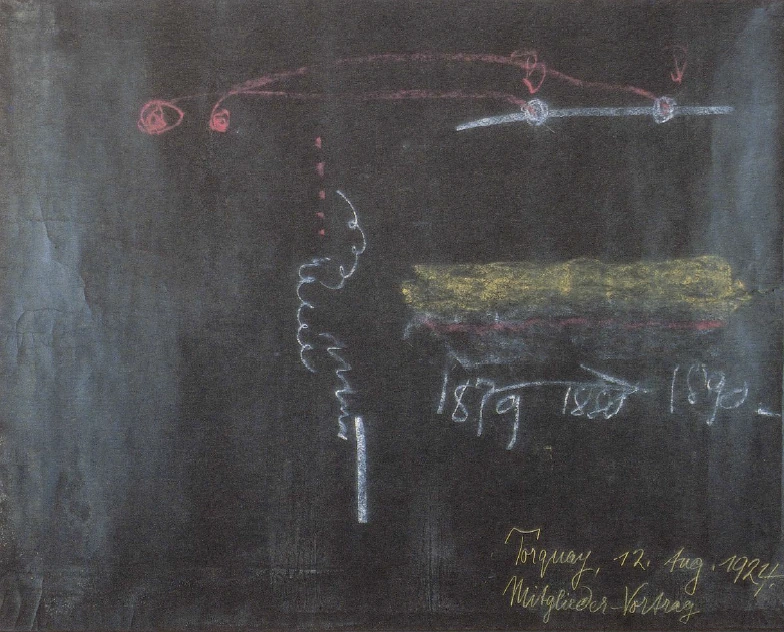
[ 44 ] You see, in the 1880s and 1890s, many things that people admired—things they were raised on, things they used to educate themselves—came to an end. Well, this era is being described in all sorts of high-flown language, especially by the newer writers. Take everything that magazines published, everything that art produced, everything that emerged in the 1880s and 1890s of the previous century—it all flows by like this: 1879, 1880, 1890, and so on. But it was precisely during these years that something else was taking place. There was a thin veil, and behind this thin veil lay a world closely adjacent to our physical world. That was the distinctive feature of the late 19th century. That was the distinctive feature of the time before the end of the Kali Yuga—the Kali Yuga, after all, came to an end with the 19th century—as if through a gossamer-thin veil that ordinary consciousness alone cannot penetrate, there was a world right next to ours: that is where what must increasingly emerge into the physical world—and what must manifest its effects in the physical world—was taking place.
[ 45 ] There was indeed something mysterious about this era at the end of the 19th century. Behind a veil, powerful phenomena were unfolding, all centered around the spiritual being we call Michael. There were powerful followers of Michael—human souls who were not in physical bodies at that time but were standing between death and a new birth—but there were also powerful demonic forces that, under Ahrimanic influences, rebelled against what was to come into the world through Michael.
[ 46 ] You see, if I may make a personal remark here, it is this: I myself grew up in such a way that I actually never had any difficulty in comprehending the spiritual world. Whatever the spiritual world offered me entered my soul, developed into ideas, and took shape in my thoughts. What came so easily to other people was difficult for me. I could grasp scientific concepts quickly, but individual facts would not stick in my memory; they simply wouldn’t sink in. I could grasp the theory of undulations and the views of mathematicians, physicists, and chemists with ease; but with a mineral, I did not need to see it once or twice—as some do—to recognize it when it appeared before me again; rather, I had to see it thirty or forty times. The facts of the external physical world presented me with resistance in terms of retaining and comprehending them. I could not easily step out into this physical, sensory world.
[ 47 ] As a result, I had to stand within this world behind the veil, with my entire intellectual and emotional soul, in this region of Michael; I had to endure whatever was taking place there. That was precisely when the great demands arose to finally take spiritual life seriously, to raise questions of such magnitude. Outer life offered no occasion for this. Outer life continued to write the old philistine biography of Darwin and Bacon. But there, behind the scenes, behind this thin veil, in the region of Michael, the great questions of life were raised. And there, above all else, one came to realize one thing: what a great difference it makes to raise this question in one’s heart—and to speak about it in words.
[ 48 ] People today believe that whatever one knows can be expressed in words. Indeed, everything that people today experience is translated into words and spoken as quickly as possible. The questions that were at the forefront in Michael’s region, particularly in the 1980s and 1990s—these questions continued to have an effect as they settled within a person; they continued to have an effect well into the 20th century. And every time—even after living under the influence of these questions for decades—when one wanted to speak about these things, it was as if Michael’s enemies were always coming to hold one’s tongue, for certain things were not to be spoken of.
[ 49 ] And, you see, even within the bosom of the anthroposophical movement, much had to be kept hidden—things that, in a sense, remained part of the Mystery of Michael. These included, above all, those truths that related to such historical contexts. For some time now, it has been possible to speak openly about these matters. For months now, opportunities have existed—and it has become possible for me in particular—to speak openly about these matters. Therefore, it is happening, has happened, and will also happen here that the connections in the Earth lives can now be discussed openly. For this is connected with the revelation of the Michael mysteries, which unfolded in the manner I have described to you.
[ 50 ] This is one of the concrete things I spoke about in abstract terms earlier. In the first part, I mentioned a possibility: that the spiritual world might have failed to manifest itself. It did not fail to manifest itself. In fact, through everything that has become possible, particularly since the Christmas Conference of the Anthroposophical Society, and through the way in which I have been permitted to engage in occult work myself since that time—these are not new things, for in the occult one cannot immediately share today things that were discovered yesterday; these are old things, things that have been experienced in the way I have described to you—but what has been added is that the demons who previously prevented these things from being spoken must now remain silent.
[ 51 ] This points to such a shift, and I am telling you this so that you will take it with the necessary seriousness when, in the future, there is talk of specific, repeated earthly lives involving both significant and insignificant individuals. One must not take these things lightly; one can only accept them by treating them with the necessary respect.
[ 52 ] Well, I wanted to make these points; they will be expanded upon in the course of the subsequent lectures, and more will come out of them. But before I speak about earlier incarnations of Darwin and others, I wanted first to draw attention to the spiritual atmosphere—the spiritual light—in which one must view such things. We will then continue to discuss these matters the next time we gather here at the general meeting.2This was followed by the English translation and a Q&A session regarding the sections.
[ 53 ] I would also like to add that we have now incorporated into the anthroposophical movement an esoteric movement in the narrower sense, which is organized into various sections. First and foremost, there is the General Section, which will encompass the esoteric for all human souls. Then we have the Pedagogical Section—details will become known in due course—and we have the Medical Section. We have two artistic sections: one for the visual arts, the other for the musical and spoken arts. We have a section for the natural sciences. We have a section for astronomy and mathematics. I will, of course, have more to say about these matters when the appropriate opportunity arises.
[ 54 ] The General Section is now represented to the world, for the time being, by its first class, and class sessions have indeed been held in Dornach for quite some time; I have also held them in various other places, for example in Prague, Breslau, and Paris. Now these class sessions are to be incorporated into the topics we discuss here among ourselves, and a class session is indeed planned for next Tuesday here. For this to happen, it is necessary that those friends who are in a position to become members of this class—and indeed of the esoteric movement as a whole—be admitted.
[ 55 ] I will have to discuss the strict requirements during the first class session. For now, however, the rule is that only those friends who have been members of the anthroposophical movement for at least two years should apply for admission to the First Class. Exceptions can be made only in rare cases. Furthermore, the administration of the School at the Goetheanum reserves the right to grant or deny membership.
[ 56 ] And it must be said from the outset that, in the future, anyone who has an interest in and a longing for the spiritual worlds will be able to join the Anthroposophical Society. One will be obligated, so to speak, to nothing more than what every decent, thinking person is actually obligated to do.
[ 57 ] In contrast, the School—which is meant to open the way into the spiritual world itself—must set very high standards. Anyone who wishes to be a member of the School must also be a true representative of the anthroposophical cause in the world.
[ 58 ] Don’t call that a restriction on human freedom! Freedom must, after all, be mutual. Anyone who becomes a member of the school is, first and foremost, a free person, but the school’s leadership must also be free. It must be free to decide to whom it wishes to impart the school’s spiritual treasures. It is, so to speak, a spiritual contract concluded between the school’s leadership and its individual members. Therefore, the school must also reserve the right—should it turn out that anyone who has become a member of the school is not acting in harmony with the school’s guiding principles, or is not conducting their life in a way that represents the school—to decide that this person can no longer be a member of the school, or may be suspended from membership for a certain period.
[ 59 ] That these matters are taken seriously may be evident to you from the fact that, even before it became possible to hold a class session here among you—which is scheduled to take place for the first time next Tuesday and will continue thereafter—it had already become necessary, in the course of the school’s work, to expel sixteen or seventeen members from the school. Matters relating to the occult life must simply be taken in all their reality.
[ 60 ] So if anyone believes they are truly qualified to seek admission to the School as a representative of the anthroposophical cause before the world, they are invited to apply. The primary requirement is that one has been a member for at least two years. Friends who have been members for longer than two years may apply, provided they have not yet received their blue certificate. In the future, one will hold the red certificate as a member of the Anthroposophical Society, and the blue certificate as a member of the School.
[ 61 ] So, those friends who wish to become members of the school—who, as I already mentioned, have not yet received a certificate, even though they have already written in and their application has not yet been processed, that is, if they have not yet received the blue certificate by mail—I ask that they report to Dr. Wachsmuth here tonight or at least within the next few days, preferably as soon as possible. This will allow us to compile a list of those who still register, and then those who can be admitted to the school will receive their blue certificate at the first class session, which, as I said, is scheduled for next Tuesday.