Esoteric Considerations of Karmic Connections
Volume VI
GA 240
14 August 1924, Torquay
Translated by Steiner Online Library
The Deepening of Christianity Through the Solar Powers of Michael II
[ 1 ] I have raised the following question: How can we explain, for certain historical and even non-historical figures—who nevertheless capture our interest through their influence—that their later earthly lives are the result of their earlier earthly lives? And now, in order to lay the groundwork for further considerations, I would like to begin today by pointing out certain connections that existed in the successive earthly lives of various personalities. Today I will first present to you the results of certain spiritual research, and then, based precisely on what is presented here today in narrative form, build a kind of understanding of how one can come to grasp the successive earthly lives of individuals.
[ 2 ] Let us take, for example, such distinctive figures as those whose names I mentioned last time. Such figures first and foremost draw our attention to how various spiritual impulses permeate our present-day civilization. For nearly two millennia—as I already noted in my previous reflection—Christianity spread throughout the West and a large part of its colonial territories; a Christianity that, more than one might think, has permeated all civilizations. And it is indeed the case that much of what does not immediately appear to be imbued with Christian impulses is, upon closer study, found to be thoroughly permeated by distinctly Christian impulses. But it simply cannot be denied—as I have already hinted—that there is something in our civilization that does not reveal a direct connection to Christianity.
[ 3 ] Certain views, and even certain ways of life, have found their way into our civilization that do not reveal a direct connection to Christianity. And so, anyone who, for deeper inner reasons, wishes to understand the course of the historical development of our spiritual life and seeks to use spiritual research to aid in this understanding finds himself compelled to turn his attention to a phenomenon that is given far too little consideration when discussing the development of Western civilization. They find themselves compelled to look toward that historical phenomenon that ran parallel to the emergence and influence of Charlemagne in the West. They find themselves compelled to look toward that court in the East, presided over with—one might well say—truly Eastern splendor by Harun al-Rashid, the contemporary of Charlemagne. Everything Charlemagne accomplished in the West pales in comparison to the immense splendor and majesty that emanated from the court of Harun al-Rashid at the same time.
[ 4 ] One need only consider the wealth of intellectual life that converged at this Near Eastern court. We must remember how, in ancient times, Greek culture was brought to Asia through Alexander’s campaigns in a form of which we have only a faint inkling today. Everything that was rooted in Greek culture was brilliantly transmitted to Asia by Alexander the Great. And in many centers of learning in the East, thanks to the institutions brought to Asia by Alexander the Great, a way of life and worldview prevailed that faithfully preserved much of the ancient tradition while rejecting much of what later flooded into the West from the ancient world.
[ 5 ] Above all, a rational, sound, scientific mysticism had been brought to Asia by Alexander the Great, so that those who adhered more closely to the philosophical view that had thus reached Asia saw cosmic intelligence spreading throughout the world. Everything in the world is permeated by cosmic intelligence. Over in Asia, people did not say as human beings, “I think something up; I am an intelligent being”—but rather they said to themselves: Everything that is thought is thought by the gods, and above all by the one God, who already played a role in Aristotelianism. What constitutes individual human intelligence is a drop from universal intelligence, revealing itself within the being of the individual, so that the individual felt—I might say—as if his head and heart were immersed within universal intelligence. That was the prevailing mood.
[ 6 ] This atmosphere also prevailed at the court of Harun al-Rashid. It still prevailed in the 8th and 9th centuries A.D. And then those Greek scholars had come over, forced to flee because Greek philosophy was being eradicated in Europe. Much of Eastern wisdom had been preserved. Everything that was possible at that time—in the realm of mystically powerful astronomy, of magnificent architecture imbued with inner plasticity, and other arts, including poetry; everything that was possible in other sciences and in the practical expressions of life—all of this converged at the court of Harun al-Rashid, because this man, who loved splendor, yet in a certain sense also extraordinarily gifted in all matters of organization, gathered at his court those people who knew the most at that time, who still preserved much of the ancient wisdom of the mysteries—people who were no longer directly initiated but who preserved much of that ancient wisdom and still lived vividly within it.
[ 7 ] In particular, there was one figure—a very wise advisor to Harun al-Rashid—whom we would like to examine a little more closely. His name is irrelevant; it has not been particularly well-known to posterity. Yet he was a very wise figure. To understand him, one must look at something that those familiar with spiritual science in particular might admire.
[ 8 ] You see, my dear friends, you can all raise a certain question. You might say: Spiritual science, anthroposophy, tells us that there were once initiates. Here and there were initiates. These initiates possessed vast knowledge and immense wisdom. But since human beings return in repeated earthly lives, how is it, for example, that we do not notice today that old initiates have returned? — It is a legitimate question that you may raise.
[ 9 ] But anyone who understands the conditions of earthly life also knows that a human individuality—which, according to its karma, must be born from a pre-earthly existence into a specific age—must take upon itself the inherited qualities that are possible in that age, and must take upon itself everything that lies within the existing educational possibilities. And so it may well be the case for an individual that they were an initiate in ancient times, but that what they knew as an initiate remains buried in the subconscious for a particular age, and while the conscious mind—the everyday consciousness—does indeed reveal something significant in their life, it is not an immediate revelation of what this personality possessed in their soul as an initiate in a previous earthly life.
[ 10 ] It was such a figure that I mean when I speak of Harun al-Rashid’s wise advisor. He was an initiate into the ancient mysteries—the very ancient mysteries. He had been reborn and, as a reborn initiate at the court of Harun al-Rashid, lived once more as an initiate whose prior initiatory knowledge manifested itself as a brilliant gift for organization and a magnificent gift for administration for the other scholars living at the court of Harun al-Rashid; yet he did not give the immediate impression of being an initiate. Through his own nature—not merely through initiation—he preserved the ancient science of the initiates, but he himself did not give the impression of being an initiate.
[ 11 ] But Harun al-Rashid held this wise man in very high regard. He entrusted him with organizing everything that shone as science and the arts at Harun al-Rashid’s court. He was glad to have this man and felt, so to speak, an immediate friendship toward him.
[ 12 ] Let us now consider these two figures, Harun al-Rashid and his wise advisor, and bear in mind that in the 8th and 9th centuries of the Christian era in Europe, within Christian culture at the court of Charlemagne, the process had just begun, I would say that the most socially prominent people were just making their first attempts at writing—indeed, that Charlemagne himself was making his first attempts at writing, and that Einhard, at Charlemagne’s court, was making his first attempts to systematize the language into grammar. At a time when everything in Europe was still primitive, over in Asia, in the ruler whom Charlemagne revered immensely—Harun al-Rashid—a powerful, dazzling intellectual culture was embodied, but an intellectual culture that knew nothing of Christ, that also wanted nothing to do with Christianity, in which the finest elements of Islam and the finest elements of Arab culture thrived, and in which ancient forms of Aristotelianism also flourished—those forms that had not at all spread throughout Europe, for in Europe it was logic, the dialectic of Aristotelianism, that had prevailed. It was developed by the Christian Church Fathers and later by the Scholastics.
[ 13 ] Over in Asia, the inner mystical and scientific insights of Aristotle had been further advanced by all that Alexander the Great had accomplished. And all of this had been developed under the influence of the immensely powerful intelligence of Arabism, which was regarded as revealed and inspired. At the court of Harun al-Rashid, people were aware of Christianity, but they regarded it—as it existed at that time—as primitive compared to the immense spiritual splendor they themselves were able to cultivate.
[ 14 ] Let us now take these two figures—Harun al-Rashid and his wise advisor—as our starting point and continue our exploration of history.
[ 15 ] These two individuals, Harun al-Rashid and his wise advisor, having acted in the manner I have described, passed through the gate of death, carrying with them the strong impulse to ensure that the sensibility, worldview, and spirit that had been cultivated at this court would continue to spread throughout the world.
[ 16 ] Let us now reflect on what happened there with the greatest possible calm and the greatest possible seriousness. So, starting from Asia, we see two individuals: the wise counselor and Harun al-Rashid, his ruler. They journey together for a while. They owe what they have absorbed into their souls to Alexandrianism and Aristotelianism. But they have also absorbed everything that took place in later times in the transformation of Aristotelianism and Alexandrianism. One truly understands only the smallest part of the world if one cannot take into account what is happening in the spiritual world while, down here in earthly life, the ordinary events of the physical world are unfolding.
[ 17 ] The era of Charlemagne and Harun al-Rashid was followed by others, as you know from history. But while all that history recounts—about Asia, about Europe, during the 9th and 10th centuries and further into the Middle Ages—was unfolding, a powerful different event was taking place in the spiritual world above this physical life. And we must not forget that as physical life flows on down here (it is recorded) and spiritual life flows on up here, the souls who do not live on Earth—but who are in the life between death and a new birth—are constantly exerting influences on earthly life. So we can say: What is also important is what the souls—who, in such an age, do not live on Earth but are up there in the spiritual world, between death and a new birth—experience and accomplish. Human life can only become truly clear and luminous—especially in its historical course—when one looks at what is taking place in the spiritual world, so to speak, behind the scenes of external world history.
[ 18 ] Yes, the impressions that souls carry through the gate of death often differ extraordinarily from the impressions those souls had here in earthly life. And for those who lack objectivity in their view of spiritual life, an earthly human being who has passed through the gate of death and then reveals themselves to the spiritually observing gaze is sometimes not easily recognizable. But there are indeed spiritual means through which one can trace not only that spiritual life that immediately follows earthly life. I have already spoken about this in the other lectures held this morning. I will then continue in these lectures to speak about the further course of life between death and a new birth; there one will see what means are available to continue following the so-called dead.
[ 19 ] And it is precisely through these sources that one can then trace the lives of figures such as Harun al-Rashid and his wise advisor. Especially with regard to these two figures, in order to gain an understanding of later events in European civilization, it is extraordinarily important to pay particular attention to the deep connection in their ways of thinking and acting that Harun al-Rashid and his wise advisor shared. Harun al-Rashid and his wise counselor shared an extraordinarily strong affinity with Alexander and Aristotle—individuals who had preceded them by centuries in earthly life—and an extraordinarily strong longing to meet them again, to have a genuine encounter with Alexander and Aristotle. And this reunion took place, and it is indeed of immense significance that it did so.
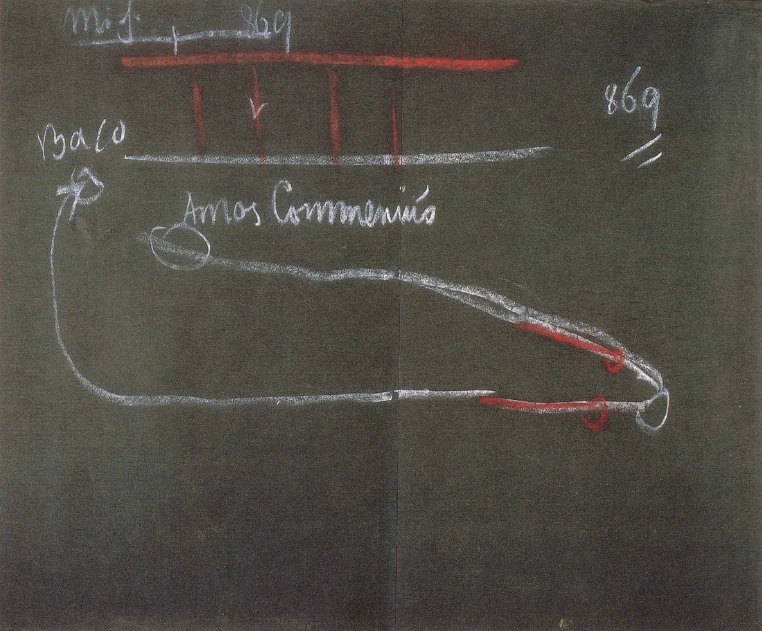
[ 20 ] So Harun al-Rashid and his wise counselor wandered for a while in the supersensible world, looking down from the supersensible realm primarily at what was taking place in the civilization lying further to the west—at what was happening in Greece and in certain regions north of what is now the Black Sea. I would like to say that they looked down upon this civilization, and among the events upon which their gaze fell was the one I have spoken of many times in other contexts in anthroposophical lectures: that event which took place in the year 869 as the Eighth Ecumenical Council in Constantinople.
[ 21 ] This Eighth Ecumenical Council in Constantinople is, after all, of great significance for Western civilization, for it was decided there that the trichotomy—the view that human beings consist of body, soul, and spirit—was heretical, and that one might speak only—if one were a true Christian—of human beings consisting of two entities, body and soul, and that the soul possessed certain spiritual qualities. That is why there was so little evidence of a tendency toward spirituality in Western Christian civilization, because the recognition of the spirit had been declared heretical at the Eighth Ecumenical Council in 869.
[ 22 ] It was a significant, a watershed event. One could say: At that time, the spirit was abolished, and human beings were to consist only of body and soul. People do not pay close enough attention to such a watershed, significant event. But what is truly shocking for the observer of spiritual life—and especially for those who experience spiritual life—is that, just as this abolition of the spirit was taking place here on earth in 869, up in the spiritual world the encounter between Harun al-Rashid and his advisor with Alexander the Great and Aristotle took place—that is, with their souls in the spiritual world.
[ 23 ] Now you must bear the following in mind, and you must get used to the fact that, from now on, in the field of anthroposophy, supersensible events will be discussed with the same matter-of-factness as events in the physical world. You must bear in mind: The life of Alexander the Great, the life of Aristotle in those incarnations of Alexander and Aristotle was such that it marked a certain conclusion—that, so to speak, the impulse that had been given with the ancient cultures, which then found its full expression in Greece, was formulated by Aristotle into concepts that, for a long time, dominated the Western world and human civilization as a whole as ideas.
[ 24 ] You must bear in mind that Alexander the Great, a contemporary, student, and friend of Aristotle, spread with tremendous force the impulse that Aristotle had provided, across a large part of the world known at the time of Alexander, an influence that continued to have an impact well into the era of Harun al-Rashid in Asia—an influence that for a long time had a brilliant center in Alexandria, but which at the same time exerted a decisive influence on the entire Eastern culture through numerous hidden channels.
[ 25 ] This, however, marked a kind of conclusion. The most diverse impulses of ancient spirituality had converged in Alexandrianism and Aristotelianism. Christianity dawned. The Mystery of Golgotha took place. It took place at a time when the individualities—the souls of Alexander and Aristotle—were not on Earth, but in the spiritual world, where they were in intimate union with what is called the reign of Michael, whose reign on Earth had also come to an end by then, for the ruling spirit of the age at that time was Oriphiel. And further centuries had passed since the Mystery of Golgotha. That which Alexander and Aristotle had established on Earth—for which they had dedicated their entire beings, one through thought, the other through comprehensive and intense powers of rulership—all of this had taken effect down on Earth. The two of them witnessed all of this in the spiritual world throughout the centuries that followed—the very centuries in which the Mystery of Golgotha took place—and they observed everything that subsequently occurred in the spread of the teaching of the Mystery of Golgotha. Throughout all those centuries, they watched their work spread below, spreading also through such geniuses as Harun al-Rashid and his wise advisor.
[ 26 ] But as for what these two individuals—Alexander and Aristotle—themselves were, there was certainly a call for something new, a call to begin in an entirely new way—not to continue what already existed on Earth, but to start anew. This, of course, also results in a kind of continuation. The old is not swept away, but a powerful new impulse—to introduce Christianity into earthly civilization in a special way—was what Alexander and Aristotle had brought to fruition.
[ 27 ] Since they had already carried their karma into their earthly lives even before this encounter with Harun al-Rashid took place, they actually lived as unnoticed, unknown individuals who died young in a corner of Europe that is, admittedly, important for anthroposophy—but, I would say, only briefly peering through a window into Western civilization, taking in impressions and impulses, but not imparting any significant impulses of their own. They had to save that for later.
[ 28 ] They had then returned once more. But they were in the spiritual world when, in 869, this event—the Eighth Ecumenical Council—took place on Earth. It was precisely at this moment that the encounter took place between Aristotle and Alexander on the one hand, and Harun al-Rashid and his wise advisor on the other. It was a confrontation of immense, transcendent significance in the supersensible worlds, for one must realize that confrontations in the supersensible world are not merely verbal discussions. When one sees people on Earth sitting together and discussing, with words flying back and forth without causing each other much harm, this is not even a faint reflection of what happens when major decisions—including those concerning spiritual life—are made in the supersensible worlds.
[ 29 ] And so it was back then that Aristotle and Alexander, on the one hand, asserted that what had been established earlier must be incorporated—in the strictest sense of the word—into the Michaelic Kingdom. — For it was well known that the Michaelic reign of the world would begin again in the 19th century.
[ 30 ] Let us be clear on this point, my dear friends! The development of humanity proceeds in such a way that, for three to three and a half centuries at a time, one of the archangels is the principal ruler of earthly civilization. At the time when Alexander the Great had transplanted Aristotelian culture to Asia and Africa—at that time, when this spread of culture took place with a strong sense of internationalism—there was a Michael reign; that is to say, spiritual life was governed by the power of Michael. During the time of Alexander, the Michael reign was on Earth. Then the Michael reign is succeeded by the Oriphiel reign. Next comes the Anael reign, the Zachariel reign—each lasting three to four centuries—followed by the Raphael reign, then Samael, leading up to the era of the 14th century. From the 15th to the 18th centuries A.D., the reign of Gabriel began, and in the 19th century, during its final third, the reign of Michael returned. Seven of the archangels take turns. After the Michael reign was followed by six other archangels during the time of Alexander, the Michael reign returned at the end of the 19th century. It is the ruling reign in our time. If we understand spiritual life correctly, we are directly under the impulse of the Michael reign.
[ 31 ] Thus, in this century, during which the encounter with Harun al-Rashid took place, Alexander and Aristotle looked back upon the ancient Michael reign under which they had worked; they looked back upon the Mystery of Golgotha, which they had experienced in union with the Michael community—not from the earth, but from the solar sphere—for that was where the Michael reign had come to an end. Michael and his followers—among whom Alexander and Aristotle were included—did not, after all, experience the Mystery of Golgotha from an earthly perspective. They did not see Christ arrive on Earth; they saw him take his leave of the Sun. But everything they experienced crystallized within them into this impulse: Under all circumstances, efforts must be made to ensure that the new Michael reign—to which Alexander and Aristotle had resolved to remain faithful with every fiber of their being—would bring about a Christianity that was not only deeply grounded but also intensely lived. It was to begin in 1879 and last for three to four centuries. We now live in the age of this Michaelic era, and anthroposophists should, above all, understand what it means to live in the age of this Michaelic era.
[ 32 ] Neither Harun al-Rashid—nor, even less so, his wise advisor, though in truth not even he—wanted to hear anything about this. Above all, they wanted the ideas that had taken deep root in Islam to come to dominate the world. Among others who took part in this intellectual struggle in the 9th century CE, there was an intense confrontation: on one side stood Harun al-Rashid and his advisor, and on the other, Aristotle and Alexander—that is, the individualities that lived within both of them.
[ 33 ] What unfolded there as a spiritual struggle had a lasting impact on European civilization, an impact that continues to this day. For what happens up there affects the earthly realm. And it was precisely from that resistance which Harun al-Rashid and his wise advisor offered at that time against Aristotle and Alexander that the impulse was strengthened in a certain way, so that from that very encounter emerged the influence of two currents: one that flows into Arabism, and one that carries Aristotelianism and Alexandrianism into Christianity through the impulses of the Michaelic reign.
[ 34 ] Both Harun al-Rashid and his wise advisor continued their journey westward after this encounter, constantly observing what was happening in earthly life. One of them, from the realm of the supersensible, took an active part in everything that was unfolding in North Africa, Southern Europe, Spain, and France. At roughly the same time, the other had passed through everything that was unfolding in the spiritual life of the East—from the Black Sea, across the regions of Europe as far as Holland, and even over to England. And at the same time, these two then arrived in European culture and were reborn.
[ 35 ] Such rebirth does not necessarily involve an outward resemblance. It is generally a mistake to believe that a person who possesses a certain spiritual quality will be reborn with that same spiritual quality. One must go deeper, look more deeply into the fundamental impulses of the human soul, if one wishes to speak correctly about rebirths and repeated earthly lives. Take, for example, the famous Pope Gregory VII, who emerged from the Central European monk Hildebrand—this powerful pope, active within the most intense form of Catholicism, who made the papacy particularly great in the Middle Ages. He reappeared in the 19th century as Ernst Haeckel, the champion against the papacy. Haeckel is the reincarnated Abbot Hildebrand, Gregory VII. I wish only to demonstrate that it is not the outward similarity of one’s state of mind, but rather the inner spiritual impulses that a person carries over from one earthly life to the next.
[ 36 ] Thus, the two of them—Harun al-Rashid and his wise advisor—were also led, at first, while the Arab campaigns were still spreading across Africa into Spain, to participate in these Arab expeditions in a protective and supportive capacity. Islam, as an outward manifestation, did indeed perish, but its inner spiritual essence was carried by these two spirits through their spiritual journey as they passed between death and a new birth, from the past into the future.
[ 37 ] Harun al-Rashid was reborn, and in his reborn life he became Baco of Verulam. He appears as Baco of Verulam. His wise advisor is also reborn; he appears almost simultaneously as Amos Comenius, the educator.
[ 38 ] Consider, on the one hand, the contributions of Bacon of Verulam—who was, after all, only outwardly a Christian—and who introduced the abstract elements of Arab thought into European science; and consider, on the other hand, what Amos Comenius brought to pedagogy in terms of the outward, material clarity of instruction and the overall approach to teaching the curriculum. It is an element that has nothing to do with Christianity per se. Even though Amos Comenius was active among the Moravian Brethren and so on, what he directly brought about is illuminated, on the one hand, by the fact that in a previous life he stood in relation to the entire development of humanity in the same way as the intellectual culture that flourished at the court of Harun al-Rashid.
[ 39 ] And on the other hand, take every line by Bacon—Lord Bacon—take everything that comes across as so-called “vividness” in Amos Comenius: you’ll find a mystery there; you won’t be able to make sense of it. Take Lord Bacon, for example. He is driven by a true fervor in his fight against Aristotelianism. In everything there is a true fervor that one can see reaches deep into the soul. The spiritual researcher, who spiritually penetrates and illuminates things, looks at Bacon of Verulam, at Amos Comenius, and traces their lives back into the supersensible world, where the human being lives between death and a new birth. One has the writings of Bacon of Verulam before one, one has the writings of Amos Comenius before one; in their tone, in everything, one finds a rebellion against Aristotelianism. How can this be explained?
[ 40 ] One must now consider: When Bacon descended into his earthly life, when Amos Comenius descended into his earthly life, that time had already passed again—the time when Alexander and Aristotle had also been reincarnated into medieval civilization, where they, for their part, had already accomplished what needed to be done for Aristotelianism, and where a form of Aristotelianism already existed that was different from the one cultivated by Bacon and Harun al-Rashid, respectively—for these are the same figures.
[ 41 ] And now imagine the whole situation. Take that interview—if I may put it that way—that took place in 869; consider how, under this influence, soul impulses developed within Harun al-Rashid that now encounter what has already been partially realized on Earth, because Alexander and Aristotle had already been there again, and because what they sought to realize was not realized in continuation of what they had been as earthly human beings in pre-Christian times. If you consider this, then you will fully understand those soul impulses that arose during that encounter. And from the fact that Bacon and Amos Comenius were now able to see what had become of Aristotelianism and Alexandrianism, you can understand why that particular tone prevails in their writings—especially in Bacon’s, but also in Amos Comenius’s.
[ 42 ] You see, my dear friends, a true contemplation of history leads from earth up to heaven. One must take into account the events that can only be revealed in the supersensible realm. If you wish to understand Bacon of Verulam, if you wish to understand Amos Comenius, you must trace them back first to what they once were on earth; you must therefore trace Aristotelianism, as propagated by Scholasticism, back to that meeting that took place around the year 869, at the time of the Ecumenical Council, and back to the time when Harun al-Rashid and his wise advisor cultivated Aristotelianism and Alexandrianism, which could indeed be cultivated at that time. It is only through this interplay of the supersensible world with the sensory-physical world that what takes place in earthly life becomes comprehensible. This is what I would like to point out to you, to show how, in fact, only by tracing back through repeated earthly lives can we understand what unfolds in such personalities on Earth.
[ 43 ] It is too late in the day to go into further detail on this subject today, so I will merely touch briefly on what is intended to round out and conclude these remarks.
[ 44 ] When we consider the progress of human civilization in the way we have just done, we find that something has crept into Christian development—precisely through such individuals as Harun al-Rashid and the man who later became Amos Comenius—that does not fit into Christianity and that leans strongly toward Arabism. Thus, in our present time, we have, on the one hand—I would say—the straightforward progression of Christianity, and on the other hand, particularly in abstract science, the influence of Arabism.
[ 45 ] What I would particularly like to urge you to consider is this: If we follow these two currents, we find ourselves compelled, when engaging in spiritual contemplation, to turn our gaze upward to all manner of events that have also taken place in the supersensible realm—such as the encounter between Aristotle and Alexander, or that between Harun al-Rashid and his wise advisor. In this way, many events have taken place that have subsequently served as impulses—on the one hand, for the spread of true Christianity, and on the other hand, for the formation of obstacles and resistance to this true Christianity. But because the Michael development in the spiritual world has taken the course I have indicated to you, a strong prospect and perspective for the future emerges: that it is precisely under the sign of the Michael impulses that Christianity will take on its true form. For under the sign of the Michael impulses, confrontations with other currents have also been waged in the supersensible realm.
[ 46 ] Now I would just like to say this: The Anthroposophical Society brings together all kinds of personalities. These individuals, too, have their own karma, which traces back to earlier times and manifests itself in the most diverse ways—if we first go back to the life that was lived in the pre-earthly realm, and then go back to earlier earthly lives. There are very few among those who approach the anthroposophical movement in good faith who are not, in their karma, involved in events such as those I have just described to you. In one way or another, those who sincerely feel the urge to join the Anthroposophical Society are connected to events such as the encounters between Alexander and Aristotle with Harun al-Rashid and his wise advisor, or similar occurrences. Karma has determined something like this, which then manifests in the present earthly life in such a way that the urge arises to receive the spiritual in the manner in which it is currently cultivated within the anthroposophical movement.
[ 47 ] However, this is linked to something else. Linked to this is the fact that, due to the particular form that the Michael Kingdom is taking, those individuals who are now entering the anthroposophical movement through their karma and their connection to the Michael Kingdom will reappear—in defiance of various laws of reincarnation—at the turn of the 20th, 21st centuries—that is, in fewer years than a century—in order to bring to culmination and full expression what they can now accomplish in the anthroposophical service of the Michael Kingdom. The interest one may have in such matters as have been presented today, if this interest is intense enough, expresses the inner urge to truly be an anthroposophist. But it is precisely by understanding these things that one also takes within oneself the impulse to reappear on Earth in less than a century in order to bring to fulfillment what anthroposophy aims for.
[ 48 ] Reflect, my dear friends, and take to heart the few guiding words I have appended here to today’s meditation. You may well find in these few words much of what can properly ground you within the anthroposophical movement, what can provide you with the right kind of guidance, so that you can feel your affiliation with this movement deeply connected to your karma.