

Esoteric Considerations of Karmic Connections
Volume VI
GA 240
21 August 1924, Torquay
Translated by Steiner Online Library
The Deepening of Christianity Through the Solar Powers of Michael III
[ 1 ] Since we have been granted this hour today, I would like to add a few points to what has already been said here and discuss certain matters that will be easier to understand today precisely because the preparatory groundwork for them has already been laid—partly during the morning sessions and partly at the most recent general meetings. The focus this evening will be on discussing matters related to the karma of the Anthroposophical Society. I will, of course, elaborate further on these topics in the coming days in London.
[ 2 ] It is clear from the lectures I have given here that, in our time, we must hold the view that the spiritual guidance of humanity—of civilized humanity—is driven by the being we refer to by the Christian name Michael. This particular—if we may call it that—era of spiritual life began in the 1870s. As I have already mentioned, it was preceded by the era of Gabriel. Now I would like to make a few remarks about matters related to this era of Michael, as it is today.
[ 3 ] Whenever Michael channels his impulses through the evolution of humanity during earthly life, he is the spirit who channels the solar forces—the spiritual solar forces—into human evolution. This is connected to the fact that, as you heard this morning in the general lectures, during the waking hours of the day, human beings receive these solar forces into their physical and etheric bodies.
[ 4 ] Now, Michael’s reign this time—which has just begun and will last three to four centuries—means that the cosmic solar forces will finally pass into the physical and etheric bodies of human beings. Above all, we must ask ourselves: What kinds of forces, what kinds of impulses do these cosmic solar forces represent? Michael is, above all, a solar spirit. That is why he is also the spirit who, in our epoch, has the specific task of profoundly deepening Christianity in accordance with its truth. One might even say that Christ originates from the sun. The solar being of Christ—as I have often explained—lived on Earth through the body of Jesus and has since lived together with the human world in a supersensible way. Humanity, however, must first gradually mature to be able to take the entire mystery connected with Christ into its soul. An essential part of this deepening will have to take place in our Michael Age.
[ 5 ] Now, when the forces of the Sun act upon the Earth, they always consist in being connected to a wave of impulse that flows into Earth’s civilization, a wave we can characterize as an intellectual wave. For all the intellect that humanity possesses, indeed all the intellect that exists in the world—as far as our world is concerned—originates from the Sun. The Sun is the source of all that is intellectual.
[ 6 ] When this truth is spoken, one may even perceive some emotional resistance among people today, for it is quite right not to think too highly of the current form of the intellect. And it is precisely those who become acquainted with the spiritual life who, in fact, cannot think much of today’s intellectualism. It is an abstract, logical kind of intellect; it is something that fills people with shadowy concepts and ideas that are far, far removed from vibrant reality—ideas that are cold, dry, and sober in comparison to what pulsates through the world and through human beings as warm, radiant life.
[ 7 ] But this is only the case with intelligence today because what we consider intelligence today is still in its infancy in the general consciousness of humanity—just as we, too, are still at the beginning of the Michael Age. This intelligence will one day become something completely, completely different. And if one wants to form an idea of what else this intelligence might become in the course of human development, then one must recall how Thomas Aquinas, in medieval Christian philosophy, referred to the beings that inhabit the stars as “intelligences.” Isn’t it true that we, too, had to counter today’s materialistic view by saying that the stars are colonies of spiritual beings? This strikes modern people as strange, because they do not even consider that when they look up at the stars, they are looking up at beings who have something to do with their own lives and who simply inhabit the stars, just as we humans inhabit the Earth.
[ 8 ] In the 13th century, Thomas Aquinas referred to the beings that inhabit the stars, although when speaking of a star, he still spoke more of it as a unified entity—just as one would speak of humanity on Earth as a unified entity if viewed from an alien star. So although he does not always state that individual beings or many beings—as we know—inhabit the stars, such that we must regard the stars as colonies in the cosmos, and although he speaks of a unified stellar being, he nevertheless speaks of the intelligences of the stars. And in this, this Christian Church Father of the Middle Ages—of the 13th century—still stands within that tradition which was already fading, waning, and in decline at that time, but which clearly still points to the fact that everything we summarize under the name “intelligence” was once something different from what it is today.
[ 9 ] If we go back to the very earliest times of human development—as I have already pointed out here in these lectures—it is not the case that human beings generate thoughts from within themselves, that they think about things through their own power. For this inner soul capacity for thinking, this inner activity of forming thoughts, has in fact only been fully developed since the 15th century, since the entry of the consciousness soul into human development. And when we go back to pre-Christian times, to ancient times, we find everywhere that people did not yet have the awareness that they were thinking at all; they do not feel at all that they have thoughts, but rather they sense that thoughts are revealed to them through things. Intelligence is spread throughout the cosmos. Intelligence is present in things. And just as one perceives colors, so too does one perceive the intelligent content, the thought content, of things. The world is full of intelligence. Intelligent beings are everywhere. Human beings have, so to speak, appropriated this intelligence in the course of recent times. One might say: Intelligence is something that is spread throughout the vast universe, of which human beings have received a drop here and there in recent times. That, then, is the human being.
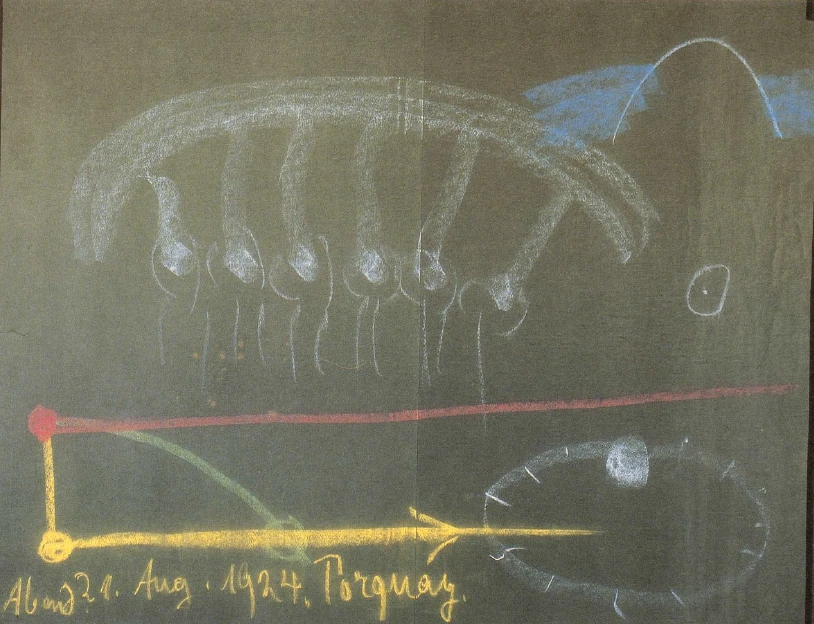
[ 10 ] In the case of the ancient man, however, whenever he thought, he was aware that his thoughts were being inspired and revealed to him. He attributed intelligence only to the universe, not to himself.
[ 11 ] Throughout all ages, the steward of this cosmic intelligence—which radiates from the sun like light and spreads throughout the entire world—has been none other than the spirit known as Michael. Michael is the steward of cosmic intelligence. In more recent post-Christian times, however, a significant development occurred: following the Mystery of Golgotha, Michael gradually lost his stewardship over this intelligence; it slipped from his grasp. As long as the Earth exists, Michael has been the steward of cosmic intelligence. And when a person felt thoughts—that is, intelligent content—within themselves, even in the time of Alexander or Aristotle, they did not regard these thoughts as their own mental content, but as thoughts revealed to them by the power of Michael, even though this being was designated by a different name in those pagan times. But this mental content gradually slipped away from Michael. And when we look into the spiritual world, we see this descent of intelligence from the Sun to Earth, a process that continued until around the 8th century A.D. In the 9th century A.D., people began—I would say—to develop the precursors of their later, independent intelligence; that is when intelligence took root in human souls. And Michael and his companions look down from the Sun upon the Earth and can say: What we have administered for eons has sunk away from us, has been lost to us, has flowed downward, and is now in the souls of human beings on Earth.
[ 12 ] You see, my dear friends, that was the atmosphere within the Michael Community on the Sun. During the time of Alexander and for centuries before that, Michael’s previous reign had been on Earth. At the time of the Mystery of Golgotha, however, Michael was in the Sun with his followers. And not only did people see Christ leave the Sun at the time of the Mystery of Golgotha—the Michael followers did not see Christ approaching as the inhabitants of Earth did; they saw him departing from the Sun—but at the same time, they saw how their dominion over the intelligence gradually slipped away from them.
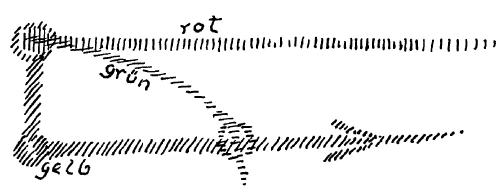
[ 13 ] Thus, in the course of humanity’s recent development, we see that, starting from the Mystery of Golgotha, development proceeds as follows: with the spiritual-heavenly line here and the earthly line here (see diagram: red and yellow)—that Christ comes to Earth and continues to develop with the Earth, and that the intelligent being gradually descends to Earth, down to the 8th, 9th centuries (green). There, in what they call science—what they develop in their thoughts—people begin to attribute their own individual, personal intelligence to themselves. Michael sees among humanity that which he has administered for eons. And the sentiment within the Michael community is: During our next reign—which was to begin in the last third of the 19th century—when we once again permeate Earth’s civilization with our impulses, we must rediscover there the intelligence that has descended from heaven to Earth, in order to administer within the hearts and souls of human beings that which we have administered for eons from the Sun and the cosmos.
[ 14 ] And so, during this time, the Michael Community is preparing to rediscover in the hearts of human beings that which has been lost—that which, under the influence of the Mystery of Golgotha, has also undergone a journey, albeit a lengthy one, from heaven to earth. I would like to describe to you a little of how this unfolded further—how Michael and his followers sought, beginning with this Michael Age—starting at the end of the 1870s—to reclaim in the hearts of human beings the intelligence they had lost in the solar heavens. Michael, who strove from the Sun to Earth—for those who perceive the spiritual in the cosmos—Michael intends to establish his abode in the future in the hearts and souls of Earth’s human beings. And this is to begin with our age; it is to be a guidance of Christianity into deeper truths, in which Christ is to find his explanation—his embodiment in humanity as a solar being—through that Solar Spirit—Michael—who has always governed understanding, that is, intelligence; who can no longer govern it in the cosmos, but who wishes to govern it in the future through the hearts of human beings.
[ 15 ] If one encounters intelligence in some revealed form today and wishes to trace its origin, one turns to the human head, because intelligence has, so to speak, descended from heaven to earth, weaves within the human soul, and manifests itself internally through the human head. It was not always this way when people sought intelligence—when they sought that which revealed itself as an intelligent being from the cosmos. Nor did human beings in earlier times seek intelligence through the development of their heads; rather, they sought it by seeking inspiration from the forces of the cosmos.
[ 16 ] I would like to say: An example of how cosmic intelligence can be sought—how it is no longer sought today, but how it was once sought—can be found when one—as we were fortunate enough to do last Sunday — in Tintagel at the site where Arthur’s castle once stood, where Arthur ruled—that strange reign, so significant for the European world—along with his twelve companions.
[ 17 ] It is not easy to get a sense of what the actual duties of this so-called Round Table of Arthur were based on what historical documents report about Arthur and his Round Table. But one can get an idea if one stands, in one’s mind’s eye, at the spot where the castle once stood and looks out over the stretch of sea that can be seen from there—that stretch of sea which is, so to speak, divided into two parts by a mountain peak. There, in a relatively short time, one can witness a wondrous interplay between light and air—and also between the elemental spirits that dwell in light and air. There one can observe how those spiritual beings—who at times pour down upon the earth with the sun’s rays, and at other times are reflected in the shimmering, flowing, liquid downpour and catch their own reflection—manifest in the air as the denser air spirits, which are subject to the Earth’s gravitational forces. There, one can also observe, when the rain ceases and the sun’s rays penetrate the air in purity, how the interplay of the elemental spirits takes place there in an entirely different way. There one observes the sun’s effect in the earthly substance. There, when one observes this—especially from a place such as this one—one becomes “pagan-devout”—one cannot truly become “Christian-devout,” for pagan devotion is something other than Christian devotion—one then becomes pagan-devout. To be pagan-devout means to surrender oneself, with heart and soul, to the spiritual beings present in the forces of nature, to the multitude of spiritual beings existing within the forces of nature.

[ 18 ] Now, given our current social structures, it is generally impossible for people today to grasp these effects, which manifest themselves in the interplay of natural forces. Only initiatory knowledge is capable of penetrating these matters. But you see, everything that is to be attained in the spirit always requires a fundamental condition. I told you this morning, in the example I used to explain what must be done to gain insight into external phenomena, that the harmonizing karma of two people must be at work for this to happen. In order for what was revealed in such a wondrous, spirit-like manner from the sea to flow in the right way into the mission and the task of King Arthur and his followers at that time, something special had to be present then.
[ 19 ] It is indeed as if even today the play that unfolds there—over the rippling, foaming waves of the sea in the air, illuminated and radiant with sunlight—continues, as if even today nature were still haunting this sea and these mountains everywhere. But in order to capture what was present in those natural phenomena, it was necessary that more than just one person perceive it. It required a group of people—a group in which one felt himself to be the sun at the center, and whose twelve companions were always brought up in such a way that, in their temperament, their disposition, and their entire expression of being, they together formed a “twelveness” that could be grouped just as the twelve signs of the zodiac are arranged around the sun. Thus, the Round Table itself consisted of King Arthur occupying the central seat, with twelve arranged around him; when they were gathered together, so to speak, in their council, they had the signs of the zodiac above them as their emblem, as their symbol, to show under what cosmic influence they stood. From this place, so to speak, European civilization emanated. There, King Arthur and his Twelve drew upon the forces they received from the Sun to make their mighty forays throughout the rest of Europe and to fight to drive out of people the ancient, wild, demonic forces that were still largely present among the European population at that time. These twelve companions of King Arthur, whom he led, fought for external civilization.
[ 20 ] If we now ask ourselves: How did the Twelve feel? What did they feel themselves to be? Yes, we can only understand what was happening there if we go back to what I have just explained. People did not feel intelligence within themselves. They did not say, “I develop my own thoughts, my intelligent thoughts”—rather, they perceived intelligence as something revealed, and they sought these revelations through a group such as the one I have described, consisting of twelve or thirteen. There they drew in intelligence—the very intelligence they needed to shape the impulses of civilization. And they, in turn, felt themselves under the power that can be designated by the Christian-Hebrew name Michael. In the most eminent sense—as the entire configuration of Arthur’s castle demonstrates—the band of the Twelve under the leadership of King Arthur is a Michaelic band, a Michaelic band from that time when Michael still administered the cosmic intelligence.
[ 21 ] Yes, it is indeed this group that has held fast the longest to securing Michael’s dominion over the cosmic intelligence. And one might say: When one looks today at the ruins of Arthur’s castle, one can still feel, even today, from the Akashic Records, the stones falling from what were once mighty castle gates; and as these stones fall, one senses something like an earthly image of the descent of intelligence—cosmic intelligence—from Michael’s hands into the minds of human beings.
[ 22 ] And alongside the Arthur-Michael current, a polar opposing current arises—that current in another place, a place to which inner Christianity has largely taken refuge; the Grail current comes into being. That connection exists, as you will find hinted at in the Parzival legend. The Grail current is found. In this Grail current, too, we find the twelve gathered around the one; but in such a way that it is now fully anticipated that what flows down from heaven to earth no longer reveals intelligence—thoughts of an intelligent nature—but rather that what flows down now appears, like the pure fool—Parzival—in contrast to earthly thoughts. So this now flows down from heaven, and intelligence is expected only within the earthly realm.
[ 23 ] Up here in the north is Arthur’s Castle, where people still believe in cosmic intelligence, where they seek to introduce the intelligence of the universe into Earth’s civilization. There is the opposing castle, the Grail Castle, where intelligence is no longer drawn down from heaven, where it is fully reckoned with that what is wise among men is foolish before God, and what is wise before God is foolish among men. From the castle further south flows that which, by excluding intelligence, seeks first to pour itself into intelligence.
[ 24 ] And so, in earlier times—times that extend all the way back to the era when the Mystery of Golgotha took place over there in Asia—in those ancient times, when we truly immerse ourselves in what is happening, we see, on the one hand, the vehement striving to to secure Michael’s cosmic dominion over the intelligence through the Arthurian principle; and on the other hand, emanating from Spain in the Grail principle, the endeavor to reckon with the fact that intelligence would have to be found on Earth in the future, that it would no longer stream down from heaven. The entire Grail legend embodies the meaning of what I have just expressed.
[ 25 ] Thus, by juxtaposing these two currents, so to speak, we encounter the great problem that was posed at that time—I would say, by what historically stood before humanity: the aftereffects of the Arthurian principle and the aftereffects of the Grail principle. The problem was posed: How does not only a person like Parzival, but also Michael himself, find the path from his Arthurian protectors—who seek to secure his cosmic dominion—to his Grail protectors, who seek to pave the way for him into the hearts and minds of human beings, so that he may grasp the intelligence there? And it all comes together for us in what stands before us as the great problem of our age: that through Michael’s reign, Christianity is to be grasped in a deeper sense. This problem stands before us in all its magnitude, embodied by the two opposites: that castle whose ruins can be seen at Tintagel, and that castle which is not so easily seen by people because it is entwined everywhere by the spirit forest that stretches sixty miles in every direction. But between these two castles stands the momentous question: How will Michael become the new source of inspiration for grasping the truth of Christianity?
[ 26 ] One cannot say that King Arthur’s knights did not fight for Christ and in the spirit of the Christ impulse. It was simply that they were still seeking Christ in the sun and did not want to stop seeking the Christ-being in the sun. It was precisely in this that they felt they were bringing heaven down to earth, that they were waging their Michaelic battles for the Christ working through the sun’s rays. Now, in another sense, the Christ impulse was at work within the Grail movement with the full awareness that it had come down to Earth, that it must be carried through the hearts of human beings, and that it unites, so to speak, the most spiritual aspect of the sun with the earthly evolution of humankind.
[ 27 ] Over the past few days, I have been able to tell you about those individuals and personalities who were still active in the 12th century at the School of Chartres, which was characterized by a high level of spiritual depth. I have drawn your attention to teachers of the School of Chartres such as Bernardus Sylvestris, Bernard of Chartres himself, Alanus ab Insulis, and several others who taught there and had a large following of students. If one considers all that I have already described to you—what was distinctive about these great teachers of Chartres—one can say: They still possessed within themselves something of the ancient traditions of a living, essential nature—not the abstract, material nature. And that is why, I would say, there was still something hovering over the School of Chartres from that “Solar Christianity,” which, as the Knights of St. Michael, sought to send the heroes of the Round Table of King Arthur out into the world as sources of inspiration.
[ 28 ] This School of Chartres is, in a strange way, situated—I would say—right in the middle between the northern Arthurian principle and the southern Christ principle. And just as the shadows of Arthur’s castle and the shadows of the Grail castle cast their influence, so do the supersensible, invisible impulses—not so much on the content of the teaching as on the overall tone, the attitude, and the atmosphere of what was present in what we would today call the lecture halls of Chartres, filled with enthusiastic students.
[ 29 ] It was a time when, particularly among these teachers of Chartres, Christianity was understood in such a way that the Christ who appeared in Jesus of Nazareth was universally regarded as the exalted solar being. So that, I would say, when one spoke of Christ, one saw both the Christ impulse—which, according to the Grail vision, continues to work within the evolution of the Earth—and, at the same time, the outpouring of the solar impulse in Christ.
[ 30 ] What presented itself to the spiritual eye as the fundamental tone of the Chartres doctrine cannot be gleaned today from the literary documents that have survived from the individual teachers of the School of Chartres. To the modern reader, these texts seem almost like lists of names. But anyone who reads them with spiritual insight will see, precisely in the brief interludes found among the abundance of names, terminology, and definitions, the profound insight—the spiritual insight—that these teachers of Chartres still possessed.
[ 31 ] Toward the end of the 12th century, these teachers from Chartres passed through the Gate of Death and entered the spiritual world. There they joined forces with that other current that drew upon the ancient Michaelic era, yet fully reckoned with Christianity in its entirety: with the Christ impulse that had descended from heaven to earth. In the spiritual world, they encountered all that had been accomplished in preparation for Christianity in ancient times by the Aristotelians as a result of Alexander the Great’s campaign into Asia; they also encountered Aristotle and Alexander themselves, who were indeed present in the spiritual world at that time. What these two carried within them could not exist on Earth at that time, because it fully anticipated a renunciation of the old, naturalistic Christianity, as it was still present in a faint reflection in the teachings of Chartres, where something was still lingering that I would describe as pagan Christianity, pre-Christian Christianity—the kind also found in the Arthurian legend. During this period, when the teachers of Chartres were active, the Aristotelians—those who founded and promoted Alexandrianism—could not have been on Earth. Their time came somewhat later, beginning in the 13th century.
[ 32 ] But in the meantime, something very significant occurred. Those who were the teachers of Chartres, and all who belonged to that group, met—just as they had passed through the gate of death and ascended into the spiritual world—those who were just preparing to descend into the physical world, and who, in accordance with their karma at that time, were drawn to the Dominican Order, which primarily cultivated Aristotelianism and Alexandrianism. So they met with these souls who were preparing for their descent. And if I am to speak in today’s colloquial terms, I would say that at the turn of the 12th and 13th centuries, at the beginning of the 13th century, a kind of discussion took place between the newly arrived souls and those descending. And in this meeting, the great reconciliation took place, in which the work of Solar Christianity—as revealed, for example, in the Grail principle and later in the teachings of Chartres—was to be united with what Aristotelianism and Alexandrianism represented. And the Alexandrians descended, founding Scholasticism—a spiritually significant movement that is not nearly appreciated enough today—within which was fought for what could initially be achieved only through the radicalism of an extreme: the insight into the personal immortality of the human being in the Christian sense, this personal immortality that the teachers of Chartres did not advocate so strictly. They still retained something of the belief that “when the soul passes through the gate of death, it returns to the bosom of the Divine.” They spoke far less of personal, individual immortality than the Dominican teachers, the Scholastics.
[ 33 ] Some significant events took place there. For example, when one of the Scholastic teachers descended from the spiritual world to spread Aristotelianism in a Christian sense, it was not yet possible—as karma would have it—during that descent to fully connect to the soul what constituted the deeper content of the Grail principle. For this reason, Wolfram von Eschenbach’s conception of the Grail was developed relatively late. Then another, who came down somewhat later, brought the corresponding insight, and within the Dominican Order, an older and a younger Dominican discussed the complete integration of Aristotelianism with what was a more natural form of Christianity, as it lived on in the Arthurian Court. Then the individualities who had been present there as Dominican teachers also ascended into the spiritual world. And now that great, real reconciliation took place under the leadership of Michael himself, who looked down upon the intelligence now present on Earth, but who was now gathering his own: Spiritual beings from the supermundane world, a vast host of elemental beings, and many, many disembodied human souls whose inner spiritual impulse was striving for a renewal of Christianity. This could not yet take place immediately in the physical world, because the time for it had not yet come. However, a great and powerful, supersensory institution of wisdom was founded under Michael’s own leadership, where all the souls were united—those who were still tinged with paganism but who were striving toward Christianity, as well as those souls who had already lived on Earth during the first Christian centuries with Christianity in their hearts, as it existed at that time. A Michael host took shape, which, in supersensible regions—in the spiritual world—absorbed the teachings of the Michael teachers from the ancient Alexandrian era, the Michael teachers from the time of the Grail tradition, and also the Michael teachers as they were present in impulses such as the Arthurian impulse.
[ 34 ] All kinds of souls with Christian sensibilities were drawn to this Michael community, where, on the one hand, significant teachings were given about the ancient mysteries and all the ancient spiritual impulses, but where attention was also directed toward the future—toward the last third of the 19th century—when Michael was to work on Earth once more and when all those teachings that had now, I would say, were developed in a heavenly school under Michael’s guidance in the 15th and 16th centuries, were to be brought down to Earth.
[ 35 ] And if you look for those souls who once gathered around Michael’s school itself, preparing for their later time on Earth, you will find among them numerous souls who today feel a longing for the anthroposophical movement. Karma has guided these souls in such a way that, back then, during the life between death and a new birth, they gathered around Michael in order to bring a cosmic Christianity down to Earth once again.
[ 36 ] But the fact that karma has united a large group of souls—those who have joined the anthroposophical movement in good faith—with such antecedents and such preconditions is what makes the anthroposophical movement the true Michael Movement, the movement that is truly renewing Christianity. This lies in the karma of the anthroposophical movement. But it also lies in the karma of many individuals who have approached the anthroposophical movement in an honest way. To carry this Michael impulse—which can be concretely grasped in this way, which can be traced in numerous monuments here on Earth, and which strikes one with remarkable force when one sees the wondrous plays of nature surrounding the ruined Arthur’s Castle—to carry this Michael impulse out into the world — for it must find its way into civilization over the course of the centuries if civilization is not to perish entirely — is, in particular, the task of the anthroposophical movement.
[ 37 ] That is what I wanted to impress upon your hearts once again at the start of today’s lecture, which has been given to us as a gift.