Esoteric Considerations of Karmic Connections
Volume VI
GA 240
24 August 1924, London
Translated by Steiner Online Library
Karma in the Individual and in the Evolution of Humanity I
[ 1 ] For now, it gives me great pleasure to express my heartfelt thanks for the kind words just spoken by Mr. Collison, the president of the English Anthroposophical Society. You can always be assured that it gives me deep satisfaction to be among you once more and to see some of our anthroposophical work take shape here. At this moment, one can indeed view this anthroposophical work through two lenses: first, the impression created by the fact that we have just come from Torquay, where we were able to spend some time immersed in manifestations from the spiritual world that were marked by which I characterized the day before yesterday as follows: the two summer events that arose from the impulse of our friend Dunlop and our friend Mrs. Merry—these events, as I would like to say, have an occult charm; one feels, from the entire atmosphere of the events, from being surrounded by nature that acts in an elemental, and spiritually elemental nature—or at least the proximity to such nature—one also derived a certain inner, impulsive inclination to engage with what was being discussed, remaining within those impulses that are thoroughly bound to the locality.
[ 2 ] The second point is that this is, in fact, the first time I have had the privilege of speaking here among you, my dear friends, following the significant Christmas Conference at the Goetheanum. The significance of this Christmas Conference is indeed clear, for—as was your intention—it has been thoroughly discussed, thought through, and deeply felt here among our English friends, It is indeed true, my dear friends, that the full, complete impulse of this Christmas Conference—on the one hand, as much as has now become apparent, since I have had the opportunity to speak in various places following this Christmas Conference—that this full, complete impulse of the Christmas Conference—while it is understood more here, less there—is being understood, that it is beginning to take root, but that it also still evokes a certain sense of alienation within the hearts of our dear anthroposophical friends.
[ 3 ] This Christmas message had become necessary because the development of the Anthroposophical Society, ever since it became independent, had broken away from and separated itself from its former external association with the Theosophical Society, and had not taken on the form that I had envisioned—particularly in 1913—that it would assume.
[ 4 ] And then various things developed out of the Anthroposophical Society that were not rooted in the organic inner life force of what the anthroposophical movement represents spiritually. I discussed all of this in detail during the Christmas Conference; I would just like to refer to it here. In a certain sense, it was a risk to come to the decision in the weeks leading up to the Christmas Conference that I myself could assume the chairmanship of the Anthroposophical Society, as it has now been established from the Goetheanum. For up until then, I had always wished to be regarded solely as a teacher in the background within the anthroposophical movement and had not officially accepted any office. It is difficult, given all that is imposed on the teacher as a duty in the spiritual world—and all the responsibilities toward the spiritual world—especially in this day and age, to take on the external administration of the Society, whose very task is the stewardship of the spiritual heritage, the heritage of wisdom, of anthroposophy. Yet it had to be done. It was, however, a risk insofar as there was, of course, the possibility that, as a result, some of those spiritual currents might be lost—currents that once flowed from the spiritual world into the human world and whose reception is the task of the anthroposophical movement.
[ 5 ] Now, however, it may be said that the situation has indeed unfolded in such a way that not only has there been no backlog of revelations from the spiritual world since the Christmas Conference, but on the contrary, the spiritual world is looking down with much greater favor upon what is taking place through the anthroposophical movement within the Anthroposophical Society, and that the gifts from the spiritual world have in fact become considerably richer since that Christmas Conference, so that we may look back on the Christmas Conference with complete satisfaction in this esoteric regard as well.
[ 6 ] What is expressed by these words—the esoteric significance of the anthroposophical movement—that, my dear friends, is to become ever truer and truer, ever more real and more real. The current running through the anthroposophical movement should take on an ever more esoteric character. This will only be properly understood when one grasps the full esoteric task of the Executive Council at the Goetheanum, when one understands what I meant at the Christmas Conference when I said that it must be an Executive Council that takes the initiative, it must take on the tasks set for the anthroposophical movement from the spiritual world, must accept them, must guide them into the world, and must not merely be an administrative board.
[ 7 ] Well, my dear friends, we have seen that people’s hearts are receiving the esoteric teachings—which have also been flowing through all the lectures since the Christmas Conference at the Goetheanum—with great receptivity. And it is to be hoped that this will also be the case in the future, even if circumstances may be such that, due to the conservative spirit in England, a faint tendency is still noticeable here—a desire to continue the old relationship as it was, without the involvement of that which is meant to emanate from the Goetheanum entirely through the will of the anthroposophical movement itself. But perhaps something progressive will gradually take root within this conservatism as well. And we may hope that what may be present today but has not yet been noticed—indeed, has not been noticed at all—will pass without being noticed and will be outgrown without people even realizing it is there. I know how deeply one clings to what has once become established. But we must certainly be able to raise our consciousness, my dear friends, to the fact that the anthroposophical movement is, after all, something new in relation to everything else in the world, and that it is extraordinarily difficult—indeed, in many areas impossible—to carry on this newness within the old forms. On the other hand, it is naturally difficult for human beings to find the new form for the new content.
[ 8 ] Well, my dear friends, building on that, I would also like to point out that, fundamentally speaking, the anthroposophical movement—as it is now seeking to take shape, particularly in its spiritual currents—is a kind of return to what was originally intended. These original intentions encompassed not only what took place back then in Berlin when the German Section of the Theosophical Society was founded—during the founding of this German Section, I gave a series of lectures titled “Anthroposophy,” so that, so to speak, the anthroposophical movement existed alongside the founding of the German Theosophical Section at that time; but what took place on our part within the Theosophical Society was never anything other than anthroposophical.
[ 9 ] And not only was this the case, but I also already had a strong intention at that time to introduce the esoteric aspect into the anthroposophical movement. That is why the first lecture I gave at that time, within the framework of what was to be discussed in the German Section of the Theosophical Society, was titled: “Practical Karma Exercises.”
[ 10 ] But the figures who had been involved in its founding at the time were utterly shocked when they heard this title, and even today I could vividly describe the astral waves of trembling and quivering that were evident especially in the elderly gentlemen who, having grown out of the Theosophical Movement, heard I wanted to speak about practical karma. And words such as these were directed at me: “Do you intend to bury all our decades of work in a single day—for people believed, after all, that they had accomplished decades of work—all our decades of work!” — And there were, so to speak, constant private meetings, “councils,” in which they made it clear to me that this could not go on like this. And I then felt not only the astral and egoic impression of the tremors and shivers, but I also felt the chilling sensation of the astral goosebumps that the old gentlemen were getting.
[ 11 ] And so it was simply impossible to stick with that program, because it would have been a lost cause. And that is how the Theosophical Movement in Germany took a more theoretical turn—as it generally does within the Theosophical Society—and the truly esoteric aspects had to wait.
[ 12 ] And perhaps that was for the best. For in the meantime, a good three times seven years had passed, during which many things that did not quite want to enter consciousness were able to take root in the unconscious and subconscious. And that is indeed what happened. And so, in that esoteric sense—especially at the very beginning of the process of internalizing the Goethean Christmas impulse—what could not be achieved back then can now begin: the process of internalization can start by seeking the occult developmental impulses of the world, the cosmos, and humanity in the realm of karma. Questions are asked—and answers are given, insofar as they can already be provided today from the spiritual world—regarding the karma of humanity, the karma of the individual, and so on. Through this, the impulses that are striving to enter—striving with all their might from the supersensible world into the world of humanity in the present—will become vividly apparent.
[ 13 ] And so, once this introduction has been translated, we would like to begin today with a discussion along these lines.
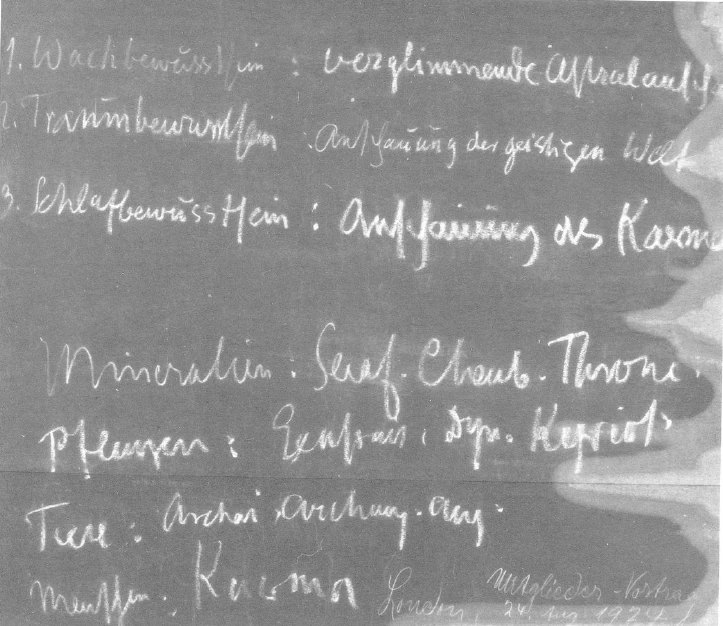
[ 14 ] How karma is rooted in the individual human being and in the evolution of humanity even today, and how individual karmic realities can be discussed in this context, this will become clear to us if we begin this discussion with an introduction to the development of human consciousness—from states in which people still had a direct, elemental perception of karma in their ordinary lives, to other states of consciousness that they later reached, in which this direct insight into karma was lost. For today it is indeed the case that human beings know nothing of their karma within the consciousness they possess as waking daytime consciousness. The world in which they live—from waking up until falling asleep—prevents them from having any direct, elemental knowledge of their karma. But humanity did not always live in this state of consciousness, which is today considered “normal”; rather, in earlier times—including during the post-Atlantean phase of Earth’s evolution—humanity lived in other states of consciousness, even in everyday life. Today, with our normal consciousness, we live in three states of consciousness that I have often described: first, waking consciousness; second, dream consciousness, in which individual fragments of the day’s experiences still surface before the consciousness in a reminiscence-like manner, but in which various influences from the spiritual world also play a role; and finally, third, the state of deep sleep, in which the human soul is surrounded by dullness, twilight, and darkness, and consciousness sinks, so to speak, into unconsciousness. (Written on the board:)
[ 15 ] 1. Waking consciousness
2. Dream consciousness
3. Sleep consciousness.
[ 16 ] It was not always this way for humanity. There were times in human development when everyday consciousness functioned in a completely different way. And if we go back far—very, very far—to the times immediately following the Atlantean catastrophe, when the Earth’s landmasses emerged where there had once been sea, and the sea appeared where where there had once been land, where the Earth had to undergo a period of glaciation—if we consider this time, which immediately followed the ancient Atlantean catastrophe, during which widespread ancient cultures perished—if, then, we look back to a time that lies some eight to ten thousand years behind us, we do indeed find a humanity that possessed three different states of consciousness. That humanity which survived the ancient Atlantean catastrophe also had three states of consciousness, but these were of a fundamentally different nature. This sober, everyday consciousness from waking to falling asleep—as experienced by modern humans, who see every other person with sharp contours, and who also perceive the rest of nature’s beings and natural processes with sharp contours—this waking state of daily consciousness did not, however, exist in those ancient times; rather, people saw human beings extending without sharp contours in all directions into the spiritual and into the auric, and in the auric they looked toward the soul. Animals, too, were seen with a powerful aura. One could see their inner processes—digestion, breathing—within the aura. Plants were seen as if striving upward with their blossoms into a kind of cloud that constantly enveloped the earth. Everything was bathed in a smoldering astral light for this consciousness. And one can indeed say that this state of daytime consciousness for that ancient humanity, following the Atlantean catastrophe, was one of a smoldering astral perception of the physical world.
[ 17 ] I say “fading,” that is, gradually diminishing in its luminosity, because just before the Atlantean catastrophe, this vision in an astral glow was much stronger and more intense than it is today. But entering this state of consciousness—that “awakening into” this state of consciousness, for it can be compared to an “awakening into,” just as today’s waking is—that “awakening into” this state of consciousness of the fading astral vision, was different from the way people today emerge from the state of sleep, where chaotic dreams first stand before the soul before the person enters the day.
[ 18 ] When these people of old awoke, it was as if a world of reality—not merely a dream world—was now dawning in their consciousness, a world into which they had immersed themselves, a world from which they knew they could emerge, and within which they had interacted with spiritual beings—beings of higher hierarchies and beings of an elemental nature. This awakening was truly like what happens today when a person moves from one place, where they have experienced many things, to another place, where, surrounded by new experiences, they recall everything they have lived through. When one entered the day in those ancient times, one had the new experiences of the day, but one also had the memory described: one had been in another place where one was only together with other beings, where one was not directly among the physical human beings who otherwise surround one along with the animals and plants, where one was surrounded by the disembodied human souls living between death and a new birth, where one was together with other beings who never live on Earth in any incarnation.
[ 19 ] After leaving behind a certain kind of inhabitant of the cosmos, one then felt as if one had been placed into another world—the world of physical experience between birth and death. But one also clearly felt the memory of the spiritual world, of that world through which a human being passes between death and a new birth. One might say: the vision of the spiritual world entered into the fading astral vision.
[ 20 ] So, in fact, this state of consciousness—in which human beings, as they do today, stand between purely physical entities—did not exist at all back then. Even back then, people had the sensation—not merely in a kind of dream, but in a very real conception of reality—that: when they emerge into waking consciousness, they see trees, animals, mountains, rocks, and clouds—but it is the same world in which those spiritual beings and human souls also live who are not incarnated on Earth, who dwell in the spiritual world, and with whom one lives between death and a new birth. And then these people gained a real sense of it: as a person awakens, these beings move into every tree, into every remarkable rock, into the depths of the mountains, and up to the heights of the clouds; they slip into and submerge themselves within the individual entities, within the creatures of the outer physical world.
[ 21 ] People went into the forest and saw a special tree. Back then, they knew that a night creature—with whom they had been in communion—had slipped inside it, and they saw clearly what the initiated can still see today: spiritual beings slip into physical places just as they would into their own homes. No wonder, then, that all these things became part of mythology and that people spoke of tree spirits, spring spirits, cloud spirits, and mountain spirits. After all, they saw the beings with whom they had spent the night slipping into the mountains, the waves, the clouds, the plants, and the trees.
[ 22 ] That was the spiritual dawn that, at that time, witnessed the spirit world slipping into the physical-sensory world. Of the outstanding, sublime spirits, it was said with dignity: they have their resting places in these physical locations during the day. Of the lesser elemental beings, who live among humans—and indeed often among animals—during their evolutionary epoch, it was said: “They hide within them.” This was expressed in a playful manner. But what was expressed there—on the one hand in sublimity, on the other in powerlessness and playfulness—corresponded exactly to the feeling people had toward this spiritual dawn.
[ 23 ] But now imagine, my dear friends, that a person was present in such a spiritual world during the final stage of sleep, and in the morning it dawned on him; it only became completely clear to him that he had been there when he woke up. Why was that? Why did he actually see this spiritual-supernatural world—with which he lived between death and a new birth—only upon waking, when the spirits had vanished? Because—while this state existed, that is, while the person was in the final phase of sleep in this state of perceiving the spiritual world—the person was still living in a third state of consciousness. There he lived in a state of consciousness that now conjured up yet another entirely different world before his soul. Specifically, while he was in the spiritual world, contemplating it in his sleep during his earthly existence, the human being looked back upon the evolution of his karma.
[ 24 ] This third state of consciousness among the people who lived immediately after the Atlantean catastrophe was the belief in karma. For them, at that time, it was simply a reality. (Continuation of the inscription on the tablet:)
1. Waking consciousness: fading astral vision
2. Dream consciousness: vision of the spiritual world
3. Sleep consciousness: vision of karma.
[ 25 ] And just as today the three states of consciousness— waking consciousness, dream consciousness, and sleeping consciousness alternate in daily life, so too did the states of fading astral vision, vision of the spiritual world, and vision of karmic development alternate for human beings at that time.
[ 26 ] Yes, my dear friends, it is true that in those ancient times the concept of karma was simply a reality of consciousness for people, and that one can therefore rightly say: there was once a kind of consciousness among humanity through which people simply perceived the reality of karma.
[ 27 ] Then the development continued in the following way: First, this sleep—which, however, was not really sleep, for while one slept, one looked back upon one’s karma—came to an end; that is, this insight into karma ceased. It became obscured. And of the reality of karma, only the insights of the initiates, those initiated into the Mysteries, remained. What had formerly been perceived by human beings as the experience of karma then became scholarship. So what was once an ancient experience, my dear friends, became scholarship in later times. For it subsided and grew dull within the ancient consciousness, and all that remained for humanity—and this was roughly the case in the era described to us as the ancient Chaldean, Babylonian, or Egyptian period—was the contemplation of the spiritual world. So that around this time—that is, in the millennia preceding Christian development—humanity lived in a state of consciousness in which the perception of the supersensible world was still entirely natural, but in which karma was merely taught. And it is therefore understandable that precisely during this period preceding Christian development—because there was still an intense awareness of the spiritual world, of the world in which the human being exists between death and a new birth, and because the awareness of karma had faded and become dulled, it is understandable that humanity as a whole completely lost this awareness of karma—that it was, so to speak, absent—when Christian development began, and that the connection between human beings and the spiritual world was then emphasized particularly strongly when the human being is disembodied. We sense this particularly strongly in what we encounter as the ancient Egyptian worldview: an immensely strong awareness of the spiritual world, a purified, subtle awareness of the world into which a human being enters through the gate of death when he becomes Osiris, but no longer any awareness of repeated earthly lives.
[ 28 ] Then, gradually, the time drew near that has now reached its peak in human development—the time that is, in fact, characteristic of humanity today. Astral perception has descended into our sober, prosaic consciousness—the state we experience in normal life between waking and sleeping—where we see, for example, only that insignificant part of the human being enclosed within the skin, in flesh, bones, and blood vessels; as perceived by today’s everyday consciousness, this is the most insignificant part of the human being. It is quite understandable that many people develop a tendency to adorn this insignificant part of the human being with all sorts of so-called beautiful outer garments, so that it might still amount to something, while deep in the subconscious they have the feeling that it is actually insignificant and belongs within the luminous, warming garments of the auric, the astral, and the I-being.
[ 29 ] And when people first began to sense this transition from seeing a person with their aura to seeing the ordinary, insignificant person of the present, they already tried to imitate, through their clothing, the appearance of what is auric in a person; so that the old fashions—if I may use that word—are, in a certain sense, reflections of the auric. As for the newer fashions, I can assure you that they are not at all.
[ 30 ] Awareness of the supernatural world has taken the form of what a person dreams about in chaotic dreams. And he completely sleeps through his karmic consciousness. He would possess karmic consciousness if the part of consciousness that is dreamless—between falling asleep and waking up—were to suddenly burst into consciousness. Then karmic consciousness would be present.
[ 31 ] Thus, in the course of human evolution since the period I have described—over the course of about ten thousand years—a transformation has taken place whereby human beings “oversleep” the spiritual in the physical world — for we also “sleep through” the spiritual, not merely “sleep through” it — so that human beings “sleep through” the spiritual, “dream away” the actual spiritual world, and “sleep through” karma.
[ 32 ] This is something that once became necessary for the emergence of a sense of freedom, as I have often explained. But humanity must once again break free from its current state.
[ 33 ] One could say that what, albeit in a very dreamlike way, was a natural state of consciousness in ancient times—knowledge of the supersensible world and of karma—has gradually faded and been dampened, and that which was meant to bring the supersensible world to humanity then became the teaching of the mysteries, whereas within the more recent materialistic age it has been completely lost. But within this materialistic age, the possibility must once again arise to build a bridge both to an awareness of the supersensible world and to an awareness of karma.
[ 34 ] But in other words, this means that if one imagines how, in the dawn of the soul in ancient times, those spiritual beings—in whose company one was from falling asleep until waking up—slipped into trees and clouds and mountains and rocks, and how a person could then say to themselves during the day, when they went to such a tree, such a rock, or such a spring: “There, within, is an enchanted spiritual being with whom I am united in my sleeping consciousness” — this is how human beings must first, through the assimilation of the newer science of initiation, come to be able—with the consciousness present during waking hours—to, as it were, spiritually perceive and, through contemplation, draw forth the most diverse spiritual beings from every rock, every tree, every cloud, every star, the sun, and the moon.
[ 35 ] We must set out on this path today, preparing ourselves so that—just as, for the people of old, the spiritual being with whom a person had been together during the night slipped into the tree or the rock upon waking—so too, for the new humanity, that which is hidden in the tree and the spring as a spiritual being will emerge from the tree and the spring. And this is possible. It can happen when people simply cast aside the perspective of habitual prejudice into which they have become accustomed—a perspective into which children are already being introduced today, even as far back as kindergarten—and when they shed the preconception that one cannot look into the spiritual world with common sense. When the initiate comes and describes the things that exist in the spiritual world and the processes that take place there—and even if people today still cannot see into it with their ordinary consciousness—if they make use of their unbiased human reason, that human reason can be illuminated by the message from the spiritual world. And that is, under all circumstances, the first true step for everyone today,
[ 36 ] Of course, there are many arguments against this. You see, after one of the lectures I gave last year on perceiving the spiritual world, a favorable review appeared in a newspaper of some standing—though what can really be called “favorable” and “respected” is debatable, given the vehement opposition to anthroposophy today. Now, in that very lecture, I had also pointed out that one does not need to be a clairvoyant to truly know about the spiritual world, but that one can certainly grasp these things with common sense when a clairvoyant communicates them. I had emphasized this very strongly. And the man who reviewed the matter quite favorably wrote the following sentence. He said: “Steiner wants to apply common sense to the knowledge of the supersensible world. As long as this common sense remains sound,” the man said, “he certainly knows nothing of a supersensible world, and as soon as he knows of a supersensible world, then he is certainly no longer sound!”
[ 37 ] I have perhaps never heard anyone express with such honest inner sincerity what, in fact, everyone who today, on the basis of “common sense,” rejects the knowledge of the supersensible world and speaks of the limits of knowledge in the usual sense would have to assert if they were honest—truly honest within themselves; for one must either abandon today’s view or assert this; anything else is not truly honest within oneself.
[ 38 ] Today’s initiate is well aware of how a spiritual being is liberated from every stone into consciousness, just as other spiritual beings are liberated from plants. They come to meet you if you do not limit yourself to outward sensory perception. And every time one goes out into nature—for example, when one first emerges from its stony dwellings and beholds the goblin-like elemental beings that are found everywhere nature begins to take on a slightly elemental character— — then, when one becomes acquainted with and befriends these elemental beings, one soon sees, beyond these elemental beings—namely, beyond the elemental beings of the mineral world—higher beings that ultimately lead upward to the first hierarchy, to the Seraphim, Cherubim, and Thrones.
[ 39 ] And if one consistently performs the exercises I have described in the book How Does One Attain Knowledge of the Higher Worlds?, which has been translated into English under the title Initiation—if one performs these exercises consistently, with great inner energy, a spirit of sacrifice, and devotion—then it is actually the case that, once one gains the necessary inner courage, one first comes to realize that in certain mineral formations out in the mountains, entire worlds of elemental beings are hidden within a single piece of stone. They simply emerge—slipping out in all directions, growing large—and bear witness to the fact that they are actually only coiled up and compressed within the realms of the elemental world. These beings are initially found within the mineral realm of nature, particularly where the earth enters a state of “rumbling”—where it feels so fresh, where it has an earthy aroma, and where the plants, too, have an earthy aroma. When one enters this world of elemental beings, it is true that these beings can actually fill one with fear and trepidation. And these elemental beings that emerge from there possess an incredible intelligence. One must have the humility—when the gnomes detach themselves from natural phenomena and objects—to say to oneself: “There you stand, you foolish human; how intelligent this elemental world really is!” — And because, in all seriousness, many people are unwilling to say this—since they are not even willing to admit that a small child who has just been born is far more intelligent than someone who has studied extensively—if one looks at it inwardly—that is why these elemental beings initially elude human sight. But if one can engage with them, then one’s horizon expands, so to speak, and what these mischievous little beings—teasing one with their cleverness and wisdom—reveal as the foreground leads into a background that extends all the way to the first hierarchy, to the Seraphim, Cherubim, and Thrones.
[ 40 ] And if one sharpens one’s awareness through what humanity has learned—precisely through the natural sciences—over the past century, then one can enter this world of elemental beings, and from there into a higher world, all the more effectively with the help of the exercises described. And if, through nature—through lovingly immersing oneself in nature—one acquires a consciousness that is not tainted by what is today recognized as authoritative knowledge, then one gradually ascends once more in the knowledge of initiation to that insight which has been lost to humanity.
[ 41 ] Whoever today comes to the point where the tree spirit—which, for the ancients, slipped into the trees in the morning during the spiritual dawn and then descended again in the evening during the spiritual twilight—comes to meet him from the trees, can then also approach human beings in a corresponding way and, emerging from the human being of the present, behold his incarnations in earlier earthly lives alongside the evolution of karma. For the human being, this contemplation leads into karma.
[ 42 ] In the mineral world, where the dwarves—who initially taunt us with their cleverness—first appear, contemplation leads to the Seraphim, Cherubim, and Thrones.
[ 43 ] For plants, this examination culminates in the Exusiai, Dynamis, and Kyriotetes.
[ 44 ] For animals, this contemplation—when one sees their spiritual beings emerging from them in this way—leads to the Archai, Archangeloi, and Angeloi.
[ 45 ] For human beings, this leads to karma.
[ 46 ] Behind the seraphim that appear in the world, the Cherubim, and the Thrones—and behind all other beings of the higher hierarchies; behind all elemental beings who may or may not startle one from among the minerals with their cleverness, or from among the plant beings with their sweet intrusiveness; behind that which emerges from the wilderness, at times with vehemence, with fiery fervor, but also with a chilling presence from the animal kingdom, behind all that has appeared in the foreground, the overwhelmingly magnificent phenomenon of karma then emerges. For in truth, it is only behind all the mysteries of the world that the mystery of karma for human beings lies.
[ 47 ] And once we have prepared our perception in this way, we will be able to move on to discussing specific karmic facts in the next lectures that I will be able to give to you here in this same place.