

Esoteric Considerations of Karmic Connections
Volume II
GA 272
20 August 1916, Dornach
Translated by Steiner Online Library
11. The Historical Significance of “Faust”
based on eurythmic-dramatic performances: “Dedication,” “Prelude at the Theater,” “Prologue in Heaven”
[ 1 ] I mentioned yesterday—and on many previous occasions—that Goethe’s Mephistopheles is, at heart, a contradictory figure. We also already know why he is a contradictory figure. One might say that Mephistophelean—that is, Ahrimanic—and Luciferic character traits are united within him in a colorful jumble. Goethe—one might say at first—did not yet know how to distinguish between these character traits. If, on the one hand, one holds a work of art in such high regard—as you have seen me do with *Faust*—then one may well also draw attention to such factual matters. It remains strange, however, that one so rarely—though it has happened in individual cases—actually notices the contradictions within the poem itself. This is also a sign of the way things are often received today: people do not approach them with sufficient inner engagement to perceive their inner life and interplay. For if they did, they would, for example, soon have to notice the inner contradictions in the figure of Mephistopheles.
[ 2 ] Let us first consider a contradiction—perhaps not exhaustive, but nonetheless very striking—that might immediately catch one’s attention when listening to Mephistopheles speak in the scene that has just passed before our eyes.
I only see how people torment themselves.
The little god of the world remains ever the same,
And is as whimsical as on the very first day.
He would live a little better,
Had you not given him the semblance of heavenly light;
He calls it reason and needs it alone,
[ 3 ] To be more animalistic than any animal. What must one feel when Mephistopheles reproaches man for acting this way? Well, no one would attribute very deep, selfless motives to Mephistopheles. Nor could he, not even after this first scene in the “Prologue in Heaven.” For what does Mephistopheles actually want? He wants Faust, doesn’t he? He wants him for himself and will therefore, deep down, have to approve of everything—good in his own sense—that Faust does in order to get close to him, to grasp him, to seize him. In this case, “to grasp” means “to seize,” not “to understand”; it is not meant in a conceptual or abstract sense. “Can you grasp him”—can you seize him. After all, Mephistopheles will want to do anything to achieve this. So it might suit him very well if Faust possessed all the very qualities that would drive him right into Mephistopheles’s clutches!
[ 4 ] Let’s turn to a later verse where Mephistopheles faces Faust himself in the study, where Faust speaks of his attitude toward reason and science. Faust leaves; Mephistopheles remains behind in his long robe. One might imagine that this Mephistopheles will now, at last, be honest with himself. Then he says:
Just despise reason and science,
Man’s greatest power,
Let yourself be emboldened by the spirit of lies
Through illusions and sorcery,
And I’ll have you in my grasp.
[ 5 ] Well, that might suit him just fine, if a person doesn't apply reason and science in the proper sense, but uses them to be more animal-like than any animal. Then he'll surely argue his case before the Lord, won't he:
Had you not given him the semblance of heavenly light;
He calls it reason and uses it solely
To be more beastly than any beast.
[ 6 ] I would say it is not a complete contradiction, but it is a strong contradiction in terms of how it feels.
[ 7 ] In the scene I just mentioned, where Mephistopheles stands face to face with Faust in the study, it is clear that he is already speaking sincerely as Ahriman-Mephistopheles. But in the passage you heard today:
He calls it reason and needs it only
To be more animal-like than any animal,
[ 8 ] There is a Luciferic element at work here. Lucifer cannot be pleased when Faust uses reason to such a great extent to stir up his animal passions. But it would suit Ahriman just fine if Faust were to behave exactly as Mephisto is reproaching him for doing. In any case, this is not just a half-contradiction, but already a three-quarters contradiction!
[ 9 ] But what about that other passage—what are we supposed to do with it?
As long as he lives on earth,
so long, let it not be forbidden to you.
Man errs as long as he strives.I thank you for that; for I have never
liked to associate with the dead.
What I love most are full, fresh cheeks.
I’m not at home for a corpse;
I’m like a cat with a mouse.
[ 11 ] If you compare this to the scene—which we might be able to perform someday—where Mephisto tries so hard at the end to get the soul, in the second part, as the corpse lies there, how on earth is one supposed to make sense of that? The Devil is, after all, after souls, and here he’s talking about the exact opposite! There are certainly many such contradictions. I just wanted to mention two examples; the first: a three-quarters contradiction found within the poem itself. Such contradictions can certainly be attributed to the fact that the two character traits—the Luciferic and the Ahrimanic-Mephistophelic—become confused.
[ 12 ] Now the question may arise for us: How is it that Goethe places the Ahriman-Mephistopheles right at Faust’s side, directs all attention toward the Ahriman-Mephistopheles, and, in a sense, completely suppresses Lucifer? — That must surely be a question worth asking. For by being led, out of the spirit of his time, to place Mephistopheles specifically at Faust’s side, Goethe also incorporated Luciferic traits and thereby, in a sense, attributed to the Mephistopheles-Ahriman everything that should have been distributed between the two. So there must be reasons in that era for paying more attention to Mephistopheles than to Lucifer; in his treatment of the Faust legend, Goethe goes back to the point where the Middle Ages collide with the modern era. And he has essentially absorbed within himself the impulses of the age that arose from this clash between the Middle Ages and the modern era. If we consider works of poetry from somewhat earlier times—poetry that follows impulses from a more distant past—we find the opposite confusion. We can talk about that another time. But today I just want to point it out. In Milton’s *Paradise Lost*, you’ll find the opposite mistake made. There, everything that should have been attributed to Ahriman-Mephistopheles has been shifted onto Lucifer, albeit not in such a crude manner as in *Faust*. As I said, we’ll talk about this another time. That was more the mistake the Middle Ages made—focusing more on Lucifer. And the mistake modern times make is to focus more on Ahriman-Mephistopheles. We now live in a time in which people must increasingly come to understand the proper balance between the two world forces, Mephistopheles and Lucifer. Hence our group, our sculptural group, which is intended for the building here and is meant to depict the Ahrimanic and Luciferic forces—Mephistopheles and Lucifer—in their proper relationship to one another.
[ 13 ] If you want to understand what this is really all about, you must consider something that still seems quite paradoxical to people today, but which will one day—when people truly do not reject Spiritual Science as part of earthly existence—be deeply understood. In modern times, we live under very special impulses that we must live with. It is true that we live under these impulses. One must simply recognize these impulses; one must not, so to speak, misjudge them. I have often explained myself how, at the beginning of modern times, the Copernican worldview had to emerge, and how justified—deeply justified—it is. Admittedly, we approach this Copernican worldview with somewhat different feelings than the outside world does. For when one considers the feelings with which the outside world regards the Copernican worldview, one can hardly arrive at any other conclusion than that people say: “Well, the Middle Ages and antiquity were foolish, and we have become wise; and since the Middle Ages and antiquity were foolish, they thought the sun moved, and constructed all sorts of cycles and epicycles—the Ptolemaic worldview—and then believed that, accepting the movements of the celestial bodies based on appearances.” — In a certain sense, this is even true of the Middle Ages, particularly the later Middle Ages, for by then confusion had already crept into what had emerged as the Ptolemaic worldview. But the original Ptolemaic worldview was not like that; it was part of the original ancient primordial revelation, having entered human souls through the ancient mysteries and by no means through mere external observation; it was thus based on revelation. Modern times broke with this revelation, and modern times posed the question: How, then, must one observe the heavens in order to understand them and their movements? — Copernicus first set out to calculate, attempting to devise a simple calculation of the movements of the celestial bodies, in order to then demonstrate how the positions he had calculated actually corresponded to the positions of the celestial bodies. And so, through calculation, he devised his Copernican system, formulating three propositions—found in Copernicus’s own works—concerning the movements of the celestial bodies in relation to our Earth. However, one of these three propositions was omitted, and this has given rise to today’s confused Copernican worldview, which is not that of Copernicus himself. The third was inconvenient—so it was omitted! Consequently, anyone today who learns the Copernican worldview solely from standard textbooks is by no means familiar with Copernicus’s actual view. But well, this was bound to happen. First, Copernicus had to establish a far more accurate doctrine with the three propositions; then our doctrine had to emerge, which is based on two of Copernicus’s propositions; and only when the whole matter is thoroughly penetrated by Spiritual Science will the truth come to light.
[ 14 ] Then came those who sought to understand the movements of the celestial bodies and their laws in a more empirical way, rather than through calculation. The telescope was invented. People learned to examine the heavens in the same way that they examine things on Earth. And in this way, modern astronomy and modern astrophysics emerged—a science that arises entirely by formulating laws based on what is observed; that is, one seeks to explain the heavens by observing them. And what could be more natural than this? After all—as modern people must think—anyone who actually wanted anything other than to come to know the heavens by observing them would have to be a completely crazy fellow. That is, after all, quite self-evident, isn’t it? And yet it is not correct; it is one of the great illusions. It is something that will be quite different in the future. In the future, too—and even more so than today—people will inquire into the heavens; they will want to understand the movements that live and weave within the celestial bodies; they will read and study the heavens closely; but they will come to know something that is not yet known today, something that seems quite paradoxical to people today when it is spoken aloud: namely, that one learns absolutely nothing about the heavens by observing them. The most mistaken method of coming to know the heavens and their movements is to observe them as we do today. — Isn’t that right? I’m saying something quite twisted. But one must relate to these distortions differently than the good Christian von Ehrenfels did, whom I referred to eight days ago. We will observe the sky, observing it more and more closely, and let it reveal its secrets to us. But what will these secrets reveal in the distant future? They will reveal what is happening here on Earth. That is what they will reveal. People will indeed observe the heavens, but from what they perceive in the heavens, they will explain how plants grow on Earth, how animals come into being on Earth—everything that forms on Earth, everything that weaves and lives on Earth. What the heavens reveal will shed light on all of this. It will no longer occur to people to ask the heavens about the heavens themselves; rather, they will ask the heavens in order to gain insight into the Earth. And the most significant laws that people will learn from the heavens will be used to unveil the mysteries of earthly existence. Ancient astrology—whose original meaning is scarcely recognized today and which has largely devolved into amateurism, even charlatanism—will be revived in an entirely new form. People will not only seek to understand earthly destinies through the movements of the stars and the laws of the heavens, but they will also explain the laws of earthly life—that which weaves and lives—through the laws of the celestial bodies. People will not know why salt crystallizes into cubes, why diamonds crystallize into octahedrons, and so on, until they can explain the things that take shape here on Earth based on the positions of the celestial bodies. And one will not know the mystery of the life of animals, plants, and human beings—as the mystery of life itself—until one explains, from the movements of the celestial bodies—whose effect is life—that which weaves and lives here on Earth. The Earth is explained through the heavens. However, what one will come to know about the heavens will take on a somewhat different form than what one claims to know today. People will investigate the laws governing the positions and movements of the celestial bodies. But then they will allow themselves to be inspired, through meditation, by what they are investigating, in order, so to speak, to enter into a relationship with the beings who live in the stars. They will let the beings who live there tell them what they will need to know for life on Earth.
[ 15 ] This is a vision of the future. You now know that, in much the same way as Copernicus, Galileo, Kepler—who, incidentally, were still influenced by old ideas—attempted to derive the laws of celestial motion through observation of the heavens, and just as this approach has been continued in their spirit in more recent times, so too have Darwin, Lamarck, and Haeckel attempted to discover the laws of earthly life. And what could be more natural here than to come to know the Earth through the Earth itself! One travels around, as Darwin did; one examines things under a microscope, as Haeckel did; one rationalizes, as Lamarck did, regarding the creatures of the Earth and attempts to discern the laws that govern life on Earth. Again, one might be considered a madman if one does not regard this as self-evident. The future will not regard this as self-evident at all! If one considers the straight, beautiful course of development that modern biology has taken—from Darwin to Haeckel and to Haeckel’s students—one finds that it has led to the formulation of certain laws, particularly regarding embryonic life. The so-called fundamental law of biogenetics plays a major role: in embryonic life, humans relive the individual animal genera. As you know, I have often drawn attention to the biogenetic law. To discover this law, observations were made in the hope of uncovering something about the life of living beings. It can be said that today’s scholars are already working to unravel these views, though this is scarcely noticed in lay circles. Copernican astronomy is already being strongly questioned by a few more discerning individuals. And Haeckel’s student, Oscar Hertwig, has expressed views—particularly in his later writings—that are likely to cast serious doubt on everything that the Darwin-Haeckel theory has brought to light. If one keeps abreast of what is happening within the specialized scientific community, one gains a different perspective than if one relies solely on what is presented to the public in popular lectures by the usual—I dare not say “Mauthnerian,” how should I put it?—well, by the usual lecturers. A great deal is already happening today in the actual specialized scientific community, and what is presented here as a future prospect is already taking shape. However, one will have to turn to the Spiritual Science so that what is taking place does not become confused, but rather truly becomes well-founded.
[ 16 ] Now I must say something that is, once again, paradoxical. By observing what is happening on Earth, one learns nothing at all about the Earth; one will come to understand this only when one reads from the stars what is happening on Earth. But what is actually happening out there in the heavens—that one comes to know through the study of, for example, embryology and so on. One can, in turn, approach this study in the way I indicated earlier—by observing the movements of the heavens—and one can enter into a relationship with the elemental beings who govern these movements within the events of the Earth. Just as one will turn to the heavens to explain the Earth, so will one turn to the Earth to explain the heavens. As I said, it is still a paradox today, but it will come to pass—in one way or another, this correct perspective will take hold on this Earth. Astronomers will use the methods of their science to establish the foundations of biology, and biologists will use the methods of their science to establish the foundations of astronomy. And a biology founded in the true sense through the means of astrology will be spiritual science, and an astrology founded through the means of true embryology will be spiritual astronomy. When you consider this, you must say to yourself: Humanity does not follow a straight line of development, but rather moves forward, up and down, in waves, so to speak. - And so that the correct spiritual perspective—which must come—could be properly prepared, the error had to arise, which consists in the modern tendency to explain the heavens through the heavens and the earth through the earth. People lived under this impression.
[ 17 ] But Goethe did not live entirely under this influence—not entirely. Goethe had, in a certain sense, “pre-Darwinized” Darwinism, but a much more spiritual form of it. He did not focus merely on the external, sensory succession of phenomena, but on the primordial plant and the primordial animal. And I have often referred to the well-known conversation between Goethe and Schiller, in which Goethe—after they had seen at the botanist Batsch’s in Jena how plants are viewed side by side, and Schiller found this unsatisfying—sketched the so-called “primordial plant” with just a few strokes. This drawing by Goethe does not exist. In the introduction to Goethe’s morphological writings in Kürschner’s *National Literature*—which I wrote back in the 1980s—I attempted to sketch this Goethean “primordial plant.” You can find it there, as I have sketched it. Schiller, however, said: “That is not reality; that is an idea.” — Goethe replied: “Then I see my idea with my eyes.” — He was well aware that for him this was a perception, an experience, not something contrived or rationalized. And when one gets to know Goethe in this way—truly intimately—whether through his poetic endeavors in connection with his scientific ones, or conversely through his scientific ones in connection with his poetic ones—which is precisely what I have sought to do in my interpretation of Goethe— then one sees how Goethe does not feel entirely at ease explaining the heavens through the heavens, or the earth through the earth, and how this principle of modern times is continually broken through in his ideas. That is why it is still so difficult to understand Goethe’s Theory of Colors today, for what Goethe actually seeks is an astronomical explanation of the mystery of color. And if you read Goethe’s *Morphology* very carefully, you will see how certain elements come into play there that stem from the very beginnings of astronomy. One senses this particularly when considering Goethe’s essays on the spiral tendency of plants. Well, that would lead into details that I can only draw attention to today; I merely wish to point this out.
[ 18 ] Let us now pose the question: How is it that this modern era—which we now date from the clash between the Middle Ages and the modern era, from the emergence of Copernicanism, Galileanism, and Keplerianism, and which we in turn trace on to Darwinism, Haeckelism, and Lamarckism—how is it that this era sets out to explain the heavens through the heavens and the earth through the earth, rather than the earth through the heavens and the heavens through the earth? How does this come about? — It comes about through a twofold seduction, in which both Ahriman and Lucifer seduce humanity. In the Middle Ages, when the groundwork was being laid, as people were moving toward Copernicanism and Darwinism, it was more a Luciferic influence; it was Luciferic impulses that prepared the way. And once Copernicanism had emerged, it was more the Ahrimanic seduction. It is Ahriman who essentially lives within human beings, bringing about this reversal in people of which I have spoken. For, after all, modern science in particular stands entirely under Ahrimanic influence. And Goethe sensed correctly when he perceived Ahriman—Mephistopheles—as close to humanity in modern times. For him, it was less important to consider the relationship between Lucifer and humanity than that between Ahriman and humanity. His very special attention had to be directed toward this. The Luciferic influence was of less concern to him. For Faust is, after all, presented from the very beginning of the story as the man of modern times. The various aberrations of late medieval theology stemmed from Lucifer. Faust, however, appears right from the start as one who sets the Bible aside and wants to become a man of the world and a physician, that is, to explain the earth through the earth, and heaven through heaven—not as was the case with the old theologians of the late Middle Ages, who, as if in a final atavism, still attempted to explain the wonders of the earth through the revelations of theology, that is, to explain them from heaven. Ahriman stood at humanity’s side in modern times. Those who sensed this but were not imbued with a sense of necessity—being instead permeated only by fear of the devil—therefore reviled Faust, who was merely following the necessary impulse of modern times. And so the 16th-century Faust epic came into being, one that has Faust burned in hell because he succumbs to Ahriman. Those who were still under the atavism of the Middle Ages were, in a sense, the ones who gave the epic this form. Goethe was no longer under the influence of the Middle Ages. That is why he could not let his Faust be burned in hell. But the great question arose for him: What, then, should actually be done?
[ 19 ] Let’s put this in very concrete terms. What does one actually do when one explains the Earth through the Earth? Let’s consider an example that—perhaps because it is somewhat removed from conventional science—is closer to our own experience. Let’s take a myth or a work of fiction and think of a commentator or interpreter of the sort I have often criticized—you remember! Let’s suppose that such a commentator, an interpreter of a myth, a legend, or a work of fiction, steps before us and explains to us, as he puts it, the work of fiction from within the work of fiction; he seeks the laws of poetry within the poem or within the myth. He may be very witty. There are certainly very witty interpreters of myths and poetry. But they all err, for one can never explain a myth or a poem by applying reason to it. Oh, what have the interpreters of *Hamlet* written in order to interpret *Hamlet*! What have even the *Faust* commentators written in their attempts to interpret *Faust*! What have theosophists done in their efforts to interpret all manner of myths! One can only get to the heart of a myth, to the heart of a work of poetry, if one knows how to direct one’s gaze toward where myths and poetry come from—from heaven. This, in turn, points once again to that future perspective. This is closer to our hearts than pointing this out in the context of science. Myths are cited—as it were, to illustrate through them—once one has grasped the great interconnections within the heavenly cosmos; one then allows them to be reflected, at least, through the myth. And once one has insight into the cosmic laws that govern there, one will not resort to intellectual commentary on works of poetry; for if one strips away from the myth and the poetry what such intellectual interpreters usually extract, what actually remains? Yes, one can always picture a certain image when such a myth interpreter or literary commentator appears in the manner we see today. Something emerges there, like the one who appeared in his bat-like form—truly something bat-like and gray—in contrast to the living life that reigns in poetry and myth. There one also becomes acquainted with Ahriman-Mephistopheles.
[ 20 ] What I have just illustrated with this example could be extended to encompass the entire state of affairs in science, though I am not criticizing science itself. I simply want to show you why this is necessary. Ahriman had to intervene for a certain period of time; otherwise, the way people acted in the Middle Ages would have become such that it would have caused them to grow complacent all too easily. People are fond of absolute peace and quiet, which is why the world gives them the devil, who acts and entices and must, as the devil, create—one who provokes, entices, and acts. This intervention by Ahriman is necessary. And it is utter nonsense when one has heard something about Ahriman and Lucifer and then asks: Is this perhaps an Ahrimanic influence? Is this a Luciferic influence? One must guard against this at all costs!
[ 21 ] Goethe understood the role Ahriman plays! But why did Ahriman have to play such a role in more recent times? Why did Ahriman-Mephistopheles have to enter the human sphere at all? After all, we know that evolution proceeds in such a way that we have the so-called Lemurian period, the Atlantean period, and our post-Atlantean period. We know that in the Lemurian period, the human “I”—that is, consciousness—was still quite inactive, still quite sluggish; it actually only begins here.
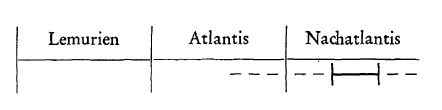
[ 22 ] But only gradually does the human being come to understand what lives and weaves within him as the “I” impulse. Only gradually do human beings become aware of where they stand in relation to Lucifer and Ahriman, as the “I” dwells in their souls; only gradually do they come to realize this. When one considers what must be the principle of the future age—even if only schematically outlined—it presents itself as follows: pointing toward the Earth to discover the mysteries of Heaven; pointing toward Heaven to discover the mysteries of the Earth. If one does the opposite—if one proceeds solely in the spirit of our time—one will not find the mysteries of the Earth; rather, instead of the laws of heaven and the mysteries of heaven that should emerge from the Earth, what emerges is the Ahrimanic force, which approaches human beings and attempts to gain a foothold within them. It must be rejected, because what must be sought in the earth—not intellectually—is not what the earth gives, but what it reveals to the heavens. Lucifer comes from outer space; he must be driven away. If he were to approach human beings, it would mean that people would seek in outer space what cannot be found within themselves: the mysteries of heaven itself. One must come to understand this relationship.
[ 23 ] It was once necessary to recognize how close Lucifer is to human beings. People have been enabled to recognize this through a symbol that is much more than a symbol—a symbol that points deep into the mysteries of the spiritual world. If one wishes to characterize what Lucifer is for humanity as a whole, one cannot express this more intimately than by presenting the matter in such a way that Lucifer approaches the powers of the woman and works into the world with the aid of specifically feminine powers, and the man is then seduced through the woman with the aid of Lucifer. This symbol had to be presented to humanity, and it had to be there when the fourth post-Atlantean epoch arrived—a time when people were first to grasp the relationship between Lucifer and humanity, when they were to feel and sense this relationship, and bring it into their consciousness. Nothing could bring the relationship between Lucifer and humanity into consciousness as effectively as studying the beginning of the Bible—how the serpent approaches the woman, how the woman draws upon her own powers, and how, through this, the seduction and temptation of the world began. This significant symbol was the most effective for this fourth post-Atlantean cultural epoch, even though it had existed earlier. The mystery of Lucifer is contained within this symbol.
[ 24 ] The fifth post-Atlantean epoch had to consciously enlighten humanity about the Ahrimanic-Mephistophelean mystery. A different symbol had to take its place. Just as in the religious text that refers to the spiritual world, the symbol of the Luciferic tempter of the woman stands at the forefront—and the man is thereby led astray through the arts that Lucifer performs with the woman’s help—so the counter-image had to emerge in the fifth post-Atlantean epoch: Ahriman, who approaches the man, first seduces the man, and then, with the man’s help, the woman. Although this may not have been achieved quite so magnificently in the opening lines of the *Faust* poem, the profoundly moving nature of Gretchen’s tragedy rests in large part on the fact that, just as Adam was seduced by Lucifer indirectly through Eve, so too was Gretchen seduced by Ahriman-Mephistopheles indirectly through Faust. The inner necessity of the matter compelled the author to set a “world book” in contrast to the “theological book”: the seduced and the seductress; the seduced and the seducer; Lucifer and Ahriman. The relationship of Lucifer to woman on the one hand, and that of Ahriman to man on the other. This is a profoundly significant spiritual connection.
[ 25 ] And that is why this “Faust,” a book about the world, truly arose from an inner spiritual impulse, in contrast to the “book of theology.” And the modern age is called upon to find the paths between Ahriman and Lucifer. For all the forces through which Lucifer works into the world are, though not identical, similar to the forces through which Lucifer succeeded in seducing the woman. All the forces through which Ahriman works into the world are similar to the forces with which Ahriman seduces the man. And just as we correctly conceive of the Luciferic temptation, as depicted in the Bible, as taking place in the Lemurian epoch, so must we seek Ahriman in a passage of the Bible that has not yet become clear, because the Ahrimanic mystery is not yet revealed in the Bible in the same way as the Luciferic mystery. While we place the Luciferic mystery in the Lemurian epoch, we must, as I have often explained, place the Ahrimanic mystery in the Atlantean epoch. There, the Bible offers only a hint—not such a clear, resplendent image as that of the temptation in the Garden of Eden. The Bible merely states that the impulses entering earthly existence caused the sons of God to take a liking to the daughters of men. This is merely an allusion to what enters as the Ahrimanic impulse.
[ 26 ] Goethe’s *Faust* does indeed have a certain historical significance. And this historical significance lies in what I have tried to outline for you today. If one wishes to draw attention to what Spiritual Science aims to be and ought to become for humanity, one must today often articulate paradoxes—statements that seem strange to many people. But it is true nonetheless. When, one day, human beings will have reached a state where their science once again recalls the primordial revelation—by explaining earthly life through the mysteries of the heavens—and when earthly science will have reached a point where, for example, the deepest mysteries of the heavens are recognized through the structure of embryonic development, then humanity will have found the proper relationship to Ahriman and Lucifer, and then, in a certain sense, that which is to be depicted in our main group sculpture currently under construction—in which the representative of humanity is positioned between Ahriman and Lucifer in the correct gesture—will be lived out within humanity.
[ 27 ] One will have to grasp what lies at the heart of Goethe’s *Faust* more and more deeply. But one will need an interpretation free from authority. Those people who seek to arrive at insight solely by, as a lady in our society once put it, “always making a face all the way down to their stomach” to express their inner state of mind will not achieve their goal. It was a lady who was not accustomed to speaking German and therefore made this slip of the tongue. Yet that is beside the point; it was an apt description. She wanted to point out those people who lack any ability to develop a sense of humor in their view of the world. If one cannot develop a sense of humor, then under certain circumstances that can become quite serious. So it will inevitably come to pass that one must find one’s way in the world in the manner I have described. Those people who wish to approach the things of the world solely from a sentimental perspective will, of course, prefer to be able to interpret even a work of art such as Goethe’s *Faust* in such a way that they pull a face “all the way down to their stomach” with every line. But those who wish to understand *Faust* will have to approach it without relying on authority. Then they will have to work their way through the contradictions, but working through these contradictions will offer the possibility of understanding. Something like the “Prologue in Heaven” is certainly no child’s play! If one shies away too much from a certain irony and a certain sense of humor toward the world, then one all too easily succumbs to the greatest humorist, who is a comrade of the one who confronts us in Goethe’s Mephistopheles—one who is more of a burden to the Lord than the mischievous fellow, who is a somewhat more dangerous spirit of the sort that is capable of negation.
[ 28 ] I would like to encourage a deeper understanding of such things, which already occupy an exceptional position in humanity’s spiritual development. For they are also a path to entering the mysteries beyond the threshold, where everything is different from what it is on this side of the threshold, where everything is such that one must already come to terms with the fact that some things sound paradoxical when spoken from the awareness of those realities that lie beyond the threshold to the spiritual world. The present age does not want to know much about the mysteries that lie beyond the threshold to the spiritual world. True, most people of our time have always been convinced that we have come so wonderfully far. Well, I do not know how far people will carry this conviction through the present age—an age that has come so wonderfully far, yet lives only in the consequences of what it has believed over the centuries. But even if what is proclaimed from the realm beyond the threshold still sounds paradoxical to many today, an ever-greater understanding of these mysteries of existence must take shape. And much of humanity’s flourishing development into the future depends on people finding an understanding of that which still sounds so paradoxical in so many ways today.
[ 29 ] It may still seem foolish to the world today to say that the earth must be explained through the heavens, and the heavens through the earth. Anyone who looks into all that which overpowers human destiny—which reveals itself from beyond the threshold—knows that what is considered so foolish and paradoxical to human beings is nevertheless wisdom in the eyes of the spiritual realm and the world. And it may already be said today without being immodest, because when one speaks from an awareness of the spiritual world, one already mustered the necessary humility to be allowed to say it—since this humility already reigns in the heart— even though one may have to exert strength to present what one would most like to express in a gesture of humility through a gesture of necessary strength—a gesture that might perhaps give the appearance of arrogance. But even that could only be perceived as such by an Ahrimanic perspective if, in this case, it were to confuse humility with arrogance. More on that another time.