

General Human Studies
as the Basis of Education
GA 293
22 August 1919, Stuttgart
Translated by Steiner Online Library
Second Lecture
[ 1 ] All education in the future will have to be based on a genuine psychology derived from the anthroposophical understanding of the world. It was, of course, recognized in many different places that teaching and the educational system in general must be based on psychology, and you are well aware, for example, that Herbart’s pedagogy—which had a very wide influence in the past—based its educational methods on Herbart’s psychology. Now, both today and in the past few centuries, there has been a certain reality that has actually prevented a genuine, practical psychology from emerging at all. This must be attributed to the fact that in the age in which we now live—the age of the conscious soul—a level of spiritual depth has not yet been attained that would have allowed for a genuine understanding of the human soul. However, the concepts that were previously formed in the field of psychology—the study of the soul—based on the ancient knowledge of the fourth post-Atlantean epoch, these concepts are today, in fact, more or less devoid of content; they have become mere clichés. Anyone who picks up any book on psychology today—or even anything that deals with psychological concepts—will find that such works no longer contain any real substance. One gets the feeling that psychologists are merely playing with concepts. Who, for example, is developing a clear and accurate concept today of what a mental image is, or what the will is? You can find definition after definition in psychology and educational theory today about “mental image” and “will,” but these definitions cannot give you a true understanding of what “mental image” is or what “will” is. We have completely failed—naturally, due to an external historical necessity—to connect the individual human being, even in a spiritual sense, to the entire universe. People were unable to grasp how the human soul is connected to the entire universe. Only when one can grasp the connection between the individual human being and the entire universe does an idea of the essence of the human being as such emerge.
[ 2 ] Let us take a look at what is commonly called “mental image.” After all, we must develop mental image, feeling, and volition in children. So we must first gain a clear understanding of what a mental image is. Anyone who looks at what lives as a mental image within human beings with a truly unbiased eye will surely notice right away the pictorial nature of the mental image: the mental image has a pictorial character. And anyone who seeks a character of being in the mental image, anyone who seeks a real existence in the mental image, is succumbing to a great illusion. But what would the mental image even be for us if it were a form of being? We undoubtedly also have elements of being within us. Just take our physical elements of being—take, very roughly, what I am saying now: for example, your eyes, which are elements of being; your nose, which is an element of being; or even your stomach, which is an element of being. You will say to yourself that, while you do live within these elements of being, you cannot use them to create a mental image. You flow out into the elements of being with your own being; you identify with the elements of being. It is precisely this that makes it possible for us to grasp and comprehend something through our mental images—that they have the character of images, that they do not merge with us in such a way that we are within them. So they do not actually exist; they are mere images. It was the great mistake made precisely at the end of humanity’s last epoch of development, in the past few centuries, to identify being with thinking as such. “Cogito, ergo sum” is the greatest error that has been placed at the forefront of the modern worldview; for within the entire scope of the “cogito” lies not the “sum,” but the “non sum.” That is to say, as far as my knowledge extends, I am not, but am only an image.
[ 3 ] Now, when you consider the pictorial nature of a mental image, you must consider it, above all, in qualitative terms. You must focus on the fluidity of a mental image; you must, so to speak, form a concept of activity that is not entirely accurate—one that would, in a sense, resonate with being. But we must imagine that even in intellectual activity, we engage only in an image-based activity. Thus, everything that is even merely movement in a mental image is the movement of images. But images must be images of something; they cannot be images merely in and of themselves. If you reflect on the comparison with mirror images, you can tell yourself: Although the mirror images appear to come from the mirror, everything contained in the mirror images is not behind the mirror but exists somewhere else, entirely independent of it, and it is quite irrelevant to the mirror what is reflected in it; all sorts of things can be reflected in it. - If we understand the mental image-like activity of imagination in precisely this sense—that it is an image—then the question arises: What is the mental image of which the mental image is a representation? Of course, no external science can provide an answer to this; only an anthroposophically oriented science can do so. The mental image is an image of all the experiences we have had before birth or, more precisely, before conception. You cannot truly grasp the nature of a mental image unless you are clear that you have lived a life before birth, before conception. And just as ordinary mirror images arise spatially as reflections, so your life between death and a new birth is reflected within your present life, and this reflection is a mental image. So you must actually imagine—if you create a mental image of it—the course of your life unfolding between the two horizontal lines, bounded on the right and left by birth and death. You must then go on to imagine that a mental image continually flows in from beyond birth and is reflected back by the human being itself. And in this way, as the activity you carried out in the spiritual world before birth—or rather, before conception—is reflected back through your physical body, you experience a mental image. For those who truly understand, a mental image itself is simply proof of pre-birth existence, because it is an image of that pre-birth existence.
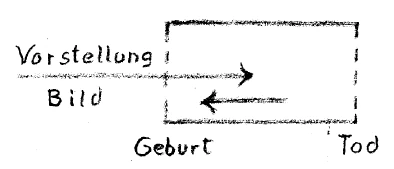
[ 4 ] I wanted to present this as an idea for now—we’ll return to the actual explanations of these matters later —to draw your attention to the fact that in this way we move beyond the mere definitions of terms found in works on psychology and pedagogy, and that we arrive at a true grasp of what mental image activity is by learning to recognize that in creating a mental image, we have mirrored the activity that the soul exercised in the purely spiritual world before birth or conception. Any other attempt to define a mental image is of no use at all, because it does not give one a true idea of what a mental image is within us.
[ 5 ] Now let us ask ourselves about the will in the same way. For ordinary consciousness, the will is actually something extraordinarily enigmatic; it is a crux for psychologists, simply because the will presents itself to the psychologist as something very real, yet fundamentally lacking any real content. For if you look to psychologists to see what content they ascribe to the will, you will always find that such content stems from a mental image. In and of itself, the will initially has no actual content. Now, it is also the case that there are no definitions for the will; these definitions are all the more difficult in the case of the will precisely because it has no real content. But what is it, actually? It is nothing other than the very seed within us for what will become a spiritual-soul reality within us after death. So when you create a mental image of what will become of us as a spiritual-soul reality after death, and when you create a mental image of it as a seed within us, then you grasp the will. In our diagram, the course of life ends on the side of death, and the will extends beyond it (see diagram on p. 34).
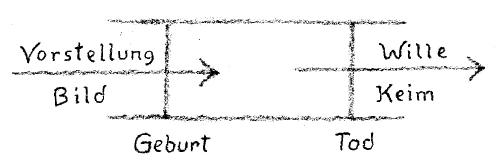
[ 6 ] So we must imagine: on the one hand, a mental image of prenatal life; on the other hand, a will that we must understand as the seed for what is to come. I ask that you carefully consider the difference between a seed and an image. For a seed is something supra-real, an image is something infra-real; a seed only later becomes a real entity, and thus, by its very nature, carries within itself the potential for the later real, so that the will is in fact of a very spiritual nature. Schopenhauer sensed this; but he could not, of course, advance to the realization that the will is the seed of the spiritual-psychic, and how this spiritual-psychic unfolds in the spiritual world after death.
[ 7 ] Now, in a certain sense, you have divided the human soul life into two realms: mental images and the will as a seed; and there is a boundary between the image and the seed. This boundary is the entire lived experience of the physical human being itself, who rejects the prenatal realm—thereby generating the mental images—and who does not allow the will to be fully lived out, thereby continually preserving it as a seed, allowing it to remain merely a seed. By what forces, we must ask, does this actually take place?
[ 8 ] We must be clear that certain forces must be present in human beings through which the rejection of prenatal reality and the suppression of postmortem reality are brought about; and here we come to the most important psychological concepts of the facts that are a reflection of what you already know from the book *Theosophy*: reflections of antipathy and sympathy. We will—and here we are picking up where we left off in the first lecture—be relegated to the physical world because we can no longer remain in the spiritual world. As we are cast down into this world, we develop antipathy toward everything spiritual, so that we reflect back the spiritual pre-birth reality in an antipathy of which we are unaware. We carry the power of antipathy within us and, through it, transform the prenatal element into a mere mental image. And we connect in sympathy with that which, as a reality of the will, radiates from beyond death into our existence. We do not become immediately aware of these two—sympathy and antipathy—but they live within us unconsciously, and they constitute our feeling, which is continually composed of a rhythm, an interplay between sympathy and antipathy.
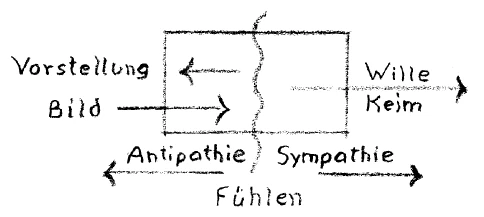
[ 9 ] We develop within ourselves a world of feelings that is a constant interplay—systole, diastole—between sympathy and antipathy. This interplay is constantly at work within us. The antipathy that leans toward one side continually transforms our inner life into a world of mental images; sympathy, which leans toward the other side, transforms our inner life into what we know as our will to act—into the preservation of the seed of what becomes spiritual reality after death. Here you arrive at a true understanding of spiritual-soul life: we create the seed of soul life as a rhythm of sympathy and antipathy.
[ 10 ] What, then, do you radiate back in antipathy? You radiate back your entire life as you have lived it, the entire world you experienced before birth—or rather, before conception. This essentially has a cognitive character. So you actually owe your insight to the shining in, the radiating in, of your prenatal life. And this insight—which exists to a far greater degree than reality does before birth or conception—is weakened into an image by antipathy. Therefore, we can say: This insight encounters antipathy and is thereby weakened into a mental image.
[ 11 ] When this antipathy becomes strong enough, something quite special occurs. For even in ordinary life after birth, we could not create a mental image—if we did not, in a certain sense, do so with the same power that has remained with us from the time before birth. When you create a mental image of yourself as a physical human being today, you do not create with a force that is within you, but with the force from the time before birth, which still continues to work within you. One might think that this force ceased with conception, but it is still active, and we imagine using this force that still shines into us. You continually carry within you the living essence of the pre-birth period; you simply have the power within you to reflect it back. This encounters your antipathy. When you now create a mental image, every such mental image encounters this antipathy, and if the antipathy becomes strong enough, a memory image arises—the memory—so that memory is nothing other than a result of the antipathy at work within us. Here you have the connection between the purely emotional—still the antipathy that radiates back indeterminately—and the determined reflection, the reflection of the perceptual activity now exercised in a pictorial form in memory. Memory is nothing but intensified antipathy. You could not have a memory if you felt such great sympathy for your mental images that you would “swallow” them; you have a memory only because you feel a kind of revulsion toward the mental images, rejecting them—and thereby making them present. That is their reality.
[ 12 ] Once you have gone through this entire process—once you have visualized it, recalled it in your memory, and held onto that mental image—the concept emerges. In this way, you have one aspect of soul activity: antipathy, which is connected to our prenatal life.
[ 13 ] Now let us consider the other side—that of the will—which is the germ-like, post-mortem aspect within us. The will lives within us because we feel sympathy for it, because we feel sympathy for this germ, which only develops after death. Just as a mental image is based on antipathy, so is volition based on sympathy. If this sympathy becomes strong enough—as was the case with the mental image, which becomes memory through antipathy—then imagination arises from sympathy. Just as memory arises from antipathy, so does imagination arise from sympathy. And when your imagination becomes strong enough—which in ordinary life happens only unconsciously—it becomes so strong that it permeates your entire being, right down to the senses; then you experience the ordinary mental images through which you perceive external things. Just as the concept arises from memory, so imagination arises from the imagination, providing the sensory perceptions. These arise from the will.
[ 14 ] It is a great error that people constantly fall into in psychology: We look at things, then we abstract from them, and in this way arrive at a mental image. - That is not the case. For example, the fact that we perceive chalk as white arises from the exercise of the will, which, through sympathy and fantasy, becomes imagination. When, on the other hand, we form a concept, it has an entirely different origin, for the concept arises from memory.
[ 15 ] With this, I have described the spiritual aspect to you. You cannot possibly comprehend the human being unless you grasp the difference between the sympathetic and antipathetic elements within the human being. These—the sympathetic and the antipathetic elements—manifest themselves, as I have described, in the world of the soul after death. There, sympathy and antipathy reign openly.
[ 16 ] I have described to you the spiritual human being. On the physical plane, this being is connected to the physical human being. Everything spiritual expresses itself and manifests in the physical, so that, on the one hand, everything that manifests in the physical—such as antipathy, memory, and concept—is revealed in the physical body. This is bound up with the physical organization of the nerves. As the nervous systems are formed within the body, everything prenatal acts within it for the human body. The prenatal soul-life works its way into the human body through antipathy, memory, and concept, and creates the nerves. This is the correct understanding of the nerves. All talk of distinguishing between sensory and motor nerves is, as I have explained to you many times before, sheer nonsense.
[ 17 ] And in the same way, will, sympathy, fantasy, and imagination, in a certain sense, radiate outward from the human being. This is bound up with the embryonic state; it must remain within that embryonic state and therefore must never truly reach a conclusion, but must fade away even as it is emerging. It must remain in the embryonic state; the embryo must not progress too far in its development; therefore, it must pass away even as it comes into being. Here we come to something very important in human beings. You must learn to understand the whole human being: spiritually, psychologically, and physically. Now, something is constantly being formed within the human being that always has the tendency to become spiritual. But because we want to hold onto it in the body out of great love—albeit selfish love—it can never become spiritual; it dissolves into its physicality. We have something within us that is material, but that constantly seeks to transition from the material state into a spiritual state. We do not allow it to become spiritual; therefore, we destroy it the very moment it seeks to become spiritual. It is the blood—the opposite of the nerves.
[ 18 ] Blood is truly a “very special fluid.” For it is the fluid that, if we could remove it from the human body—which is impossible under earthly conditions—in such a way that it would still remain blood and not be destroyed by other physical agents, would then rise up as spirit. To prevent the blood from rising up as spirit, so that we can retain it within us as long as we are on Earth, until death, it must be destroyed. Therefore, we constantly experience within ourselves: the formation of blood—the destruction of blood, the formation of blood—the destruction of blood, and so on, through inhalation and exhalation.
[ 19 ] We have a polar process within us. We have within us those processes that run along the blood and the blood vessels, which constantly tend to direct our existence toward the spiritual realm. To speak of motor nerves in the way that has become customary is nonsense, because the motor nerves are actually the blood vessels. In contrast to the blood, all nerves are such that they are constantly in the process of dying off and becoming material. What lies along the nerve pathways is actually excreted matter; the nerve is actually secreted matter. Blood always strives to become more spiritual, while the nerve always strives to become more material; therein lies the polar opposition.
[ 20 ] In subsequent lectures, we will further explore the fundamental principles presented here and will see how applying them can truly provide us with what will also be useful in terms of the hygienic organization of instruction, so that we may raise the child toward mental and physical health rather than toward intellectual and emotional decadence. So much miseducation occurs because so much goes unrecognized. As much as physiology believes it has something to offer by speaking of sensory and motor nerves, it is really just playing with words. We speak of motor nerves because it is a fact that a person cannot walk if certain nerves are damaged—for example, those that go to the legs. It is said that a person cannot walk because the nerves—which, as “motor” nerves, set the legs in motion—have been paralyzed. In reality, the reason one cannot walk in such a case is that one cannot perceive one’s own legs. The age in which we live has, by necessity, had to become entangled in a web of errors so that we might once again have the opportunity to extricate ourselves from these errors and become independent human beings.
[ 21 ] Now you can already see from what I have just explained here that the human being can actually only be understood in connection with the cosmic. For when we create a mental image, we have the cosmic within us. We were in the cosmos before we were born, and our experiences from that time are now reflected within us; and we will be in the cosmos again once we have passed through the gate of death, and our future life is expressed in embryonic form in what reigns within our will. What reigns unconsciously within us reigns very consciously for higher knowledge in the cosmos.
[ 22 ] However, even in physical revelation we find a threefold expression of this sympathy and antipathy. In a sense, we have three centers where sympathy and antipathy interact. First, we have such a center in our head, in the interaction of blood and nerves, through which memory arises. Wherever nerve activity is interrupted, wherever there is a break, there is such a focal point where sympathy and antipathy interact. Another such break is found in the spinal cord, for example, when one nerve runs toward the posterior column of the spinal cord and another nerve originates from the anterior column. Then there is yet another such break in the clusters of ganglia embedded in the sympathetic nerves. We are not nearly as uncomplicated beings as we might seem. This plays out at three points in our organism—in the head, the chest, and the abdomen—where there are boundaries at which antipathy and sympathy meet. With perception and volition, it is not the case that something is redirected from a sensory nerve to a motor nerve; rather, a direct current leaps from one nerve to the other, and through this, the spiritual aspect within us is touched: in the brain and spinal cord. At these points, where the nerves are interrupted, we are connected through our sympathy and antipathy to the physical body; and then we are connected again where the clusters of ganglia develop in the sympathetic nervous system.
[ 23 ] Through our experiences, we are connected to the cosmos. Just as we engage in activities that continue to unfold within the cosmos, so too does the cosmos continually engage in activities with us, for it constantly manifests the forces of antipathy and sympathy. When we consider ourselves as human beings, we ourselves are, in turn, a result of the cosmos’s sympathies and antipathies. We generate antipathy from within ourselves; the cosmos generates antipathy along with us. We generate sympathy; the cosmos generates sympathy along with us.
[ 24 ] Now, as human beings, when we reveal ourselves outwardly, we are clearly divided into the head system, the chest system, and the actual body system with its limbs. But I would ask you to consider that this division into distinct systems can very easily be challenged, because when people systematize things today, they want the individual parts to be neatly arranged side by side. So when one says: We distinguish in the human being a head system, a chest system, and an abdominal system with the limbs, then, in people’s view, each system must have a strict boundary. People want to draw lines when they classify, but that is not possible when speaking of realities. In our head, we are primarily head, but the whole human being is head—it’s just that the other parts are not primarily head. For just as we have the actual sensory organs in our head, so too have we developed, for example, the sense of touch and the sense of warmth throughout the entire body; therefore, when we perceive warmth, we are entirely head. We are primarily head only within the head; otherwise, we are “incidentally” head. Thus, the parts merge into one another, and we do not have it as convenient with the limbs as the pedants would like. The head, then, extends beyond itself; it is only particularly developed within the head. The same is true of the chest. The chest is the actual chest, but only primarily so, for the whole human being is, in turn, chest. Thus, the head, too, is somewhat chest, as is the lower abdomen along with the limbs. The limbs, then, merge into one another. And it is the same with the abdomen. Some physiologists have noted that the head is the abdomen, for the very delicate structure of the head’s nervous system does not actually lie in what we take pride in—the brain, the outer cerebral cortex—but rather beneath the outer cerebral cortex. Indeed, the more elaborate structure, the outer cerebral cortex, is, in a sense, already a regression; there the complex structure is already in the process of regression; rather, a nourishing system is already present in the cerebral mantle. So that human beings, if one wishes to express it in such comparative terms, need not take any special pride in their cerebral mantle; it is a regression of the more complex brain into a more nourishing brain. We have the cerebral cortex so that the nerves associated with cognition are properly supplied with nourishment. And the fact that we possess a superior brain that goes beyond the animal brain is solely because we nourish the cerebral nerves more effectively. It is only because we nourish the brain nerves better than animals can that we have the ability to develop our higher cognition. But the brain and the nervous system have nothing at all to do with cognition itself; they are concerned only with the expression of cognition in the physical organism.
[ 25 ] Now the question arises: Why do we have the contrast between the head system—let us leave the middle system aside for the moment—and the polar limb system with the abdominal system? We have it because, at a certain point in time, the head system is “exhaled” by the cosmos. Human beings owe the formation of their heads to the cosmos’s antipathy. When the cosmos is, so to speak, so “repulsed” by what human beings carry within themselves that it expels it, this image comes into being. In the head, human beings truly carry the image of the cosmos within themselves. The round-shaped human head is such an image. Through its antipathy, the cosmos creates an image of itself outside of itself. That is our head. We can therefore use our head as an organ of our freedom because the cosmos first expelled this head from itself. We do not view the head correctly if we think of it, for example, as being as intensely integrated into the cosmos as our system of limbs, to which the sexual sphere indeed belongs. Our system of limbs is integrated into the cosmos, and the cosmos is drawn to it, feeling sympathy toward it, just as it feels antipathy toward the head. In the head, our antipathy encounters the antipathy of the cosmos; there they collide. It is there, in the clash of our antipathies with those of the cosmos, that our perceptions arise. All inner life that arises on the other side of the human being stems from the loving, sympathetic embrace of our limb system by the cosmos.
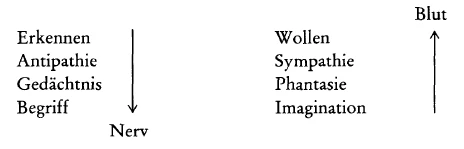
[ 26 ] Thus, the human physical form expresses how the human being is also spiritually shaped by the cosmos and what the human being, in turn, absorbs from the cosmos in a state of separation. Based on such considerations, you will therefore more easily understand that there is a great difference between the formation of the will and the formation of the imagination. If you focus particularly on the formation of imagination—if you focus one-sidedly on the formation of imagination—you are in effect pushing the whole human being back into the prenatal stage, and you will harm them if you raise them in a rationalistic way, because you are then harnessing their will to what they have actually already experienced: the prenatal stage. You must not introduce too many abstract concepts into what you present to the child in their education. You must incorporate more images into it. Why? You can see this from our compilation. Images are imaginations; they pass through the imagination and sympathy. Concepts—abstract concepts—are abstractions; they pass through memory and antipathy, and originate in prenatal life. So if you use many abstractions with the child, you will encourage the child to focus particularly intensely on the process of carbon dioxide formation in the blood, on the process of physical hardening and decay. If you teach the child as many imaginative images as possible, if you educate the child as much as possible by speaking to it in images, then you are planting within the child the seed for the continuous preservation of oxygen, for continuous becoming, because you are pointing it toward the future, toward what lies beyond death. In a sense, through our upbringing, we resume the activities that were carried out with us as human beings before birth. We must admit today: a mental image is an activity of imagery that stems from what we experienced before birth or conception. The spiritual powers have worked with us in such a way that an activity of imagery was placed within us, one that continues to have an effect even after birth. By passing on mental images to children, we begin, in our educational work, to resume this cosmic activity. We implant images in them that can become seeds, because we place them within a physical activity. Therefore, as educators who acquire the ability to work with images, we must constantly be aware that when we work with images, we are influencing the whole person—there is a resonance from the whole person.
[ 27 ] To internalize the feeling that all education is a kind of continuation of the prenatal supersensible activity—this gives all education the necessary consecration, and without this consecration, one cannot educate at all.
[ 28 ] Thus, we have acquired two conceptual systems: cognition, antipathy, memory, concept—will, sympathy, fantasy, imagination; two systems that can then serve us, when applied specifically, in everything we need to carry out in practice in our educational work. We will continue discussing this tomorrow.