

General Human Studies
as the Basis of Education
GA 293
23 August 1919, Stuttgart
Translated by Steiner Online Library
Third Lecture
[ 1 ] The modern teacher must, underlying everything he does in the classroom, possess a comprehensive understanding of the laws of the universe. It goes without saying that teaching in the lower grades—in the early stages of schooling—in particular requires the teacher’s soul to be connected to the highest ideas of humanity. A fundamental flaw in the school system to date has been that teachers in the lower grades have been kept in a certain—I would say—state of dependence; specifically, they have been confined to a sphere in which their status seemed inferior to that of teachers in the higher grades. It is not my place here, of course, to discuss this general question of the intellectual element of the social organism. But it must be pointed out that in the future, all members of the teaching profession must be on an equal footing, and that the public will need to develop a strong sense that teachers in the lower grades are entirely equal—including in terms of their spiritual constitution—to teachers in the higher grades. Therefore, it will not surprise you that we are pointing out today precisely how, in the background of all teaching—even at the lowest school levels—there must be that which, of course, cannot be used directly with the children, but which a teacher must absolutely know; otherwise, the instruction could not be fruitful.
[ 2 ] In our lessons, we introduce children to the natural world on the one hand and the spiritual world on the other. As human beings, we are indeed connected to the natural world on the one hand and to the spiritual world on the other, insofar as we are human beings here on Earth, on the physical plane, and fulfill our existence between birth and death.
[ 3 ] Psychological insight, however, is something that is exceptionally underdeveloped in our time. In particular, psychological understanding suffers from the lingering effects of that ecclesiastical dogmatic declaration issued in the year 869, which obscured an older insight based on instinctive knowledge: the insight that human beings are composed of body, soul, and spirit. Indeed, almost everywhere you hear people speaking of psychology today, you hear them speak of a mere two-part division of the human being. You hear them say that the human being consists of body and soul, or of body and spirit—whichever term one prefers to use; in this view, body and soul, as well as spirit and mind, are regarded as more or less synonymous. Almost all schools of psychology are built upon this error of the dichotomy of the human being. One cannot arrive at a true understanding of the human being at all if one turns exclusively to this dichotomy as something universally valid. Therefore, fundamentally speaking, almost everything that appears today as psychology is thoroughly amateurish, and sometimes nothing more than a play on words.
[ 4 ] But this is generally based on that great error, which only became so widespread in the second half of the 19th century because a truly great achievement in the field of physics had been misunderstood. You know, of course, that the good people of Heilbronn erected a monument in the center of their city to the man whom they had confined to an asylum during his lifetime: Julius Robert Mayer. And you know that this figure, of whom the people of Heilbronn are naturally very proud today, is associated with the so-called law of conservation of energy or force. This law states that the sum of all energies or forces existing in the universe is a constant, and that these forces merely transform one into another—so that, for example, a force may appear as heat at one time and as mechanical force at another, and so on. However, one can only frame Julius Robert Mayer’s law in this way if one thoroughly misunderstands him! For his concern was with uncovering the metamorphosis of forces, not with formulating such an abstract law as the law of conservation of energy.
[ 5 ] Viewed in a broader context, what does this law of the conservation of energy or force mean in terms of cultural history? It is the great obstacle to understanding human beings at all. For as soon as one believes that new forces are never truly created, one will be unable to gain insight into the true nature of human beings. For this true nature of human beings lies precisely in the fact that new forces are continually being formed through them. Admittedly, within the context in which we live in the world, human beings are the only beings in whom new forces—and, as we shall hear later, even new substances—are formed. But since today’s worldview is completely unwilling to incorporate elements through which human beings can be fully understood, it then resorts to this law of the conservation of energy, which, in a certain sense, is not problematic if one considers only the other kingdoms of nature—the mineral, plant, and animal kingdoms—but which immediately obliterates all true knowledge when one seeks to approach human beings.
[ 6 ] As teachers, you will need, on the one hand, to help your students understand nature and, on the other hand, to guide them toward a certain understanding of spiritual life. Without being familiar with nature, at least to a certain degree, and without having a relationship to spiritual life, people today cannot fully engage in social life. Let us therefore first turn our attention to the external world of nature.
[ 7 ] External nature presents itself to us in such a way that, on the one hand, our mental images and thoughts—which, as you know, are of a pictorial nature and are a kind of reflection of prenatal life—stand in contrast to this external nature; and on the other hand, everything that is of a volitional nature—which points, as a seed, to our life after death—turns toward nature. In this way, we are always directed toward nature. At first glance, this does indeed seem to be a twofold orientation toward nature, and it has also given rise to the misconception of the twofold division of the human being. We will return to this matter later.
[ 8 ] When we approach nature in such a way that we turn our thinking and our powers of imagination toward it, we actually perceive only that aspect of nature which is a continuous process of dying. This is an extraordinarily significant law. Be absolutely clear about this: No matter how beautiful the laws of nature you may discover—laws found with the help of the intellect and the powers of mental images—these laws always refer to that which is dying in nature.
[ 9 ] The living will, which exists in embryonic form, experiences something entirely different from these laws of nature—which pertain to the inanimate—when it turns its attention to nature. Here you will encounter a considerable difficulty in understanding, since you are likely still filled with various mental images stemming from the present age and the errors of its science. — What initially connects us to the external world through the senses—in the full scope of the twelve senses—is not of a cognitive nature, but of a volitional one. People today have, in fact, completely lost this insight. That is why they regard it as childish when they read in Plato that seeing is actually based on a kind of tentacle extending from the eyes toward objects. These tentacles, of course, cannot be perceived by sensory means; but the very fact that Plato was aware of them proves that he had penetrated into the supersensible world. In fact, when we look at things, what takes place is nothing other than a process—albeit in a more subtle way—similar to the one that occurs when we touch things. If, for example, you touch a piece of chalk, this is a physical process quite similar to the mental process that takes place when you send the etheric forces from your eye to perceive the object through sight. If people were able to observe in the present moment at all, they would be able to deduce these facts from observations of nature. If, for example, you look at a horse’s eyes, which are set wide apart, you will get the feeling that simply because of the position of its eyes, the horse is placed in a different relationship to its surroundings than a human being is. I can best explain what underlies this by posing the following hypothetical scenario. Imagine that your two arms were shaped in such a way that you would be unable to bring them together in front of you, so that they could never cross over one another. You would always have to stop at “A” in eurythmy; you could never reach “O”—a resistive force would make it impossible for you to bring your arms together in front of you by moving them forward. The horse, with regard to the supersensible tentacles of its eyes, is in this very situation: it can never allow the tentacle of the left eye to touch that of the right eye. The human being, precisely because of the position of his eyes, is able to allow these two supersensible tentacles of his eyes to touch one another continuously. This is the basis for the sensation—which is of a supersensible nature—of the “I.” If we were never able to bring the right and left sides into contact with one another, or if the contact between right and left were of such minor significance as is the case with animals—which never quite use their front paws, so to speak, for prayer or any similar spiritual purpose—then we would not attain a spiritualized sense of our self.
[ 10 ] What is important everywhere in the sensory perceptions of the eye and the ear is not so much the passive aspect; it is the active aspect—that which we deliberately bring to bear on things. Modern philosophy has, after all, sometimes had intuitions of something true and has then invented all sorts of terms, which, however, generally demonstrate how far one is from grasping the matter at hand. Thus, in the fundamental tenets of Lotze’s philosophy, such intuitions regarding the activity of the will-sensory life are present. But our sensory organism—which quite clearly demonstrates its connection to metabolism in the senses of touch, taste, and smell—is linked to metabolism all the way up to the higher senses, and this metabolism is of a volitional nature.
[ 11 ] Therefore, you can say to yourself: By standing in opposition to nature, human beings confront nature through their rational faculties and thereby grasp all that is dead within it, appropriating laws from this dead matter. But what rises in nature from the bosom of the dead to become the future of the world—that is grasped by human beings through their will, which seems so indeterminate to them and extends all the way into the senses.
[ 12 ] Imagine how vivid your relationship with nature will become if you truly take what has just been said to heart. You will then say to yourself: When I go out into nature, light and color shine out toward me; by taking in the light and its colors, I unite within myself that which nature sends forth into the future, and when I then return to my room and reflect on nature, spinning out laws about it, I am engaging with that which is constantly dying in nature. - In nature, constant dying and becoming are intertwined. The fact that we perceive dying stems from the fact that we carry within us the reflection of our prenatal life—the world of the intellect, the world of thought—through which we can perceive the dead that underlies nature. And the fact that we can perceive what nature will bring into being in the future stems from the fact that we do not merely set our intellect, our life of thought, against nature, but that we can set against it that which within ourselves is of a volitional nature.
[ 13 ] If a person could not preserve something from his pre-birth life—something that remains with him continuously throughout his earthly life—if he could not preserve something of what ultimately became mere mental life during his pre-birth existence, then he would never be able to attain freedom. For human beings would be bound to the dead, and at the very moment they sought to call that part of themselves—which is akin to dead nature—to freedom, they would be calling something dying to freedom. If he were to make use of that which connects him as a being of will to nature, he would be numbed; for in that which connects him as a being of will to nature, everything is still in a germinal state. He would be a natural being, but not a free being.
[ 14 ] Above these two elements—the mind’s apprehension of the dead and the will’s apprehension of the living, of what is becoming—there is something within the human being that only he, and no other earthly being, carries within himself from birth to death: that is pure thinking—the kind of thinking that does not relate to external nature, but relates only to that which is supersensible within human beings themselves, that which makes human beings autonomous beings, something that stands even above what is found in the subhuman and the prehuman. If, therefore, one wishes to speak of human freedom, one must look to this autonomy within the human being, to pure, senseless thinking, in which the will always lives as well.
[ 15 ] But if you look at nature itself from this perspective, you will say to yourself: I am looking at nature; the flow of dying is within me, and so is the flow of becoming anew: dying and being born again. Modern science understands very little of this connection; for to it, nature is, in a sense, a unity, and it constantly conflates the dying and the becoming, so that everything that is said today about nature and its essence is quite confused, because dying and becoming are constantly mixed together. If one wishes to clearly distinguish these two currents in nature, one must ask oneself: What would nature be like if human beings were not part of it?
[ 16 ] When faced with this question, modern science and its philosophy are, in essence, at a loss. Just imagine asking a true modern scientist: What would nature and its essence be like if humans were not part of it? He would, of course, be somewhat shocked at first, because the question would strike him as strange. But he would then reflect on the evidence his science provides for answering this question, and would say: Then there would be minerals, plants, and animals on Earth; only human beings would be absent, and the course of Earth’s history—from the very beginning, when the Earth was still in the Kant-Laplacean nebular state—would have unfolded in such a way that everything would have proceeded exactly as it has; only human beings would not have been part of that process. —Essentially, no other answer could possibly emerge. He might perhaps add: As a farmer, man tills the soil and thus alters the Earth’s surface, or he constructs machines and thereby brings about changes; but this is not so significant compared to the other transformations that occur through nature itself. Thus, the naturalist would always say: Minerals, plants, and animals would develop without the involvement of man.
[ 17 ] That is not correct. For if human beings were not present in Earth’s evolution, then animals would, for the most part, not exist; because a large portion of them—namely, the higher animals—came into being in Earth’s evolution only because human beings were compelled—I am speaking figuratively, of course—to use their elbows. At a certain stage of his earthly development, he had to separate the higher animals from his own being—which at that time was quite different from what it is now—and cast them off so that he could move forward. I would like to compare this shedding to the following: Imagine a mixture in which something is dissolved, and imagine that this dissolved substance then separates out and settles to the bottom. Thus, in his earlier stages of development, humanity was intertwined with the animal world and later excreted the animal world like sediment. The animals would not have become the animals we see today in the course of Earth’s evolution if humankind had not been destined to become what it is now. Without humankind in Earth’s evolution, therefore, animal forms and the Earth itself would look quite different from what they do today.
[ 18 ] But let us now turn to the mineral and plant worlds. We should be clear that not only the lower forms of life, but also the plant and mineral worlds would have long since become static—no longer in a state of becoming—if human beings were not on Earth. Again, it is necessary for today’s worldview—which is based on a one-sided view of nature—to say: Well, people die, and their bodies are cremated or buried and thus returned to the earth; but this has no significance for the earth’s development; for if the earth’s development did not absorb human bodies, it could proceed just as it does now, since it does absorb human bodies. — This means, however, that people are completely unaware that the continuous return of human corpses to the earth—whether through cremation or burial—is a real process that continues to have an effect.
[ 19 ] Women farmers in the countryside are even more aware than women in the city that yeast plays a certain role in baking bread, even though only a small amount is added to the dough; they know that the bread could not rise unless yeast were added to the dough. Likewise, however, the Earth’s evolution would have long since reached its final state if it were not continually supplied with the forces of the human corpse, which is separated from the spiritual-soul aspect upon death. It is through these forces—which the Earth’s evolution continually receives through the addition of human corpses, or rather, through the forces contained within the corpses—that the Earth’s evolution is sustained. As a result, minerals are prompted to continue unfolding their crystallization forces even today—forces they would have long since ceased to unfold without these contributions; they would have crumbled and dissolved long ago. This causes plants that would otherwise have long since ceased to grow to continue growing even today. And the same is true with regard to lower animal forms. Through his body, the human being imparts to the Earth the ferment—as it were, the leaven—for further development.
[ 20 ] Therefore, it is not irrelevant whether humans live on Earth or not. It is simply not true that Earth’s evolution—with regard to the mineral, plant, and animal kingdoms—would continue to progress even if humans were not present! The natural process is a unified, closed system of which human beings are a part. A proper mental image of human beings can be formed only if they are conceived—even after death—as still being part of the cosmic process.
[ 21 ] If you consider this, you will hardly be surprised when I go on to say the following: By descending from the spiritual world into the physical world, a human being receives the garment of his physical body. But of course, the physical body is different when one receives it as a child than when one sheds it through death at any stage of life. Something has happened to the physical body. What has happened to it can only occur because this body is permeated by the human being’s spiritual and soul forces. Isn’t that so? After all, we all eat the same things that animals eat; that is to say, we transform external substances just as animals do, but we transform them through the active participation of something that animals do not possess—something that descends from the spiritual world to unite with the physical human body. Through this, we do something different with the substances than animals or plants do with them. And the substances that are returned to the earth from the human body are transformed substances; they are something different from what the human being received at birth. Therefore, we can say: The substances that a human being receives, as well as the forces received at birth, are renewed during the course of life and returned to the earthly process in a transformed form. The substances and forces that a human being returns to the earthly process at death are not the same as those received at birth. Thus, he contributes to the earthly process something that, through him, continually flows from the supersensible world into the physical-sensory earthly process. At birth, he brings down something from the supersensible world; this, having been incorporated into the substances and forces that compose his body during his life, is then returned to the earth at his death. In this way, the human being continually mediates the trickling down of the supersensible into the sensible and the physical. You can form a mental image of something that is continually raining down from the supersensible into the sensible; yet these drops would remain entirely barren for the earth if the human being did not take them in and, through himself, convey them to the earth. These drops, which human beings absorb at birth and release at death, constitute a continuous fertilization of the earth by supersensible forces, and it is through these fertilizing, supersensible forces that the earth’s evolutionary process is sustained. Without human corpses, therefore, the earth would have been dead long ago. Birth Death
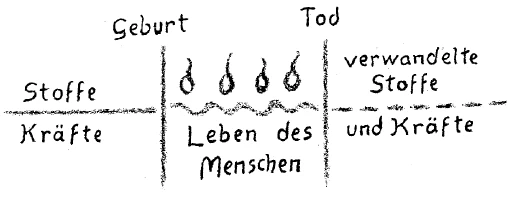
[ 22 ] Having established this, we can now ask: What do these deadly forces do to human nature? The deadly forces that prevail in the external natural world do indeed influence human nature; for if human beings did not continually breathe life into the external natural world, it would wither away. How, then, do these life-destroying forces operate within human nature? They operate in such a way that human beings, through them, bring forth all those systems that lie along the line from the skeletal system to the nervous system. What builds up the bones and everything related to them is of a completely different nature than what builds up the other systems. The life-destroying forces are at work within us: we leave them as they are, and thereby we are “bone people.” But the life-destroying forces are also at work within us in another way: we weaken them, and thereby we are “nerve people.” — What is a nerve? A nerve is something that constantly strives to become bone, but is prevented from doing so only because it is connected to non-bony or non-nervous elements of human nature. The nerve constantly strives to ossify; it is constantly driven to wither away, just as the bone in humans is always something that is, to a high degree, dead. The situation is different with animal bones; they are much more alive than human bones. — So you can create a mental image of human nature by saying: The death-bringing current is at work in the skeletal and nervous systems. That is one pole.
[ 23 ] The constantly life-giving forces—the other current—are at work in the muscular and circulatory systems and in everything associated with them. Nerves are not bones at all simply because they are connected to the blood and muscular systems in such a way that the impulse within them to become bone is counteracted by the forces acting in the blood and muscles. The nerve does not become bone only because the blood and muscular systems oppose it and prevent it from becoming bone. If, during growth, there is an incorrect connection between bone on the one hand and blood and muscles on the other, rickets results—which is the prevention of the proper resorption of bone by the muscle-blood nature. It is therefore extremely important that the correct interaction take place in humans between the muscle-blood system on the one hand and the bone-nerve system on the other. Because the bone-nerve system extends slightly into our eye, while the bone system withdraws into the eye’s lining and sends in only its attenuated form—the nerve—the eye is able to connect the will-like entity that lives in muscle and blood with the imaginative activity inherent in the bone-nerve system. This brings us back to something that played a major role in older science but is now derided by modern science as a childish mental image. Yet modern science will return to it once again, albeit in a different form.
[ 24 ] The ancients, in their understanding, always sensed a connection between the nervous marrow, the nervous substance, and the bone marrow or bone substance, and they believed that one thinks with the bone just as one does with the nerves. This is indeed the truth. We owe everything we have in the realm of abstract science to the capacity of our skeletal system. Why, for example, is a human being able to develop an understanding of geometry? Higher animals have no geometry; this is evident from their way of life. It is sheer nonsense when some people say: Perhaps higher animals also have geometry; we just don’t notice it. — So it is the human being who develops an understanding of geometry. But how, for example, do they form the mental image of a triangle? Anyone who truly reflects on this fact—that human beings form the mental image of a triangle—must find it marvelous that human beings create the triangle, the abstract triangle, which exists nowhere in concrete life, purely out of their geometric-mathematical imagination. There is much that is unknown underlying the events of the world that are apparent. Imagine, for example, standing in a certain spot in this room. At certain times, as a supersensible human being, you perform strange movements of which you are usually unaware, something like this: you take a small step to one side, then you take a small step back, and then you return to your spot. The line in space that you describe—which remains unconscious to you—actually follows a triangular path. Such movements do indeed exist; you simply do not perceive them. However, because your spine is aligned vertically, you are situated within the plane in which these movements occur. The animal is not within this plane; its spinal cord is oriented differently, so these movements are not performed there. Because the human being has a vertically aligned spinal cord, he is within the plane where this movement takes place. He does not bring this to conscious awareness by saying to himself, “I am constantly dancing in a triangle.” — But he draws a triangle and says, “That’s a triangle!” — In truth, this is an unconsciously performed movement that he carries out in the cosmos.
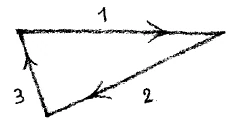
[ 25 ] These movements, which you capture in geometry by drawing geometric figures, are performed by the Earth. The Earth does not merely undergo the motion described by the Copernican worldview; it also performs entirely different, artistic movements that are carried out there continuously. And even more complex movements are carried out—such as those found in the lines that define geometric solids: the cube, the octahedron, the dodecahedron, the icosahedron, and so on. These solids are not inventions; they are reality—albeit an unconscious reality. In these and other geometric forms, there are strange echoes of this knowledge that lies in the human subconscious. This is brought about by the fact that our skeletal system possesses an essential insight; but your consciousness does not extend down to the skeletal system. Awareness of this fades away; it is reflected only in the images of geometry that human beings create as such. Human beings are very deeply connected to the cosmos. By developing geometry, they recreate something that they themselves do within the cosmos.
[ 26 ] On the one hand, we look into a world that encompasses us and is constantly dying. On the other hand, we look into everything that extends into the forces of our blood-muscle system: this is in constant motion, in constant fluctuation, in constant becoming and emerging; it is entirely germinal—there is nothing dead there. We hold back the process of dying within ourselves, and only we as human beings can halt it and bring it into the dying process of becoming. If human beings were not here on Earth, the process of dying would long since have spread throughout the Earth’s process, and the Earth as a whole would have undergone a great crystallization. But the individual crystals would not have been preserved. We snatch the individual crystals from the great crystallization and preserve them as long as we need them for our human evolution. But in doing so, we also keep the life of the Earth active. It is therefore we humans who keep the Earth’s life active, who cannot be excluded from the Earth’s life. That is why it was already a genuine thought on the part of Eduard von Hartmann—who, out of his pessimism, wanted humanity to one day become so mature that all people would kill themselves. There is no need to add what Hartmann sought to achieve out of the narrowness of the scientific worldview: for it would not have been enough for him that all people would one day kill themselves; he also wanted to blow up the Earth through a large-scale undertaking. He wouldn’t have needed to do that. He would only have had to decree the day of the great suicide, and the Earth would have slowly blown itself up all on its own! For without what is transplanted into the Earth by human beings, the Earth’s evolution cannot continue. We must once again let this insight sink into our hearts. It is essential that these things be understood in the present.
[ 27 ] I do not know if you recall that a certain thought recurs throughout my very earliest writings—a thought through which I sought to place knowledge on a different foundation than it stands on today. In external philosophy, which stems from Anglo-American thought, human beings are essentially mere spectators of the world; with his inner soul processes, he is a mere spectator of the world. It is believed that even if human beings did not exist—even if they did not relive in their souls what is happening in the outside world—everything would still be as it is. This applies to the natural sciences with regard to the development of facts that I have cited, but it also applies to philosophy. Today’s philosopher feels quite at home as a spectator of the world—that is, within the merely deadened element of cognition. I wanted to lead cognition out of this deadened element. That is why I have repeatedly said: Human beings are not merely spectators of the world, but they are the stage upon which the great cosmic events play out again and again. I have said time and again: Through his inner life, the human being is the stage upon which world events unfold. This can also be expressed in a philosophical-abstract form. And especially if you read the concluding chapter on freedom in my work *Truth and Science*, you will find that this idea is strongly emphasized: that what takes place within the human being is not something equivalent to the rest of nature, but rather that the rest of nature extends into the human being, and that what takes place within the human being is at the same time a cosmic process—so that the human soul is a stage upon which a cosmic process unfolds, not merely a human one. Naturally, this is still difficult for certain circles to understand today. But without imbuing oneself with such views, it is impossible to become a true educator.
[ 28 ] What actually happens within the human being? On the one hand, there is the bone-nerve nature; on the other, the blood-muscle nature. Through the interaction of both, substances and forces are continually being created anew. The Earth is preserved from death by the fact that substances and forces are created anew within the human being itself. Now you can connect what I have just said—that the blood, through its contact with the nerves, brings about the creation of new substances and forces—with what I said in the previous lecture: that the blood is constantly on the path toward spirituality and is held back in the process. We will combine these ideas, which we have gained in these two lectures, and then build upon them further. But you can already see how erroneous the idea of the conservation of force and matter is, as it is usually presented: for it is refuted by what takes place within human nature, and for a true understanding of the human being, it is merely an obstacle. Only when we regain the synthetic idea that, while it is true that nothing can arise from nothing, one thing can be transformed in such a way that it ceases to exist and another comes into being—only when we have replaced the idea of the conservation of energy and matter with this idea—will we be able to achieve something fruitful for science.
[ 29 ] You can see in what ways some of the ideas that live in our thinking are mistaken. We formulate something—such as the law of conservation of energy and matter—and proclaim it as a universal law. Underlying this is a certain tendency in our mental images, indeed in our spiritual life as a whole, to describe things in a one-sided manner, whereas we should only formulate postulates based on what we develop in our imagination. For example, in our physics textbooks you will find the law of the impenetrability of bodies set forth as an axiom: At the point in space where a body is located, no other body can be present at the same time. — This is presented as a general property of bodies. But one should only say: Those physical entities or beings that are such that, at the point in space where they are located, no other being of the same nature can exist at the same time—these are impenetrable. —One should merely use these concepts to distinguish one domain from another; one should merely formulate postulates and should not provide definitions that claim to be universal. Likewise, one should not formulate a law of the conservation of energy and matter, but rather seek to determine for which entities this law holds significance. It was precisely an endeavor of the 19th century to formulate a law and declare: “This applies to everything”—instead of using our spiritual life to approach things and observe what we experience in them.