

The Art of Education
Methodology and Didactics
GA 294
1 September 1919, Stuttgart
Translated by Steiner Online Library
Tenth Lecture
[ 1 ] We will now try to make some progress in teaching methodology by, from now on in these classes, paying a little more attention to the curriculum and a little more attention to what the course material will be within that curriculum. We won’t have everything that’s supposed to be in the curriculum right away, because we’ll be structuring our future approach in a step-by-step manner.
[ 2 ] I first presented you with some considerations that offer the possibility of incorporating certain elements into the educational stages. How many educational stages will we essentially distinguish during elementary school? Based on what we have learned, we see a significant turning point around the age of 9, so that we can say: When a child reaches the age of 9, we have the first period of elementary school education. What will we do during this time? We will take the arts as our starting point. We will engage the child in both music and painting and drawing in the way we have discussed. We will gradually allow writing to emerge from painting and drawing. We will thus gradually develop written forms from the drawn forms and then move on to reading.
[ 3 ] It is important that you understand the reasons for this approach—that you do not begin by reading and then move on to writing, but rather that you transition from writing to reading. Writing is, in a sense, even more vibrant than reading. Reading tends to isolate people greatly and draw them away from the world. In writing, we still imitate the forms of the world when we approach writing through drawing. Printed letters have already become extraordinarily abstract. They did, after all, originate from cursive letters; therefore, in class, we also have students derive them from cursive letters. It is absolutely correct, at least for writing instruction, not to break the thread that leads from the drawn form to the written letter, so that the child, in a sense, can still sense the originally drawn form within the letter. In this way, you overcome the otherworldliness of writing. As a person finds their way into writing, they are, after all, acquiring something very otherworldly. But when we link the written forms to forms from the world—such as “f” for “fish” and so on—we at least lead people back to the world. And it is very, very important that we do not sever people’s connection to the world. The further back we go in culture, the more vividly we find this connection between human beings and the world. You need only conjure up an image in your mind, and you will understand what I have just said. Instead of me, who is speaking here, imagine—by transporting yourself back to ancient times—a Greek rhapsode reciting Homer to his people in that peculiar manner of the time, in that hybrid form between song and speech that we no longer have; and imagine someone sitting next to this Homer-reciting rhapsode, taking shorthand. A grotesque image! Impossible, utterly impossible! Utterly impossible for the simple reason that the Greeks had a memory quite different from ours and were not compelled to invent something as alien to the world as stenographic forms in order to retain what reaches people through language. You can see from this that something immensely destructive must constantly find its way into our culture. We need this destructive element. After all, we cannot do without shorthand in our entire culture. But we should become aware that it has a destructive aspect. For in truth—what is this appalling habit of transcribing shorthand in our culture? In our culture, this is nothing other than when we can no longer cope with our proper rhythm between waking and sleeping and use our sleeping hours to engage in all sorts of activities, thereby implanting something into our inner life that, by its very nature, it would no longer absorb. Through our “stenography,” we preserve within our culture something that, according to our present natural disposition, a human being—if left to his own devices—would not heed but would forget. We thus artificially keep alive in our culture something that destroys our culture just as the students’ nightly toiling, when they are overzealous, destroys their health. Our culture is therefore no longer entirely healthy. But we must be clear that we have already crossed the Rubicon; that occurred in the Greek era. The Rubicon was crossed back then, when humanity still possessed a completely healthy culture. Culture will become increasingly unhealthy, and people will have to turn the educational process more and more into a healing process against whatever in their environment is causing illness. We must not harbor any illusions about this. That is why it is so infinitely important to reconnect writing with drawing and to teach writing before reading.
[ 4 ] Then one should begin the calculations a little later. Since there is no single, exact point in a person’s life development, this can be adjusted according to other factors that must be taken into account. So one should begin arithmetic a little later. We will then incorporate the relevant details into the plan later on and begin arithmetic as I have shown you. However, a certain amount of foreign language instruction will always be incorporated into this entire plan at the first stage, because it is a cultural necessity; but at this age, these foreign languages must still be taught as a means of learning to speak, by treating the children in such a way that they learn to speak the foreign language.
[ 5 ] It is not until the second stage—from age 9 to about age 12—that we begin to develop self-awareness more fully. And we do this through grammar. By then, through the changes the child has undergone—which I have described to you—the child is already capable of incorporating into their self-awareness what grammar can offer; specifically, we deal with morphology at this stage. But then we begin with the natural history of the animal kingdom, just as I demonstrated to you with the octopus, the mouse, and the human being. And only later do we move on to the plant kingdom, as you intend to demonstrate to me this afternoon.
[ 6 ] And now, at this stage of a person’s development, we can also move on to geometry, whereas before we had kept what would later become geometry entirely within the realm of drawing. Through drawing, we can help a person develop an understanding of the triangle, the square, the circle, and the line. So we develop the actual shapes through drawing, by drawing them and then saying: “This is a triangle; this is a square.” But what comes into play as geometry—where we explore the relationships between the shapes—we don’t begin until around the age of 9. Of course, foreign language instruction continues during this time and also feeds into the study of grammar.
[ 7 ] Finally, we introduce the child to concepts in physics. Then we move on to the third stage, which lasts until the end of elementary school—that is, until the child is 14 or 15 years old. At that point, we begin to teach syntax. Children do not actually become ready for this until around age 12. Before that, we instinctively encourage activities that allow children to construct sentences.
[ 8 ] Now the time has come when we can move on to the mineral kingdom using geometric forms. We will examine the mineral kingdom in constant relation to the physical realm, which we also apply to human beings, as I have already said: Refraction—the lens of the eye; that is, physically and chemically. Then, at this stage, we can move on to history. Geography—which we can always support through natural history by introducing physical concepts, and through geometry by drawing maps and incorporating physical concepts—we approach geography through all of this and ultimately connect it with history. That is, we show how different peoples have developed their characters. We carry this out throughout these two childhood stages. Foreign language instruction, of course, continues and is expanded to include syntax.
[ 9 ] Of course, we will have to carefully take various factors into account. After all, we cannot—by starting to make music with the young children entrusted to us—conduct these musical activities in a classroom at the same time that the other children are engaged in activities requiring quiet while they study. So we’ll have to schedule painting and drawing activities for the young children in the morning and music activities for the late afternoon. We’ll also have to organize the school’s physical layout so that these activities can take place side by side. For example, we cannot have the children recite poems or discuss history while the little ones are playing the trumpet in the next room. These are matters that are closely related to the structure of the curriculum, and we will have to carefully consider them when organizing our school—such as which activities should be scheduled for the morning or afternoon and so on. Now the point is that, since we are familiar with these three levels of the curriculum, we have the opportunity to take the children’s varying abilities into account. Of course, we’ll have to make compromises, but I’ll focus more on the ideal scenario for now and later shed light on the curricula of current schools so that we can reach a proper compromise. We would do well—ideally speaking—to make the boundaries between classes less rigid within each stage than when moving from one stage to the next. We should bear in mind that a uniform progression can really only take place between the first and second stages and between the second and third stages. For we will find that the so-called less gifted students usually just take longer to grasp concepts. Thus, throughout the grades of the first level, we will have the gifted students—who will grasp things earlier but process them later—and the less gifted students, who will struggle at first but eventually come to understand. We will certainly make this observation, and therefore we should not form a judgment too early about which children are particularly gifted and which are less so. Now, as I have already emphasized, we will have children who have already gone through a wide variety of classes. The older they are, the more difficult it will be to work with them. But we will still be able, to a large extent, to reverse the distortions that have been imposed on them, provided we make the necessary effort. Thus, once we have done what we emphasized the day before yesterday with regard to foreign languages—Latin, French, English, and Greek—we will not fail to move on as soon as possible to doing what gives the children the greatest joy: letting them converse with one another in class in the language in question, with the teacher merely guiding this conversation. You will find that the children truly enjoy it when they converse with one another in the language in question and the teacher does nothing but correct them—or, at most, guide the conversation; for example, if one student says something particularly boring, the teacher redirects the conversation toward something interesting. This is where the teacher’s presence of mind must play a very special role. You really have to feel as if the students in front of you are a choir that you have to conduct—but with even greater focus on their inner world than a conductor has when leading an orchestra.
[ 10 ] The point, then, is for you to ascertain what poems the students have learned in the past, what they have retained from other lessons and the like—in short, what they can present to you from their memory as a treasure. And you should base every lesson in the foreign language on this treasure that the children hold in their memories—in particular, you should build upon it when covering the grammar and syntax they need to catch up on; for it is of particular importance that what the children have absorbed by heart—such as poems and the like—remains with them, and that they can build upon it when they later wish to recall the rules of grammar or syntax in order to use a language. I have said that it is not good to overburden the memory with the sentences one constructs during grammar lessons—and through which one learns the rules—by having students write these sentences down. They can be forgotten. Instead, what one learns from these sentences should be transferred to the things one has retained in memory. That way, what one has retained in memory will later serve as an aid in mastering the language. When one later writes a letter in the language or converses in it, one should be able to quickly and spontaneously recall—based on what one has learned in this way—what constitutes a good turn of phrase. Taking such things into account is part of the efficiency of instruction. One must also know what makes foreign-language instruction particularly efficient—or what hinders it. If one reads something aloud to the children in class while they have the books in front of them and read along, that is nothing but time stolen from the children’s lives. That is the very worst thing one can do. The correct approach is for the teacher to present what he wants to convey in a narrative manner, or—even if he reads a passage verbatim or recites a poem—to present it personally from memory without a book, and for the students to do nothing but listen—that is, not to read along; and that, if possible, what has been heard be reproduced without having been read beforehand. This is important for foreign-language instruction. For instruction in the native language, this does not need to be taken into account as much. But with a foreign language, it is very important to ensure that understanding comes through listening and not through reading, and that comprehension is achieved through spoken expression. Once the time allotted for such activities has ended, the children can be allowed to take the book and read it afterward. Or, provided it does not overburden the children, they can simply be given homework assignments to read from their book what was covered orally during school hours. Homework in foreign languages should also be limited primarily to reading practice. So whatever is to be written should actually be done in school itself. In foreign languages, as little homework as possible should be assigned, and only at later levels—that is, after the age of 12; but even then, only on topics that actually occur in real life: writing letters, composing business communications, and the like. In other words, things that actually happen in life. Having students write essays in a foreign language in class that have no connection to real life is, in fact, not quite—but to a greater degree—nonsense. One should stick to letters, business communications, and the like. At most, one could go so far as to cultivate narrative writing. The narrative account of events and experiences should indeed be emphasized much more than the so-called free composition in elementary school. The free composition does not really belong in elementary school yet. But the narrative presentation of what has happened and what has been heard does belong in elementary school, because the child must absorb this; otherwise, the child cannot participate socially in human culture in the proper way. In this area, our contemporary “cultured” people generally observe only half the world, not the whole.
[ 11 ] As you know, experiments are currently being conducted that are specifically intended to serve the field of criminal psychology. These experiments are conducted, for example, in the following way—I’ll cite a case, since people today want to establish everything through experiments: One sets out to hold a lecture series; the experiments are conducted at the university level, specifically at universities. So, in order to make this seminar experimental, they make a precise agreement with a student or attendee, as they say: I, as the professor, will step up to the lectern and say the first words of a lecture. Okay, let’s write that down now. At that very moment, you’ll jump up onto the lectern and rip the coat off the hook where I’d hung it earlier. — So the student has to carry out exactly what has been specified. Then the professor acts accordingly: he lunges at the student to prevent him from taking down the coat. Now we specify further: we get into a scuffle. We precisely define the movements we’ll make. We rehearse it thoroughly and memorize it well in order to carry out the entire scene as planned. Then the audience, who knows nothing—after all, we’re only discussing all this with one student—will react in some way. We can’t determine that in advance. But we’ll try to bring in a third person to keep the secret, who will now take precise notes on what the audience does. So, now we’ve carried out the experiment. Afterward, we’ll have the audience—every single student—write down the scene.
[ 12 ] Such experiments have been conducted at universities. The experiment I just described was in fact carried out, and it turned out that when there is an audience of about 30 people, at most 4 or 5 write down the process correctly! This can be confirmed because everything was discussed in detail beforehand and carried out exactly as planned after the discussion. So barely one-tenth of the audience writes down the procedure correctly. Most people write down all sorts of crazy things when such a procedure takes them by surprise. Today, when experimentation is so popular, this is something that’s done very often, and from which the important scientific conclusion is then drawn that witnesses called to testify in court are not credible. After all, if even educated people in a college lecture hall—and they’re all educated people, aren’t they?—handle an event in such a way that only one-tenth of them write it down correctly, while the others write down something incorrect and some even write down some really outlandish stuff, how can we expect witnesses in court proceedings to accurately recount an event they may have witnessed weeks or even months ago? Common sense tells us this from everyday life. After all, in everyday life, people usually recount what they’ve seen incorrectly and only very rarely correctly. You really have to have a knack for telling whether something is being recounted correctly or incorrectly. Barely one-tenth of what people on the right and left tell you is true in the strict sense that it is an account of what actually happened.
[ 13 ] But the fact is, people only do half of what needs to be done; they focus on the half that, if one really used common sense, could be left out, because the other half is the more important one. We should ensure that our culture develops in such a way that we can rely more on witnesses and that people speak the truth more often. But to achieve this, we must begin in childhood. And that is why it is important to have children retell what they have seen and experienced, rather than focusing on having them write creative essays. In this way, children will develop the habit of not making things up—whether in daily life or, potentially, in court—but of telling the truth in light of observable, sensory facts. In this area, too, the volitional aspect should be given greater consideration than the intellectual. By first discussing that process in that auditorium and then determining the outcome based on the audience’s statements, the aim was to find out to what extent people lie. This is something that is understandable in an intellectualistic age such as ours. But we must bring this intellectually oriented age back to the realm of the volitional. Therefore, in pedagogy, we must pay attention to such details that, once children are able to write—and especially after the age of 12—we allow them to recount what they have actually seen, rather than placing too much emphasis on free composition, which does not yet truly belong in elementary school.
[ 14 ] It is also particularly important that, in foreign language instruction, we gradually help students learn to recount what they have seen and heard in a short narrative. But then it is necessary to cultivate, in particular, the reflexive, instinctive aspect of language—that is, to give the children commands as much as possible: “Do this, do that”—and then have them carry them out, so that in such classroom exercises, what the teacher says is followed not so much by reflection on what was said or by a slow verbal response, but by action. In this way, the volitional and the motor aspects are also cultivated in language instruction. These, in turn, are things you must carefully consider and internalize, and which you must specifically take into account when conducting foreign-language instruction. It will always be a matter, in particular, of knowing how to properly combine the volitional with the intellectual.
[ 15 ] Now it will be important that, while we do use visual instruction, we do not trivialize it. The child should never feel that what we present as visual instruction is actually something to be taken for granted. I’ll show you a piece of chalk. What color is the chalk? — It’s yellow. What’s the chalk like at the top? — It’s broken off. — Many hands-on lessons are taught in this manner. It is dreadful. For what is actually self-evident in life should not be taught as a hands-on lesson. Hands-on lessons should definitely be elevated to a higher sphere. At the same time, the child should be transported to a higher sphere of their inner life through visual instruction. Of course, you can do this particularly well when you combine visual instruction with geometry.
[ 16 ] Geometry offers you an exceptionally good example of how to combine visual instruction with the subject matter of geometry itself. For example, you first draw a right-angled, isosceles triangle for the child. As you draw this for the child, you can attach a square to the bottom of this triangle so that the square is adjacent to the right-angled isosceles triangle (see Figure I). Now, if you haven’t already taught the child this, explain that in a right-angled triangle, sides a and b are the legs and c is the hypotenuse. You have constructed a square on top of the hypotenuse. Of course, all of this applies only to an isosceles triangle. Now divide the square with a diagonal. Create a red section (top and bottom) and a yellow section (right). Now tell the child: “I’m cutting out the yellow section here and placing it next to it” (see Drawing II). And now place the red part next to the yellow part as well. You have now constructed a square over one of the legs, but this square is composed of a red piece and a yellow piece. What I have drawn next to it (see Figure II) is therefore exactly as large as the red and yellow parts combined in Figure I and is half the area of the square with the hypotenuse. I will now do the same for the other side using blue chalk and attach the blue piece at the bottom so that I again obtain an isosceles right triangle. I will now draw this out again (see Figure III). Now I have the square over the other leg once more.
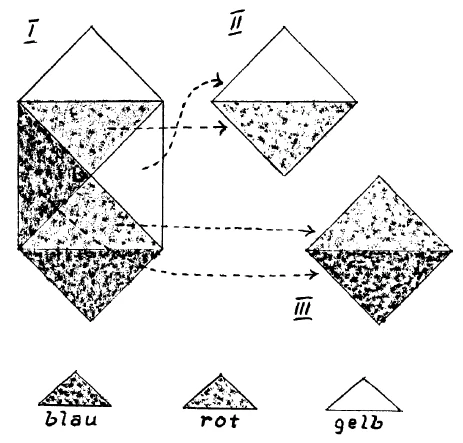
[ 17 ] Schopenhauer was incredibly annoyed in his day because the Pythagorean theorem was not taught that way in schools, and he expressed this in his book *The World as Will and Mental Image* by saying, in his somewhat blunt manner: How foolish schools are not to teach something like this simply by superimposing figures, so that one can grasp the Pythagorean theorem through visual perception. - At first, this applies only to an isosceles triangle, but you can do the same thing with a scalene right triangle by folding the shapes together, just as I’ve just explained to you. That is visual instruction. You can structure geometry as visual instruction. But it is significant—and I have often tested this myself—if you work toward making the Pythagorean theorem concrete for children after the age of 9, doing so in a way that you yourself aim to construct the Pythagorean theorem for the child directly from the individual flaps of the hypotenuse square. And if, as a teacher, you are conscious of this goal in the lead-up to the geometry lesson, then in 7 to 8 hours at most you can teach the child everything necessary in geometry to reach the Pythagorean theorem—the well-known mnemonic—in class. You will proceed with tremendous efficiency if you present the very basics of geometry in this concrete and vivid way. You will save a great deal of time, and moreover, you will spare the child something very important—something that has a destructive effect on instruction if it is not avoided—namely: You do not have the child engage in abstract thinking to understand the Pythagorean theorem, but rather you have them engage in concrete thinking, moving from the simple to the complex. One should first, as shown here in the drawing for the isosceles triangle, construct the Pythagorean theorem from the triangles, and only then move on to the scalene triangle. Even where it is illustrated today—which is already happening—it is not done with reference to the Pythagorean theorem as a whole. The simple process that effectively prepares students for the more complex concepts is not first carried out using the isosceles triangle, and only then is the transition made to the scalene right triangle. However, it is important to consciously incorporate this into the objectives of geometry instruction. So, I ask you to consider the application of different colors. The individual faces should be colored, and then the colors should be layered on top of one another. Most of you have probably already done something similar, but not in this way.
I. Up to age 9
Music—Painting and Drawing
Writing—Reading
Foreign languages. Arithmetic a little later.II. Up to age 12 (Geography)
Grammar, vocabulary
Natural history of the animal kingdom
and the plant kingdom
Foreign languages. Geometry
Concepts of physics.III. Through the end of elementary school (Geography)
Syntax
Minerals
Physics and Chemistry
Foreign Languages
History.