

Spiritual-Scientific Linguistic Considerations
A Suggestion for Educators
GA 299
29 December 1919, Stuttgart
Translated by Steiner Online Library
Third Lecture
[ 1 ] The facts of life often lead, when viewed from the outside, to contradictions; but it is precisely when one subjects such contradictions to proper examination that one arrives at the deeper, essential connections. If you reflect on it thoroughly enough, you can identify such a contradiction between what I explained to you in the first lecture here and summarized in the second, and what I then discussed yesterday using specific examples as an internal connection among European languages. Let us now visualize the two sets of facts characterized by this: On the one hand, we have pointed out that we find many intruders in the current state of our language; that we sense how, coming from the south with Christianity into our regions, something else has been added to the original Germanic linguistic richness—something that, in a sense, brought Christian words along with Christian ideas and Christian sentiments; so that these Christian words now exist within our linguistic system in the manner described. Then I spoke of other intruders that are nonetheless significant because they are already part of the scope of our linguistic system; of those invasions that began around the 12th century, originating from Western Romance-speaking countries, and which also occurred during a period in which the German linguistic genius possessed a transformative power. At that time, the German language still reshaped what it received from the West in its own way—reshaping it phonetically and also semantically. I said at the time: Few people today realize, for example, that the word fein used in German is actually of French origin—fin—and that it did not enter our linguistic system until after the 12th century; it was not there before. — I then pointed out how Spanish, too, made its way into the language at a time when the transformative power of the German language system was no longer present; and how this transformative power had completely vanished by the time, in the latter part of the 18th century—but especially in the 19th century—elements of English began to enter the German language system. We see time and again that words were adopted into Central Europe from Latin, or from Greek—via the detour through Latin—or, in turn, from the Western Romance languages. This is a fact that must lead us to say: Our current vocabulary consists only in part of native elements and also incorporates later adoptions. But now I have once again drawn your attention to the close kinship that exists among a whole series of languages. I have pointed out to you certain Gothic forms and shown how these were subsequently incorporated into the forms of our language; and in some instances we have been able to point out how the word in question can also be found in Latin or Greek. So while we must say, “Our language has incorporated foreign elements,” we must also say, “Our language is fundamentally related to those languages from which it later incorporated elements that were, in a sense, foreign.”
[ 2 ] Now it is very easy to demonstrate—albeit not in a very comprehensive sense, but using characteristic examples—that there is a primordial linguistic kinship extending across other regions of the world. You need only take something like naus, the Sanskrit word for ship. If you look up this word in Greek, you’ll find the same thing; if you look it up in Latin, you’ll find navis. If you look up the same word in regions with a stronger Celtic influence, you’ll find the word nau; if you look it up in Old Norse or the Old Scandinavian languages, you’ll find nor. The fact that such words have been discarded in German is of little consequence. But we see that there is a kinship on a vast scale—a kinship that we can demonstrate in many cases, indeed across an extraordinarily large area spanning Europe and Asia. Take the Old Indian word aritras; we find the word again as eretmón in Greek; we find the same word, with certain alterations, as remus in Latin; we find rame in Celtic regions, and we find ruodar in Old High German. We still have this word; it is our Ruder. And so one could compile a large number of words that exist in transformed forms across vast areas of language: for example, in Gothic, the Nordic-Scandinavian languages, the Frisian languages, the Low German languages, High German, as well as in Baltic languages, Lithuanian, Latvian, and Prussian. Such affinities can also be demonstrated in Slavic languages; in Armenian, Iranian, Indian, Greek, Latin, and Celtic. Across the regions of these languages, we see how a primordial linguistic kinship exists. Thus, we can very easily form a mental image of how, in a sense, the causes of language formation across all these territories were similar in very ancient times, and that they only later became differentiated.
[ 3 ] I said: These two sets of facts contradict each other; but it is precisely by observing such contradictions that one can gain a fundamentally deeper insight into certain aspects of life. For it is precisely through such a series of phenomena that we are led to say to ourselves: The development that humanity undergoes in the course of history does not take place, as is often imagined, in a truly continuous manner, but rather in a kind of wave-like motion. For how else are you to form a mental image of this entire process—expressed by these two seemingly contradictory facts—other than by assuming that a certain kinship exists among the populations across these vast territories; that these peoples remain isolated for a certain period of time, during which they develop their distinct linguistic varieties; that there is, in other words, a period of isolation among the peoples, and that this alternates with a period in which one people exerts influence on another. Admittedly, this is a somewhat crude characterization of the matter; but only by considering such an ebb and flow can certain facts truly be explained. Now, if one considers the development of language in both directions, as I have just indicated to you, one can gain deeper insights into the nature of cultural development in general. One need only consider, on the one hand—and we will now apply this to the development of the German language—the way in which certain linguistic elements develop, as it were, in isolation from the outside world, and how, in turn, foreign elements are absorbed and also contribute to the entire spiritual and psychological life that can be expressed through language. We can already surmise that these two elements must relate in very different ways to the spiritual and psychological life of the people in question.
[ 4 ] On the one hand, we can point to the extraordinarily significant fact that there is a primordial kinship, which becomes particularly evident when we see that extremely important words are related—for example, in Latin and in the older forms of the Central European languages. Latin verus: true; Old High German: wâr. If you take such striking examples as: velle = to want, or the Latin taceo = I am silent, corresponding to the Gothic thahan, then you must conclude that similar-sounding words—that is, linguistically related ones—were prevalent in ancient times across vast regions of Europe—and one could also demonstrate this for Asia.
[ 5 ] On the other hand, it is extremely curious that the inhabitants of Central Europe—from whom today’s Germans eventually emerged—also adopted foreign linguistic elements relatively early on. Even earlier than I have described to you so far. There was a time when Europe was much more permeated by the Celtic element than in the historical periods of which we usually speak. The Celts, however, were subsequently pushed into the western regions of Europe, and Germanic peoples migrated into Central Europe, most certainly from northern regions. Now, even from the Celts—who were their western neighbors at the time—the Germanic peoples adopted foreign lexical elements just as they later adopted them from the south, from Latin. This means that the inhabitants of Central Europe, after having developed in relative isolation while others developed independently, later continuously adopted foreign linguistic elements from the peripheral regions, which were, however, originally linguistically related to them.
[ 6 ] We have quite a few words that are no longer considered particularly elegant; take, for example, the word Schindmähre: it refers to a worn-out horse. This Schindmähre points to an even older word: Mähre, meaning “horse”; from which we still have, for example, the word Marstall. This word, however, is of Celtic origin and is found among the Celts after they had already been pushed into Western Europe. And there is likely no metamorphosis that would have occurred first in Central Europe and then in the West; rather, the Germanic peoples must simply have adopted this word from the Celts at a later date. And a whole series of such words was adopted, though this also includes those for which there is a transformative force. For example, in the name—which is actually only partially a name—Vercingetorix, the word rix is contained within it. Rix is an originally Celtic formation; it was adopted by the Celts, where it meant “ruler” or “the powerful,” and has evolved into our word “reich” (“rich”), meaning “to be powerful through wealth.” So here, too, there was transformation not only from Latin but also from Celtic during the time when the Central European linguistic genius still possessed an inner transformative power.
[ 7 ] If one could trace the development of language far enough back in time—which, of course, is impossible—one would ultimately arrive at that primitive language-forming Power of ancient times, in which languages arise from a relationship between consonants and vowels such as I characterized yesterday. Languages arise in a primitive form. What then appears as differentiation within languages stems from the fact that what originally seeks to form in the same way out of human nature is expressed in the most diverse ways, depending, for example, on whether a tribe inhabits a mountainous region or a flat region. The larynx and its neighboring organs seek to express themselves differently in a mountainous region than in a flat region, and so on.
[ 8 ] Now, a peculiar phenomenon occurs in the development of language, which we will examine using the example of the Indo-European languages. Take the word “two,” for example: in Latin, we have duo. If we look at older forms of the languages of Central Europe, we find the word “two” corresponding to it, and if we consider our own language today, we have the word “zwei.” You can observe the following in the metamorphosis of this word: “duo” points to the earliest stage, which has been preserved in Latin; “two” represents a later stage, and the most recent stage that has emerged is “zwei.” It would be very complicated to take the vowels into account. We’ll focus on the consonants here and must note: Along the path of metamorphosis this word has taken, we see that d becomes t and t becomes z, specifically in this sequence: d-t-z. We can thus see that a sound transformation takes place as the word evolves. The German z corresponds to the th stage in other languages.
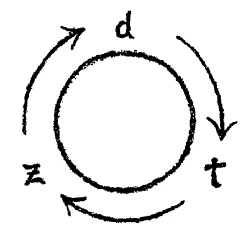
[ 9 ] This is by no means something that has been artificially contrived. If one were to describe it in detail, one would of course have to elaborate, but this pattern corresponds to a natural process in the metamorphosis of language. Take, for example, the Greek word thyra. If you view it as an ancient stage that has remained at an earlier stage, then the next stage would have to be one featuring d. You find this stage in the English word “door.” And the final transformed stage would have to progress from d to t, following the direction of the clock’s hands. We have the High German word Tür. And so we can say: We can, in a sense, identify an oldest “linguistic-geological” layer in which word metamorphoses always occur at one of these stages. The next metamorphosis occurs at the next stage. And then we can identify a third stage in High German, which in turn occurs at the next stage.
[ 10 ] If the stage that finds its expression in Greek were to have a t, then English, which has lagged behind, would have a th; High German, which has advanced beyond English, would have a d.
[ 11 ] Where High German has a z corresponding to the English th, the preceding stage would have had to have a t, and the preceding Greek-Latin stage a d. We can prove that this is indeed the case.
[ 12 ] So a word that, for example, would have a “t” at the second stage—in Gothic—would have to have a “z” at the next stage. If we take a word that can be used here to illustrate the relationship between New High German and the next lower stage in Gothic, we have “Zimmer”; in Gothic—or rather, in Old Saxon, which is at the same stage—the word for “room” is timbar. From z, we must go back to the £; I just want to explain the principle to you; you can look up these details yourself in a dictionary.
[ 13 ] Just as this sequence is correct, you can trace this—along with many other essential metamorphic features—in the language: if you compare words that contain a “b,” it becomes a “p” in the next stage, which in turn becomes a pf, ph, or f in the next stage, and this, in turn, becomes a b.
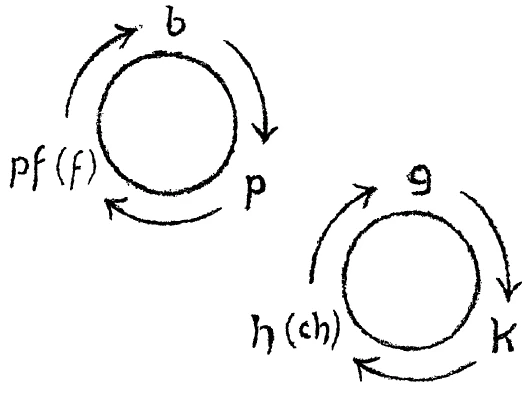
[ 14 ] Just as with this, there is also the sequence g-k-ch (h) and then back to g. There are corresponding examples for this as well. Thus, we can say the following: The Greek-Latin language preserved this linguistic element at an earlier stage of metamorphosis. That which became Gothic has advanced to a later stage. Much of what has advanced to this stage is still preserved today, for example in Dutch. A final shift, which did not actually take place until the 6th century CE, moves things up another stage: this is the High German stage. So we can say: We would first have to identify the first stage, perhaps extending very far across Europe, perhaps dating only as far back as 1500 BCE. Then we find everything that dominated vast regions—with the exception of the southern regions, where the oldest stage remained—the second stage. And then, in the 6th century CE, the High German stage crystallized. English and Dutch remained at the earlier stage, while High German crystallized.
[ 15 ] Now I ask you to consider the following. Only once, so to speak, can the relationship that a person enters into with the environment—by forming the wording from the consonantal—that is, by still forming the wording entirely from a sense of language—only once can this occur in complete harmony with the environment. Once the distant ancestors of the Central European languages had formed the sound of certain words according to the first stage—let us say, at the stage of the “z”—they realized: the consonantal structure must be adapted to external phenomena; thus, they formed the “z” in accordance with the external world. The subsequent stages of development can no longer be shaped by the external world. Once the word exists, the subsequent stages are transformed internally and are no longer shaped in adaptation to the external world. This transformation is, in a sense, an independent achievement of the Folk-souls. First, at some stage, the sound of the word is formed in harmony with the external world; then the subsequent stages need only be experienced internally; there is no further adaptation to the external world.
[ 16 ] Thus, one might say: The stage that remained stuck in the Greek-Latin tradition expressed, in many respects, what it means for the language-forming element to adapt intuitively to its environment. The next stage, which developed in Gothic, Old Germanic, and so on, went beyond this immediate adaptation and underwent a spiritual transformation. This gives the language a far more spiritual nuance. Thus, upon entering the first stage of transformation, the linguistic element acquires a spiritual nuance. Consequently, everything that has entered our sense of language through our having undergone this second stage imparts inner depth to our language.
[ 17 ] This has developed slowly and gradually since the year 1500 B.C. This kind of inwardness was characteristic of certain ancient times. However, as it persisted into later times, it became increasingly primitive. Thus, where it still exists today—in Dutch and English—it has evolved into a more primitive sense of the sound of the words.
[ 18 ] High German reached its third stage around the 6th century A.D. However, this represents an even greater departure from its original form; it is a profound internal process through which High German evolved from its earlier stage. While reaching the second stage brings about a spiritual transformation, the third stage takes one very far away from life. Hence the peculiar, often unworldly, abstract element of the High German language—that which High German imposes of its own accord upon the German soul as something that many other people in Europe do not understand at all. Where, for example, the High German element has been used to a particular degree—as in the works of Goethe and Hegel—it cannot be translated into English or the Romance languages. These are mere pseudo-translations. One must produce such translations because it is better for things to be rendered than not to be rendered at all. What lies in such words—which, in the most eminent sense, belong exclusively to the organism of High German—in terms of what is deeply spiritual, not merely imbued with spirit, cannot simply be transferred into other languages. For they have no expression for it.
[ 19 ] Thus, ascending the second level is, on the one hand, an imbuing of language with spirit, but also an imbuing of the inner life of the people in question through language. Reaching the third stage—which can be studied specifically in Standard German—is more a matter of distancing oneself from life, so that one can, through one’s words, attain such abstract heights as, for example, Hegel or, in certain cases, Goethe and Schiller attained. This is very much connected to this ascent to the third stage through Standard German. Thus, you can see from the example of the High German language how—by the fact that, in a sense, the formation and development of language break away from adaptation to the external world, and by the fact that it becomes an inner, independent process—that human-individual spiritual aspect progresses, which develops in a certain way independently of nature.
[ 20 ] Thus, the Central European linguistic element went through stages in which it first became emotional and then intellectual, whereas at the first stage it was a kind of instinctive, animal-like adaptation to the external world. Languages such as Greek and Latin then developed through other influences. If one considers these languages solely in terms of their word forms, one must say: the word forms, the sound forms, are very strongly adapted to their environment. But the peoples who spoke these languages did not remain content to maintain this primitive adaptation to their environment. Through all manner of foreign influences—which had a different effect than those in Europe, coming from Egypt and Asia—their languages became merely the outer garment for a culture that had been transmitted to them, largely a culture of mysteries. The mysteries of Africa and Asia were transmitted to the Greeks and, to a certain extent, to the Romans, and they had the power to clothe the mysteries of Asia and Egypt in the language of the Greeks and Romans. Thus, these languages became outer garments for a spiritual content that was, as it were, infused into them. This was a process that the languages of Central Europe and the Nordic European languages did not undergo; rather, they underwent the other process just described. They did not simply absorb the spiritual at the first stage, but first developed at least to the second stage and were in the process of reaching the third stage: only then, for example, did Christianity penetrate them as a foreign spiritual element with new words. And the second stage had evidently already been reached when that Celtic element I spoke of today made its way in. So we are dealing here with an internal transformation of the language. Only then does the spiritual influence come into play. In the case of Greek and Latin, however, we are not dealing with such a transformation of the language, but rather with the infusion of the spiritual into the first stage.
[ 21 ] One must therefore seek out, in concrete terms, what actually determines the character of individual peoples. Through such things, one discovers phenomena such as the transformation of languages and their relationship to intellectual life. Now, in Modern High German, we have, first of all, a language that—having risen to the third stage of metamorphosis—has become far removed from life. But this language also contains quite a number of words that have entered it through various channels—such as through Christianity from the south, through Scholasticism from the south, and from the French and Spanish cultural spheres from the west. These linguistic elements all entered the language later; they are now part of High German. All of this shows how High German has coalesced from its various elements.
[ 22 ] For something that is now adopted as a foreign element from another language, one does not have the same feeling as one does for a word—for a sound combination that one forms oneself within a people in relation to nature. Consider, for example, the word “Quelle.” It is a word that, as we perceive it, is so perfectly attuned to the essence to which it belongs that one can hardly imagine calling it anything else from within our own sensibility. The word expresses everything one experiences in connection with a spring. In general, the original formation of speech sounds, words, and so on was such that their consonants and vowels were fully adapted to the environment. But when you hear, for example, the word “essence” or the word “category” or the word “rhetoric,” can you feel the connection to what the word originally meant in the same way? No; as a people, we receive the sound of the word and must strive to grasp the concept on the wings of that sound. One cannot at all undergo that inner experience which represents the harmony between the sound of the word and the concept, the feeling. There is a profound wisdom in the fact that, in that characteristic upward and downward development, a people adopts from other peoples such words that it has not formed itself directly—words in which it hears the sound but does not experience the harmony with what is being designated. For the more such words are adopted, the more the people who adopt them feel the need to draw upon something quite special in their inner life in order to cope with such things at all. One need only recall. You see, even today we can study this adaptation of the language-forming power to the environment to some extent through onomatopoeic sounds, which speak concretely to human experience: “Pfui!” “Tratsch!” “Tralle walle!”—how we adapt ourselves in these sounds to what we wish to express! How different it is when you’re in school—I don’t even mean studying logic or philosophy, but any modern science at all. There you truly encounter words where you must draw upon other inner forces than what, for example, the “Moo” conveys as an imitation of what you hear from a cow. When you say “moo,” you re-experience what comes to you as an experience.
[ 23 ] When you hear a word from a foreign language, you must truly do something other than simply hearing what you are supposed to hear based on the sound of the word. You must use your power of abstraction; you must use your pure conceptual power; you must learn to create mental images. That is why a people—such as the Central European peoples, who have particularly embraced foreign elements—has, through this embrace of foreign elements, cultivated the power of conceptual thinking. And two things come together in this Central Europe, if we consider High German: on the one hand, that peculiar inwardness—which is in itself an inner alienation from life—that arises from ascending the third stage; and on the other hand, that which is inherent in the continuous assimilation of foreign elements. Through the convergence of these two elements, the strongest ideal force has been developed within the High German element—once it is established there—namely, the ability to ascend to entirely pure concepts and to move within those pure concepts. This has been a tremendous educational process brought about by these two currents of linguistic development for the Central European linguistic tradition. The training in inner, wordless thinking—where we truly progress toward wordless thinking—has been brought about to a particular degree in Central Europe by the facts just described.
[ 24 ] These are things that follow directly from the facts, and we cannot truly understand the nature of High German unless we view it in this light—that is, unless we examine it through the lens of phonetic and lexical metamorphosis, as well as the adoption of foreign words at various stages. That is what I wanted to explain to you today regarding the characteristics of the Central European languages.