

Spiritual-Scientific Linguistic Considerations
A Suggestion for Educators
GA 299
31 December 1919, Stuttgart
Translated by Steiner Online Library
Fourth Lecture
[ 1 ] You have seen that, in these considerations, the primary task is to trace the historical aspects of language back to the psychological. Indeed, one cannot gain an understanding of the process of language formation—nor of the current state of any linguistic structure—without addressing the psychological element. And today I would also like—in order to illustrate this in the coming hours with specific examples from the history of language—to present some of what the study of linguistic phenomena can reveal about the development of Folk-souls.
[ 2 ] I would like to draw your attention to two related words: Zuber and Eimer. If you take these words—which are Old High German—today, you will deduce from their usage that an Eimer is a container used to carry something, with a single handle attached at the top; a Zuber is one that has two handles. This fact holds true today and is reflected in the two words: Zuber and Eimer.
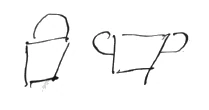
[ 3 ] If we examine the word Eimer, we can go back over a thousand years: we find it in Old High German or at an even earlier stage, where we find the word einbar. Now, remember that I have already demonstrated the phonetic connection with “bar” to you. It is related to beran: to carry, and through the contraction of einbar, Eimer was formed. We have thus clearly expressed—so that it can be clearly seen in the old form—the act of carrying with one handle; for bar is simply something for carrying. Zuber is called zwiebar in Old High German, meaning something carried by zwei, that is, a vessel with two handles. Thus we see how modern words have arisen through contractions, which we still find separated in their ancient forms, though we can no longer distinguish them within the word today.
[ 4 ] We can observe similar phenomena in other linguistic material as well. Let’s consider a few characteristic examples. Take, for example, the word Messer. The word traces back to the Old High German mezzisahs. Mezzi, with an initial M, is nothing other than a form related to ezzi, essen — ezzan, the old form of “essen.” But sahs, sax—one could also say these with a different pronunciation. You need only recall: When Christianity spread across southern Germany, the monks there still encountered the older worship of those three deities, one of whom was the deity Saxnot; that is the war god Ziu. Saxnot is the compound for the living sword, and sahs shares the same phonetic structure. So in the word Messer, you have the compound Essensschwert: the sword with which you eat.
[ 5 ] The word Wimper is also interesting. It can be traced back to wintbra. Bra = the Braue, and wint means “twisting”. You can clearly see it here: the twisting eyebrow. In the compound word Wimper, we no longer distinguish between these meanings.
[ 6 ] Now, here’s another characteristic word for such contractions, where there are still perceived connections from the original. You are probably familiar with the not-so-rare German word Schulze. If we go back to Old High German, we find the word sculdheizo. This was the man in the village whom people went to so he could tell them what debt they owed, the one who would call them out when they had done something wrong. The man who was tasked with deciding—heißen—what one’s debt was, the sculdheizo, the “debt-declarer”—that is who became the Schulze. I’ll present these examples so that you can follow me in understanding the course of a language’s ongoing development.
[ 7 ] One can also observe something else along these lines. Let’s consider something that still occurs fairly frequently in dialect. In Vienna, for example, certain dialectal features have been preserved more purely than in northern Germany, where abstraction took hold early on. And this dates back to primitive culture, which extends into the 10th century. What has been preserved in southern German regions—that linguistic genius in which one can still frequently observe how ancient forms of linguistic expression manifest—has not found its way into Nordic culture. For example, there is a vivid word in Vienna called Hallodri. This is someone who likes to get into mischief, who causes a lot of trouble, and who, under certain circumstances, indulges in excesses—albeit not necessarily of an exceptionally serious nature. The Hallo refers to what he does; the final syllable ri refers to his behavior. This ri is a dialectal remnant of the Old High German ari, which became the Middle High German aere, and which has been greatly weakened in Modern High German to the final syllable er. Take, for example, an Old High German word: wahtari. There you also have this syllable—it’s what you perceive in the Austrian dialect in the word Hallodri. This way of carrying oneself in life with a certain something is embodied in the final syllable ari, and wath means to watch. The person who performs the duty of watching in this way is the wathari; in Middle High German, it becomes wahtaere, still with a full final syllable; in Modern High German, it is Wächter. It has become the syllable er, in which one can scarcely sense what one once felt in ari: the handling of the matter. In all words that have this final syllable “er,” one should therefore sense—when one immerses oneself once more in what has been preserved from ancient times—this handling of a matter. The one who tends to the garden is the gartenaere, our modern-day Gärtner. From this you can see how the language strives to gradually transform what is sonorous—I would say, what is musical—into something abstract, in which the full content of the sound is no longer evoked and, in particular, is no longer connected to the full content of the mental image or the sensation.
[ 8 ] Here is an interesting example: Today, you are familiar with the syllable ur in words such as Ursache, Urwald, Urgroßvater, and so on. If we go back about two millennia in the development of our language, we find the same syllable in Gothic as uz; if we go back to Old High German, that is, to around the year 1000, we find the same syllable as ar, ir, ur. Seven hundred years ago, it was still ur, and it is today as well. So this syllable underwent a transformation relatively early on. It has only weakened in the case of verbs. For example, when expressing that which makes something known, we say Kunde. But if we want to refer to the first piece of news—the one from which the other news originates—we say Urkunde. Now, the ur weakens to er in verbs, so that when we form the verb kennen, we do not say—as would also be possible—urkennen, but rather erkennen; yet this “er” has exactly the same semantic value as the ur in Urkunde. If I make it possible for someone to do something, then I am granting them permission to do so; if I turn this into a noun in a specific context, it becomes the word Urlaub, which I grant them through my permission. Now there is another word formation that echoes all of this and is extraordinarily interesting. You know the phrase: “to make a field arable.” This “urbar” is also related to beran, “to make bear fruit.” Urbar is the original, the first act of making a field bear fruit. There, I would say, is a semantic analogy in the word ertragen, which still exists today. When you say today, “the yield of the field”—this is the same word as “making the field arable” = the field’s first yield. And originally, the urbar was also used for this when one wanted to say: to work the field so that it can bear something, for example, its rent or its tax.
[ 9 ] The study of the prefixes and suffixes that appear in our words is, in general, extremely interesting. For example, in numerous words we find the prefix ge. It can be traced back to the Gothic ga. In this Gothic ga, the contracting force was still distinctly felt; ga has, roughly speaking, the emotional connotation of contraction or pressing together. This then became gi in Old High German and ge in Modern High German. If you then take the words salle or selle, which were formed in other ways, and place the ge at the beginning, Geselle, you have a person who shares a room with another or sleeps in the same hall with him: that is the “Geselle.” Genosse is the one who enjoys the same things as the other.
[ 10 ] I would like to draw your attention here to the characteristic thread running through these examples. One must relate to a word differently when one still has an immediate sense of its meaning in the sound of the word itself, as opposed to when one no longer has that sense. If one simply says: “Geselle” because one has known since childhood that “Geselle” means this or that, it is still different from when one still has the sense of the hall and, in the case of “Geselle,” precisely this connection between the hall and two or more people. This emotional element is cast aside. Only then does the possibility of abstraction arise.
[ 11 ] Now, for example, many of our words end with the suffix lich: göttlich (divine), freundlich (friendly). If you trace this lich back two thousand years, you’ll find it in Gothic as leiks. But this Gothic leiks, which then became lich in Old High German, is etymologically related to leich and also to leib; and I have already told you that leich-leib refers to the form that remains after a person has died. “Leichnam” is actually something of a tautological formation—the kind a child might create when it first has two words that sound exactly the same and puts them together: “wau-wan,” “muh-muh,” whereby meaning is established through repetition. However, dissimilar sounds can also be combined; and you find such a combination, for example, in the word “Leichnam.” “Leich” is actually the form that remains when a person is forsaken by the soul; “nam,” however, traces back to “ham,” and “ham” is the word that has been preserved even in “Hemd” (shirt) and means “covering”; so that “Leichnam” is the form-covering, the form-shirt that we have cast off after death. So there are two similar things: “Gestalt” (form) — and the somewhat shifted “Hülle” (covering), combined like “wauwau.” Now, however, our suffix “lich” is formed from this “leiks,” “leich.” So you see: when you form the word “göttlich” (divine), it must point to a form; for “lich” is “leiks”: form. I am pointing here to a form that expresses the divine; thus, “gottgestaltet” would be “divine.” This is particularly interesting to observe, for example, when we consider the Old High German word “anagilih.” There we still find the element “ana,” which comes from Gothic, and “ana” means “nearly,” “almost”; “gilih” is the form. So what is “similar” is that which “almost” has that form. Thus, when it becomes a Modern High German word, it becomes “ähnlich.”
[ 12 ] In this example in particular, you can study something that is not, at first glance, purely a matter of linguistic history, but—I would say—of linguistic psychology, because it can show you how emotional values live within words, yet how these emotional values gradually detach themselves from human feeling, and how the mental image still links to the sounds becomes a completely abstract element. I have shown you the prefix “ge,” the Gothic “ga.” So consider: one still senses this interplay in ga, which has now become ge, and one applies this to form, to leich; then, from the perspective of the history of sensation, I would say: “harmonious form.” It lives within it without being explicitly expressed. Geleich, “equal,” would thus be: “harmonious forms,” “interacting forms”; geleich = “equal.”
[ 13 ] Let’s take a look at a word that reveals some secrets—today we’ll examine it from just one perspective—let’s look at our word “Ungetüm.” This “ä” is simply the umlaut for an original “u”: “Ungetum”; but the “tum” that we’re isolating here goes back to the Old High German “tuorm,” and this “tuom” is related to the word “tun”: to bring about, to do, to establish a relationship. In all words where this “tum” has become a suffix, one can still sense that there is something of a cooperative relationship contained within them: “Königtum” (kingship), “Herzogtum” (duchy), “Ungetüm” (monster). “Ungetüm” is that in which no proper, cooperative “tum” arises: the #2 negates the cooperation; the getum would be the cooperation itself.
[ 14 ] As you know, we have numerous words with the suffix ig: feurig (fiery), gelehrig (docile), and so on. This goes back to the Old High German ac or ic, and to the Middle High German ag, ig—and this is actually a reflection of what the adjective eigenschaft literally means: “belonging to oneself”; it is eig to it. So wherever the suffix ig appears, it indicates something “belonging to oneself.” Feurig = feuereigen, “belonging to fire.” I have told you that we can thus observe how, through such contractions and the resulting transformations of the sound system that occur during contraction, the process of abstraction takes place that the linguistic genius undergoes.
[ 15 ] One could put it this way: In the very, very early stages of a people’s linguistic development, human perception is entirely attuned to sound. One might say: Language actually consists only of differentiated, complex images in the consonantal sounds—in which external processes are imitated—and of the interjections found within them, sounds of sensation in the vocalic formations. Now the language-forming process continues. Human beings, so to speak, detach themselves from this shared experience—from this sensory experience of sound. What, then, do they do by detaching themselves? They are still speaking, of course; but as they speak, speech is pushed down into a much more subconscious realm than it was before, when a mental image and sensation were still connected to the formation of sounds. Speech itself is cast down into a subconscious realm. Meanwhile, consciousness seeks to intercept the thought. Observe this carefully as a process of the soul. By rendering the context of sounds unconscious, one rises with consciousness to the level of mental images and sensations that are no longer felt solely in the sound and its context. One thus seeks to grasp something to which the sound still points, but which is no longer as intimately connected to the sound as it once was. Such a process can still be observed even when the original, I might say, “emerging” from the sound contexts has already taken place, and one must now do with word contexts what one previously did with sound contexts, because words have already emerged in which one no longer fully feels the sound context, in which one already relates the sound context to the conceptual context more through memory. At a higher level, one goes through the same process with words that one previously went through with sounds and syllables.
[ 16 ] Suppose you wanted to refer to the human beings of a particular region, but you did not yet want to proceed to complete abstraction—so that, for example, you would say: “The human beings of Württemberg.” You would not yet want to say that; it would still be too abstract. One would not yet have risen, let us assume, to such strong abstractions as: “The people of Württemberg.” If one wanted to capture the same thing that is later expressed by “The people of Württemberg” using something even more concrete, then one would say: “The citizens and peasants of Württemberg.” One says this by referring to that which is neither a farmer nor a citizen—or both—but which, in a sense, hovers in between. To capture what hovers in between, one uses both words. This becomes particularly interesting and clear when the two words used to express a concept—which is designated by approaching it, as it were, from two sides—are further apart from one another, for example, when one says: “Land and People.” When you say this, what you mean lies in between, and you approach it. Or: “wind and weather.” When you say this, you mean something that cannot be expressed by a single word—something that is neither wind nor weather, but lies in between—which you, however, encompass by using “wind and weather.”
[ 17 ] Now, it is interesting that, in the course of language development, such combinations come to be expressed in ways that somehow alliterate, assonate, or the like. From this you can see that a sense of sound still plays a role in these matters. And anyone with a lively sense of language can still carry on such practices today; they can use similar-sounding words to capture intermediate mental images for which one does not initially have a direct word. Take, for example, the case where I want to express something about a person—such as their behavior, how it is habitual to them, or how it is intrinsically their own. If I take issue with using merely a word that portrays a person as a passively living being—because I do not wish to portray them in their essential self-expression and self-revelation as a passively living being, nor do I wish to portray them merely as active, but rather to derive their activity from their essence—then I cannot say: “A person’s soul lives”—that would be too passive for me; nor can I say, “A person’s soul weaves”—that would be too active for me. I need something in between, and even today I say: “The soul lives and weaves.” Such expressions abound in the genius of language. Consider, for example, that when one wishes to express something that is neither song nor sound, one says “song and sound.” Or, when referring to a medieval poet, one wants to express that he presents both sound and text—this was often what one wanted to convey, that poets presented sound and text—yet one could not say: “They go about singing”—but rather: “They go about singing and speaking.” What they actually did was a concept for which no word existed. — You see, such things are merely, I would say, the belated manifestations of what once occurred through sound relationships that are no longer transparent today. In a sense, with words like “song” and “sound,” “sing” and “speak,” we are still forming connections that were once made with sound elements which still retained the link between the sound element and the element of a mental image or sensation.
[ 18 ] Take the following example, for instance, to illustrate something quite characteristic of this trend: When the ancient Germans gathered together and held a court session, they called such a day “tagading.” What they did was a “ding.” Today, we still have the expression “ding drehen.” A “ding” is what took place when the ancient Germans were gathered together. They called it “tagading.” Now take the prefix “ver-”; it always indicates that something is entering a process of development. So if what happened at the “tageding” enters into a process of development, then one could say: it was “vertagedingt.” And this word gradually became our “verteidigen” (to defend); with a slight shift in meaning, it evolved into our “verteidigen.” And so you see how here, still within the sound system, “vertagedingen” undergoes the same process that later takes place through the lexicon.
[ 19 ] This gradually leads us to the realization that the world of imagination strays even further from the mere world of sound. Take, for example, a word like the Old High German alawari. That would mean “entirely true.” From this, our word albern has developed. Just imagine the depths of the Folk-souls you are peering into when you see that something which originally meant “entirely true” has become albern, just as we understand the word albern today. The use of the word alawari must be shaped—I would say—by tribes that regard the manifestation of the human being in the capacity of “utterly true” as something contemptible, tribes that subscribe to the belief that the cunning one is not alawar. As a result, the notion—that whoever is “wholly true” is not “cunning”—is transferred to what originally had an entirely different connotation; and thus the meaning of “wholly true” shifts to “silly.”
[ 20 ] When we study shifts in meaning, we can gain deep insight into the language-forming genius in connection with the soul. Take, for example, our word “Quecksilber” (mercury): this is the mercurial metal. This “Queck” is exactly the same word as, for example, in “Quecke” (couch grass), which also means “agility,” or the same word found in “erquicken” (to refresh). This phonetic connection—queck and quick—with a slight shift in sound to “keck”—originally meant “to be agile.” So if I had said about one of you 500 years ago: “He is a ‘keck’ person,” I would have meant: “He is a lively person who doesn’t just laze around, but is hardworking and active.” Through a shift in meaning, this has become the modern word “keck.” Here, the process of reification is at the same time the path to a very significant shift in meaning. Thus, we find a word that originally expressed “boldness in battle.” We need only go back about five hundred years, and the word for “bold” in battle was “frech.” A “frech” person in the sense of earlier times would mean: a bold person, someone who does not shy away from standing their ground in battle. Here you have the shift in meaning. These shifts in meaning allow us to look deeply into the development of the soul’s life. Take the Old High German word diomuoti. Deo and dio always mean “servant”; muoti, which is related to our word mut (courage) but used to have a different meaning, can be rendered today only by saying: “disposition,” the way one is attuned toward the outside world or toward other people. Thus we can say: “diomuoti” had the meaning of the proper attitude of a servant—the attitude a servant ought to have toward his master. Then Christianity made its way in. The monks wanted to convey to people what they should have as their attitude toward God and toward spiritual beings. They could express what they wanted to convey only by drawing on a feeling that people already had regarding this “servant’s attitude.” Thus, this “diomuoti” gradually became “humility.” Religious humility is a descendant of the servant’s attitude of the ancient Germanic era. This is how shifts in meaning occur.
[ 21 ] In general, it is particularly interesting to study the shifts in the meanings of words—or, more precisely, the relationships between sounds and syllables—that have undergone changes in meaning due to the introduction of Christianity. Many such changes took place when the Roman priesthood brought Christianity to the northern regions—changes that can actually only be recognized in their original meaning by examining the shifts in the meanings of words. In ancient times, when Christianity did not yet exist but there was a pronounced relationship between the master and the servant, if a master wanted to say of some person whom he had made subservient, whom he had subjugated: “He is useful to me,” he would say: “He is pious; that is a pious person.” Today, this word survives only in a final remnant—where, to be a bit mischievous, it still recalls its original meaning, “to be useful”—in the expression: “to one’s benefit and good.” When one says “for benefit and piety,” the word is indeed paired with “benefit”—with which it was originally synonymous in meaning—but it now only playfully alludes to this notion of being found useful. The pious servant was the one who was of the greatest possible use. The Roman priests also found that some were more useful to them than others, and they called the most useful ones “pious.” And so the word “pious” has come about in a curious way, precisely through the spread of Christianity from Rome. In humility, piety, and many other aspects, you can already learn something from the particular impulses through which Christianity was carried from the south to the north.

[ 22 ] One must certainly take into account the psychological aspect—that is, inner experience—if one wishes to understand language. What is present in the formation of words is, on the one hand, what I characterized as the consonantal element—when one imitates what is an external process—and, on the other hand, the feeling, the interjective element—when one expresses one’s feelings in reference to the external world. Let us consider a distinctly consonantal quality in the perception of language at an advanced stage of linguistic development. Suppose one perceives this form that I am sketching here. When early humans perceived this form, they perceived it in two ways. They perceived it—looking from the bottom up—as something indented. This gradually became the kind of sound structure we find in the word “arch.” When he looked down at this form—as can be expressed outwardly, for example, by my bending it upward as much as possible (it is drawn)—what I see when looking down comes into being: then it becomes a bulge. From bottom to top it is an “Bogen,” from top to bottom a “Bausch”; in “Bogen” and “Bausch” there is still something of the sensation contained within. If one then wishes to express what encompasses both—what, in a sense, no longer draws on the sensation but extends outward to express the entire process—then one says: in Bausch und Bogen. In “Bausch und Bogen”, expressed imaginatively, this (referring to the drawing) would be seen from above and from below. — This can also be applied to moral situations, such as when one enters into a business deal with someone, so that the result can be viewed from both the inside and the outside: viewed from the inside, it yields a profit; viewed from the outside, the opposite—a loss. When one enters into a business deal with someone on a profit-and-loss basis, one could say: one enters into it Bausch und Bogen, without taking into account the distinctions made in the individual terms.
[ 23 ] My aim was to make it clear to you that by tracing the development of the sound system—as well as the lexicon—one gains insight into the evolution of the folk-soul element; and if you follow this progression from the concrete realm of sound life to the abstract realm of the life of the imagination as a guiding principle, you will be able to discover much on your own. All you need to do is open an ordinary dictionary or pick out words from everyday speech and examine them using these guidelines. For our teachers, I would like to add in particular that it is exceptionally stimulating to point out such moments in the history of language in the middle of a story, because they can sometimes be deeply enlightening and, moreover, greatly stimulate thought. But one must always be prepared for the fact that one can, of course, stray onto the wrong path here; therefore, one must always be very careful, for words undergo manifold metamorphoses, as you have now seen. So it is important not to immediately formulate hypotheses based on superficial similarities, but rather to proceed with the utmost diligence.
[ 24 ] You can see from an example I’d like to share with you that one must proceed conscientiously. There was an original, quite honest German word called Beiwacht—when people would gather and keep watch together—Beiwacht, Zusammenwacht. It is one of those words that, unlike many others, did not migrate from France to Germany, but rather migrated unexpectedly to France at some point—just like the word guerre, “war,” and Wirren. Beiwacht migrated to France in ancient times and became “bivouac” there. And it migrated back again with the numerous migrations of Western words that crossed over after the 12th century; it migrated back and became Biwak. This word is originally German, but it first migrated to France and then returned. In the meantime, it was rarely used. So things like this happen: words migrate, then find the foreign atmosphere too stifling, and return home. In short, all sorts of situations occur.