

Educational Practice from the
Perspective of a Spiritual Scientific Knowledge
GA 306
15 April 1923, Dornach
Translated by Steiner Online Library
First Lecture
[ 1 ] Distinguished guests and dear friends!
[ 2 ] Let me extend my warmest greetings to you at the start of this event. Had you appeared here four or five months ago—as we would have been so delighted to have you do—I would have been able to welcome you in that building over there, which we called the Goetheanum, and whose forms and entire artistic design would have reminded you of what is intended here in Dornach, from the Goetheanum. The tragedy—which is so immensely painful for many who loved the Goetheanum so dearly—the tragedy of New Year’s Eve has taken this Goetheanum from us, and for the time being we will have to carry on without the physical structure that was meant to house the spirit that sought to reign within it.
[ 3 ] In particular, I would like to extend a warm welcome to those distinguished guests who have come here from Switzerland and who, in doing so, affirm that—despite all the hostility that has recently affected us right here on this soil—they have developed a certain interest in our cause from an educational perspective. It is also with particular satisfaction that I welcome the friends of anthroposophical education—or those who hope to become such—who have come here in such large numbers from Czechoslovakia. They thereby affirm that the question of education must certainly be counted among the most prominent of humanity’s general concerns at the present time. The educational question can, after all, only attain the great social significance to which it must aspire if it is approached in this manner by the teachers themselves. I also welcome those individuals who have gathered here from other countries as well; this alone demonstrates that what is being sought here is truly an international cause, a cause of universal humanity.
[ 4 ] And I would also like to welcome our friends, the teachers from the Stuttgart Waldorf School, who have come here primarily to contribute their pedagogical experience from the Waldorf School—and who are so valuable to us here above all because, as people deeply committed to our cause, they wanted to participate in this event.
[ 5 ] Today, I will begin by giving a sort of introduction to prepare the ground for what we plan to discuss together over the next few days.
[ 6 ] There is, of course, an enormous amount of discussion today about pedagogy and the education system. Countless people among those responsible for raising and teaching children speak of the need for reform, particularly with regard to the education and teaching systems. And it’s fair to say: there are an immense number of perspectives from which these discussions are taking place. When one considers all these perspectives and what is being said from them—sometimes with tremendous enthusiasm for a restructuring and reform of the education and teaching systems—it can indeed be cause for anxiety. Not only because it is initially very difficult to foresee how a certain degree of uniformity is to emerge from these most diverse viewpoints—each of which, of course, claims to be the only correct one—but also, one might say, from an entirely different angle, one could feel anxious and apprehensive. The viewpoints being put forward do not worry me as much, for the necessities of life often bring about a balancing out and rounding off of what is said from such perspectives. But it is something else that keeps welling up from the depths of my soul time and again when, today, one hears—one might even say—almost every person one encounters speaking of the reorganization of the education and teaching system. And where, exactly, do these reform ideas—put forward with such laudable enthusiasm—actually stem from? They stem from memories of one’s own youth and from memories of one’s own upbringing. Deep down in one’s soul, there is an immensely deep dissatisfaction with one’s own upbringing and the education one received. Yes, but—by harboring this feeling, one admits something highly peculiar: namely, that one is terribly poorly educated. In fact, when one raises these reform ideas from these underlying depths, one must say to oneself: I am a terribly poorly educated person. And in truth, even if people do not admit it to themselves or to others, this judgment is truly embedded in the specific nuances of the words and sentences of their reform impulses as they are expressed. How many people think to themselves: How poor my upbringing was; that has to change! — Yes, but then two things come to mind that are not at all comforting. For one thing, if one is so terribly ill-bred, if all sorts of terrible things came crashing down on one during one’s own upbringing, how is one supposed to know now what a good upbringing looks like? Where on earth is one supposed to have learned that?—So, if one invokes one’s own poor upbringing to justify ideas for educational reform, that’s actually not quite right.
[ 7 ] And the second point becomes apparent when one listens to the way some people speak about their own upbringing and their own education. I’d like to give you a practical example here, because I certainly don’t want to spend the entire eight days speaking purely from a theoretical standpoint, but rather to base everything on practical foundations. You see, a book was published just a few days ago that doesn’t usually interest me much, but which is interesting precisely because the first chapters contain quite a lot of discussion by a certain figure—a very remarkable figure who is extraordinarily famous today—about his own upbringing and education. The “Memoirs” by Rabindranath Tagore have now been published. Well, since I do not share the same interest in him as other people in Europe today, I must say that these “Memoirs” do not otherwise interest me all that much, but with regard to education, they do offer quite interesting details.
[ 8 ] You will agree with me that what we carry over into life from our childhood days—even if our schooling and upbringing were truly exceptional—does not include, as the most beautiful part, the memory of the specific details we were taught in this or that lesson. That would be a pity. For what educates us and what we are taught must merge into a kind of way of life, a set of life skills. We must not be burdened by these details in later life; they must merge into a great stream of practical life experience. But what we carry forward as the most beautiful aspect of the days when we were educated and taught is, in fact, the memory of the individual personalities of our teachers and educators. And it must indeed be considered a blessing when, even in old age, one can still look back with deep satisfaction on this or that revered teacher. That is a gain in life. It is also an integral part of the art and practice of education that this becomes possible for a lifetime.
[ 9 ] Well, if we turn to the relevant passages in Tagore’s memoirs and look at the way he speaks about his teachers, it is not exactly as if he looks back on them with heartfelt admiration, saying, for example: “One of the teachers at the normal school also gave us private lessons at home. He was thin, his face gaunt, his voice sharp. He looked like a walking cane.” - One might think that it is only in our European culture—so often contested by Asians—that there is so much to say about what is necessary in matters of education and instruction. But you can see from this that a man who has already achieved fame looks back on his Indian school in this way. So—to use an expression that Tagore has just used—the problem of educational failure certainly no longer seems to be confined to Europe on an international scale; rather, it appears to be the most widespread cultural issue today. And we will have much to discuss regarding how to ensure that teachers and educators know how to arouse interest in what they have to teach. - Now I’d also like to share an example from Tagore’s memoirs, in which he reflects on the interest his English teacher in India was able to instill in him. He says: “When I think back on his lessons as a whole, I cannot say that Aghor Babu was a strict teacher. He did not rule us with the cane.” Of course, this points back to older, bygone times. The fact that Tagore in particular—if you read his *Memoirs*, you will see this—speaks so extensively of the cane must still point to a primitive culture. It is certainly justified to assume this when he says of a teacher not only that he was a walking cane, but also that he did not use the cane. He goes on to say: “Even his reproaches never turned into a scolding.” But whatever his personal virtues may have been, his time was evening, and his subject was English! I am certain that even an angel would appear to any Bengali boy as a true messenger of Yama (the god of death) if, after all the misery of the school day, he came to him in the evening and lit a desolate, dim lamp to teach him English.”
[ 10 ] Well, here’s an example of how a modern-day celebrity talks about how she was raised! But Tagore also speaks of how the child already has certain needs when it comes to upbringing and education, and in doing so, he points out in a very realistic way how one should respond to what the child actually demands of you—and how that was not the case in his own upbringing. I’ll leave it up to you to apply these ideas to European circumstances. For it strikes me as quite appealing to illustrate these points—which might cause offense here and there if told from a European perspective—by drawing on Asian contexts instead. Everyone can then apply them to Europe on their own.
[ 11 ] Tagore recounts: “Aghor Babu would sometimes try to bring in the zephyr of science from outside, so that it might blow across the barren monotony of our classroom. One day, he pulled a package wrapped in paper out of his pocket and said, ‘Today I want to show you a marvelous work of art by the Creator.’ As he unwrapped the paper, a human larynx was revealed, and he explained to us the wonders of this mechanism.
[ 12 ] I still remember what a shock it was to me back then. I had always believed that the whole person spoke—I had never had the slightest inkling that the act of speaking could be viewed in such isolation. No matter how marvelous the mechanism of a single part may be, it is certainly less so than the whole human being. Not that I had realized this so clearly at the time, but it lay at the root of my sense of rejection. The fact that the teacher had lost sight of this truth was probably the reason why the student could not share the enthusiasm with which the teacher expounded on the subject.”
[ 13 ] Well, that was the first shock regarding our introduction to human nature itself. But there was a second one, which was even worse: “Another time, he took us with him to the dissection room at the medical school.” One can be quite certain that Aghor Babu wanted to make that a particularly memorable day for the boys. “The corpse of an old woman lay stretched out on the table. That didn’t bother me so much. But a severed leg lying on the floor completely threw me off balance. The sight of a human being in such a fragmented state seemed so horrifying, so absurd to me, that I couldn’t shake the impression of that dark, expressionless leg for days.”
[ 14 ] You can see from this example how a young person fares when he or she is brought into direct contact with human beings today. For, when all is said and done, such things are only incorporated into education because it appears that they stem directly from today’s academic world. It goes without saying that, coming from the world of academia—which, thank God, one must admit, one has embraced as a teacher—one thinks it is absolutely wonderful to be able to explain speech using a larynx model or to explain the specific internal anatomical and physiological characteristics of a leg. For, in the spirit of today’s scientific thinking and perspective, one certainly does not need the whole human being. — But for the time being, these are not the considerations that prompt me to cite precisely these passages from Tagore’s memoirs. We will speak more about this in the course of this week, not in connection with Tagore, but in connection with the matter itself. But something else prompts me to do so. Namely: anyone who today regards Tagore as a writer, as a poet, says to themselves: This is an outstanding person—and rightly so. And this man is now recounting his life story and pointing out the utterly appalling methods of upbringing and education he endured during his childhood. Yes, this gives rise to a rather strange thought—namely, that it did Tagore no harm at all to have been poorly raised and educated. And one might now think: it doesn’t do any harm at all, no matter how bad the upbringing is; for one can not only become a perfectly decent person as a result, but even a famous Tagore. And so, in two respects, one actually feels quite overwhelmed today when hearing all the proposals being put forward as educational reforms. On the one hand, one asks oneself: If one has to look back and see how terribly ill-educated one is oneself, how can one possibly know how to do it better? On the other hand, one asks oneself: But if one can become not just a passable person, but a famous person, then such an education hasn’t actually done any harm! Why, then, should one go to so much trouble to ensure that education is good?
[ 15 ] You see, if one looks only at the surface, it might seem that today we should perhaps be concerned with other things than ideas for reforming the education and teaching systems. For one thing, one comes to realize—based on one’s own poor upbringing—that one can’t really know anything worthwhile; and on the other hand—Tagore’s examples could, of course, be multiplied a hundredfold, even if not in such an extraordinarily elegant form—on the other hand, one is again pressed by the question: “Is it really so absolutely necessary to expend so much effort in search of an educational ideal, when a person who has so much to complain about regarding his own upbringing has, after all, become Tagore?”
[ 16 ] If anthroposophy—this much-maligned anthroposophy—were merely to shape reform ideas, as reform ideas are sometimes received today, I would actually not consider it particularly significant, especially from the perspective of anthroposophy, that attempts are now being made in the field of education and teaching. But anthroposophy is, after all, fundamentally something quite different from the mental image most people still have of it today. Anthroposophy truly springs today from the deepest cultural needs. And anthroposophy does not act like its opponents, who denigrate in the most terrible way whatever does not immediately belong to it; rather, anthroposophy seeks to recognize the good wherever it exists in the world—and to recognize it thoroughly. - As I said, I only want to speak to you today by way of introduction; the assertions I am making here will be substantiated in the coming days. - Anthroposophy draws attention to how magnificent the achievements of science have been over the past three to four centuries, and how particularly magnificent they became in the course of the 19th century. It fully acknowledges these achievements of the natural sciences.
[ 17 ] But anthroposophy must not only look to the individual achievements of the natural sciences; it must also look to the state of the human soul that has arisen from the modern trend in the natural sciences. We cannot say: “Well, what does it matter to us what individual people educated in the natural sciences think today? After all, that is of no great significance for humanity as a whole.”—We cannot say that. For even those who know nothing at all about the natural sciences derive the most important foundations for their state of mind and their orientation in the world from the findings of the natural sciences. One might even go so far as to say: The most orthodox people in this or that religious tradition hold to orthodox beliefs out of tradition and habit, but their orientation in the world is derived from the findings of natural science. The spiritual disposition of modern humanity is increasingly taking on a character that stems precisely from natural science and its magnificent achievements, which cannot be praised highly enough.
[ 18 ] But scientific research has produced something peculiar in response to this state of mind. It has made people increasingly familiar with the external natural world, but it has also increasingly alienated them from their own human nature. For what do we do when we approach human beings from a scientific perspective? First, we learn—in what one might call a fully developed way—the fundamental laws of the inanimate, inorganic world. Then we dissect the human being, examine what is happening within him physiologically and chemically, and apply what we know from the laboratory to the human being. Or we observe other kingdoms of nature, the plant and animal kingdoms. Natural science is, of course, well aware that it does not yet have laws as satisfactory as those for the inorganic realm; but—at least with regard to the animal kingdom—what has been learned there is also applied to human beings. As a result—and one can already say this today—in the popular consciousness, human beings have not come to be seen as the crown of earthly creation, but rather as the culmination of the animal kingdom. One considers the animal kingdom in its degrees of perfection all the way up to human beings. One understands the animals to a certain extent, then adapts what the animals possess—skeletal structure, muscular structure—and arrives at the culmination: the highest-ranking animal—human beings.
[ 19 ] But a true understanding of human existence has not yet emerged from this. We will have to recognize this, particularly with regard to details that are of specific interest to us from an educational perspective. And one can say: While in earlier worldviews the human being was, above all, at the center of all understanding, he has now been pushed out; he is no longer at the center. He is, after all, overwhelmed by the geological periods; he is overwhelmed by what can be said about the animal kingdom in terms of evolutionary theory. One is already pleased when, let’s say, one can trace a ossicle back to the quadrangular bone of a lower-standing, still animal-like being. This is just one example; but the way in which the human physical being is organized soul-spiritually out of the human: that has been pushed out of view; it is no longer there.
[ 20 ] And this is something that is given far too little attention, precisely because people always regard an approach such as the one I have just described as something entirely self-evident. It is modern culture that has brought this about. And it would be sad if it had not brought this about; in fact, it is good that it has, because humanity could not have continued with the earlier mental images that existed before the age of natural science. But today, precisely in the spirit of scientific thinking, we need a new understanding of the human being. It is precisely through this that we also gain insights into the nature of the world.
[ 21 ] I have often tried to make it clear how, precisely from today’s scientific standpoint—which, as I have said, cannot be praised highly enough—the strongest illusions are created by the very fact that this scientific standpoint is always right. If we can prove anywhere that it is wrong, then the matter is relatively easy; but the most difficult part is figuring out where it is right. Let me give you a hint about this. How does one arrive today at that theory—which has already become common knowledge among educated people—that theory which traces back to the origin of the Earth, to the formation of the planetary system, according to the famous Kant-Laplace theory, which has, of course, been modified today? One goes back through long periods of time. If someone speaks of 20 million years, they’re actually just scratching the surface, because others speak of 200 million and so on. One calculates the processes currently taking place on Earth—and rightly so, for physically one cannot consider anything else—one observes, for example, how a deposit forms here or there, how a transformation or metamorphosis occurs, and then one forms a mental image of that which has now been significantly transformed, calculating how long that must have taken. For example: if Niagara Falls has been cascading over the rocks below it for such-and-such a long time and one can calculate how much it erodes, then at another location where more erosion has occurred, one can arrive at 20 million years simply by multiplication—which is entirely accurate. And so, starting from the current perspective, one can calculate for the future when the Earth will enter the famous heat death, and so on. Yes, but you see, you could actually perform the same calculation differently. Observe, year by year, how the human heart changes. Record this change, and by calculating correctly, you can now ask yourself a question that fully corresponds to a sound method—one that could be modeled after the geological method—namely, what the human heart looked like 300 years ago and what it will look like 300 years from now. The calculation will be absolutely correct; there is nothing to be said against it. If one takes the average human lifespan—say, around 35 years—one will arrive at a long period of time that the human heart could have gone through. Only one small detail has been overlooked: the human heart did not yet exist 300 years ago, and it will no longer exist 300 years from now. So the calculation is absolutely correct, but the matter is not in line with reality. — In our intellectualistic age today, we are simply too focused on what is “correct” and have completely lost sight of the fact that everything we must grasp in life must not only be logically correct but also in line with reality.
[ 22 ] This term will come up again from time to time as the week goes on. But sometimes, when we’re developing proper theories today, we completely lose sight of certain things. Haven’t you experienced—I don’t mean to say that you’ve done it yourself, since those present are always excluded from things that aren’t exactly said in a friendly way—haven’t you experienced that the rotation of the planets around their central body, the Sun, is demonstrated quite vividly even in school by taking a small piece of cardboard, cutting it into a circle, sliding it through a drop of oil, inserting a pin through it, letting the water carry it, and setting it in motion. Then the little planets—the oil planets—break away, and you create a beautiful miniature planetary system. The matter is now “proven,” of course. Well, when it comes to matters of the moral order, it’s very nice when a person forgets themselves, but in scientific experiments, the very first foundation for creating a realistic result is that you don’t overlook any conditions—and the most important condition for anything to have happened is, after all, the teacher who turns the pin around! So you may only develop this into a hypothesis if you assume that a giant teacher turned the story around on a large world pin; otherwise, you must not formulate the hypothesis at all.
[ 23 ] And so, precisely within the most correct aspects of what emerges today from the scientific worldview—aspects that are in themselves, in their own methodology, entirely beyond reproach—there lie an immense number of elements of a state of mind that is out of touch with reality, elements that are simply carried into the school. For how could it be otherwise? Of course, one moves through the education of the times! That is, after all, quite correct. But when one sits down to examine such a geological calculation, such an astronomical comparison, and studies the matter—yes, then everything adds up. One is sometimes simply amazed at the tremendous ingenuity; everything one does there is correct—but it leads one away from reality! But if we want to educate people, we must not stray from reality; for then reality stands before us, and we must reach the people themselves. Yet in a certain sense, this inability to reach people has already crept into our thinking about educational and teaching practices. I’d like to illustrate this with an example. You see, when one has to educate a boy or a girl, it becomes clear that one is particularly gifted in one area and less so in another. You are probably all familiar with these concepts, which are taught today in pedagogy; I am merely mentioning them so that we can understand one another. So one finds various talents. Now, how does one approach these talents today, particularly in the very field where, I would say, scientific thinking has advanced the most? As you all know from your reading of educational literature, one approaches them through the so-called correlation method. One calculates what is known as the correlation coefficient. Namely, if two aptitudes are always found together—which is never an exception—the correlation coefficient for these two aptitudes is set at 7. In reality, this doesn’t actually exist, but it is simply an assumption. If two aptitudes were completely incompatible with one another, then this fact is assigned a correlation coefficient of 0. Using this method, one then examines how the children’s individual aptitudes align. For example, one finds that drawing and writing have a correlation coefficient of, say, 0.70. This means that in well over half of the children, if one of them has an aptitude for drawing, they also have an aptitude for writing. We look for such correlation coefficients for other relationships between aptitudes—for example, between writing instruction and instruction in the native language; there, the correlation coefficient is 0.54. Then we look for the correlation coefficient, say, between arithmetic and writing, and find 0.20; between arithmetic and drawing, 0.19; and so on. So, arithmetic and drawing are the least closely related, while writing and drawing are the most closely related. The aptitude for the native language and for drawing is closely related in about half of the students in the sample.
[ 24 ] Yes, you see, there is absolutely no intention here to raise the slightest objection to the validity of such research in the field of science. One would, of course, be on entirely the wrong track if one were to say now, for example, that such things should not be studied. These matters are, of course, extraordinarily interesting. And I am not in the least opposed to experimental or statistical methods in psychology. But when these are to be applied directly to educational and teaching practice, it strikes me as exactly the same as if one wanted to make someone a painter and did not point out to him that he is now working with colors, and did not guide him into handling colors according to his individuality, but instead told him: ‘Look, here’s a fine textbook on aesthetics; read through the chapter on painting, and you’ll become a painter.’—A very famous painter in Munich once told me something, which I’ve mentioned on other occasions: He was attending art school at the time; there was the famous aesthetician Carriere, who lectured on aesthetics in Munich. The art students went to see this scholar once—he also spoke about painting. But they didn’t go more than once, because they said of this famous aesthetician that he was “the aesthetic grumbler.”—That’s how it seems to one, too, when one is supposed to derive anything at all from the aforementioned information for use in educational and teaching practice. As a scientific finding, all of this is certainly quite interesting, but something else is necessary for the practical application of education and teaching. For example, it is necessary to penetrate so deeply into the human being that one knows from which inner functions drawing skills and writing skills arise, and from which, in turn, the skill and ability for the mother tongue arise. This requires a living understanding of the human being in order to discover how this particular ability to draw, this particular ability to find one’s way into the mother tongue, and so on, flows from within the child. Then one does not need such figures; instead, one relies on what the child itself provides. At most, such figures serve as a very interesting confirmation afterward. They therefore certainly have their value, but to want to learn how to teach and educate based on them merely indicates how far we have strayed from an understanding of the human being.
[ 25 ] We want to analyze human nature statistically. This has its advantages in certain areas. We can analyze human nature scientifically and statistically, but we do not thereby penetrate its essence. Just think how much statistics help in a certain field where they can be applied in a very practical way: the insurance industry. If I want to take out insurance today, I’m asked about my age and my health is assessed. It’s very easy to calculate how much I’ll have to pay in premiums depending on whether I’m still young or an old man. They calculate my probable life expectancy, and this life expectancy is perfectly accurate for the needs of the insurance industry. But once you’ve taken out insurance—let’s say for 20 years when you’re 37—will you now feel obligated to die at age 57 just because the calculations are entirely accurate? It’s quite another thing to approach life directly than to make logically sound considerations, which can be very beneficial in a certain field.
[ 26 ] When it comes to writing and drawing, for example: If one conducts experiments specifically with children who have reached school age—and we will be discussing these age stages in the course of these lectures—these children have entered the age at which they are going through the process of losing their baby teeth. Now, as these lectures continue, we will hear that we must structure all education according to the three main stages of a growing person’s life: the stage from birth until the change of teeth, the stage from the change of teeth until sexual maturity, and the stage after sexual maturity; and that we must study in detail how a person behaves during these three stages of life.
[ 27 ] Let’s take this example of writing and drawing. Yes, because one has studied the three kingdoms of nature so thoroughly and applies everything one has learned there to human beings, it seems as though one understands human beings if one can apply all of that—if, so to speak, one can think about human beings in the same way one has learned to think about the three kingdoms of nature. But when one approaches human beings directly, one finds the following. - One need only have the courage to truly view human beings in the same way one views the external natural world; the current worldview has the courage only to view the external natural world, but it lacks the courage to view human beings in the same way it views the external natural world.
[ 28 ] Let’s take a look at how a child develops up until the time of tooth replacement: the child loses its baby teeth—as you know, this is the process of tooth replacement—and since the subsequent replacement of individual teeth is out of the question—in a normal human life, this is the final event in one’s earthly existence; nothing like it occurs again until death. Now, if you have a feeling similar to the one Tagore has toward a person’s severed leg, you will say to yourself: That which brings forth the second set of teeth does not reside merely in the jaws, but in the whole person. Until about the age of seven, there is something within the whole human being that manifests itself, one might say, as a culmination during the change of teeth. In its original form, as it exists in the human organism, it is present until the age of seven; later, it no longer exists in that form.
[ 29 ] Today, for example, in physics, we have the courage to say: There is latent heat, and there is free heat. Some heat is bound; it cannot be measured with a thermometer; through some process it is released, and then it can be measured with a thermometer. — We have this courage when it comes to external natural phenomena. We do not have this courage when it comes to human beings; otherwise, we would say: What was present in the human being up to the age of seven, what then emerged during the change of teeth, was bound to his organism—it is also expressed in other bone formation—then it is released and appears in a different form, as inner, soul-related qualities of the child. These are the same forces with which the child has worked on its organism. — One must have the courage to view human beings from a cognitive perspective in the same way that one views nature. Modern natural science does not view human beings in the same way as it views nature; rather, it views nature but does not dare to approach human beings with the same methods. But when we say this to ourselves, we are drawn to everything that is bony in the human being—that which, so to speak, solidifies the human form and gives it stability. - Well, ordinary physiology could, if necessary, go that far—and it will go that far, even if it is not yet willing to do so today. The most important sciences, in particular, are currently undergoing a transformation, and they will yet take the paths I have just indicated. But now something else comes into play. You see, in later life we also engage in various mental pursuits. We engage in geometry, for example. In our current age of abstract intellectualism, people have a mental image—let’s take something very simple—of the three spatial dimensions, which float somewhere in the air. They are simply three lines perpendicular to one another, conceived as extending to infinity. Of course, one can gradually arrive at this through abstraction, but it is not experienced. Yet three-dimensionality also wants to be experienced; and it is experienced even in the unconscious, when the child learns—from the clumsy crawling stage, where it loses its balance everywhere—to stand upright and come into equilibrium with the world. That is where three-dimensionality is concretely present. There, we cannot draw three lines in space; rather, there is a line that coincides with the upright axis of the body—the one we test when we sleep and lie down and are not fully present—which is also our most important distinguishing feature from animals, whose spinal cord runs parallel to the ground, whereas ours is upright. The second dimension is the one we unconsciously gain when we stretch out our arms. The third dimension is the one that runs from front to back. In truth, the three dimensions are concretely experienced: up, down; right, left; front, back. And what is applied in geometry is abstraction. Human beings experience what they represent in geometric figures in themselves, but only at an age when there is still much that is unconscious and semi-dreamlike; later, it is brought to the surface, and it appears abstract.
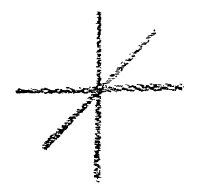
[ 30 ] It is precisely through the process of tooth replacement that what gives a person stability—inner stability—is established. From the point in life when the child begins to stand upright to the point when it undergoes that inner hardening inherent in the change of teeth, the child unconsciously experiments with geometry and drawing on its own body. Now this becomes a matter of the soul; it is precisely with the change of teeth that it becomes a matter of the soul. And on the one hand we have the physiological; we have, so to speak—just as when a solution cools, a sediment can form and the rest becomes all the clearer as a result—formed the hard substance within us, our own strengthened skeletal system, like the sediment; on the other hand, the soul has remained behind and has become geometry, drawing, and so on. We see the soul qualities flowing out from within the human being. And just think what a fascinating insight this offers into the human being. We will see how all of this flows out in detail and how the soul aspect in turn influences the human being.
[ 31 ] In this regard, a person’s entire life is interconnected. What we do for a child, we do not merely for the moment, but for their entire life. Developing an observational perspective for the whole of life—that is something most people do not do, because they want to base their observations solely on the present; for example, on experimentation. In an experiment, one has the present before one’s eyes. But just observe, for example, how there are people who, when they come among others at a fairly advanced age, have such a blessed effect. They don’t need to say anything at all; simply by the way they are present, they have a blessed effect. They bestow grace, so to speak; they are able to bless. And if you trace the life stories of such people, you will find that as children they learned to revere—I might also say, to pray—not in a forced way, but in a genuine way, whereby I understand “praying” in the broadest sense to include the reverence of another human being. I would like to express this with an image I have used many times before: Those who did not learn to fold their hands in their youth cannot spread them out to bless others in later life.
[ 32 ] The stages of human life are interconnected, and when we consider how these different stages relate to one another, it becomes immensely important for us to take the entire course of human life into account in our educational and teaching practices. We learn a great deal about the child by understanding how the soul emerges after it has been at work within the body during the first stage of life. Psychologists today are exploring the most curious hypotheses regarding the interplay between soul and body. One stage of life sheds light on another. If we understand the relationship in a child between the change of teeth and sexual maturity, this then sheds light on what has been taking place in the body through the soul up to the change of teeth. The facts must shed light on one another. Just think how interest in this grows! And we need this interest in the human being for our educational and teaching practices. But people today tend to think in abstract terms about the relationship between soul and body. And because their thinking has yielded so little, a rather amusing theory has already emerged: the theory of so-called psychophysical parallelism. According to this theory, mental and physical processes run parallel; we need not concern ourselves with points of intersection. Psychophysical parallelism no longer needs to concern itself with the relationship between soul and body—they intersect at an infinite distance. That is why the theory is downright amusing. But if one engages with what truly emerges from experience, then one finds these connections. One need only look at the whole course of human life. Let’s consider a person who, say, develops diabetes or rheumatism at a certain age. People always focus only on the present: so they think about a cure for these diseases. That is quite right, and there is nothing wrong with thinking about how to cure them. Very well. But anyone who surveys the entire course of human life will find that some cases of diabetes stem from the fact that, between the loss of baby teeth and puberty, the memory was either unduly burdened or otherwise mishandled. The health of older people on earth depends on the way one relates to the soul during childhood. The way you develop your memory will, after a certain period, affect your metabolism. If, between the ages of 7 and 14, you leave behind memory residues that are not processed by the child’s soul, then, between the ages of approximately 35 and 45, that person’s body will accumulate physical residues that cause rheumatism or diabetes.
[ 33 ] It’s fair to say: Teachers should also know something about medicine. It is not a healthy dynamic when, on the one hand, the teacher must turn to the school physician—who, incidentally, does not know the children at all—for everything related to the children’s health. If so much in our time requires a universal approach to education, pedagogy and teaching practice require this universality more than anything else.
[ 34 ] This is what I wanted to offer you as an introduction to point out where the true source lies—the source from which anthroposophy draws comfort when, in the view of some people, it “meddles in education” and, in the view of others, has something to say. One is not swayed by the idea that education and instruction might be unnecessary or that they cannot be discussed simply because one is poorly educated oneself; in anthroposophy, one starts from something entirely different—not from correcting old ideas, but from an understanding of the human being that has simply become necessary today due to the progress of humanity.
[ 35 ] Look back at the old educational systems: they all emerged from general human culture, from the universal that people felt and sensed within themselves. We must once again arrive at something that flows from within the human being as a universal. I would prefer it if I could call anthroposophy something different every day, so that people do not cling to the word, translate it from the Greek, and form their judgment based on that. It is entirely irrelevant what one calls what is being pursued here. What matters is only that what is being pursued here seeks to engage with reality everywhere and to look reality squarely in the eye, rather than seeking to realize a sectarian idea.
[ 36 ] And so, one might say, on the one hand we have today what we encounter time and again. What is that, exactly? People say: Oh, we’ve had plenty of educational systems that were thought out so neatly and correctly! We suffer so much from intellectualism; at the very least, it must be eliminated from the educational system! That is true. But then they go on to say to themselves: So we must not have scientific pedagogy, but must instead appeal once again to our pedagogical instincts! Yes, that sounds quite nice, but unfortunately it won’t work, because humanity has, after all, made progress. The instincts that existed in the past no longer exist today, and we must regain that naivety through a process of intellectual understanding. This can only be done by delving once more into the very nature of the human being. And that is what anthroposophy seeks to do.
[ 37 ] And there is something else to consider. One senses intellectualism and abstractness everywhere, and people say: Children must not merely be educated in such a way that one seeks only to educate their intellect; one must educate the children’s hearts! — That is quite correct. But one sometimes notices in educational literature and in educational practice that merely formulating this demand is not enough. Once again, the demand that the heart be educated is made in a theoretical and abstract way. Yet even less attention is paid to the fact that the demand should not only be made of the child—that the child should be educated according to the heart—but that the demand should be made of the teacher and, above all, of pedagogy itself. I would like us to discuss this during our time together—not merely to state the demand: “You must educate the child’s heart and not merely their intellect,” but to explore how this demand can be fulfilled: What must happen so that education itself regains its heart?