

Educational Practice from the
Perspective of a Spiritual Scientific Knowledge
GA 306
18 April 1923, Dornach
Translated by Steiner Online Library
Fourth Lecture
[ 1 ] In the preceding reflections, I have attempted to provide an introduction to what is referred to here as the knowledge of human nature. Some of what is still missing will, of course, become clear as we proceed. And I have said that this understanding of the human being is one that does not merely lead to theory, but can become a human instinct—albeit a more deeply spiritualized, more deeply imbued with spirit human instinct—so that it then indeed leads into the living practice of education and teaching. Of course, one must take into account that in lectures, one can, so to speak, only allude—in a sort of gestural way—to what this understanding of human nature ultimately becomes in the practice of teaching and education. But precisely because these things are aimed at practice, they must be discussed here in a much more suggestive manner than is otherwise customary today. At the very least, people today are not aware of how much what can be described in words remains, in the end, merely a kind of hint—a kind of reference to what is, in life, far more multifaceted than can be suggested in words.
[ 2 ] If we consider that the child is essentially an imitative being, that the child is, in a sense, a spiritual sensory organ devoted to its surroundings in a physical-religious way, then for this stage of life, that is, up until the teeth are replaced, we must essentially ensure that everything in the child’s environment truly has an effect that allows the child to take it in meaningfully and process it within itself. Above all, therefore, we must ensure that, along with what the child meaningfully assimilates from its surroundings, it also always assimilates the moral aspect in a soul-spiritual way; so that by the time the child approaches the age of tooth replacement, we have in fact already prepared everything for it with regard to life’s most important impulses. So when a child enters school around the time of tooth replacement, we are faced not with a blank page, but with one that has already been extensively written upon. And it is precisely in this more pedagogical and didactic consideration that we must now undertake we must pay attention not to how something original can be introduced into the child during the period between the change of teeth and puberty, but rather to how we must recognize everywhere the impulses that were instilled in the child during the first seven years of life and how we must give them the direction that the person’s later life will then require. That is why it will be so crucial that the teacher and educator, in particular, be able to observe all the children’s life impulses with great sensitivity. For there is already a great deal contained within these life impulses by the time the children enter school. And they must then guide and direct these life impulses; they must not simply declare: “This is right, that is wrong; you should do this, you should do that.” Rather, they must get to know the children and carry their life impulses forward.
[ 3 ] Of course, this raises the question that we have not been able to test in practice at the Waldorf School—namely, what should be done for children from the time their baby teeth fall out until they reach sexual maturity. The early years leading up to the change of teeth, starting from birth, are certainly the most important phase of educational work; but since we already face the greatest difficulty in creating facilities suitable for children once they have reached school age, we cannot even think of establishing a kindergarten at this time—since every year we have to add a new class for older children to the lower grades; we began with an eight-grade school program at the Waldorf School—we cannot even consider establishing something like a kindergarten or the like as a preparatory stage for elementary school. Those who think superficially about such matters are, of course, of the opinion that one need only establish such a kindergarten, and then one can get started. But that is not how it works. What is necessary is an extraordinarily detailed planning process—down to the finest details—of the pedagogy and didactics for the kindergarten. And it is simply not possible to devote oneself to this as long as a new class has to be tacked onto the Waldorf School every year.
[ 4 ] The seriousness associated today with so-called reform movements is, unfortunately, understood correctly by only a very small number of people. For the reform movements of the laity consist mainly in making demands—demands that are, of course, very easy to make; there is nothing easier today, when everyone is so clever—and I mean this not at all ironically, but in all seriousness—than to make demands. Yes, to draw up a flawless school reform program, all that’s needed today is for eleven or twelve people to be found within our civilization—which, after all, is brimming with cleverness—though even three or four would be clever enough—who then set forth the demands for what must happen: first, second, third, and so on. Something extraordinarily clever will come of it; I have no doubt about that. The abstract programs that are drawn up everywhere are extraordinarily clever. For today, because people are so intellectualistic, one can achieve very good things in this way—I mean abstract, outwardly good things—in an extraordinary manner. But to someone who judges things from the perspective of life itself—and not from the standpoint of intellectualistic thinking—it all looks as if people are somehow pondering what a proper stove in a room is supposed to do. Of course, they’ll be able to cite a whole series of categorical imperatives that the stove must fulfill: it must heat the room, it mustn’t smoke, and so on. Paragraphs 1, 2, and 3 may be very well-formulated, but even if one knows all of this—that the stove should be warm, that the stove should not smoke, and so on—one still cannot manage the process of stoking a stove; one must learn other things to do so. And depending on the layout of the room and perhaps other factors, it may not even be possible to perfectly fulfill all these requirements, which can certainly be formulated very sensibly. And that is how most of the programs put forward by reform movements today are; they are about as abstract as what I said about the stove. That is why they should by no means be opposed—they undoubtedly contain much that is correct—but the practice of a real school is something other than ideally correct school requirements. Here we are not dealing with something that ought to be, but rather with a specific number of children; here we are dealing with a specific number of—allow me to mention this as well, for it is a factor—a specific number of teachers with such and such talents. All of this must be taken into account. In the abstract, a reform program can be drawn up; in practice, however, one has only a certain number of teachers with specific talents, for whom it may not even be possible to fully meet these abstract requirements.
[ 5 ] Our contemporary world fails to grasp this fundamental difference between life and intellectualism for a very specific reason. It fails to grasp it because our contemporary society has, in fact, become so accustomed to no longer sensing intellectualism at all—and least of all where it asserts itself most intensely. Anyone who truly understands today how great the difference between theory and practice is will find the most appalling, impractical theories in today’s business world. The current structure of business life is, in reality, organized as theoretically as possible. Yet the people immersed in business life grab hold with a firm hand; they elbow their way through and often brutally impose their theoretical ideas. This goes on until the business goes under. There, one can be intellectualistic. But where life begins to be real life—where one is presented with something, as in school, that cannot simply be grasped, but rather involves given impulses that must be further developed—there, even the most beautiful theories are of no help unless they can be practically applied based on the most deeply individual understanding of human nature. That is why people whose minds are so filled with all kinds of theoretical pedagogical knowledge are truly the least suited for practical school teaching. In fact, people who rely on instinct—who can understand children from within themselves, out of a natural love—are actually much more suited to this task. But today, instincts are no longer so reliable that one can get very far with them without allowing these instincts to be guided by the spirit. Human life has become complicated today, and instinctual life demands a simple human life—a human life that almost reaches down to the simplicity of animal life. All of this must be taken into account; only then will one be able to view in the right way what is presented here as truly practical pedagogy and didactics.
[ 6 ] In this regard, the education system has, in fact, kept pace with the gradual encroachment of materialism into our modern civilization. This is particularly evident in the fact that, especially for the age up to the change of teeth—which is actually the most crucial period in human life—mechanical methods have often been introduced in place of organic ones. But we must realize this: until the teeth are replaced, the child is predisposed to imitate. What the later seriousness of life demands—and what the later seriousness of life weaves into work—is carried out by the child, as I mentioned yesterday, as play; but as play that is, at first, taken very seriously by the child. And the difference between a child’s play and the work of life consists solely in the fact that, in the work of life, adaptation to the external practicality of the world comes first—that we must submit to the external practicality of the world. Whereas the child wants to develop whatever it puts into practice out of its own nature, out of its human life. Play works from the inside out; work works from the outside in. This is precisely the immensely significant task of elementary school: to gradually transform play into work. And if one can practically answer the big question—How is play transformed into work?—then one has actually answered the fundamental question of elementary school education.
[ 7 ] But the child plays by imitating and wants to play by imitating. Because we have not gained a true, genuine understanding of childhood through real, authentic insight into human nature, we have devised all sorts of “playful” activities for children in kindergarten based on the intellectualistic musings of adults—activities that are, in fact, conceived by adults. While children want to imitate the work of adults, people often invent special activities for children—such as “stick-laying” or whatever such things are called—which the children are then supposed to perform, and through which they are completely diverted from what flows vividly from within them and which simply seeks to imitate the work of adults. They are led away from this and, through all sorts of mechanically devised activities, are drawn into spheres of activity that are not appropriate for a child’s age. The 19th century, in particular, was very inventive in devising all kinds of children’s activities for kindergarten that really should not be carried out. For in kindergarten, the only thing that really matters is that the child adapts to the few people who run the kindergarten, that these few people behave naturally, and that the child receives the impulse to imitate what these few people do—that one does not go from one child to another and tell them: “You should do this or that.” For a child does not yet want to follow what is simply told to them: “You should do this.” They want to imitate what the adult does. Thus, it is precisely the task of the kindergarten to incorporate the activities of life into such forms that they can flow from the child’s own activity into play. One must incorporate life—the tasks of daily life—into the activities of the kindergarten. One should not invent things that actually occur only exceptionally in life and that are truly mastered only when, later in life, one must learn them in addition to what one has already acquired in the normal course of life. For example, one can see how children are encouraged to cut slits in sheets of paper and then thread all sorts of red, blue, and yellow materials through them, so that a woven pattern emerges from the colorful paper. What this achieves is that, through a mechanized activity, the child is prevented from engaging in normal life activities. For what the child is supposed to do directly with their fingers is achieved through normal activity by having them perform some form of sewing or embroidery in a primitive manner. The tasks performed by the child must be drawn directly from life; they must not be contrived by the intellectualistic culture of adults. What is particularly important in kindergarten is that the child must imitate life.
[ 8 ] This work—shaping one’s life in such a way that, in the presence of the child, one correctly carries out what is appropriate to life’s purposes, which in the child’s case corresponds to the emergence from the organism’s own desire to be active—is a great undertaking, an immensely significant pedagogical task. The task of coming up with ways to arrange sticks or making paper weaving projects is easy to do. But the work of truly shaping our complicated lives in the way the child already does it—where the boy plays with a spade or something similar and the girl plays with a doll—of correctly translating human activity into childlike play and finding this approach for the more complex activities of life as well: that is what must be accomplished, and it is a long-term endeavor for which there is still almost no preparatory work available today. For we must be clear that in this imitation, in this meaningful activity of the child, the moral and spiritual aspects are embedded, as is the artistic perspective—but entirely subjectively, entirely within the child. Give the child a handkerchief or a rag, and tie it so that it has a head at the top and a pair of legs at the bottom—then you have made a Bajazzo or a doll for the child. You can then add eyes, a nose, and a mouth with ink blots—or better yet, let the child do it themselves—and you’ll see: a healthy child takes great delight in this doll. For then the child can supplement what would otherwise be part of the doll through imaginative, imitative mental activity. It is much better to make a doll for a child out of a scrap of canvas than to give them a beautiful doll that may even have its cheeks painted in the most absurd color, is dressed beautifully, and can even close its eyes when laid down, and so on. What are you actually doing when you give a child such a doll? You prevent the child from developing their soul activity; for they must shut off their soul activity—this wonderfully delicate, awakening imagination—in every other area in order to focus on something very specific and beautifully formed. You completely separate the child from life because you are holding back their own activity. This is particularly relevant for children until they lose their baby teeth.
[ 9 ] And when the child then starts school, what we encounter is precisely that the child is most resistant to reading and writing, as I said yesterday. After all, isn’t there a man: he has black or blond hair, he has a forehead, a nose, eyes, and legs; he walks, reaches out, says something, and has this or that train of thought—that is the father. But now the child is supposed to regard the symbol there—FATHER—as representing the father. There is absolutely no reason for the child to regard that as the father. There is not the slightest reason for it. The child brings with it formative powers that seek to emerge from its organism—powers with which it has developed internally to the point of the marvelous formation of the brain and all that is connected to it in the nervous system; with which it has developed to the point of that marvelous formation of the permanent teeth. Human beings should become humble and ask themselves what they would have to understand if they were to form the second set of teeth through their own art, based solely on the first set of teeth; what unconscious wisdom reigns in all of this! The child was surrendered to this unconscious wisdom in the formative forces. The child lives in space and time—now one must guide the child toward the meanings that emerge through reading and writing. One must not simply lead the child toward what advanced culture has developed in this regard; one must lead the child toward what the child itself desires from within its own being. One must introduce the child to reading and writing in such a way that its formative powers—which have been at work within the child until the age of seven and are now emerging to become outward spiritual activity—are allowed to express themselves.
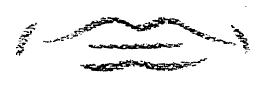
[ 10 ] If, at first, you do not write down letters or even words for a child, but instead draw for the child—drawing from the imaginative powers that also exist within the child’s soul—what looks like this, then you will see that the child still remembers something that is truly there, something the child has already grasped with its imaginative powers. The child will say to you: “That’s a mouth!” And now you can gradually guide the child by saying: “Now say ‘Mmmouth’; leave out the last part.” You guide the child to gradually say “mmm...” And now you say to them: “Now let’s draw what you’ve made there. We’ve left something out:
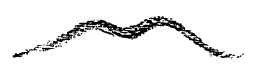
[ 11 ] we drew it. And now let's make it easier:
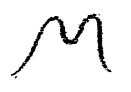
[ 12 ] It turned out to be an M.
[ 13 ] Or we draw something like this for the child (it is drawn): The child will say, “Fish...” We’ll then move on to saying “F.” Let’s simplify this fish! Then it becomes an “F.” We derive these abstract so-called letters from pictures everywhere.
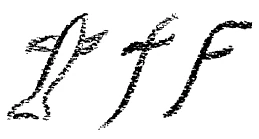
[ 14 ] It is not necessary for us to trace the history of how our modern writing system actually evolved from pictographic writing. That is not necessary at all; we do not need to engage in cultural-historical pedagogy. We need only find our way into it ourselves, inspired by our imagination; then we will find the possibility in all languages to start with characteristic words that we can transform into images, and from which we can then derive the letters. In this way, we address what the child wants, especially during the transition from baby to permanent teeth and immediately afterward. And from this alone it follows for you that one must first move from drawing-as-painting and painting-as-drawing—for it is good for the child to use colors right away; after all, the child lives in color, as anyone who knows a child is aware—and then, from painting-as-drawing, transition to writing, and only from writing derive reading. For writing is an activity that engages the whole person. The hand must be involved; the whole body must participate in some way—even if only subtly—and the whole person is engaged in the process. Writing, derived from drawing-as-painting, still has a concrete quality to it. Reading, on the other hand, involves sitting still—one becomes a real bookworm—and only one part of the person exerts effort: the head. Reading has already become abstract. It must gradually be developed as a partial manifestation derived from the whole.
[ 15 ] In these matters, it is extremely difficult today to remain true to what is purely natural in the face of contemporary prejudices. For when one begins to teach children in such a completely natural way, they learn to read a little later than is expected today. When children from such a school then transfer to another school, they may not yet be as proficient as the children at the other school. Yes, but it doesn’t really matter what mental images we’ve formed—based on the materialistic cultural era—about what a child should be able to do at age eight. Rather, what matters is that it may not be good for the child at all to learn to read too early. For when a child learns to read too early, one also closes off certain possibilities for their later life. If a child learns to read too early, one introduces them to abstraction too soon. And you would be doing countless future sufferers of sclerosis a great service for the rest of their lives if you did not teach them to read too early as children. For this hardening of the entire organism—as I call it in layman’s terms—which later manifests in the most varied forms of sclerosis, can be traced back to an incorrect method of teaching reading. Of course, these issues also stem from many other factors, but the point is that these factors do indeed exist, and that teaching that is in harmony with the soul and spirit has a wholesome, physical effect on the body in every respect. When you understand how to structure instruction and upbringing, you simultaneously understand how to give the child the best possible health for life. And you can be absolutely certain: if healthier methods prevailed in today’s school system, then many a young man would not be walking around with a bald head so early in life, as is very often the case!
[ 16 ] These things—which are based precisely on the fact that one sees the soul-spiritual continuing to work everywhere within the physical-material—are given far too little consideration from a materialistic standpoint. And I would like to emphasize this again and again: The tragedy of materialism lies in the fact that it knows nothing at all about material processes anymore, but merely observes them entirely from the outside; that it no longer knows at all how something moral transitions into something physical. People today are already developing a completely false mental image simply through the way in which human beings are treated—one might almost say mistreated—by science. Just think about it for a moment: When you open physiology or anatomy textbooks today, you find certain diagrams: the skeletal system is depicted, the nervous system is depicted, the circulatory system is depicted. This has a very suggestive effect; one gets a mental image of the human being being truly represented when all of this is depicted in this way. But what is depicted here is not at all what a human being is physically and bodily. That is, at most, 10 percent of it, because 90 percent of a human being is a column of fluid. He consists of 90 percent fluid that constantly fluctuates within him—fluid that cannot be depicted with fixed contours at all. Now, you might say: Physiologists know that! Certainly, but it remains within the realm of physiology; it doesn’t carry over into everyday life, because even the drawings suggestively lead one in a different direction. But what we’re even less aware of is that we’re not merely—to a very small extent—a solid human being, and to a large extent a liquid human being, but that we’re also, at every moment, an air human being. The air outside is inside us the next moment; the air inside us is outside the next moment. I am a part of the entire atmosphere. This is constantly fluctuating within me. And then there are the states of heat! In reality, we must distinguish between the solid human, the liquid human, the air human, and the heat human—this could go even further, but let us limit ourselves to this for now.
[ 17 ] The fact that people hold completely nonsensical, false views about these things is evident from the following. If it were really as it is depicted—as a skeletal system, a nervous system, and so on, where simply everything is transformed into such a diagram that one is constantly tempted to create a mental image of the human being as a mere solid organism—if all that were true, it would be no wonder that moral and spiritual life cannot enter into these solid bones or this rigid blood circulation: it has nothing to do with that at all. But if you begin to truly form a mental image of the human being now also as a being of fluid, as a being of air, and finally as a being of heat, then you have a subtle agent, a subtle entity—for example, in the states of heat—and then you will come to realize how the moral constitution of the human being can indeed flow into the physical course of heat. When you create a mental image of reality, you arrive at that unity of the physical and the moral. And you must keep that in mind if you wish to address human beings in their development—you absolutely must keep that in mind.
[ 18 ] So it really comes down to our ability to look at the person, to find our way to that person from a completely different physiological and psychological foundation, and then it becomes clear how to treat that person. Otherwise, they develop an inner resistance to what they are actually supposed to learn, whereas the goal must be for them to grow into what they are supposed to learn on their own. And as they grow into it, they naturally begin to love what they are supposed to learn. But they can only come to love it by growing into it from their own inner forces.
[ 19 ] What is most harmful—especially for children of this age, around 7, 8, or 9 years old—are the one-sided illusions, these fixed ideas that one forms: this or that must happen in such and such a way. For example, people are so incredibly proud that, over the course of the 19th century—though the groundwork was laid as early as the 18th century—the old spelling method gave way to the phonetic method and then to the standard-word method for learning to read. And because people today are ashamed to still respect the old method in any way, you’ll hardly find anyone today who would rave about the old spelling method. He’d be considered a fool by today’s standards—that’s unthinkable—so he’s no longer allowed to rave about the old spelling method. Both the phonetic method and the standard-word method are used. People are very proud of the phonetic method, where children are taught the phonetic nature of sounds. The child doesn’t learn: “This is a P” or “This is an N” or “This is an R”; instead, they learn to pronounce everything exactly as it sounds within the word. Well, that’s quite good. The “normal words” method is also good; it sometimes starts with whole sentences, where the teacher forms a sentence for the child and only then analyzes it down to the individual words and sounds. But it’s bad when these methods become dogmatic. The rationale behind all three methods—even the old spelling method—is sound and ingenious; there’s no denying that they’re all ingenious. But where does this ingenuity come from? It comes from the following. Imagine you’ve known a person from a photograph and have always seen them face-on. You’ve formed a certain mental image of that person. Now you’re handed a picture, and someone says, “This is a picture of that person.” - The picture is a profile. You’ll say: “But no, that’s a completely wrong picture! The person looks completely different: here’s the front-facing picture—that’s the right one; the other one is completely wrong.” - In this case, it is a picture of the same person, but it was taken from the other side. And that’s how it always is in life—things in life must be viewed from all sorts of different angles. Of course, one can become attached to a one-sided point of view because it may be very clever; one may have good reasons; one may defend the spelling method, the phonetic method, or the standard-word method, and the opponent won’t be able to refute you because, naturally, you only believe in your own reasons. It’s quite possible that the best reasons are put forward, but they are one-sided. In practical life, things must always be approached from a wide variety of angles.
[ 20 ] Once one has derived forms from painting-as-drawing and drawing-as-painting, and once one has then moved on—as is indeed quite advisable—to cultivating a sort of phonetic or word-based method, so that the child does not get too lost in the details but is instead guided toward the whole, something has nevertheless been lost to the materialistic age, and that is the following: the sound as such—the individual “M,” the individual “P”—is indeed something in itself. And it is crucial that, once the sound is contained within the word, it has already made its way into the external world; there it has already passed into the material-physical world. For what we have in our soul are, in fact, the sounds as such, and this depends very strongly on the nature of our soul. When we spell out a word, if we want to pronounce the “M,” we actually say “EM.” The Greeks did not do this; they said “MY.” That is to say: they placed the auxiliary vowel after the consonant, while we place it before it. Today in Central Europe, we produce the sound by moving from the vowel to the consonant. In Greece, the same sound was produced by taking the reverse path. This points to the underlying constitution of the soul.
[ 21 ] This is extraordinarily important and significant. For whoever does not merely look at the outward form of language—as language has already become a language of meaning—our languages are, after all, almost all languages of meaning; in our words, we have hardly anything other than signs for what exists outside—whoever goes back from there to the spiritual aspect that lives in the words, that lives in language itself, returns to what is called the “sound.” For everything consonantal has a completely different character than everything vocalic. — As you know, there are the most diverse theories regarding the origin of language. It is, again, much like with photography. Among other things, there is, for example, the “woof-woof” theory. It holds that what humans form linguistically is an imitation of the sounds that emanate from beings. They imitate this essential nature. They hear the dog: woof-woof. When they themselves believe they are expressing something similar in their state of mind, they also use a similar sound. There is nothing wrong with that. There are many reasons to be cited in favor of this “Woof-Woof” theory—very ingenious reasons. If one remains solely on that ground, they cannot be refuted. But life does not consist of justification and refutation; rather, life consists of living movement, of transformation, of living metamorphosis. What is true in one context is false in another, and vice versa. Life must be grasped in all its fluidity. — As you know, there is another theory that stands in opposition to the “woof-woof” theory and challenges it. This theory traces the origin of language to the fact that, just as when a bell is struck—the metal has a certain internal constitution and this or that sound is produced—so, too, does the human being relate to things. This “Bim-Bam” theory involves more of an empathetic immersion into things than an external imitation. It, too, is entirely correct for certain things. One could say that this theory has much going for it, as does the “Wau-Wau” theory. But real language does not arise through the “bim-bam” method or the “wau-wau” method alone, but through both methods and many others as well. These are one-sided views. Some elements of our language are indeed formed in such a way that the “bim-bam” is sensed, while others are modeled on “wau-wau” or “muh-muh.” It is certainly true that both theories are correct, and so are some others. But what matters is that one grasps life. If one grasps life, one will find that the “Wau-Wau” theory fits better for the vowels, and the “Bim-Bam” theory for the consonants; but again, not entirely—these are still just one-sided views. Ultimately, however, one comes to realize—as I have already hinted at in the short treatise *The Spiritual Guidance of Man and Humanity*—that the consonants are in fact modeled after external events and the external forms of things: the “F” is modeled after the fish, the “M” after the mouth, the “L” after running, and so on. The consonants have indeed come into being in such a way that, in a certain sense, they accord with the BimBam theory—but it simply needs to be refined further. The vowels, however, are modes of expression, revelations of the inner self. Here, in the form he gives to the sound or the letter, he does not imitate the external; in fact, he does not imitate anything at all at first, but rather expresses his feelings of sympathy and antipathy. His feelings of joy or curiosity with 7; of amazement or wonder: A, I am amazed; Z, I want to get rid of something that bothers me; U, I am afraid; Ei, I love you. Everything contained in the vowels is a direct revelation of the soul’s sympathies and antipathies. It does not arise through imitation, but rather in this way: A person wants to express themselves, wants to express their sympathies and antipathies. Now they hear the dog—when the dog wants to convey something frightening—saying “woof-woof”; they adapt to this when their experience is similar to the dog’s “woof-woof,” and so on. However, the process of vocalization proceeds from the inside out; the process of consonant formation proceeds from the outside in—it is a matter of imitation. Imitation begins already in the sound itself. You will be able to demonstrate this if you go into detail.
[ 22 ] But you will then see—since this applies only to sounds, not to words (it is not tied to the soul)—that even teaching a child letters in analysis is already a continuation of the word back to the original state of the soul. So one can say: One need only correctly grasp what the child itself demands at a certain age; then, in essence, one will simply use a jumble of letters, just as a proper photographer—who can often become a nuisance precisely because of this—also has the subject turn around and photographs him from all sides; only then has he truly captured him. In the same way, it is necessary for anyone who wishes to approach a human being to grasp that person from all sides. With the standard vocabulary method, one grasps only the physical and bodily aspects. With the phonetic method, one already comes close to the soul, and—horribile dictu—yes, it is terrible to say: with the spelling method, one enters fully into the soul. The latter is, of course, still considered idiotic today, but it is undoubtedly more attuned to the soul; it simply cannot be applied directly. One must introduce it to the child with a certain pedagogical skill and practice, with artistic pedagogy, so that the child is not trained to pronounce the letter conventionally, but rather experiences the emergence of the letter—which lies within the child’s own imaginative powers, which the child truly possesses. That is what matters. And then we will see that it is still more than sufficient if, in this way, we enable the child to read by about the age of nine. For it does no harm at all if the child cannot read earlier, since the child has learned to read in a natural way if it has learned in the manner just described and is, say, a few months past nine years of age. For different children, this may be somewhat earlier or later.
[ 23 ] That is when a smaller phase of life begins for the child. The major phases of life are those mentioned several times: from birth until the teeth fall out, from when the teeth fall out until sexual maturity, and then into the twenties. But of course, you can’t even talk about “development” to people today anymore! After all, it’s not acceptable today—is it?—to tell people: “You’re still going through a process of development until you reach a particular state of maturity after the age of 21.” That offends people today—after all, they don’t “develop” anymore; they write feature articles. So today, one must be a bit more cautious when speaking of later stages of life. But it is necessary for educators and teachers to grasp the major stages of life, as well as the smaller stages that are contained within the larger ones. There is a small stage between the ages of 9 and 10, closer to age 9: this is when the child begins to distinguish itself more and more from its surroundings. It is only then that the child actually becomes aware that it is an “I.” Before that, therefore, education and instruction must provide the child with what enables it to grow together with its surroundings as much as possible; up to this age, the child is simply unable to distinguish itself from its surroundings as a “self.” In this regard, however, the most curious views prevail. For example—think of how often you hear the remark—: When a child bumps into a corner, it starts hitting the corner. Then the intellectualist comes along and explains it this way: one only hits something when one has consciously perceived what, in turn, has consciously bumped into one. That is the definition of the case of hitting—yes, with such definitions one is always reminded of the Greek example of the definition: What is a human being? A human being is a living creature that has two legs and no feathers. That is a perfectly correct definition. It goes back to ancient Greece. I don’t even want to get into the fact that our physics definitions today aren’t much better; there, too, children are often taught that a human being is a creature that walks on two legs and has no feathers. A boy who was a bit more quick-witted thought further about the story. He caught a rooster, plucked its feathers, and brought it to school. He held up the plucked rooster and said, “This is a human being! This is a creature that walks on two legs and has no feathers.”—Well, definitions are certainly very useful, but they’re also almost always very one-sided. What matters, however, is that one finds one’s way directly into life. I must repeat this again and again. The point is that, above all, one must grasp how a child up to the age of nine does not really distinguish itself from its surroundings at all. So one cannot actually say: The child forms a mental image of the table as being alive when it hits it. That doesn’t even occur to the child. It strikes out from the very core of its being. — This animism doesn’t exist at all—this attribution of a soul to inorganic matter, which has already crept into cultural history. It’s quite astonishing what kind of imagination scholars often have when, for example, they believe that humans endow things with a soul. Entire mythologies are explained this way. It is as if the people who say such things had never encountered primitive peoples. For example, it would never occur to a farmer—who is, after all, still primitive—to ascribe a soul to natural phenomena. The point is that the child does not possess the concepts of “infusing a soul into things” or “bringing things to life.” Just as the child lives, so does everything else; yet the child does not consciously project this into its perceptions. Therefore, you need not make any distinction in your descriptions and speech when describing the surroundings: you must let the plants live, you must let everything live; for the child does not yet distinguish the “I” from the surroundings. That is why, at this early stage of life—up to the age of 9—you cannot yet reach the child with anything that is, for example, an already intellectualized description. You must transform everything into images with complete freshness. Where the image ends and the description begins, you achieve nothing at all in the 8th or 9th year of life. Only later is this possible. And then it is again a matter of finding your way into these individual stages of life in the right way. Up until the age of 9, the child has an understanding only for pictorial representations; everything else passes by the child’s comprehension just as sound passes before the eye. But around the time between the ages of 9 and 10, you can then begin, let’s say, to describe plants. There you can start with primitive descriptions of the nature of plants; for by then the child is gradually distinguishing itself from its surroundings. But you cannot yet describe minerals to the child; for its power of discrimination is not yet strong enough to grasp the great difference between what it experiences inwardly and the mineral itself. Only now does it have the ability to grasp the difference between itself and the plant. Then you can gradually move on to describing animals.
[ 24 ] But it has to be done in such a way that the whole thing is truly rooted in life. Today we have botany. We tend to bring that into school as well. We do this out of a certain kind of complacency. Actually, it’s a terrible thing when we bring what we rightly possess as adults—our understanding of botany—into the school. For what is this botany that we have? It is a systematic classification of plants, arranged according to certain criteria. First come the fungi, the algae, the buttercups, and so on, all lined up side by side. Yes, but if you were to develop such a science—which, as a science, is quite good—well, it would be roughly like pulling out a person’s hair and then developing a classification system for the different types of hair that grow behind the ears, on the top of the head, and on the legs—as if you were to arrange all of that systematically. You’ll end up with a nice classification system, but you won’t understand the nature of hair through it. People therefore fail to realize—because it’s too obvious—that the nature of hair must be considered in connection with the whole human being. The nature of plants doesn’t exist in isolation either; the nature of plants belongs to the Earth. You think you can understand a laburnum just by looking at it the way it’s classified in botany! I have no objection to its classification in botany; but only when you see it on the sunny slopes and observe the layers of earth beneath it can you understand why it is yellow: because that color comes from the earth beneath it! Then the plant will seem to you like the hair that sprouts from a human being. The earth, with the plants growing on it—which the child first comes to know—becomes a unified whole. You must not approach the child directly with what comes from modern botany and carry that into the school. Here, too, you must describe the plant and the earth from the perspective of everyday life, just as you would describe the hair growing from a person. And so you cannot describe the plant at all without speaking of sunlight, the climate, and the earth’s configuration—in a way that is appropriate for the child.
[ 25 ] Describing individual plants side by side, as is also done in botany, so that one says: “One must also offer the child visual instruction”—this is not appropriate for the child. Visual instruction is also about what one allows the child to observe. The child has an instinctive sense, rooted in what it carries within itself, for what is alive, for what is truly real. If you present the child with something dead, you injure this sense of life, this sense of what is truly real within the child. But people today have little sense for the nuances of existence. Just think of a philosopher today who reflects on the concept of being. It will make no difference to him whether he takes a rock crystal or a flower as an example of a being. For both are there; one can bring them out—they are existing things. But that is not true at all! Things are not the same in terms of being. You can pick up the rock crystal again in three years: it exists through its own persistence. The flower, however, is not at all what it appears to be. The flower in and of itself is, in fact, a “natural lie”; it can only have a mode of being within the context of the entire plant. You must describe the entire plant if you wish to have the right to attribute a mode of being to the flower. The flower taken on its own is a real abstraction; the rock crystal is not. But today people have completely lost their sense of such distinctions in reality. A child still possesses this instinctively. If you present a child with something that is not a whole, it is deeply unsettled inside. This continues to affect the person well into later life. Otherwise, Tagore would not have described the eerie impression the severed leg made on him in his childhood. A human leg is not reality; it has nothing to do with reality anymore. For the leg is only a leg as long as it is attached to the whole organism; once it is severed, it ceases to be a leg.
[ 26 ] But such things must become second nature to us in the most thorough way, so that we all grasp reality in such a way that we start from the totality everywhere, and not from the individual. After all, we could treat the individual in a completely wrong way. Thus, in botany, when teaching young children, we must start from the entire Earth and regard plants, so to speak, as the hair growing on the Earth.
[ 27 ] And the animals—yes, the child develops absolutely no relationship with animals if you present them side by side. You can expect a little more from the child in this regard, because the child’s engagement with the animal world doesn’t really begin until the 10th or 11th year of life. Teaching the child about animals in this side-by-side manner—certainly, scientifically speaking, that’s quite good, but it’s not true to reality. For the reality is that the entire animal kingdom is a human being spread out. Take the lion: it is the one-sided development of the chest region in particular. Take the elephant: its entire organism is developed toward the elongation of the upper lip; the giraffe: its entire organism is developed toward the elongation of the neck. If you understand each animal in such a way that a certain organ system of the human being is developed in a one-sided manner within that animal, and then survey the entire animal kingdom down to the insects—and this can be extended even further down to the geological animals (though terebrates are, strictly speaking, not geological animals)—then you will find yourself saying: The entire animal kingdom is a human being unfolded like a fan, and the human being, in terms of physical organization, is the folding together of the entire animal kingdom. In this way, you place the animal kingdom at the proper distance from the human being—and yet, at the same time, correctly united with the human being. Of course, I am expressing something abstract here in just a few words. You must translate this into something living, so that you can truly describe every animal form as a one-sided development of a human organ system. If you find the necessary strength to describe this vividly to the children, you will see how quickly they grasp it. For that is what they want. Plants are connected to the earth as if they were the earth’s hair. Animals are connected to human beings as if the human being were to become one-sided—as if he were at times arms, at times legs, at times a nose and the like, at times the torso—and this were then to take on form: then one obtains the form of animals, of the entire animal kingdom. In this way, one truly succeeds in structuring the lesson so that it is akin to what lives within the developing human being, the child itself.
FAQs
[ 28 ] Regarding a question about religious education.
[ 29 ] A misunderstanding has arisen because I have so far described how the child develops in terms of its religious impulses. I have not yet spoken at all in my lectures about religious instruction, because I have only just begun today to address pedagogical and didactic matters. What I have explained is that a kind of physical-religious—I said bodily-religious—relationship exists between the child and its environment. Thus, what the child simply experiences through its physical constitution up until the change of teeth only transitions into thinking after sexual maturity, around the age of 14 or 15. I used the analogy that what initially reveals itself in a physical-spiritual way flows on, as it were, in an undercurrent and then emerges for thinking—through which religion manifests itself in adults—only around the age of 15. Now, however, the fact is that, particularly in a pedagogy based on nature, whatever emerges at any stage of life must be carefully prepared for in the earlier stages of life. And the didactic-pedagogical question that arises from this is this: How should religious education be structured in elementary school, specifically, in light of these laws of human development? This is a question that will underlie the upcoming lectures. What I would like to say in advance is this: We must be clear that the religious element is truly innate in human beings; it is part of human nature. This is expressed particularly clearly by the fact that this very religious orientation of the child, as I have described it, persists until the child’s teeth begin to fall out. What we now have, through general civilization, as the religion of adults is, of course, one that lives in mental images—or at least derives its content from mental images—which, however, are lived out primarily in the mind. A person does not become mature enough for this conceptual content until after the age of 14. It is precisely the elementary school age that presents us with the important question: How should we organize religious instruction at this stage? The primary question is: What should we focus on during this age range, from 7 to 14 years old? In the first stage of life, up until the change of teeth, we, as the educational environment, actually focus on the physical aspect. After puberty, we essentially focus on judgment and mental images. In the intervening period, we focus specifically on the soul and feelings. That is why it is also necessary to begin this period by using images with children as they enter elementary school. These images, in fact, appeal directly to the child’s sensibility and soul. The mental image matures gradually and is prepared for the appropriate age. Now, just as I will explain tomorrow with regard to individual subjects, we must ensure in religious education that we address the child’s feelings above all else. And this is what it comes down to: What influences the child’s feelings and acts upon them? Indeed, what influences them most of all is what is experienced through sympathies and antipathies. If we now develop such sympathies and antipathies in the child—particularly between the ages of 7 and 14—that prepare the way for a sound religious judgment, then we are doing the right thing. So we say: We do not structure the lessons in such a way that we place commandments at the forefront everywhere—“You shall do this, you shall not do that”; that simply does not work, especially for this age group. Rather, we must structure the lessons so that the child develops a sense of sympathy for what they are supposed to do. We keep what the child is supposed to do in the background, but we present in images that which is to flow into the child in a sympathetic way—even in a religious context—in a higher and very elevated sense. We try to instill in the child an aversion to that which it is not supposed to do. In this way, and precisely through the child’s emotional judgment, guided by the image, we strive to gradually lead the child from the divine-spiritual in nature, through the divine-spiritual in human beings, to the internalization of the divine-spiritual. But the entire process must take place through the child’s emotions and feelings, especially at the elementary school age. So not dogmatically or through commandments, but rather by thoroughly preparing the mind and feelings for what may later emerge through the child’s own formed judgment. And we will achieve entirely different results, especially regarding the child’s religious orientation, than if we were to present commandments or articles of faith at an age when the child is not receptive to them. When we present these images to the child and thereby prepare them for what the young person will later form a religious judgment about on their own, we give the individual the opportunity to truly grasp—through their own spirituality—that which they are meant to grasp as their innermost being: namely, religious orientation. In a sense, we give the child the freedom to find their own religious orientation when we bring the religious to their heart—that is, when we present the religious through images, not through articles of faith or commandments. It is of immense importance that, after reaching puberty and well into their twenties, a person has the opportunity to elevate to a judgment—arising from within themselves—that which they have first taken in through their soul, through their feelings—I would say with a certain breadth and versatility. They then set themselves on the path toward the divine. There is a great difference between whether a child, during the period when he or she is attuned to authority, is given a strictly defined direction by that authority, or whether the child is guided in such a way that he or she sees the religious orientation in his or her educator or teacher, climbs toward it figuratively, and can later draw from it the “Thou shalt” and “Thou shalt not.” After first finding approval or disapproval in what emerges as “You shall” and “You shall not,” and after learning through a pictorial view of nature how the soul is set free by the mental image of a divine-spiritual weaving in nature and history, the child comes to form these mental images on its own. It gains the opportunity to receive religious education from the very center of life, which one only approaches upon reaching sexual maturity. This, then, is what it is all about: preparing for what comes later in the right way, based on these foundations derived from an understanding of human nature. I have illustrated this in my lectures by using a comparison with a river that sinks underground and reemerges further downstream. During the first seven years, a person is religiously inclined. This now sinks into the depths of the soul, becomes entirely spiritual, and only resurfaces as thinking with the onset of puberty. And now we must work into the depths of the child’s soul through a personal revelation of our own inner life. In this way, we prepare the child for what makes them a religious person, whereas we hinder this process if we do not offer them the opportunity to gain a religious orientation from the very center of their being. This inner religious orientation is inherent in the human being. It must be developed after the age of 15. We must prepare the ground for it in the right way. That is why religious education must be structured like other subjects at this age; it must speak to the soul through imagery and stir the child’s emotions. Even in mathematics, a religious element can be woven into every subject. And those who have experienced Waldorf education will sense that this is indeed the case. Christianity is truly present in every single subject—even in mathematics, Christianity is present. The religious element underlies everything. However, due to current circumstances, we are compelled—since we are not a school based on a particular worldview but rather a pedagogical school, and since we place value only on teaching according to natural methods—to handle religious instruction in this way. We have based our approach on anthroposophy precisely because we believe that a truly sound pedagogy springs from it, but we do not want to indoctrinate children in anthroposophy at the Waldorf School; that is why we have Catholic religious education taught by Catholic priests and Protestant religious education taught by Protestant pastors. The children who are taught by our own teachers are, in fact, those who would mostly be considered “dissident” children today—that is, children who would not receive any religious education at all. It is a surprising fact that this constitutes by far the largest majority of Waldorf school children. They all attend what is called “free religious education,” which, in essence, simply brings together what actually underlies the entire curriculum. This “free religious education” is actually a source of considerable concern for us. We have a very special relationship with the school regarding this instruction. We regard all other subjects as those that, according to anthroposophical research, must be present as necessary pedagogical and didactic methodologies. We teach the free religious instruction ourselves, feeling just as much a part of the school as the Catholic and Protestant religious education teachers. We teach it as outsiders within the school. We do not want to have a school based on a particular worldview or denomination, not even in the anthroposophical sense; but ultimately, of course, it is precisely the anthroposophical methodology that proves quite fruitful in this free religious education, in which anthroposophy is not taught as such, but rather the work is carried out in the way I have just described methodologically. All sorts of objections are raised against this free religious education, for example, that an awful lot of children are switching from the other religious education classes to the free ones. This causes a great many difficulties because we’ve had to hire one religious education teacher after another and no longer have enough people for the job. We can’t help it if the children are switching over, running away from the other religious education classes. This is simply because the others do not have the methodology that is inherent in our religious education. For us, the right pedagogy is also essential in religious education.
[ 30 ] In response to another question.
[ 31 ] The defining characteristic of the Waldorf school is said to be that it approaches all issues from a pedagogical perspective—including religious education. Now, however, Pastor X himself will admit that the two issues raised—the question of replacing religious instruction with moral instruction and that of denominational schools—are raised from entirely different perspectives. Above all, the idea of replacing religious instruction with moral instruction is raised by those who wish to eliminate religion from civilization altogether—those who consider religion to have become something superfluous. Naturally, they do not want religion, but rather moral instruction. On the other hand, the inclination toward dogmatic denominations naturally gives rise to a desire to make schools denominational. However, these are not pedagogical considerations. But so that we may associate something precise with what must be called pedagogy, I would like to ask: What, in fact, is the pedagogical perspective? The pedagogical perspective can only be the assumption that human beings—as is self-evident—are not yet fully formed individuals in their childhood or adolescence, but must first become so; that one only becomes a fully formed human being in the course of one’s life. One must therefore nurture all human potential. This is, ultimately, the most abstract form of the pedagogical perspective. Now, if someone speaks from an educational standpoint and says—based on the understanding of human nature that underlies pedagogy—that the child is already born with a religious disposition toward the world, that in the first seven years of life even its physicality is religiously oriented, then it must seem to one that, if one wants to replace religious instruction with moral instruction, it is as if one were to refuse to develop a physical limb of the human body, a leg, because one would come to believe that a person needs to develop everything except their legs. To want to omit what belongs to a human being can stem from fanaticism, but never from pedagogy. Insofar as pedagogical principles are championed here and pedagogical impulses are taken into account, the necessity of religious education follows entirely from a pedagogical perspective. That is why, as I have already said, we have established optional religious education for those children who would otherwise be non-denominational—that is, who would have no religious education under the Württemberg School Law. As a result, there are no children in the Waldorf school without religious education; for they all attend the optional religious education classes. This gives us the opportunity to bring religious life back into the school. This may well be the best form of religious renewal—if we are to speak of properly cultivating religious life in the school—by countering what today appears as secular enlightenment through a simple appeal to the human being’s innate religious disposition. I regard it as a kind of success for the Waldorf School that we have brought the “dissident” children to religious education in this way. The Catholic and Protestant children would, of course, have attended their own religious education classes, but it really was not so easy to find the form that would now turn all the other children toward religious education as well. This is what we have strived for from a pedagogical standpoint.