

The Educational Value
of Understanding Human Nature
GA 310
19 July 1924, Arnheim
Translated by Steiner Online Library
Third Lecture
[ 1 ] You have already been able to gather from the remarks I have made here over the past two days that there is a significant difference in the inner constitution of the human being at different stages of life. This is certainly recognized today as well, in accordance with current psychological and physiological views. These distinctions are recognized in the stages of life up to the change of teeth, then up to sexual maturity, and again from sexual maturity into one’s twenties. But these distinctions run much deeper than can be grasped today based on the conventional views—which, while excellent, are not sufficient. And our task now will be to examine these distinctions in the stages of human life from the perspective that Spiritual Science brings to light. Much of what is already familiar to you will reappear, though—I would say—immersed in a deeper contemplation.
[ 2 ] When the child emerges from the embryonic state into the external world—that is, if we take an external characteristic, such as the process of external respiration—it is, physiologically speaking, initially dependent on not being immediately absorbed by the external world; for it naturally receives breast milk—that is, not yet food taken in from the external world, but rather food that originates from the same source from which the child itself originates. Today, however, we tend to view substances we encounter in the world more or less solely in terms of their external chemical and physical properties, rather than in terms of the finer qualities they possess through their spiritual content. Indeed, everything is viewed in this way today. And with such an approach—which is not to be dismissed, but rather its validity must be fully acknowledged—we have nevertheless arrived at a strong externalization, precisely because we sought to observe the external aspects that could not be observed in this way in earlier civilizations. Today, people view all things in such a way that—if I may speak in comparative terms—they say: I observe death, the process of dying; plants die, animals die, human beings die. — But the question arises as to whether dying—the cessation of the forms of life that first meet the eye—is the same process for all three kinds of living beings, or whether it merely appears that way on the surface. One can use the following comparison: If I have a knife, there is still a difference between using it to cut food and using it to shave; it is always a knife, but its properties as a knife must be further differentiated. Such differentiation is not made today for many things. With regard to dying, no distinction is made between a plant, an animal, or a human being.
[ 3 ] This also occurs in other areas. There are people who, in a certain sense, want to be natural philosophers and speak of this by seeking to be thoroughly idealistic, even spiritual: Plants, too, can be animated, can have a soul. — And they then examine the external characteristics of plants that suggest plants possess something spiritual. They observe plants that, when insects come near them, open their leaves, as it were; the insect is trapped because it is attracted by the scent of what is inside the plant; then, like the Venus flytrap, for example, they snap their leaves shut, and the insect is trapped. This is regarded as a kind of animacy in plants. Yes, I know of another kind of creature that functions in the same way. It can be found set up somewhere; when a mouse comes near it, it is attracted by the smell of some food that is tasty to it, begins to eat it, and—in a flash!—the thing snaps shut: a mousetrap. If one applies the same line of reasoning as with plants, one could say that the mousetrap is animated.
[ 4 ] This way of thinking, which one can certainly acknowledge to a certain extent, does not, however, lead to any real depth, but rather remains more or less stuck on the surface. If one wishes to gain insight into human nature, however, one must absolutely penetrate to the very depths of human nature. Then one must also be able to look truly impartially at what appears paradoxical from an external perspective. To do this, however, it is necessary to first consider what constitutes the full human constitution.
[ 5 ] First, we have the actual physical organism in human beings. Human beings share this with all earthly beings, above all with mineral beings. But then, clearly distinct from the physical organism, we have the etheric organism in human beings. Human beings do not share this with minerals, but only with the plant kingdom. But a being that possessed only an etheric organism would never be able to experience sensation or inner consciousness. Here, then, human beings have—though it may appear to be an external division—their astral organism, which they share with the animal kingdom; as we will see in the course of these lectures, this can be deeply inner in nature. In addition, humans possess their “I” organization, which is not found in the animal kingdom and is unique to them among earthly beings. Viewed in this way, however, this is by no means merely an external schema; even when speaking, for example, of the etheric or Life-Body, this has nothing to do with what an outdated natural science called “life force,” “vital force,” and so on, but is rather the result of observations. For if one observes a child up to the time of tooth replacement, the child’s development depends primarily on its physical organism. The physical organism must first adapt to the external world. But it cannot do so immediately; it cannot even do so in the most basic physical sense. Because it contains within itself what the human being brought with them from the spiritual world in which they existed in their pre-earthly life, it cannot even readily absorb the substances of the external world; it must absorb them in a prepared form through the mother’s milk. It must, so to speak, remain with what is initially of a similar nature to itself. It must first grow into the external world. And the culmination of this process of the physical organism growing into the external world is the appearance of the second set of teeth around the age of 7. This is, in a sense, the culmination of the child’s physical organism growing into the external world.
[ 6 ] During this period, however, when the child’s development is primarily focused on the formation of the skeletal structure, the child is interested only in certain aspects of the external world, not in everything. The child is interested only in what might be called gestures, signs, and patterns of movement. Now you must bear in mind that the child’s consciousness is at first dreamlike and hazy, that its perceptions are initially quite dull, and only gradually does its capacity for perception become clearer. But essentially, the fact remains that during the period between birth and the loss of baby teeth, the child’s perception clings to everything that constitutes gestures, movements, and patterns of motion—and clings to them so strongly that the moment it perceives a movement, it feels an inner urge to imitate it. There is a very specific law of development in human nature, which I can characterize as follows.
[ 7 ] As a human being grows into the physical, earthly world, their inner being develops in such a way that this development initially arises from gestures, movements, and patterns of motion. Within the organism, language develops out of these patterns of movement, and thought develops out of language. This lies at the foundation of human development as a profoundly significant law. Everything that manifests itself in sound and language is, mediated through the inner workings of the human organism, the result of gestures. If you focus your attention on how a child, while learning not only to speak but also, let’s say, to walk, learns to move, then you can observe how one child tends to step more strongly with the back of the foot, with the heel, while another tends to step more with the toes. You can observe children who, as they learn to walk, tend more to move their legs forward, while with others you may notice how they tend, so to speak, to pause between two steps. It is incredibly interesting to watch a child learn to walk. One must learn to observe this. But it is even more interesting—and yet much less often taken into account—to watch a child learn to grasp and learn to move their hands. There are children who, when they want something, move their hands in such a way that their fingers start moving; others keep their fingers still and reach for objects with their fingers held steady. There are children who extend their hand and arm while keeping their upper body still; others immediately follow the movement of their arm and hand with their upper body. I met a child when he was very young; if he was sitting in his high chair some distance from the table and there was a dish on the table that he wanted to reach, he would “paddle” toward it—his whole body was in motion. He could not make any movement with his arms and hands at all without his entire body moving as well.
[ 8 ] This is the first thing to look for in a child, for the way a child moves is, at first, the most inner impulse of life, the most primordial impulse of life. And in this movement, the tendency to cling to others immediately emerges: to perform such a movement just as the father or mother or other family members do. The principle of imitation manifests itself in gestures and body language. For gestures are the very first form of expression to appear in human development. And these gestures are internally transformed into the specific structure of the human physical, psychological, and spiritual organism, and they are transformed into language. Anyone who observes this knows quite clearly: a child speaks in such a way that the sentences seem choppy when the child steps with the heels; a child speaks in such a way that the sentences flow into one another when the child steps with the toes; a child tends to emphasize the vowels when the child grasps more lightly with the fingers; a child is more inclined to emphasize consonants when it uses its whole arm to assist in grasping. In speech, one gets a precise reflection of what the child is predisposed toward. And understanding the world—understanding it in terms of meaning and thought—develops, in turn, out of language. Thought does not give rise to language; rather, language gives rise to thought. This is true of the cultural development of all humanity: first, people spoke; then they thought. The same is true for the child: first, the child learns to speak and articulate through movement; only then does thinking emerge from language. Therefore, we must regard this sequence as something important: gesture—language—thought.
[ 9 ] All of this takes on its own very special character during the child’s first stage of life, up until the change of teeth. As the child gradually grows into the world during the first, second, third, and fourth years of life, it does so precisely through gesture, and everything depends on gesture. I would say that speaking and thinking occur to a high degree unconsciously; they are simply guided by gesture, by the immediate. Therefore, we can say, roughly speaking: From ages 1 to 7, the child’s life is dominated by gesture—but gesture in the broadest sense, and gesture that lives in the child through imitation. We must take this keenly into account in education; for, in fact, until the child’s teeth change, it absorbs nothing but gestures and shuts itself off from everything else. When we say to the child, “Do this this way, do that that way”—it does not actually hear it or observe it. Only when we stand there ourselves and demonstrate it to the child will the child imitate it. For the child acts according to the way I myself move my fingers, or looks at something in the way I look at it—not according to what I tell the child. It imitates everything. That is the secret of a child’s development during the period leading up to the change of teeth: it lives entirely through imitation, entirely through copying what it encounters externally as a gesture in the most all-encompassing sense. Hence the surprises that arise when one is faced with this childhood stage in the process of raising a child. Once, a father came to me and said: “What on earth am I supposed to do? “Something terrible has happened—my son has stolen something.” I said, “Let’s first find out if he’s really stealing; what did he do, exactly?” And the father explained that the boy had taken money from the cabinet, bought candy with it, and shared it with the other boys. I said: “That’s probably the cabinet where the boy has often seen his mother take money out to go shopping; naturally, the boy is imitating that.” — And that was indeed the case. I went on to say: “But that isn’t stealing; rather, it’s part of the boy’s natural developmental process—up until his teeth fall out—that he imitates what he sees; he has to do it that way.” - So, in the child’s presence, one must avoid everything that a child should not imitate. That is how one educates him. If one says, “You should do this or not do that”—this has absolutely no influence on the child at all until his teeth have fallen out. It has an effect, if at all, only when you clothe it in a gesture by saying: “Look, you’ve just done something I would never do!”—because this is, as it were, a gesture in disguise.
[ 10 ] What matters is that one understands with one’s whole being how a child, up until the time of tooth replacement, is an imitative being. During this period, there is in fact a certain inner connection between the child and its environment—the active environment—which is later lost. For as strange and paradoxical as it may sound to people today—who do not think of the spiritual at all in reality, but only in abstraction—it is nevertheless true that the child’s entire relationship to the gestures and movements of its surroundings has a natural, religious character. Through its physical body, the child is devoted to everything that is gesture; it cannot help but devote itself to it. What we later do with the soul, and even later with the spirit—surrendering ourselves to the divine, that is, to the external world re-spiritualized—the child does with its physical body by setting itself in motion. It is, in fact, completely immersed in religion, with all its good and bad qualities. Later on, all that remains for us is the soul-spiritual aspect, which the child also possesses within its physical organism. Therefore, if a bear-like or lion-like father lives alongside the child—one who often flies into a rage and acts out his emotions in the child’s presence—we must be clear about this: the child does not yet understand, inwardly, what lies within those emotions; but in what it sees, it experiences something that is not moral. This child unconsciously perceives the moral aspect along with the outburst of anger; thus, it not only takes in the outward image of the gesture but also absorbs the gesture’s entire moral value. When I make an angry gesture, it permeates the child’s blood system, and if these gestures are repeated, they find expression in the child’s blood circulation. The child’s physical body becomes organized in the same way that I behave gesturally in its presence. Or if I do not behave lovingly in the child’s presence, if I, without paying attention to the child, do something that is appropriate only for my own age, and am not constantly aware that the child is in my presence, then it may happen that the child devotes itself lovingly to something that is not childlike but only appropriate for my age, and its physical body will be organized accordingly. Anyone who considers the entire course of human life—from birth to death—in light of the requirements I have spoken of will see that a child who was treated in this way—even if allowed to imitate things appropriate only for their age—will later, from the age of 50 onward, succumb to sclerosis. One must be able to understand this within its full context. Illnesses that arise in old age are often merely the consequence of errors in upbringing made during the very earliest childhood.
[ 11 ] Therefore, an education that is truly grounded in an understanding of the human being must take into account the whole person, from birth to death. And that is the essence of anthroposophical insight: that one looks at the whole person. Then one also comes to understand how a much stronger connection exists between the child and its environment. I would say that the child’s soul still reaches out into its surroundings, intimately experiencing them—and in a much stronger connection than in later life. In this respect, the child—only spiritualized and endowed with a soul—is still very close to the animal; the animal experiences all this in a coarser way, but it, too, has this connection with its surroundings. That is why some recent phenomena—because we cannot go into the details of things—have been so inexplicable, such as the “calculating horses,” which have caused such a sensation in recent times, where horses performed simple arithmetic operations by stamping their hooves. I have not seen the famous Elberfeld horses, but I did see Mr. von Osten’s horse. It also displayed some nice arithmetic skills. Mr. von Osten would ask, for example, “What is 7 + 5?”—and then begin counting from 1, and the horse would stamp its foot when the result was 12. So it could add, subtract, and so on. Now there was a private lecturer who studied this problem and wrote a book about it that is extraordinarily interesting. In it, he proceeds from the assumption that the horse sees certain small gestures made by Mr. von Osten, who always stands next to the horse. And he argues: If, then, Mr. von Osten counts—7 + 5, up to 12—and the horse stamps its foot at 12, then Mr. von Osten must make a very subtle expression at 12 that the horse notices, and that is why it stamps its foot. Everything, he argues, must be traced back to something tangible. — But then he raises another question: Why don’t you see this gesture that Mr. von Osten makes so subtly that the horse sees it and stamps its foot at 12? And the private lecturer replies: These gestures are so subtle that I, as a human being, cannot see them. — From which one might conclude that a horse sees more than a private lecturer. But this was by no means true for me. For I saw this marvel of an intelligent horse, Clever Hans, and next to him Mr. von Osten in his long coat. And I saw then: in his right coat pocket he had nothing but sugar cubes, and while he was conducting his experiments with the horse, one sugar cube after another kept coming out of his pocket toward the horse; so that inside the horse the feeling arose that sweetness was emanating from Mr. von Osten. Through this, a kind of love is established between the gentleman and the horse. And only when this is present—that is, when, so to speak, the horse’s inner being is connected to Mr. von Osten’s inner being through the flow of sweetness—does the horse “calculate” by actually absorbing something—not through facial expressions, but through what Mr. von Osten is thinking. He thinks: 547 = 12, and the horse is primed to receive this thought and actually forms an impression of it. For one can indeed see: the horse and the gentleman are spiritually attuned to one another; they convey something to one another when they are attuned through the sweetness. Thus, the animal still has this more subtle relationship with its surroundings, which can still be stimulated from the outside, as in this case by the sugar.
[ 12 ] Such a relationship with the environment is still present in children, albeit in a subtle way. It lives within the child and should be taken into account. Therefore, for example, kindergarten education can never be based on anything other than the principle of imitation. One must sit down with the children and actually demonstrate to them the things they are supposed to do, so that the child need only imitate. All education and instruction before the child’s teeth fall out must be based on the principle of imitation.
[ 13 ] Things are quite different for the child once it has gone through the process of losing its baby teeth. Its inner life changes completely. It reaches a point where the child no longer perceives merely individual gestures, but rather the way in which gestures harmonize with one another. Whereas before, for example, the child had only a sense of a particular line, it now develops a sense of harmony—of where something is symmetrical. This sense of harmony and disharmony emerges, and the child then gains the capacity within its soul to perceive imagery. But the moment the visual is perceived, an interest in language arises. During the first seven years of life, the interest lies in gesture and movement; from ages 7 to 14, the interest lies in everything that is visual, and language is the most exquisite form of the visual. After the child’s teeth have fallen out, their interest shifts from gesture to language. And during the time the child is in elementary school—that is, between the loss of baby teeth and puberty—we can work on them primarily through everything inherent in language, but also through everything of a moral nature contained within language. For just as the child previously behaved in a religious manner toward the environment through gesture, so now—as the religious aspect gradually refines itself into the spiritual—the child behaves morally toward everything it encounters in language.
[ 14 ] Now we must learn to influence the child through language at this stage of life. But everything that is to have an effect through language must do so through natural authority. In order to teach the child a certain concept through language, I must be a source of natural authority for the child—just as one must be a role model for the young child until the child’s teeth fall out, so one must become a human role model for the child between the loss of baby teeth and puberty. This means it makes no sense at all, at this stage of life, to justify anything to the child or give them reasons so that they might somehow come to understand that they should do or refrain from doing something because it is justified or unjustified. The child is not receptive to that. One simply has to accept that this is the case. Just as the child, in the earliest stages of human life, observes only gestures, so too, between the loss of baby teeth and puberty, the child pays attention only to what I am to the child as a human being. For example, the child must learn morality at this stage of life in such a way that it regards as good whatever the natural authority of the educator designates as good through language; it must regard as evil whatever this authority also regards as evil. The child must learn: What my authority does is good; what my authority does not do is evil; or, to put it another way, what my authority says is good is good, and what it says is evil is evil. — You will not expect me—who wrote my *Philosophy of Freedom* thirty years ago—to advocate for the sole and only salvific principle of authority. But precisely when one understands the nature of freedom, one also knows that, between the loss of baby teeth and sexual maturity, the child—by human nature—is dependent on facing a self-evident authority. Anything that does not encompass this relationship between the child and the self-evident authority of the educator and teacher is a failure in education. The child must see the guiding principle for everything it should or should not do, think or not think, feel or not feel, in what is conveyed to it through the language of the teacher and educator. Therefore, it makes no sense to try to teach the child anything through the intellect at this age. Everything during this period must be oriented toward feeling; for feeling takes in the pictorial, and the child at this age is organized toward the pictorial, toward the harmony of details. Therefore, for example, moral instruction cannot be presented to the child by establishing commandments: “You shall do this; you shall not do that!”—That does not work. But it does work when, through the way one speaks to the child, the child’s inner state of mind is such that the child finds pleasure in what is good and displeasure in what is evil. Between the loss of baby teeth and puberty, the child is an aesthete, and one must ensure that the child takes pleasure in what is good and finds displeasure in what is evil. Then the child will also mature best in moral terms.
[ 15 ] And once again, one must be sincere—sincerely so, from the heart—in this imaginative work alongside the child. But this requires that one be deeply and inwardly imbued with everything one does. This is not the case if one stands just a little way away from the child and immediately feels: “You’re so incredibly smart—the child is incredibly stupid.” This ruins all education and also destroys the child’s sense of authority. What, then, should I transform into the image that I wish to present to the child? I have chosen the following example to illustrate this concept.
[ 16 ] You cannot speak to a child about the immortality of the soul in the same way you would to an adult; but you must convey the concept of the immortality of the soul to the child—only it must take the form of an image, and you must—it may take an hour—develop the following image. One can explain to the child what a butterfly chrysalis is and tell them: “Later, the fully formed butterfly will fly out of there; the chrysalis already contained the butterfly—it just wasn’t visible yet; it wasn’t ready to fly out, but it was already inside.” - Now one can go further and say: In a similar way, the human body already contains the soul, only it is not visible; but at death, the soul flies out of the body; the difference between a human being and a butterfly is simply that the butterfly is visible, while the human soul is not. - In this way, one can speak to a child about the immortality of the soul, so that the child, in a manner appropriate to his or her age, gains a perfectly accurate mental image of immortality. But one must not stand beside the child thinking: “I am intelligent, I am a philosopher, and I prove the immortality of the soul to myself through reasoning; the child is naive, is foolish, and I will simply form the image of the butterfly emerging from the cocoon.” - If one thinks this way, one misses the mark with the child; then the child gains nothing from it. There is only one possibility: One must believe in the image oneself; one must not seek to be wiser than the child; one must stand beside the child with exactly the same faith. How can one do that? — Anyone who is an anthroposophist, a scholar of the Spiritual Sciences, knows this: the butterfly emerging from the chrysalis is itself an image placed in the world by the gods to symbolize the immortality of the human soul. They never think otherwise than that the gods have inscribed into the world this image of the butterfly emerging from its chrysalis as a symbol of the immortality of the human soul; they have a spiritual view of nature and can make it clear to the child that this is so. They see in all the lower stages of the process the higher processes that have become abstract. If I do not hold the mental image that the child is stupid and I am smart, but instead stand before the child with the awareness that this is how the world works and introduce the child to something in which I myself believe most intensely, then an imponderable relationship is formed, and the child truly makes progress in their education. Moral imponderables are constantly at play in the educational relationship. And that is what matters.
[ 17 ] Once one sees through this, one will, in educational instruction—in teaching-as-education—come to understand from one’s whole mindset what is truly right. Let’s take an example. How should a child learn to read and write? In reality, there is a much greater tragedy associated with this than one might usually assume—based on a crude, human-centered perspective—since learning to read and write is viewed as a necessity. It is recognized as a necessity, so the child must be trained under all circumstances to learn to read and write. But consider what this means for the child! Once they’ve become adults, people aren’t inclined to put themselves in the child’s shoes and imagine what the child experiences when learning to read and write. In our modern civilization, we have letters—a, b, c, and so on—which appear before us in certain forms. Yes, the child has the sound “ah.” When does the child use it? For the child, this sound is an expression of an inner state of mind. It uses this sound when it stands before something in admiration, in amazement, or in a similar state of mind. It understands this sound; it is connected to human nature. Or it has the sound “eh.” When does it use this one? When it wants to indicate: Something has approached me, something I have experienced, something that affects my very nature. If someone stings me, I say “eh!” And so it is with the consonants as well. Every sound corresponds to an expression of life; the consonants mimic the external world, while the vowels express what is experienced inwardly in the soul. — Linguistics, or philology, today touches upon such matters only in its most basic elements. The most learned linguists have pondered how language might have come into being in the course of human evolution. There are two theories. One holds the view that language arises from what the soul experiences, as is already evident in animals in its most primitive form—that some inner soul experience finds expression: “moo-moo,” which is what the cow experiences; what the dog experiences: “woof-woof.” And so, through a process of complication, what becomes articulated language in humans would emerge from this inner urge to give form to sensations. This view is somewhat humorously referred to as the “woof-woof theory.” The other view assumes that we imitate in speech sounds what is taking place externally. When a bell rings, we can imitate in speech what is happening inside the bell: “bimbambimbam.” Here, we attempt to imitate what is happening externally. This is the theory that attributes everything in language to resonance—to the imitation of external events—the “Bimbam Theory.” Thus, these two theories stand in opposition to one another. I do not mean this in a humorous way at all, for in reality both are correct: the “Wauwau Theory” is correct for vowel sounds, and the “Bimbam Theory” for consonant sounds. — We learn by translating gestures into sounds, by imitating external processes internally through consonants, and by expressing inner emotional experiences through vowels. The inner and the outer converge in language. This is inherent in human nature; it is something we understand.
[ 18 ] We are bringing the child into elementary school. Through its inner organization, the child has become a speaking being. Now it is suddenly expected to experience a connection—and I say this, weighing my words carefully, not merely to recognize but to experience—a connection between the astonishment, the sense of wonder “ah,” and this demonic symbol “a.” This is something entirely foreign to the child. It is expected to learn to relate something that is completely alien to it to the “ah!” This is something entirely impossible for the child’s state of mind. The child feels utterly overwhelmed when we start from our modern letter forms.
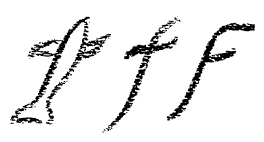
[ 19 ] But there is something to consider here. What we know today as letters did not always exist. Let us look at those ancient peoples who used pictographic writing: they expressed their ideas through images that were already related in some way to what was being spoken. They did not have letters like ours, but rather pictures that were related to what they signified. The same could also be applied, in a certain sense, to cuneiform writing. Those were times when, when something was recorded, people still had a human connection to it. Today we do not have that. With children, we must return to this. However, this does not mean studying cultural history and reverting to the forms that once existed in pictographic writing; rather, in order to arrive at useful images, one must above all stimulate one’s imagination as a teacher and educator. One must certainly possess this imagination, for without it one cannot be a teacher or educator. That is why, whenever we are characterizing something that arises from anthroposophy, we must always point to enthusiasm and inspiration. — I am never particularly inspired, for example, when I walk into a classroom at our Waldorf school and notice that the teacher is tired, teaching from a certain state of weariness. Yes, you simply can’t do that! You can’t be tired; you can only be enthusiastic, fully present with your whole being when you’re teaching. It’s completely wrong to be tired when you want to teach; you have to save that for other things. — So it’s definitely a matter of teachers being able to get their imagination going. What does that mean? First, I draw the child’s attention to something they’ve seen at the market or somewhere else—for example, a fish. I guide them so that, at first—even letting them use colors—they draw a fish by painting, and paint by drawing. Once I’ve guided them to do this, I then have them say the word “fish,” not by blurting it out quickly, but “F-i-sh.” I then guide the child to say only the beginning of the word “fish,” “F…,” and I gradually transform this fish-like symbol into the shape of a fish while simultaneously encouraging the child to say “F”: the “F” is there!
[ 20 ] Or I have the child say, “Wave,” and teach him what a wave is (see drawing). I then have the child draw a wave, encourage him to say the beginning of the word “wave”: “W...,” and I then turn the drawing of the wave into the letter W.
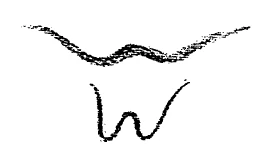
[ 21 ] By continuing to develop this further, I extract the written characters from painting-as-drawing and drawing-as-painting, just as they originally arose. I do not bring the child into a stage of civilization that has nothing in common with him yet; rather, I guide him in such a way that his connection to the outside world is never severed. To do this—unless one specifically wants to study cultural history (since today’s writing evolved from pictographic writing, though one doesn’t actually need to study cultural history)—one need only set one’s imagination in motion; for then one can guide the child to develop writing from painting-like drawing.
[ 22 ] Now, one must not merely emphasize that one has done something ingenious, that one has a new method. One must focus on how the child grows inwardly into other things when its soul activity is continually stimulated. It does not grow into them if it is pushed, so that it continually enters into alien relationships with its surroundings. What matters is that one works on the child’s inner being.
[ 23 ] What, then, is the principle today? It’s true that it’s already a bit outdated today, but it wasn’t that long ago that girls were given “beautiful” dolls—with real hair and so on—and eventually even ones that could close their eyes when laid down, dolls with beautiful faces and so on. Of course, they’re still hideous because they lack artistic merit, but civilization calls them beautiful. But what kind of dolls are these? They’re the kind that leave no room at all for a child’s imagination. Now let’s do it differently. Tie a handkerchief together so that it forms a figure with arms and legs; then make eyes with ink blots, and perhaps even a mouth with red ink; then the child has to use its imagination to bring it to life when it is asked to create a mental image of this as a person. Something like this has an incredibly vivid effect on the child because it offers the child the opportunity to set its imagination in motion. Of course, you have to do it yourself first. But you must provide the child with this opportunity, and this should be done as early as the play age. Therefore, all things that do not stimulate the child’s imagination are harmful as toys. — I said that today we’ve already moved beyond beautiful dolls; for today we give children monkeys or bears. The imagination certainly cannot build upon these in a human way. But precisely such instances—when children come to you and you give them a bear they can cuddle—show just how far our civilization stands from what it means to look into the innermost core of human nature. And it is quite remarkable how children can give form to this inner core of human nature in a naturally artistic way.
[ 24 ] To this end, we have structured the transition from regular instruction to a kind of art class at the Waldorf School. So, aside from the fact that we don’t start by teaching the children to write at all, but rather let them paint while drawing and draw while painting—one could also say we let them “make a mess”; you then have to have the classroom cleaned afterward, which is perhaps a bit inconvenient; I’ll also explain tomorrow how we transition from writing to reading—aside from that, we also introduce the child to the artistic realm as much as possible, to working with small sculptural pieces, without directing the child toward anything other than what they want to create from within themselves. This gives rise to some very curious phenomena. I’d like to cite one example, for instance, that occurs in a wonderful way with older children.
[ 25 ] We introduce the study of the human form relatively early on as a subject of instruction, for children around ten or eleven years old. There, they learn to recognize how bones are shaped and structured, how bones support one another, and so on. And the children learn this specifically through artistic means, not in an intellectualistic way. Now the child has had a few such lessons in which they have gained an understanding of the structure of human bones, the dynamics of the bones, and how they support one another. Now we move over to the workshop, where the children are sculpting figures, and we can immediately see from what the child is making that they have learned something about bones. Not that they are imitating the shapes of bones, but rather how the soul sets itself in motion, inwardly—this is expressed in the way they now create their forms. Previously, they also came up with the idea of making small containers, for example; the children come up with the idea of making such bowl-like objects all on their own. These take on a completely different character, stemming from the child’s nature, before they have received such instruction, and afterward, when the experience is truly as it should be. But one must then present the study of human nature in such a way that it permeates the whole person. Today, that is difficult.
[ 26 ] If someone has spent as much time as I have in studios and seen how people paint and sculpt, then they also know that today hardly any sculptor creates anything without a model; they must have a human form in front of them if they want to model it. That would have been nonsense to a Greek artist. He did, of course, become familiar with the human form through public performances, but he sensed the human form intuitively. He knew from how he felt it within himself—and he embodied this feeling without a model—he knew the difference in how an arm looks when it is extended, when the index finger is also extended, and so on. He then embodied this feeling into the form. But if you teach human anatomy today as is customary, you simply place one bone next to another based on illustrations or drawings, describe one muscle next to another, and you get no sense of how everything relates to one another. - With us, when children study a vertebra from the spinal column, they recognize how it resembles the skull; they develop a sense of how bones transform. Then they become immersed in the human form and feel the urge to express this artistically. This brings it into life; it does not remain merely external.
[ 27 ] Therefore, it is my deepest desire—and also my demand as the director of the Waldorf School—that, as far as possible, everything that constitutes science—I value this science; no one can value it as highly as I do—but everything that is fixed, fixed in books, should be excluded from school instruction. One may pursue it outside of school if one cannot rein it in; but I would otherwise go mad if I saw a teacher standing in front of the class with a book. In teaching, everything must come from within; everything must be self-evident. How, for example, is botany taught today? We have botany textbooks; they are reproductions of scientific views, but they do not belong in school, where children are between the stages of losing their baby teeth and reaching sexual maturity. The literature that a teacher needs must, in fact, grow once again out of the living principles of education of which I wish to speak here.
[ 28 ] So it really is a matter of the teacher’s entire being—their emotional, spiritual, and physical being—being deeply rooted in the world. Only then can they have an impact on the children; only then are they the natural authority figure for them during the period between losing their baby teeth and reaching puberty. It always comes down to having grown into the experience and ensuring that everything flows vividly into life. That is the fundamental principle that must guide education today. Then the connection with the class is established, and with it that which must be present as an intangible atmosphere.
Q&A
[ 29 ] Question: There are adults who seem to have remained at the stage of the imitative child. How is that possible?
[ 30 ] Dr. Steiner: At every stage of human development, it is possible for a person to come to a standstill. When we describe the stages of development in this way—if we now add to what we were able to discuss today the embryonic period, then the period up to the change of teeth, and then the period up to sexual maturity—we have identified the epochs that can unfold in a fully developed human life. But very recently, the context of our anthroposophical development has revealed that the task at hand was to give lectures on curative education, drawing on specific cases of children who are either developmentally delayed or exhibit abnormal development in some respect. We then arranged things so that we presented individual cases—treated at Dr. Wegman’s Clinical-Therapeutic Institute in Arlesheim—from the perspectives of pedagogy, medicine, hygiene, and so on. Among these cases was one involving a child who is nearly one year old and is also approximately the size of a one-year-old, but whose entire physical development has remained at the stage of, one might say, a seven- to eight-month-old embryo. If you were to sketch only the outline of that child—without drawing the limbs, which are already somewhat more developed, very clearly, but merely hinting at them— but clearly draw the shape of the head as it appears in this boy, and then, if you glance at the drawing from above, have no idea that this is a boy who is nearly one year old, you will believe that it is an embryo, because this boy has retained the embryonic constitution in many respects even after birth.
[ 31 ] Every stage of life, including the embryonic stage, can be carried over into a later one. This is because the successive stages of development are such that, so to speak, at each new stage the old is transformed and something new is added. If you take very precisely what I have said regarding the child’s natural-religious devotion to its surroundings before the change of teeth, then you have there the natural-religious aspect, which later transforms into the soul-related, and you have the aesthetic stage added as a second one. Now, there are many children who carry the first stage into the second, and the second stage then remains stunted. But this can go even further: the stage that has already been embodied can appear in any other stage; then, in later stages, the original stage will be carried into them. And it need not even be particularly noticeable in the superficiality of life that, so to speak, an earlier stage has remained within a later one, unless such a phenomenon manifests itself at a particularly late age. But it does happen that earlier stages are carried over into later ones.
[ 32 ] Consider a lower kingdom of nature. The mature, fully developed ordinary plant has a root, a stem with leaves, then green foliage concentrated into a calyx, followed by the petals, stamens, pistil, stigma, and so on. But there are, of course, plants that do not reach the flowering stage, that remain at the stage of the herb, the green leaves, and form fruit only in an undeveloped form. How far behind, for example, is a fern compared to a buttercup! In plants, this does not lead to abnormality. But in the case of human beings, there is only one type of human. Then, throughout their entire life, a person remains an imitative being or one who must be under . authority. For in life we may encounter not only people who remain imitative beings, but also those who, in terms of their actual characteristics, remain at the stage that is fully developed between the loss of baby teeth and sexual maturity. Such people are, in fact, very common; this stage carries over into their later life. These people then do not progress much further in terms of what they possess in later life, so that what emerges later comes to the fore only to a limited extent; yet they always remain at the level of authority. - If this were not the case, then the tendency toward the formation of sects and the like—which still exists today—would not exist either; for sectarian affiliations are based on the fact that one does not need to think for oneself, but rather lets others do the thinking and follows them. But in certain areas of life, the vast majority of people remain at the stage of authority. For example, when it comes to judging some scientific question, people do not strive to gain insights for themselves, but instead ask: “Where is the person who must know this, who teaches in a department at some university?”—There you have the principle of authority. But even among the sick, the principle of authority—though justified—is highly developed. And in legal matters, for example, no one today wants to judge for themselves; they go to a lawyer who knows the law, and there they always remain at the level of an 8- or 9-year-old. And sometimes this lawyer isn’t much older himself. When you ask him questions, he pulls out a law book or a folder, and there you have an authority figure once again. The reality is that every stage can merge into a later one.
[ 33 ] The Anthroposophical Society was actually intended to consist only of people who have transcended authority, who do not recognize any principle of authority at all, but only true insight. People on the outside find this so hard to conceive that they always say: Anthroposophy is based on authority. — But the exact opposite is true: the goal is to transcend the principle of authority through the very kind of insights cultivated in anthroposophy. The point is for a person to take up every tiny particle of insight so that they can pass through the various stages.
[ 34 ] Question: Why, from the perspective of anthroposophy, is immortality not a matter of faith but a matter of knowledge?
[ 35 ] Dr. Steiner: Anthroposophy progresses from the outer understanding of the human being to the inner understanding of the human being. For example, of the people who are here and have been attending lectures for a long time, it is not the physical body that remains, but only the etheric body. Anthroposophy penetrates as far as that; thus, one can speak of what extends from birth to death. Conventional science is mistaken about this. Speaking of the etheric body is no more a matter of faith than speaking of the physical body is. The etheric body is perceived through imagination. If one proceeds further in anthroposophical knowledge, one learns through inspiration to recognize how the human astral body continues to live on after death.
[ 36 ] The modern concept of faith is not even as old as Christianity itself. It only emerged when people began to move away from what can be observed as spiritual.