

Spiritual Science and Medicine
GA 312
22 March 1920, Dornach
Translated by Steiner Online Library
Second Lecture
[ 1 ] We will proceed from starting points such as those chosen yesterday and gradually delve deeper into the nature of the human being by becoming attentive to certain polarities that prevail there. You will have noticed already yesterday that we are compelled to combine the forces still at work in the animal into a parallelogram with forces directed, so to speak, vertically, and that we have a corresponding analogy to this in muscular reaction. If these two lines of thought are pursued further in the study of the human skeletal and muscular systems—and if, in pursuing them, we draw upon everything that experience can already offer today—then it will likely soon be possible to derive something from the study of bones and muscles that is more significant for medicine than has been achieved so far. However, linking our understanding of the human being with the needs of medicine becomes particularly difficult when we take the study of the heart as our starting point today. I would like to say: What is only beginning to emerge in the study of bones and muscles has become thoroughly established in the view that has developed regarding the study of the heart. For what, after all, is the commonly held view of the human heart—let us limit ourselves to this for the moment? The view is that it is a kind of pump that pumps blood into the various organs. All sorts of interesting mechanical models have also been devised to explain this “heart” as a pumping mechanism. Now, although these mechanical models are entirely at odds with embryology, no one has taken the trouble to actually regard this mechanical theory of the heart as questionable, to reexamine it—at least not within mainstream science. That—I will first outline the points, and what we will demonstrate over the next few days will, piece by piece, serve as confirmation of what I am compelled to state first as a point of view—that which must be taken into account above all else when considering the heart is that this heart is by no means what one might call a kind of active organism. For the activity of the heart is not a cause, but rather a consequence. You will understand this statement only if you consider the polarity that exists between all those activities in the human organism that are connected with the intake of food, with the further processing of food, and with its transfer—either directly or through vessels—into the blood; for, as you will see, I might say, proceeding from the bottom up in the organism—from the processing of food all the way to the interaction that initially exists between the blood that has absorbed the food and respiration, through which the air we breathe is taken in. If you look very closely at the processes involved here—you really just need to look at them closely—you will find that there is a certain contrast between everything that pertains to the respiratory process and everything that pertains, in the broadest sense, to the digestive process. Something is trying to balance itself out there. There is something there that, I would say, thirsts for one another, seeks to satisfy itself through the other. Of course, one could also choose other expressions, but we will come to understand each other better and better over time. An interaction takes place, which initially exists between the nutrients that have become liquid and what is taken in by the organism in gaseous form through respiration. This interaction must be studied closely. This interaction consists of forces that interact with one another. And what interacts there—I would say—accumulates in the heart prior to its mutual interplay. This arises as a reservoir organ between what I would now like to call the lower functions of the organism—food intake and food processing—and the upper functions of the organism, the lowest of which I would again include respiration. A storage organ is involved, and the most essential aspect of this is that the heart’s activity is a consequence of the interaction between the food that has become liquid—that is, between the food fluid and the air taken in from the outside. Everything that is expressed in the heart, everything that can be observed in the heart, must be regarded as a consequence, first and foremost in a mechanical sense.
[ 2 ] The only promising start that has been made—at least to consider this mechanical basis of cardiac activity, though nothing more—was made by an Austrian physician, Dr. Karl Schmid, who practiced in northern Styria and published a paper on the subject in the *Wiener Medizinische Wochenschrift* in 1892, Nos. 15–17, titled “On the Heartbeat and Pulse Curves.” There is not yet very much contained in this treatise, but one must acknowledge that at least here, for once, someone has observed from his medical practice that the heart is not to be regarded as an ordinary pump, but rather as a storage apparatus. Schmid conceives of the entire process of cardiac movement and the heartbeat as the action of a hydraulic ram set in motion by the currents. Therein lies the truth inherent in Dr. Karl Schmid’s explanations. But we are only dealing with the mechanical aspect when we understand all that constitutes heart activity as the result of these interrelated—I can now symbolically call them “currents”—the fluid current and the gaseous current. For ultimately, what is the heart? Ultimately, the heart is, in fact, a sensory organ. And even if we do not have the heart’s sensory activity directly in our consciousness—even if what takes place in the heart belongs to the subconscious sensory activities—the heart is nevertheless there so that, in a sense, the higher activities can perceive and feel the lower activities of the human being. Just as you perceive external colors with your eyes, so too do you perceive—albeit in the dim subconscious—through the heart what is taking place in your lower abdomen. Ultimately, the heart is a sensory organ for inner perception. It must be addressed as such.
[ 3 ] One can understand the polarity within the human being only when one realizes that the human being is, in fact, a dual-natured being who perceives his lower self from the perspective of his higher self. Now, however, I must add the following: We have indeed considered the lower activities—that is, one pole of the entire human being—when we study the intake and processing of food in the broader sense, up to its balance with respiration. This balance with respiration then takes place through a rhythmic activity. We will have more to say about the significance of our rhythmic activity. But intertwined with the activity of breathing—and belonging to it—we must consider the sensory-nervous activity: everything that relates to external perception and to the continuation of this external perception, as well as its processing through nervous activity. So if, on the one hand, you create a mental image of everything that is interconnected—respiratory activity and sensory-nervous activity—you have, so to speak, one pole of the human organism. If you take everything that, on the other hand, constitutes food intake, food digestion, and metabolism in the ordinary sense of the word, you have the other pole of the processes in the human organism. The heart is essentially the organ whose observable movements express the balance between this upper and lower realm; psychologically—or perhaps better said, subpsychologically—it is the organ of perception that mediates between these two poles of the human organism. You can study everything that anatomy, physiology, and biology have to offer in light of this principle, and you will see that only then does light shed upon the human organism. As long as you do not distinguish between this upper and lower realm—which is mediated by the heart—you will not be able to understand human beings, for there is a fundamental difference between everything that takes place in the lower organizational activity of human beings and what takes place in the upper organizational activity.
[ 4 ] If one wishes to express this difference in a simple way, one might say something like this: everything that takes place in the lower realm has its negative, its negative counterpart, in the upper realm. It is always the case that for everything connected with the upper realm, one can find a counterpart in the lower realm. What is significant here, however, is that there is actually no material mediation between the upper and lower realms, but rather a correspondence. One must always know how to correctly relate one thing in the lower realm to another in the upper realm, rather than seeking a material mediation. Let us take a very simple example: the urge to cough and the actual cough, as it relates to the upper realm—that is, insofar as it belongs to the upper realm—will have its corresponding counterpart in the lower realm in the form of diarrhea. We always find a corresponding counterpart for something in the upper realm in the lower realm. And only in this way can one truly come to an understanding of the human being—by being able to correctly grasp these correspondences, many of which will become apparent to us in the course of our reflections.
[ 5 ] However, there is not merely such an abstract correspondence; at the same time, in a healthy organism, there is an intimate interconnection between the upper and lower regions. This interdependence in the healthy organism is such that the upper—any upper activity, whether it be an activity related to breathing or one related to the nervous-sensory system—must in some way subdue the lower and must unfold in complete harmony with it. And there is immediately—and this will later lead us to a true understanding of the disease process—an irregularity in the organism whenever, in any way, a lower aspect gains dominance or supremacy, such that it is too strong for the corresponding activity in the upper aspect, or an upper aspect gains dominance, such that it is too strong for a corresponding activity in the lower aspect. The activities of the upper part must always relate to the activities of the lower part in such a way that they correspond to one another in a certain sense, that they balance each other out, that they proceed toward one another in the way that, I might say, they are oriented toward one another. There is a very specific orientation here. It is individual to each person, but there is a very specific orientation of the entire upper course of the processes toward the entire lower course of the processes.
[ 6 ] The point now is to find the transition from this healthy organism, in which the upper corresponds to the lower, to the diseased organism. If, I would say, one starts from the signs of illness in what Paracelsus called the “Archaeus”—what we call the etheric body—or if you wish to phrase it in such a way that it won’t be taken amiss by outsiders, by people who want to know nothing of these things, then you might also say, you want to speak first of all about the signs of illness in the functional or dynamic realm—that is, the first stirrings that, in a sense, are the very beginnings of illness. If we take these as our starting point, if we speak of what first manifests itself in the etheric body or in the purely functional realm, then we can also speak of a polarity, but a polarity that already carries within itself the lack of correspondence, the irregularity. And this arises in the following way.
[ 7 ] Let us assume that in the lower region—that is, in the process of food intake and in the digestive system in the broader sense—what predominates are the internal chemical or organic forces of the ingested food. In a healthy organism, it must be the case that all those forces that act within the food itself—those that are inherent in the food, which we therefore examine externally in the laboratory—are overcome by the Upper, so that they do not come into play at all in the organism’s internal processes; that nothing at all of external chemistry, external dynamics, or the like occurs there, but rather that all of this is completely overcome. But it can happen that the higher aspect is not strong enough in its correspondence to truly encompass the lower aspect entirely—to, so to speak, cook it through completely— I could also say, to ‘etherize’ it—which would be a more precise way of putting it—then there is a preponderant process in the human organism that does not actually belong to it, a process that otherwise takes place in the external world, but should not take place in the human organism. Such a process manifests itself because the physical body is not immediately fully affected by such irregularities; rather, they first appear in what one might call the functional aspect—in the etheric body, the Archaios. If we wish to choose a common term that is taken, so to speak, from certain forms of this irregularity, we must choose the term “hysteria.” Let us choose “hysteria” as a term—we will see later that the term is not poorly chosen—to describe the excessive autonomy of metabolic processes. The truly hysterical phenomena in the narrower sense are, after all, nothing other than the driving of this irregular metabolism to its culmination. In reality, even in the hysterical processes that extend to sexual symptoms, we essentially have nothing other than such metabolic irregularities, which are in fact external processes by their very nature—processes that should not be present in the human organism—processes, therefore, against which the higher functions prove too weak to cope. That is one pole.
[ 8 ] When such phenomena occur in conjunction with a hysterical disposition, we are dealing with an excessive intensification of non-human activity in the lower parts of the human organism. But the same irregularity in the interaction can also arise because the upper process is not proceeding correctly—because it proceeds in such a way that it places too great a demand on the upper organization. It is the opposite, so to speak, the negative of the lower processes; it places too great a demand on the upper processes. It ceases, as it were, before it is mediated through the heart to the lower organization. It is therefore too strong spiritually, too strong—if I may use the expression—organically intellectual. Then the other pole of these irregularities emerges: neurasthenia. These two irregularities of the human organization—which, I would say, are still rooted in the functional—must be taken into account above all else. For they are, so to speak, the defects that manifest in the upper region and manifest in the lower region. And we will gradually have to understand how the polarity in the human organism is subject to one deficiency or the other. In neurasthenia, therefore, there is a functioning of the upper region that places too great a strain on the organs of the upper region, so that what is actually supposed to occur in the lower region—mediated by the heart from above—already takes place in the upper region, is already settled there, so that the activity does not penetrate downward, mediated by the congestion in the heart, into the lower flow. You can also see that it is more important—much more important, I would say—to observe the external physiognomy of the clinical picture than to examine the damaged organs through autopsy. For what the autopsy reveals in the damaged organs are, after all, merely secondary effects. The essential thing is to take in the whole picture, the physiognomy of the disease. This physiognomy will always present you, in a certain way, with a picture that initially leans in one direction or the other—toward the neurasthenic or toward the hysteric. But of course, one must broaden the meaning of these terms beyond their ordinary usage.
[ 9 ] Now, once one has formed a sufficient picture of this interplay between the upper and the lower, one will gradually come to recognize how that which is initially present only functionally—that is, as we would say, takes place in the etheric—takes hold of the organic-physical realm by, so to speak, becoming denser in its forces, and how one can speak of what is initially present only as a hysterical hint taking on, so to speak, a physical form in various abdominal disorders, just as, on the other hand, neurasthenia can take on an organic form in disorders of the throat and head. Studying this—I would say—imprinting of these initially functional physical phenomena in neurasthenia and hysteria will be of extraordinary importance for the future of medicine. It will be the consequence of what I would call “hysteria that has become organic”: irregularities in the entire digestive process, and indeed in all processes of the abdomen. But what occurs in this way within an organism inevitably has a reciprocal effect on the entire organism. We must not overlook the fact that these irregularities, in turn, have a reciprocal effect on the entire organism.
[ 10 ] Now just imagine: something that—if one could initially observe it functionally—would simply be a hysterical phenomenon is not expressed functionally at all. That may very well be the case. It is not expressed functionally. The etheric body immediately imprints it into the physical body. Nor does it appear as a distinct illness in the abdominal organs, but it is there. So there is, let’s say, something in the abdominal organs that is like a stamp of hysteria. Because it has been imprinted into the physical body, it does not manifest psychically as a hysterical phenomenon, but it is also not yet strong enough to be a troublesome illness—a physical illness. But it is strong enough to affect the entire organism. Then we have the peculiar phenomenon that something—which, I would say, hovers between illness and health—acts from the lower regions upward, affects the upper regions, infects the upper regions, so to speak, and appears in its negative form. This phenomenon—where, in a sense, the first physical consequence of the hysteric manifests in its effect on the areas that, when they become one-sided or irregular, are otherwise prone to neurasthenia—this phenomenon constitutes the predisposition to tuberculosis.
[ 11 ] That is an interesting connection. The predisposition to tuberculosis is a reaction of the activity in the lower region—which I have just described—on the upper region. This very peculiar interaction, which arises because a process that has not fully run its course—as I have described it—feeds back into the upper regions, creates the predisposition to tuberculosis. One will not find anything that rationally addresses tuberculosis unless one goes back to this—I would say—primordial predisposition of the human organism. For the fact that parasites take hold in the human organism is merely a consequence of those predispositions I have just spoken to you about. This does not contradict the fact that, when the necessary conditions are present, something like tuberculosis is contagious. Of course, the necessary conditions must be present. But it is indeed the case that, unfortunately, this predominance of lower organic activity is present in a terribly large portion of humanity today, so that the predisposition to tuberculosis is actually widespread in an alarming way today.
[ 12 ] Well, “contagion” is indeed a valid concept in this field, because someone with a more advanced case of tuberculosis does have an effect on those around them. And if one is exposed to the environment in which the person with tuberculosis lives, then what is otherwise merely an effect can in turn become a cause. I always try to clarify this relationship between the primary onset of a disease and contagion using a comparison, an analogy—for example, by saying: Let’s suppose I run into a friend on the street with whom I otherwise have no close personal ties. He seems sad; he has a reason to be sad, because a friend of his has died. I have no direct connection to the friend who has died. But when I encounter him and he shares his sadness with me, I become sad along with him. He becomes sad through a direct cause; I do so through contagion. Yet it remains true that only the mutual relationship between him and me is the prerequisite for this contagion.
[ 13 ] So these two terms—primary onset and infection—are certainly valid, and they are particularly valid in the case of tuberculosis. However, they should really be used in a rational sense. After all, tuberculosis sanatoriums are sometimes nothing more than breeding grounds for tuberculosis. If we are going to cram tuberculosis patients together in sanatoriums, we should, as much as possible, constantly dismantle these sanatoriums and replace them with others. After a certain period of time, tuberculosis sanatoriums should actually always be dismantled. For this is the peculiar thing: tuberculosis patients themselves are most susceptible to infection; that is to say, their illness—which might otherwise be treatable—may worsen if they are in the vicinity of patients with more severe tuberculosis. But for now, I simply wanted to point out the nature of tuberculosis. We see in tuberculosis, as an example, just how the various processes in the human organism must, so to speak, interlock—processes which, as you can imagine, must always be influenced by the fact that we are dealing with the upper and lower organizations, which correspond to one another just as a positive image and a negative image are opposites. One can, I would say, study the most striking manifestations—which initially pave the way for tuberculosis when the organism has the constitution I have described—and, in their course, further investigate how the nature of disease should be viewed in general.
[ 14 ] Let us consider the most common presentation of a person who is, say, in the early stages of tuberculosis—that is, someone in whom tuberculosis is actually still in the future, just beginning to develop. We may notice that he is coughing. We will notice that they have pain in the throat and chest, and perhaps also pain in the limbs. We will notice certain signs of fatigue in them; in particular, we will notice night sweats.
[ 15 ] What is all this? When we consider these phenomena, what are they actually? Everything I have just described to you is, first of all, something that arises as a consequence of the internal, irregular interactions I have described. But at the same time, it is a struggle that the organism wages against what lies beneath as a deeper foundation. You see, coughing—let’s consider such simple things first; we’ll get to the more complicated ones later—always trying to suppress a cough under all circumstances is certainly not good. Sometimes the organism may even need to artificially induce a cough. If a person’s lower constitution is such that it cannot be subdued by the upper constitution, then what manifests as a cough reflex is a healthy reaction of the human organism to prevent certain harmful substances from entering the body. And simply suppressing a cough under all circumstances can, under certain conditions, be harmful, because then the body absorbs harmful substances. It coughs precisely because, in this temporary state, it cannot tolerate these harmful substances and wants to expel them. The urge to cough is precisely the indication that something is going on in the organism, creating the need to prevent the corresponding intruders—which would otherwise be able to enter the organism quite easily—from doing so.
[ 16 ] But the other symptoms we have mentioned are also a form of defense, a struggle by the organism against what is emerging in the tuberculous predisposition. A sore throat and aching limbs simply indicate that the organism will not allow those processes to proceed that cannot be subdued by the higher processes. Again, for example, if the predisposition to tuberculosis is detected in time, it might be beneficial to support the organism by moderately inducing the urge to cough—in particular, as we will see in the following lectures, — by inducing the resulting symptoms, and even—as we shall see—by means of a certain diet, one can induce symptoms of fatigue. Even if, for example, weight loss occurs, this is merely a defensive mechanism. For the process that then takes place—if one does not lose weight—is perhaps precisely that which is occurring in the lower region and cannot be overcome by the upper region, so that the organism defends itself by losing weight, thereby ensuring that what cannot be overcome is temporarily absent.
[ 17 ] It is therefore extremely important to study such matters in detail, rather than, for example, immediately putting someone on a weight-gain regimen simply because they are losing weight, since this weight loss may serve a very good purpose in relation to what is currently manifesting itself temporarily in the organism.
[ 18 ] Night sweats are particularly instructive in individuals who do not yet have tuberculosis but are at risk of developing it. For night sweats are nothing other than an activity of the organism carried out during sleep that should actually take place during wakefulness amid full mental and physical activity. That which should actually take place during the day while fully awake does not occur and finds its expression at night. It is both a consequence and, at the same time, a defense mechanism. While the organism is relieved of its mental activity, it generates the activity that finds expression in night sweats.
[ 19 ] However, in order to fully appreciate this fact, one must understand to some extent that all excretory processes—including perspiration—are intimately connected with what is otherwise encompassed by psychological and mental activity. The constructive processes—the actual vital constructive processes—are, in fact, merely the foundation of the unconscious. What corresponds to waking, conscious psychological and organic activities are, in every case, excretory processes. Even our thinking is not accompanied by constructive processes in the brain, but rather by excretory processes—degradation processes in the brain. And the occurrence of night sweats is precisely such an excretory process, which in normal life should actually run parallel to mental and psychological activity. But because the higher and the lower are not in the proper interrelationship, such processes are then saved up for the night, when the organism is relieved of mental and psychological activity.
[ 20 ] So you see how a careful study of all the processes related to the entire growth and development of the healthy and diseased human organism ultimately leads to the conclusion that there is also an interaction between symptoms of disease. Weight loss is, first and foremost, a symptom of disease. But in its relationship to the predisposition to tuberculosis—that is, to tuberculosis that is already having some effect—emaciation is an integral part of it. And there is, I would say, an organization, an ideal organization of the symptoms of disease. In a certain sense, one symptom belongs to another. This then implies that it is entirely rational—when other conditions of the organism give rise to something like a reaction (let us stick with the predisposition to tuberculosis), but the organism itself lacks the strength to bring about this reaction—to come to its aid and deliberately induce it, so that one disease is allowed to follow the other. The ancient physicians explicitly stated this as, I would say, a significant rule of training for the physician. They said: The danger of being a physician is that he must not only be able to dispel diseases, but also to induce them. — And to the same extent that the physician can cure diseases, he can also induce them. Thus, the ancients—who knew somewhat more about such connections through their atavistic clairvoyance—saw in the physician, at the same time, one who, if he becomes malicious, can make people not only healthy but also sick. But this is connected to the necessity of inducing certain pathological states in order to bring them into the proper relationship with other pathological states. But these are, after all, states of illness. And all of these—coughing, sore throat, chest pain, signs of emaciation, signs of fatigue, night sweats—are, after all, symptoms of illness. One must induce them, but they are, after all, symptoms of illness.
[ 21 ] This will lead to the obvious realization that, once one has achieved a partial cure—that is, once one has induced these symptoms of the disease—one cannot simply leave the patient to his fate, but rather the second phase of the healing process must then begin. Care must then be taken to ensure that it is not merely these reactions that are present—not merely what has been induced to ward off the disease—but that what follows is what, in turn, heals the reaction and brings the entire organism back on the right track. So one must ensure that, for example, when coughing impulses have been induced—whether naturally or perhaps artificially—as a defense against a predisposition to tuberculosis, and a sore throat has developed or been induced, one ensures that the digestive process—which will then invariably exhibit some degree of constipation—is restored to normal. One will notice in some way that this digestive process must be transformed into a laxative process, into a kind of diarrhea. It is always necessary to allow such diarrhea-like processes to follow the coughing symptoms, as well as the sore throat and the like. This precisely illustrates how one must not regard what simply occurs in the upper region as something in and of itself, and how one must very often seek the healing of what occurs in the upper region through processes in the lower region—even if there is no material mediation, but only a corresponding relationship. This is something that must be taken into account above all else.
[ 22 ] Symptoms of fatigue—I would not simply call them subjective symptoms of fatigue, but rather entirely organically caused symptoms of fatigue, which are actually always based on a predominance of metabolism—as they occur strongly in a metabolism that is not controlled by the higher faculties, such symptoms of fatigue—since they are indeed caused by tuberculosis—must subsequently be counteracted at the appropriate time by ensuring, through an appropriate diet—we will discuss the specifics of such a diet later—that digestion takes precedence, so that the individual digests food better than usual, so I would say that what is more easily processed must be processed through the digestive process. Weight loss will later have to be counteracted by a diet that, in turn, leads to a certain degree of fat formation—to something that is stored in the organs and organ tissues. Night sweats must be addressed later—after having initially brought them on—by trying to instruct the person to engage in an activity in which they actually break a sweat through spiritualized exertion, that is, through thoughtful effort, so that they once again return to healthy perspiration.
[ 23 ] You see, once one understands—through a correct understanding of the heart’s activity—how the upper and lower regions of the human being correspond, one then understands the initial manifestations, I would say, the first signs of illness in the functional and etheric realms—as in neurasthenia and hysteria—then one can proceed to understand what subsequently manifests in the organic and physical realms, and through the study of the physiognomy of the associated clinical picture, one will come to understand—including that which one oneself initially brings about— first, I would say, to induce a course of the disease in a certain direction—toward a condition that may be even more or less pronounced—and then, when the time is right, to guide the entire process back toward recovery.
[ 24 ] Of course, the greatest obstacles to a treatment that has already been somewhat characterized in this way are, first and foremost, social conditions. That is why medicine is certainly also a social issue. On the other hand, it is the patients themselves who pose the greatest obstacles, because patients naturally demand, first and foremost, that something—as they put it—be “removed.” But if you so directly remove something they have, it can very easily happen that you make them much sicker than they already are. You must also take into account that you are making them much sicker than they are, but they must then wait until you are once again in a position to make them well. But by then, as many of you will agree, they’ve usually run away!
[ 25 ] This is precisely what a proper examination of healthy and sick people leads to: that the doctor must also have full control over the follow-up care if the entire treatment is to have any real value at all. We simply must work publicly to bring about such changes. In our age of blind faith in authority, it should not be difficult—if such movements were only initiated—to draw attention to these necessities. But of course—forgive me for saying this in your presence—it is not always merely the patients or merely the circumstances; sometimes it is also the doctors themselves who do not consider it appropriate to truly pursue the illness to its very end, but are more or less satisfied simply to have gotten rid of something.
[ 26 ] But you will see how, little by little, this accurate examination of the heart’s role in the human organism will lead us into the realm of disease. You will, however, need to take note of the radical difference that exists between the lower organic activities—which, in a certain sense, have indeed transcended what is merely external chemical activity, yet are still, in a certain way, similar to the higher activity, which is entirely opposite. It is extremely difficult to adequately define this dualism in the human organism, because our language has almost no means of indicating that which is opposed to physical and organic processes. But perhaps you will understand me well—and I do not shy away from the possibility of encountering one prejudice or another among some of you—if I first attempt to clarify, through the following analogy—we will, after all, have more to say about these things—what this dualism between the lower and higher processes actually entails. If you consider the properties of any substance—specifically those properties that lead to its effectiveness when it is present to us in any form—you first have that which, when overcome by the organism—as happens during digestion—is thus incorporated into lower human activity. Now, however, one can also, if I may put it that way, “homeopathize.” One can dissolve the aggregation, the coherence of the substance. This happens when one dilutes the substance in some way, when one, as I said, prepares homeopathic doses. You see, something comes to light here that is not properly considered at all in our current natural science, and people are so inclined to view everything abstractly. That is why they say that if we have a light source here, then light spreads out in all directions, and they create a mental image—they create this mental image about the sun as well—that it spreads out in all directions and then disappears into infinity. But that is not true. Nowhere does such an activity vanish into infinity; rather, it extends only to a limited sphere, and then it rebounds as if elastically, even if the quality—the nature—of the rebound is often different from the nature of the outward movement (see drawing on page 53). In nature, there are only rhythmic processes; there are no processes that extend into infinity—there is only that which rhythmically rebounds back into itself.
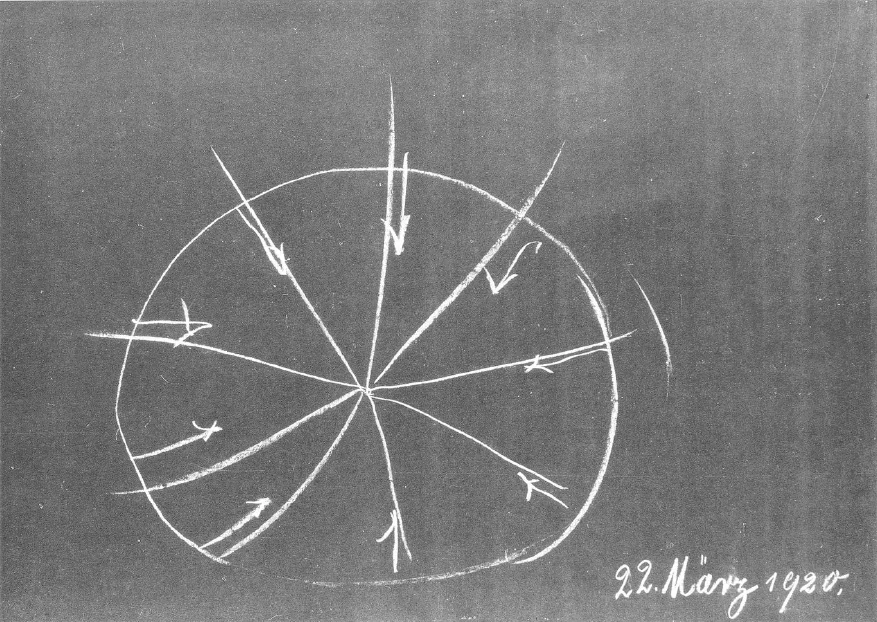
[ 27 ] And this is not only the case with quantitative expansions, but also with qualitative expansions. When you begin to divide a substance, it initially possesses certain properties at the starting point. These properties do not diminish to infinity; rather, once a certain point is reached, they reverse and become the opposite properties. And this inner rhythm also underlies the contrast between lower organization and higher organization. Our higher organization is something homeopathic. It is something that, in a certain sense, is directly opposed to the ordinary digestive process, forming its opposite, its negative. And so one could say that, in preparing the dilutions, the homeopathic pharmacist is in fact transforming the properties that otherwise relate to the lower human organization—and are connected to it—into properties that then relate to the upper human organization. This is a very interesting internal connection, and we will discuss this connection further in the coming days.