

Spiritual Science and Medicine
GA 312
22 March 1920, Dornach
Translate the original German text into any language:
Versions Available:
Spiritual Science and Medicine, tr. SOL
Zweiter Vortrag
Second Lecture
[ 1 ] Wir werden von solchen Ausgangspunkten wie den gestern gewählten weiterschreiten und allmählich auch in das Wesen des Menschen weiter vordringen, indem wir aufmerksam werden auf gewisse Polaritäten, die da herrschen. Sie werden schon gestern bemerkt haben, daß wir genötigt sind, die noch bei dem Tier lastenden Kräfte zu einem Parallelogramm zu verbinden mit gewissermaßen senkrecht gerichteten Kräften, und daß wir entsprechend ein Analogon dazu haben in der Muskelreaktion. Wenn diese beiden Gedanken beim Studium des menschlichen Knochensystems und des menschlichen Muskelsystems weiterverfolgt werden, wenn bei ihrer Verfolgung alles zu Hilfe genommen wird, was die Erfahrung heute schon geben kann, so wird man wahrscheinlich aus der Knochen- und Muskellehre etwas ja bald für die Medizin Bedeutsameres machen können, als man bisher gemacht hat. Ganz besonders schwierig wird aber die Verbindung der Menschenerkenntnis mit dem, was die Medizin braucht, wenn heute ausgegangen werden soll von der Herzlehre. Ich möchte sagen: Was sich bei der Knochen- und Muskellehre erst in der Anlage zeigt, ist bei der Anschauung, die sich herausgebildet hat über die Lehre vom Herzen, gründlich herausgekommen. Denn was hat man denn eigentlich so landläufig von dem menschlichen Herzen — wir wollen zunächst uns auf dieses beschränken — für eine Ansicht? Man hat die Ansicht, daß es eine Art von Pumpe sei, welche das Blut in die verschiedenen Organe hineinpumpt. Man hat auch allerlei interessante mechanische Konstruktionen ausgedacht, welche dieses Pumpwerk «Herz» erklären sollen. Nun widersprechen zwar diese mechanischen Konstruktionen durchaus der Embryologie, aber man ist nicht aufmerksam darauf geworden, diese mechanische Herztheorie wirklich einmal für fragwürdig zu halten, sie noch einmal zu kontrollieren, wenigstens nicht sie zu kontrollieren in der landläufigen Wissenschaft. Dasjenige — ich werde die Dinge zunächst skizzieren, und das, was wir in den nächsten Tagen uns vorführen werden, wird ja stückweise immer eine Bestätigung dessen sein, was ich genötigt bin, zuerst als Gesichtspunkt anzugeben —, dasjenige, was man vor allen Dingen berücksichtigen muß bei der Herzanschauung, ist, daß dieses Herz ganz und gar nicht ist, was man eine Art tätigen Organismus nennen kann. Denn die Herztätigkeit ist nicht eine Ursache, sondern sie ist eine Folge. Verstehen werden Sie diesen Satz nur dann, wenn Sie ins Auge fassen die Polarität, die besteht zwischen all denjenigen Tätigkeiten im menschlichen Organismus, die zusammenhängen mit der Nahrungsaufnahme, mit der weiteren Verarbeitung der Nahrung, mit ihrer Überleitung entweder direkt oder dutch Gefäße ins Blut, denn Sie verfolgen, ich möchte sagen, von unten nach oben gehend, im Organismus die Nahrungsverarbeitung bis zu der Wechselwirkung, welche zunächst besteht zwischen dem Blute, das die Nahrung aufgenommen hat, und der Atmung, durch die die Atemluft aufgenommen wird. Wenn Sie sich die Vorgänge, die dabei in Betracht kommen, ganz ordentlich ansehen — man braucht sie wirklich nur ordentlich anzusehen —, so werden Sie finden, daß ein gewisser Gegensatz besteht zwischen all dem, was im Atmungsprozesse liegt, und dem, was im weitesten Umfange im Verdauungsprozesse liegt. Es will da etwas sich ausgleichen. Es will da etwas, was, ich möchte sagen, zueinander hindurstet, sich aneinander sättigen. Man könnte selbstverständlich auch andere Ausdrücke wählen, allein, wir werden uns ja im Laufe der Zeit immer besser verstehen. Es findet eine Wechselwirkung statt, die zunächst besteht zwischen den flüssig gewordenen Nahrungsstoffen und zwischen dem, was luftförmig von dem Organismus durch die Atmung aufgenommen wird. Diese Wechselwirkung, sie ist genau zu studieren. Diese Wechselwirkung besteht in ineinanderspielenden Kräften. Und dasjenige, was da ineinanderspielt, das, möchte ich sagen, staut sich vor seinem gegenseitigen Ineinanderspiel im Herzen. Das entsteht als ein Stauorgan zwischen dem, was ich nun ferner nennen möchte die untere Betätigung des Organismus, Nahrungsaufnahme, Nahrungsverarbeitung, und den oberen Tätigkeiten des Organismus, zu deren unterster wiederum ich rechnen möchte die Atmung. Ein Stauorgan ist eingeschaltet, und das Wesentlichste dabei ist, daß die Herztätigkeit eine Folge der Wechselwirkung ist zwischen dem flüssig gewordenen Nahrungsstoft, also zwischen der Nahrungsflüssigkeit und der von außen aufgenommenen Luft. Alles dasjenige, was sich im Herzen ausdrückt, was man im Herzen beobachten kann, muß als eine Folge betrachtet werden, zunächst im mechanischen Sinne.
[ 1 ] We will proceed from starting points such as those chosen yesterday and gradually delve deeper into the nature of the human being by becoming attentive to certain polarities that prevail there. You will have noticed already yesterday that we are compelled to combine the forces still at work in the animal into a parallelogram with forces directed, so to speak, vertically, and that we have a corresponding analogy to this in muscular reaction. If these two lines of thought are pursued further in the study of the human skeletal and muscular systems—and if, in pursuing them, we draw upon everything that experience can already offer today—then it will likely soon be possible to derive something from the study of bones and muscles that is more significant for medicine than has been achieved so far. However, linking our understanding of the human being with the needs of medicine becomes particularly difficult when we take the study of the heart as our starting point today. I would like to say: What is only beginning to emerge in the study of bones and muscles has become thoroughly established in the view that has developed regarding the study of the heart. For what, after all, is the commonly held view of the human heart—let us limit ourselves to this for the moment? The view is that it is a kind of pump that pumps blood into the various organs. All sorts of interesting mechanical models have also been devised to explain this “heart” as a pumping mechanism. Now, although these mechanical models are entirely at odds with embryology, no one has taken the trouble to actually regard this mechanical theory of the heart as questionable, to reexamine it—at least not within mainstream science. That—I will first outline the points, and what we will demonstrate over the next few days will, piece by piece, serve as confirmation of what I am compelled to state first as a point of view—that which must be taken into account above all else when considering the heart is that this heart is by no means what one might call a kind of active organism. For the activity of the heart is not a cause, but rather a consequence. You will understand this statement only if you consider the polarity that exists between all those activities in the human organism that are connected with the intake of food, with the further processing of food, and with its transfer—either directly or through vessels—into the blood; for, as you will see, I might say, proceeding from the bottom up in the organism—from the processing of food all the way to the interaction that initially exists between the blood that has absorbed the food and respiration, through which the air we breathe is taken in. If you look very closely at the processes involved here—you really just need to look at them closely—you will find that there is a certain contrast between everything that pertains to the respiratory process and everything that pertains, in the broadest sense, to the digestive process. Something is trying to balance itself out there. There is something there that, I would say, thirsts for one another, seeks to satisfy itself through the other. Of course, one could also choose other expressions, but we will come to understand each other better and better over time. An interaction takes place, which initially exists between the nutrients that have become liquid and what is taken in by the organism in gaseous form through respiration. This interaction must be studied closely. This interaction consists of forces that interact with one another. And what interacts there—I would say—accumulates in the heart prior to its mutual interplay. This arises as a reservoir organ between what I would now like to call the lower functions of the organism—food intake and food processing—and the upper functions of the organism, the lowest of which I would again include respiration. A storage organ is involved, and the most essential aspect of this is that the heart’s activity is a consequence of the interaction between the food that has become liquid—that is, between the food fluid and the air taken in from the outside. Everything that is expressed in the heart, everything that can be observed in the heart, must be regarded as a consequence, first and foremost in a mechanical sense.
[ 2 ] Der einzige hoffnungsvolle Anfang, der gemacht worden ist, wenigstens diese mechanische Grundlage der Herztätigkeit — mehr allerdings nicht — einmal ins Auge zu fassen, der ist gemacht worden von einem österreichischen Arzte Dr. Karl Schmid, der Arzt in der nördlichen Steiermark war und der darüber eine Veröffentlichung hat erscheinen lassen in der «Wiener Medizinischen Wochenschrift» 1892, Nr. 15-17, «Über Herzstoß und Pulskurven». Es ist nicht sehr viel noch in dieser Abhandlung enthalten, aber man muß sich sagen, daß wenigstens da einmal jemand aus seiner medizinischen Praxis heraus bemerkt hat, daß man es nicht zu tun hat mit dem Herzen als mit einer gewöhnlichen Pumpe, sondern mit dem Herzen als einem Stauapparat. Schmid denkt sich den ganzen Vorgang der Herzbewegung und des Herzstoßes wie die Tätigkeit des hydraulischen Widders, der durch die Strömungen in Bewegung gesetzt wird. Darinnen liegt das Wahre, was den Ausführungen des Dr. Karl Schmid innewohnt. Aber man ist erst bei dem Mechanischen, wenn man alles, was Herztätigkeit ist, auffaßt als die Folge dieser ineinandergehenden — ich kann sie jetzt symbolisch Strömungen nennen —, der flüssigen Strömung und der luftförmigen Strömung. Denn letzten Endes, was ist das Herz? Letzten Endes ist das Herz nämlich ein Sinnesorgan. Und wenn wir auch dasjenige, was die Sinnestätigkeit des Herzens ist, nicht unmittelbar im Bewußtsein haben, wenn es auch zu den unterbewußten Sinnestätigkeiten gehört, was im Herzen vorgeht, so ist deshalb doch das Herz dazu da, daß gewissermaßen die oberen Tätigkeiten wahrnehmen, empfinden können die unteren Tätigkeiten des Menschen. So, wie Sie mit Ihren Augen wahrnehmen die äußeren Farbenvorgänge, so nehmen Sie, aber allerdings im dumpfen Unterbewußtsein, durch das Herz wahr dasjenige, was in Ihrem Unterleibe sich vollzieht. Ein Sinnesorgan zum inneren Wahrnehmen ist zuletzt das Herz. Als solches ist es anzusprechen.
[ 2 ] The only promising start that has been made—at least to consider this mechanical basis of cardiac activity, though nothing more—was made by an Austrian physician, Dr. Karl Schmid, who practiced in northern Styria and published a paper on the subject in the *Wiener Medizinische Wochenschrift* in 1892, Nos. 15–17, titled “On the Heartbeat and Pulse Curves.” There is not yet very much contained in this treatise, but one must acknowledge that at least here, for once, someone has observed from his medical practice that the heart is not to be regarded as an ordinary pump, but rather as a storage apparatus. Schmid conceives of the entire process of cardiac movement and the heartbeat as the action of a hydraulic ram set in motion by the currents. Therein lies the truth inherent in Dr. Karl Schmid’s explanations. But we are only dealing with the mechanical aspect when we understand all that constitutes heart activity as the result of these interrelated—I can now symbolically call them “currents”—the fluid current and the gaseous current. For ultimately, what is the heart? Ultimately, the heart is, in fact, a sensory organ. And even if we do not have the heart’s sensory activity directly in our consciousness—even if what takes place in the heart belongs to the subconscious sensory activities—the heart is nevertheless there so that, in a sense, the higher activities can perceive and feel the lower activities of the human being. Just as you perceive external colors with your eyes, so too do you perceive—albeit in the dim subconscious—through the heart what is taking place in your lower abdomen. Ultimately, the heart is a sensory organ for inner perception. It must be addressed as such.
[ 3 ] Nur dann versteht man die Polarität im Menschen selbst, wenn man weiß, daß es sich handelt darum, daß der Mensch eigentlich ein solches dualgebautes Wesen ist, das von seiten seines Oberen wahrnimmt sein Unteres. Nun muß ich allerdings das Folgende hinzufügen: Die unteren Tätigkeiten, also den einen Pol des ganzen Menschenwesens, haben wir allerdings gegeben, wenn wir Nahrungsaufnahme, Nahrungsverarbeitung im weiteren Sinne studieren bis zum Ausgleich mit der Atmung. Der Ausgleich mit der Atmung erfolgt dann mit einer rhythmischen Tätigkeit. Wir werden von der Bedeutung unserer rhythmischen Tätigkeit noch zu sprechen haben. Aber verschlungen mit der Atmungstätigkeit, dazugehörig zu der Atmungstätigkeit, müssen wir die Sinnes-Nerven-Tätigkeit ansehen, alles dasjenige, was sich bezieht auf die äußere Wahrnehmung und auf die Fortsetzung dieser äußeren Wahrnehmung, auf ihre Verarbeitung durch die Nerventätigkeit. Wenn Sie also auf der einen Seite sich vorstellen alles dasjenige, was zusammenhängend ist: Atmungstätigkeit, Sinnes-Nerven-Tätigkeit, so haben Sie gewissermaßen den einen Pol der menschlichen Organisation. Wenn Sie zusammennehmen alles dasjenige, was auf der anderen Seite Nahrungsaufnahme, Nahrungsverarbeitung, Stoffwechsel im gewöhnlichen Sinne des Wortes ist, so haben Sie den anderen Pol der Prozesse in der menschlichen Organisation. Das Herz ist im wesentlichen dasjenige Organ, welches in seinen beobachtbaren Bewegungen der Ausdruck ist des Ausgleiches zwischen diesem Oberen und Unteren, welches psychisch oder vielleicht besser gesagt, unterpsychisch das Wahrnehmungsorgan ist, das vermittelt zwischen diesen beiden Polen der menschlichen Organisation. Sie können alles dasjenige, was Ihnen Anatomie, Physiologie, Biologie bieten, studieren auf dieses Prinzip hin, und Sie werden sehen, daß dadurch erst Licht kommt in die menschliche Organisation. Solange Sie nicht unterscheiden zwischen diesem Oberen und Unteren, das durch das Herz vermittelt ist, werden Sie den Menschen nicht verstehen können, denn es ist ein Grundunterschied zwischen alledem, was in der unteren Organisationstätigkeit des Menschen vorgeht, und dem, was in der oberen Organisationstätigkeit vorgeht.
[ 3 ] One can understand the polarity within the human being only when one realizes that the human being is, in fact, a dual-natured being who perceives his lower self from the perspective of his higher self. Now, however, I must add the following: We have indeed considered the lower activities—that is, one pole of the entire human being—when we study the intake and processing of food in the broader sense, up to its balance with respiration. This balance with respiration then takes place through a rhythmic activity. We will have more to say about the significance of our rhythmic activity. But intertwined with the activity of breathing—and belonging to it—we must consider the sensory-nervous activity: everything that relates to external perception and to the continuation of this external perception, as well as its processing through nervous activity. So if, on the one hand, you create a mental image of everything that is interconnected—respiratory activity and sensory-nervous activity—you have, so to speak, one pole of the human organism. If you take everything that, on the other hand, constitutes food intake, food digestion, and metabolism in the ordinary sense of the word, you have the other pole of the processes in the human organism. The heart is essentially the organ whose observable movements express the balance between this upper and lower realm; psychologically—or perhaps better said, subpsychologically—it is the organ of perception that mediates between these two poles of the human organism. You can study everything that anatomy, physiology, and biology have to offer in light of this principle, and you will see that only then does light shed upon the human organism. As long as you do not distinguish between this upper and lower realm—which is mediated by the heart—you will not be able to understand human beings, for there is a fundamental difference between everything that takes place in the lower organizational activity of human beings and what takes place in the upper organizational activity.
[ 4 ] Will man in einer einfachen Weise diesen Unterschied ausdrücken, so könnte man etwa sagen: alles dasjenige, was im Unteren vorgeht, hat sein Negativ, sein negatives Gegenbild im Oberen. Es ist immer so, daß man zu allem, was mit dem Oberen zusammenhängt, ein Gegenbild finden kann im Unteren. Nun ist aber das Bedeutsame dieses, daß eigentlich eine materielle Vermittlung zwischen diesem Oberen und Unteren nicht stattfindet, sondern ein Entsprechen. Man muß immer das eine im Unteren auf das andere im Oberen richtig zu beziehen verstehen, nicht darauf ausgehen, eine materielle Vermittlung zu wollen. Nehmen wir ein ganz einfaches Beispiel, nehmen wir den Hustenreiz und den wirklichen Husten, wie er zusammenhängt mit dem Oberen, also insofern er dem Oberen angehört, so werden wir dafür das entsprechende Gegenbild im Unteren in der Diarrhöe haben. Wir finden immer ein entsprechendes Gegenbild für ein Oberes in dem Unteren. Und nur dadurch kommt man recht auf ein Begreifen des Menschen, daß man diese Entsprechungen — es werden uns viele solche im Laufe der Betrachtungen vor Augen treten — richtig ins Auge fassen kann.
[ 4 ] If one wishes to express this difference in a simple way, one might say something like this: everything that takes place in the lower realm has its negative, its negative counterpart, in the upper realm. It is always the case that for everything connected with the upper realm, one can find a counterpart in the lower realm. What is significant here, however, is that there is actually no material mediation between the upper and lower realms, but rather a correspondence. One must always know how to correctly relate one thing in the lower realm to another in the upper realm, rather than seeking a material mediation. Let us take a very simple example: the urge to cough and the actual cough, as it relates to the upper realm—that is, insofar as it belongs to the upper realm—will have its corresponding counterpart in the lower realm in the form of diarrhea. We always find a corresponding counterpart for something in the upper realm in the lower realm. And only in this way can one truly come to an understanding of the human being—by being able to correctly grasp these correspondences, many of which will become apparent to us in the course of our reflections.
[ 5 ] Nun besteht aber nicht bloß ein solches abstraktes Entsprechen, sondern es besteht zu gleicher Zeit im gesunden Organismus ein inniges Zusammengehören des Oberen und des Unteren. Es besteht ein solches Zusammengehören im gesunden Organismus, daß das Obere, irgendeine obere Tätigkeit, sei es eine Tätigkeit, die zusammenhängt mit dem Atmen, sei es eine Tätigkeit, die zusammenhängt mit dem Nerven-Sinnes-Apparat, irgendwie ein Unteres bezwingen muß, mit einem Unteren in vollem Einklang sich abspielen muß. Und es besteht sofort — und das wird uns später führen auf ein wirkliches Begreifen des Krankheitsprozesses — eine Unregelmäßigkeit im Organismus, wenn irgendwie die Vorherrschaft gewinnt, die Oberherrschaft gewinnt ein Unteres, so daß es zu stark ist für die entsprechende Tätigkeit im Oberen, oder ein Oberes, so daß es zu stark ist für eine entsprechende Tätigkeit im Unteren. Es müssen sich immer die Tätigkeiten des Oberen zu den Tätigkeiten des Unteren so verhalten, daß sie in einer gewissen Weise einander entsprechen, daß sie einander bezwingen, daß sie so zueinander verlaufen, wie sie, ich möchte sagen, zueinander orientiert sind. Da gibt es eine ganz bestimmte Orientierung. Sie ist individuell für die verschiedenen Menschen, aber es gibt eine ganz bestimmte Orientierung des ganzen oberen Verlaufes der Prozesse zu dem ganzen unteren Verlauf der Prozesse.
[ 5 ] However, there is not merely such an abstract correspondence; at the same time, in a healthy organism, there is an intimate interconnection between the upper and lower regions. This interdependence in the healthy organism is such that the upper—any upper activity, whether it be an activity related to breathing or one related to the nervous-sensory system—must in some way subdue the lower and must unfold in complete harmony with it. And there is immediately—and this will later lead us to a true understanding of the disease process—an irregularity in the organism whenever, in any way, a lower aspect gains dominance or supremacy, such that it is too strong for the corresponding activity in the upper aspect, or an upper aspect gains dominance, such that it is too strong for a corresponding activity in the lower aspect. The activities of the upper part must always relate to the activities of the lower part in such a way that they correspond to one another in a certain sense, that they balance each other out, that they proceed toward one another in the way that, I might say, they are oriented toward one another. There is a very specific orientation here. It is individual to each person, but there is a very specific orientation of the entire upper course of the processes toward the entire lower course of the processes.
[ 6 ] Nun handelt es sich darum, daß man den Übergang finden könne von diesem gesund wirkenden Organismus, in dem das Obere dem Unteren entspricht, zu dem kranken Organismus. Wenn man, ich möchte sagen, ausgeht von den Andeutungen des Kranken in dem, was der Paracelsus Archaeus genannt hat, was wir Ätherleib nennen, oder wenn Sie es so frisieren wollen, daß es Ihnen von außen, von den Leuten, die nichts wissen wollen von diesen Dingen, nicht übelgenommen wird, so können Sie ja auch sagen, Sie wollen reden zunächst von den Andeutungen des Krankseins im Funktionellen oder Dynamischen, also von den Anflügen, die gewissermaßen erst da sind zum Kranksein — wenn wir von diesen ausgehen, wenn wir davon reden, was sich zuerst im Ätherleib oder im bloßen Funktionellen ankündet, so kann man auch von einer Polarität reden, aber einer Polarität, die schon das Nicht-Entsprechende, die Unregelmäßigkeit in sich trägt. Und das entsteht auf die folgende Weise.
[ 6 ] The point now is to find the transition from this healthy organism, in which the upper corresponds to the lower, to the diseased organism. If, I would say, one starts from the signs of illness in what Paracelsus called the “Archaeus”—what we call the etheric body—or if you wish to phrase it in such a way that it won’t be taken amiss by outsiders, by people who want to know nothing of these things, then you might also say, you want to speak first of all about the signs of illness in the functional or dynamic realm—that is, the first stirrings that, in a sense, are the very beginnings of illness. If we take these as our starting point, if we speak of what first manifests itself in the etheric body or in the purely functional realm, then we can also speak of a polarity, but a polarity that already carries within itself the lack of correspondence, the irregularity. And this arises in the following way.
[ 7 ] Nehmen wir an, daß im Unteren, also im Nahrungsaufnehmen und im Verdauungsapparat im weiteren Sinne, präponderiert dasjenige, was die inneren chemischen oder auch organischen Kräfte der aufgenommenen Nahrung sind. Im gesunden Organismus muß es so sein, daß alle diejenigen Kräfte, welche in den Nahrungsmitteln selber wirken, welche den Nahrungsmitteln immanent sind, die wir also außen im Laboratorium an den Nahrungsmitteln untersuchen, durch das Obere überwunden sind, daß sie für die Wirksamkeit des Inneren im Organismus gar nicht in Betracht kommen, daß da gar nichts von äußerer Chemie, von äußerer Dynamik und dergleichen geschieht, sondern alles das ganz überwunden ist. Aber es kann so kommen, daß das Obere nicht stark genug ist in seinem Entsprechen, um das Untere wirklich ganz zu durchfassen, um es gewissermaßen ganz zu durchkochen, ich könnte auch sagen, zu durchätherisieren, das würde etwas genauer gesprochen sein, dann ist im menschlichen Organismus ein eigentlich nicht zu ihm gehöriger präponderierender Vorgang, der ein Vorgang ist, wie er sich sonst in der Außenwelt abspielt, wie er sich nicht abspielen sollte im menschlichen Organismus. Es zeigt sich ein solcher Vorgang, weil nicht gleich der physische Leib voll ergriffen wird von solchen Unregelmäßigkeiten, zunächst in dem, was man eben das Funktionelle nennen könnte, in dem Ätherleib, dem Archäus. Wenn wir einen gebräuchlichen Ausdruck wählen wollen, der nur genommen ist, ich möchte sagen, von bestimmten Formen dieser Unregelmäßigkeit, so müssen wir den Ausdruck Hysterie wählen. Hysterie wollen wir wählen als Ausdruck — wir werden später noch sehen, daß der Ausdruck nicht schlecht gewählt ist —, als Terminus für das zu große Selbständigwerden der Stoffwechselprozesse. Die eigentlich hysterischen Erscheinungen im engeren Sinne sind ja nichts anderes als ein Bis-zur-Kulmination-Treiben dieses unregelmäßigen Stoffwechsels. In Wirklichkeit haben wir auch in dem bis zu den sexuellen Symptomen hinreichenden hysterischen Prozesse im wesentlichen nichts anderes vorliegen als solche Unregelmäßigkeiten des Stoffwechsels, die eigentlich Außenprozesse sind ihrem Wesen nach, die nicht im menschlichen Organismus sein sollten, Prozesse also, denen gegenüber sich das Obere zu schwach erweist, um sie zu bewältigen. Das ist der eine Pol.
[ 7 ] Let us assume that in the lower region—that is, in the process of food intake and in the digestive system in the broader sense—what predominates are the internal chemical or organic forces of the ingested food. In a healthy organism, it must be the case that all those forces that act within the food itself—those that are inherent in the food, which we therefore examine externally in the laboratory—are overcome by the Upper, so that they do not come into play at all in the organism’s internal processes; that nothing at all of external chemistry, external dynamics, or the like occurs there, but rather that all of this is completely overcome. But it can happen that the higher aspect is not strong enough in its correspondence to truly encompass the lower aspect entirely—to, so to speak, cook it through completely— I could also say, to ‘etherize’ it—which would be a more precise way of putting it—then there is a preponderant process in the human organism that does not actually belong to it, a process that otherwise takes place in the external world, but should not take place in the human organism. Such a process manifests itself because the physical body is not immediately fully affected by such irregularities; rather, they first appear in what one might call the functional aspect—in the etheric body, the Archaios. If we wish to choose a common term that is taken, so to speak, from certain forms of this irregularity, we must choose the term “hysteria.” Let us choose “hysteria” as a term—we will see later that the term is not poorly chosen—to describe the excessive autonomy of metabolic processes. The truly hysterical phenomena in the narrower sense are, after all, nothing other than the driving of this irregular metabolism to its culmination. In reality, even in the hysterical processes that extend to sexual symptoms, we essentially have nothing other than such metabolic irregularities, which are in fact external processes by their very nature—processes that should not be present in the human organism—processes, therefore, against which the higher functions prove too weak to cope. That is one pole.
[ 8 ] Dann, wenn solche Erscheinungen mit dem hysterischen Charakter auftreten, dann haben wir es zu tun mit einem Zu-stark-Werden der außermenschlichen Tätigkeit in den unteren Teilen der menschlichen Organisation. Aber es kann dieselbe Unregelmäßigkeit der Wechselwirkung auch eintreten dadurch, daß der obere Prozeß nicht richtig verläuft, daß er so in sich verläuft, daß er die obere Organisation zu stark in Anspruch nimmt. Er ist der entgegengesetzte, gewissermaßen das Negativ der unteren Prozesse, er nimmt die oberen Prozesse zu stark in Anspruch. Er hört gleichsam auf, bevor er sich durch das Herz vermittelt mit der unteren Organisation. Er ist also zu stark geistig, zu stark — wenn ich den Ausdruck gebrauchen darf — organisch intellektuell. Dann tritt der andere Pol dieser Unregelmäßigkeiten auf, die Neurasthenie. Diese beiden, ich möchte sagen, noch im Funktionellen steckenden Unregelmäßigkeiten der menschlichen Organisation müssen vor allen Dingen ins Auge gefaßt werden. Denn sie sind gewissermaßen die Defekte, die sich ausdrücken im Oberen, ausdrücken im Unteren. Und man wird allmählich verstehen müssen, wie die Polarität in der menschlichen Organisation dem einen oder dem anderen Mangel unterliegt. Man hat also in der Neurasthenie ein Funktionieren des Oberen, das zu stark die Organe des Oberen in Anspruch nimmt, so daß dasjenige, was eigentlich, vermittelt durch das Herz von oben aus, im Unteren geschehen soll, schon im Oberen geschieht, schon da abgemacht wird, so daß die Tätigkeit nicht hinunterdringt, vermittelt durch die Stauung im Herzen, in die untere Strömung. Sie sehen auch, daß es wichtiger, viel wichtiger ist, ich möchte sagen, die äußere Physiognomie des Krankheitsbildes zu beobachten als durch die Autopsie die defekt gewordenen Organe. Denn was die Autopsie in den defekt gewordenen Organen zeigt, sind doch nur Folgeerscheinungen. Das Wesentliche ist, das ganze Bild, die Physiognomie der Krankheit ins Auge zu fassen. Diese Physiognomie wird Ihnen immer geben in einer gewissen Weise ein nach der einen oder der anderen Richtung zunächst inklinierendes Bild nach dem Neurasthenischen oder nach dem Hysterischen. Aber natürlich, man muß diese Ausdrücke erweitern gegenüber dem gewöhnlichen Wortgebrauch.
[ 8 ] When such phenomena occur in conjunction with a hysterical disposition, we are dealing with an excessive intensification of non-human activity in the lower parts of the human organism. But the same irregularity in the interaction can also arise because the upper process is not proceeding correctly—because it proceeds in such a way that it places too great a demand on the upper organization. It is the opposite, so to speak, the negative of the lower processes; it places too great a demand on the upper processes. It ceases, as it were, before it is mediated through the heart to the lower organization. It is therefore too strong spiritually, too strong—if I may use the expression—organically intellectual. Then the other pole of these irregularities emerges: neurasthenia. These two irregularities of the human organization—which, I would say, are still rooted in the functional—must be taken into account above all else. For they are, so to speak, the defects that manifest in the upper region and manifest in the lower region. And we will gradually have to understand how the polarity in the human organism is subject to one deficiency or the other. In neurasthenia, therefore, there is a functioning of the upper region that places too great a strain on the organs of the upper region, so that what is actually supposed to occur in the lower region—mediated by the heart from above—already takes place in the upper region, is already settled there, so that the activity does not penetrate downward, mediated by the congestion in the heart, into the lower flow. You can also see that it is more important—much more important, I would say—to observe the external physiognomy of the clinical picture than to examine the damaged organs through autopsy. For what the autopsy reveals in the damaged organs are, after all, merely secondary effects. The essential thing is to take in the whole picture, the physiognomy of the disease. This physiognomy will always present you, in a certain way, with a picture that initially leans in one direction or the other—toward the neurasthenic or toward the hysteric. But of course, one must broaden the meaning of these terms beyond their ordinary usage.
[ 9 ] Nun, hat man sich ein genügendes Bild gemacht von diesem Zusammenwirken des Oberen und des Unteren, dann wird man von da ausgehend allmählich erkennen, wie das, was zunächst nur funktionell vorliegt, also — wie wir sagen würden — im Ätherischen sich abspielt, ergreift das Organisch-Physische, indem es gewissermaßen in seinen Kräften dichter wird, und wie man davon sprechen kann, daß dasjenige, was zuerst nur als hysterische Andeutung vorhanden ist, in verschiedenen Unterleibserkrankungen gewissermaßen physische Gestalt annehmen kann, wie nach der anderen Seite in Halskrankheiten, Kopfkrankheiten die Neurasthenie organische Gestalt annehmen kann. Dieses, ich möchte sagen, Abdrücken dieser zunächst funktionellen physischen Erscheinungen im Neurasthenischen und Hysterischen zu studieren, das wird außerordentlich wichtig sein für die zukünftige Medizin. Es wird die Folge der, ich möchte sagen, organisch gewordenen Hysterie sein: Unregelmäßigkeiten in dem ganzen Verdauungsvorgang, überhaupt in allen Vorgängen des Unterleibes. Aber dasjenige, was so in einem Organismus vorgeht, das wirkt doch wiederum auf den ganzen Organismus zurück. Das darf nicht außer acht gelassen werden, daß dasjenige, was als Unregelmäßigkeiten vor sich geht, wiederum auf den ganzen Organismus zurückwirkt.
[ 9 ] Now, once one has formed a sufficient picture of this interplay between the upper and the lower, one will gradually come to recognize how that which is initially present only functionally—that is, as we would say, takes place in the etheric—takes hold of the organic-physical realm by, so to speak, becoming denser in its forces, and how one can speak of what is initially present only as a hysterical hint taking on, so to speak, a physical form in various abdominal disorders, just as, on the other hand, neurasthenia can take on an organic form in disorders of the throat and head. Studying this—I would say—imprinting of these initially functional physical phenomena in neurasthenia and hysteria will be of extraordinary importance for the future of medicine. It will be the consequence of what I would call “hysteria that has become organic”: irregularities in the entire digestive process, and indeed in all processes of the abdomen. But what occurs in this way within an organism inevitably has a reciprocal effect on the entire organism. We must not overlook the fact that these irregularities, in turn, have a reciprocal effect on the entire organism.
[ 10 ] Nun denken Sie sich einmal, so etwas, was, wenn man es zunächst im Funktionellen beobachten könnte, einfach eine hysterische Erscheinung wäre, kommt funktionell überhaupt nicht zum Ausdruck. Es kann das durchaus sein. Es kommt funktionell nicht zum Ausdruck. Der Ätherleib drückt es sogleich in den physischen Leib hinein. Es erscheint auch nicht als eine ausgesprochene Erkrankung irgendwie in den Unterleibsorganen, aber es ist drinnen. Es ist also in den Unterleibsorganen, sagen wir, etwas, was wie ein Stempelabdruck der Hysterie ist. Dadurch, daß es sich in das Physische hinein abgedrückt hat, kommt es nicht psychisch als hysterische Erscheinung zum Vorschein, aber es ist auch noch nicht stark genug, um eine belästigende Krankheit, physische Krankheit zu sein. Aber es ist dann stark genug, um doch im ganzen Organismus zu wirken. Dann haben wir die eigentümliche Erscheinung, daß so etwas, was, ich möchte sagen, schwebt zwischen Krankheit und Gesundheit, daß das vom Unteren aufs Obere hinaufwirkt, aufs Obere zurückwirkt, das Obere gewissermaßen ansteckt und in seinem Negativ erscheint. Diese Erscheinung, wo gewissermaßen der erste physische Folgezustand des Hysterischen in seiner Wirkung auf die Gebiete erscheint, die sonst, wenn sie einseitig, unregelmäßig werden, der Neurasthenie unterliegen, diese Erscheinung, die gibt die Anlage zur Tuberkulose.
[ 10 ] Now just imagine: something that—if one could initially observe it functionally—would simply be a hysterical phenomenon is not expressed functionally at all. That may very well be the case. It is not expressed functionally. The etheric body immediately imprints it into the physical body. Nor does it appear as a distinct illness in the abdominal organs, but it is there. So there is, let’s say, something in the abdominal organs that is like a stamp of hysteria. Because it has been imprinted into the physical body, it does not manifest psychically as a hysterical phenomenon, but it is also not yet strong enough to be a troublesome illness—a physical illness. But it is strong enough to affect the entire organism. Then we have the peculiar phenomenon that something—which, I would say, hovers between illness and health—acts from the lower regions upward, affects the upper regions, infects the upper regions, so to speak, and appears in its negative form. This phenomenon—where, in a sense, the first physical consequence of the hysteric manifests in its effect on the areas that, when they become one-sided or irregular, are otherwise prone to neurasthenia—this phenomenon constitutes the predisposition to tuberculosis.
[ 11 ] Das ist ein interessanter Zusammenhang. Die Anlage zu Tuberkulose ist eine Rückwirkung der Ihnen eben geschilderten Tätigkeit im Unteren auf das Obere. Diese ganz merkwürdige Wechselwirkung, die da entsteht dadurch, daß ein nicht ganz auslaufender Prozeß, wie ich ihn geschildert habe, zurückwirkt auf das Obere, gibt die Anlage zu Tuberkulose. Man wird nicht finden irgend etwas, was rationell der Tuberkulose beikommt, wenn man nicht auf diese, ich möchte sagen, Ur-Anlage des menschlichen Organismus zurückgeht. Denn daß die Parasiten Platz greifen im menschlichen Organismus, das ist nur eine Folgeerscheinung jener Ut-Anlagen, von denen ich Ihnen jetzt eben gesprochen habe. Das widerspricht nicht der Tatsache, daß, wenn die nötigen Voraussetzungen dazu da sind, so etwas wie die Tuberkulose ansteckend ist. Natürlich müssen die nötigen Voraussetzungen dazu dasein. Aber es ist schon so, daß bei einem furchtbar großen Teile der heutigen Menschheit dieses Prädominierende der unteren organischen Tätigkeit leider vorliegt, so daß die Disposition zur Tuberkulose in einer erschrekkenden Weise heute eigentlich ausgebreitet ist.
[ 11 ] That is an interesting connection. The predisposition to tuberculosis is a reaction of the activity in the lower region—which I have just described—on the upper region. This very peculiar interaction, which arises because a process that has not fully run its course—as I have described it—feeds back into the upper regions, creates the predisposition to tuberculosis. One will not find anything that rationally addresses tuberculosis unless one goes back to this—I would say—primordial predisposition of the human organism. For the fact that parasites take hold in the human organism is merely a consequence of those predispositions I have just spoken to you about. This does not contradict the fact that, when the necessary conditions are present, something like tuberculosis is contagious. Of course, the necessary conditions must be present. But it is indeed the case that, unfortunately, this predominance of lower organic activity is present in a terribly large portion of humanity today, so that the predisposition to tuberculosis is actually widespread in an alarming way today.
[ 12 ] Nun, Ansteckung ist deshalb doch ein gültiger Begriff auf diesem Gebiete, denn derjenige, der in einem höheren Grade tuberkulosekrank ist, wirkt schon auf seine Mitmenschen. Und wenn man dem ausgesetzt ist, in dem der Tuberkulosekranke drinnen lebt, so tritt eben das ein, daß, was sonst bloß Wirkung ist, wiederum zur Ursache werden kann. Ich versuche immer mit einem Vergleich, mit einer Analogie diese Beziehung zwischen dem primären Entstehen einer Krankheit und der Ansteckung klarzumachen, indem ich etwa sage: Nehmen wir an, ich treffe auf der Straße einen Freund, dessen menschliche Beziehungen mir sonst nicht naheliegen. Er kommt traurig, er hat einen Grund, traurig zu sein, denn es ist ihm ein Freund gestorben. Ich habe keine direkten Beziehungen zu dem Freunde, der ihm gestorben ist. Indem ich ihm aber begegne und er mir seine Traurigkeit meldet, werde ich mit ihm traurig. Er wird traurig durch die direkte Ursache, ich durch eine Ansteckung. Aber dabei bleibt es doch richtig, daß nur die gegenseitige Beziehung zwischen mir und ihm die Voraussetzung zu dieser Ansteckung ist.
[ 12 ] Well, “contagion” is indeed a valid concept in this field, because someone with a more advanced case of tuberculosis does have an effect on those around them. And if one is exposed to the environment in which the person with tuberculosis lives, then what is otherwise merely an effect can in turn become a cause. I always try to clarify this relationship between the primary onset of a disease and contagion using a comparison, an analogy—for example, by saying: Let’s suppose I run into a friend on the street with whom I otherwise have no close personal ties. He seems sad; he has a reason to be sad, because a friend of his has died. I have no direct connection to the friend who has died. But when I encounter him and he shares his sadness with me, I become sad along with him. He becomes sad through a direct cause; I do so through contagion. Yet it remains true that only the mutual relationship between him and me is the prerequisite for this contagion.
[ 13 ] Also die beiden Begriffe: primäres Entstehen und Ansteckung, haben durchaus ihre Berechtigung, und sie haben insbesondere bei der Tuberkulose eine starke Berechtigung. Nur sollte man sie im rationellen Sinne wirklich verwenden. Die 'Tuberkuloseanstalten sind ja manchmal gerade Brutanstalten für die Tuberkulose. Wenn man die Tuberkulösen schon zusammenpfercht in Tuberkuloseanstalten, so sollte man diese Tuberkuloseanstalten, soviel man kann, immer wiederum abbrechen und durch andere ersetzen. Nach einer bestimmten Zeit sollten Tuberkuloseanstalten eigentlich immer entfernt werden. Denn das ist das Eigentümliche, daß die Tuberkulösen selber die allergrößte Anlage haben, angesteckt zu werden, das heißt, daß ihre vielleicht sonst ausbesserbare Krankheit vielleicht schlimmer wird, wenn sie in der Nähe von schwereren Tuberkulosekranken sind. Aber ich wollte ja vorläufig zunächst nur auf das Wesen der Tuberkulose hinweisen. Wir sehen gerade bei der Tuberkulose als an einem Beispiel, wie gewissermaßen ineinandergreifen müssen die verschiedenen Prozesse am menschlichen Organismus, die ja, wie Sie sich denken können, immer unter dem Einflusse dieser Tatsache stehen müssen, daß wir es eben mit der oberen und mit der unteren Organisation zu tun haben, die einander so entsprechen, wie positives Bild und negatives Bild einander entgegengesetzt sind. Man kann an den, ich möchte sagen, ganz auffälligsten Erscheinungen, welche die Tuberkulose zunächst vorbereiten, indem eine solche Konstitution des Organismus vorhanden ist, wie ich sie dargelegt habe, in ihrem Verlaufe dann weiter studieren, wie überhaupt das Krankheitswesen anzuschauen ist.
[ 13 ] So these two terms—primary onset and infection—are certainly valid, and they are particularly valid in the case of tuberculosis. However, they should really be used in a rational sense. After all, tuberculosis sanatoriums are sometimes nothing more than breeding grounds for tuberculosis. If we are going to cram tuberculosis patients together in sanatoriums, we should, as much as possible, constantly dismantle these sanatoriums and replace them with others. After a certain period of time, tuberculosis sanatoriums should actually always be dismantled. For this is the peculiar thing: tuberculosis patients themselves are most susceptible to infection; that is to say, their illness—which might otherwise be treatable—may worsen if they are in the vicinity of patients with more severe tuberculosis. But for now, I simply wanted to point out the nature of tuberculosis. We see in tuberculosis, as an example, just how the various processes in the human organism must, so to speak, interlock—processes which, as you can imagine, must always be influenced by the fact that we are dealing with the upper and lower organizations, which correspond to one another just as a positive image and a negative image are opposites. One can, I would say, study the most striking manifestations—which initially pave the way for tuberculosis when the organism has the constitution I have described—and, in their course, further investigate how the nature of disease should be viewed in general.
[ 14 ] Nehmen wir die gebräuchlichste Erscheinung eines Menschen, der etwa ein angehender Tuberkulosekranker ist, bei dem also die Tuberkulose eigentlich erst in der Zukunft liegt, sich vorbereitet. Da werden wir vielleicht wahrnehmen, daß er hustet. Wir werden wahrnehmen, daß er Hals-Brust-Schmerzen, vielleicht auch Gliedschmerzen hat. Wir werden wahrnehmen gewisse Ermüdungszustände bei ihm, wir werden namentlich wahrnehmen Nachtschweiße.
[ 14 ] Let us consider the most common presentation of a person who is, say, in the early stages of tuberculosis—that is, someone in whom tuberculosis is actually still in the future, just beginning to develop. We may notice that he is coughing. We will notice that they have pain in the throat and chest, and perhaps also pain in the limbs. We will notice certain signs of fatigue in them; in particular, we will notice night sweats.
[ 15 ] Was ist das alles? Wenn wir diese Erscheinungen uns vor Augen führen, was sind sie eigentlich alle? Dies alles, was ich Ihnen jetzt vorgeführt habe, ist zunächst etwas, was als Folge von den geschilderten inneren unregelmäßigen Wechselwirkungen auftritt. Aber es ist zu gleicher Zeit ein Kampf, den der Organismus eingeht gegen dasjenige, was da als tiefere Grundlage vorliegt. Sehen Sie, Husten — betrachten wir solche einfache Dinge zunächst, wir werden schon auch zu den komplizierteren kommen —, Husten immer unter allen Umständen zu bekämpfen, ist ganz gewiß nicht gut. Manchmal kann es sogar der Organismus nötig machen, vielleicht Husten künstlich hervorzurufen. Wenn die untere Organisation des Menschen irgendwie so ist, daß sie von der oberen Organisation nicht bezwungen werden kann, dann ist das, was als Hustenreiz auftritt, eine gesunde Reaktion des menschlichen Organismus, um gewisse Dinge, die sonst eindringen, nicht eindringen zu lassen. Und unter allen Umständen Husten einfach direkt zu unterbinden, kann unter Umständen von Unheil sein, denn dann nimmt der Körper Schädlichkeiten auf. Er hustet aus dem Grunde, weil er in dieser zeitweiligen Disposition diese Schädlichkeiten nicht vertragen kann und sie sich fortschaffen will. Der Hustenreiz ist gerade die Anzeige dafür, daß irgend etwas im Organismus los ist, so daß die Nötigung vorliegt, die entsprechenden Eindringlinge, die sonst ganz gut in den Organismus eindringen können, nicht eindringen zu lassen.
[ 15 ] What is all this? When we consider these phenomena, what are they actually? Everything I have just described to you is, first of all, something that arises as a consequence of the internal, irregular interactions I have described. But at the same time, it is a struggle that the organism wages against what lies beneath as a deeper foundation. You see, coughing—let’s consider such simple things first; we’ll get to the more complicated ones later—always trying to suppress a cough under all circumstances is certainly not good. Sometimes the organism may even need to artificially induce a cough. If a person’s lower constitution is such that it cannot be subdued by the upper constitution, then what manifests as a cough reflex is a healthy reaction of the human organism to prevent certain harmful substances from entering the body. And simply suppressing a cough under all circumstances can, under certain conditions, be harmful, because then the body absorbs harmful substances. It coughs precisely because, in this temporary state, it cannot tolerate these harmful substances and wants to expel them. The urge to cough is precisely the indication that something is going on in the organism, creating the need to prevent the corresponding intruders—which would otherwise be able to enter the organism quite easily—from doing so.
[ 16 ] Aber auch die anderen Erscheinungen, die wir angeführt haben, sind ein Wehren, ein Kampf des Organismus gegen dasjenige, was heraufzieht in der Tuberkuloseanlage. Halsschmerzen, Gliederschmerzen zeigen einfach an, daß der Organismus diejenigen Prozesse nicht vor sich gehen läßt, die nicht bezwungen werden können als untere Prozesse von den oberen. Wiederum könnte es zum Beispiel, wenn rechtzeitig die Tuberkuloseanlage bemerkt wird, gut sein, den Organismus dadurch zu unterstützen, daß man Hustenreize in mäßiger Art hervorruft, daß man insbesondere — wir werden sehen, wie man das machen kann, in den folgenden Vorträgen — die Folgeerscheinungen hervorruft, ja auch durch eine gewisse Diät — man kann das, wie wir sehen werden — sogar die Müdigkeitserscheinungen hervorruft. Auch wenn zum Beispiel Abmagerung eintritt, so ist das auch nur ein Abwehrmittel. Denn der Prozeß, der dann vor sich geht, wenn man nicht abmagert, ist vielleicht gerade dasjenige im Unteren, was vom Oberen nicht bezwungen werden kann, so daß der Organismus sich dadurch wehrt, daß er abmagert, damit dasjenige, was nicht bezwungen werden kann, zeitweilig nicht da ist.
[ 16 ] But the other symptoms we have mentioned are also a form of defense, a struggle by the organism against what is emerging in the tuberculous predisposition. A sore throat and aching limbs simply indicate that the organism will not allow those processes to proceed that cannot be subdued by the higher processes. Again, for example, if the predisposition to tuberculosis is detected in time, it might be beneficial to support the organism by moderately inducing the urge to cough—in particular, as we will see in the following lectures, — by inducing the resulting symptoms, and even—as we shall see—by means of a certain diet, one can induce symptoms of fatigue. Even if, for example, weight loss occurs, this is merely a defensive mechanism. For the process that then takes place—if one does not lose weight—is perhaps precisely that which is occurring in the lower region and cannot be overcome by the upper region, so that the organism defends itself by losing weight, thereby ensuring that what cannot be overcome is temporarily absent.
[ 17 ] Es ist also außerordentlich wichtig, solche Dinge im einzelnen zu studieren, nicht etwa, wenn jemand einer Abmagerung unterliegt, ohne weiteres ihn einer Fettkur zu unterwerfen, denn diese Abmagerung kann ihren sehr guten Sinn haben in dem, was sich gerade zeitweilig im Organismus ausdrückt.
[ 17 ] It is therefore extremely important to study such matters in detail, rather than, for example, immediately putting someone on a weight-gain regimen simply because they are losing weight, since this weight loss may serve a very good purpose in relation to what is currently manifesting itself temporarily in the organism.
[ 18 ] Und insbesondere sind sehr lehrreich, bei dem noch nicht Tuberkulosekranken, bei dem aber die Tuberkulose in Aussicht steht, die Nachtschweiße. Denn die Nachtschweiße sind nichts anderes als eine während des Schlafes vollzogene Tätigkeit des Organismus, die eigentlich im Wachen unter der vollen geistig-physischen Tätigkeit vor sich gehen sollte. Dasjenige, was eigentlich bei Tag bei vollem Wachen vor sich gehen sollte, das geht nicht vor sich und schafft sich seinen Ausdruck in der Nacht. Es ist eine Folgeerscheinung und zu gleicher Zeit ein Abwehrmittel. Während der Organismus entlastet ist von seiner geistigen Tätigkeit, schafft er sich die Tätigkeit, die in dem Nachtschweiße zum Ausdruck kommt.
[ 18 ] Night sweats are particularly instructive in individuals who do not yet have tuberculosis but are at risk of developing it. For night sweats are nothing other than an activity of the organism carried out during sleep that should actually take place during wakefulness amid full mental and physical activity. That which should actually take place during the day while fully awake does not occur and finds its expression at night. It is both a consequence and, at the same time, a defense mechanism. While the organism is relieved of its mental activity, it generates the activity that finds expression in night sweats.
[ 19 ] Man muß allerdings, um diese Tatsache voll würdigen zu können, ein wenig wissen darüber, daß alle Ausscheidungsvorgänge, auch die Schweißbildung, in innigem Zusammenhang stehen mit dem, was sonst seelische und geistige Tätigkeit in sich schließt. Die aufbauenden Prozesse, die eigentlichen vitalischen Aufbauungsprozesse, sind nämlich bloß die Grundlage des Unbewußten. Dasjenige, was entspricht den wachen, bewußten seelisch-organischen Tätigkeiten, das sind überall Ausscheidungsprozesse. Auch unserem Denken entsprechen nicht etwa Aufbauprozesse des Gehirns, sondern Ausscheidungsprozesse, Abbauprozesse des Gehirns. Und das Auftreten von Nachtschweißen ist eben ein Ausscheidungsprozeß, der eigentlich im normalen Leben parallel gehen müßte einer geistig-seelischen Tätigkeit. Weil aber das Obere mit dem Unteren nicht in dem richtigen Wechselverhältnis steht, so spart sich so etwas dann für die Nacht auf, wo der Organismus entlastet ist von der geistig-seelischen Tätigkeit.
[ 19 ] However, in order to fully appreciate this fact, one must understand to some extent that all excretory processes—including perspiration—are intimately connected with what is otherwise encompassed by psychological and mental activity. The constructive processes—the actual vital constructive processes—are, in fact, merely the foundation of the unconscious. What corresponds to waking, conscious psychological and organic activities are, in every case, excretory processes. Even our thinking is not accompanied by constructive processes in the brain, but rather by excretory processes—degradation processes in the brain. And the occurrence of night sweats is precisely such an excretory process, which in normal life should actually run parallel to mental and psychological activity. But because the higher and the lower are not in the proper interrelationship, such processes are then saved up for the night, when the organism is relieved of mental and psychological activity.
[ 20 ] So sehen Sie, wie ein sorgfältiges Studieren aller Vorgänge, die mit dem ganzen Wachsen und Werden des gesund-kranken menschlichen Organismus zusammenhängen, doch dazu führt, daß man sagen kann: es besteht auch eine Wechselwirkung zwischen Krankheitserscheinungen. Abmagern ist zunächst eine Krankheitserscheinung. Aber in seiner Beziehung zur Tuberkuloseanlage, also zur schon doch etwas wirkenden Tuberkulose, ist das Abmagern etwas, was dazugehört. Und es besteht, ich möchte sagen, eine Organisation, eine ideelle Organisation der Krankheitserscheinungen. Eine Krankheitserscheinung gehört in gewissem Sinne zur anderen Krankheitserscheinung dazu. Das bedingt dann, daß es ganz rationell ist, wenn durch andere Bedingungen des Organismus hervortritt so etwas wie eine Reaktion — bleiben wir bei der Tuberkuloseanlage —, der Organismus aber selbst nicht die Kraft hat, diese Reaktion hervorzurufen, daß man ihm zu Hilfe kommt und sie dann gerade hervorruft, daß man dann gerade der einen Krankheit die andere folgen läßt. Die alten Ärzte haben dieses ausgesprochen als eine, ich möchte sagen, bedeutungsvolle Erziehungsregel für den Arzt. Sie haben gesagt: Das ist das Gefährliche beim Arztsein, daß er nicht bloß in der Lage sein muß, Krankheiten zu vertreiben, sondern auch Krankheiten hervorzurufen. — Und in demselben Maße, als der Arzt Krankheiten heilen kann, kann er sie auch hervorrufen. So daß also die Alten, die noch etwas mehr gewußt haben über solche Zusammenhänge aus ihrem atavistischen Hellsehen heraus, in dem Arzt zu gleicher Zeit gesehen haben den, der, wenn er böswillig wird, die Menschen nicht nur gesund, sondern auch krank machen kann. Aber es hängt das zusammen mit der Notwendigkeit, gewisse Erkrankungszustände hervorzurufen, um sie in das rechte Verhältnis zu anderen Erkrankungszuständen zu bringen. Aber es sind doch eben Krankheitszustände. Und all das: Husten, Halsschmerz, Brustschmerz, Abmagerungserscheinungen, Ermüdungserscheinungen, Nachtschweiße, sind doch eben Krankheitserscheinungen. Man muß sie hervorrufen, aber sie sind doch eben Krankheitserscheinungen.
[ 20 ] So you see how a careful study of all the processes related to the entire growth and development of the healthy and diseased human organism ultimately leads to the conclusion that there is also an interaction between symptoms of disease. Weight loss is, first and foremost, a symptom of disease. But in its relationship to the predisposition to tuberculosis—that is, to tuberculosis that is already having some effect—emaciation is an integral part of it. And there is, I would say, an organization, an ideal organization of the symptoms of disease. In a certain sense, one symptom belongs to another. This then implies that it is entirely rational—when other conditions of the organism give rise to something like a reaction (let us stick with the predisposition to tuberculosis), but the organism itself lacks the strength to bring about this reaction—to come to its aid and deliberately induce it, so that one disease is allowed to follow the other. The ancient physicians explicitly stated this as, I would say, a significant rule of training for the physician. They said: The danger of being a physician is that he must not only be able to dispel diseases, but also to induce them. — And to the same extent that the physician can cure diseases, he can also induce them. Thus, the ancients—who knew somewhat more about such connections through their atavistic clairvoyance—saw in the physician, at the same time, one who, if he becomes malicious, can make people not only healthy but also sick. But this is connected to the necessity of inducing certain pathological states in order to bring them into the proper relationship with other pathological states. But these are, after all, states of illness. And all of these—coughing, sore throat, chest pain, signs of emaciation, signs of fatigue, night sweats—are, after all, symptoms of illness. One must induce them, but they are, after all, symptoms of illness.
[ 21 ] Das wird dazu führen, natürlich leicht einzusehen, daß man nun doch, wenn man dann halb geheilt hat, das heißt diese Krankheitserscheinungen hervorgerufen hat, den Kranken nicht seinem Schicksal überlassen kann, sondern daß dann die zweite Partie des Heilungsprozesses erst eintreten muß. Es muß dann wiederum dafür gesorgt werden, daß nicht bloß diese Reaktionen da sind, nicht bloß dasjenige, was man hervorgerufen hat, um die Krankheit abzuwehren, sondern es muß dann dasjenige erfolgen, was wiederum die Reaktion heilt und den ganzen Organismus wieder auf den richtigen Weg bringt. Also man müßte dafür sorgen, daß zum Beispiel dann, wenn als natürliche oder vielleicht auch künstlich hervorgerufene Abwehr gegen die Tuberkuloseanlage Hustenreize hervorgerufen worden sind, Halsschmerzen auftreten oder hervorgerufen worden sind, man dafür sorgt, daß der Verdauungsprozeß, der dann stets etwas von Verstopfungen, Obstipationen aufweisen wird, in Ordnung kommt. Man wird das schon in irgendeiner Weise bemerken, daß dieser Verdauungsprozeß in einen Abführprozeß, in eine Art Diarrhöe übergeführt werden muß. Es ist immer notwendig, daß man den Hustenerscheinungen, auch den Halsschmerzen und dergleichen, solche Diarrhöeprozesse folgen lasse. Das weist eben darauf hin, wie man dasjenige, was einfach im Oberen auftritt, nicht als etwas für sich betrachten darf, wie man sehr häufig auch die Heilung desjenigen, was im Oberen auftritt, durch Vorgänge im Unteren suchen muß, wenn auch keine materielle Vermittlung, sondern nur ein Entsprechen da ist. Das ist etwas, was vor allen Dingen berücksichtigt werden müßte.
[ 21 ] This will lead to the obvious realization that, once one has achieved a partial cure—that is, once one has induced these symptoms of the disease—one cannot simply leave the patient to his fate, but rather the second phase of the healing process must then begin. Care must then be taken to ensure that it is not merely these reactions that are present—not merely what has been induced to ward off the disease—but that what follows is what, in turn, heals the reaction and brings the entire organism back on the right track. So one must ensure that, for example, when coughing impulses have been induced—whether naturally or perhaps artificially—as a defense against a predisposition to tuberculosis, and a sore throat has developed or been induced, one ensures that the digestive process—which will then invariably exhibit some degree of constipation—is restored to normal. One will notice in some way that this digestive process must be transformed into a laxative process, into a kind of diarrhea. It is always necessary to allow such diarrhea-like processes to follow the coughing symptoms, as well as the sore throat and the like. This precisely illustrates how one must not regard what simply occurs in the upper region as something in and of itself, and how one must very often seek the healing of what occurs in the upper region through processes in the lower region—even if there is no material mediation, but only a corresponding relationship. This is something that must be taken into account above all else.
[ 22 ] Ermüdungserscheinungen — ich möchte sie eben nicht bloß subjektive Ermüdungserscheinungen nennen, sondern schon ganz organisch bedingte Ermüdungserscheinungen, die eigentlich immer auf Prädominieren des Stoffwechsels beruhen —, wie sie stark auftreten bei einem Stoffwechsel, der nicht von dem Oberen bezwungen wird, solche Ermüdungserscheinungen, weil sie nun wirklich bei Tuberkulose hervorgerufen werden müssen, müßten hinterher in dem nötigen Zeitpunkte dadurch bekämpft werden, daß man durch eine entsprechende Diät dafür sorgt — wir werden von dem Speziellen einer solchen Diät noch zu sprechen haben —, daß überwiegende Verdauung stattfindet, daß also besser als gewöhnlich von demselben Menschen verdaut wird, also ich möchte sagen, daß dasjenige, was leichter aufgearbeitet wird, durch den Verdauungsprozeß aufzuarbeiten ist. Abmagerung wird man später durch eine Diät zu bekämpfen haben, die eben wiederum zu einer gewissen Fettbildung führt, zu etwas, was Einlagerung ist in die Organe, in die Organgewebe. Die Nachtschweiße muß man später dadurch bekämpfen, nachdem man sie zuerst geradezu hervorgerufen hat, daß man versucht, dem Menschen anzuweisen eine Tätigkeit, in der er tatsächlich durch durchgeistigte Anstrengungen, also durch etwas, was durchdachte Anstrengungen sind, in Schweiß gerät, so daß er wiederum einläuft in eine gesunde Schweißbildung.
[ 22 ] Symptoms of fatigue—I would not simply call them subjective symptoms of fatigue, but rather entirely organically caused symptoms of fatigue, which are actually always based on a predominance of metabolism—as they occur strongly in a metabolism that is not controlled by the higher faculties, such symptoms of fatigue—since they are indeed caused by tuberculosis—must subsequently be counteracted at the appropriate time by ensuring, through an appropriate diet—we will discuss the specifics of such a diet later—that digestion takes precedence, so that the individual digests food better than usual, so I would say that what is more easily processed must be processed through the digestive process. Weight loss will later have to be counteracted by a diet that, in turn, leads to a certain degree of fat formation—to something that is stored in the organs and organ tissues. Night sweats must be addressed later—after having initially brought them on—by trying to instruct the person to engage in an activity in which they actually break a sweat through spiritualized exertion, that is, through thoughtful effort, so that they once again return to healthy perspiration.
[ 23 ] Sie sehen, versteht man zuerst durch ein richtiges Auffassen der Herztätigkeit, wie Oberes und Unteres im Menschen korrespondiert, versteht man dann das erste Auftreten, ich möchte sagen, die Anflüge des Krankseins im Funktionellen, im Ätherischen, wie in der Neurasthenie und in der Hysterie, so kann man dazu übergehen, auch dasjenige, was dann im Organischen, im Physischen sich abdrückt, zu verstehen, und man wird durch das Studium der Physiognomie des zusammengehörigen Krankheitsbildes dazu kommen — auch dasjenige, was man selbst erst hervorruft —, zuerst, ich möchte sagen, einen Verlauf der Krankheit nach einer Richtung, nach einem vielleicht sogar stärker oder schwächer abgeleiteten Kranksein hervorzurufen, um dann, wenn die Zeit dazu da ist, den ganzen Prozeß wiederum zum Gesundwerden zurückzuführen.
[ 23 ] You see, once one understands—through a correct understanding of the heart’s activity—how the upper and lower regions of the human being correspond, one then understands the initial manifestations, I would say, the first signs of illness in the functional and etheric realms—as in neurasthenia and hysteria—then one can proceed to understand what subsequently manifests in the organic and physical realms, and through the study of the physiognomy of the associated clinical picture, one will come to understand—including that which one oneself initially brings about— first, I would say, to induce a course of the disease in a certain direction—toward a condition that may be even more or less pronounced—and then, when the time is right, to guide the entire process back toward recovery.
[ 24 ] Natürlich, die größten Hindernisse für eine schon damit ein wenig charakterisierte Behandlung sind ja erstens die Verhältnisse, die sozialen Verhältnisse. Daher ist Medizin durchaus auch eine soziale Frage. Auf der anderen Seite sind es die Kranken selbst, die die stärksten Hindernisse bilden, denn die Kranken verlangen natürlich zunächst, daß man irgend etwas, wie sie sagen, wegbringt. Aber, wenn man so direkt etwas, was sie haben, wegbringt, so kann es sehr leicht geschehen, daß man sie viel kränker macht, als sie schon sind. Das muß man auch berücksichtigen, daß man sie viel kränker macht, als sie sind, aber sie müssen dann abwarten, bis man wiederum in der Lage ist, sie gesund zu machen. Aber dann sind sie einem wohl oftmals zumeist, wie viele von Ihnen mir Recht geben werden, davongelaufen!
[ 24 ] Of course, the greatest obstacles to a treatment that has already been somewhat characterized in this way are, first and foremost, social conditions. That is why medicine is certainly also a social issue. On the other hand, it is the patients themselves who pose the greatest obstacles, because patients naturally demand, first and foremost, that something—as they put it—be “removed.” But if you so directly remove something they have, it can very easily happen that you make them much sicker than they already are. You must also take into account that you are making them much sicker than they are, but they must then wait until you are once again in a position to make them well. But by then, as many of you will agree, they’ve usually run away!
[ 25 ] Das ist dasjenige, worauf gerade ein richtiges Betrachten des gesunden und kranken Menschen führt, daß der Arzt auch die Nachkur durchaus in der Hand haben muß, wenn die ganze Kur überhaupt einen richtigen Wert haben soll. Auf solche Dinge muß eben einfach öffentlich hingewirkt werden. In unserer Zeit des Autoritätsglaubens dürfte es nicht schwer sein, wenn solche Bewegungen nur eingeleitet würden, auf solche Notwendigkeiten hinzuweisen. Aber natürlich sind es — verzeihen Sie, daß ich in Ihrer Gegenwart das sage — nicht immer bloß die Patienten, bloß die Verhältnisse, manchmal auch die Herren Ärzte, die es nicht opportun finden, die Krankheit wirklich bis zu ihren letzten Ausläufern zu verfolgen, sondern mehr oder weniger damit zufrieden sind, wenn sie irgend etwas einfach weggebracht haben.
[ 25 ] This is precisely what a proper examination of healthy and sick people leads to: that the doctor must also have full control over the follow-up care if the entire treatment is to have any real value at all. We simply must work publicly to bring about such changes. In our age of blind faith in authority, it should not be difficult—if such movements were only initiated—to draw attention to these necessities. But of course—forgive me for saying this in your presence—it is not always merely the patients or merely the circumstances; sometimes it is also the doctors themselves who do not consider it appropriate to truly pursue the illness to its very end, but are more or less satisfied simply to have gotten rid of something.
[ 26 ] Aber Sie werden sehen, wie uns nach und nach diese richtige Verfolgung der Stellung des Herzens im menschlichen Organismus in das Krankheitswesen hineinführe. Nur werden Sie eben den radikalen Unterschied beachten müssen, der besteht zwischen den unteren organischen Tätigkeiten, die in einer gewissen Beziehung zwar dasjenige überwunden haben, was nur äußerliche chemische Tätigkeit ist, aber die eben doch noch in einer gewissen Weise auch ähnlich sind der oberen Tätigkeit, die ganz entgegengesetzt ist. Es ist außerordentlich schwierig, diesen Dualismus im menschlichen Organismus genügend zu definieren, weil unsere Sprache fast keine Mittel hat, um dasjenige, was den physischen und den organischen Prozessen entgegengesetzt ist, anzudeuten. Aber vielleicht werden Sie mich gut verstehen — und ich scheue nicht davor zurück, vielleicht bei einigen von Ihnen auch auf das oder jenes Vorurteil zu stoßen —, wenn ich durch folgende Analogie zunächst — wir werden ja über diese Dinge mehr zu sprechen haben — klarmachen möchte, wie eigentlich dieser Dualismus zwischen den unteren und den oberen Prozessen ist. Wenn Sie sich die Eigenschaften irgendeines Stoffes denken, so wie diese Eigenschaften des Stoffes sind, die zur Wirksamkeit führen, wenn er uns in irgendeiner Weise vorliegt, so haben Sie zunächst dasjenige, was, wenn es vom Organismus überwunden wird, wie es bei der Verdauung geschieht, also aufgenommen wird in die untere menschliche Tätigkeit. Nun kann man aber auch, wenn ich so sagen darf, homöopathisieren. Man kann das Aggregieren, die Kohärenz des Stoffes aufheben. Das geschieht, wenn man den Stoff in irgendeiner Weise verdünnt, wenn man, wie gesagt, homöopathische Dosen macht. Sehen Sie, da tritt etwas zutage, was überhaupt in unserer gegenwärtigen Naturwissenschaft nicht ordentlich betrachtet wird, und die Menschen sind so geneigt, alles abstrakt zu betrachten. Daher sagen sie, wenn wir hier eine Lichtquelle haben, dann breitet sich Licht nach allen Seiten aus, und sie stellen sich vor — sie stellen sich das auch vor von der Sonne —, daß sich das nach allen Seiten ausbreite und dann verschwinde in der Unendlichkeit. Das ist aber nicht wahr. Nirgends verschwindet eine solche Tätigkeit in der Unendlichkeit, sondern sie geht nur bis zu einer begrenzten Sphäre, und dann schlägt sie wie elastisch zurück, wenn auch die Qualität, das Quale, oftmals verschieden ist von dem, was das Quale vom Hingange ist (siehe Zeichnung Seite 53). Es gibt in der Natur nur rhythmische Verläufe, es gibt nicht in die Unendlichkeit verlaufende Verläufe, es gibt nur dasjenige, was rhythmisch wiederum in sich selbst zurückschlägt.
[ 26 ] But you will see how, little by little, this accurate examination of the heart’s role in the human organism will lead us into the realm of disease. You will, however, need to take note of the radical difference that exists between the lower organic activities—which, in a certain sense, have indeed transcended what is merely external chemical activity, yet are still, in a certain way, similar to the higher activity, which is entirely opposite. It is extremely difficult to adequately define this dualism in the human organism, because our language has almost no means of indicating that which is opposed to physical and organic processes. But perhaps you will understand me well—and I do not shy away from the possibility of encountering one prejudice or another among some of you—if I first attempt to clarify, through the following analogy—we will, after all, have more to say about these things—what this dualism between the lower and higher processes actually entails. If you consider the properties of any substance—specifically those properties that lead to its effectiveness when it is present to us in any form—you first have that which, when overcome by the organism—as happens during digestion—is thus incorporated into lower human activity. Now, however, one can also, if I may put it that way, “homeopathize.” One can dissolve the aggregation, the coherence of the substance. This happens when one dilutes the substance in some way, when one, as I said, prepares homeopathic doses. You see, something comes to light here that is not properly considered at all in our current natural science, and people are so inclined to view everything abstractly. That is why they say that if we have a light source here, then light spreads out in all directions, and they create a mental image—they create this mental image about the sun as well—that it spreads out in all directions and then disappears into infinity. But that is not true. Nowhere does such an activity vanish into infinity; rather, it extends only to a limited sphere, and then it rebounds as if elastically, even if the quality—the nature—of the rebound is often different from the nature of the outward movement (see drawing on page 53). In nature, there are only rhythmic processes; there are no processes that extend into infinity—there is only that which rhythmically rebounds back into itself.
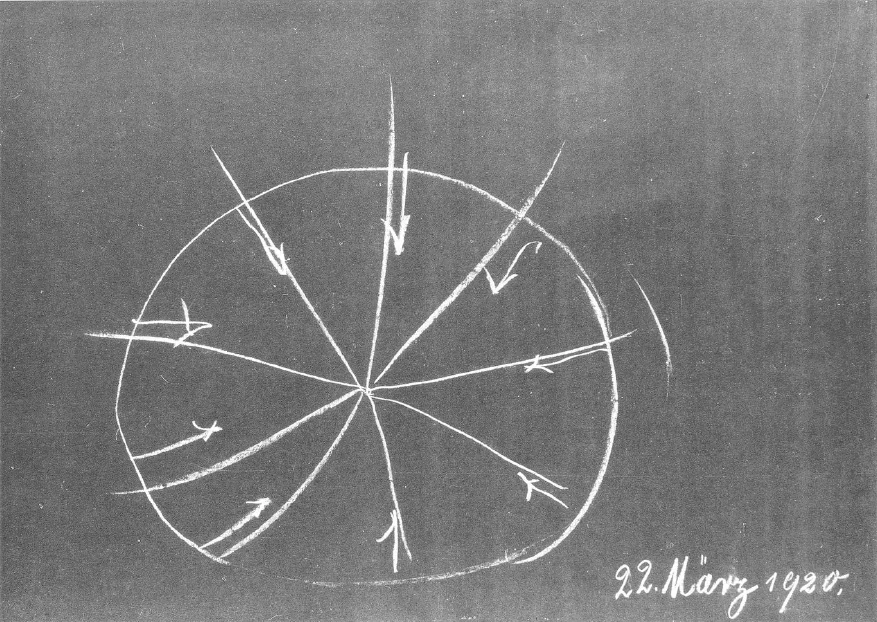
[ 27 ] Und das ist nicht nur bei den quantitativen Ausbreitungen der Fall, sondern das ist auch bei den qualitativen Ausbreitungen der Fall. Wenn Sie anfangen, einen Stoff zu teilen, so hat er zunächst beim Ausgangspunkt Eigenschaften. Diese Eigenschaften nehmen nicht ins Unendliche ab, sondern, wenn man bei einem bestimmten Punkte angekommen ist, schlagen sie zurück und werden die entgegengesetzten Eigenschaften. Und auf diesem inneren Rhythmus beruht auch dasjenige, was der Gegensatz ist zwischen unterer Organisation und oberer Organisation. Unsere obere Organisation ist etwas Homöopathisierendes. Sie ist etwas, was in einer gewissen Weise dem gewöhnlichen Verdauungsprozesse schnurstracks entgegengesetzt ist, das Gegenteil, das Negativ davon bildet. Und so könnte man sagen, daß, indem der homöopathische Apotheker die Verdünnungen herstellt, er eigentlich in Wirklichkeit die Eigenschaften, die sich sonst auf die untere menschliche Organisation beziehen, zu ihr eine Beziehung haben, überleitet in Eigenschaften, die dann zu der oberen menschlichen Organisation eine Beziehung haben. Das ist ein sehr interessanter innerer Zusammenhang, und wir werden dann in den nächsten Tagen von diesem Zusammenhang weiter sprechen.
[ 27 ] And this is not only the case with quantitative expansions, but also with qualitative expansions. When you begin to divide a substance, it initially possesses certain properties at the starting point. These properties do not diminish to infinity; rather, once a certain point is reached, they reverse and become the opposite properties. And this inner rhythm also underlies the contrast between lower organization and higher organization. Our higher organization is something homeopathic. It is something that, in a certain sense, is directly opposed to the ordinary digestive process, forming its opposite, its negative. And so one could say that, in preparing the dilutions, the homeopathic pharmacist is in fact transforming the properties that otherwise relate to the lower human organization—and are connected to it—into properties that then relate to the upper human organization. This is a very interesting internal connection, and we will discuss this connection further in the coming days.