

Spiritual Science and Medicine
GA 312
23 March 1920, Dornach
Translated by Steiner Online Library
Third Lecture
[ 1 ] I will address all the requests that have been submitted to me during the course of the lectures. Since some points are repeated, it is naturally necessary that, at least to a certain extent, all the requests be gathered together; and it also matters whether the issues raised or alluded to here are discussed before a certain foundation has been laid, or afterward. Therefore, taking into account what I have noted in your requests, I will try—if possible—to lay the groundwork for all subsequent considerations as early as today.
[ 2 ] You have seen that I have attempted to begin my initial examination with the structure and internal functioning of the skeletal and muscular systems, and that yesterday we had already progressed, at least initially, to an exemplary examination of the disease process and the necessities of the therapeutic procedure; and that, in order to be able to build upon this examination using an example, we had to begin with circulation in the cardiac system.
[ 3 ] Today I would also like to offer some introductory remarks of a general nature regarding a perspective that can be gained from a deeper contemplation of humanity concerning the possibility and nature of healing in general. Specific points will be addressed in the following reflections, but I would like to begin with these general considerations.
[ 4 ] If one has a mental image of the nature of medical education today, one will find—at least for the most part—that therapy goes hand in hand with pathology without there being a clearly discernible connection between the two. In therapy, in particular, the purely empirical method is often the dominant approach today. Something rational—something on which one could actually build a practical foundation based on principles—is virtually nowhere to be found, particularly in therapy. We know that these shortcomings in medical thinking even led, in the course of the nineteenth century, to the school of medical nihilism, which placed all emphasis on diagnosis and was, in fact, satisfied merely with the identification of diseases, while generally maintaining a rather skeptical attitude toward any rational basis for healing. Now, if one were to, purely, I would say, rationally—one would actually have to say that, along with the diagnosis, there must already be something that points toward healing. There must not merely be an external connection between therapy and pathology. One must, so to speak, already be able to recognize the nature of the disease in such a way that, based on that nature, one can form a conception of the healing process.
[ 5 ] This, of course, ties in with the question: To what extent can there even be remedies and healing processes within the broader context of natural processes? A very interesting saying by Paracelsus is often quoted: “The physician must examine nature.” But one cannot say that recent scholarship on Paracelsus has much use for such a statement, for otherwise it would surely be intent on eavesdropping on nature’s own healing processes. Certainly, attempts are made to do so when disease processes are present against which nature itself devises a remedy. But this ultimately amounts to observing nature’s healing processes only in exceptional cases, so to speak—when damage has already occurred and nature is helping itself—whereas true observation of nature consists in observing normal processes. And the question must arise: Is there a way to observe normal processes in nature—what we call normal processes, so to speak—in order to gain some insight into the healing process from them? — You will immediately notice that this is connected to a somewhat problematic question. Of course, one can only observe healing processes in nature in a normal way if disease processes are normally present in nature. And the question arises: Are disease processes already present in nature as such, so that one can study nature and learn to heal through it? — We will try today to at least come a step closer to answering this question, which, of course, can only be fully addressed in the course of these lectures. But one can say right away that the path outlined here is actually obscured by the scientific foundation of medicine as it is practiced today. Under current conditions, it is extremely difficult to follow this path, for it is very curious that the materialistic tendency of the nineteenth century has led to a complete misunderstanding of the functions of the very system I must now add here to the skeletal, muscular, and cardiac systems—namely, the nervous system.
[ 6 ] It has gradually become common practice to attribute, so to speak, everything psychological to the nervous system and to break down all psychological and spiritual processes that take place within the human being into parallel processes that are then said to be found in the nervous system. Now you know that I had to object to this kind of view of nature in my book *The Riddles of the Soul*, in which I first attempted to show—and much of what can be learned from experience to corroborate these truths will become apparent to us precisely in these considerations—that only the actual processes of imagination are connected to the nervous system, whereas all emotional processes are connected not indirectly but directly to the rhythmic processes in the organism. Today’s natural scientist generally thinks that emotional processes have nothing to do with the rhythmic system directly; rather, he believes that the emotional life is expressed through the nervous system only because these rhythmic processes are transmitted to it. And in the same way, I sought to show that the entire life of the will is directly—not indirectly via the nervous system—connected to the metabolic system. Thus, even with regard to volitional processes, the nervous system is left with nothing but the perception of these volitional processes. The nervous system does not bring about any will; rather, it perceives what happens within us through the will. Everything I have asserted here can certainly be substantiated by the corresponding facts of biology, whereas the opposing view—that the nervous system is solely associated with the life of the soul—cannot be substantiated at all. I would just like to see how, with perfectly sound reasoning, the fact that one can sever a so-called motor nerve or a sensory nerve, allow them to grow back together, and then have a unified nerve emerge from this—how this could possibly be reconciled with the other assumption that there are sensory and motor nerves. Such nerves simply do not exist; rather, what are called motor nerves are nothing other than sensory nerves that perceive the movements of our limbs—that is, what takes place in the metabolism of our limbs when we will. Thus, even in the motor nerves, we actually have sensory nerves that perceive only within ourselves, while the nerves actually called sensory perceive the external world.
[ 7 ] In this regard, there is something of immense importance for medicine, but it can only be properly appreciated once the facts of the matter themselves are thoroughly examined. For it is precisely in the case of the symptoms of disease—which I took as my starting point yesterday using tuberculosis as an example—that it is difficult to make do with the division into sensory and motor nerves. Reasoning natural scientists have therefore already assumed that every nerve has a pathway not only from the periphery to the center or vice versa, but also always a pathway from the periphery to the center, or from the center to the periphery. Likewise, every motor nerve would then have two pathways; that is to say: if one wishes to explain anything based on the nervous system—such as hysteria, for example—one must assume the existence of two pathways running in opposite directions relative to one another. Thus, as soon as one examines the facts, one is already compelled to assume such properties of the nerves that actually completely contradict the hypotheses about the nervous system. By learning to think about the nervous system in this way, one has in fact obscured everything one ought to know about what lies beneath the nervous system in the organism—such as what occurs in the case of hysteria. Yesterday we characterized what occurs in cases of hysteria—for example—as metabolic processes that are merely perceived by the nerves. One should have focused on that. Instead, hysteria was sought solely in a kind of excitability and disturbance of the nervous system alone, and everything was attributed to the nervous system.
[ 8 ] This has led to something else as well. One cannot deny that among the somewhat more distant causes of hysteria there are also psychological causes: grief, disappointments suffered, and various inner stirrings—whether fulfillable or unfulfillable—that then manifest as hysterical symptoms. By effectively separating the rest of the organism from mental life—and linking only the nervous system directly to mental life—one is compelled to attribute everything to the nervous system. This has given rise to a view that, first of all, no longer corresponds in the slightest to the facts and, second, offers no means whatsoever of bringing the psychological realm into account within the human organism. In fact, it is brought into contact only with the nervous system. It is not brought into contact with the entire human organism. At most, this is done by inventing motor nerves that do not actually exist, and by expecting the functions of these motor nerves to influence circulation and so on—which is, of course, always an extremely hypothetical notion.
[ 9 ] What I have discussed here has, in particular, led even the most intelligent people astray when concepts such as suggestion and hypnosis emerged. One could witness—though this was some time ago now—that hysterical women misled even the most intelligent doctors, leading them by the nose, because they simply fell for all sorts of things that such people made the doctors believe, and were unable to grasp what was actually happening within the organism. It is perhaps not uninteresting to point out in this context—although this case involves not a hysterical woman but a hysterical man—the error into which Schleich fell, or rather had to fall, even though he was actually quite accustomed to thinking clearly about such matters, when a man came to him as a doctor having pricked his finger with an ink-filled pen and said, that this would most certainly lead to death the following night, that blood poisoning would set in, and that the arm would have to be amputated. It goes without saying that Schleich, as a surgeon, could not perform the amputation. He could only calm the man down and do what needed to be done in such cases—draining the wound and so on—but he certainly could not cut off his arm based solely on the man’s assertion that he would develop blood poisoning the following night. The patient in question then went to another specialist, who, of course, did not amputate his arm either. But Schleich began to feel somewhat uneasy about the matter. First thing in the morning, he inquired—the patient had indeed died during the night. And Schleich concluded: Death by suggestion.
[ 10 ] It is so obvious—it is all too obvious—to conclude: death by suggestion. But when one considers the nature of the human being, it is simply not possible to conceive of this death by suggestion in this way; rather, the point is that when one diagnoses death by suggestion, a fundamental confusion of cause and effect immediately arises. Nor was there any blood poisoning—as the autopsy revealed—but the person in question died, it seemed, from a cause unknown to the doctors, yet for someone who can see through the matter, undoubtedly from a cause deeply rooted in the organism. And this cause, which was deeply rooted in the organism, had already made this man somewhat unsteady and uncertain the previous day, so that he pricked his finger with an ink-stained pen—something one does not normally do. That was already a consequence of his unsteadiness. But while he became physically unsteady on the outside, his inner perception was somewhat heightened, and under the influence of the illness, he had a prophetic foresight of his death, which would occur that night. This death was not in the least connected to the fact that he pricked his finger with the ink-stained quill; rather, death was the cause of what he felt because he carried the cause of death within himself, and everything that had taken place is nothing other than something that is entirely externally related to the actual inner processes that brought about his death. There is absolutely no question of “death by suggestion” having occurred here. For even the man’s faith and everything else he possessed had nothing to do with bringing about his death; rather, there were deeper causes. But he foresaw his death and interpreted everything that happened in light of this foreknowledge of death. You can see from this example, at the same time, how extremely cautious one must be if one wishes to form a proper judgment about the complex processes in nature. One cannot proceed from the simplest assumptions.
[ 11 ] But now we must ask the question: Do sensory perception and everything similar to sensory perception provide us with any indication of—I would say—the somewhat different kinds of influences that remedies are said to exert on the human organism?
[ 12 ] Isn’t it true that there are three kinds of influences on the human organism in its normal state: first, that which comes through sensory perceptions, which then continues in the nervous system; second, that which comes through the rhythmic system—breathing and circulation; and third, that which comes through metabolism. These three normal relationships must have some analogues in the abnormal relationships we establish between the remedies—which we must, after all, derive in some way from the external natural world—and the human organism. However, what occurs between the external world and the human organism is most clearly evident in the influence on the nervous system. We must therefore ask ourselves: How can we rationally conceive of a connection between the human being itself and that which is non-human nature—and which we wish to use, whether as processes or substantively as remedies, for human healing? We must gain an understanding of the interrelationship between the human being and non-human nature, from which we derive our remedies. For even when we use cold-water cures, we are applying something non-human. Everything that is applied is applied from the non-human realm to human processes, and we must form a rational understanding of the relationship between human beings and non-human processes.
[ 13 ] This, however, brings us to a section where, once again, a mere collection of facts prevails in our standard medical curriculum instead of an organic connection. Although medical students do hear lectures on the foundational natural sciences, general and specific pathology, general therapeutics, and so on are then built upon these foundational natural sciences, and once the actual medical lectures begin, there is little to be heard about how the processes discussed in those lectures—and, in particular, how therapeutic measures relate to the processes in the external natural world. I believe that physicians who have undergone today’s medical training will not only perceive this as a deficiency on a purely intellectual level, but they will also carry within themselves a strong sense of it—a feeling that imposes itself upon them when they are called upon to intervene practically in disease processes—as a certain sense of uncertainty regarding which remedy to use. After all, a true understanding of the relationship between the remedy to be used and what is happening within the human being is very rarely actually present. The point here is that the very nature of the matter itself points to a thoroughly necessary reform of medical education.
[ 14 ] Today, I would like to begin by using certain processes of non-human nature to illustrate how different these processes are, in many respects, from the processes of human nature. I would like to begin with the processes that we can initially observe in lower animals and plants, and from there find our way to those processes that can be brought about by the non-human realm in general—that is, the plant kingdom, the animal kingdom, and especially the mineral kingdom. But we will only be able to approach this characterization of pure mineral substances if we start from very elementary scientific concepts and then ascend to what happens, for example, when we introduce—say—arsenic or tin or something else into the human organism as a remedy. It must first be pointed out that, unlike what is the case with human nature itself, the growth metamorphoses in non-human beings are quite different.
[ 15 ] We will have no choice but to conceive, in some way, the actual principle of growth—of living growth—in human beings, and to conceive it also in non-human beings. But the difference that arises here is of fundamental importance. Consider, for example, something very familiar: the common so-called false acacia, Robinia pseudacacia. If you cut off its leaves at the petioles, something interesting happens: the petioles undergo a metamorphosis and are somewhat transformed, and these transformed, tuberous petioles then take over the function of the leaves. There is something at work here to a high degree—which we shall tentatively call a “force”—that is present throughout the entire plant and manifests itself when we prevent the plant from using its normally developed organ for certain functions. The fact that—I would say—a remnant of what is evident to a very pronounced degree in simpler plants still exists is demonstrated by the fact that, for example, in a person who is prevented by some circumstance from using one arm or one hand for certain functions, the other arm develops more vigorously, becomes stronger, and also grows physically larger, and so on. We must indeed connect such things with one another, for that is the path that leads to the recognition of the possibility of a method of healing.
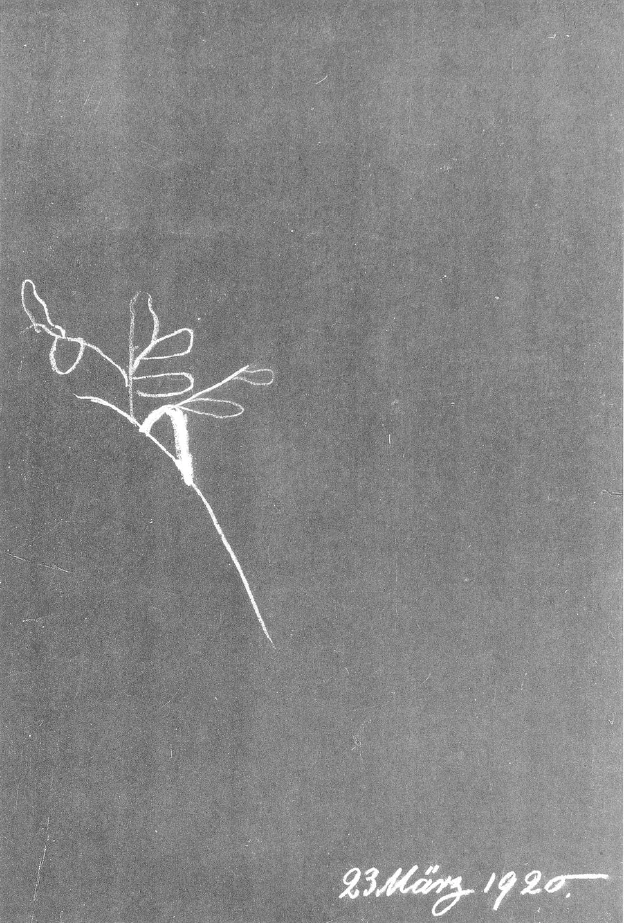
[ 16 ] Well, in the non-human natural world, things go very far. For example, one can observe the following: Suppose a plant grows on a mountainside; it happens that such plants develop certain leaf stalks in such a way that the leaves remain undeveloped—they are absent. Instead, the petiole bends and becomes a supporting organ. The leaves wither away (see illustration on page 63); the petiole bends, becomes a supporting organ, and provides support: plants with modified petioles in which the leaves wither away. This points to the plant’s internal formative forces, which enable the plant to adapt to a large extent to the way of life dictated by its environment. Now, the forces at work within the plant manifest themselves in a very interesting way, particularly in lower organisms.
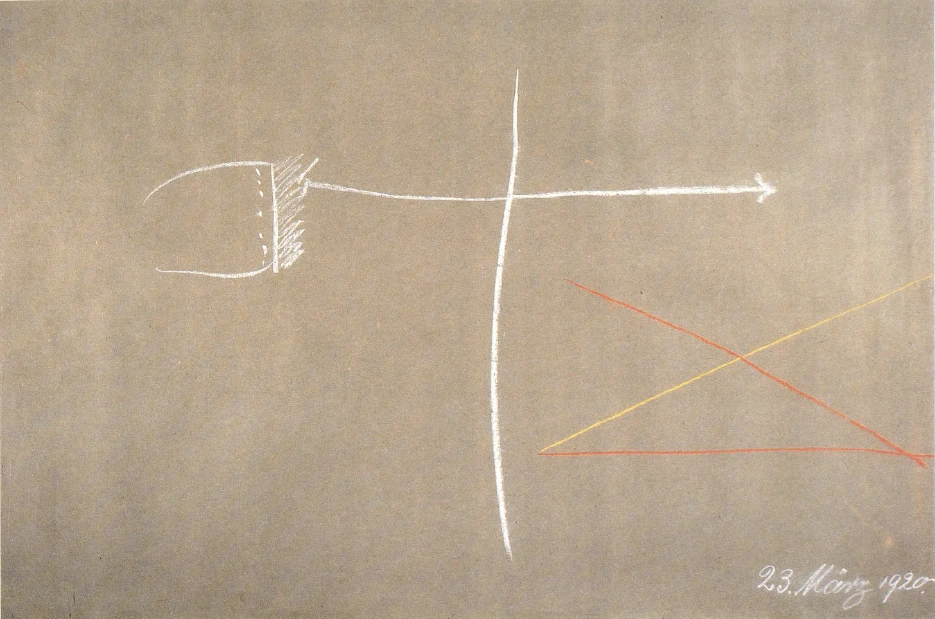
[ 17 ] For example, if you take any embryo that has progressed to the gastrula stage, you can cut the gastrula in half, and each piece will round out again and develop within itself the potential to form the three sections of the foregut, midgut, and hindgut. So we cut the gastrula apart and find that each piece behaves just as the uncut whole would have behaved. You know that this experiment can be extended to lower animals, even earthworms, and that when pieces are cut off from certain lower animals, they regenerate, so that through their inner formative powers they once again produce what we have cut off. These formative powers must be pointed out objectively, not hypothetically by assuming some kind of life force, but they must be pointed out objectively. For if one looks more closely, if one truly observes what is actually taking place, one sees, for example, the following: One sees that if, say, one cuts off a part of a frog’s organism at a very early stage, the remaining organism—the part that was cut off—reattaches itself. Anyone with a somewhat materialistic way of thinking will say: Well, there are tensile forces in the wound, and through these tensile forces in the wound, the new growth attaches itself. — But that cannot be the case. For if it were the case that when I cut off a part of an organism here (see drawing on page 65) and something new reattaches itself here at the wound due to the tensile force present here—then what would reattach here would have to be the next segment, that is, the part immediately adjacent to it in the complete organism. But that is not the case in reality; rather, in reality, when one cuts something off—in frog larvae, terminal organs, even the tail or head; in other animals, sensory filaments—what grows back are not the parts that are immediately adjacent here, but rather those that the organism needs first. It is therefore entirely impossible that the tensile forces inherent immediately here cause what is forming here to take root; rather, it is necessary to assume that the entire organism is involved in some way in these processes.
[ 18 ] In this way, one can truly trace what is happening in lower organisms. Now that I have shown you how to go about this, if you apply this approach to all the findings recorded in the literature to date, you will see everywhere that this is the only way to gain any insight into this matter at all. You will hardly be able to entertain any other thought than this: In humans, it simply isn’t like that. — It would be quite amusing, after all, if one could cut off a person’s finger or arm and they would regrow it. But they simply don’t. The question is: Well, what about the forces—which are, as shown in Table 5, growth-forming forces and which are quite clearly evident here—what about these forces in the human organism? Have they been lost there, or are they not present at all?
[ 19 ] Anyone who knows how to observe nature properly understands that this is the only way to arrive at a natural understanding of the connection between the spiritual and the physical in human beings. For in human beings, these forces—which we come to know here, I might say, as formative forces, that is, forces that directly shape forms out of substance—are simply lifted out of the organs and are present only in what is soul-spiritual in the human being. That is where they are found. Because they have been lifted out of the organs—because they have not remained as the formative forces of the organs—human beings possess them separately. He possesses them in his spiritual-soul functions. When I think or feel, I think and feel with the very same forces that are plastically active in the lower animal kingdom or in the plant world. I simply could not think if I did not carry out thinking, feeling, and willing with the very same forces that I have drawn out of matter. So when I look out at the lower organisms, I must tell myself: What lies within them—those formative forces—is the very same thing I carry within myself. But I have extracted it from my own organs, set it apart, and now think, feel, and will with the very same forces that are actively at work out there in the world of lower organisms.
[ 20 ] Anyone who wishes to become a psychologist with substance in their psychological constellations—not merely with words, as psychology is constructed today—would actually have to trace the processes of thought, feeling, and will in such a way as to demonstrate within them—albeit unfolding on a spiritual-psychic level—the very same processes that appear down below in the plastic formations. Just consider how, inwardly in our psychological process, we can actually carry out what we can no longer carry out in the organism: supplementing trains of thought that we have lost by drawing on those of others, and how we proceed in a manner similar to what I have described here, so that it is not what is immediately adjacent but what lies far removed that appears.
[ 21 ] There is a complete parallelism between what we experience inwardly and spiritually and what, in the outer world, are the formative forces of nature and the formative principles of nature. A complete parallelism exists there. One must point out this parallelism and show that what the human being essentially has in the external world as formative principles is what he has extracted from his own organism as his inner soul-spiritual life—and which therefore no longer underlies the matter, the substance, of his own organism. But now, we have not extracted it with equal intensity from all parts of the organism; we have extracted it in various ways. And only when one is, so to speak, equipped with the kind of prior knowledge we have now developed can one approach the human organism in an appropriate manner. For if you consider all the elements that make up our nervous system, you will find something peculiar: precisely what is usually referred to as nerve cells and what is called nervous tissue and so on—these are actually structures that have remained at relatively early stages of development; they are not very advanced cellular structures, so that one might say: one would actually expect these so-called nerve cells to exhibit the characteristics of earlier, primitive cellular structures. Yet in other respects, they do not do so at all; for example, they are incapable of reproduction. Nerve cells, just like blood cells, are indivisible once they are fully formed; they are incapable of reproduction. Thus, at a relatively early stage, they are deprived of a capacity that is characteristic of non-human cells; this capacity is taken from them. They remain at an early stage of development, becoming, so to speak, stunted at this stage. That which is stunted within them separates off as the soul-spiritual. Thus, through our soul-spiritual processes, we do in fact return to what was once formed in organic substance—but we achieve this only because we carry within us the nervous substance that we kill off, or at least paralyze, at a relatively early stage.
[ 22 ] In this way, one can approach the true nature of nervous tissue. One then discovers why this nervous substance possesses the peculiarity that, on the one hand, it actually resembles primitive formations quite closely—even in its further development, it resembles primitive formations—and yet serves what is commonly called the highest faculty in humans: mental activity.
[ 23 ] I believe—and this is just a digression, not part of the main discussion—that even a superficial examination of the human head, in which a person’s various nerve cells are enclosed within a solid shell, is more reminiscent of lower animals than of highly developed ones. Our head, in particular, actually reminds us—I would even say—of prehistoric animals. It merely appears to have been transformed. And when we speak of lower animals, we usually say: They have an exoskeleton, whereas higher animals and humans have an endoskeleton; but only our head—precisely where we are most highly developed—has an exoskeleton. That is, after all, something that could at least serve as a kind of leitmotif for what has just been stated.
[ 24 ] Now just imagine: if we were to have something—which we call a disease—cause our organism to take back what we have thus deprived it of—I will come back to this in more detail — then imagine: these formative forces that exist in nature outside of humanity, which we have deprived our organism of because we use them for the spiritual and soul life—if we return these to the organism as a remedy by using a plant or something similar, we are connecting the organism with what it initially lacks. We come to its aid by supplying it with what we had first taken from it simply by becoming human.
[ 25 ] Here you can already see the beginnings of what might be called a healing process: drawing upon those forces in the natural world that we, as ordinary human beings, do not possess when we need them, so that something within us becomes stronger than it is in an ordinary person. So, to speak concretely—but only by way of example—let’s take any of our organs, say, for the sake of argument, our lungs or something similar; it would turn out that even with such organs, we have drawn upon formative principles to make them available for the spiritual-soul aspect. Now, if we take the forces we have extracted from the lungs and introduce them into a person’s body—specifically in the plant pond—in the event of any disturbance in the pulmonary system, we are aiding the functioning of their lungs. You see, the question would arise: Which forces in nature outside of the human being are similar to the forces underlying the human organs, but which have been extracted for spiritual-soul activity? — You can see here a path from the mere trial-and-error method of therapy to a kind of rational approach in therapy.
[ 26 ] However, in addition to the errors that have been committed regarding the nervous system and those regarding the inner workings of the human being, there is a very significant error concerning nature outside of humanity, which I will only hint at today but intend to elaborate on in greater detail later. In this materialistic age, people have gradually come to conceive of a kind of evolution of external beings, ranging from the so-called simplest to the most complex. After first extending one’s observations to include lower organisms and studying the transformation of forms up to the most complex organisms, one then turned one’s attention to what are not organisms—for example, the mineral kingdom. The mineral kingdom was viewed in such a way that people said to themselves: The mineral kingdom is simply simpler than the plant kingdom. — This ultimately led to the emergence of all those peculiar questions regarding the origin of life from the mineral kingdom, regarding some once-existing condition under which substances came together, transitioning from their mere inorganic activity to organic activity. The *generatio aequivoca* is what has sparked so much discussion.
[ 27 ] Well, an unbiased examination does not at all confirm the validity of this view; rather, one must conclude: In a certain sense, just as one can conceive of a kind of evolution from plants through animals to humans, one can also conceive of a kind of evolution from organisms—that is, from plants—toward minerals, by depriving them of life. — As I said, I only want to hint at this today; it will become clearer in the following reflections. One can only make sense of this if one does not conceive of evolution as moving upward from the mineral realm through the plant and animal realms to human beings, but rather if one takes the starting point in the middle and conceives of one evolution that moves upward from the plant realm through the animal realm to human beings, and another evolution that descends toward the mineral realm—in other words, if one does not place the beginning in the mineral realm, but rather places it in the very center of nature, so that one arises through an ascending evolution and the other through a descending one. Through this, however, one will come to realize that, as one descends from the plant to the mineral—and especially, as we shall see, to that particularly significant mineral, the metal—forces can arise in the descending evolution that stand in a very special relationship to its mirror image, the ascending evolution.
[ 28 ] In short, the question arises deep within us: What are these very special forces present in minerals that we can study only by examining here the formative forces we have studied in lower organisms? — In minerals, we see them manifest in crystallization. Crystallization clearly shows us something that occurs when we consider descending evolution—something that can only be related to, but is not the same as, the formative forces that arise when we consider ascending evolution. If, therefore, we introduce into the organism what exists as forces in the minerals, a new question arises. We have been able to answer a similar question: When we supply the human organism with the formative forces—which we have removed from our own spiritual-soul structure—from the plant and animal kingdoms, we help the organism. But what happens if we were now to supply the human organism with the different forces that lie in descending evolution—that is, in the mineral kingdom? That is the question I wish to pose today, and one that we shall answer in depth in the course of our reflections.
[ 29 ] But even with all this, we have not yet reached the point where we can contribute anything in the true sense to the question we have placed at the forefront of our discussion today: whether we can actually discern a healing process in nature itself. Such a question always involves approaching nature with the right insights—and we have, after all, tried to gain at least a rough outline of such insights regarding these matters—so that certain processes may then reveal their true nature. That is what matters.
[ 30 ] Well, you see, there are two processes in the human organism—they also exist in the animal kingdom, but that is of less interest to us at the moment—which, in a certain sense, when we view them through the lens of the ideas we have now gained, appear to be opposing processes. These two opposing processes are not entirely—I emphasize this explicitly and ask that you take note of it so that what I am about to explain cannot be misunderstood—but to a high degree, they are polar processes. And these processes are: blood formation and milk formation, as they occur in the human organism. Blood formation and milk formation—even outwardly, blood formation and milk formation differ in a very fundamental way. Blood formation, I would say, is very strongly situated in the hidden side of the human organism. Milk formation is something that ultimately tends more toward the surface. But the most essential difference between blood formation and milk formation is that blood formation possesses, to a very great extent, the capacity to form formative forces itself, when we consider the human being as such. Blood is, after all, the substance to which we must attribute formative forces throughout the entire system of the human organism, if we may use that somewhat pedantic expression. Blood thus still possesses, in a certain sense, the formative forces that we perceive here in the lower organism; blood has these within itself. But modern science, in particular, could base itself on something very important here when it considers the blood; yet to this day it has not actually done so in a truly rational sense. It could base itself on the fact that the main component of the blood is the red blood cells, which in turn are incapable of reproduction—they have the distinctive characteristic of being incapable of reproduction. This is something they share with nerve cells. But when one emphasizes such a shared characteristic, it always comes down to whether the reason for this is the same in both cases. The reason cannot be the same, for we have not stripped the blood of its formative capacity to the same extent as we have stripped the nervous substance of it. Nerve tissue, which is, after all, the very foundation of the life of the imagination, is to a high degree devoid of inner formative capacity. In humans, nerve tissue continues to be shaped—even after birth—to a great extent by external impressions. Thus, the inner formative capacity takes a back seat to the ability to simply adapt to external influences. With blood, it is different. Blood has retained its inner formative capacity to a high degree. This inner formative capacity—as you know from the facts of life—is also present, in a certain sense, in milk. For if it were not present in milk, we would not be able to give milk to infants as a healthy food. What infants need is milk. It possesses a formative capacity similar to that of blood. Thus, with regard to this formative capacity, there is a certain similarity between blood and milk.
[ 31 ] But there is a very significant difference. Milk possesses this ability to form. However, it lacks something that blood needs to the highest degree for its composition—or at least it has it only in very small amounts, in vanishingly small amounts: iron, which is essentially the only metal in the human organism that, in its compounds within the human body, exhibits a proper ability to crystallize. So even though milk contains other metals in small quantities, the difference is certainly this: blood needs iron—a distinct metal—for its composition. Milk, which also has this ability to form, does not need this iron. This raises the question: Why does blood need iron?
[ 32 ] This is actually a fundamental question for the entire field of medical science. For the blood needs iron. We will provide the evidence to support these facts that I have raised today; first, I want to establish how the blood is the substance in the human organism that is inherently diseased by its very nature and must be continually healed by iron. This is not the case with milk. If milk were “sick” in the same sense as blood, then milk could not, as is the case, serve as a formative agent for human beings themselves—a formative agent applied to them from the outside.
[ 33 ] When we consider blood, we are considering that which, in human beings, is constantly somewhat diseased simply because of the human constitution, because of the body’s organization. The blood is inherently diseased simply by its very nature and must be continually treated with iron supplements. This means that the process taking place in our blood is, in fact, a continuous healing process within us. If the physician wishes to examine nature, he must, above all, observe not an already abnormal natural process, but a normal one. And the blood process is certainly a normal one, but it is at the same time one in which nature itself must constantly heal, in which nature must constantly heal through the added mineral—through iron. So that if we were to represent graphically what happens to the blood, we must say: What the blood exhibits by its own constitution, without iron, is a curve or line that slopes downward and would ultimately lead to the complete dissolution of the blood (see diagram on page 74, red), whereas what the iron does in the blood continuously leads it upward, continuously healing it (yellow line).
[ 34 ] We do indeed have a process here that is a normal one and, at the same time, one that must be emulated if we are to consider healing processes at all. Here we can truly examine nature, for here we see how nature carries out processes by bringing that which is non-human—the metal with its forces—into the human realm. And at the same time, we see how that which absolutely wants to remain within the organism—such as blood—must be healed, and how that which strives to leave the organism—such as milk—does not need to be healed; rather, if it contains formative forces, it can transfer those forces in a healthy way to another organism. This is a certain polarity—and I say: a certain, not a complete, polarity between blood and milk—but one that must be taken into account, for there is much to be studied in it. Let us continue tomorrow.
[ 35 ] I had to preface all of this because I saw from the questions that they can be answered in a completely different way once one has the concepts—the foundations—for answering them.