

Spiritual Science and Medicine
GA 312
25 March 1920, Dornach
Translated by Steiner Online Library
Fifth Lecture
[ 1 ] As we delve deeper and deeper in these considerations into that specific area where pathology intersects with therapy and a bridge must be built between the two, it will be necessary to mention all sorts of things that, in a sense, can only represent a kind of ideal for treatment and that cannot be fully applied in every situation. Nevertheless, once one has an overview of everything that might be considered in the treatment of patients, one will be able to extract one thing or another from the details and at least know how to evaluate even fragmentary findings regarding the disease.
[ 2 ] Above all, it is necessary to consider how important it is—even in the most specialized cases—to gain an understanding of the whole person standing before you. This understanding of the whole person should, in fact, always extend to the most important moments in life. And since healthcare providers have sometimes placed their trust in me and spoken with me about this or that, I have often been surprised, for example, when, after just a few words, I asked, “How old is the patient, actually?”—and the healthcare provider was unable to provide a clear answer, meaning they had not taken the time to consider how old the patient in question actually was. As we will see in the coming days, it is one of the most essential things to first and foremost ascertain the patient’s age with a fair degree of accuracy, for treatment depends to a large extent on the patient’s age. And when certain things were mentioned here the day before yesterday—that they help extraordinarily well in some cases but not in others—such statements naturally raise the question: How is the lack of effectiveness related to the age of the patient in question? — Regarding this—the effect of age—very precise records must be kept, especially when it comes to remedies.
[ 3 ] But then the issue is as follows: One should always take a close look at how the patient in question has actually grown—whether he is short and stocky or tall and lanky—and it is of great importance to deduce, based solely on this—being short and stocky or tall and lanky—what forces are at work in what we call the etheric body in human beings. It is—and I have thought a great deal about this—unavoidable, and you probably would not wish otherwise, to use these terms—which are now part of the reality of the human being—such as “etheric body” and so on. One could, of course, replace them with terms that are more popular among non-anthroposophists; however, we may be able to do that at the end. For the sake of better understanding, let us now stick to using such terms where necessary. The etheric body, then, in terms of—I would say—the intensity of its activity, can be assessed by how tall the person in question has grown. But one should also, if possible—as I said, I want to mention everything; it is not always possible to take everything into account, since one simply does not have access to all the data, but it is good to know everything—above all, to inquire whether the person in question grew slowly or quickly during adolescence, that is, whether they remained small for a long time or whether they had already shot up to a considerable height at a relatively young age and then later lagged behind in their growth. All these things point to what one might call the behavior of the etheric body—that is, the functional expressions of the human being in relation to his physical body. And this must be taken into account if one wishes to recognize a relationship between the human being and his remedies.
[ 4 ] Furthermore, it is also necessary to recognize the relationship between the physical and etheric bodies and the higher members of the human being—namely, what we call the astral body, which is the true soul, and the “I,” which is the true spirit. It is necessary to elicit this information from the patient. For example, one should not hesitate to ask the patient whether he or she has a rich or sparse dream life. If a patient has a rich dream life, this is of extraordinary significance for their entire constitution, for it indicates that the astral body and the “I” have a tendency to develop their own activity—that is, they do not wish to engage too strongly or too deeply with the physical body—and thus the truly human-soul formative forces do not flow into the human organ system.
[ 5 ] Furthermore, even if it may be uncomfortable, one should inquire whether the person in question is agile and diligent or whether they tend toward inertia. For personalities who tend toward inertia possess a strong inner agility of the astral body and the “I.” This may seem paradoxical, but this agility is not conscious; it is unconscious. And therefore, because it is unconscious, the person in question is not, in any sense, diligent in their consciousness, but is, on the whole, sluggish. For what I refer to here as the opposite of inertia is the organic ability to intervene in the lower self through one’s higher self—that is, to truly channel activity from one’s astral body and ego to the physical body and the etheric body. And this ability is very limited in the inert person. From a perspective of Spiritual Science, the sluggish person is actually a sleeping human being.
[ 6 ] Then one should find out whether the person in question is nearsighted or farsighted. Near-sighted people are those whose ego and astral body also exhibit a certain degree of detachment from the physical body, and nearsightedness is precisely one of the most important signs that one is dealing with a person whose spiritual-soul aspect does not wish to intervene in the physical-bodily aspect.
[ 7 ] I would now like to point out something that might one day be feasible, that would be extraordinarily important for patient care, and that, I believe, could already take on some practical significance if more social awareness were to take hold within the individual professions. Namely: It would be extremely important if dentists were to apply their knowledge of the dental system, the digestive system, and everything related to them in such a way—of course, the patients in question would have to be won over to this idea— but as I said, with a certain degree of social sensitivity, this might be achievable—so that they, as it were, provide their patients with a kind of outline during every treatment, in which they note their findings regarding the effectiveness of everything related to tooth development, whether there is an early predisposition to dental caries and the like, and whether the teeth will remain healthy into later life. As we will see in the coming days, this is extraordinarily significant for assessing the overall constitution of the human being. And if the physician treating an individual case of illness were to obtain such a signature—I would call it a “health signature”—from the dental findings, this could serve as an extraordinarily important point of reference.
[ 8 ] Then it would be extremely important, if I may say so, to get to know the patients’ physical likes and dislikes. It is particularly important to determine whether any person one is treating, for example, has a craving for salt or a craving for something else. One would have to find out which foods the person in question has a particular craving for. If they have a craving for anything salty, then one is dealing with a person in whom there is an excessively strong connection between the ego and the astral body on the one hand, and the physical body and the etheric body on the other—in whom, so to speak, there is an excessively strong affinity between the spiritual-soul aspects and the physical-bodily aspects. Similarly, bouts of vertigo caused by external mechanical movements—such as rapid spinning of the body—also point to such a strong affinity. One should therefore determine whether the person is prone to bouts of vertigo when performing mechanical movements with their body.
[ 9 ] Furthermore, one should always educate oneself—and this is, after all, fairly well known—about disturbances in secretion and about the entire range of human glandular activity; for where there are disturbances in secretion, there is always also a disturbance in the cohesion of the ego and the astral body with the etheric body and the physical body.
[ 10 ] I have thus outlined for you certain points that, in essence, should always be understood first when dealing with a patient. I have singled out specific points, but you will see the general direction these matters take, insofar as they relate to the constitution of the body itself. Over time, we will also discuss how to gather information about lifestyle, the possibility of breathing healthy or poor-quality air, and so on. This can be examined in greater detail when we discuss the individual chapters. Well, in this way, one will first gain some insight into the nature of the person one is treating. For only when one knows this will one be able to determine, in specific cases, how to prepare a remedy.
[ 11 ] First, I would like to point out in general—as has already become clear from individual observations made in the preceding days—that there is an inner kinship between human beings and the entire non-human world. In Spiritual Science, it is often stated—though initially in abstract terms—that human beings have, in the course of evolution, projected the other kingdoms out of themselves, and that therefore what exists outside of them has a certain kinship with their own being. In contrast to this abstract expression of the relationship, we will have to point out time and again, in the context of organ therapy, very specific examples of such kinships. First of all, however, let us be clear above all else about what the healing relationship between human beings and the non-human natural world is based on in the first place.
[ 12 ] As you know, there is a great deal of controversy in this field, and therapeutic methods—which we will discuss in greater detail later on—are locked in fierce competition with one another. One of these conflicts, in particular, is well known: the one between homeopathic-minded physicians and allopathic-minded physicians. Now, you might be interested in how Spiritual Science is supposed to intervene in this dispute. But this intervention—I’d like to say a few general words about it today and go into more detail on the specific points later—is actually quite peculiar. For, fundamentally speaking, from the perspective of Spiritual Science, there are actually no allopaths at all. In reality, there are no allopaths at all, because even what is prescribed allopathically as a remedy undergoes a process of homeopathization within the organism and actually heals only through this process of homeopathization. Thus, every allopath actually finds support for his allopathic procedure through the homeopathization of his own organism, which actually accomplishes what the allopath fails to do: the dissolution of the connection between the individual parts of the remedies. However, there is still a considerable difference between whether or not one relieves the organism of this type of homeopathization, for the simple reason that the healing processes within the organism are indeed related to the states into which the remedies gradually enter once they have been homeopathized. But the organism faces, in what the bodies of the external world otherwise possess, something with which it has no healing affinity—something it thus takes into itself as a foreign body—so that it is actually burdened with a tremendous workload and a disturbance when it is overburdened with all the forces that then manifest when the remedy is administered to it in its allopathic state. We shall discuss in particular those cases in which it is impossible to relieve the body of this homeopathization.
[ 13 ] Well, as you can see, homeopathy is essentially something that, to a certain degree, is actually very carefully modeled after nature itself, even if, as we shall see, fanaticism has taken significant leaps in this regard. But the point now is to understand how to find a way to grasp the details of the relationship between human beings and their nonhuman environment. And here, of course—as I already said yesterday in another context—we cannot simply parrot what the ancient physicians have said, although a thoughtful immersion in older medical works can be useful; rather, we must, for example, engage with this interrelationship between human beings and their non-human environment using all the means of modern science. First of all, it must be noted that one cannot achieve very much through the chemical analysis of substances—that is, through a kind of examination of what the individual substances reveal in the laboratory. I have already indicated that this kind of microscopic examination—which is, after all, a form of microscopic examination—should actually be replaced by macroscopic observation, by what arises from the observation of the cosmos itself.
[ 14 ] Today I will begin by presenting you with significant arrangements that can, in a sense, indicate to us how the non-human world corresponds, in a kind of threefold structure, to the threefold human being. We must direct our attention above all to everything that manifests itself as soluble. You see, solubility is, in fact, the final property that was of particular significance in the developmental process of our Earth. What has separated out in the Earth as solid matter is, to a large extent, fundamentally attributable to a cosmic process of dissolution that has been overcome and has eliminated and deposited the solid parts. And to think merely of the mechanical deposition of sediments and to base geognosy and geology on that is, after all, merely superficial. What the formation of the Earth is—what the incorporation of solid components into the Earth’s body is in general—essentially involves specific cases of crystallization out of solution or of settling out of solution. Thus, we can say that what is at work in the process of dissolution is something which, insofar as it takes place in external nature—in nature outside of humanity—is also something that humanity has projected from within itself. Something is happening out there in the process of dissolution that human beings have projected from within themselves. Thus, the task will be to investigate the relationship between dissolution processes in the non-human cosmos and the inner processes of the human organism.
[ 15 ] Of fundamental importance is what I have mentioned: that certain people, who have too strong a connection between their spiritual-soul aspect and their physical-etheric aspect, have an organic craving for or hunger for salt—that is, they seek to reverse the process of salt deposition in their organism, meaning they wish to undo this process of earth formation, in essence, they want to return the salt to an earlier stage of Earth formation than the one in which the Earth solidified. It is of particular importance to look closely at such things. In doing so, one truly gains insight into the connections between the human organism and the non-human natural world. One might say: Human nature possesses within itself a kind of organic need to reverse certain processes taking place in the external world, to fight against them. As you know, I mentioned yesterday that even gravity is counteracted by the development of buoyancy to support the human brain. Thus, there is a general tendency toward this kind of resistance.
[ 16 ] The question now is: What does this initial struggle against the process of Earth formation mean? It essentially means nothing less than freeing the lower human being from the spiritual-soul aspect, driving the spiritual-soul aspect out of the lower human being—initially, so to speak, into the upper human being. In all cases, then, where there is a craving for salt, this craving for salt reveals to us that, in a certain sense, the lower human being wants to free itself from the excessive influence of the spiritual-soul elements within it, that it wants, as it were, to allow this influence of the spiritual-soul elements to flow out toward the higher human being.
[ 17 ] Let us assume that there are disturbances in the lower human being—disturbances that can be recognized. We will later examine the means by which they can be recognized and the specific illnesses to which they lead. What can be done?
[ 18 ] I would now like to insert a comment here that might be of interest to those who tend to be overly one-sided in their use of remedies. There is also a certain aversion to mineral remedies among some people. This aversion is unwarranted, for we shall see that pure plant remedies can only be effective within very specific limits, and that mineral remedies are of great importance, particularly in more serious cases. I therefore ask you not to take offense if, in this fundamental discussion, I begin with mineral remedies—though I should say, with the integration of the efficacy of these mineral remedies into life itself, into organic life. For you can gain a profound understanding of certain methods of treating the human lower abdomen in relation to the upper body by studying the oyster. The oyster, with its shell formation, is something extraordinarily interesting. For you see, the oyster builds its carbonate-calcium shell from the inside out. If you—and here, of course, Spiritual Science must come to the aid of the investigation—examine the oyster from a perspective of Spiritual Science, you will come to recognize that although this oyster is a very low-level living being in the animal kingdom, it nevertheless occupies a relatively high position in the entire cosmos. It occupies such a position that what the human being carries within as thought is separated from it. In a sense, the forces that form the shell and direct it from the inside out show the path by which that which, if it were to combine with the oyster’s organic growth, would make the oyster very intelligent—and would indeed transform the oyster into a very high-level animal—is led away from the oyster. That is directed outward; it is diverted. And you can literally—I would say tangibly—see in the formation of the oyster shell the work of calcium carbonate, Calcarea carbonica, this work that channels the excessively intense mental and emotional activity out of the organism.
[ 19 ] If you now find that excessive mental and emotional activity is manifesting itself in the lower abdomen—which also occurs in certain forms of illness that we will characterize further—you will have to resort to the remedy that you owe to oyster shells or similar substances, I might say, substances that act from the inside out through the mysterious powers of carbonated lime. An essential aspect of the therapeutic treatment, therefore, depends on being clear about this: there are certain healing powers in this drive from the inside out. You see, everything connected with remedies such as Calcarea carbonica, and everything related to related remedies, can only be studied rationally if one views it in this context.
[ 20 ] Now, everything that lies in the forces of, say, phosphorus is polar opposites to what lies in the forces of calcium carbonate. If—and the terms I use are, in their true meaning, no less scientific than what is often passed off as science today—everything salty behaves, so to speak, in such a way that it surrenders itself to its surroundings, the reason lies in the fact that everything saline arises because the corresponding substances are stripped of, freed from, the inner influence of the imponderables—light and other imponderables. I would say that everything that is saline has, through its process of formation, repelled the imponderable to such an extent that it is not intrinsically part of it.
[ 21 ] The exact opposite is true of phosphorus. And ancient, atavistic insights were therefore not entirely without merit in describing this phosphorus as a bearer of light, because they correctly recognized that it truly carries the imponderable—the light. That which the salt keeps at a distance is what this phosphorus carries within itself. Thus, the substances that are polar opposites of the salt are those that, so to speak, internalize the imponderable—namely, light, but also other imponderables such as heat and the like—and make it their own. The healing efficacy of everything that lies within phosphorus—and of everything related to phosphorus in any way with regard to the healing process—is based on this fact. Therefore, phosphorus, which internalizes the imponderables, is particularly well-suited to draw the astral body and the “I” back toward the human being when they are unable to properly approach him.
[ 22 ] So if you have a patient with a certain illness—and we’ll discuss the individual illnesses in a moment—and you discover that the patient, let’s say, suffers from intense dreaming, which means that the astral body tends to separate from the physical body and engage in its own activities, and if you also discover that the patient, for example, has an organic tendency toward peripheral inflammations—which in turn is evidence that the astral body and the “I” are not properly situated within the physical body—then you will be able to use the power with which phosphorus holds its imponderables to induce this astral body and this “I” of the human being to engage more fully with the physical body. Phosphorus can be applied for a wide variety of pathological conditions, particularly in people who have restless sleep, because it tends to guide the ego and the astral body back into the physical body and the etheric body in the appropriate manner.
[ 23 ] In a certain sense, phosphorous and saline substances are polar opposites. And I would like to draw your attention to the fact that we must pay much more attention to how these substances fit into the overall process of the world than to the specific names given to individual substances by, let’s say, modern chemistry. For we will see in due course how phosphorus can also be used as a remedy in substances that act in a phosphorus-like manner.
[ 24 ] You see, in this way you have established two opposing states in the external natural world: the salt-like action and the phosphoric action. Between the two lies the mercurial action. Just as the human being is a threefold being: the nervous-sensory being, the circulatory being, and the metabolic being—just as the circulatory being mediates between metabolism and nervous-sensory activity, so too in the external natural world, everything that neither gives itself over to a great degree like the salt-like force nor internalizes imponderables to a great degree, but rather, I would say, maintains a balance between these two activities by seeking to express itself in the form of a drop. For, fundamentally speaking, the mercurial is always that which, through its inner interplay of forces, tends toward the form of a drop. That is what matters with regard to the Mercurial—not that one refers to the substances we call mercury today as the Mercurial, but rather the interplay of forces that maintains the balance between the dissolving nature of the salty and the inwardly concentrated state in which the imponderables are held together. So what matters is studying the state of forces that is most clearly evident in all that is mercurial. That is why you will also find that this mercurial is essentially connected to everything intended to bring about a balance between the activities for which the phosphoric is suited and the activities for which the saline is suited. We will see later—when we discuss syphilitic and similar diseases in particular—that the effect within the organism does not contradict what I have just said.
[ 25 ] Now, by discussing these phosphoric, mercurial, and saline types, I have, so to speak, presented you with the particularly vivid examples from the mineral kingdom. You have, however, seen that when it comes to the saline, one must already speak of the organic process inherent in the formation of oyster shells and which underlies it. This process is, in a certain sense, also present when the imponderable is concentrated in phosphorus. But since everything is internalized here, it is simply less vivid to demonstrate outwardly. Now the point is to move from the perception of what is typically formed in the external world to what, I would say, the human being has separated from within itself at a different time—namely, the plant realm.
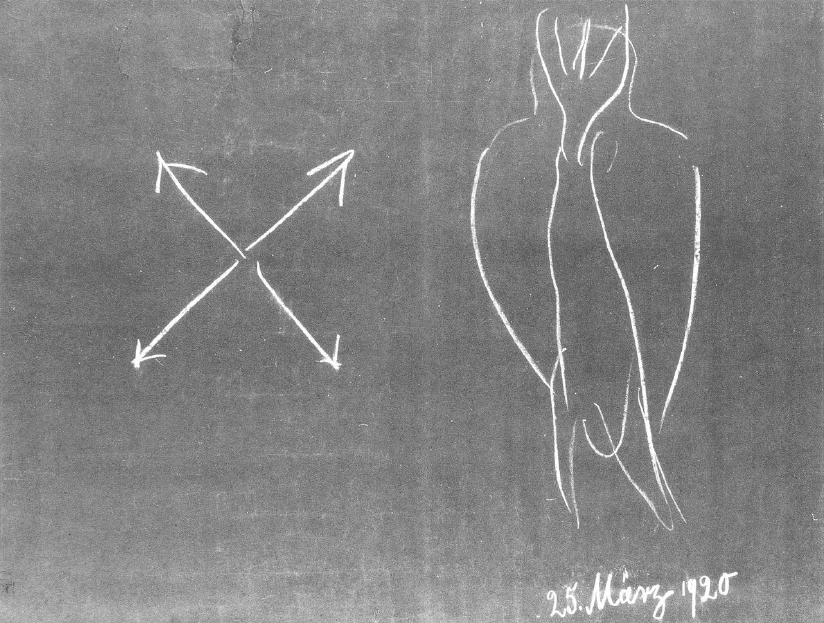
[ 26 ] As we saw yesterday from other perspectives, the plant realm represents, in a sense, the opposite of what exists as activity in the human organism. But within the plant itself, we can clearly distinguish between three aspects. This distinction between the three becomes particularly evident when you consider, on the one hand, that which unfolds toward the earth as a root, and, on the other hand, that which shoots upward in the form of seeds, fruits, and flowers. Indeed, I would say that even in the outward direction you can see this contrast between the plant and the human—not the animal, in this case. Yes, there is even something extraordinarily important and significant here. The plant sinks its roots into the earth and strives upward with its flower, that is, with its reproductive organs. Human beings form the complete opposite in relation to their place in the cosmos: they, so to speak, take root with their heads pointing upward, and they reach downward with their reproductive organs, directly toward the plant. So it is by no means absurd to picture the human being as a plant that rests within him, with roots reaching upward and its flower developing downward toward the reproductive organs. In this way, the plant realm is integrated into the human being in a very special form. And again, an important distinguishing feature between humans and animals is that, as a rule, in animals the plant that is integrated into them is oriented horizontally—that is, at a right angle to the direction of the plant—while the human, I would say, has performed a complete rotation relative to the plant in his position within the cosmos, a rotation of 180 degrees. This is one of the most instructive insights one can find when considering the relationship of the human being to the external world. And if our medical students were to delve more deeply into such macrocosmic matters, they would discover more about the forces still at work—for example, within the cells—than they do when looking through a microscope. For microscopy really reveals very little, because the most important forces at work within the cells—and there are differences depending on whether the organism is a plant, an animal, or a human being—can be observed on a macrocosmic scale. One can study the human cell much more effectively by examining the interplay between the forces moving vertically upward, vertically downward, and those maintaining balance. These forces, which can be observed in the macrocosm, extend all the way into the cellular level. And what is at work within the cells is, in essence, nothing other than a reflection of this macrocosmic influence.
[ 27 ] Now, however, when you consider the plant life of the Earth, you must above all not view this plant life as it is usually viewed—that is, by walking across the Earth and observing one plant after another, classifying them in detail, devising a two- or three-part name, in order to classify that plant within a system—but rather you must bear in mind that the entire Earth is a single being and that—though not in the same way as with hair, which is identical among itself, at least in a certain respect, whereas plants differ from one another—the entire plant world belongs to the Earth’s organism just as much as your hair belongs to your own organism. You can no more regard the individual plant as something in and of itself than you can regard the individual hair as an organism in and of itself. The fact that plants are different is due solely to the fact that the Earth, in its interaction with the rest of the cosmos, develops forces in a wide variety of directions, and as a result, plants are organized differently. But underlying all plant life is a unity in the Earth’s organization. Therefore, it is of particular importance to focus one’s attention on certain things. You will first find—let us say, when you observe fungi—that for these fungi, the Earth itself is a kind of habitat, a kind of mother soil. You will then find, when you move on to the higher herbaceous plants, that the earth is still a kind of mother soil there as well, but that what is extraterrestrial already exerts a certain influence on these herbaceous plants—light and so on—in the formation of the flowers, as well as the leaves and so on. But what is particularly interesting is that when you turn your attention, let’s say, to the tree, you will see that in the formation of the tree’s trunk—which makes the tree a perennial plant—there is a continuation of what, for the plant that sits directly on the earth, is the entire earth itself. For you see, you must create a mental image of it this way: Imagine you have the earth here; the plant sprouts from the earth. Then we can look for forces within the earth itself that underlie plant growth, forces that interact with what flows in from the cosmos. But when a tree grows—please don’t be too shocked by what I’m about to say, for it is truly so—the earth, in a certain sense, envelops that which previously flowed directly from the earth into the plant; this shoots into the trunk, and all trunks are, in essence, outgrowths of the earth. The fact that people do not view it this way stems solely from today’s truly appalling materialistic mental image, which imagines the earth as consisting solely of minerals—and thus fails to realize that this mental image of a purely mineral earth is, in fact, impossible. This earth, in addition to secreting the mineral, also contains within itself the forces that shoot into the plant realm. This pushes upward and becomes the stem. And what then grows on the stem can be compared, in relation to the stem, to what grows directly out of the earth in lower, herbaceous plants. I would like to say: In the case of lower, herbaceous plants, the earth itself is the stem, and the plants form an additional stem upon which their flower and seed organs sit. From this you can see that there is a certain difference between taking a flower from a tree and taking a flower from a herbaceous plant.
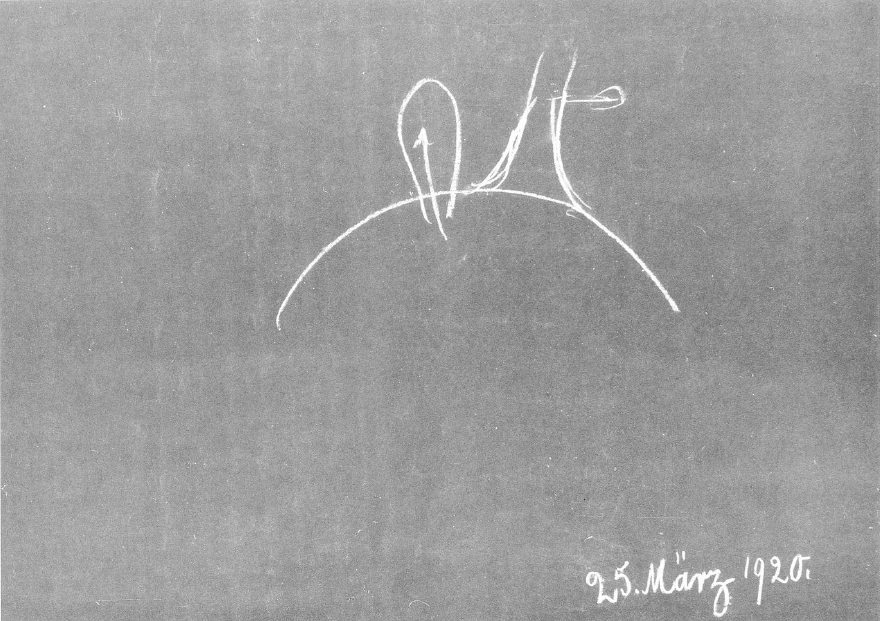
[ 28 ] From this perspective, also consider the formation of parasites on plants, specifically the formation of mistletoe. Here you have what otherwise remains organically connected to the plant—the attachment of the flower- and seed-bearing organs to the stem—as an external secretion, as a process in its own right. Thus, in the formation of mistletoe, you must see an intensification—combined with a kind of separation from the earthly forces—of what is otherwise present in flower and seed formation. In a sense, that which is unearthly in the plant emancipates itself precisely in the formation of mistletoe. Thus, we see that which strives upward from the earth—and interacts with the non-earthly—gradually separating itself from the earth in flower and seed formation, and reaching a particularly strong, individualizing emancipation in the formation of mistletoe.
[ 29 ] If you now consider this in relation to what you perceive as forms in plants, you will say to yourself: There must therefore be a considerable difference in the plant world, depending on whether a plant tends more toward root formation—that is, expresses its growth conditions primarily through root formation—and exhibits small or stunted flower formations. Such plants tend more toward the earthly. Those plants that emancipate themselves from this earthly realm are the ones that flourish in seed formation and flower formation, but especially those that assert themselves as parasites in the plant kingdom. But plants have a tendency to make each of their organs, so to speak, the most prominent—consider the pineapple, how it seeks to make the stem the most prominent, or any other plant—and you can say: Each of the plant’s main organs—root, stem, leaves, flowers, and fruits—is sought after by some form of plant as its primary organ. Take plants such as, say, Equisetum. You can see how its striving is focused on stem formation. Other plants strive to focus on leaf formation, while still others cause stem and leaf formation to wither away and focus on flower formation.
[ 30 ] It now turns out that there is a certain parallelism between these various tendencies in plant growth and what I have described today as the three types of mineral activity in non-human nature. If one considers what lies in particular in the emancipating activity of plants—that which then culminates in the inner activity of parasites—one finds something that tends toward the internalization of the imponderables. That which flows in as imponderables from the cosmos to the Earth is preserved in these organs—when they predominate—just as it is in the phosphoric substance. Thus we can say: In a certain sense, the flowers and seeds, and everything that tends toward the formation of mistletoe and the like, are phosphoric. Conversely, when we study the process of rooting, we find that what the plant develops by regarding the earth as its mother ground is intimately related to salt formation. Thus, it is precisely in the plant that these two polarities confront us. And in the mediating activity of the plant—which you always see as the link between the upward-striving floral and fruiting parts and the downward-rooting parts—there lies the mercurial process, that which brings about balance. So that when you now consider the plant’s inverse relationship to the human being, you will say to yourself that everything that is internally predisposed toward the formation of flowers and fruit must have a very strong affinity with the organs of the human lower abdomen and all the organs that are oriented from the human lower abdomen; and that the phosphoric aspect, too, must have a very strong affinity with the organs of the human lower abdomen. We will see in the coming days that this is indeed correct. On the other hand, everything in plants that tends toward the root system will have a special affinity for everything that organizes itself upward. But of course you must bear in mind that one cannot simply divide the human being into three parts according to an external scheme, but that what belongs, for example, to the lowest part—the digestive system—definitely strives, I would say, to continue even up toward the head. It is, after all, a quite—one might almost say—silly view that the gray matter of the brain essentially constitutes the thinking substance, for that is not the case. The gray matter essentially serves to nourish the brain and is actually a colony of digestive organs for the brain’s nourishment, whereas it is precisely the white matter that is of great significance as the substance of thought. That is why, even in the anatomical structure of the gray matter, you will find something that is much more closely connected to a total activity than to what is usually attributed to it. So you see that when we speak of digestion, we cannot speak merely of the abdomen. But it is certainly true that when one considers the relationship of the root-like aspect, one is dealing with something that pertains not only to the upper part of the human being but also to the rest of the human being. Everything in the plant that brings about a balance between the flowering, fruiting, and root-related aspects—which is thus expressed, so to speak, in the leaves and the like of the ordinary herb—will be of very special significance, even when extracted, for everything related to circulatory disorders, and thus also to the rhythmic balance between the upper and lower human beings. If one has previously considered minerals that internalize the imponderables, minerals that keep the imponderables at a distance, and those that lie in between, you will see that this can be paralleled with—I would say—the entire configuration of the plant. And with this, you have the first rational means of establishing an interrelationship with the human organism from the plant itself, depending on which organ the plant emphasizes for development. We will see how this becomes further specialized.
[ 31 ] We have been able to point out so far that such interrelationships exist between the plant realm, the mineral realm, and the human realm. In more recent times, I would say, something very promising has emerged: the idea that there is a kinship, an interrelationship, between humans and the animal realm. However, quite apart from the fact that the introduction of serum therapy was carried out in a rather peculiar manner, fundamental objections must also be raised specifically against this conventional form of serum therapy. You see, when serum therapy was first introduced, Behring did indeed proceed in a very peculiar way. For if one followed the speeches that were given and the publications that remained more on the periphery—those that merely discussed what the serum was supposed to help with—one got the impression that this was truly a reform of the entire medical system. However, if one looked more closely at what the fundamental studies described—and this is no exaggeration, as some of you may already know—it turned out that the treatment, which was intended to be derived from the guinea pig studies and applied to humans, proved to be ineffective in a “remarkably large” number of guinea pigs. Namely, out of the entire large number of guinea pigs treated with the serum, there was only one that showed a favorable outcome; a single guinea pig in its thus masked natural healing process—at the very moment when people were already beginning to beat the drum for the serum treatment! I would just like to cite this as a fact. I believe that some of you are probably already aware of it. And this, I would say, extraordinary recklessness in scientific conduct does indeed deserve closer consideration in the history of science.
[ 32 ] But what should be mentioned in principle today as a conclusion—and elaborated upon tomorrow or in the coming days—is this: that you have seen that it is not those processes of the non-human being that are directly at work within human beings—those that lie so immediately on the surface—but rather those that must first be drawn out from the deeper essence.
[ 33 ] Now, human beings are, in a certain way, related to what they have set aside—the phosphorus process, the salt process, the flowering process, the fruiting process, the rooting process, the process of leaf formation— but in such a way that he lives in a true reversal of all this, that he carries within himself the tendency to negate what is manifested in this non-human nature, to turn it into its opposite.
[ 34 ] This is not the same as with animals. For the animal has already gone through half of this process. Humans are not opposed to animals in the same sense. They stand, so to speak, at a right angle to animals, while they stand at an angle of 180 degrees to plants. And this is something that must be taken into account to the highest degree when the question arises regarding the use of such animal-derived remedies as serum or the like.