Spiritual Science and Medicine
GA 312
26 March 1920, Dornach
Translated by Steiner Online Library
Sixth Lecture
[ 1 ] I am actually somewhat concerned about what needs to be discussed today. For if I were to spend a quarter of a year going over these matters, it would not be easy to dismiss them as mere fantasies. But since I can only touch on them briefly in today’s session—in order to make them fully understandable in light of what follows, which will then address the specific aspects of healing—some things will, I might say, appear to be merely touched upon. Nevertheless, I will endeavor, through the way I present these ideas, to show that all of these things are well-founded—and indeed better founded—than the principles upon which modern natural science is based. So today I would like to begin by presenting the process of plant formation as such within its cosmic context. We have, after all, pointed out how the reverse process—which is revealed in the process of plant formation—is, so to speak, functionally at work within the human being. It is therefore necessary, in order to uncover the direct relationship between the plant world and human beings, to present this process of plant formation here, at least in outline. If you look at a plant, you will find that it most definitely exhibits two opposing tendencies throughout its entire process of formation. One tends toward the earth. And as I already indicated yesterday, in tree-like plants the earth is, so to speak, turned inside out in the trunk, so that the flowers of the tree, together with their leaves, take root in the trunk in the same way that purely herbaceous plants—or even lower plants—otherwise take root in the earth.
[ 2 ] On the one hand, we are reminded here of the plant’s tendency toward the earth. But on the other hand, the plant strives away from the earth. It does not merely strive away from the earth as if by a mechanical force opposing the earth’s gravitational pull, but it strives away from the earth in its entire, even inner, process of formation. The processes in the flower differ from those in the root. The processes in the flower become much more dependent on the non-earthly, on the extra-terrestrial, than the processes in the root. And we must first turn our attention to this dependence of flower formation on forces that are not strictly earthly. For we will find that the very same forces used by the plant to initiate the process of flower and seed formation externally in the flower—that these very same processes become necessary because of the functional reversal of the plant process in the human being, as indicated to you in the previous lectures, in the human abdomen, and in all that pertains to excretions, secretions, and the basis of sexuality. Thus, precisely when we explore this relationship between the human being and the plant, we are directed just as much to the plant’s non-terrestrial processes as to its terrestrial ones.
[ 3 ] I would not want to fail to point out to you that what I am presenting here is not drawn from older medical writings, but is based entirely on current research in Spiritual Science. However, we must occasionally draw on the terminology of older literature, since the more recent literature has not yet developed a terminology in this area. But anyone who were to believe that anything presented here is taken solely from older writings would be very much mistaken.
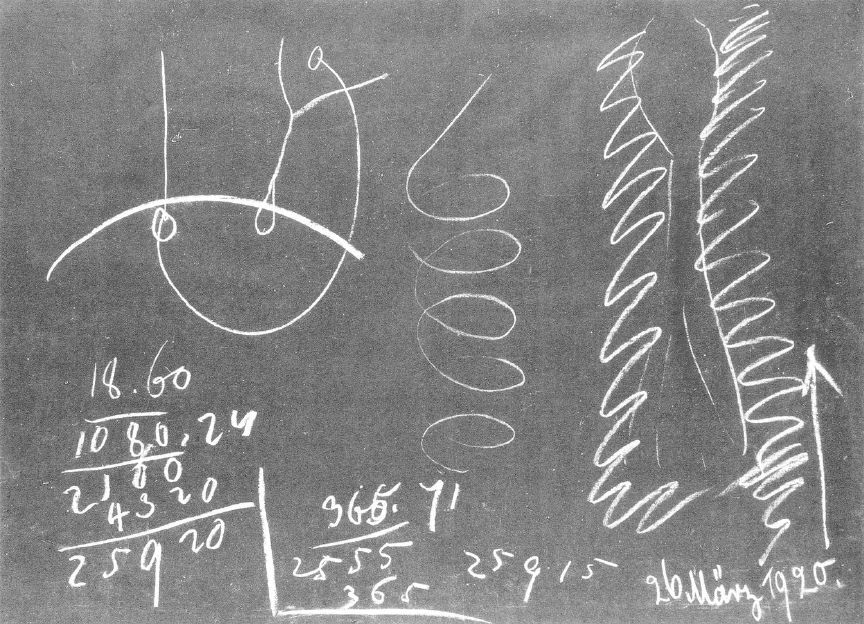
[ 4 ] If you observe plant growth as it progresses from the earthly realm upward, you will first be led to note the spiral pattern in the development and formation of the leaves and also of the flower. In a sense, the plant’s formative forces follow a kind of spiral path around the stem, This spiral path cannot be derived from internal tensile forces within the plant, but rather is attributable to the influence of the extra-terrestrial, namely, primarily to the effects of what we might call the apparent—for the Earth’s motion toward the Sun is, after all, only relative—that is, the apparent path of the Sun. In a certain sense, one can certainly study the course of the stars—based on the course of the formative processes in the plant—using better points of reference than the Galilean-mathematical ones. For what the stars do, the plant faithfully reproduces.
[ 5 ] However, one would be entirely mistaken to believe that only this upward-moving, sun-dependent process of formation in the plant is at work; rather, the stars act in concert—first of all—with the movements of our planetary system caused by the sun, in such a way that, so to speak, the sun’s power would completely assimilate the plant and continuously carry it on into infinity, were it not for the so-called outer planetary forces counteracting this sun’s power with their spirals (see illustration on page 119). For in reality, the planets do not move in ellipses, but in spirals. The entire Copernican worldview should, in fact, already have been reevaluated and replaced by another one. The so-called outer planets, which include Mars, Jupiter, and Saturn—Uranus and Neptune are only astronomically considered part of our system; they do not actually belong to our system—have entered our system because foreign bodies that lay outside this system have, so to speak, attached themselves to this system—so that one is quite correct to disregard these bodies, which were first invited into our planetary system and have come along with it, and which are actually guests—these outer planetary forces, which bring about a reduction in the upward-directed force by damming up what would otherwise be expressed solely in the spiral of the leaf and thereby bringing about the formation of flowers and seeds. So if you observe the plant’s development from leaf formation upward, you must attribute its origin to those forces that arise from the interaction of the solar with the mars-like, Jupiter-like, and Saturn-like forces.
[ 6 ] However, it is not only these two elements that interact; they, in turn, are counteracted by forces emanating specifically from the Moon and from the so-called inferior planets, Mercury and Venus. Mercury, Venus, and the Moon are the forces that generate the tendency in the plant toward the Earth, downward, and which find their most characteristic expression in root formation. Thus, everything that appears earthly is in fact simultaneously influenced by the sub-solar planets in connection with the Moon. They therefore express in the plant, I might say, the entire planetary system that belongs to us. Until one understands how the entire planetary system associated with us is expressed in the plant—and how, conversely, it is expressed in the human being—one cannot truly grasp the connection between the plant system and the human system.
[ 7 ] You need only consider the fact that when you burn plants that tend toward root growth—that is, plants that undergo the process of flower and seed formation to a lesser extent than those that tend toward flower formation—or when you burn plant roots in general, there are significantly more ash components than when you burn flowers, or even when you burn mistletoe or tree-like plants. The difference simply stems from the fact that the sub-solar, the lunar, the Mercurial, and the Venusian forces have a greater effect on plants that show a strong tendency toward root formation. In the ashes, you will find iron, manganese, and silica—components that are, in fact, direct remedies and that also act as remedies when any part of the plant is used. In contrast, you will find few ash components when you burn the opposite type of plants. What is expressed in the combustion process is, first and foremost, what I would call a true external manifestation of the plant’s connection to the entire cosmos—not merely to what is found on Earth.
[ 8 ] Consider the plant process even more comprehensively. In a sense, when we are dealing only with annual plants, it comes to an end at a certain time of year with seed formation. We must therefore attribute this seed formation primarily to the extraterrestrial realm. But it is interrupted and handed over to the earthly realm, and, so to speak, at a lower level, what reached a certain higher level in the old year must continue anew in the new year. Thus, you can observe a remarkable progression throughout the entire process of plant growth. Imagine that this is the Earth’s surface; then you have the entire plant growing out of the Earth, toward the extraterrestrial realm (see drawing on page 122). But that which has been formed in the extraterrestrial realm is in turn transferred back into the Earth, and the cycle begins anew. So that when you consider the entire process of plant growth, every year the celestial forces actually sink down into the earth so that they can unite with the forces of the earth, and this cycle is carried out anew. Thus, every year they lower the flowering and fruiting parts down into the root system, thereby achieving those cycles to which the entire process of plant growth is subject.

[ 9 ] You see, this first points out to you that what we refer to as the Earth’s flora is, in fact, something that represents an interaction between the Earth itself—in its entirety—and the extraterrestrial realm. This extends not only to the form, but also to the internal chemistry and to the entire organ system. For just as that which is earthly is overcome by the cosmic in the mechanical aspect of form, so too is the earthly chemistry in the plant, in a sense, overcome by the extraterrestrial; and once it has been overcome to a certain degree, it must in turn be restored to the earthly realm in order to manifest earthly chemistry. It is then not difficult to realize that earthly chemistry manifests itself externally in all that is expressed in the ash-like substance—that earthly chemistry, in other words, can be expressed through that which is excreted from the living. But this is subject to gravity, whereas the plant’s upward growth is a continuous overcoming of gravity and the other earth-bound forces, so that we can speak of a polar opposition between gravity and light. Light is that which continually overcomes gravity. And the plant is, in a certain sense, drawn into this struggle between gravity and light—between that which drives toward the ash and that which drives toward the fire—into this process. And here we are directed to this polar opposition between becoming ash and that which reveals itself in fire—to the opposition between the ponderable and the imponderable. Now, on the one hand, we have the plant world in its cosmic context.
[ 10 ] If you observe human beings, you will find—especially in light of the discussions of the past few days—that you cannot come to terms with them unless you now also conceive of them in terms of polar orientation. For I have shown you, on the one hand, that what grows from the bottom up in a plant grows from the top down in human beings, so that in human sexual and excretory processes, the flower-like and seed-like aspects move downward, while the rooting aspect moves upward. However, in human beings this is a functional process, whereas in plants it is a material process.
[ 11 ] From this you can already see that in human beings we have something that is the opposite of what is present in plants. But we do not merely have the opposite in human beings; we also have the bearer of that opposite. So you must say to yourself: On the one hand, in human beings, you have, functionally speaking, that which takes root upward and grows downward—the plant-like aspect—and surrounding it is the material aspect, which in turn has a tendency from below to above. So what is actually done artificially with the plant—removing it from the sphere of the upper and sinking it into the sphere of the lower—occurs continuously in human beings. Here, a tendency from top to bottom and from bottom to top is always at work together. And this interplay is actually what constitutes healthy and diseased human life. And you see, one really does not understand the complex processes of the human being at all unless one takes into account that things are as I have just described them—that on the one hand there is a carrier that acts upward from the earth, and on the other hand something inserts itself into this carrier that acts downward.
[ 12 ] It is easy to see how human life, in both healthy and diseased states, exists through the interplay of these forces when one is confronted—I would say, with a sense of near despair—with a very important fact: namely, that the human organism must be treated quite differently depending on whether its upper parts or, so to speak, its parts located below the heart are being considered. In such cases, the human being must even be viewed according to different principles. This is expressed in facts such as, for example, the behavior—which is a mystery to many—of, say, craniotabes compared to ordinary rickets: two conditions that, to those who view the human being as a unity, seem so closely related, whereas, precisely because they originate in different regions of the human body that are polar opposites, they must also be viewed according to entirely different principles. This extends in a significant way to the healing process. Therefore, physicians who achieve some success in treating rickets through phosphorus therapy will likely achieve no success whatsoever in treating craniotabes; rather, the opposite treatment—perhaps involving carbonated lime or something similar—must be employed. But this, I would say, is merely an expression of a very general fact—one that is somewhat uncomfortable to voice, yet is absolutely true. Namely, whenever it comes to treating human beings—that is, in the medical field—if something is said, the opposite of it may also be true in certain cases—and that is the fatal problem, you see. It is entirely possible that someone might prescribe a perfectly correct course of treatment for one condition or another, yet for seemingly identical symptoms in the organism, that very course of treatment may not be the right one at all—but rather, the opposite approach must be taken. Thus, in medicine, one therapeutic theory can always be disproved by another if one is not aware that only one part of the human being can be treated with one therapeutic method, while another part must be treated with a different one. This is precisely what we must understand here.
[ 13 ] But now the point is that we must properly take into account that which, in a sense, appears to us as distinct in the plant—that which constitutes one aspect of the human organism. Yesterday I drew your attention to the three formative impulses that are, so to speak, peculiar to non-human nature: the saline formative impulse, the mercurial formative impulse, and the formative impulse that consists in certain substances, such as phosphorus or sulfur, retaining within themselves the forces of the imponderables and serving as carriers of the imponderables.
[ 14 ] In light of what I have said today, what is the difference between these three distinct inner formative impulses of non-human nature? Everything that is salt-like in its process—or, rather, that leads to the formation of salt in its process—is what transfers the inner processes into the realm of heaviness. Those who read ancient medical works would do well, whenever ancient texts speak of substances becoming salty, to always bear in mind: Through this process, the substance in question is subjected to the force of gravity; whereas through the opposite process—the process of light—the imponderables are indeed withdrawn from the force of this gravity. — Thus, when we take light as a substitute, as a representative, for the other imponderables, we must always also consider, throughout non-human nature, the struggle between light and gravity—between that which strives toward the extraterrestrial and that which causes earthly substances to tend toward the center. In this, we first have the opposition of gravity and light and the oscillating, perpetual search for equilibrium between gravity and light, which finds expression in the Mercurial. The Mercurial contains nothing other than that which represents the perpetual search for a state of equilibrium between light and gravity.
[ 15 ] Now the task is to place this contrast between the saline, the phosphoric, and the mercurial within the entire cosmos—within the heavy, the light, and the contrast between the two—that is, within the search for balance between them. Now you see, the entire activity of the human heart is, in a remarkable way, embedded within this complete contrast. That is, I would say, the terrible aspect of the current scientific view: that—apart from that “pump” model applied to the heart, the untenability of which I have already explained to you—people today have a mental image of everything as if its activity were limited to what is, so to speak, enclosed outwardly by the skin of the being in question. After all, people today do not imagine it much differently than that the heart is somehow connected to what pulses through the body. But this is not the case; rather, as an organic being, the human being is integrated into the entire world process, and the human heart is not merely an organ within the organism, but something that belongs to the entire world process. And what takes place in the plant—the interplay of the supra-solar and the infra-solar—also takes place in the human being and finds its expression in the movements of the heart. The heart’s movements are not merely a reflection of what happens within the human being, but also, to a very real extent, a reflection of conditions beyond the human realm. When you consider the human heart, what is reflected within it—I would say, in essence—is the entire world process. Human beings are, in fact, individualized solely as spiritual-soul beings. They are integrated into the entire world process in that, for example, the beating of their hearts is in fact an expression not of what is going on within the human being, but of the struggle between light and heaviness that takes place throughout the cosmos.
[ 16 ] I have often tried to explain to the general public this sense of humanity’s embeddedness in the cosmos using the most basic, concrete examples, by making the following calculation. If you assume that a person takes about eighteen breaths per minute, you will find that the number of these breaths in a day—that is, in twenty-four hours—is a specific number: you get 25,920 breaths. Take a single day of human life and consider that there are 365 days in a year; assume that a person reaches an average maximum lifespan—though one can, of course, live much longer—of 71 years. You will then find that the number of days in a human lifetime is exactly the same as the number of breaths in a single 24-hour day—25,915. And if you take the entire orbit of the Sun around the zodiac—that is, a Platonic year, the time it takes the Sun to return to its starting point after rising in Aries at the vernal equinox—you get 25,920 years. There you have a remarkable numerical example of the connection between the human being and the entire universe, for the solar cycle—the Platonic year—represents, in terms of years, something that can be expressed by the same number as the days of a human life. This, you see, can be illustrated quite vividly, but it points to extraordinary depths of the world’s constitution. You need only keep in mind what we in anthroposophy must also emphasize: that when a human being falls asleep, their I and their astral body step out of the physical body and the etheric body, and upon waking, step back in again. You need only create a mental image of this as a kind of exhalation and inhalation of the spiritual-soul aspect through the physical body; thus, you have such breaths that are carried out through this exhalation and inhalation during the course of a human life, which must therefore be a day for something—25,915 or 25,920—isn’t that right, these are leap days, which is why this difference of five emerges again. And again, there must be something in the universe that corresponds to the same number as a solar revolution—an apparent solar revolution. There you have a rhythm within the course of the universe that expresses itself on a grand scale, that expresses itself in the individual human life course, and that expresses itself in the breathing processes of the individual day. It will no longer seem so wondrous to you that, based on the old atavistic view, the ancient world spoke of the days and nights of Brahma, of the world’s exhalation and inhalation, because it discovered that this exhalation and inhalation of the world has its small, microcosmic image in the daily life process of human beings.
[ 17 ] It is through such things—truly not through any likes or dislikes, but through things based on very concrete realities—that one actually comes to a true reverence for primordial wisdom. I can assure you that I would not be an admirer of primordial wisdom if I had not convinced myself in countless instances that today we are discovering things that are to be found once again in primordial wisdom and that have completely disappeared between what the people of primordial wisdom knew and what we can once again attain today. What the person who truly strives for knowledge cultivates as a reverence for ancient wisdom does not arise from a general urge toward ancient wisdom, but can arise precisely from a clear understanding of certain, very concrete circumstances.
[ 18 ] Now, if we wish to seek the luminous, we must direct our gaze toward all that is, so to speak, in our planetary system that is of a solar nature—the Mars-like, Jupiter-like, and Saturn-like aspects. And since everything that happens on Earth is, in a certain sense, an effect of what exists beyond Earth, we must find in the earthly realm precisely these effects of what is taking place in the cosmos. This leads us to seek the reasons for the configuration or states of aggregation of earthly substances not in such an abstract, fanciful way as modern molecular physics or molecular-atomic chemistry does. This atomic chemistry, so to speak, peers into that which cannot be seen—the inner workings of the body’s constitution—conceives all manner of beautiful intuitions about atoms and molecules, and then speaks—perhaps less so today, but a few decades ago they spoke with great pride—of “astronomical knowledge” of what is taking place within the body’s structure. People spoke of this some time ago. Today, as I mentioned in my public lecture the day before yesterday, these things are photographed; even in spiritualist circles, they photograph—spirits. And since natural scientists today are not inclined to believe in spirit photographs, they must allow others who see through these things not to believe in their atomic photographs; for these are subject to the same principles as spirit photographs.
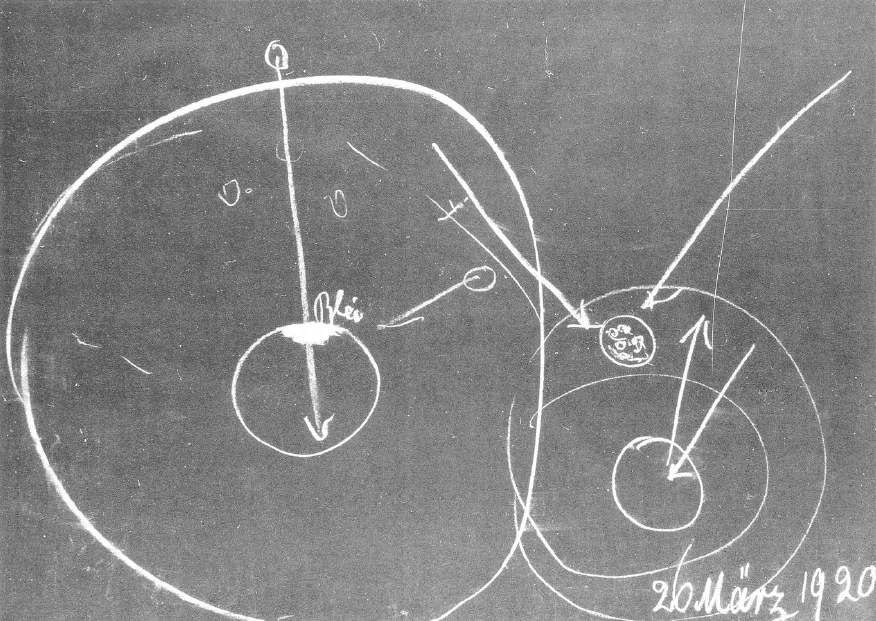
[ 19 ] What we are dealing with in plants are not the forces bound to atoms and molecules, but rather the forces that act from outside the Earth and influence earthly substance. So when we have configured an earthly substance, it is not these little demons within it—the atoms and molecules—that bring about the configuration, but rather the cosmic forces that act in some way. If, let’s say, there is a constellation in outer space that can have a particularly favorable effect on a point on Earth—for example, Saturn from our solar system—it can exert a favorable influence if we are as far away as possible from its line of action—that is, if this here is the Earth and Saturn is acting upon the Earth (see diagram on page 130)—and the other lines of action—that is, the influence of the Sun, Mars, and so on—do not lie within its orbit or just outside it, but are as far away as possible, so that, in a sense, Saturn acts alone, then, since our Earth is characterized by other factors, if there happens to be a favorable disposition at this very spot on Earth for these Saturn forces—which in this case are only slightly influenced by other extraterrestrial forces—it brings about a structure in the earthly substance that is simply different from what would occur, for example, if Mars were acting under the same conditions. We see in earthly substances nothing other than the products of the interplay of the stellar forces. So that in the case I have highlighted here, where Saturn acts particularly favorably on certain places on Earth over long periods of time, the effect becomes evident in the product, in that we are dealing here with the formation of lead.

[ 20 ] That is why certain earthly substances—particularly those of a metallic nature—must be correlated with certain constellations in the extraterrestrial cosmos. One simply cannot help but draw a parallel between what modern research and Modern Spiritual Science have to offer and what was presented in the past based on primordial wisdom—something that can truly be understood only when it is rediscovered. For the older writings are, in essence, virtually impossible to read for people today who think in terms of chemistry or physics. This is illustrated by an example recorded by a very intelligent Nordic scholar in a history of alchemy, in which he describes a process that—as he quite rightly says—is nonsense according to modern chemical concepts, since nothing can be deduced from it. It is a lead process. But the good gentleman failed to recognize that this explains the process of seed formation. He believed that it explained the process in the laboratory. In that context, of course, it is nonsense. But the gentleman does not realize that one must completely reorient the terminology—I would say, place it on a different plane—and that certain expressions must be understood in an entirely different way; that is why it seems like nonsense to him. He is just as right as he is wrong, of course.
[ 21 ] One therefore cannot help but relate earthly substances to the forces that act upon the Earth from its surroundings. The study of metals in particular—when conducted as I intend to outline for you in these lectures—reveals very specific connections, so that we must assign, for example, lead primarily to the effects of Saturn undisturbed by other influences, tin to the effects of Jupiter undisturbed by other influences, iron to the effects of Mars undisturbed by other influences, copper to the undisturbed influences of Venus, mercury—as we call it today in chemistry—to the undisturbed influences of Mercury—which is why the ancients referred to Mercury and the planet Mercury by the same name—and we must recognize a kinship between everything silvery—I am specifically referring to silvery substances here—and that which is subject to undisturbed lunar influences. It is truly quite amusing to read in today’s literature that in earlier times the connection between silver and the Moon was established simply because the Moon appears to shine with a silvery luster, and that people were said to have based their conclusions purely on this external characteristic. Anyone who knows just how meticulous, in their own way, the studies on the individual metals were that were conducted back then will not be able to fall prey to such an error. However, you can see from this that there is now ample opportunity to turn to other substances. For what I have mentioned to you—lead, tin, iron, copper, mercury, and silver—are, after all, only the most outstanding substances. There is ample opportunity to explore other substances because all manner of other planetary influences now compete with those already mentioned—so that, for example, the lines of Mars’s influence fall within the line of Saturn’s influence, and so on. This is precisely how the less representative metals come into being. In any case, however, we see in the Earth’s metallic realm the result of extraterrestrial forces. And in a certain sense, this links what we have described regarding the action of metals with what we observe in plant formation. For if you consider what lies in the agents of lead, tin, and iron—you have, in essence, everything that must also be present in all that pertains to the formation of flowers and seeds in plants, insofar as these processes occur above the Earth’s surface beyond the earthly realm; and everything related to the formation of plant roots must be connected to all that is coppery, mercurial, and silvery.
[ 22 ] While, on the one hand, the Mercurial element serves as a certain kind of balance, you naturally find yourself having to seek another kind of balance on the other hand. For you see, the Mercurial element is the balance between the Telluric and, so to speak, the supra-Telluric. But our entire universe is, in reality, permeated by spirit. And there, I would say, another polarity arises. If you have a mental image of the earthly here, and then of the extraterrestrial, you have the contrast between light and gravity in the earthly and the extraterrestrial. But this only gives you the opportunity to look toward a state of equilibrium between the earthly and the extraterrestrial.
[ 23 ] But now there is a different state of equilibrium between that which now uniformly permeates all earthly and extraterrestrial things, and this state itself—namely, between the spiritual and the material, whether the material is imponderable or ponderable. At every point within the material realm, equilibrium must again be maintained between the spiritual and this material realm; but this is also true throughout the universe. The nearest point where this equilibrium is maintained for us in the universe is the Sun itself. The Sun maintains the state of equilibrium between the spiritual in the universe and the material in the universe. Therefore, the Sun corresponds, I would say, at the same time to a celestial body that maintains order in the planetary system, but also brings about order through the forces that penetrate our material system. Just as one can discern the connection between the individual planets and the metals, as I characterized it earlier, so too can one discern the connection between the Sun and gold. But here, too, it is true that the ancients did not value gold for its Ahrimanic qualities, but rather for its connection to the Sun, for its connection to the balance between spirit and matter.
[ 24 ] Now, the important thing is always to keep in mind that in nature, what we separate—both in our thoughts and in what we ultimately accomplish here on Earth—is in fact always united in some way. In our thoughts, we separate that which is subject to gravity—that which tends toward the formation of salt—from that which becomes a bearer of light—that which tends toward the action of light—and, in turn, from that which is subject to the balance between the two.
[ 25 ] But in nature, these are not everywhere separate; rather, in nature these modes of action are interconnected and interwoven, so that they form highly artificial structural systems, and this artificial structural system is already contained within the gold in its radiance, because through the gold the spiritual, so to speak, gazes purely into the outer world. This draws our attention to something I would like to mention—I might say, in parentheses—because you may well be able to work fruitfully toward incorporating the insights that can still be gleaned from the ancient literature into the new literature. If you undertake the dissertations mentioned yesterday, you will be able to gain many insights from the ancient literature, provided you can understand this ancient literature correctly. It is therefore extremely important to see how ancient literature actually views all three principles—the saline, the mercurial, and the phosphoric or sulfuric—in some combination within every substance, and how, in earlier times, efforts were made to separate these three from any given substance. It was therefore believed that lead is formed in the manner we have indicated, but that lead—just like gold or copper—contains all three principles: the saline, the mercurial, and the phosphorous. And the point is that, in order for us to be able to treat people with the saline, the mercurial, and the phosphoric, we must extract them—that is, separate them in a certain way from that with which they are combined. And in early chemistry, the greatest care was taken with this process. This process was found to be most difficult with gold. Hence the Roman saying, which is truly something that in turn leads to reverence for the ancient: “Facilius est aurum facere quam destruere”—“It is easier to make gold than to destroy it.” For it was believed that in gold the three essential natural principles—the saline, the mercurial, and the phosphoric—are so firmly bound together that it is exceedingly difficult to separate them from gold.
[ 26 ] Now, it is certainly true that if one were to proceed exactly as the ancients did in this process of elucidating the three natural principles, one would hardly be able to manage it easily today. But if one were to set aside the old methods entirely—as is precisely the intention in these lectures, where light is shed only occasionally on the old literature—and focus instead on what can still be investigated today, one would also come to the conclusion that, in order to extract from natural substances what is needed from these three principles—which I characterized for you yesterday and today— one must, in a certain sense, actually carry out the process of combustion with the natural substances, whereby, for example, one first separates out the fire-bearing and light-bearing elements; and then one must attempt to extract the mercurial element from the natural substances for certain purposes, so that only what tends toward the salty remains. This can then be extracted using some kind of acid, and one will obtain a truly salt-like remedy, whether from plants or from minerals. I will go into more detail on the specifics later. So in nature, we will either have to seek out that which is light-bearing in order to obtain the extra-terrestrial element, or we will have to seek to remove this extra-terrestrial element from the earthly substances and retain the terrestrial element—then we will have the truly salt-like substance—or we will attempt to obtain something that represents the state of equilibrium between the two.
[ 27 ] Now, however, one can, I would say, take two paths that are different in nature, each of which leads to the goal to a certain degree. In fact, one can take both approaches. One can adopt the standpoint taken by the ancient physicians, who always sought to isolate from known substances that which, by its nature, was phosphorus, salt, or mercury, and who then used the substance in question. For them, the different, specific effect of the remedies arose from the fact that it made a difference whether they obtained the relevant substances from lead or from copper. They therefore took the origin into account. So when they produced a salt from lead, that was, for them, something different from the salt produced from copper. So even when they spoke of salt, they were actually referring to the fact that in this particular salt—among the various salts—there is something that, while earthly in nature because it is salt, is also, by virtue of being derived from different metals, something non-terrestrial and related to the most diverse aspects of the human being—which we will be able to characterize more precisely tomorrow. One can take this path, for example, toward the production of salt-like substances in medicine. One can then take the path that was taken after the other path of the ancients had run its course, but which was taken out of a still clear sense that human beings are indeed not merely a retort, but are more than that. And this is the path where one simply attempts, by accepting what is there and by potentizing what is there, to make use of the forces underlying the already existing substances. This is the path that is essentially inherent in the Hahnemannian approach and which, I would say, represents a kind of renewed ascent arising from the entirety of human medical endeavor, after the old path had already run aground because nothing was known anymore about any extraterrestrial or other connections.
[ 28 ] That is, in fact, what I would say lies at the heart of the despair of modern medicine: that modern medicine no longer looks to what actually underlies the earthly realm—the extraterrestrial—and that it always seeks to cope with what lies solely within the earthly realm. The homeopathic system strives beyond this; naturally, the physical method of healing also strives beyond this—which, precisely because it no longer has the means to use the light-bearer, Phosphorus, or the air-bearer, Mercury, in the proper way, uses light and air directly. This, of course, is also a third possibility.
[ 29 ] But a true, viable path will only open up again if, through Spiritual Science, we penetrate the connection between the mineral and the extraterrestrial, between the plant and the extraterrestrial, and between the animal and the extraterrestrial. When one reaches the animal realm—as I already hinted at yesterday—one comes dangerously close to the human realm. The ancients drew a boundary there, which we in turn wish to reexamine in light of more recent research. For they said: Plants—they belong to the realm of the planetary system; minerals—they belong to the realm of the planetary system; but when one ascends into the animal world, one leaves the planetary system behind, and the situation becomes such that one must be much more cautious in dealing with these things than when one remains within the planetary, extraterrestrial realm. The forces that lead to the formation of animals—and especially to the formation of human beings—are scattered much further out in the cosmos than the forces found in minerals and plants. They drew the zodiac so that one would not seek healing powers beyond what lies in the plant or mineral kingdoms, or at least be mindful that one is entering a precarious realm.
[ 30 ] Now, however, we have entered this field via the path I began to describe to you yesterday—a path we will need to discuss in even greater detail when we delve into the specifics of pathology and serum therapy. Such approaches are usually such that, because they lead to specific details, they give rise to quite strong illusions, which then completely obscure what lies behind these things as a danger.