

Spiritual Science and Medicine
GA 312
28 March 1920, Dornach
Translated by Steiner Online Library
Eighth Lecture
[ 1 ] The terminology that we—I would say—must use to some extent to condense or simplify our ideas when we speak of the “etheric body,” “astral body,” and so on, can certainly be traced back to what, in a sense, is reflected in physical events. However, people today are not very inclined to truly relate what is expressed in physical events to the spiritual foundation of existence. Yet for medical thinking and perception to be imbued with spirituality, this will absolutely have to happen. For example, we will absolutely have to address how the interaction between what we call the etheric body and what we call the physical body actually takes place. As you know, this interaction occurs within the human being, and yesterday we spoke of one aspect of this interaction, namely, when a kind of disorder arises in relation to the influences of the astral body. But this interplay also takes place outside, in nature beyond the human realm.
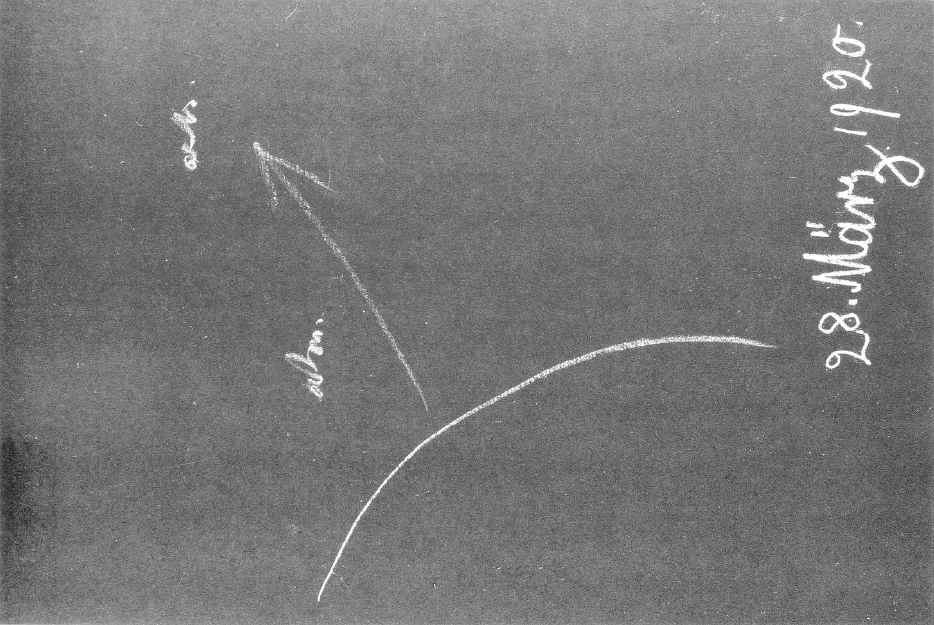
[ 2 ] Now consider that if you follow this line of thought through to its logical conclusion, you will actually gain a quite thorough insight into the relationship between human beings and non-human nature. You look out into non-human nature. You are surrounded—let’s focus on this for now—by the entire plant kingdom with all its individual species, and you perceive this plant kingdom through your various senses. So when you look out there, you can perceive the flora with your various senses and at least sense an interplay between this flora and, first, everything that is in the Earth’s atmosphere, and everything that lies outside this earthly sphere in the planetary and astral realms. We can say, in a sense, that when we look at the flora of the Earth—as shown here (see illustration on page 158), Plate 12
[ 3 ] the Earth's surface, this flora points us toward the atmospheric, toward the astral, understood here in the sense that it extends toward the stars, toward the extra-terrestrial realm; and even without delving into the occult, we can at least sense that out there there is a living interaction between what is manifested in the flora—in the blossoming and fruiting—and what acts upon it from the vast expanse of the universe.
[ 4 ] If we then turn our attention away from all of this and direct our thoughts inward—though you must try to draw on a little intuition in this contemplation, for as I have already said, medicine is absolutely impossible without intuition—if we turn our thoughts away from the external world and look into our own inner being, we find a certain kinship with what is out there. And since we must acknowledge that in the plant kingdom the ethereal is closely connected with the physical, we must also sense a certain kinship between this kind of connection between the ethereal and the physical in the plant kingdom and the nature of the connection between the ethereal and the physical in human beings themselves.
[ 5 ] The point now is for us to consider what concrete, external evidence we have for this relationship between the etheric and the physical. We can, of course, begin by stating abstractly: The etheric is closer to the astral than to the physical, insofar as it opens upward. But we must also acknowledge that the ethereal has some kind of relationship to the physical. We will therefore have to look at this dual relationship, in which the etheric stands, on the one hand, in relation to the physical and, on the other hand, in relation to the astral, and we will have to seek out something that, so to speak, leads us into this dual relationship. Now I would like to begin by describing to you as concretely as possible how you can be led into this dual relationship.
[ 6 ] Let’s say you’re walking down an avenue lined with linden trees and try to really picture yourself walking through that avenue, surrounded by the scent of the blooming linden trees. Realize that a process is now taking place between everything that, let’s say, spreads like a nerve impulse into your olfactory organs, and this scent of linden blossoms. Then, when you turn your attention to this process of perceiving the scent of the linden blossoms, you will, so to speak, experience the emergence of the inner—the sense of smell—in response to the scent of the linden blossoms, and you must tell yourself: A process is taking place here that brings an inner aspect into contact with an outer one; through their inner kinship, they somehow accomplish something together. And you must tell yourself: That which is diffused outward through the scent of linden blossoms—which undoubtedly rests on an interaction between the flora and the entire external environment, the flora that opens itself up to the external environment—is, in a sense, internalized within the very act of olfactory perception itself. Since you perceive this, there is undoubtedly something within you that acts from the etheric body onto the astral body; otherwise, you could not perceive it—otherwise, it would be merely a life process. The process of smelling itself testifies to the fact that the astral body is involved. But what reveals to you the kinship with the outside world also shows you that the emergence of that sweet scent exuded by the linden blossoms is, in a certain sense, related—polar—to what is taking place in your olfactory organ. And indeed, in this spreading, sweet scent of the linden blossoms, we have the interaction of the plant-etheric with the surrounding astral, which permeates the entire world space. We therefore have in our sense of smell a process that unfolds in such a way that, through this process, we participate in what, in the plant kingdom, is related to the extra-terrestrial astral realm.
[ 7 ] If we now take any taste—let’s say, to give another example related to what was just mentioned, the taste of licorice or the taste of sweet grapes—we have something similar. But here we are dealing with a process that takes place in our organ of taste, in contrast to the processes that take place in our olfactory organs. You know how closely related the organ of taste is to the organ of smell, and you will therefore readily be able to form a mental image of how closely related—in terms of the entire natural process—what takes place in tasting is to what takes place in smelling. But at the same time, you must realize that tasting is a much more organic and internal process than smelling. Smelling takes place more on the surface. Smelling participates in the processes of the non-human world, which, so to speak, spread out and are distributed throughout space. This is not the case with tasting. Through tasting, you gain insight into certain properties that must lie within the substances themselves—properties that are therefore connected to the substance itself. Through tasting, rather than through smelling, you discover what things—in this case, plants—are like on the inside. And you simply need to call upon your intuition a little; then you will tell yourself that everything connected with the process of solidification in plants—with the organic processes of solidification in plants—is revealed through the taste of everything that is within the plant. But this plant nature resists solidification. This becomes evident to us in what causes the plant to become fragrant. Therefore, you cannot really doubt that taste is a process connected with the relationship between the ethereal and the physical.
[ 8 ] So now combine smell and taste. By experiencing smell and taste in relation to the plant kingdom, you are actually living within those relationships that the etheric realm has with both the astral and the physical realms. You truly enter into the etheric realm—that is, into its imprint—when you turn your attention to the senses of smell and taste. Where the senses of smell and taste are present in the human being, there is, in essence, a manifestation of the etheric realm within the physical world, revealing its relationships to the astral and physical realms. In a sense, we are ourselves at the surface of the human being when we examine what takes place in the senses of smell and taste. But you see, the real issue today is that we must finally move beyond the abstract-mystical in order to enrich true science through Spiritual Science and truly advance toward a concrete grasp of the spiritual. What good does it really do if people go on and on talking about the need to grasp the divine in human beings, when by “divine” they mean, at most, some entirely abstract concept of the divine? This approach will only bear fruit when we can engage with concrete phenomena, when we observe, in this concrete sense, the internalization of external processes, for example, by actually observing in the senses of smell and taste—which are related to human beings—the etheric, how it becomes internalized, and how we see in these perhaps coarsest of the higher sensory processes an immediate “becoming internal” of external processes. This is so extraordinarily important for our time: to move beyond the merely abstract and mystical. Now, however, you will be aware that in nature everything is in a state of constant transition into something else, that in nature everything is such that one process tends to pass into another, to metamorphose into another process. So take what we have just said: the sense of smell, which is located more on the surface (see drawing on page 162), and taste—which is situated more deeply within the human being—all of this relates to the flora, the plants—and this, I would say, extends into the etheric, insofar as the etheric opens up toward the astral or solidifies into the physical—that is, moving outward—toward all that occurs in the plant kingdom in terms of volatilization, becoming aromatic, or even withdrawing from the aromatic in the act of tasting, internalizing everything that leads to solidification in the external world. In a sense, the external and the internal flow together when we focus our attention on smelling and tasting.

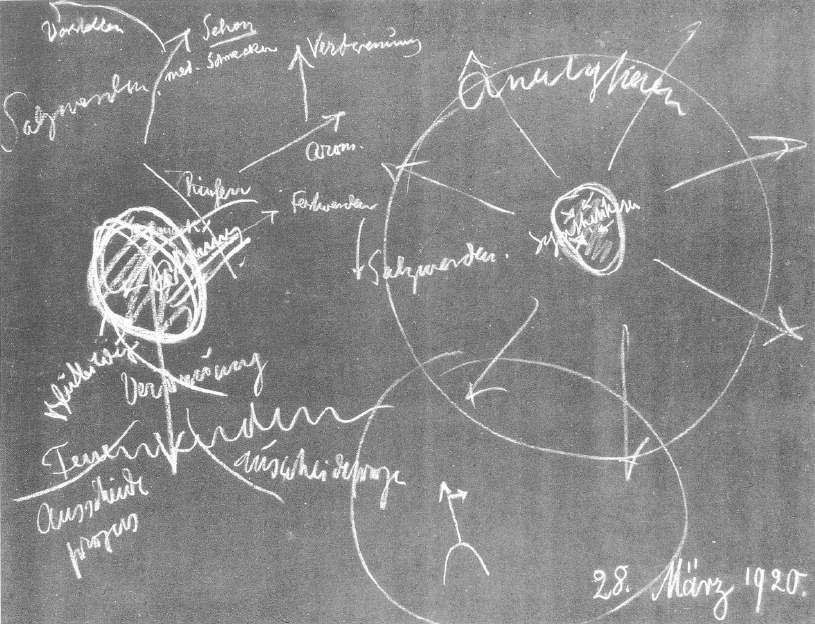
[ 9 ] But in nature, one process always flows into the next. Let us turn our attention to this aromatic aspect of the flora—to everything through which the flora, so to speak, eludes its “solidification,” where the flora still seeks to transcend its plant nature, where the plant, so to speak—forgive the layman’s expression—still projects its spirituality into the atmosphere, so that the atmosphere still carries within the fragrance something of the plant’s essence. In a sense, the phantoms of the plants are still present in what we smell out there. Consider this. What, in fact, is actually happening out there when the plant sends out its fragrant shadows, when it does not allow itself to fully become a solidified plant being, when it sends out from the flower something that, while it wants to become a flower, nevertheless eludes this process of becoming a flower and preserves itself in its transience? For this is nothing other than a restrained process of combustion. If you think of this aromatization as continuing metamorphically, you will come to conclude: this aromatization is actually a restrained process of combustion. When you look at combustion on the one hand and the aromatization of the plant world on the other, you will recognize in them two metamorphoses of a common unity. I would like to say: burning is simply present in aromatization at a different level.
[ 10 ] Now let us look at that aspect of the plant which stimulates the sense of taste—that is, what lies deeper within the plant, what causes the plant not to expel its formative power like a phantom into the surrounding environment, but rather to hold it together within itself and use it for inner formation. Since you participate in this inner formation through the sense of taste, you arrive at the same process that underlies the solidification of the plant—a process that is, at this other stage, a metamorphosis into salt, but of course into the salt of the plant, for we are speaking of the flora (see illustration on page 162).
[ 11 ] Do you think there has been a strange metamorphosis within the plant? You have introduced the process of aromatization into the plant from above, which is, in a sense, a restrained combustion process and can already lead to the onset of combustion processes; for the processes of flowering are simply combustion processes that become integrated there. From below, you have the process of solidification, of becoming salt. And what you taste in the plant is precisely that which is still a restrained process of becoming salt. But when the salt integrates itself and you find the salt within the plant itself—that is, when the plant contains these plant salts—then these salts are something that has gone beyond the path of the plant’s development, where the plant, pressed into its own essence, has its own form.
[ 12 ] Once the rationale for the remedy has been recognized, it begins—I would say—in a certain sense to become light within the flora, because one looks into what is happening there. It is this—and I must emphasize this again and again—concrete act of looking that matters.
[ 13 ] Now, to continue, you just need to keep the following in mind: Wherever possible—and I would say, purely for higher opportunistic reasons—I want to link what needs to be discussed to what is common practice today, so that you, too, will be able to bridge the gap between what Spiritual Science can offer and what constitutes external science. Of course, I could now characterize what I will discuss in the following sentences in even more Spiritual Science terms, but I want to build upon the common mental images of modern science that are already in place. Today, the physiologist speaks of what is before him—which, for that very reason, need not be before the spiritual scientist, since the latter does not need to dissect in the same sense. But let us simply build upon these common mental images. We certainly do not need to adopt the others’ anatomical nonsense, but we must nevertheless reckon with the fact that it has already existed and has yielded its results. It will only cease when the natural sciences have been enriched by Spiritual Science. So let us examine this! It will then become quite clear from Spiritual Science just how close a kinship, how close a relationship exists between the process that takes place in the eye and the process that takes place in smell and, in particular, in taste—in the extension of the taste nerve into the rest of the organ’s tissue and in the extension of the optic nerve within the eye. There is such a close relationship that one can hardly avoid seeking analogies to the process of tasting when characterizing the inner workings of the visual process. Of course, since the extension of the taste nerve within the organic substance is not preceded by the intricate structure of the eye—which precedes the extension of the optic nerve within the organic substance—seeing is something entirely different. But what, in a sense, begins as the process of seeing behind the intricate development of the physical eye is already very closely related to the process of tasting. I would like to say: In seeing, we carry out a metamorphosed form of tasting—metamorphosed in that we have placed before the organic processes that take place in tasting everything that is conditioned by the intricate structure of the eye.
[ 14 ] Now, of course, with regard to each sense, we must distinguish between what our organism brings to the external world and what the external world brings to our organism. We must therefore look at what happens internally as processes resulting from the blood flowing into the eye—that is, from the organism’s action within the eye. This is even more pronounced in certain animals that, in addition to our organs, have the fan and the sword-like process in the eye—that is, blood organs—through which the ego is driven more deeply into the eyeball, whereas in us the ego withdraws and leaves the eyeball internally free. But the entire organism acts upon the entire sensory process through the eye via the circuitous route of the blood, and within the process of seeing, the process of tasting is, so to speak, metamorphosed, so that we can call seeing a metamorphosed form of tasting. We would thus, in a sense, have placed seeing above tasting and smelling as a metamorphosed form of tasting (see drawing on page 162). |
[ 15 ] It thus corresponds to what the entire process of taste—as well as the process of sight—is: something external that interacts with the internal. The process must therefore, in a sense, undergo a metamorphosis upward. The process of vision is a metamorphosis of the process of taste. But there must also be a metamorphosis of the process of taste downward into the body. While in the process of seeing we ascend more toward the external world—the eye is enclosed only within the bony socket, and from there we move outward; the eye is a very external organ, and the process of seeing is organized more toward the external—we must now conceive of the metamorphosis of the process of tasting in the opposite direction, downward into the organism. We then arrive, so to speak, at the other pole of vision—that which corresponds to the process of vision within the organism—something that will shed an immense amount of light on our subsequent considerations. For what is it that we encounter when we trace the metamorphosis of the process of tasting downward? For digestion is conditioned by this, and you will arrive at a true inner understanding of digestion only if you have in your mind the mental image of seeing as a metamorphosed continuation of tasting, and, on the other hand, of digestion as a metamorphosed continuation of tasting, but in such a way that you are able to grasp digestion in its full polar opposition to externalized seeing; for externalized seeing leads you precisely to recognize what in the external world corresponds to this digestion—of which digestion is, organically speaking, an internalization. On the other hand, you will become aware of how the process of digestion must be conceived as related to the process of tasting. You simply cannot understand the intimate processes within the human organism, insofar as they are localized within the digestive process, if you do not have in your mental image of the entire digestive process the idea that good digestion is based on an ability to “taste” with the entire digestive tract, so to speak, and that poor digestion is based, so to speak, on the inability to “taste” with the entire digestive system.
[ 16 ] Now, the process we have been considering here divides into tasting and smelling. In a sense, a single process splits in such a way that, on the one hand, we are dealing with a process in tasting that is more a matter of the interaction between the etheric and the physical, and on the other hand, with a process in smelling that is more a matter of the relationship between the etheric and the astral. That which we have within the organism as a continuation of tasting, we have subjected to the same division: on the one hand, digestion tends toward excretion through the intestines—toward fecal excretion—and on the other hand, we have excretion through the kidneys—through urination. Here you have the exact counterpart in the lower and upper regions of the human being. You have precisely what appears as two polar opposites: on the one hand, the division into tasting and smelling; and on the other hand, the division into ordinary digestion and that which is separated from ordinary digestion—namely, everything based on the more intimate activity of the kidneys, that which is associated with the more intimate activity of the kidneys.
[ 17 ] Here, in a sense, we have the opportunity to regard what takes place within the organism—bounded by the skin—as an internalization of the external. For with everything we continue to bring upward, we move further into the external; there, the human being opens up to the external. Now we must pursue this matter further in such a way that, in what lives within us, so to speak, as a soul force—yet is bound to the organism, not in a materialistic sense but in another sense that you are familiar with from the lectures—we have a metamorphosed form of vision, oriented in a certain respect toward the inner realm, in thinking and in the formation of mental images (see drawing on page 162), whereby we must conceive of those organs that underlie the mental images—that is, those of the human inner head—as metamorphosed organs of sight directed in a certain direction. Please simply consider how most of your mental images, which live in thought, are simply continuations of visual images; you need only compare the soul life of someone born blind or born deaf. We have an extension of inner vision in thinking. And this leads us to realize that light is also shed on the remarkable interplay that exists between the anatomy of the head and brain and the thought process itself. It is, for example, very peculiar that when one thoroughly examines our thought processes—a fine topic for a medical dissertation, by the way—and seeks to investigate how the organization of the brain relates to synthetic thinking, one strangely encounters structures that appear to be a transformation of the olfactory nerve. So one could say: our scattered, analytical thinking, viewed from within, is very similar in its inner structure to seeing. But the synthesis of what is seen—the association of mental images—is actually, from an inner organic perspective, very similar to smelling. This is expressed in the anatomical structure of the brain in a truly remarkable way. In any case, this brings us to the mental image and thinking on the one hand.
[ 18 ] Where, then, do we end up when we once again seek the inner process? Is it not true that, in a mental image, we have—starting from seeing—that which is externalized in seeing, which in turn, in a sense, radiates back inward into thinking? One endeavors, as it were, to reverse the process of seeing and direct it back toward the organism. Its polar opposite process will therefore consist in not striving to direct what is a process toward the inner, but rather toward the outer. And that is: the digestive process continues into the excretory process (see diagram on page 162), which thus becomes the counterpart of a mental image. Here you have, from a different, more intimate perspective what I showed you a few days ago through comparative anatomy, where I also pointed out to you how the simple structure of the human body—and particularly the nature of the intestinal flora—in a certain way indicates the intimate relationship that exists between the so-called mental faculties of human beings and their regulated or unregulated excretory process. Here you have it from another angle. So just as we have, inwardly, a continuation of the visual process in the thought process, we have, outwardly, a continuation of the digestive process in the excretory process. If we now return to what we observed just a moment ago—that aromatization is a restrained process of burning and the solidification of the plant is a restrained process of becoming salt—we will once again have shed light on what is happening internally; we must simply be clear that a reversal is taking place. Here (above) there is a reversal of perception toward internalization; here (below) there is a reversal toward externalization. Therefore, here (above) we will come to recognize a connection between these processes and the formation of salt, and here (below) a connection between these processes and the formation of fire or combustion, with fire (see drawing on page 162). So if you direct that which is suitable for bringing about the aromatization and the restrained combustion process in the plants (see notes) toward the lower abdomen, you will be helping the lower abdomen. If you direct what is intended in the plant to hold back the salt process or to internalize it within the plant toward the upper human, you will support the processes of the upper human. We will then have to carry this out in detail.
[ 19 ] There you can see how, in a sense, the entire outer world can reappear within the entire inner world. And the deeper we penetrate into the human being, the more we must seek the outer within the human being. We must look specifically within what takes place in the digestive organs—namely, in the kidneys—for something that is very, very closely related to the processes of aromatization and combustion, only at the opposite pole. And in what takes place in the human organism—starting from the lungs and moving upward through the larynx and head—we must seek something that is intrinsically related to all that in the plant tends toward becoming salt, and to everything in human nature that tends toward becoming salt. So one might say—that is, not only might one say it, but one can say it: if one knows the various ways in which plants accumulate salt within themselves, then one need only look for the corresponding process in the human organism. We have explored this in general terms today; we will examine it in more detail in the following lectures.
[ 20 ] Here, you can see, in a sense, the entire field of herbal medicine characterized in principle. You can see what it is based on. I would say: You can see into the entire real process that takes place in the interaction between the inner and the outer; but you can also already see something very specific. Take, for example, those odors which, I would say, even as smells, lean more toward the taste sensation, so that when you chew the plant in question, you actually first encounter the true smell and perceive a synthesis between smell and taste—as with lemon balm or ground ivy—then we find that there is already something of the process of becoming salty at work there, that there is already an interaction between becoming salty and becoming aromatic. This indicates to us that the organs that must be related to these plants, such as lemon balm and so on, tend to be located more toward the exterior, toward the chest, while those organs that must be related to what is strongly aromatic—such as, say, the linden or the rose—must be related to what is more deeply embedded in the lower abdomen or lies more toward the lower abdomen.
[ 21 ] Now you will find that, from an organic point of view, another process is integrated into everything that lies within the higher human being in the realm of smell or taste—a process that, in a somewhat deeper sense, is an important life process for human beings; namely, the process of respiration, which is integrated here (see diagram on page 162). We can now also seek the process that is polar opposites to this respiratory process. It must be the process that, so to speak, branches off from the digestive process insofar as the digestive process leads to the excretory process, and the polar opposite is the organic process of imagination. Something must also be distinguished here that is still organically closely related to the digestive process, just as breathing is locally related to the processes of smell or taste, viewed organically. This encompasses everything that takes place in the lymphatic and blood processes, in the blood-formation process—that is, what is pushed inward from digestion, what thus lies within the organs such as the lymph glands and so on, in all the organs involved in blood formation. So here you see two polar processes: one separated from digestion, the other separated from the sensory processes located more toward the outside—that which, so to speak, lies behind the sensory processes, namely breathing, and that which precedes digestion—insofar as this digestion then leads to excretion—namely, the blood- and lymph-forming process. It is remarkable how we proceed from the process itself to gain an understanding of the whole human being, whereas today people usually view the human being solely from the perspective of the visible organs. Here, starting from the process and from the human being’s entire relationship with the world outside of humanity, we seek to recognize and understand this human being, and we do indeed find connections that truly provide us with an immediate picture of the entire etheric activity within the human being—for we have, after all, been studying the etheric activity in the human being in today’s lecture. And these two processes—the respiratory process and the process of blood formation—meet again, and their meeting takes place in the human heart. You see, the entire external world, insofar as it also includes the human exterior, presents itself to us as a duality that accumulates in the human heart, striving toward a kind of balance within the human heart.

[ 22 ] And so we can arrive at a remarkable image—the image of the human heart with its inner life, with its synthesis of everything that acts upon us externally across the entire expanse of the body—a synthesis, and in the outer world, an analysis, a scattering everywhere of that which, I might say, has been gathered together in the heart (see drawing on page 172). There you arrive at an important mental image that could be expressed something like this: You look out into the world and see the surrounding sphere and ask yourself: What is there in this sphere, what acts inward from this sphere? Where do I find anything within myself that is related to it and of the same nature? — When I look into my own heart! There, in a sense, is the reversed heaven within—the polar opposite. While here you have the periphery—the point, I might say, expanded into infinity—you have the circle condensed within the human heart. The whole world is in there. To use a rough analogy, one could simply say: Imagine a person standing on a mountain, looking out into the vast expanse and seeing the vast expanse of the world. And if you place a tiny little dwarf inside the human heart and try to visualize what this little dwarf sees in there, what he sees in there is, in reverse, the complete image of the world condensed and synthesized. This may be merely a figurative mental image, a kind of imagination; yet at the same time, it is precisely what—if taken in the right way—can function as a quite proper, regulative image, as a regulative principle, and can guide us to synthesize in the right way precisely what we recognize in detail.
[ 23 ] I have now laid most of the groundwork for what will be specific considerations, which will also serve as the basis for answering in detail the many questions that have been posed to me.