

Spiritual Science and Medicine
GA 312
2 April 1920, Dornach
Translated by Steiner Online Library
Thirteenth Lecture
[ 1 ] It may be that, particularly in light of three sets of facts, the more materialistically oriented school of medicine will first turn toward the more Spiritual Science-oriented one, and this will most likely occur in connection with the sets of facts that we must now also begin to discuss. This will be evident in the observation of everything related to tumor formation and, in particular, to their possible cure. And it will become apparent in a truly rational understanding of so-called mental illnesses and, furthermore, in the therapeutic insights that will need to be acquired for the application of external remedies—that is, rubs, ointments, and the like. We can hardly hope, with ordinary physical examinations—without at least some insights from the Spiritual Science to provide direction and orientation—to come close to understanding such things as all the tumor formations that ultimately culminate in the development of carcinoma. Psychiatry today is in such a sorry state, particularly because it offers no bridge to people’s consciousness—for bridges in nature are everywhere—to the usual other fields of pathology and therapy; it is perhaps in these two areas that one will be most willing to engage in Spiritual Science consideration. In particular, it will be necessary to take into account everything that Spiritual Science has to say; one need only consider my writings today to find that they have already said quite a great deal in this direction. One will have to take into account the entire interaction of the etheric body with the human organism.
[ 2 ] One shouldn't simply say that one must necessarily be a clairvoyant in order to speak about the activity of the etheric body in the human organism. For one can see from a great many processes that are simply opposed to the activities of the etheric body that the etheric body is, in a certain sense, not active—or at least not functioning properly. And in order to arrive at valid mental images in this area, it will be necessary to consider everything related to inflammation—that which develops on the basis of inflammation—and everything related to tumor formation, which, so to speak, destroys the human organism starting from there. In the case of tumor formation, it is indeed a very justified aspiration—one that, however, cannot yet be realized given today’s social conditions, which must also be changed in parallel—not the external conditions, but the social conditions into which medicine plays a role— namely hygiene—are not yet feasible, that the call is repeatedly made, based on a legitimate ideal, to do without the surgeon’s scalpel in cases of tumor formation. The point, however, is to create a substitute for what the surgeon’s scalpel achieves and does not achieve—it certainly achieves certain things, but there are also things it does not achieve. Undoubtedly, many who today advocate for the surgeon’s scalpel simply because the means of diagnosis do not yet exist will change their minds the moment such diagnostic methods are developed.
[ 3 ] Now, I certainly don’t need to explain to you the entire nature of inflammatory processes, including their various specific manifestations in different organs. That is something I can say is already well known. But what is not well known is precisely that which, so to speak, hovers as a unified process above all inflammatory processes. This unified process can best be characterized by saying: In everything that is a true inflammation—whether very small or very large, and which, on the basis of inflammation, then leads to ulcer formation—in all of this, I’ll put it this way—from the perspective of Spiritual Science—that the entire etheric body of the human being acts as such; one can therefore still rely on the fact that something can be done to restore the activity of the etheric body—which has, in a certain sense, become sluggish in one particular direction—to its normal distribution, so that the entire etheric body of the human being functions in a healthy manner. It is really just a matter of directing the activity of the etheric body toward very specific directions, whereas a healthy etheric body must extend its activity across all the corresponding directions of the organism. Essentially, this is such that one can say: One can find reactions—we will speak of such later—that can once again stimulate the etheric body, which, for example, has become sluggish toward a certain organ system, to unfold its, if I may say so, universal activity in that direction, provided it is still healthy as a whole.
[ 4 ] The situation is different with regard to tumors—all types of tumors. In these cases, certain processes in the physical body directly oppose the activity of the etheric body; in a sense, certain processes in the physical body simply rebel against the activity of the etheric body, and as a result, the etheric body is no longer effective in these areas of the physical body.
[ 5 ] However, the etheric body possesses a very great capacity for regeneration, and one can always observe through methods of Spiritual Science that if one can remove the obstacle—that is, eliminate the enemy—that stands in the way of its activity in a certain area, then one can indeed overcome the problem. Thus, one can say: In the case of tumors, the task will be, so to speak, to bring about—through the workings of nature—the elimination of the physical activities that oppose the etheric body, so that the etheric body may once again exert its influence in the place where it otherwise does not.
[ 6 ] This will become particularly significant in, say, the treatment of carcinoma. For carcinoma clearly shows—if it is properly observed—that despite its manifold forms, it nevertheless represents a revolution of certain physical forces against the forces of the etheric body. From the effect—which can be seen very characteristically, for example, in internal cancerous formations where keratinization occurs, which remains more in the background but is nevertheless present in tendency even in cancerous formations located closer to the surface—one can see how the physical formation actually overrides the etheric formation that should be present at that particular location. If one therefore studies these two things correctly, one ultimately arrives at the insight—which is now almost tangible—that inflammations and ulcerations represent the complete opposite of tumor formations. These two phenomena are true polar opposites. When I say that this is something one can almost grasp with one’s own hands, I simply ask you to recall the experiences you may have when a carcinoma located near the surface occurs—a condition in which what is taking place there can very often be mistaken for pseudoulcers, at least in certain respects. Above all, the study will have to focus on examining this polarity more closely.
[ 7 ] Well, of course, what often causes problems with these things are not exactly old, but—I would say—medieval naming conventions—not those related to the Middle Ages, but even those related to a Middle Ages that lies very close behind us. It is not entirely correct to describe these growths as “new formations.” They are such, at most, in the very trivial sense that they did not exist before, but they are not such in the sense that they grow, for example, from the surface of the organism itself, which is covered by skin. Rather, because the physical body, in a process, comes into such strong opposition to the etheric body, the outer body, in a sense, also submits to the external environment—to nature, which is hostile to human beings—and this opens the tumor formation to all manner of external influences.
[ 8 ] Now the point is that one must also, I would say, study the opposite of all these things. In this regard, I refer you to the study of—let us say, for the time being—mistletoe formation in the non-human natural world. It is necessary to first focus attention on how mistletoe species develop on other plants. But that is not even the essential point. The essential point for botany is certainly the parasitic nature of the mistletoe. But for the study of the relationship between non-human nature and human nature, it is fundamentally much more important that the mistletoe, by growing on other plants—on trees—is compelled to carry out its life cycle according to a different annual rhythm—that is, for example, that it has already completed its flowering before the trees on which it grows begin to produce foliage in the spring; that it is, in other words, a kind of winter plant; that it does not, so to speak, expose itself—this mistletoe is a plant that, I would say, behaves in an aristocratic manner—by shielding itself from the sun’s rays or the light effects of summer, which are too intense, through the foliage of the trees. According to the processes described the day before yesterday, we must always regard the sun merely as the representative of light effects. This would be the subject of a physical analysis and does not belong here. Of course, one cannot entirely avoid what has crept into our language from a not entirely correct view of nature. But the whole way in which the mistletoe grows and thrives by attaching itself to other plants—that is what is particularly important. Through this, the mistletoe acquires very special powers. It acquires powers that can be described roughly as follows: by virtue of its powers, it does not want anything that the straight organizational forces—the forces that develop in a straight line—want, and it wants what the forces that develop in a straight line do not want. Here, too, the matter will only become clear if one understands it in this way: If, to put it very schematically (see diagram on page 251), there is a spot here in the physical human body that, through its own forces, rebels against the entire inflow of etheric forces, so that the etheric forces, as it were, become blocked and come to a standstill, thereby giving rise to what appears to be a new formation—then it is the mistletoe that counteracts this blockage that has formed there. It draws it, so to speak, back to the place where it does not want to go.
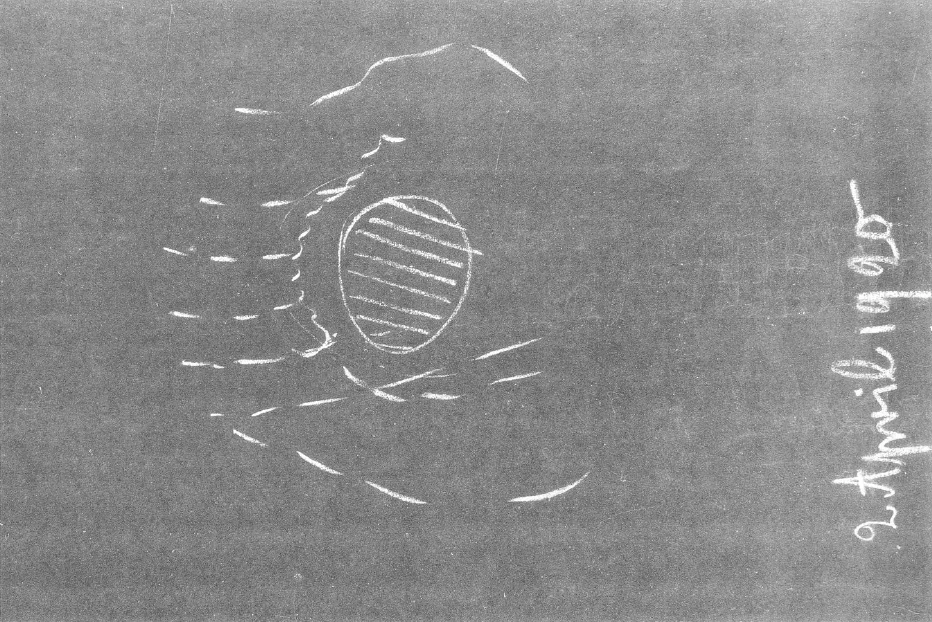
[ 9 ] Here, too, you can convince yourself to some extent through the experiment—which, of course, I would say, can only be conducted on an ad hoc basis. You will be able to study this counter-tendency of mistletoe against linear organization quite well by observing how mistletoe affects the expulsion of the afterbirth. It actually holds back the afterbirth in the human organism; that is, in its own way, it does the opposite of what linear organization actually aims to do. This is something that belongs to the very most essential characteristics of the mistletoe’s process of action—to bring about something like the retention of the afterbirth, that is, to hold back the ordinary organization. In processes within the human organism that are more subtle but are actually based on the same principle as the retention of the afterbirth, this naturally presents itself much less prominently. But the very same thing that now has such a strong effect when mistletoe counteracts the linear tendency toward organization is what one encounters in the images that arise when one considers the effect of mistletoe at all. Isn’t it true that when one notices that mistletoe counteracts the tendencies of the etheric body—which, for example, does not want to grasp the physical body to the proper degree—and one then brings about a certain mistletoe effect, the etheric body grasps the physical body too strongly, and convulsions arise? In other cases, it is precisely the effect of mistletoe that gives rise to this peculiar sensation that one might fall over at any moment. These are things that, in turn, are related to the fact that, for example, mistletoe essentially promotes pollutions.
[ 10 ] So everywhere you can see—even in connection with the onset of epilepsy, for example—that mistletoe possesses this ability to counteract the human organism. But this has less to do with its parasitic nature than with the fact that it, too—if I may use the colloquial expression, and the Viennese in particular will understand me—gets special treatment from nature as a whole. It gets special treatment insofar as it does not thrive according to the usual course of the year—blooming in the spring and then bearing fruit—but rather develops these things at a different time, specifically at an “extra” time, during the winter. In this way, it conserves those forces that counteract the usual course of events. If it weren’t too controversial to say so, one might observe, when looking at mistletoe growth and considering its active nature: this active nature has gone mad in this process; it does everything at the wrong time as far as the mistletoe is concerned. But this is precisely what one must make use of when, on the other hand, the human organism becomes physically deranged—which it does, for example, in the formation of carcinoma. The task then is to develop an understanding specifically for such connections.
[ 11 ] Mistletoe is undoubtedly the substance whose potentization will be necessary to replace the surgeon’s scalpel in the treatment of tumors. The only issue will be ensuring that the mistletoe fruit—in particular, but certainly in conjunction with other properties of the mistletoe itself—can be properly prepared to make it a remedy.
[ 12 ] Isn’t it true, for example, that the absurdity also lies in the fact that the entire existence of the mistletoe depends on the fact that its fertilization relies on transmission by birds in flight in all these respects; isn’t it true that the mistletoe would die out if the birds did not constantly carry the fertilizing substances from one tree to another? Curiously, these fertilizing substances also choose to travel via the birds, so that the mistletoe substances are first taken into the birds’ bodies and then excreted, only to sprout anew on another tree. All of these are things that, when observed properly, provide insight into the entire—if I may say so—mistletoe formation process. And the point is to place the glue-like substance of the mistletoe in the proper context with a trituration medium and gradually bring out a very high potency of this mistletoe-like substance.
[ 13 ] Then it will be a matter of specializing for the various organs—I will come back to this later—in part based on the location of the mistletoe, whether it grows on this or that tree. But another important aspect will be to develop remedies based on the fact that this gelatinous substance interacts with certain metallic substances—substances that can, of course, also be obtained from the metal content of other plants. But the interaction—let’s say, for example, between mistletoe from an apple tree and the trituration of silver salts—would produce something that could be highly effective in counteracting all cancers of the lower abdomen.
[ 14 ] You will now understand that I must speak cautiously about these matters because, on the one hand, the trend indicated by them is absolutely correct, is based on well-founded research in the Spiritual Sciences; but on the other hand, the moment the practical healing process begins—and full dependence on the processing of the mistletoe substance begins—there is, in fact, hardly enough knowledge to carry out the process in the proper manner. This is, of course, where Spiritual Science could have a beneficial effect only if it were actually able to stand in constant interaction with that upon which so much in the rest of the medical profession is based—namely, the clinical process. And this is what makes the relationship between Spiritual Science and medicine so difficult, because today, due to our social institutions, these two areas—clinical observation and spiritual scientific research—are simply forced to remain completely separate. But it is precisely from this that one can see that success can only be achieved if the two are combined. So the task will be to actually gather experience in this direction, because you will hardly be able to impress the outside world with such matters in any other way than by providing at least some verification through external clinical reports and so on. It is not so much an internal necessity as an external one that this is needed.
[ 15 ] It will also be possible to prove that the effect of mistletoe is indeed based on what I have just explained. One need only proceed methodically. For one will say to oneself: According to what I said here a few days ago, the trunks of trees are actually more like outgrowths of the earth’s substance itself; they are really just small mounds in which the vegetative substance is still contained, upon which then grows that which otherwise belongs to the tree. Well, if mistletoe grows on top of that as well, doesn’t it, then it actually grows with its roots toward the earth while making itself comfortable on the tree itself. Therefore, it is to be expected that if one conducts experiments with such plants—which adopt the absurd aristocratic nature of mistletoe without simultaneously acquiring the bohemian quality of parasitism—one might have a similar experience with them. Well, that is indeed the case. If one sets out to examine winter plants for their tendency to counteract the normal tendencies of the human organism—including the normal tendency to develop disease—one can expect that plants which find it appropriate to bloom in winter must have similar effects. All one needs to do, then, is to extend the series of experiments to include, for example, Helleborus niger, the common Christmas rose, and one will find that similar effects are indeed achieved. However, one must take into account the entire contrast—as I have already characterized it for you, at least for the time being—between the masculine and the feminine. Thus, with Helleborus niger, one will hardly achieve any effects—strongly visible effects—in women, but at least perceptible effects in men when tumors are present, and if one attempts in a similar manner to obtain a higher potency, as I have indicated for Viscum.
[ 16 ] When working in this way, one must truly take such conditions into account: whether a plant thrives in winter or in summer, whether it derives its potency from behaving like mistletoe or from leaning more toward the earth than mistletoe does. Mistletoe does not like to grow close to the ground, whereas the black hellebore, the Christmas flower, does like to grow close to the ground; it is therefore more closely related to the masculine force system, which in turn is more closely related to the earthly realm, as I explained a few days ago, whereas the feminine force system is more closely related to the non-terrestrial realm. These things must certainly be taken into account. Specifically, the aim will be to gain a certain insight into the natural processes themselves. That is why I also attempted to characterize it in the way we did—to show, so to speak, how the forces are out there—and tried to draw on moral images that can serve us quite well, such as those of bohemians, aristocrats, madness, and so on, because they are in fact not entirely inadequate in relation to what is actually at stake here.
[ 17 ] Well, once one has formed such mental images, one will also encounter the characteristic difference between the effectiveness of an external remedy and that of an internal one. But before we can consider this, we must first form mental images that can properly lead us to this distinction. For example, there is certainly something that will need to be studied in relation to certain diseases that are now emerging: that for these somewhat novel illnesses—as I already hinted at yesterday—we will have to study certain aspects of the healing process, such as, for example, simply exposing Carbo vegetabilis to marsh gas for a certain extended period of time, simply leaving it in the marsh gas, and then, once it has become sufficiently impregnated with marsh gas, performing the trituration. This will yield a substance that would be effective externally, in a certain sense, as an ointment or the like, especially if the trituration is carried out with substances that can further enhance the effect. The point is simply to find the technical method for something like this. If the trituration is carried out using technical methods—which can certainly be developed—such as with talc, for example, then this remedy would contain something that would, in a certain sense, be effective for external use as an ointment or the like.
[ 18 ] But the point now is to see through such a process. One will not be able to understand it unless one first sharpens one’s perspective by learning to think clearly even within the field of psychiatry. Believe me when I say that the scholar of Spiritual Science—if I may speak bluntly—is actually already annoyed by the very term “mental illness,” for it is foolish to use the term “mental illness,” since the spirit is always healthy and cannot actually become ill. It is nonsense to speak of mental illnesses. It is always a matter of the mind’s ability to express itself being disrupted by the physical organism, and never a matter of an actual illness of the mental or psychological life itself. What occurs there are all merely symptoms.
[ 19 ] But now one must sharpen one’s focus on the specific individual symptoms. And this will involve observing what might be called the initial predisposition and then the further development of, let’s say, something like religious madness or something similar—isn’t that right? The terms aren’t precise, because the terminology in this field is extraordinarily confusing, but we have to use the words anyway. All of these are, of course, merely symptoms. But let’s assume that something like this develops; in that case, the task will be to gain a clear picture of this entire developmental process. But once we have gained this picture, it will be necessary, in a person who exhibits this picture, to look closely for any abnormalities in the process of lung formation—not in the respiratory process, but in the process of lung formation, in the metabolism of the lungs. For even the term “brain disease” is actually not entirely accurate. If the term “mental illness” is entirely incorrect, then the term “brain disease” is actually only half-correct, for even what occurs in the form of degenerative changes in the brain is, in fact, always secondary. In diseases, the primary cause never lies in what takes place in the upper human realm, but always in the lower human realm. The primary cause actually always lies in the organs that make up the four organ systems: the liver, kidney, heart, and lung systems. And what is more important than anything else in the case of someone who is prone to those forms of insanity in which interest in external life dies away and the person becomes inwardly brooding and pursues delusions, is to gain a mental image of the nature of their pulmonary process. This is extraordinarily important.
[ 20 ] It is also important, in the case of people who exhibit what might be called obstinacy, stubbornness, or dogmatism—that is, everything that represents a certain inflexibility in their conceptual framework, a rigid insistence on clinging to that framework—to allow oneself to be guided to examine the state of the liver process in the person in question. For in such a person, it is always the inner organic chemistry that is not functioning properly. Even what we have become accustomed to calling “dementia,” for example, in everyday life—these are all secondary matters. The primary cause, especially in so-called mental illnesses, lies in the organ systems, even if it is sometimes more difficult to observe. And because the root of the problem lies in the organ systems, it is sometimes so disheartening to see how mental therapy is the least effective way to address these issues—how, in fact, one can achieve much more with mental therapy in cases of actual organic diseases than in so-called mental illnesses. We will have to get into the habit of treating mental illnesses with remedies. That is the essential point, and that is precisely the second area where the conventional medical field will have to find its way toward Spiritual Science.
[ 21 ] In this field, the true observer will always be the thoroughly trained psychologist. For there is an extraordinary wealth of information in psychological life, with its great diversity and its tendency to manifest itself often only subtly; and one must truly acquire the ability to observe it properly, step by step. I can illustrate this with an example: simply because it is not at all the case with human beings that, in terms of their abilities—by which I now mean everything that also lies in the capacities derived from their physical constitution, which, after all, becomes the instrument for their mental constitution—they are not simply a certain type, not simply a certain form. As strange as it sounds, it is entirely possible for someone to possess characteristics that compel one to label them a fool, a mentally deficient person, yet for them to produce things that are witty and ingenious. That is entirely possible. This is possible because a person, due to their mental deficiency, can be highly suggestible and can very easily reflect the mysterious influences of their environment within themselves. From a cultural-historical and pathological perspective, one can make the most interesting observations here. Of course, there is no need to name names when presenting the results of such investigations; doing so naturally shakes people’s beliefs somewhat, but it is not advisable to name names. Journalism, in particular, has the peculiarity that people who are actually mentally deficient can become good journalists precisely because their mental deficiency prevents them from expressing their own stubborn opinions; instead, they reflect the prevailing opinion of the time. This is mirrored through them, so that, for example, the writings of mentally deficient journalists are far more interesting than those of stubborn, strong-willed journalists. One learns far more about what humanity thinks from feeble-minded journalists than from strong-willed journalists, who are always intent on forming their own opinions. This results—it is merely an extreme case, but one that occurs time and again in life—in what can be called, to the highest degree, a masking of the actual situation. For this reason, one does not notice the underlying foolishness, because at first something appears that may even be a very ingenious statement. Now, of course, in everyday life this doesn’t matter much, because after all, it doesn’t hurt if our newspapers are written by fools, as long as they report good news, does it? But precisely in the extreme cases, where the matter crosses the line and develops into a pathological condition, this leads to the necessity of truly adopting an unbiased—a very unbiased—perspective when observing the mental state of people who then fall into the realm of psychiatry. In such cases, one cannot always judge based on the form in which their mental activity has masked itself, but must instead judge based on deeper-lying symptoms. One must therefore always bear in mind: When observing a mental state, the risk of falling into error is the greatest of all, because it is not so much a matter of whether a person, for example, expresses sensible thoughts, but rather whether, when expressing sensible thoughts, they tend, for instance, to repeat those sensible thoughts more often than is necessary for the context. The “how”—how someone expresses their thoughts—that is what matters. Whether someone repeats thoughts very frequently or omits thoughts, so that there are no transitions, is far more important than whether the thoughts are sensible or foolish. A person can be perfectly healthy and yet still foolish—merely physiologically foolish, not pathologically so. A person can express intelligent thoughts and yet harbor a predisposition to so-called mental illness, or even succumb to it; this can be recognized much more readily than by any other sign by the fact that the person suffers from omissions of thoughts or from frequent repetitions of thoughts. Those who suffer from frequent repetitions always carry within them a predisposition that is fundamentally linked to an abnormal lung development process. Those who suffer from omissions of thoughts always carry within them a connection to a malfunctioning liver process. The other factors lie somewhere in between.
[ 22 ] These things, too, can be studied—I would say—in life. Where something is still a food or a luxury item and is not yet used as a remedy—at least in the ordinary sense—one can see, for example—and I have, incidentally, mentioned this publicly on earlier occasions, at least in certain circles—how coffee has a very clear, pronounced effect on the entire symptomatic process of the soul’s life. One shouldn’t really pay any attention to such effects, for they only make the soul sluggish if one relies on them, but they are, after all, present. One can compensate for a lack of logic by drinking coffee; that is to say, by drinking coffee one can actually prepare the organism in such a way that more mental energy can be drawn from it for logical thinking than if one did not drink coffee. Therefore, it should be part of the journalistic practices based on the current worldview that journalists drink plenty of coffee, so that they do not have to chew on their pen holders so much in order to connect their thoughts. That applies on the one hand. On the other hand, drinking tea is what prevents us from pedantically, in a professorial manner, linking one thought to the next, whereby—when taken to the extreme—we do not actually express ourselves wittily, but rather always demonstrate our own logical process to others; this is when we always become boring. The professions that are now at the stage of compromise—but for which, given their old organizational structure, one would have had to suggest a way for them to be as witty as possible without actually becoming so internally, but merely through an external stimulant—should naturally have been advised to drink tea. Just as coffee is a good drink for journalists, tea is an extraordinarily effective drink for diplomats, one that essentially fosters the habit of using disjointed thoughts—those thrown out casually—through which one can appear witty.
[ 23 ] It is precisely these kinds of things that are important to know, because if one understands how to properly appreciate them and possesses the necessary moral disposition, then one knows that, naturally, in a moral life, these things must be fostered in ways other than through this or that diet. But in order to learn about certain natural relationships, such things are extraordinarily important—just as it is important in a cultural context, for example, to take a look at the very low sugar consumption that was customary in Russia, and at the very high consumption in the Western world, the English-speaking world. There one will then find that, simply where things are not paralyzed by a lack of spiritual development, a person’s way of life very clearly reflects what is actually being provided to them: in the case of the Russian, who expresses himself through a certain devotion to the external world and has a weak sense of self—which is replaced, if at all, only theoretically—and which is connected to low sugar consumption; whereas in the case of the Englishman, who has a strong sense of self rooted in organic foundations, this is connected to high sugar consumption. However, here in particular, the focus should be less on the act of enjoyment itself than on the urge. For the act of enjoyment develops precisely from the urge, from the longing for enjoyment, and therefore it is important to pay special attention to these things.
[ 24 ] If you now consider that the true origin of so-called mental and emotional illnesses must actually be sought in the organ systems of the lower human being, then you will be made aware of interactions within the human being that must not be disregarded when dealing with pathological and therapeutic matters. These interactions between what I have simply referred to as the lower and upper human must always be taken into account in both pathology and therapy; otherwise, one will never be able to gain a proper understanding of how external influences—through which one seeks to affect the patient—actually affect that patient. There is a great difference between applying heat—or the effects of water—to the patient through the feet or through the head. But one cannot make sense of these things unless one first becomes aware of the significant differences in functioning between the lower and the upper human being. Therefore, we will now discuss external influences on the human being, to the extent that this is feasible for us in this field as well.