

Spiritual Science and Medicine
GA 312
1 April 1920, Dornach
Translated by Steiner Online Library
Twelfth Lecture
[ 1 ] For those whose task is healing, a fundamental sense should arise from contemplating the sometimes quite remarkable interplay between external—that is, non-human—“facts” and inner human facts. For it is through this contemplation that highly significant intuitions emerge, particularly regarding the nature of remedies. To mention an obvious example, I would simply like to recall how, for instance, a substance such as Roncegno water or Levico water is—relatively speaking—prepared by a “good spirit” to prepare, under certain circumstances, various forces within non-human nature that can play a beneficial role in the human organism. When we consider—and we will characterize such matters in greater detail in the coming days—how, in this water, the two forces of copper and iron are balanced against one another in a truly wondrous way, and how, in turn, because of this balancing, I would say, to place it on a broader basis, the arsenic is present—then one says to oneself: there is something in the external world that is literally prepared for certain human conditions. It may well happen that such things have an extraordinarily adverse effect on certain individuals. But it is precisely in the negative cases that the general fruitfulness of the universal principle will become apparent. When discussing such matters—especially today—one must draw attention to this point. For the examination of such things will reveal a possibility for addressing certain disease manifestations whose symptoms are, in fact, only now beginning to appear. Let us not forget how the realization is now emerging from all sides among truly impartial observers that very special conditions are, one might say, sweeping across parts of the earth and giving rise to very special forms of human illness. And let us also not forget that another phenomenon of great interest must be present at the moment, namely that even something like the common flu, as it occurs today, undoubtedly has a highly peculiar characteristic. For it actually awakens dormant diseases—illnesses to which the organism is predisposed and which otherwise remain hidden due to the organism’s counteracting forces, and which, under certain circumstances, might even remain dormant until death—and these are, in a certain sense, brought to light when a person is struck by the flu.
[ 2 ] All of this comes together to form a set of questions that I intend to use as the basis for my lectures over the next few days. But in order to establish a fruitful starting point, I would like to draw your attention to another remarkable phenomenon—one whose full, profound significance, however, can only be grasped by the scholar of the Spiritual Science. As you know, oxygen and nitrogen are bound together in our atmosphere in a certain loose compound that, one might say, cannot really be properly defined in physical or chemical terms. Now, as human beings—as earthly human beings—we are, in fact, completely interwoven with the activity that emanates from oxygen and nitrogen, and one can therefore assume from the outset that the way oxygen relates to nitrogen in our atmosphere—the way it relates in principle—has significance.
[ 3 ] Now, the significant point is that Spiritual Science shows us that every change in the composition of the air—one that tends to shift the normal ratio of oxygen to nitrogen in one direction or the other—is also linked to disturbances in the human sleep process. This leads us to examine the underlying relationship more closely. As you know, in Spiritual Science we are compelled to say that the human being consists of these four members: the physical body, the etheric body, the astral body, and the I. You know that we are further compelled by the facts to say that the I and the astral body, to a certain extent, “step out” when we fall asleep—though this “stepping out” is to be understood in a more dynamic sense—and “step back in” again upon waking. So you must realize: in the state of sleep, the astral body remains bound to the “I,” and the etheric body to the physical body; and therefore, even during the waking state, we must observe a looser relationship between the astral body and the “I” on the one hand, and the etheric body and the physical body on the other, than between the “I” and the astral body, or between the etheric body and the physical body. The relationship is looser. This looser relationship between the two parts—the upper part of the human being, the “I” and the astral body, and the lower part, the etheric body and the physical body—this relationship within the human being is a faithful reflection of the loose relationship between oxygen and nitrogen in the external air. The two correspond to one another in a most remarkable and wondrous way. The composition of the external air is arranged in such a way that it simultaneously provides a ratio for the connection between the astral body and the etheric body, and between the physical body and the “I” associated with them.
[ 4 ] This will, of course, also draw our attention to how we should approach the composition of the air—how we must consider whether we are able to provide people with the right air composition, or whether they are lacking it. But now, I would say, you can delve even deeper into physiology and perceive this correspondence. If you then examine all the substances known today that play a role in the human organism, you will find that all these substances—which are involved in the human organism and its processes—are bound to other substances within the human organism itself. These are generally compounds and solutions. Only oxygen and nitrogen occur in a free state within the human organism. Thus, the very elements that make up the air outside play a very special role within the human organism itself. In fact, through their interaction, oxygen and nitrogen are, so to speak, at the very center of the material world for the human organism. Oxygen and nitrogen are involved in the functions of the human organism, and they are the only substances that act in a free state—substances whose mode of action cannot be modified by other substances bound to them within the sphere in which they are present in the human organism. You can see from this that it is not only significant what we can trace from the non-human realm into the human organism, but that we must also trace the “how”: whether the effect remains free or whether it is bound to something else. For what is peculiar is that within the human organism, substances develop a very special affinity for one another and form very special relationships. So when we introduce a substance and another is already present in the human organism, this affinity, this kinship, can then come to the fore. If you pursue this thought further, it leads you to a very specific intuition that Spiritual Science must point out. You know that the plant, animal, and human organisms are based on protein substances. You know that, in the sense of modern chemistry, the principal constituents of protein are the four most important elements in nature: carbon, oxygen, nitrogen, and hydrogen; and that sulfur is added to these as—I would say—a homeopathically balancing agent for what the other four elements do.
[ 5 ] Now it is necessary to form a mental image of how, in fact, the function—the internal function—of proteins actually comes about. In fact, our current chemical science, based on its own premises, is quite naturally inclined to say: Well, such a substance simply has the configuration imposed on it by its internal forces. — The necessary consequence of this is that one identifies things that are not actually identical, nor are they identical to the degree one has in mind. Even if one acknowledges a certain difference, the identity still does not hold. In fact, it is merely a consequence of this atomistic way of thinking about the structure of protein that one forms a mental image of plant protein and animal protein as being more or less similar—at least chemically identical to a certain degree. However, this is by no means the case; rather, a closer observation of the human organism reveals that plant protein neutralizes animal protein—and human protein in particular—that they are polar opposites, and that one effectively cancels out the effects of the other. This is the peculiar thing about it—one must in fact admit that animal protein functions in such a way that these functions are impaired, nullified, or partially or completely counteracted by the functions of plant protein. And this leads one to ask: Well, what exactly is the difference between what occurs as such a substance in the animal—or, specifically, in the human—organism, and what occurs in the plant organism? — You see, I have been compelled to speak about this more often in recent days: that the four organ systems—the bladder, the kidney system, the liver system, and the lung system—play an important role in relation to, I would say, everything meteorological and extraterrestrial; and then there is the heart system as well.
[ 6 ] These four organ systems play an essential role in the human relationship to the external, meteorological world. Now, what do these four organ systems actually mean, when considered more closely? These four organ systems mean nothing other than that they are the creators of the structure of human protein. It is these four organ systems that we must study. We do not need to study the molecular and atomic forces of protein; rather, if we ask ourselves, “Why is protein the way it is?”—then we must understand the internal structure of protein as the result of what emanates from these four organ systems. Protein is, in fact, a direct result of the interaction of these four organ systems. This also says something about the internalization of external influences in human beings. We must locate within the organ systems what modern chemistry seeks in the structure of the substances themselves. Human protein, therefore, cannot be conceived of in terms of its structure within our earthly sphere. It cannot remain in its structure unless it is under the influence of these four organ systems. It must necessarily change this structure.
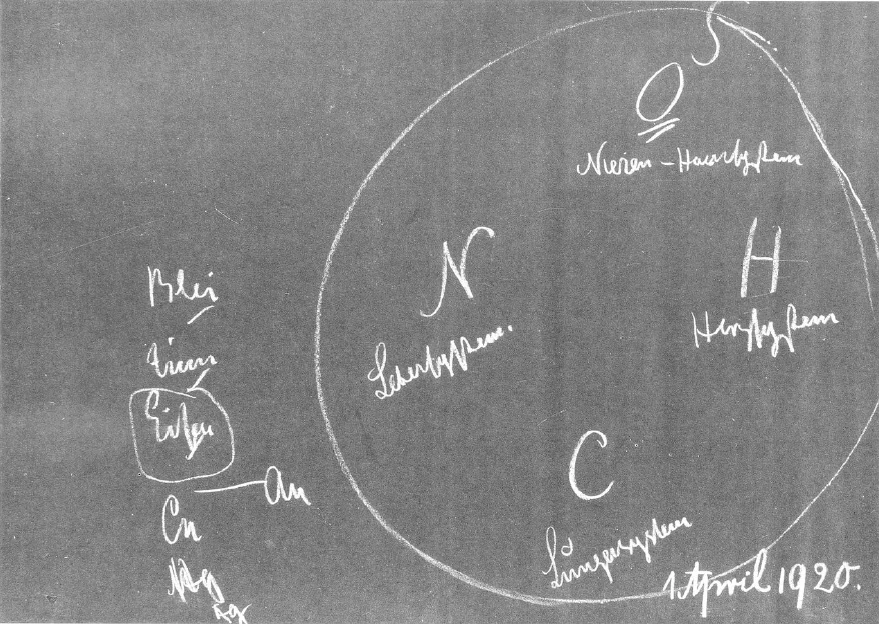
[ 7 ] The situation is different with plant protein. Plant protein is not subject to the influence of these four organ systems—at least not apparently—but it is subject to a different influence. It is influenced by oxygen, nitrogen, hydrogen, carbon, and by whatever else is present in the entire external meteorological world—as well as by sulfur, which mediates the functions of these four. And in plant protein, the four substances dispersed in the atmosphere have the same effect as the heart, lungs, liver, and so on have in the human being. In the external human realm, these four substances contain formative forces that are individualized within the four organ systems of the inner human nature. It is important to remember that when we utter the names “oxygen” and “hydrogen,” we should not merely think of them as internal forces within these so-called substances, as modern chemistry describes them, but rather we must conceive of these substances as possessing formative forces and active forces that are always in relation to one another, in that these substances contribute through their effects to the fabric of the earthly realm. When we go into detail and identify, in terms of internal organs, the effects that oxygen has when it is present externally, we must identify this internally with the kidney-urinary system. What carbon does when it unfolds its formative forces externally, we must identify internally with the lung system—but not the lung system understood as the respiratory system, rather the lungs insofar as they possess their own formative powers. We must identify nitrogen with the liver system and hydrogen with the heart system (see diagram on page 234). Hydrogen in the external world is, in fact, the heart of the external world; nitrogen is the liver of the external world, and so on.

[ 8 ] It would be desirable for humanity today not merely to allow itself to be persuaded to acknowledge these things, but to work out these things on its own. For you see, if you consider that the cardiac system is related to the formative forces of hydrogen, you will readily acknowledge the importance that hydrogen life, as such, has for the entire upper aspect of the human being. For, in a sense, with the development of hydrogen toward the higher human being, that which is more animalistic in the lower regions is transformed into what is truly human—into that which pertains to mental images and so on. But there I had to tell you that this leads to an influence that is extra-terrestrial and which we had to identify with lead. You will recall how we described lead, tin, and iron as forces related to the higher human being. Even today, there is still not a very strong inclination to acknowledge such a thing. There will still not be a very strong inclination to look outward from the human being and see something special in the effect of lead, which in turn is connected to the fact that the human being, through the heart, allows hydrogen to be prepared within them, which then serves as the vehicle for the development of the thinking apparatus. But the unconscious drive of human evolution—and I do not mean through any kind of agitation, but the unconscious drive of human evolution—is leading humanity toward recognition of this fact. For the fact that lead plays a role of some kind in nature outside of humanity—even if we consider it solely in terms of its functions—is something that people today can no longer deny, since, among the transformation products of radium that science has identified, they have now actually found lead alongside the release of helium. Just as lead has been discovered—even if its so-called atomic weight does not yet correspond exactly to what is known today, though it is already referred to as lead—so too will tin be discovered; and so will iron, which, while belonging to the non-human realm, is the only element from non-human nature that intervenes in human nature. I mean, it is necessary today not to allow oneself to be constrained solely by such things as X-ray science, which actually provides a wonderful pointer toward this venture into the extra-human realm—and toward reaching not merely the coarse, lumpy metals given to us in the earth, but the metallic forces that act upon us from the extra-terrestrial realm. This is something that must be said today. For one will notice, particularly in the occurrence—I would say—of today’s new types of diseases, that such things must certainly be taken into account.
[ 9 ] What must therefore be of particular interest to us at this point is that what, externally, consists of carbon, hydrogen, oxygen, and nitrogen—through its interaction, mediated by sulfur—internally takes on the form of the four organ systems, individualized for the human being. Now, if you consider such a thing properly, you will actually already perceive how deeply one can look into the very essence of the human being when viewed in this way. For then it will no longer seem—I would say—wondrous when that which is involuntary in the human being, that which at first does not appear to be directly subject to his spiritual functions, is brought into connection with the whole of nature outside the human being. For the following is also true: Human beings are constructed in such a way that they possess, so to speak, a renal system. But each such system has the tendency to become the whole human being. In fact, each of these four systems always strives to become the whole human being. I would like to say: the kidney wants to become the whole human being with its functions; the heart wants to become the whole human being; the liver system wants to become the whole human being; the lung system wants to become the whole human being.
[ 10 ] Now, in order to convince oneself of such matters that come into consideration, it is important to direct one’s attention—or rather, one’s sensory perception—toward how one can observe in oneself certain effects of the non-human in human beings. It is hardly possible to avoid pointing out here the sharp distinction between the natural sciences and the Spiritual Sciences. For you see, as you progress in your medical-meditative life—as you come to understand more and more how to attune yourself to the meditative life, so that you feel yourself to be a meditating person—you increasingly come to gain a concrete, real self-knowledge. This concrete, real self-knowledge is truly not to be scoffed at when it comes to positive tasks, such as healing in life. As you make progress in meditation, you will notice that things within your own organism—which were previously completely unconscious—are becoming conscious to you. You need only take stock of what rises into your consciousness; in this way, you become aware of something that is still difficult to discuss in public lectures or even in talks for laypeople, because doing so gives rise to a very specific tendency. If one were to speak of such things—such as an elemental being, to which I now wish to draw your attention—and if these things were communicated to a wider circle today, given the current moral state of humanity, the question would immediately arise: “Well, why isn’t this being put to use?” — The question would arise: “Well, am I supposed to meditate?” — “I can achieve that more easily if I simply take in this or that substance.” — It’s more convenient to take this or that than to meditate. In a certain sense, people are thereby ruining themselves morally. But given the current moral state of humanity, people today would not give in—you’ll see right away what I actually mean—and would, instead of meditating, prefer to take some external remedy that would help them, at least in the first steps of the path, achieve a result similar to that of meditation. It is indeed the case that something like this can happen. For you see, if you truly continue meditating for a while and are inclined to reflect on such things, you will come to be aware of the radiant effect of iron in just the same way that you otherwise consciously know you have hands with which to grasp and feet with which to walk. It is indeed the case that the awareness of the iron effect arises as something one becomes aware of, just as one otherwise becomes aware that one has arms and legs or a head that can turn, and so on. The awareness of feeling like an iron phantom—that is what arises. What I mean is that, naturally, people would come along and say: Well, so if one can externally increase one’s sensitivity to iron—the sensitivity to the iron within oneself—through something one ingests, then one achieves the same effect. This is, in fact, quite correct for certain steps. But then the danger would be that people would start experimenting in this way simply to achieve “clairvoyance,” as they say, in an easy manner. These things have, after all, been done many times. If they are done—I would say—as a sacrifice for humanity, then that is something else; but if they are done out of curiosity, then they destroy the moral constitution of the human soul from the ground up. One man who experimented extensively with himself in this direction—and through this very path actually discovered much of what you can find today in his writings—was van Helmont. \Whereas with Paracelsus the situation was rather such that one has the feeling his insights rise up from within him as if atavistically—he brings them into the world from a supernatural realm—with Helmont it is always the case that he gains remarkable insights by administering this or that to himself. One can see this from the way he presents his ideas, and he hints at it quite clearly, I believe, in certain passages. It is the most obvious thing that can be achieved: an inner sensitivity to the radiant effect of iron, to that peculiar effect which testifies that a radiant influence emanates from the higher human being and branches out to all the limbs. One clearly has the perception—and I say explicitly the perception—that one is working with the iron, that is, with its function and its forces, within oneself.
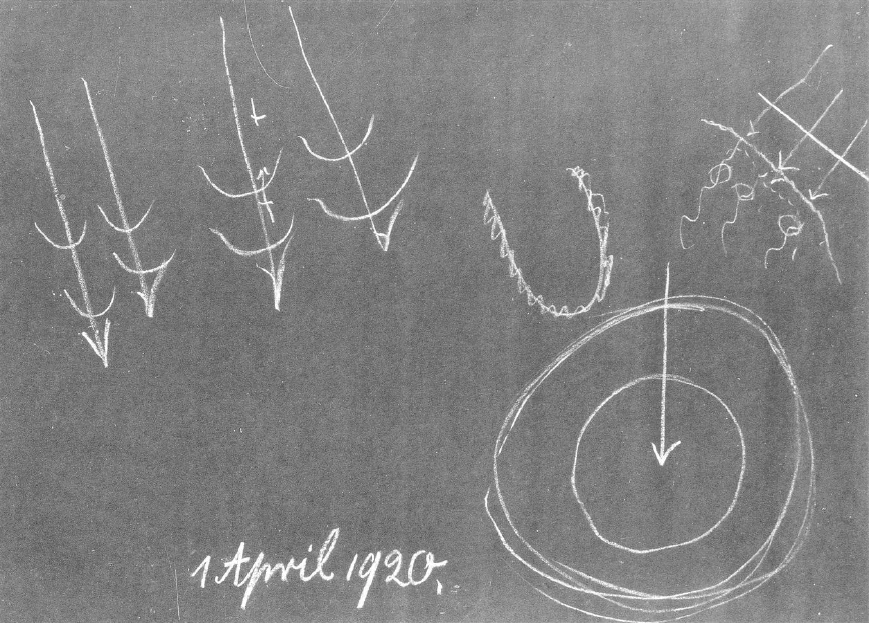
[ 11 ] Now, however, if I wish to schematically represent this iron radiation, I must also mention at the same time that, as iron radiation, it is not inclined to act beyond the human organism. One always has the feeling that what is radiating out is localized within the human organism and remains there. There is something everywhere that counteracts it (see drawing on page 239), which causes these iron-radiating forces to become blocked. One might say it is as if the iron were radiating positively toward the periphery and were met by a negative counter-radiation, but from something that opposes it as in spherical waves. These are precisely the two perceptions: the radiating force and the fact that one is in turn inhibited—that one collides with the iron’s radiations, cannot pass through them, and, above all, cannot extend beyond the body’s surface. One gradually realizes that what radiates in opposition is precisely the force of protein, so that through the iron one has introduced a functional connection into the organism that is counteracted by everything emanating from the four organ systems I mentioned earlier. They push back against one another. This struggle is constantly present in the organism. This is, in a sense, the first thing that can be perceived through inner contemplation. It is indeed the case that, as one progresses in the study of the history of human thought, one clearly notices how Hippocratic and even Galenic medicine work with remnants of such inner observations. Galen was no longer able to perceive much on his own, but all sorts of traditions from an earlier time were still present, which he essentially recorded. Anyone who can read him correctly can still find much to illuminate in Galen regarding the old, atavistic medicine—which, after all, had already begun to decline with Hippocrates—which is why so many important insights into natural healing processes are found precisely in the Galenic writings.
[ 12 ] The fact is, however, that when one pursues such matters, one inevitably comes to the study of these two polarities within the entire human organism: these radiations and that which opposes them, which holds the radiations back. It is important to take these things into account, because everything that, in the way I have described, tends to form protein is always connected with these blocking effects, and everything of a metallic nature introduced into the human organism is connected with the effects of radiation. Admittedly, there are significant exceptions to this, but these are precisely what are extraordinarily characteristic, and it is precisely through such extraordinarily characteristic exceptions that one can, in turn, gain a deep insight into this entire remarkable interplay of forces within the human organism—forces that assert themselves from every possible corner of worldly existence. To do this, of course, it is necessary to explore a little further what I have already hinted at here—and which you can then think through in more detail on your own. For example, I need only mention that carbon in plants—as we see in Carbo vegetabilis, which we discussed yesterday—lacks something that animal carbon generally has, in fact always has: a certain content of nitrogen. This accounts for the very different behavior of animal carbon and plant carbon when it comes to combustion. This, in turn, accounts for the tendency of animal carbon to be involved in the production of substances such as bile, mucus, or even fat. This difference we see between animal and plant carbon already leads us to turn our attention to the way in which the metallic differs from the non-metallic in the human organism. I say: that which radiates and that which blocks radiation, causing it to accumulate.
[ 13 ] Now, when we focus specifically on this polar interaction, we arrive at some very important points. You see, we have often had to emphasize in the course of our exposition of Spiritual Science how human beings go through different life stages. The period of childhood up to the change of teeth, the period that then extends to sexual maturity, and then the third period of life, which lasts until the early twenties. These life periods are in fact connected to intimate processes within the human organism, and one can say: the first life period, which comes to an end with the change of teeth, is truly what I have often characterized as it is a process of self-restriction, a sort of concentration of all human organ activity on the formation of the solid framework, on the integration of the solid framework. This process reaches its culmination when this solid framework sends forth the teeth to the outside. Now it is obvious that this emergence into solidity within the human being—who is, after all, still largely fluid—that this emergence into solidity must have to do with the entire formation of the human form, and specifically with the formation of the human form toward the periphery. And it is very remarkable that we must attribute an intimate role in all that takes place here to two substances that are otherwise given far too little attention in the human organism: fluorine and magnesium. Fluorine and magnesium, in their—I would say—diluted form as they occur in the human organism, play a particularly prominent role in this very process of childhood up to the change of teeth. What takes place in this process of integrating solidification into the human organism is a continuous interplay between the forces of magnesium and the forces of fluorine, in which the forces of fluorine take on the role of acting within the human being like a sculptor—rounding out forms and retaining radiance—while the forces of magnesium act radiantly, organizing the bundles of fibers and the like so that the calcium substance can then organize itself within them. And you are not actually saying anything nonsensical, but rather something that corresponds remarkably well with what occurs in nature, when you say: A tooth is formed simply because, in terms of its volume, its cementum, and enamel, the “sculptor” fluorine shapes it, and into that shape is poured what is to be molded—magnesium. — That is why it is so important—I would say, in a sense, to set the balance correctly during early childhood between the intake of magnesium and the intake of fluoride—and you will always find that teeth are bound to become damaged early on if this balance is not properly established. It is necessary to begin observing the child’s tooth development as soon as the first tooth appears, to determine whether the enamel is underdeveloped or whether the teeth are growing too small—we will discuss this in greater detail later, but for now I would like to briefly outline the issue— and that one then ensures that, through an appropriate diet, either one or the other problem is remedied by the intake of fluoride or by the intake of magnesium in the appropriate compounds. This allows us to look directly into the human development process. We find this interaction between magnesium and fluoride—that is, between something that is, in terms of its material constitution, strongly non-human in the first years of life, because in these early years the human being is truly, to a large extent, merely a part of the external world. Here, the fluoride is taken from the external world, from the non-human realm, which strives toward the radiant effect of the metal.
[ 14 ] If we consider the third stage of human life, the proper balance between iron and protein—that is, the entire process of protein formation—is similarly of great importance. If the balance is not properly adjusted and no strong counteracting forces arise against what the improperly adjusted balance—namely, the improperly adjusted interaction between protein and iron—is causing, then all the symptoms that manifest externally as anemia will appear. It is essential, first of all, not merely to look at a person’s development in a superficial way—noting that they exhibit one thing or another—such as decayed teeth later in life, the seeds of which are already sown in youth and which lead to tooth decay in later years—or, in the case of pallor, focusing only on what is addressed chemically today, — but one must penetrate the entire mystery of the human organism if one wishes to understand anything of what occurs in a sick person.
[ 15 ] Now you have a general idea of which metals are involved in the structure—that is, the internal structure—of the human organism. Not involved are those metals that I have just described to you as the most important in a certain regard: lead, tin, copper, mercury, silver, and gold—with the exception of iron. As I said, with the exception of iron, these are not directly involved in the overall functioning of the human organism, but that does not mean they play no role in the human being. If we trace the substance that contributes to the formation of what is, so to speak, the outermost layer of the human organism, we arrive at silicon. I have already spoken of this. But what takes place within the human being is, so to speak, not confined to what lies within the skin; rather, it must be said that the human being is woven into universal processes. And just as the substances you are familiar with are significant within the human organism, so too are the very metals I have listed here significant outside the human organism—yet effective for the human being. Only iron is assigned the role of mediator. Iron is what, in a sense, assumes the mediating role between what lies within a person’s skin and what lies outside it. Thus we can say: The entire system that manifests in the “lung-oriented human,” who, after all, strives once again to become a whole human being, is something that is closely connected to the human being’s entire relationship to universal natural life. One must be clear that one is actually considering only a part of the human being when one focuses on what one sees when one merely dissects the human body. For that is not the whole human being; it is that part of the human being which counteracts the non-human aspect inherent in the human being—an aspect that in turn consists of the effects of lead, tin, copper, and so on, effects that are contained outside the human being itself. Thus, even when we consider the human organism solely in the scientific sense, we must never limit the human being to the boundary of the skin. As can be seen from this, what comes into consideration in the human being are not merely the effects that, so to speak, drive from the inside out, but rather those effects that give direction to his organic processes in general. You can see from the following very significant passage that this is indeed the case.
[ 16 ] You know that certain substances in the human organism exert their effects simply by occurring either bound to bases, bound to acids, or—as scientists say—in a neutral state in salts. But this behavior of bases and acids as opposing polar force systems—which then converge toward a kind of neutrality in salts—does not exhaust the matter; rather, we must consider here how this triad—acids, bases, and salts—relates in general to the entire direction of the human body’s organ functions. There one will find that everything basic has a tendency to support those functions in the human being that begin, let us say, in the mouth and continue through digestion, moving from front to back; likewise, all other processes that proceed from front to back are related to this. Bases are connected to this front-to-back direction, acids to the opposite. Only when one considers the contrast between the “forward-oriented human” and the “backward-oriented human” does one actually arrive at the contrast between the alkaline and the acidic. In relation to this, the salty is directed toward the earth, standing vertically between the two. All those processes that proceed from top to bottom are what the salty throws itself into. So one must certainly take these three directions into account when considering: How does the human being relate to the alkaline, the acidic, and the salty? — Here you have yet another example of how, through the observation of the human being, you can build a bridge between purely external metallic chemistry and physiology, for here you have the directing forces. Here, too, you have the entire relationship between the salty and the earth, and here you have the entirety of what the alkaline and the acidic possess, which could be schematically illustrated something like this: if there is earth here, the salty tends toward the earth, and the alkaline and the acidic tend to circle around the earth. And this is connected once again to the fact that simply by familiarizing oneself in a certain way with the directions of functioning inherent in the organism, one can in turn intervene in these directions of functioning. There is something quite essential here: healing through external remedies, through rubs, through ointments—all that which acts externally. And here it is necessary to study what acts externally in a certain direction. Under certain circumstances, the effect of a drawing mustard plaster or the effect of a metal ointment—prepared appropriately, of course—can be just as important for the organism as an internal treatment. One must simply—as should be clear from what I have just said—pay attention to how to apply and use these remedies, for it is, of course, not a matter of indifference whether, in a given situation, one applies a plaster to one part of the body or another. For it is absolutely essential that, by applying the ointment to the appropriate part of the body, one counteracts a harmful force. Simply slapping it on the painful or otherwise irritated area will not always be the right thing to do.