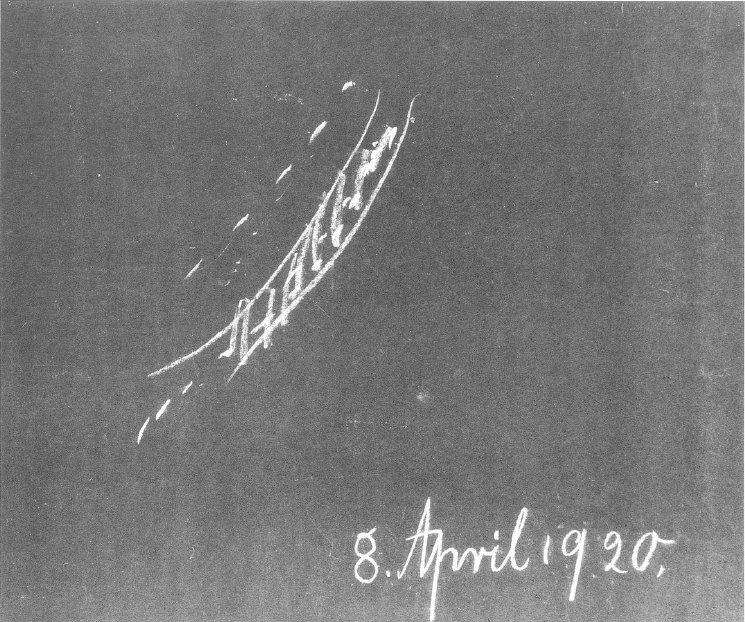
Spiritual Science and Medicine
GA 312
8 April 1920, Dornach
Translated by Steiner Online Library
Nineteenth Lecture
[ 1 ] I will try to catch up as much as possible today and tomorrow. After all, such an initial suggestion—and it is indeed an initial suggestion, as has been given in this course—is primarily about gaining a more precise understanding, as Spiritual Science can provide it, of the path that non-human substances take within the human organism, and, in turn, of their effects. For if one has a complete overview of the nature of a substance’s effect, then one has a guide for its application as a remedy, and one can judge for oneself. And that is much better than simply following prescriptions that say, “This is for that, and that is for this.” Now, today I will once again have to start with something that seems very remote in order to arrive at something very close at hand. Among the questions that have been asked, one has always come up that must naturally interest all of you: the question of heredity. It plays an extraordinarily important role in the assessment of both healthy—or at least relatively healthy—and sick people.
[ 2 ] Now, it must be said that this heredity, this process of inheritance, is actually studied only in a very abstract way in contemporary materialistic natural science; it is by no means studied in a way that could yield much of practical value for life. However, when one seriously sets out to study a subject such as heredity, one finds that it is indeed highly remarkable—more so for the exotericist, whereas for the esotericist it is a law that is vividly apparent—that everything a person needs to know about the interconnections of the world is revealed in some way that is quite outwardly visible. Something always reveals, through an external manifestation, which hidden forces—yet very potent within the human being—exist in nature. One must pay particular attention to these forces when studying heredity. For, on the other hand, everything related to heredity is constantly distorted and cloaked in illusions, so that it cannot be properly assessed. One might form a judgment about heredity, only to find that it does not align with other phenomena. This stems precisely from the fact that the facts of heredity are exceptionally heavily shrouded in illusions, and this is connected to the fact that the masculine and the feminine are involved in heredity in a completely lawful, yet difficult-to-regulate manner. The process is lawful, but given the way the law manifests, it is not always possible to achieve a clear-cut regulation in this context either. Phenomena of heredity are thus governed by laws, but are difficult to regulate. Just as keeping the balance beam level is based on a law, but when weight is placed on the left and right sides, the balance tips to one side or the other, this makes the strict law difficult to regulate. It is roughly the same with hereditary phenomena. They follow a law similar to the one that keeps the balance beam horizontal. But this law manifests itself in a high degree of variability in its occurrence, and this stems from the fact that both the masculine and the feminine are always involved in heredity, and specifically in such a way that, in the process of heredity, the male always transmits precisely that which the human being owes to earthly existence—that which he owes to earthly forces—while the female organism is more oriented toward transmitting that which comes from the extraterrestrial cosmos. One could say: the Earth continually makes its claims on the man; it organizes him through its forces. After all, it is also the cause of the emergence of male sexuality. The heavens, if we may put it that way, constantly make their demands on the woman. They continually shape her. It is the heavens that exert the predominant influence in all inner organizational processes. This, in turn, points back to something I have already said. But this gives rise to the following. Imagine that a female being develops through conception; this female being tends more and more to integrate itself into the extraterrestrial processes. It tends more and more—if I may put it that way—to be taken up by Heaven. When a male being develops, it tends more and more to be claimed by Earth. So heaven and earth do indeed interact. For what I am saying is not to be interpreted as meaning that heaven acts upon the woman and earth acts upon the man; rather, both act upon both, and in the woman the balance tilts toward heaven, while in the man the balance tilts toward the earthly. It is a strict law; yet it is variable. This, however, gives rise to a certain consequence. Because of what the woman harbors within her organism, that which is earthly is continually combated within her. But the peculiarity lies in this: it is combated only within her own organism, not in her germ, not in the seed. Thus, this struggle between heaven and earth is limited, in the female organism, to all organizational processes that lie outside of sperm formation—that is, outside of egg formation, outside of that which is directly integrated into the processes of reproduction—so that the woman continually withdraws her organism from the forces inherent in the reproductive process. With regard to everything surrounding reproduction, she continually withdraws from it, so that one can say: There is a tendency, through the man, to pass on what lies in the reproductive forces—that which can therefore be inherited. In the woman, there is a tendency to withdraw herself from this inheritance. But in return, she has a stronger tendency toward inheritance in her egg-forming powers.
[ 3 ] One might therefore ask: How can human society counteract the devastating forces of heredity? — Is it not true that the forces of heredity do not stop at what is called the “spiritual” or the “physical”? This is clearly evident in a phenomenon such as the fact that in families where mental illness is prevalent, diabetes can very easily occur across generations, so that the metamorphosis spreads from one side to the other. So this is indeed an extraordinarily important question: How can we protect people from the devastating effects of heredity? — There is no other remedy for this than, first, to ensure that the female population is kept as healthy as possible; for then, through the female population, the extraterrestrial influence is drawn into our earthly processes, and it will also come to pass that those processes which work to transmit the harmful effects of heredity through the germ will be continually counteracted by the female organism. Thus, in a society where great care is taken to ensure that women are healthy, one combats the harmful influence emanating from earthly forces with regard to hereditary processes, because one is, in effect, appealing to the efficacy of the balancing forces acting from the extraterrestrial realm, which, so to speak, have their earthly accumulator only in the female organism. This is something that is extremely important to take into account.
[ 4 ] What I have just said applies to all earthly and extraterrestrial forces; it is something very universal. But it becomes particularly evident when dealing with hemophiliacs and bleeding disorders. It must be pointed out that one should not speak in general terms about hereditary phenomena, but rather study cases where concrete facts clearly point to heredity. Take a look at these hereditary manifestations among people with hemophilia. There you will find a highly peculiar phenomenon, one that is familiar to all of you and which is merely an outward expression of what I have just explained: You will find that, within the family, the hemophilia trait is transmitted only to male individuals, whereas it is passed on only by female individuals; thus, a woman who is the daughter of a hemophiliac tends to pass the disease on to her male offspring, even if she herself does not have it at all—she naturally acquires it simply by being part of the family. In contrast, the men become hemophiliacs. However, if they marry women who are demonstrably not from families with hemophilia, the condition is not transmitted.
[ 5 ] There you have it—if you analyze it—a clear external manifestation of what I have just said, and the phenomena observed in hemophiliacs demonstrate much more clearly than any of Weismann’s recent experiments how things actually work with regard to heredity. This is precisely what we must now recognize as important for a comprehensive assessment of the human organism, and it is on this basis that we must evaluate the human organism—that is, what factors can influence it.
[ 6 ] What, then, is the actual cause of hemophilia? After all, a superficial examination reveals its cause. The blood lacks the ability to clot, so that even the slightest external wound—such as a simple nosebleed or dental surgery—can cause a person to bleed to death; things that would normally cause the blood to clot at the site of the wound simply do not result in clotting in people with hemophilia. The entire condition is actually based on this lack of the blood’s ability to clot. So the blood must contain something that counteracts its ability to clot, and if whatever it contains has too strong an effect, it is not counteracted by those forces that begin to act from the outside when the blood clots. When the blood coagulates, we are dealing with forces acting from the outside. If there is something in the blood that prevents these forces from taking effect, then there is simply excessive liquefaction of the blood, an excessive tendency of the blood to liquefy.
[ 7 ] You will easily find that such a strong tendency toward blood liquefaction is connected with the entire process of human ego formation. But this connection is not merely superficial; it is connected with what acts within the human ego as will, not with what acts within the human ego as a mental image. So that organization—which causes the blood to have an excessive capacity for liquefaction—is connected to everything in the human being that strengthens or weakens the will. I would like to say that history has provided a beautiful example here, which in turn shows how, through proper interpretation, one can uncover certain mysteries of nature. It is not nature alone, but history that has presented the famous Engadin case—which you may be familiar with—the famous case of the Engadin maidens. Those two Engadin maidens have, in a sense, presented something that, I would say, can have a profoundly enlightening effect on the understanding of human nature as medicine requires it. These Engadine maidens came from families with a history of hemophilia, and they made the resolute decision not to marry, so that these Engadine maidens stand in history as personal champions against the transmission of hemophilia.
[ 8 ] In such a case, one must simply focus on what is right. It is certainly not a characteristic of all girls from families with a history of hemophilia to withdraw from the reproductive instinct in this way. This requires the development of a strong subjective will—precisely that strong subjective will that acts within the “I,” not within the astral body. So this must have been present in them. That is to say, the situation is such that what these women possessed in their “I,” in their will, is in a certain way connected to those forces that are active in a specific way precisely among the “Bluters.” When these forces are consciously strengthened, they can be strengthened more easily than they can be in non-“Bluters.” This is something which, when properly understood, leads one to look into the forces that are actually inherent in the blood and to recognize how an interaction with the extra-human takes place there. By looking in this way at those forces in the blood that are connected to the conscious will, one can discover the nature of the connection between the human will and extra-human forces in general. Now the fact is that certain non-human forces have an inner kinship with the human forces of will, which is based on the fact that, in the course of evolution within the natural kingdom, what has to do specifically with the conscious human will—and with the human will in general—was ultimately separated out. This was ultimately separated out in the natural kingdom.
[ 9 ] The task now is to study those elements found in nature that are byproducts of the human-forming process and that, through their own qualities, reveal how they may be connected to that process. Such things have actually been studied in nature for a long time, and as it stands, they are extremely difficult to overlook, because it is hard to reawaken in today’s intellectual human being the forces that atavistic medicine itself preserved well into the seventeenth and eighteenth centuries. What has been studied there is, in fact, everything related to antimony.
[ 10 ] Antimony is, in fact, a most remarkable substance. That is likely why those who have had so much to do with antimony—such as the legendary Basilius Valentinus—have studied it so intensively. You need only look at certain properties of antimony, and then you will, I would say, recognize the unique way in which antimony is integrated into the entire natural process. It is integrated into the entire natural process in a unique way. Consider for a moment that antimony is so integrated into the natural process that, first of all—and this is perhaps its least significant property—it has an extraordinary affinity for other metals and other substances, meaning that it frequently appears in combination with these other substances, particularly with sulfur compounds of other materials. Sulfur, after all, has this specific effect in nature, which we have already discussed, at least in part. Antimony’s tendency toward sulfur compounds of other substances shows how it is integrated into the natural process. But another property of antimony shows even more clearly how it is integrated into natural processes. Namely, wherever it is given the opportunity, it crystallizes in tuft-like formations—that is, it strives toward the line, away from the earth. Where antimony, so to speak, accumulates in linear formations, one can, as it were, see with one’s own eyes the crystallizing forces entering the earthly realm from the extraterrestrial. For the forces that otherwise occur with greater regularity and are responsible for crystallization are at work in these spiky and tuft-like formations of antimony. Here, the antimony substance itself reveals how it is embedded in the entire natural process. Likewise, what takes place in the Saiger process strongly indicates how antimony is, in a sense, the betrayer of the crystallizing forces. Through the Saiger process, one obtains antimony in a form that is fine-fibrous.
[ 11 ] Another property of antimony is that, when it is heated to incandescence, it can oxidize—it can burn, in a certain sense. The white smoke that forms there reveals a peculiar affinity with cold bodies, to which it adheres and produces the famous antimony flowers—again, something in which, so to speak, the crystallizing force discharges itself in response to other bodies.
[ 12 ] But the most remarkable thing of all is that peculiar resistance antimony exhibits against those forces which, over the course of the days you have been here, I have described as, so to speak, subterranean forces—the forces at work in electricity and magnetism. If one treats antimony in a certain way through electrolysis, then brings it to the cathode, and touches the antimony deposit on the cathode with a metal tip, the antimony explodes, causing small explosions. This resistance of antimony to electricity—when one merely gives it a little assistance—is so extraordinarily characteristic of antimony. Here we truly gain insight into antimony, seeing how a substance positions itself within the entire natural process. Other substances do not exhibit this in such a—I would say—obtrusive manner.
[ 13 ] Now, one can only understand what is being demonstrated here through a concrete example in nature if one assumes that the forces present in nature are at work everywhere; however, when substances manifest these forces to a particular degree, it is precisely in these substances that these forces are concentrated and localized. But what is at work in antimony is actually present everywhere. Everywhere, if I may coin the term, the “antimonizing force” is at work. This antimonizing force is precisely what also acts as a regulating force in human beings, but in such a way that, in their normal state, human beings derive this antimonizing force from the extraterrestrial realm. In a sense, they derive from the extraterrestrial realm that which antimony produces in concentrated form. In their normal state, they do not turn to the antimony-regulating force in the earthly realm or to what is concentrated in antimony, but rather to the external, extraterrestrial force of antimony. And so it is only natural to ask now: What, then, is this antimony-regulating force in the extraterrestrial realm?
[ 14 ] It is the interaction, in planetary terms, of Mercury, Venus, and the Moon. When these do not act individually but work together, they do not act in a Mercurial, silvery, or coppery way; rather, they act just as antimony does within the Earth. This is something that, of course, must simply be investigated by examining such constellations in their effect on human beings—where the three forces, the lunar force, the Mercurial force, and the Venusian force, neutralize one another through corresponding opposition and quadrant positions. When they neutralize one another—when all three interact in such a way that they cancel each other out—then the same interaction takes place that is related to the effect of antimony, which is drawn upon by the Earth from antimony. In everything that is antimony on Earth, the same force acts from the Earth as that which acts upon the Earth from these three planetary bodies, from the outer space.
[ 15 ] This brings me to something I really must mention. Namely, when it comes to the constitution of the Earth, it is actually incorrect to speak only of an individual piece of antimony. All antimony in the Earth’s organization forms a single unity, just as all the silver and all the gold on Earth form a single unity. The individual piece is not really what matters. When you remove a single piece of antimony from the earth, you are simply digging into the earth’s entire antimony body, which is integrated into it. So that is part of the entire antimony body. We have thus described, on the one hand, everything that becomes manifest, so to speak, through the action of antimony. Every action in nature is counteracted by a reaction. It is precisely through the back-and-forth oscillation of action and reaction that formed bodies always come into being.
[ 16 ] Now you see, we must seek out these counteracting forces. These counteracting forces reveal themselves to us when we can recognize—when we can see through the fact—that the antimony forces act upon a person at the very moment when something that is actually regulated within the person pushes outward. For it is precisely these antimony forces that are at work in the coagulation of the blood. The antimonizing force is at work there within. Wherever the blood shows a tendency to clot in its composition or flow, there is an antimoniating force. Wherever the blood seeks to resist this clotting force, there are counteracting forces at work. So, curiously enough, where we encounter blood clots, we find the anti-antimoniating forces. There you have the anti-antimonizing forces. These anti-antimonizing forces, however, are identical to what I would like to call—if I may coin the term—the albuminizing forces, the protein-forming forces, which act in such an organizing way that they promote the formation of protein. For, once again, what prevents the blood from clotting are the protein-forming forces.
[ 17 ] In this way, we gain an understanding of the relationship between the antimonizing and albuminizing forces in the human organism. I must say, I believe that if one were to study this interplay between the antimonizing and albuminizing forces, one would gain profound insights into the processes of disease and healing. For what are albuminizing processes? They are the processes through which everything plastic, everything formative in nature, is incorporated into the human and also the animal organism for the formation of its substance. The antimonizing forces are those which, acting from the outside, so to speak, are the plastic artists who give form to the organ-forming substance. Thus, the antimonizing forces have a certain relationship to the internal organizing forces of the organs.
[ 18 ] So, please, distinguish between the two processes—this is an important distinction—in an organ; let’s say, for example, the esophagus. It is, after all, internally organized. You can, so to speak, trace its internal structure without initially taking into account what kind of process is taking place—how the chyme travels along the esophagus and so on. Then the esophagus comes into play and interacts with what enters the human organism. So, in the abstract, one can distinguish between the internal processes within the organ and what happens in the organ when it interacts with what is supplied to the human being from the outside. These are two different processes. Inside the organ itself, the antimony-forming force in the human being is at work. The human being is, in fact, antimony, if one thinks through everything that is introduced into him from the outside. He is antimony himself. The point is that one must not overload the inner organ-forming force in the normal life process with this antimony-forming force. One must not introduce this into the normal life process; otherwise, one poisons the organism and stimulates it too strongly. But when it is necessary to stimulate it more strongly, then one must supply it with what one normally must not supply. This brings us to the effect of antimony, which—precisely because of the characteristics of antimony described above—is specifically different depending on whether you administer it externally or internally. If you administer it internally, you must try to obtain antimony in such a high dilution that you can introduce it into the upper human being. If you can get it into the upper human being, then antimony will have an extraordinarily stimulating effect on disturbed organ formations and internal organ processes. Therefore, in certain forms of typhoid fever, finely potentized antimony can play a major role.
[ 19 ] In contrast, the effect is somewhat different and is achieved when antimony is taken in a lower potency, particularly when applied externally via ointments and the like. Of course, it may also turn out that, under certain circumstances, one must rely on the power of refined antimony for external use as well. But essentially, the external effect will be brought about by generally using the lower potencies.
[ 20 ] You can see from this that such a remedy—which is, at the same time, a truly extraordinarily useful remedy—fits into what I have said, into this lawful course, which, however, constantly exhibits its fluctuations. And one will therefore have to adhere to the principle that antimony is used internally, preferably when dealing with people of very strong will, and that it is used externally when dealing with people of weaker will. One must specialize in this way. You can see from this that antimony, within the mineral kingdom, possesses something that has an inner kinship with the human will, insofar as the human will—the more conscious it is—feels all the more compelled to produce a counteraction to the effect of antimony. The human will has a destructive effect on all those forces I described to you earlier, which constitute the distinctive behavior of antimony. Whereas everything that has an organizing effect in the human being—under the influence of the powers of thought, but especially the unconscious powers of thought, including those that, for example, still act unconsciously in a child—is actually supported by the forces of antimony; the forces of antimony work in conjunction with these. So that when I introduce antimony into the human organism in any way and it is initially able to exert a strong effect through its own properties, it creates a powerful phantom within the human being. The inner organ forces are immediately stimulated, and nothing remains for this work in conjunction with what has been introduced into the human organism: vomiting, diarrhea—which is due to the fact that the effect is directed back toward the organs and does not extend to the areas surrounding the organs. This is also evident in the counteraction.
[ 21 ] If you happen to be in a position to do so, you can counteract the harmful effects of antimony using the very remedy that people—driven by a certain instinct—tend to use themselves, particularly those for whom the regular functioning of all their circulatory and rhythmic processes must be of particular importance. Coffee consumption has a balancing effect on these rhythmic processes—I am merely describing the facts; I certainly do not intend to make any recommendations, for it can, in another respect, be very harmful to relieve the ego itself of the task of regulating these rhythmic processes, but I do not wish to speak of that; I wish only to speak of the fact. Coffee consumption brings rhythmic processes—when a person is not mentally strong enough to regulate them—into a certain state of regulation. This is why coffee serves as a certain antidote in cases of antimony poisoning, because it restores the rhythm between the internal organic processes and what occurs externally. This is also sustained by a specific rhythm. We actually drink coffee so that a continuous rhythmic balance is established between our internal organs and what happens in the vicinity of the organs with the food we have consumed.
[ 22 ] All of this, in turn, leads us to focus our attention on something else, namely the albuminizing processes. These are intensified—that is, all those processes are intensified that now lie on the other side, the side where the organs do not possess their own inner organizing power, but where digestion occurs through the external action of the organs, that is, everything that occurs mechanically in the movement of the intestines and everything else that takes place in digestion is, in turn, in close interaction with the albuminizing forces—the forces that act upon what are, at the same time, the protein-forming forces, that is, the forces opposite to the antimonizing forces.
[ 23 ] Now I must once again point out something I have already mentioned. A very instructive object—or, if you will, subject—is the oyster and the formation of its shell. To a much lesser extent, the same process is already present in the calcium secretions of eggs and the formation of eggshells. What, then, is the underlying principle here? What exactly is a shell like that of an oyster or the ordinary eggshell? It is a product that the egg substance—or the oyster—must rid itself of, must expel outward, for the simple reason that if it were to retain it within itself, it would be killed as a result. This shell formation is based simply on the need to sustain life. So when you eat oysters, you are eating—I hope you’ll allow me to put it this way; of course, if one wanted to speak in a manner pleasing to modern science, one would have to phrase it in somewhat more refined terms—that very life process which manifests itself outwardly in the oyster precisely through the formation of the shell. You are eating this life process along with the oyster. So one consumes an albuminizing process—a process that is the opposite of the antimonizing one; that is what one consumes. In doing so, one promotes within the human being everything that leads to typhoid-like symptoms. Eating oysters is an extraordinarily interesting process. Eating oysters promotes the formative power, the albuminizing power, in the human abdomen. As a result, however, it relieves pressure, drawing certain forces away from the head, and after eating oysters, a person subjectively feels less burdened by the forces that seek to work within their head. In a certain sense, they clear their head. We must, after all, continually develop these albuminizing forces, because we cannot allow the head to become so overloaded with formative forces. But the oyster-eater takes this too far; he strives with all his passion for an empty head. Consequently, he also increases the likelihood of certain forces breaking through to the lower abdominal organs—which I described yesterday—and thus promotes a predisposition to typhoid fever. And so you can imagine how, in turn, this predisposition, once it exists, calls for treatment with antimony. One would therefore achieve good results if one were to bring about what is necessary to combat the predisposition to typhoid from within by introducing simultaneous internal and external treatment with antimony—above all, rubs with antimony ointments and, at the same time, highly potentized antimony taken internally. This, in turn, would have a regulating effect, as it would mutually regulate the predisposition to typhoid.
[ 24 ] You can see how there is a constant effort to place human beings within their entire universal environment. The significance of this becomes apparent when you examine the relationship between human beings and those aspects of nature that arise because they resist the immediate forces of the Earth in a certain way. Plants can resist the direct forces of the earth. In doing so, they conserve much of their formative energy for the time when flowering and seed formation occur. Our ordinary plant growth—which underlies edible plants—is based precisely on the fact that a very specific amount of earthly forces is used for the plant’s formation. If the plant resists these earthly forces, it is then exposed to the extraterrestrial forces when the final stage of seed formation—fruit formation—occurs, and it becomes a plant that would actually like to look out into the world in the same way that the higher beings, who stand above the plant kingdom, look out into the world. Then it displays a desire to perceive. But it lacks the organization to do so; it has remained a plant and seeks to develop something akin to what lies within the human eye. Yet it cannot develop an eye, precisely because it possesses a plant body, not a human or animal body. That is why it becomes a belladonna, an Atropa belladonna. I have tried to describe to you, in a vivid and figurative way, this process that takes place as it becomes a belladonna. It becomes a belladonna, and in becoming a belladonna—yet with these forces already lying within its roots, which ultimately lead to the formation of the black berries— is akin to everything that acts within the human organism in such a way that it drives toward the formation of shapes, that it drives toward what can actually only take place in the sphere of the senses—that is, it lifts the human being out of the sphere of his organization into the sphere of his senses. The process that takes place when ingesting small, potentized quantities of belladonna is extraordinarily interesting, for it is strikingly similar to the process of waking up, which is interwoven with dreams. In a sense, this process occurs in a normalized form. Upon waking, when one is not yet perceiving through the senses but when sensory perception is still internally predisposed to the intermingling of consciousness with dreams, there is actually always a kind of belladonna effect in the human being. And belladonna poisoning is based on the fact that the same process that normally takes place in a person upon waking—when waking is interwoven with dreams—is induced in the person by the belladonna toxin, but it is sustained continuously; it is not taken over again by consciousness, but rather these transitional phenomena become permanent. This is what is interesting: one sees that the processes, which are also brought about by the symptoms of poisoning, are such that, when they are induced in a person at the right time, they then become part of the entire human organism.
[ 25 ] As I described earlier: becoming mad is a mad striving toward becoming human. One could say, then, that human awakening has something of becoming belladonna about it; it is merely a tempered form of becoming belladonna, a moderation of that process—one that is limited precisely to the moment of awakening. If, therefore, you wish to relieve the body of its internal albuminization processes—if you wish to influence it in such a way as to counteract the overly active albuminization processes, to channel the physical into the spiritual, so that what otherwise acts within the bodily substances manifests as hallucinations—then you administer potentized Belladonna. In doing so, you place something into the soul from which you wish to relieve the body. This is precisely what one encounters—albeit in a confusing manner and permeated with illusions, as I mentioned at the beginning of the lecture—in the ordinary macroscopic effects of Belladonna. Of course, if you cause a person not to transition from the waking state to the alert state, but to remain in the waking state, you will kill him outright. A person is always in mortal danger when he wakes up. But they wake up so quickly that they overcome this mortal danger. These are the interesting connections between what is, so to speak, normal—but reduced to the proper measure—and what becomes anti-normal the moment it is taken beyond the proper limit.³
[ 26 ] These are the processes that, it seems to me, the ancient physicians sought to pursue time and again. And when the ancient physicians spoke of the creation of the homunculus, what they were essentially doing was using their remaining clairvoyance to perceive something akin to the phantom of antimony. In the process of visualization they carried out externally in their laboratory—while antimony was unfolding its powers—what emerged, projected from their own being, was that which counteracts these antimony forces as albuminizing forces. This appeared to them precisely as a force. They projected outward that which normally remains within the human organism, and there they saw the homunculus that appeared as the process unfolded in which antimony assumes its various forms. What appeared in this unfolding process, they saw as the homunculus.