

Physiological Therapeutics
based on Spiritual Science
GA 314
7 October 1920, Dornach
Translated by Steiner Online Library
Physiological Therapy Based on the Spiritual Science I
[ 1 ] The speaker isn't here yet. I hope he'll arrive soon, but I don't want to keep you sitting here waiting any longer. It goes without saying that this lecture series holds particular importance within our course. It is intended to demonstrate, through a practical field of application, how our anthroposophically oriented Spiritual Science is capable of truly influencing everyday life. Now, as every person knows from personal experience, the area of daily life that concerns medicine and therapy is one of the most important, and for this reason alone, the integration of anthroposophy into the field of medicine must not be overlooked right from the very beginning of our anthroposophical endeavors.
[ 2 ] In this course, we have made a special effort to have the individual subjects represented by experts who are, so to speak, officially recognized in their fields, and it is essential for the representation of Spiritual Science to the world that these individual subjects be represented by experts; otherwise, they will not be received in the way they ought to be. And so, until the lecturer arrives, I will endeavor to speak to you a little about physiology and its relationship to therapy from the perspective of Spiritual Science. This should, after all, touch on the topic at hand. And I want to show you how Spiritual Science is called upon to influence medical studies and, subsequently, medical practice—indeed, the entire art of medicine.
[ 3 ] As you know, within our university system, the actual medical program is usually preceded by preparatory studies in the natural sciences. This is followed by the medical program itself. So, after becoming familiar with the more biological and physiological phenomena, one turns one’s attention more to pathological phenomena, and then works one’s way toward therapy. But it is likely also known to a large number of my esteemed listeners just how poorly therapy is actually treated in this medical curriculum. It is indeed the case that, due to its orientation toward the natural sciences, medical education leads to an understanding of natural processes in humans, and that, in a sense, when the aspiring physician enters the field of pathology, he arrives with a certain conception of natural processes that prevents him from gaining a proper understanding of pathological processes. One thing, however, seems to me to have emerged in recent times as a view with a certain inevitability: We have become accustomed to forming a very specific understanding of natural processes, their internal connections, and the underlying causality. In a healthy person, according to this premise, we must quite obviously seek certain natural processes within a necessary causal relationship. In a sick person—or, let us say, in a diseased organism—what else can we look for other than natural processes that, in essence, also proceed in a causally necessary manner? —Nevertheless, we are compelled to say that what is present in these clearly causally determined natural processes in the context of disease is abnormal in relation to the healthy organism; it falls, in a certain sense, outside the causal context of the healthy organism. In short, when we enter the field of medicine, we are quite obviously made to waver and become skeptical regarding what, as our actual view of nature, underlies our modern understanding of natural phenomena. This has also led to the emergence among many physicians of a skepticism—indeed, what I have already mentioned here on other occasions—a kind of nihilism toward therapy. I still knew those famous professors who worked at the Medical Faculty in Vienna—at a time when that Medical Faculty had reached the height of its glory—and who were, at heart, therapeutic nihilists. They said: One can—and they specifically chose the disease to which such a view is particularly applicable—such as pneumonia, for example—really only let a disease take its own course and, through various palliative, supportive, and other external measures, guide this course in the right direction until the crisis sets in and then the whole thing subsides again. — In the true sense of the word, one cannot really speak of what has been called a “cure” for centuries, indeed millennia.
[ 4 ] If such a view were consistently pursued, medicine would gradually develop into mere pathology. For as far as the investigation of diseases is concerned—albeit from the standpoint of materialistically oriented natural science—extraordinary perfection has been achieved, particularly in this age of therapeutic nihilism. And I would also like to take this opportunity to warn against a misunderstanding that might arise if anyone were to believe that, from this perspective and on the part of anthroposophically oriented Spiritual Science, the great significance of modern natural science could be misjudged or underestimated. That is by no means the case. Anyone who has even briefly examined the advances made in pathological research methods during the second half of the 19th century cannot help but stand in awe and admiration before this magnificent, tremendous progress. Indeed, not only that, but they must also bring themselves to make a very different acknowledgment. They must say to themselves: Certainly, materialism has risen to prominence. Materialism, first of all, cannot satisfy certain needs of the human soul; but on the other hand, it also cannot shed sufficient light on the vast realms of human knowledge. — But on the other hand, this materialism has, I would say, had a kind of mission. It has developed the capacity for experimental, observational research in an extraordinarily meticulous manner. And we owe something like modern pathology—albeit one tinged with materialism—solely to this materialism. People always hold it against you if you are not one-sided in modern times, and when I—while serving as editor and publisher of the *Magazin für Litteratur*—wrote an article on Büchner’s death that did not condemn him but rather acknowledged his merits, I was labeled a materialist myself. This is precisely the essence of experiencing and pursuing Spiritual Science: that one can put oneself in everyone’s shoes, that one finds everywhere the form of thought and the form of feeling from which even the most opposing movements and worldviews can perhaps draw their strength, and that one can also acknowledge the merits of what has emerged from something like materialism—which, admittedly, must be overcome in the present—simply because that is a demand of the times.
[ 5 ] But there is something else I would like to bring to your attention. You have heard here, in the course of our lectures, that we are striving for a phenomenology in science. You have also heard—and quite rightly so—that we must even strive for a hypothesis-free chemistry. Now, I am quite curious to see whether, in some of the points that must be raised specifically in relation to medicine and medical practice, someone might find in the discussions one thing or another that strikes them as a hypothesis. But one must first properly define the concept of a hypothesis, especially when one is now entering into the consideration of the organic from the inorganic.
[ 6 ] What is a hypothesis? Well, let’s take a very trivial example from everyday life. If I’ve been walking down a path and I saw a person along the way, and then I keep walking and don’t see him anymore, I probably won’t assume at first that this person has vanished into the ground—that would be the case in very few instances—but rather I’ll look around and perhaps see a house. I can narrow down my thoughts so that I can say to myself: Well, the person has gone into that house. I don’t see them now, but they’re inside, and I won’t formulate an unfounded hypothesis when, so to speak, the thoughts that arise in the course of my sensory perception—when something occurs in that course that must be explained by assuming something— I must assume—as a hypothesis—something that, although it arises from the course of my imagination, cannot be directly seen or observed, and is therefore not an immediate phenomenon for me. I will not formulate an indeterminate hypothesis when I assume such a thing, any more than I formulate an indeterminate hypothesis when, through some process, I first perceive heat with a thermometer and then, through solidification or the like, see this heat disappear and speak of vanished latent heat.
[ 7 ] The point is, then, that it is indeed necessary for fruitful research to continue the series of sensory representations here and there. An unjustified hypothesis is one that leads to mental images which, when fully explored, reveal to discerning thought that the underlying reality can never be perceived at all. One must then endow the mental images one arrives at—and these are the mental images of atomism and molecularism—with elements that can never be perceived; otherwise, one would indeed be able to perceive them. For one can never, for example, succumb to the illusion that, if one were still able to see the smallest parts of bodies through some process, one could then explain light through motion. For then one would, after all, be carrying light all the way down into these smallest parts.
[ 8 ] I ask you to take this opportunity to form a clear understanding of legitimate reasoning based on experience and of the formulation of unfounded hypotheses.
[ 9 ] If we now return to our earlier thought, we must say the following: We see the so-called normal person before us. On the other hand, we see the sick person before us. We must necessarily recognize a naturally occurring process in both states. And yet, how does one process relate to the other? It is precisely the separation of physiology from pathology and therapy—as has become so common in recent times—that prevents us from arriving at appropriate mental images when transitioning from one to the other. Moreover, the modern physician cannot, in essence, take the spiritual into account at all when practicing physiology or even pathology, for this spiritual aspect is, after all, essentially an unknown within the modern scientific mindset. And it therefore falls outside the scope of all our considerations. Now, by first clearly and vividly contrasting these two natural processes—the physiological and the pathological—in abstract form—I would say, by placing certain extreme forms of the pathological at the forefront of our consideration—we may, through the examination of such extreme forms, be able to arrive at fruitful mental images. You do not need to think, right at the outset of a science, about the existence or the requirement of an absolute necessity. What is called correctness, what is called inner necessity, can only emerge in the course of the examination. And so, I would say, one can begin at any point when one wishes to examine a certain natural phenomenon. Let us take a very extreme case within the diseased human organism. There we have, as a very extreme case that poses extraordinary difficulties for modern medicine, the formation of carcinoma, the formation of cancer.
[ 10 ] Within this clinical picture, we see, in a sense, something emerging that is also evident upon microscopic examination—something organic, or at least something that appears organic—which manifests in the normal organism in such a way that it gradually destroys the life of the rest of the organism. For now, we can only say that we find something occurring, as it were, within the physicality of the human organism, where we see how, rising up from unknown depths, something else inserts itself into our ordinary natural course, disrupting that course.
[ 11 ] But we can also go to the other extreme of the pathological organism; we can see how, on the other hand, something can arise that is, in a certain sense, an overgrowth of the normal activity of the human organism into the abnormal—we then regard a human organism as abnormal. I do not wish to play around with the terms “normal” and “abnormal” in any particular way, but they may suffice for the time being to facilitate understanding. As we proceed—if these very considerations were to be continued, which I do not hope will be the case—it would become apparent that even in transitional states, the normal simply merges into the so-called abnormal. But for the time being, the terms “normal” and “abnormal” can certainly be used to facilitate understanding. We see that when we consider the normal human constitution, a certain way of willing, a certain way of feeling, and a certain way of thinking also develop psychologically. In social life, we have gradually learned, so to speak, to crystallize a kind of “normal” image from the mental images we form through our interactions with others—an image that guides us to regard as “normal” a person who, to a certain extent, expresses their willing, feeling, and thinking in a particular way.
[ 12 ] If we take this idea just a little further, we inevitably come to the conclusion that: If the organism functions too vigorously—if, so to speak, it functions like any body containing latent heat, from which we were to remove that latent heat, causing it to release far too much free heat into the environment, so that we would no longer know what to do with this heat—if, then, the human organism were to function in such a way that it, so to speak, expels too much in this direction from within itself—then it would, quite necessarily, if it were to confront us in reality, have to show us the very results that we find, for example, within the realm of thought, where, however, the emotional always comes into play through feeling. Within the realm of thought, such a human organism would appear to us to be afflicted with what we call mania. We now see, then, something occurring in this human organism that results, so to speak, from an overflow of organizational forces into this organism, forces that are pushing toward the sensory realm. In carcinoma-like formations, we have something where, in a sense, natural organizing power appears within the organism as a separate entity, where this organizing power becomes embedded in the organism. On the other hand, in the pathological manifestations of mania or similar phenomena, we have something that, in a sense, cannot be retained by the organism—something that emerges from the organism. If I were to sketch this schematically, I could draw it as follows: If I were to use this symbol here to represent the normal development of the human organism, I would have to depict the occurrence of a carcinomatous condition (in red) by, so to speak, drawing something at a certain point that manifests as growth forces which now adhere internally to the organism, so that it must release something there that it would otherwise release to the entire organism.
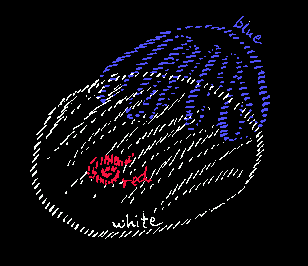
[ 13 ] If I were to depict what occurs at the other pole—in mania—I would have to assume—schematically, of course—that it flows out of the organism (blue), as something pressing toward the mental-emotional realm.
[ 14 ] You can then create a mental image of these extreme cases I have cited here—which are, in a sense, extreme cases—in a less severe form. Let’s imagine that it does not progress to the formation of a carcinoma, but rather, in a sense, to a carcinoma formation that is halted along the way. If it comes to a stage where carcinoma formation is halted along the way, then simply some organ—for what is happening there cannot, of course, take place in a vacuum, not in the interstices of the organism—some organ is affected, but, in a sense, the force that otherwise strives inward in the formation of a carcinoma—and emancipates itself internally in a completely autonomous manner—combines with what is the normal force within an organ, and we are then dealing with a disease of an organ that we can describe in a wide variety of ways, as has become common practice in medicine.
[ 15 ] Let us assume that such a tendency toward mania is halted halfway. The individual is not driven by the abnormality of his constitution to the point where his mental and emotional life is completely sidelined, as in full-blown mania, where he, so to speak, completely loses himself and his thoughts take on a life of their own, driven by emotion. What drives the person toward the other extreme comes to a halt, as it were, halfway: then we are dealing with the various forms of so-called mental illnesses—so-called, I say—which can manifest in the most diverse ways, ranging from organically caused delusions and so on to states of hysteria and the like, which are scarcely detectable organically but are nevertheless always rooted in the organism.
[ 16 ] As you can see, an attempt has been made here to trace, as it were, in two different directions, the phenomena that lead us from the normal into the pathological. And only by first tracing these phenomena can one arrive at an understanding of them. I would now like to show you from another perspective how—without having yet fully departed from the realm of that Spiritual Science whose method I have characterized to you as imagination, inspiration, and intuition— I would say, already from a certain instinct, one can grasp in a certain way what actually underlies this—but how this grasping, if it does not wish to advance all the way to the path of Spiritual Science, nevertheless remains stuck in the middle.
[ 17 ] We have an extraordinarily interesting phenomenon within the development of German thought. Quite apart from how one might view Schelling as a philosopher, he represents an interesting cultural-historical phenomenon. Even if everything he developed in his philosophy may be wrong and flawed, he possessed a certain instinct for natural processes that extended into areas where conventional natural science is so reluctant to investigate natural phenomena, relying instead on very crude empiricism. Wherever the opportunity arose, Schelling certainly attempted to think in medical terms; indeed, he even engaged extensively with questions concerning healing processes. In philosophical historical reflections on the modern era, little attention has been paid to how Schelling actually came to instinctively shift from a purely abstract, logical-philosophical perspective to a concrete observation of nature—including the organic realm. And he even published a journal that dealt extensively with medical issues.
[ 18 ] Where does this come from? One can gain insight into this if one knows—and understands how to properly appreciate—the deep instincts of insight from which Schelling drew his truths and his errors. And so we find in Schelling—a statement that is by no means based on clear cognition, but, I would say, carved out of the instinctive realm of spiritual life—a remarkable proposition. To know nature, he said, is to create nature. — Yes, if this proposition were directly realized in human cognition, then we would have an easy time entering the realm of medicine. If we could incorporate the creative forces into our cognition, if we had these creative forces present in our consciousness, then we could very easily penetrate the realm of physiological and pathological phenomena, for then we would be able, as it were, to observe creative nature as it proceeds. Empirical observation simply states: We cannot do that. — And whoever goes further may say that it is precisely in the unattainability of such a demand—one that goes beyond human capacity, as Schelling has formulated it—that lies something that initially prevents us from gaining insight into a process where new formations arise. Because we cannot directly follow nature’s creative process through our cognition, we cannot look into the very place where new formations arise; that is to say, we cannot readily track the existence of material processes, such as those that take place in the formation of cancer. But in the proper synthesis of what is actually denied to us—since we cannot fulfill the instinctive demand of a genius: “To know nature is to create nature”—in the unfulfillability of this demand, when combined with what does, after all, present itself to us in the carcinomatous process, it will become clear how one must tackle such processes.
[ 19 ] On the other hand, yes, Schelling certainly did not speak out of instinct there. I ask you just once to consider the polar opposite of what Schelling said. If, on the one hand, there is the statement: “To know nature is to create nature”—which we cannot fulfill—then on the other hand there would be the statement: “To know the spirit is to destroy the spirit.” This statement has so far been uttered only by people who study Spiritual Science, and even then only in a certain mysterious obscurity: “To know the spirit is to destroy the spirit.” If we cannot fulfill the task of creating nature, then—let us concede this for now by analogy, though we can discuss it further later—we cannot, by our own human capacity, destroy the spirit either. We cannot advance with our cognition to the point where the destruction of the spiritual begins. But you can already sense that there is a certain kinship here with manic or similar states, for in those cases something destructive arises within the spirit. And we must seek, on the one hand, the connection between those normal human faculties that cannot create nature through cognition, and that cannot destroy the spirit through cognition. Here I have first shown you the path—something that leads us directly from a normal, yet instinctively more deeply stirred consciousness into a relationship between the human being and nature. We shall see that along this path, which has been indicated here, lies what must actually be sought in the transition from physiology to pathology.
[ 20 ] Well, I hope I won't be forced to speak to you in this manner again tomorrow, but I will nevertheless try, over the next few days, to at least continue this reflection in outline form at some point in the evening.