

Physiological Therapeutics
based on Spiritual Science
GA 314
9 October 1920, Dornach
Translated by Steiner Online Library
Physiological Therapy Based on the Spiritual Science III
[ 1 ] Of course, in the limited time available for this therapeutic portion of our event, it will only be possible to provide a general overview of specific healing methods. On the other hand, it is also, I would say, somewhat questionable to have to provide detailed information on specific medical matters when one is not addressing a purely professional audience, as was the case here in the spring, for example. For as much as it will be necessary for the future of human development that the broadest circles acquire an understanding of the general guiding principles of healing—in a sense, the implications of medicine—so that a trusting yet fact-based relationship between doctor and patient can exist, and just as much as it will be necessary for such an understanding of the guiding principles of medicine to be attained in the broadest circles for the sake of public health, so little is it desirable, on the other hand, for overly strong amateurish and lay judgment to influence medical practice—which, unfortunately, has happened all too often due to the state of the medical profession in recent times. It must be emphatically stated that it is certainly not my intention to promote quackery in any way, but rather that within our anthroposophically oriented Spiritual Science there must be a resolute endeavor to promote genuine medical science—based on faithful, methodical study—as a medical art, and to incorporate insights from spiritual science into this genuine medical art. So we should certainly not take the side of those who, out of what one might call an unlimited ignorance of what they are actually talking about, rail against everything they call conventional medicine and the like. We should truly not take the side of these people. There is also something else to consider when discussing matters such as those at issue today. Something has crept into medicine in recent times; in a certain sense, it has certainly been there for a long time, but in recent times it has made itself felt with all the vehemence with which things now make themselves felt in our seemingly chaotic social order: namely, the formation of factions even within the medical profession. And the opposing factions face off against one another in this arena in a manner scarcely different from, I might say, political parties. That this cannot be beneficial for the medical profession is generally easy to see, and the dispute between allopaths and homeopaths, between so-called conventional physicians and naturopaths, and so on, has now brought ample confusion to what we need as an understanding of the medical profession in broader circles of humanity. I had to preface all of this so that what I have to say today is not placed on any false foundation.
[ 2 ] I have, after all, drawn your attention to how, on the one hand, the spiritual-soul aspect is embedded within the human organizational process, yet in the course of physical disease processes it, so to speak, runs rampant, so that this spiritual-soul aspect does not function in the proper way, separated from the physical organ, and therefore proliferates within it. We are then dealing with all those diseases that lead to new growths in the organism. On the other hand, we are dealing with such diseases in which the spiritual-soul aspect develops in such a way that it intervenes too little in the physical organism, and consequently certain parts of the physical organism are left not to the processes governed by the human constitution, but rather to the subordinate processes of natural existence, so to speak, so that organs—if I may use the term—become excessively “physicalized” instead of being permeated by the soul and spirit. Then the soul-spiritual flows out without being properly integrated with the ego-consciousness, and all those forms of illness arise that are improperly referred to as mental illnesses.
[ 3 ] But this view must be modified the moment one moves from sound physiology to sound pathology and therapy; that is to say, I would say, it must be developed in an even more precise manner. For it must be integrated with that view of the nature of the human being that has already been presented here repeatedly, though in a context quite different from the one we need today. It is the view of the threefold nature of the human organism. After all, in the human being we are dealing, on the one hand, with a threefold division of the soul in the powers of imagination, feeling, and the impulses of the will. But this threefold division of the soul corresponds exactly to a threefold division of the physical body into a kind of head system or nervous-sensory system, a rhythmic system, and a metabolic-limb system. I expressly note that this division of the human organism must not be an intellectual one, but an intuitive one. For anyone who, for example, were to understand the head system as that which extends down to the neck, and then the circulatory or rhythmic system as that which encompasses the torso, and the system comprising the digestive system, the limb system, and the reproductive system—such a person, if they were to make such an external division, would by no means be hitting the mark. Rather, the point is that the nervous-sensory system is primarily localized in the head, yet it extends throughout the rest of the organism as such. So that, in a certain sense, when we speak here of the nervous-sensory system in an anthroposophical context, we must say, it is that system of functions within the human organism—for we are dealing not with spatial boundaries but with functional boundaries—which is essentially localized in the head, but whose primary activity extends throughout the entire human being, so that, in a certain sense, the whole human being is, in turn, the head. The same applies to the other systems. And it was therefore sheer nonsense when a frivolous professor of medicine—who had no intention of delving into these matters, but every intention of slandering them before the world—spoke of the “abdominal system” in order to discredit what is actually meant by the metabolic system. He has just demonstrated that he has absolutely no understanding of how, in this classification, what matters is the functional aspect and not the spatially delimited one.
[ 4 ] Once one understands this structure of the human being—a topic on which one could give many lectures to describe it in full detail—one is able to clearly see the differences that exist between the head system, that is, the nervous-sensory system on the one hand, the metabolic-limb system on the other, and the middle system—the rhythmic system—which is essentially called upon to bring about a balance between the other two systems. If we wish to grasp the entire essence of the human being, we then have the following before us: The actual imaginative and perceptual activity of the human being has as its foundation—one cannot even say “instrument,” but rather its physical foundation—everything that takes place physically within the nervous-sensory system. It is not, however, as modern psychology and physiology assume, that the processes primarily connected with the emotional and volitional systems also take place within the nervous-sensory system. No, this view does not hold up to a closer examination of the matter. You will find this closer examination—at least in its broad outlines—outlined in my book *On the Mysteries of the Soul*; but a great deal of detailed work still needs to be done in this direction. Then what Spiritual Science has to say with certainty from its own perspective today will also become evident from the other side—the physical-empirical side—and it will become clear that human feeling is not primarily connected to the nervous-sensory system, sensory system, but rather with the rhythmic system; that just as the nervous-sensory system corresponds to mental images, the rhythmic system corresponds to feeling, and that it is only through the interaction of the rhythmic system with the nervous-sensory system—indirectly via the rhythm of the cerebrospinal fluid, which impinges upon the nervous-sensory system—that the nervous-sensory system is engaged as the vehicle of the life of mental images when we elevate our feelings to the level of mental images, whereby our own dull, dreamlike emotional life is perceived and represented internally. And just as the emotional life is directly connected to the rhythmic system and is indirectly mediated through it, so too is the life of the will directly connected to the metabolic system. And this connection is such that, in a secondary sense—because metabolism naturally also takes place in the brain—the metabolic system, through its functions, interacts with the nervous-sensory system; and in this way, we internally bring about the mental images of our volitional impulses, which would otherwise remain in a dull, sleep-like state within our organism.
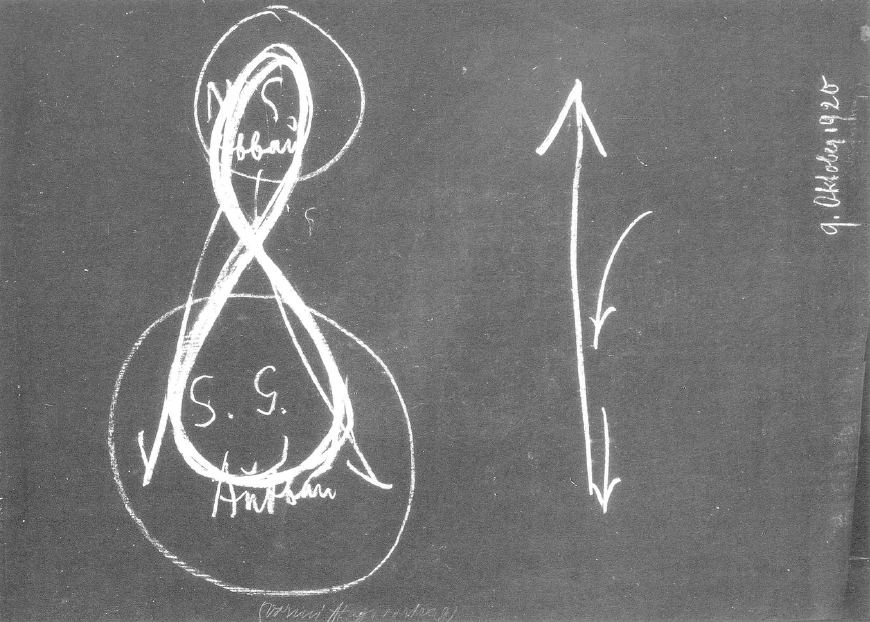
[ 5 ] As you can see, we have three distinct systems within the human organism that support the life of the soul in different ways. Now, these systems are not only distinct from one another, but they are also opposites—as I said, I can only sketch these things out today—so that on the one hand we have the nervous-sensory system, and on the other hand we have everything that constitutes the functions of the metabolic system, the metabolic-limb system (see drawing). You can form your own mental images about the connection between metabolism and the limbs simply by considering the effects of moving limbs on metabolism. This effect is much greater than is usually supposed in ordinary consciousness. But these two systems—I would say the nervous-sensory system and the metabolic-limb system—are also, in a certain sense, polar opposites. And this polar opposition must be thoroughly taken into account for a sound approach to pathology and therapy—particularly for a pathology that leads organically into therapy—and carefully studied in all its individual details, of which there are, of course, countless. For when one delves into the specific effects, the following becomes apparent. It turns out that what I already hinted at yesterday is present to a high degree. Within everything related to the head system—or the nervous-sensory system—we have processes of breakdown, so that while our mental image is active in the waking state, while we perceive and form a mental image, this perception and formation are not bound, for example, to processes of growth and construction, but rather to processes of breakdown and excretion. And one will actually come to this realization if one takes a completely sound look at what empirical-physiological science is already presenting in this direction today. In essence, empirical proof—or rather, empirical confirmation—of what Spiritual Science provides through intuition is already available today. Just follow what certain insightful physiologists are able to reveal about the physical processes in the nervous system that occur as parallel phenomena to mental images and perception. Then you will see that this assertion—that we are dealing with processes of excretion and breakdown, not with processes of synthesis, while we think, think while awake, and perceive—is already very well supported today. In contrast, where the processes of the will are mediated for the human being through the metabolic and limb systems, we are dealing with processes of synthesis. Now, however, all of the individual functions of the human being are thoroughly interconnected. And if we examine the matter carefully, we must say: The constructive processes from below influence the destructive processes, and the destructive processes from above influence the constructive processes. And if you follow this line of reasoning, you will find—as a balancing system, as functions that bring about balance—the rhythmic processes in between the catabolic and anabolic processes, processes that drive catabolism into anabolism and anabolism into catabolism. And if we study the matter in substance—not merely superficially—if we study in substance what takes place in the so-called blood circulation of the heart and in the breathing of the human body, then we find everywhere within it, I would say, specialized courses that are somehow interrupted. I cannot go into detail about this interruption; it serves a good purpose; but everywhere we find specializations of this rhythmic curve that I have plotted here (see diagram). The respiratory process is a special case of this curve; the process you sketch when you draw the flow of blood from the heart upward toward the head or, respectively, toward the lungs, and downward toward the body—in this, you find specializations of this process. In short, when you bring to life what is indicated here, you do not penetrate the functional fabric of the human organism in such a lifeless way as is usually the case, but in a living way. However, in doing so, you must bring your own mental images to life. It must be possible, so to speak, to visualize a three-dimensional image of the human organism. One cannot grasp the human organism with the static, abstract mental images with which one seeks to grasp it in modern physiology and pathology; rather, one must grasp it with dynamic mental images—mental images that themselves truly intervene in the effects of what possesses inner movement, which are by no means mere mechanical interactions between organs at rest. This leads us to the realization that, fundamentally, there is a constant interaction within the human organism between the processes of breakdown and death and the processes of building up, growth, proliferation, and so on. Without this activity, the human organism cannot be understood.
[ 6 ] But what is actually going on here? Just take a closer look at the matter. When the process of breakdown in the nervous-sensory system acts through rhythm into the metabolic-limb system, then there is something present that counteracts the metabolic-limb system—something that is toxic to this metabolic-limb system. And conversely, what is present in the constructive system, when it acts rhythmically into the head system, is toxic to the head system. And since the systems, as I have indicated, are spread throughout the rest of the organism, we are dealing everywhere in the human organism with a continuous process of poisoning and detoxification, which is brought into balance by the rhythmic process. So we do not look into a natural process of the kind one usually has in mind—one that proceeds unilaterally, or, I might say, in a one-sided manner—such that the healthy processes can simply be described as normal; rather, we look into two opposing processes, one of which is, for the other, a thoroughly harmful process, and we cannot live within the physical organism at all without constantly exposing our limb-metabolic system to the causes of disease originating in the head system, and the head system to the causes of disease originating in the metabolic system. And just as a scale, when not evenly loaded, tilts—in accordance with the laws of nature—so that the balance beam is not horizontal, so too, because life is inherently dynamic, there is simply no static state of equilibrium, but rather a state of equilibrium that can swing into irregularity in either direction. And healing means nothing other than, for example, relieving the head system—if it is having an excessively toxic effect on the metabolic system—of its toxic effect, that is, removing its toxic influence. Or conversely, if the limb-metabolic system is having an excessively toxic, that is, proliferative, effect on the head system, its toxic effect must be removed. But a complete understanding in this area can only be attained when one extends what one is able to observe in human beings to the observation of nature as a whole—when one is able to comprehend this nature in the sense of Spiritual Science. If, for example, you consider the process of plant formation, then you will see quite clearly, I would say, in the most macroscopic sense, a clear upward striving in the process of plant formation, a movement away from the center of the Earth, and you can fascinatingly study these metamorphosing formative efforts of plants—at least in their basic outlines, their fundamental lines—in Goethe’s *Metamorphosis of Plants*.
[ 7 ] Goethe’s *Metamorphosis of Plants* initially contains only a rough outline—the very first elements of what needs to be studied about the nature of plants from this perspective. But the direction of this study must be further developed. The basic principles must be followed; then we will gain a vivid understanding of everything that takes place in plant growth: when the plant takes root in the soil—developing, as it were, an upward striving in a negative direction within the root—it begins to grow, then grows upward, overcoming the Earth’s gravitational pull, which is still predominantly active in the root, then struggles through other forces to finally reach flowering, fruiting, and seed formation.
[ 8 ] A great deal happens in this way. For example, this is how an opposing force comes into play. You can observe this opposing force at work if, for example—you can choose any example—let’s say, the common birch, white birch, Betula alba—and closely follow the process that unfolds from root formation through trunk formation, and specifically through bark formation, to see how, based on everything that interacts in the formation of the trunk and bark, what eventually emerges in the formation of the leaves takes shape. This can be studied particularly well from a perspective of Spiritual Science by observing the young birch leaves, which still appear brownish, in the spring. If one studies all of this vividly, one gains an insight into the metamorphosis of the forces at play there—those acting within the plant—and one gains an insight into how, on the one hand, a force directed from the bottom upward is at work in the plant’s formative processes. But one also perceives what still has a retarding effect—what initially, at the root, I would say, acted strongly as gravity, but which then, as the plant breaks free from the earth’s substance and begins to act out of the air, interacts in a different way with the upward-striving force. And we then have an interesting stage—but also a stage that is appropriate here—to understand how, in plant formation, during this upward-striving process, certain salts—potassium salts—are deposited in the birch bark; these are simply the result of the downward-acting forces that interact with the upward-acting forces and, I would say, tend toward protein formation—toward what I would like to call the formation of an albuminizing force. This is how one gains insight, for example, into the process of plant formation. I can only hint at this here. You see, we gain insight in just this way by observing, as it were, how the potassium salts are deposited in the birch bark, how something then breaks free from this downward-pulling force—I would say, from the process that could be compared, for example, to when a salt precipitates out of a solution— we then arrive at the process that takes place as the solution separates from the salt; by grasping this vividly, we enter the process of protein formation, into what I would like to call the albuminization process. Here we have a way to study the external world that surrounds human beings—to study it vividly.
[ 9 ] And then, then we look back at the human being and see how the human being, essentially—let’s say, if we consider the process of decay acting from top to bottom—possesses within itself the same kind of forces that act from bottom to top in the plant. We see, as it were, in the forces acting from the head system downward toward the limb-metabolic system, a sort of reversed plant process at work within, just as the forces we observe acting upward in plant growth are, in fact, acting downward. If, for example, a human being improperly halts this—I would say—plant-forming process at work within him, so that what acts in the head—the astral, the I-being—does not properly permeate the physical body, but this permeation manifests itself within the body, then we are dealing with something that is being held back—something that should be flowing through the human organism—we are dealing with a pathological phenomenon that we encounter, for example, in cases of rheumatism or gout. We study what is brought about in the human organism by this process of formation being, in a certain sense, held back; we study this and find it again in the process of rheumatism, in the process of gout formation, and so on. And now we turn our gaze once more from the interior of the organism, let us say, to a plant formation process such as that found in Betula alba; then we arrive at the following. On the one hand, we look into what is taking place there in salt formation; on the other hand, into protein formation. And we find that, if we properly understand this process of protein formation, we find within it the opposite process of that which is being held back there. Within the organism, the process that should be taking place—similar to the process that occurs as the proper process of albuminization in birch leaves—is being held back, and through this we establish a connection between the processes that take place, for example, in birch leaves and the processes of the organism, by transforming what is found in the birch leaves into remedies that we teach people to use, and through which—because they are correctly opposed to this process of stagnation that occurs in rheumatism and gout—we are able to bring about healing in this way. In other words, we consider in this way what takes place outside in nature together with what takes place within the organism, and from this we gain a mental image of how we should direct the healing forces. On the other hand, we see how, when the breakdown processes proceed in such a way that the organism is, so to speak, unable to halt them—that they spread downward, that the rhythmic system does not counteract them properly—they then flow out to the periphery of the body, pushing their way out through the skin, so to speak. We see inflammatory conditions on the outside of the human body; we see skin rashes and the like. And we look back again at our plant, Betula alba, and find the opposite process in the deposition of potassium salts in birch bark; this gives us the opportunity to understand how we can combat this process—which in the human being leads to excessive exudation in the form of a skin rash—by preparing a remedy from birch bark.
[ 10 ] And so we can study how plant and mineral processes work, and we come to understand the connection between what exists in the external natural world and what is at work within the human being. In other words, we witness the ascent of medical empiricism—of therapeutic empiricism—to what Goethe, in his own sense—not in the intellectual sense, but in his own sense—calls the rational stage of science; we arrive at a science as therapy that truly penetrates these connections. Things are not that simple, for one must study them in detail, at least according to certain types—initially the hidden types of the human personality and the mysteries of natural existence. And one must not suppose that, having studied the process in a case such as Betula alba, one can then already grasp everything that comes into play. In the case of other plant formation processes—I mean, for example, in the horse chestnut and the like—these formation processes unfold in a fundamentally different way; and what is indicated here by no means leads to general drivel and rambling, but rather to a very serious and extensive study.
[ 11 ] But—and I would like to address this point in particular to the esteemed student body—if pursued in a rational manner, this course of study need not instill in you a fear of its scope. For I can assure you that if all that which is exam ballast—which, to speak in this Paracelsian sense, is the “Tartarus of exams”—is eliminated, and instead everything that leads in this way to a rational understanding of therapeutic pathology and pathological therapy is pursued, then medical students will not have to study more, but rather less, And because they will live through this course of study, it will inspire in them even greater enthusiasm than what currently introduces them to the human body—which essentially offers them nothing more than the sight of organs that are by no means static, but are only understood when viewed in their living function and in their interaction with other organs; when one studies this organization; when one is fully immersed in the functional aspect, coupled with an external natural science that likewise drives one toward the functional. After all, it will certainly be necessary to study in parallel, time and again, that inner process in human beings—that peculiar phenomenon that unfolds there in the form of poisonings and toxic effects that have been thrown out of balance—and those processes that do not occur within the natural order and which, because the external relates to the internal in a polar manner, must also be treated in a polar way in a certain sense, and which can therefore certainly lead into pathology—or, better said, into therapeutic pathology and pathological therapy.
[ 12 ] Thus, I was able to give you only a glimpse of what, I might say, guides the steps that the study of medicine must take toward recovery, and I was able to give you only a glimpse of how Spiritual Science seeks to influence this study of medicine. This evening, when I will once again give a half-hour lecture for everyone here following the eurythmy mental image, I will provide a few more examples that will show you how this intuitive synthesis of external natural forces with the effects of the inner organism can lead to therapeutic practice and to an understanding of pathology. I would then like to go into detail about specific substances. In the short time available to me here, I was able to illustrate the principle, so to speak, using the example of Betula alba; I will mention a few other things this evening, but I will stick to merely hinting at what should enter into people’s general understanding. For it is from this foundation that the physician must then build upon it in a specialized manner. He must delve into the specifics, for treating specific conditions requires an individual assessment in every case, and it is therefore necessary that, from the layperson’s understanding of medical approaches and medical principles, an understanding—a sympathetic appreciation—of what the physician must accomplish within the external world may emerge.
[ 13 ] And if you consider, in the true sense, the path that anthroposophically oriented Spiritual Science actually intends to take for medicine—I will have more to say about this later this evening—you will surely say to yourselves: Truly, this anthroposophically oriented Spiritual Science does not seek to drive medicine into quackery, amateurism, or dilettantism; rather, it aims above all to work toward the revitalization of science—genuine, serious science itself—which will then, in turn, have its own social impact.