

Remedial Education Course
GA 317
28 June 1924, Dornach
Translated by Steiner Online Library
Fourth Lecture
[ 1 ] Well, my dear friends, today we will try to wrap up our introductory remarks, and then, starting tomorrow, we will be able to move on to the practical examination of individual cases. The point is that a genuine examination of the nature of so-called mental illness must necessarily lead to the identification of guidelines for treatment. The fact that treating adults still poses difficulties for our methods today stems from what I explained yesterday: that certain prerequisites must be in place for the treatment of such conditions, which—as long as world conditions remain as they are now—cannot be realized at all within our society for the mentally ill. In contrast, with children, the situation is such that education can indeed make an extraordinary difference. However, as you have come to realize, my dear friends, mental illnesses—and of course other illnesses as well, but here in a much deeper, more profound, and more specific sense—involve karmic connections that manifest themselves in these illnesses.
[ 2 ] So, of course, the question is legitimately raised—not so much explicitly; it must be raised unconsciously; we must sense what underlies it—: To what extent can an improvement be brought about? — Every degree of improvement we can bring about is a benefit for the sick person. We must never console ourselves with the thought: “Karma is what it is, and that is why things are unfolding this way.” We say this in reference to external events of fate and may well do so; but we can never do so when it comes to the freely flowing course of thoughts, feelings, and actions within the human being themselves. For there, karma can take various paths. And a diversion of karma can occur, so that it is not that the things that must be fulfilled are not fulfilled, but rather that they can be fulfilled in different ways. I have often said—when it has been suggested that prenatal education should be practiced, by which is meant education during the embryonic period—I have often said: As long as the child is not breathing, it is a matter of the mother’s upbringing and behavior. And besides, one should not interfere with the work of the gods. There, it is entirely a matter of what takes place within the mother herself.
[ 3 ] Now, however, we can undertake a proper examination, as we began to do yesterday with regard to epileptic madness, taking into account the physical body, the etheric body, the astral body, and the “I” organization. So, what have we discovered regarding all the forms of childhood insanity that are epileptic or epileptoid? We have found that it involves a blockage of the astral body and the ego organization within a particular organ. The surface of an organ does not allow the astral body and the ego organization to pass through; they become blocked. They become blocked within the organ. A condensed astral and ego atmosphere develops within the organ. This gives rise to the convulsions. For whenever a convulsion occurs, the following is present: The nature of the convulsion consists in the fact that when there is an organ here (see Plate 6, left), with its etheric body within it, there is a very specific relationship between this physical body and etheric body—for each organ—and the astral body and the “I.”
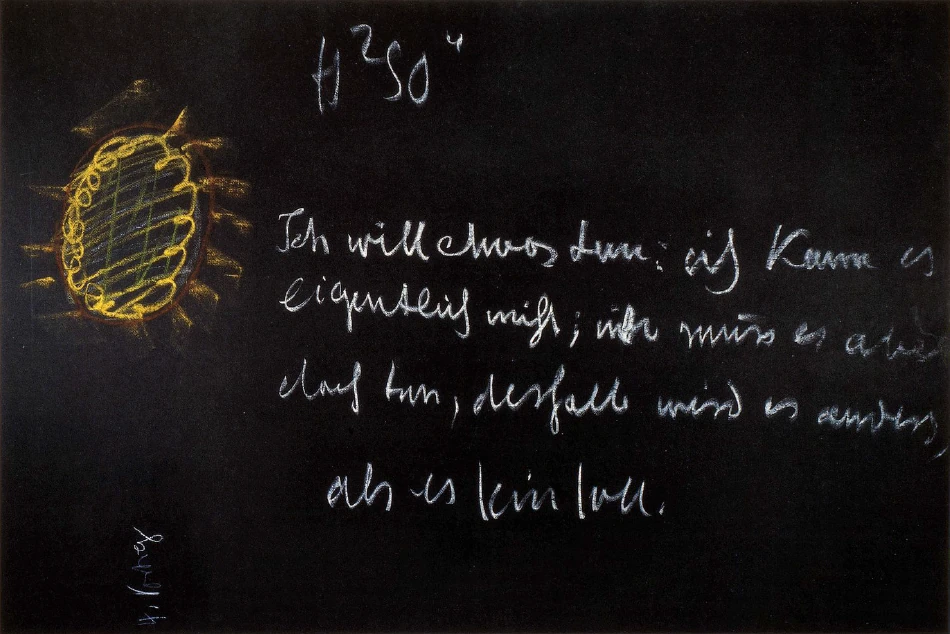
[ 4 ] Don’t you all know—one can only speak of this if one makes such assumptions—what the specific external conditions are under which substances combine with one another in inorganic nature? While it’s not exactly how chemistry works, certain ratios do exist—I’m not talking about atomic or weight ratios, because that already delves into theory—but the fact remains that hydrogen and oxygen combine in a specific ratio. When we have sulfuric acid, H₂SO₄, we have hydrogen, sulfur, and oxygen in it in a specific ratio in which they are related to one another. If this ratio changes, the substance that results may, under certain circumstances, be something entirely different. If we have a different ratio of hydrogen, sulfur, and oxygen than that found in sulfuric acid, we obtain sulfurous acid, H₂SO₂, even though it contains the same substances.
[ 5 ] Thus, there is a very specific relationship in the so-called normal person; I say “so-called” because the expression “in the normal person” is utterly philistine—it implies that there is a clear boundary. Now, within certain limits, this relationship is variable. But when it exceeds a certain degree of variability—and this, in turn, can vary from person to person—when it goes beyond a certain limit, then abnormality and pathology are present. - It is thus the case that the astral body and the “I”-organization are situated within an organ, such that they cannot fill it within a certain ratio and cannot extend beyond the organ—as we recognized yesterday to be necessary—beyond the physical body. If the astral body and the “I” become congested within a particular organ, then the excess astral body and the excess “I”-organization are present within that organ; the proper amount is not present, but rather there is a congested, excessive amount within it, and as a result, the organ is compelled to sense and perceive the astral nature. If the correct amount of astrality is present within it, the organ does not perceive the astrality. For any activity of the astral body and the “I” organization that does not belong to the organ must be perceived by the organ. If anything fails to pass into consciousness and becomes congested—so that there is an excessive amount of astrality and “I” organization that does not pass into consciousness—then a spasm arises. And with that, you have already described the accompanying symptom: the disturbance of consciousness. This disturbance of consciousness must always occur whenever the organ in question has anything to do with consciousness at all. If the organ in question has no direct connection to consciousness—there are also organs that are not directly, but inversely, related to consciousness, which are inhibitory organs—then unconsciousness does not result, but rather pain. Pain is heightened, not diminished, consciousness. The state of spasm as such is not painful; that is simply a fact. What can occur as pain is what happens when congestion occurs in an inhibitory organ—not in an organ that promotes consciousness, but in an organ that restrains consciousness. This is when heightened consciousness—pain—occurs. That is the essence of pain.
[ 6 ] Well, with that we have covered all those forms of mental disorder—including those in the child’s organism—that lead to epilepsy or epileptoid conditions, which we will discuss in detail, but preferably using individual cases.
[ 7 ] But you will easily see that things can also be different. It may be the case that an organ does not function in such a way that its surface retains the ego-organization and the astral body within itself, but rather that the surface allows too much to pass through—that, so to speak, the organ does not retain enough within itself for its own use—so that here, astral energy, which also includes the ego-organization, does not become congested, but rather flows easily beyond the organ, so to speak (see Plate 6). One could say that the surface becomes too permeable for astrality and the “I” organization; the organ “leaks out” in terms of its astrality and “I” organization. We then see, through imaginative consciousness, the organ radiating outward; it leaks out. Such a leaking organ is always associated with the physical counterpart of secretion, which, of course, does not occur strongly in certain organs, but which can certainly be noticeable. We will have to discuss this. You see, when it comes to childhood, we are dealing with a phenomenon that can only be healed by strengthening the astral body and the ego organization—by bringing them back into the organ, so to speak.
[ 8 ] Well, what forms—what externally perceptible symptom complexes—does such an inner constitution then give rise to? This brings us to a topic where the situation for childhood differs from that for adulthood. Here we come to forms of mental disorder that must take on specific forms during the period of human development from birth to sexual maturity; here we come to forms of hysterical mental disorder. All the ambiguities of external science are alive in these forms of hysterical mental disorder today. All the unscientific coinings of terms are embedded within them. This begins with the very first conception one has of this matter; for, naturally, according to today’s views, one will have to relate this hysterical madness, to a greater or lesser extent, to sexual life. In fact, it is even associated—in the forms under which it is currently classified—more with a woman’s sexual life than with a man’s. It is not the term itself that matters. What matters is which cases are currently classified under this term, whether they deserve the designation “hysterical insanity” as it is commonly understood, or whether a much broader complex must be taken into account.
[ 9 ] The fact is that, until sexual maturity, a child simply cannot experience this form of madness that is attributed to it when one thinks of gender in the context of hysteria; rather, in the earliest stages of life, a child can experience something that I have described as the astral body and the ego-organization extending beyond an organ. That is the only thing it can experience. We must set aside all existing descriptions intended to capture hysterical madness, for all such descriptions inherently involve thinking in terms of certain general concepts; but if one thinks in terms of a certain general concept, the description becomes incorrect. And so today, numerous descriptions in the field of psychiatry are simply incorrect. One cannot approach this subject the way it is approached today.
[ 10 ] Let’s take a look at what is actually happening here. As I said yesterday, the child has difficulty perceiving the outside world. It has difficulty grasping the state of equilibrium with liquids, the state of equilibrium with air, the nuances of warmth, the nuances of light, the nuances of chemistry, and the nuances of world life in general; it grasps these, rather than—as is the case with epileptic madness—perceiving them as too weak or too strong; it immerses itself everywhere in its surroundings—in heaviness, in warmth—it immerses its astral body and its “I” into them, perceiving everything in such an intense way as is actually impossible for the so-called “normal” person. What arises from this?
[ 11 ] Well, just create a mental image of yourself scratching your skin somewhere and touching something with a sore spot—a spot where you’ve scraped your skin, where you’re sensitive. You’re sensitive there because your inner astral body is coming into too close contact with the outside world. One may only engage with the external world through one’s astral body and the “I”-structure to a certain extent. The child who, from the very beginning, projects its astral body outward perceives all things in a subtle way, just as if it were wounded. This naturally gives rise to an experience of hypersensitivity, a hypersensitive devotion to the entire environment. Such a human being then perceives the environment much more strongly and intensely, and also reflects it much more deeply within themselves. Consequently, mental images arise that are painful in themselves. The moment one exerts one’s will in response to this, one reaches into something to which one is hypersensitive. A peculiar phenomenon arises in the conscious realms when one exerts one’s will: an excessive awareness of the act of will arises, and pain arises with the exertion of the will; this pain is present in its nascent stage, in its “status nascendi.” One wants to hold it back. This happens intensely. One fidgets in one’s actions because one wants to hold back the pain.
[ 12 ] As you can see, these descriptions lead, in a very specific sense, to real-life situations. You get descriptions here where the child wants to do something, and the situation is this: the child feels pain and cannot do it, but instead of the inner life flowing out into action, the child has a terribly intense inner experience that makes the child shudder. The child shudders at itself. Or even when it is not a matter of an action, but of a masked action that lies within the life of the imagination—for the will is active there as well—when it is a matter of an action in the life of the imagination, when mental images are supposed to develop, it may be that, in certain forms of illness, the mental images, at the very moment they are supposed to arise, evoke fear and cannot come into being. Every such mental image that, at the moment it is supposed to enter consciousness—at the moment of its emergence—evokes fear, every such mental image simultaneously causes the emotional life beneath it to unfold. Emotions surge, and a depressive state always begins then. Emotions that are not captured by mental images are depressive; only those emotions are not depressive that are immediately captured by the life of the imagination as they arise.
[ 13 ] What is described based on the nature of the matter itself can be seen, and this is essentially already a complex of symptoms. So if one learns to recognize the essence of such an abnormality, one can see it directly through intuition. This is what must be at stake when Spiritual Science, with its intuitive insight, intervenes in these practical areas of life. For those who are to intervene there, the descriptions must now move entirely away from the abstract and into the living reality, so that the description culminates in what the person who has received the description then sees in the patient. And here you can literally see what is happening: the leakage of astrality or “I”-organization from some organ or organ complex.
[ 14 ] A very crude manifestation in the child—one that, in a sense, coarsely expresses the complex of symptoms outwardly—will be bedwetting. This is entirely natural. But only then do you place the child’s bedwetting in its proper perspective. It has its origin in this fact. So wherever bedwetting is involved, you can assume: The astral body is leaking out. For all kinds of discharges and excretions have to do with the activity of the astral body and the ego organization. These must be in order if the discharges and excretions are to be in order.
[ 15 ] Now we can say once again that the “I” organization and the astral body are connected through the physical body to the ordinary, so-called four elements, and that in the etheric body, the “I” organization and the astral body are more closely connected to the higher elements—to a portion of warmth, to light, to the chemical forces, and to the general life of the world. So if one extends terms that can be quite descriptive to the spiritual realm—as was certainly the case in earlier times with instinctive clairvoyance, when the physical was not yet so sharply distinguished from the spiritual—one can say: There is a psychological vulnerability in the child. And this psychological vulnerability in the child encompasses, as a general concept, everything that occurs there. And if this emotional vulnerability cannot be alleviated through special education, then upon reaching sexual maturity, the female or male form of this vulnerability will manifest. The female form will then take on the character of what has been termed “hysteria,” as it was described as long as that view prevailed; the male form takes on a different configuration, which we can also discuss, but which manifests in a different way.
[ 16 ] Thus, wherever there is a condition opposite to epileptic or epileptoid madness, you are guided to pay attention to the nature of the child’s excretions. You are guided, in particular, to carefully observe the child’s sweating patterns. In particular, you will need to pay careful attention to whether, when you wish to teach the child something—that is, when you wish to evoke certain mental images—the inner sensitivity to a mental image manifests itself in episodes of sweating. There is a certain difficulty here. Under normal circumstances, you might believe that once you have evoked such an inner state, you can immediately observe the sweating patterns afterward. This may be the case under certain circumstances, but it need not be so. For here the peculiarity arises that whatever is present in the way of inner anxiety or inner restraint, or a sense of inner sensitivity, does not act like an external sensation of pain; rather, what arises there is first processed within the person and sometimes takes the strangest paths within the person, emerging not immediately but, curiously enough, only after some time—in the course of the next three or three and a half days. In all that occurs with the expansion of the astral body and the ego-organization, we are dealing with the very process that takes place during the normal expansion of the astral body and the ego-organization at the moment of death. If there has been a blockage, the opposite of dying occurs. In epilepsy, there is an attempt to congest life within the organism, to imitate—in an abnormal proportion—the process of life “creeping” into the physical organism as it descends. In the conditions we are now discussing, we are dealing with an imitation of what happens in the process of dying: the astral body and the ego expand as life dissolves after death. This is what we are dealing with.
[ 17 ] Once you have this feeling, you gradually acquire what is important when observing such cases: You develop a sense of smell for what is present in the child; you can smell this outflow. In fact, one actually smells it. And this already belongs to the esoteric aspect of these matters—that one develops a sense of smell for the fact that the aura of such children smells different from that of normal children. And indeed: there is something faintly cadaverous in the auric emanations of such children. But this shows you that this is indeed the case; the accompanying symptoms of this dying process also appear, namely this sweating for one reason or another. These can occur over the course of the next three days, roughly during the same period in which this retrospective view of death also takes place, when the astral body and the “I”-organization undergo expansion.
[ 18 ] Based on this insight, you must therefore get into the habit of noting down something you have observed in the child’s mental images or volitional activity, and then observe the child closely over the next three to four days. Then you will find out whether the form of abnormal mental life I just spoke of is actually present. Then, given the appropriate circumstances, the question will arise for you: How do I treat such a child?
[ 19 ] Such a child approaches me in such a way that, in every action it takes, I can already see its soul laid bare. Their soul flows into everything the child does around me. You understand that in such a case—when, so to speak, the child’s soul flows toward you—education depends very much on what the educator, for his part, can offer the child in terms of his own state of mind and overall disposition, by managing something in his surroundings, by doing something himself. Now let’s suppose you are a fidgety educator—the kind of person who constantly acts in a way that shocks others with what he does. This character trait, which is a trait of human temperament, is much more widespread in life than one might think. It is often extraordinarily common among teachers. If I may use a colloquial expression: Aren’t most teachers today a bit hyperactive? This restless nature that is constantly getting ahead of itself in its actions! This must be the case because teacher training is the way it is. Teacher training today is such that it actually exaggerates what is supposed to be instilled in people. Above all, teacher-training students—and since my task today is only to speak about teacher-training students, the others are not relevant—above all, teacher-training students should never be subjected to an exam. For the exam itself is precisely what puts one into a state of mind that leads to this restlessness.
[ 20 ] Now you’ll see right away what a strange situation one gets into when one has to work things out based on the facts of the matter. This concerns the establishment of the Lauenstein Institute for children with special needs. Based on police legislation, those taking over the institute must be advised to take their exam. At least one person must take it. But that is completely unreasonable, because it is, of course, yet another way to become restless. This is something that must simply be understood in a very matter-of-fact sense; otherwise, one goes through life blindfolded. So there is no choice but to break the habit of restlessness again after taking the exam. Most people do not do that.
[ 21 ] Therefore, anything in the child’s environment that causes subtle shocks—especially when these arise from the teacher’s unconscious or temperament—must be avoided. Why? Because the teacher must have complete control, acting entirely from a conscious and deliberate choice, to induce such shocks. For they are sometimes the very best remedies for such conditions. But they are effective only if they are not done out of habit; they are effective only when they are carried out in full consciousness, with thorough observation, in the presence of the child.
[ 22 ] So, if you notice such a complex of symptoms in a child, you must take the child and—now teach him or her to write, read, or draw something—but what do you do next? You try to let the child progress as far as his or her particular nature allows. At a certain point, you try to shift the entire pace of the work to a faster one. This forces the child not to let the pain recede, but rather to let go of the anxiety associated with the pain—because you are standing before the child, and the child must therefore enter into that state of anxiety. But precisely because the child must enter into this anxiety at that moment—because the child is now entering an artificially induced impression that differs from the previous one—by entering into such an impression, the child strengthens and consolidates that which seeks to flow out from within. And if you carry out this process systematically with a child over and over again, then the consolidation of the “I” and the astral body takes place. You must not grow weary, however; you must do this over and over again, preparing the entire lesson so that it flows methodically, so that it simply shifts direction at certain points. To do this, you must be in control of the lesson yourself. If you have a different subject every three-quarters of an hour, then you cannot pursue this approach. You can structure a curriculum for children with special needs if you work on the basis of what we have introduced in the Waldorf school—that is, on the basis of block teaching—where, in the main lessons, a single subject is continued over the course of weeks, and where, for weeks on end, you have the option of having no set schedule at all between 8:00 and 10:00 a.m.; you can do whatever you want—whatever you methodologically consider to be the right thing to do.
[ 23 ] From such an educational foundation, you can now also determine what you must do for children with special needs. You can incorporate the method that continuously brings about changes in the teaching approach and adjustments to the pace of instruction. And through such measures, you will have an immensely powerful effect on glandular secretion and, consequently, on the consolidation of the child’s astral body. You need only maintain a certain degree of resignation; for the world will not notice where healing has taken place if the children have been treated in such a way that they have become healthy. The world will only notice that healing has not occurred in individual cases, because in life, returning to normal is always taken for granted. But returning to normal is not at all something to be taken for granted. That is one thing.
[ 24 ] So you see: while epileptic and epileptoid insanity involved taking more manual and moral measures, as I explained yesterday, this form of insanity, which I have discussed today, primarily involves developing didactic methods capable of combating the condition. Inducing these shock effects is one thing. The other is to carefully observe how the states alternate between depression and a kind of manic effects—bursts of cheerfulness and pleasure.
[ 25 ] For what, then, causes the alternation between depressive and manic states in these forms of illness? It occurs continuously precisely because the child is inwardly wounded and harbors a longing to prevent the will from unfolding at all. If the will does not find expression in the child’s imaginative life, depressive states arise. Conversely, when this has been going on for a long time and the child can no longer hold back but must finally release itself, then—because the inner wound is soothed and the child can fully pour itself out into the astral realm—a heightened sense of well-being arises, and states of sadness and cheerfulness alternate, which one must carefully observe, especially in such a child who exhibits the other symptoms: sweating and bedwetting.
[ 26 ] For it is precisely didactics that must be brought into these fluctuating states. Let’s assume we are dealing with a child in a depressive state. We will be able to address such a depressive state the moment the child feels: we are deeply connected to their inner world; we understand them. But precisely because this involves a kind of hypertrophy of the mental images and volitional life, the child has a need not to experience merely a sharing in the sadness. If we simply become gloomy and sad along with the child, the child gains nothing from it. Rather, the child will benefit only if we are able to rise to the occasion of the state we are witnessing and can effectively comfort the child, so that the child receives effective comfort.
[ 27 ] The educator who can respond to these matters with understanding will come to recognize typical patterns. For example, he will know that a recurring mental image among such children is that they feel they should do something but are unable to. It is a complicated mental image, but one must be able to study it: They are supposed to do something and cannot, yet they must do it anyway, and then the result turns out differently than they had intended. Just examine the inner life of the children I have spoken of, and focus specifically on identifying within their inner life what might be described as:
[ 28 ] I want to do something: I can't really do it; but I have to do it anyway—that's why it turns out differently than it should.
[ 29 ] For it is within this complex of perceptions that the child’s entire illness resides. The child senses and feels this peculiar constitution, which consists of the outflow of the astral body and the “I” organization. This in itself already acts as a projection out into the world of the astral body. I want to do something—but the child knows that it immediately comes into contact with the outer world, with the forces at work there. There is a tenderness, it hurts; and the child must feel: I can’t really do it. — But now the child knows: It has to happen after all. I must reach out with my astral body into the forces of the world. There I cannot master what I take in my hands; there I am so clumsy with my flowing astral body; it turns out differently because I cannot be fully present. The body flows out too strongly.
[ 30 ] It is precisely in such children that one observes, in the most wonderful way, what the subconscious—which reaches up into the life of feeling—actually does. It is, after all, so incredibly clever. It shapes into the clearest concepts what is taking place in the child’s inner constitution and in the relationship between people and their environment. This takes shape in the subconscious, but it does not rise into the child’s consciousness. So one can say: One must set out to discover these inner, unconscious complexes of imagination in the child. — And now: He appears. You notice him; he is almost always there whenever the child is about to begin something—whether in outward action or through thought. He is almost always there. Intervene at that moment by gently and softly participating in what the child is supposed to do—so that, in a sense, you feel every movement of the child’s hand in your own—and then the child will have the feeling that the second part is being corrected by what you are doing. But of course, the child gains nothing if you actually do everything the child is supposed to do. You need only intervene symbolically. Let the child paint, but do not paint yourself; instead, move the brush alongside the child’s, staying close by, accompanying every movement. You let the child imagine that, as they form their own mental images, you are gently guiding them by participating as kindly and clearly as possible in what the child is supposed to do, accompanying them emotionally with a soothing touch. It is through such close observation of the situation that we can discover exactly what we need to do.
[ 31 ] Now we must understand that whatever Spiritual Science can offer can only ever be an appeal to human beings. People are always looking for rules: “You should do this this way, and that the other way.” — Anyone who wants to become an educator for children with special needs is never finished; for them, every child is a new problem, a new puzzle. But they can only figure out how to proceed in each individual case if they are guided by the essence within the child. It is an arduous task, but it is the only real one.
[ 32 ] Therefore, from the perspective of the Spiritual Science, it is of the utmost importance that we, as educators in the most eminent sense, cultivate self-education.
[ 33 ] We will practice the best form of self-education when we observe the symptoms of illness with interest. When we feel that such a symptom of illness is actually something wonderful. But one must not go around proclaiming: “The mad are actually divine beings.” — One must not do that in our time. But one must be clear about this: When an abnormal symptom appears, there is something there that, viewed spiritually, is closer to the spiritual than what a person does in a healthy organism. This closeness to the spiritual simply cannot manifest itself in the appropriate way in a healthy organism. Once one has this insight, one will be made aware of such intimacies.
[ 34 ] As you can see, it is true that in every field, diagnosis and pathology lead to effective treatment when the diagnosis addresses the essence of the matter.