

Remedial Education Course
GA 317
30 June 1924, Dornach
Translated by Steiner Online Library
Fifth Lecture
[ 1 ] You have already seen how certain abnormalities in the soul—in the life of the soul—that manifest as symptoms of illness appear in children in an indeterminate way, only to develop later in a more specific form. And so I was able to draw your attention to how what later becomes a hysterical manifestation appears in childhood in a very peculiar, still indefinite way. However, in order to correctly assess the actual abnormalities of childhood, one must consider the entire context between a person’s prenatal life—which, so to speak, brings the karmic impulse into physical life—and the child’s gradual development through the first two stages of life, and perhaps even beyond, through the first three stages of the child’s life.
[ 2 ] Today, as a preparatory step, we’ll first discuss some more theoretical concepts, and then we’ll be able to cover everything else we need to know using practical examples. And Dr. Wegman will, in fact, be making a young man available to us here first thing tomorrow morning—a patient we’ve been treating for quite some time here at the Clinical-Therapeutic Institute—and through whom we’ll be able to demonstrate some particularly characteristic features.
[ 3 ] However, to show you what you need to know beforehand, I would like to present a schematic representation of the human organism—the human organism as a whole—(see Plate 7). To make everything clear, I will always depict the “I” organization in red in the following drawing. I will then depict the astral organization in this shade of violet, the etheric organization in this shade of yellow, and the physical organization in this shade of white. So let us today define very precisely what is relevant to us; let us strive to grasp the matter clearly. For it is not the case in the human organization that we can say: Here is the ego organization, here is the astral organization, here is the etheric organization, and so on—but rather, the situation is this: Imagine a being that is organized in such a way that the ego organization lies on the outermost layer; then, further inward, lies the astral organization, followed by the etheric organization, and finally the physical organization. So, in a sense, we have here a being that presents its “I” organization outwardly; further inward lies the astral organization, then the etheric organization, and deepest within lies the physical organization (see Plate 7, center).
[ 4 ] Let us now consider another arrangement, in which the “I” organization is located entirely within, with the astral organization radiating outward, so to speak; further outward, the etheric organization; and even further outward, the physical organization (see Plate 7, top left). You see, now we have two polar, so to speak, oppositely oriented entities. When you look at these two polar, oppositely oriented entities, you can say to yourself: The second entity will exhibit a strong physical organization outwardly, into which the etheric organization still plays a role, while the astral and ego organizations will recede more inwardly. - However, because this is the case, the configuration may change somewhat. The configuration of what I have drawn here in the second position can be as follows: we can have the physical organization, so to speak, fully developed upward and open downward, atrophied. We can then have the etheric organization, in turn, developed somewhat more strongly downward than the physical organization, yet still atrophied. We may have the astral organization extending more downward, with the “I” organization extending downward, so to speak, like a kind of thread. For what is schematically arranged here in spherical form can indeed appear in this way (see Plate 7, bottom left).
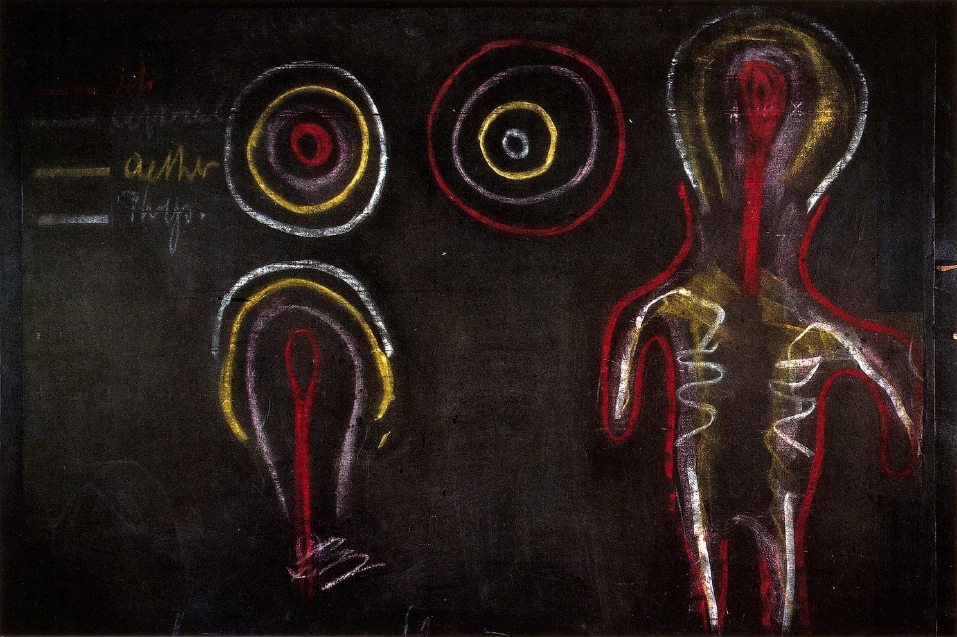
[ 5 ] Now, however, I would like to make this a bit clearer by drawing this “I” organization for you here, followed by the astral organization, the etheric organization, and the physical organization. And now let’s connect the other being. Let us connect this other being in such a way that we first allow the “I” organization—which is here on the outside—to be somewhat configured; that is, instead of drawing a circle, I have allowed the circle to be somewhat configured. For it is always the case in the malleable forms of the natural being—of the world being in general—that whatever is spherical or circular configures itself in various ways. Further inward, I have now connected the astral organization to the “I” organization; even further inward, the etheric organization; and finally, at the very center, the physical organization (see Plate 7, right). And you have transformed the first being into the human head. You have transformed the second being into the human metabolic-limb system. And, in fact, the reality is that in the human head organization we have that which conceals the “I” within, the astral body also remains relatively concealed within, while outwardly the physical body and the etheric body take shape and give form to the face.
[ 6 ] In contrast, in the metabolic-limb system, the situation is such that the “I” actually vibrates everywhere on the outside—in the organism’s sensitivity to heat and pressure—and, emanating from the “I,” the astral body vibrates inward; then, further inward, it becomes etheric, and within the long bones, it becomes physical as it moves inward.
[ 7 ] Thus, centrifugally—from the “I” outward toward the physical body—we have the arrangement of the head organization; centripetally—from the outside inward, from the “I” to the physical—we have the arrangement of the metabolic-limb organization. And constantly intermingling, so that one cannot even tell whether it is moving from the outside in or from the inside out—this is the arrangement in the rhythmic system in between. The rhythmic system is half head, half metabolic-limb system. When we inhale, it is more of a metabolic-limb system; when we exhale, it is more of a head system. So that between systole and diastole, the process unfolds in such a way that one can say: head system–limb system = exhalation–inhalation. Now you see, then, that—mediated by the middle part of the rhythmic organism—we actually carry within us two completely polar opposites. What follows from this? Something extraordinarily important follows.
[ 8 ] Imagine that we take something in through our mind—as when we receive a message through another person’s speech—and take it in with our mind; this first enters the “I,” the astral body. But the various parts of the organism interact with one another, and the moment something strikes here—through an impression in one “I” organization—it also vibrates into the other “I” organization; and the moment something strikes one astral organization, it also vibrates through into the other astral organization. If this were not the case, my dear friends, we would have no memory, for all the impressions we receive from the external world have their reflections in the metabolic-limb organization; and when I receive an impression from the outside, it disappears from the head organization, which is arranged centripetally from the physical body toward the “I.” The “I” must maintain its integrity; it cannot hold a single impression for hours on end, otherwise it would become identical with the impression. But the impressions remain below, and they must rise up again when a memory is recalled.
[ 9 ] But if you consider this, the following possibility arises: The entire lower system—which is polar opposites to the upper system—may be too weakly developed in a person. Then impressions occur. These impressions do not become deeply enough imprinted in the lower system. The “I” receives an impression. If everything is normal, the impression is imprinted on the lower system and is simply retrieved in memory. If the lower system—the “I” organization, which lies quite peripherally—is too weak, and the impressions are not imprinted strongly enough, then whatever does not sink into the “I” organization continually radiates back upward, into the head.
[ 10 ] We have a child who is organized in this way. We showed him a watch once—let’s say, for the first time. He was interested in it. But his motor coordination is too weak. So the impression doesn’t fade away; instead, it radiates back. Now I’m spending time with the child, and he keeps saying, “The watch is beautiful.” — No sooner have I spoken a few more words than he says again: “The clock is beautiful.” — It keeps coming back. We must focus our attention in the child’s upbringing on such dispositions, which are sometimes only very faintly hinted at but are nevertheless extraordinarily important. For if we fail to strengthen the child’s weak motor-metabolic organization, this rebound effect will grow ever stronger, and in later life, that paranoid disorder linked to obsessive thoughts will emerge. Then these become fixed, consolidated mental images. The child knows that they are completely out of place in its inner life, but it cannot reject them. Why can’t it reject them? Because the conscious inner life is up above, but the unconscious below is uncontrolled; it pushes back certain mental images, and obsessions arise.
[ 11 ] As you can see, we are dealing here with a metabolic-limb system that is underdeveloped. What does that mean? An underdeveloped metabolic-limb system is one that prevents the protein substance in the human organism from containing the correct amount of sulfur. In other words, a metabolic system that produces sulfur-deficient protein. This can indeed occur. A different stoichiometry applies here than usual. Then what I have just described occurs: these obsessive thoughts, which manifest in the child’s organism, begin to emerge.
[ 12 ] But the opposite can also be true. The metabolic limb system may be predisposed to have an excessive affinity for sulfur: in that case, the protein becomes too rich in sulfur. Then we have carbon, oxygen, nitrogen, and hydrogen in the protein, and, relative to these, too much sulfur. In this metabolic system—which, as its name implies, is influenced in its manifestation by the composition of the substances it contains—we then experience the urge not to repel everything, but rather the opposite: due to the excess sulfur, impressions are absorbed too strongly; they become too deeply ingrained there. This is something different from the congestion on the surface of the organs that I described earlier. Congestion causes spasms. But here we are dealing not with congestion, but with an absorption of impressions. And the result of this is that the impressions disappear. We cause the child to have impressions, but there is nothing we can do: certain impressions, due to their particular nature, disappear into the sulfur-rich protein substance. And only when we then manage to draw these impressions back out of the sulfur-containing protein substance do we bring about a certain balance in the spiritual-soul-physical organism. For this disappearance of impressions into the sulfur-containing substance does indeed cause a highly unsatisfactory state of mind, because it stirs the soul inwardly. It stirs us subtly, gently, causing the entire organism to tremble slightly within.
[ 13 ] You see, I have often said: Psychoanalysis is dilettantism squared, because the psychoanalyst knows neither the soul, nor the mind, nor the body, nor the etheric body; he has absolutely no idea what is going on there—he merely describes it. And because he can do nothing more than describe, he says: “These things have disappeared down below; we must bring them back up.”—The strange thing is that materialism cannot investigate the properties of the material. Otherwise, one would know that what is present has its origin in the protein substance of the will organism, which is too rich in sulfur. The peculiarity of physical substance can only be discovered through Spiritual Science.
[ 14 ] And so it would be helpful if those who have to raise children with abnormalities developed an eye for determining whether a child is “sulfur-rich” or “sulfur-poor.” We will, of course, be able to discuss a wide variety of forms of mental abnormalities, but we should develop the ability to be truly guided along a specific path by certain symptoms. If I am entrusted with the upbringing of a child in whom I see that impressions initially cause difficulties, this may, of course, be attributable to conditions such as those I have described in recent days. However, it may also be attributable to what has been described today. How should I proceed in such a case?
[ 15 ] First, I observe the child. We’ve just met the child; we need to get to know him or her. First, I observe the child and note one of the most superficial symptoms: the color of the hair. If the child has black hair, I will not look very far to determine whether it might be sulfur-rich; for if it has black hair, it can at most be sulfur-poor. And if there are abnormal symptoms, I will then have to look for them in some other area than an excess of sulfur—at most, in a deficiency of sulfur in black-haired children. And if recurring mental images then become apparent, I must look elsewhere than in an excess of sulfur. But if I have a blond-haired or red-haired child, I will look in the direction of an excess of sulfur in the protein substance. Blond hair results from an excess of sulfur, black hair from an excess of iron in the human organism. In this way, we can trace the so-called mental and emotional abnormalities all the way down to the physical substance.
[ 16 ] Well, let’s take such a fire-breathing mountain—a sulfur-laden child—who, in a sense, sucks impressions into the realm of the will, so that they solidify there and cannot escape. We can observe this phenomenon in the child very early on. The child will be prone to states of depression, to melancholic states. These hidden impressions, which lie within, torment the child. We must bring them to the surface—not by proceeding psychoanalytically in the modern sense, but in the true sense of the term. We can do this by familiarizing ourselves with that which we notice is more or less disappearing in the child. And so we should observe the child who presents us, on the one hand, with inner agitation and, on the other, with a certain outward apathy, in such a way that we become precisely aware of this: what does this child remember easily, and what does it allow to disappear into its inner self? We should, as far as possible, present to the child—in a rhythmic sequence, again and again—precisely those things that do not resurface in its consciousness. In this regard, my dear friends, there is much that can be done. Sometimes in a much simpler way than one might think; for healing and education—and the two are, after all, related—do not depend so much on devising all sorts of complicated concoctions, whether physical or psychological, but rather on knowing what actually helps.
[ 17 ] That is why we have a bit of a hard time with our remedies. Of course, the doctor is right to demand that we tell him what our remedies are, because he wants to know. But since remedies are generally based on knowing what helps—since they are simple substances—the moment you’ve said what they are, anyone can replicate them. If, at the same time, you’re counting on economical production, you find yourself in a dilemma. The point, then, is to truly know what is to be applied, to truly arrive at that conclusion.
[ 18 ] I have often observed at the Waldorf School that there are children who display a certain kind of apathy, yet at the same time show inner agitation. In particular, in Mr. Killian’s class, we had a very peculiar character in this regard. He was agitated and apathetic at the same time. He’s already improved. When he was in third grade—he’s in fifth now—but back when he was still in third grade, his apathy showed in the fact that it was hard to get through to him. He didn’t take anything in; learning came slowly and with difficulty. But as soon as Mr. Killian stepped away from the back desk and leaned forward toward another student, Feuerstein was right there and gave Mr. Killian a slap on the back of the head. And so, at the same time, he was, in terms of his inner will, as mercurial as mercury, yet intellectually an apathetic child.
[ 19 ] You see, there are many children like this, with these kinds of tendencies to a greater or lesser extent. The point is that, as a rule, such children have a capacity for absorbing external impressions that is limited to very specific types of impressions—those with a certain, typical character. If one then has the right idea—and that comes when one has the right attitude—then one finds, for example, a specific sentence for the child, and one directs the child’s attention specifically to that sentence. This can work wonders. It is simply a matter of orienting the child’s entire direction of striving in a certain way. But it is actually up to the educator to guide the child in that direction. The educator can easily do this if he does not try to be too clever, if he lives in such a way that the world becomes vivid to him—that is, if he does not think too much about the world but instead perceives it vividly.
[ 20 ] Just think for a moment—and this is something you must take to heart if you want to raise children who are not abnormal—how boring it is to have to operate time and again with just a few concepts that people have. The inner life of many people is terribly boring and dreary because they have to work with just a few concepts. Humanity is sliding too deeply into decadence with these few concepts. How difficult it already is today for a poet to find rhymes, because everything has already been rhymed. It’s the same in the other arts: echoes everywhere, because everything has essentially already been done. Just imagine how Richard Strauss—who is now so famous and notorious—incorporates all sorts of things into the orchestra so as not to present only the same old things! In contrast, how interesting it is—I mean, just to study all possible nose shapes for once—every person has a different nose—and to develop an eye for all possible nose shapes! There is diversity in that. There, too, one has the opportunity to bring concepts to life internally; one constantly moves from one to the next. Well, isn’t that so? I’ve only picked out the shapes of noses; when one develops a sense for forms, for the visual, then one gradually immerses oneself in a state of mind in which something comes to mind when the occasion arises.
[ 21 ] And you will see for yourselves, my dear friends, that when you immerse yourselves in a vivid—if I may put it that way— way of perceiving the world—not a conceptual one—then you will find that if you have a child who is restless and lively on the inside but apathetic on the outside, observing the child’s physical appearance will reveal something to you that brings you to the right understanding. You will have the feeling that you must say to this child every morning: “The sun shines on the mountain”—or something like that; it can be something quite trivial. The point is that something like this penetrates the child rhythmically from the outside. When it penetrates rhythmically from the outside in this way, everything fiery within the child is relieved and becomes freer. And so, with such children—who need to be protected in their tender childhood so that they do not later become the favorite subjects of psychoanalysts—we achieve a great deal if we rely precisely on their rhythmic nature and if we repeatedly impart such things to them from the outside through ourselves.
[ 22 ] But you see, it already has a positive effect when something like this is made a general rule. Here at our Waldorf school, lessons begin with a verse that, in and of itself, permeates our imaginative life in a certain way through its rhythmic repetition every day. This helps to free the organism from excessive absorption.
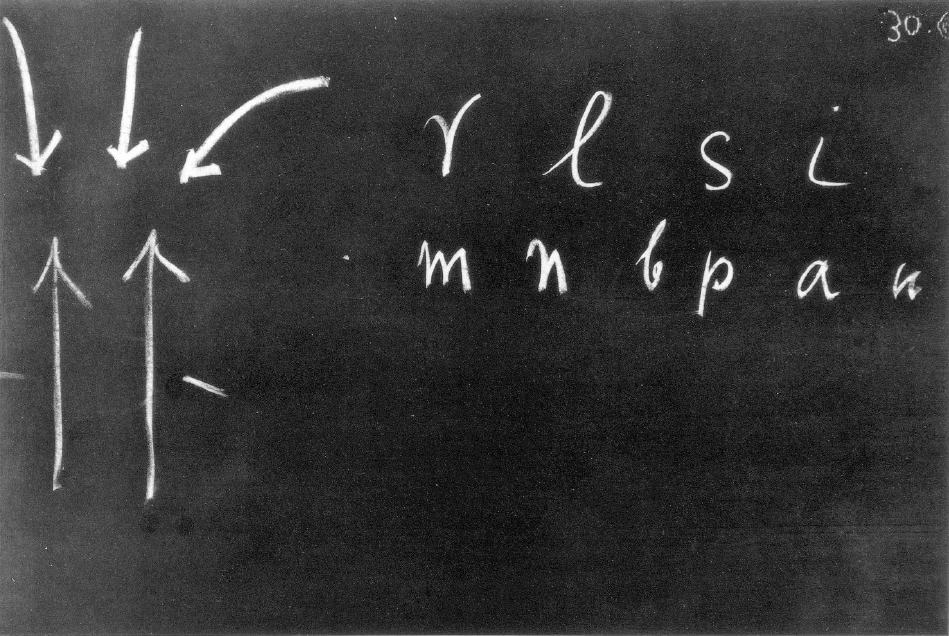
[ 23 ] Now, if one wishes to treat children with special needs properly, they should actually be grouped together every morning. If there are only a few children with special needs, one can, of course, start by bringing them all together. And something truly wonderful can come of this if the children are allowed to recite a prayer-like verse, even if there are some among them who cannot speak. There is, after all, a wonderfully balancing effect in what emerges from this choral recitation. The primary aim, therefore, will be to use rhythmic repetition to evoke specific impressions in children whose impressions tend to fade—impressions that can be changed every three to four weeks—to continually introduce such impressions from the outside and thereby reveal what lies within, so that even the protein gradually weans itself off its higher sulfur content. What is the basis for this? It is based on the fact that the inner self does not reflect these impressions back; in other words, something too weak rises from below, which is negative. If, on the other hand, we introduce something strong from above, we stimulate the weak element here to greater activity (see Plate 8).
[ 24 ] Let’s assume we have the opposite case: we are dealing with children who already show the first signs of obsessive thoughts. The reflection is too strong; there is too little sulfur in the plasma. In that case, we will really have to do the exact opposite. And it’s particularly effective when we notice that the same phrase, the same impression, keeps coming back to the child—if we now form an impression from the outside that we instinctively believe might suit this child, but convey this impression to the child as if in a very soft murmur, whispering it to the child. So the treatment can be as follows: “Look, that’s red!” — The child: “The clock is beautiful.” — The teacher: “You have to pay attention to the red!” — The child: “The clock is beautiful.” — Now try repeating a certain impression—one that is actually simply paralyzing to the first one—quieter and quieter, very softly: “Forget the clock!” — “Forget the clock!” Forget the clock! — So whisper this to the child in this manner, and you will see that, little by little, through this whispering—through this rhythmic, murmuring dismissal of the obsessive thought—the obsessive thought will gradually subside as well. It is remarkable: when it is spoken aloud, it is weakened; it gradually subsides, and eventually the child overcomes the issue, so that we have this under control as well, and in fact, an extraordinary amount can be achieved through our simple psychological treatment.
[ 25 ] Yes, these are the kinds of things one simply needs to know. Just imagine a typical school: You have a class with children who already show early signs of obsessive tendencies, though these are still mild. They aren’t placed in classes for less gifted students; instead, they remain in the regular class. But there’s a teacher who shouts so loudly that the walls seem to come crashing down. Then these children turn into complete madmen who suffer from obsessive thoughts. This wouldn’t have happened if the teacher had known that, under certain circumstances, he might need to lower his voice—and that he should have whispered gently to the children. It is crucial that we interact with children in the right way.
[ 26 ] Then, of course, especially in these cases, psychological treatment can simply be combined with conventional therapeutic methods. Naturally, when we have a child whose sensory impressions are fading, we would do well to say to ourselves: Well, first and foremost, we want to combat this child’s strong tendency toward sulfur formation in the proteins. - We can do this simply by feeding the child properly. If, for example, we give the child a lot of fruit-based foods or a lot of the kind of food derived from fruit, we will be promoting the child’s sulfuric nature. If we give the child a diet based on root vegetables—foods that are not high in sugar but high in salt—of course, we must not oversalt the soup, but rather provide foods in which the salt is naturally incorporated—then we will be able to heal such a child. And you see, one comes to understand such things by developing an eye for what is happening.
Dr. Steiner recounts an observation from his own life: The people of a certain region instinctively favored a particular diet that counteracted a common ailment prevalent in that area.
[ 27 ] Therefore, by following an appropriate diet—especially for children who will later become patients of psychoanalysts—it would be much better to treat them with a slightly salty diet during childhood rather than leaving them in the hands of a psychoanalyst.
[ 28 ] Consider the opposite case: children who do not absorb the impressions that flow back to them—those who are low in sulfur—should ideally be treated physically by teaching them to eat as much fruit as possible and by getting them used to enjoying fruit. And if the condition already appears to be strongly pathological, then one should also try to introduce them specifically to aromatic fruits—fruits with a distinct aroma. For there is a strong sulfuric element in the aroma. And if it becomes too pathological, one must proceed directly with therapeutic treatment using sulfur. But you see, it is precisely through a spiritual consideration of the matter that one arrives at the therapy to be applied in such a case. And it is important never to be satisfied with a mere description of a symptom—for then one has only the symptomatology—but rather to try, as I have described, to penetrate into the inner structure of the organism.
[ 29 ] Now you see, these are irregularities caused by the fact that, so to speak, the lower and upper parts of the human being do not fit together properly—that the impressions received by the upper part, the head organization, do not find the right resonance in the metabolic-limb organization. But it may also be the case that, overall, the ego organization, the astral organization, and the etheric-physical organization do not fit together—that, let’s say, the physical organization is too dense. Indeed, in such a case, the child is absolutely unable to submerge its astral body into this densified physical organization. Thus, an impression enters the astral body; the astral body can stimulate the corresponding astral activity of the metabolic system, but this stimulation does not carry over into the etheric body—and certainly not into the physical body. We can observe whether this is the case when we notice that the child cannot quite manage it—for example, when we say: “March a little, take five or six steps!”—The child does not quite understand what to do; that is to say, the child understands the words quite well, but cannot translate them into movement—it is as if the legs do not want to respond. We notice most clearly that the physical body is too rigid and unwilling to take in thoughts—and that the child appears mentally deficient—when we encounter difficulties with the child, when we give it a command that is to be carried out by the legs, and the child hesitates to set its legs in motion at all. Such conditions, precisely because the body seems too heavy, will be accompanied psychologically by depressive-melancholic moods. In contrast, if the legs can’t wait for any command but always want to run, then we see in the child a predisposition toward mania. It may initially manifest only very faintly, but it is in the legs that we first notice it. Therefore, we should certainly also observe what else the child does with its legs and fingers. You see, a child who loves to let its hands and legs—you can also observe this with the hands—fall onto everything, rest them everywhere, has a predisposition toward mental retardation. A child who constantly moves his fingers, touches everything, and kicks his feet around everywhere has a predisposition to become highly manic, possibly even violent. But what we notice most strongly in the limbs, we can observe in all activities; it merely appears more subtly—though particularly characteristically—in certain activities linked to mental processes. Just think for a moment how strongly the following applies to some children: They learn a certain technique—let’s say, they acquire the ability to draw a facial profile. They simply cannot stop; wherever they see a person, they want to draw that person’s facial profile. It becomes entirely mechanical. This is a very bad sign for a child. And there’s no dissuading it at all. When it’s in the midst of drawing a profile, I can say whatever I want to it, even bring it a treat—it persists; the profile simply must be drawn. This is connected to the manic nature of the excesses of intellectualism. In contrast, the urge—even when all the conditions are right—to do nothing, to not get down to work, is in turn connected to the mental deficiency that may be on the horizon.
[ 30 ] All of this shows us precisely how, by learning to control the limbs in a regular manner, we can counteract both mental retardation and mania. And there you have the direct transition—especially in the case of mentally retarded children—to therapeutic eurythmy. When you are dealing with a mentally disabled child, you need to transform their metabolic-limb system into mobility. This stimulates their spiritual life. Have the child do RLSI, and you will see how beneficial your approach is for the child. If you are dealing with a manic child—and you understand how this relates to the limb-metabolic system—have the child do MN BPAU, and you will again see how this affects their manic disposition. We must simply take into account this intimate connection—which is still present in children—between the physical-etheric and the soul-spiritual realms. Then we will also arrive at the appropriate treatment methods.