

Anthroposophical Foundations
for a Renewed Christian-religious Work
GA 342
14 June 1921, Stuttgart
Translate the original German text into any language:
Versions Available:
Anthroposophical Foundations for a Renewed Christian-religious Work, tr. SOL
Vierter Vortrag
Fourth Lecture
[ 1 ] Rudolf Steiner: Ich denke, dieses soll wieder eine Art Diskussionsstunde sein, und ich denke, Sie werden recht viel auf dem Herzen haben. Bitte, sich also ruhig auszusprechen nach allen Richtungen!
[ 1 ] Rudolf Steiner: I think this will be another kind of discussion session, and I imagine you’ll have quite a lot on your minds. So please feel free to speak your minds openly on all topics!
[ 2 ] Emil Bock: Auf dem Herzen liegt uns die Kultusfrage, weil wir von uns aus die neue Kultusform nicht gestalten können.
[ 2 ] Emil Bock: The issue of culture is close to our hearts because we cannot shape the new form of culture on our own.
[ 3 ] Rudolf Steiner: Nun, es wird ja natürlich schon notwendig sein, daß man nach dieser Richtung hin einiges Symbolisches ausbildet, daß heißt einfach, daß wir in dem Kultus, von dem wir gesprochen haben, gewissermaßen einzelne Beispiele von Kultusformen ausarbeiten. Die Gestaltung des Kultus ist ja eigentlich eine solche, daß man dazu kommt, wenn man die Voraussetzungen dazu hat. Natürlich, es handelt sich dabei durchaus darum, sich einzugewöhnen in das bildhafte Gestalten desjenigen, woran man heute so gewohnt ist, es intellektuell zu betrachten. Und Herr Uehli hat, glaube ich, heute einiges gesagt, nicht wahr, über etwas Kultusartiges, wie es in der Waldorfschule gehandhabt wird. Daß das Kultusartige schwierig zu gestalten ist, das mag Ihnen schon daraus hervorgehen, daß man seit langer Zeit allen Kultus darauf beschränkt hat, das Traditionelle zu übernehmen. Alle Kultusformen, die man heute hat, sind eigentlich uralt, nur in dem einen oder andern etwas umgestaltet. Und in der Zeit, in der der Menschheit abhanden gekommen ist die Fähigkeit, bildhaft zu gestalten, in der Zeit ist ja auch der Kultus in gewissem Sinn bekämpft worden. Vielleicht kann es Ihnen helfen zum Verständnis des Kultus, wenn wir zu dem, was wir heute morgen gesagt haben, noch einiges hinzufügen von einer ganz andersartigen Kultusgestaltung.
[ 3 ] Rudolf Steiner: Well, it will of course be necessary to develop some symbolic elements in this direction; that simply means that, in the ritual we have been discussing, we will, so to speak, work out individual examples of ritual forms. The nature of the ritual is such that one arrives at it when one has the necessary prerequisites. Of course, this is very much a matter of becoming accustomed to the pictorial shaping of that which we are so used to viewing intellectually today. And Mr. Uehli, I believe, said a few things today—didn’t he?—about a ritual-like practice as it is carried out in the Waldorf school. The fact that the cultic aspect is difficult to shape may already be evident to you from the fact that, for a long time, all cultic practice has been limited to adopting the traditional. All forms of cultic practice we have today are actually ancient, merely modified in one way or another. And during the period in which humanity lost its ability to create imagery, during that time, cultural life was, in a certain sense, also suppressed. Perhaps it will help you understand cultural life if we add a few more points to what we said this morning regarding a completely different approach to cultural life.
[ 4 ] Sie wissen ja, daß eigentlich überall da, wo wirkliche Gemeinschaft gesucht wird, innere Gemeinschaft, daß da der Kultus eine gewisse Rolle spielt. Ich erinnere Sie nur daran, daß, als die etwas bedenkliche Heilsarmeebewegung sich verbreitete, sogar diese Heilsarmeebewegung nach einem gewissen Kultus trachtete; und es ist ja auch bekannt, daß sogar die Abstinenzbewegung ganz spärliche Surrogate von Kultus hat. Überall da, wo darauf gesehen wird, daß eine richtige Gemeinschaftsbewegung erzielt werden soll, überall da wird nach irgendeiner Form des Kultus gestrebt.
[ 4 ] You know, of course, that wherever genuine community—inner community—is sought, ritual plays a certain role. I’d just like to remind you that when the somewhat questionable Salvation Army movement was spreading, even that movement sought a certain form of ritual; and it is also well known that even the temperance movement has very sparse substitutes for ritual. Wherever the goal is to achieve a genuine community movement, there is a striving for some form of ritual.
[ 5 ] Nun, eine sehr weitgehende Gemeinschaft ist ja, wie Sie wissen, die Freimaurerbewegung in der neueren Zeit. Nicht wahr, diese Freimaurerbewegung sucht auch die Pflege der Gemeinschaftsbildung durchaus durch den Kultus zu erreichen, und man kann schon sagen, die Freimaurerbewegung zeigt, wie der Kultus werden muß, wenn er übergeht in eine rein materialistische Bewegung. Denn eigentlich ist ja die Freimaurerbewegung die materialistische Form einer geistigen Bewegung.
[ 5 ] Well, as you know, the Masonic movement in modern times is indeed a very extensive community. Isn’t it true that this Masonic movement also seeks to foster community-building through its rituals, and one could certainly say that the Masonic movement demonstrates what rituals become when they evolve into a purely materialistic movement? For in reality, the Masonic movement is the materialistic form of a spiritual movement.
[ 6 ] Sehen Sie, die Freimaurerbewegung hat im wesentlichen zu ihren Kultushandlungen und Kultussymbolen das Geheimnis der menschlichen Wesenheit. Wenn Sie den Menschen betrachten und das eigentliche Wesen des Menschen in seinem Zusammenhang mit der Welt studieren wollen, dann wird Ihnen heute der materialistisch gesinnte Forscher sagen: Der Mensch hat eigentlich nur dieselben Muskelformen, dieselben Knochenformen wie die höheren Tiere, sogar dieselbe Zahl dieser organischen Formen — er ist ein höher ausgebildetes Tier, ein umgestaltetes Tier. Das ist ja doch dasjenige, was mehr oder weniger klar ausgesprochen unserer gegenwärtigen Erkenntnis zugrunde liegt. Diese Erkenntnis wird sogleich [aus dem Felde] geschlagen, wenn man Rücksicht darauf nimmt, wie der Mensch sich ganz anders eingliedert in den gesamten Kosmos [als das Tier]. Das Wesentliche des Tieres — wenn man einzelne Abweichungsformen, die ja überall sind, nicht berücksichtigt, das Wesentliche des Tieres ist doch, daß seine Rückgratlinie auf die Horizontale hin gebaut ist. Bitte, mißverstehen Sie nicht, was ich damit meine. Es kann natürlich sich ein Tier so aufsetzen wie das Känguruh, und dadurch kann scheinbar seine Rückgratlinie einen Winkel bilden mit der Horizontalen. Das ist aber eigentlich nicht in der organischen Konstitution bedingt. Ebenso können gewisse Vögel, Papageien, eine mehr oder weniger aufrechte Stellung haben; es ist aber nicht der plastische Bau des Tieres darauf angelegt, die Rückgratlinie aus der Horizontalen herauszuheben. Dagegen ist das Wesentliche des Menschen die Bildung seiner Rückgratlinie in vertikaler Richtung. Der Mensch hat also die Rückgratlinie in vertikaler Richtung gebildet. Dies gibt eine von den wesentlichen Charakteristiken zur Unterscheidung des Menschen von der Tierwelt. Sie müssen eben nur bedenken, daß man ein Wesen in der Welt nicht bloß für sich betrachten kann.
[ 6 ] You see, the secret of human nature is essentially at the heart of the Masonic movement’s rituals and symbols. If you observe human beings and wish to study the true nature of humanity in its relationship to the world, then today a materialistically minded researcher will tell you: Human beings essentially have the same muscular structures and the same skeletal structures as higher animals, and even the same number of these organic structures—they are a more highly developed animal, a transformed animal. After all, this is precisely what, more or less clearly articulated, underlies our current understanding. This understanding is immediately swept aside when one considers how human beings integrate themselves into the entire cosmos in a completely different way [than animals]. The essential characteristic of the animal—if one disregards individual variations, which are, of course, everywhere—is that its spinal axis is oriented horizontally. Please do not misunderstand what I mean by this. Of course, an animal can stand upright like a kangaroo, and as a result, its spinal axis may appear to form an angle with the horizontal. But this is not actually determined by its organic constitution. Similarly, certain birds, such as parrots, can assume a more or less upright posture; yet the animal’s physical structure is not designed to raise the spinal axis above the horizontal plane. In contrast, the essential characteristic of the human being is the formation of the spinal axis in a vertical direction. Humans have thus formed their spinal line in a vertical direction. This is one of the essential characteristics that distinguishes humans from the animal kingdom. You simply have to bear in mind that a being in the world cannot be considered in isolation.
[ 7 ] Sehen Sie, wenn jemand eine Magnetnadel betrachtet, so wird es ihm nicht einfallen zu sagen, diese Magnetnadel nimmt eine bestimmte Richtung ein durch dasjenige, was nur in ihr ist, sondern er sagt ganz natürlich, die Erde hat einen magnetischen Nord- und Südpol, die Magnetnadel wird gerichtet durch die ganze Erde. Nur beim Organischen gefällt es dem Menschen, alles dasjenige, was im Organismus ist, nur aus dem Organismus selber erklären zu wollen, den Menschen gar nicht in Beziehung zu bringen zum ganzen Weltall. Derjenige, der aber die Dinge durchschaut, bringt auch den Organismus in Beziehung zum ganzen Weltall. Da stellt sich die Sache doch so, daß durch das ganze Weltall Systeme von Kräften gehen; [die einen] umkreisen die Erde [horizontal], [die anderen wirken] so, daß diese Horizontalkräfte von Kräften durchsetzt sind, die in der radialen Richtung gehen, so daß der Mensch seine Rückgratlinie einstellt in der Richtung der radialen Kräfte. Damit gliedert er sich ganz anders dem Weltall ein, als das Tier eingegliedert ist, das sein Rückgrat, also die wichtigste körperliche Linie, in die Horizontale, also in eine Parallele mit der Erdoberfläche eingliedert. Nun, darauf beruht noch manches andere.
[ 7 ] You see, when someone looks at a magnetic needle, it would not occur to them to say that this magnetic needle points in a certain direction because of something that exists only within it; rather, they would quite naturally say that the Earth has a magnetic north and south pole, and that the magnetic needle is aligned with the entire Earth. It is only when it comes to the organic realm that people feel compelled to explain everything within the organism solely in terms of the organism itself, without relating the human being to the entire universe at all. But those who see through these things also relate the organism to the entire universe. The situation is actually this: systems of forces run through the entire universe; [some] circle the Earth [horizontally], [while others act] in such a way that these horizontal forces are interwoven with forces that run in a radial direction, so that the human being aligns his spinal column in the direction of the radial forces. In this way, he integrates himself into the universe quite differently than the animal does, which aligns its spine—that is, its most important physical axis—horizontally, that is, parallel to the Earth’s surface. Well, many other things are based on this as well.
[ 8 ] Sehen Sie, das menschliche Gehirn, das ja 1300 bis 1400 Gramm schwer ist, es würde, wenn es sein volles Gewicht ausüben würde, sofort alle Blutgefäße, die darunter sind unter dem Gehirn, erdrükken. Das Gehirn ist [durch sein Gewicht] durchaus geeignet, die Blutgefäße zu erdrücken. Warum erdrückt das Gehirn sie nicht? Weil das Gehirn eingebettet ist im Gehirnwasser. Das Gehirnwasser oszilliert durch den Arachnoidalraum, den die Rückenwirbelsäule innerlich bildet; da strömt das Gehirnwasser unter dem Einfluß des Atmens auf und ab. Das ganze Gehirn schwimmt im Gehirnwasser. Aus der Physik wissen Sie vielleicht, daß ein Körper so viel an Gewicht verliert, als das verdrängte Flüssigkeitsvolumen wiegt, so daß das Gehirn statt mit 1300 bis 1400 Gramm zu drücken, höchstens mit 20 Gramm auf die Blutgefäße drückt. Sie sehen also, das menschliche Gehirn ist darauf eingerichtet, nicht in seiner Schwere zu beharren, sondern einen Auftrieb zu haben, sich zu entreißen der Schwere. Das ist nur möglich, wenn der Mensch die Rückgratlinie vertikal hat. Beim Tier drückt die ganze Schwere des Gehirns, und zwar deshalb, weil der Arachnoidalraum horizontal hineingeht in das Gehirn. Die Zirkulation, die bewirkt wird, geht in ganz anderer Weise vor sich.
[ 8 ] You see, the human brain, which weighs between 1,300 and 1,400 grams, would—if it exerted its full weight—immediately crush all the blood vessels located beneath it. The brain is certainly capable [due to its weight] of crushing the blood vessels. Why doesn’t the brain crush them? Because the brain is embedded in cerebrospinal fluid. The cerebrospinal fluid oscillates through the subarachnoid space formed internally by the spinal column; there, under the influence of breathing, the cerebrospinal fluid flows up and down. The entire brain floats in the cerebrospinal fluid. From physics, you may know that a body loses as much weight as the volume of fluid it displaces, so that instead of exerting a pressure of 1,300 to 1,400 grams, the brain exerts a pressure of at most 20 grams on the blood vessels. So you see, the human brain is designed not to remain weighed down by its own heaviness, but to have buoyancy, to free itself from that heaviness. This is only possible when a person’s spine is vertical. In animals, the entire weight of the brain exerts pressure, precisely because the subarachnoid space extends horizontally into the brain. The resulting circulation takes place in a completely different way.
[ 9 ] Man darf nicht bloß auf den Bau des Menschen schauen, sondern man muß auch auf die Hineinstellung ins Weltall schauen. So daß man sagen kann: Wenn man die hervorragende Stellung des Menschen im Weltall betrachtet, so ergeben sich vor allen Dingen mehrere wichtige Linien. (Es wird an die Tafel gezeichnet.)
[ 9 ] One must not merely consider the physical structure of human beings, but must also consider their place in the universe. Thus, one can say: When one considers the exceptional position of human beings in the universe, several important themes emerge above all else. (A diagram is drawn on the board.)
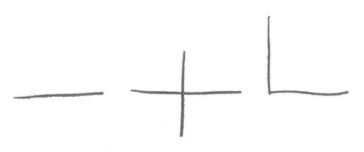
[ 10 ] Erstens die Linie parallel zu der Erdoberfläche, die Horizontale. Zweitens dasjenige, was den Menschen unterscheidet von dem Tier, daß bei ihm die Rückgratlinie vertikal steht auf der Horizontalen. Damit haben Sie zwei Gebilde hingezeichnet; erstens die Horizontale, also die Waagrechte, und zweitens den rechten Winkel. Wenn man sich bewußt ist, welche Bedeutung die Horizontale hat, die die Tierheit schafft im Grunde genommen, und welche Bedeutung der rechte Winkel hat für die Hineinstellung des Menschen in das Weltall, dann verbindet man gewisse Vorstellungen mit der Horizontalen und mit dem rechten Winkel, die dadurch zu Symbolen werden können.
[ 10 ] First, the line parallel to the Earth’s surface—the horizontal. Second, what distinguishes humans from animals is that in humans, the spine stands vertically relative to the horizontal. You have thus drawn two lines; first, the horizontal line, and second, the right angle. When one is aware of the significance of the horizontal line—which, in essence, gives rise to animality—and of the significance of the right angle for humanity’s place in the universe, then one associates certain ideas with the horizontal line and the right angle, which can thereby become symbols.
[ 11 ] Das Freimaurertum, das das Wesen des Menschen charakterisieren will, hat die Wasserwaage und den rechten Winkel unter seinen Symbolen. Auch die anderen Symbole sind durchaus nachgebildet den Kräften des Weltalls. Wie sie nachgebildet sind den Kräften des Weltalls, das kann sich Ihnen ergeben noch aus der folgenden Betrachtung.
[ 11 ] Freemasonry, which seeks to characterize the essence of humanity, includes the level and the right angle among its symbols. The other symbols, too, are clearly modeled after the forces of the universe. How they are modeled after the forces of the universe will become clear to you from the following discussion.
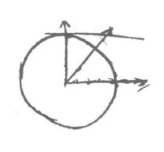
[ 12 ] Sehen Sie, wenn wir hier uns die Erde denken; der Mensch bewegt sich auf der Erde, sagen wir so, ich will es also radial zeichnen, dann ist es so, daß der Mensch hier in der Vertikalen seine Richtung hat und daß die Art, wie er sich verbindet mit dem Erdmittelpunkt, ein Dreieck ist. Sie haben wiederum das Dreieck als ein Symbolum im Kultus der Freimaurer. Alles in dieser Freimaurerei ist — im ersten Grad — von der Konfiguration des Menschen genommen. Da sehen Sie die Herausbildung der Symbolik. Die Symbolik ist da, wo sie auftritt in ihrer Wirklichkeit, nicht willkürlich ausgedacht. Zur Symbolik kommt man nur, wenn man sie studiert an der Wirklichkeit. Die Symbolik ist im Weltall begründet, sie ist irgendwo da. So ist es auch mit dem Kultus.
[ 12 ] You see, if we imagine the Earth here; the human being moves on the Earth—let’s put it that way—so I’ll draw it radially. Then it is the case that the human being has his direction here along the vertical axis, and that the way he connects to the center of the Earth forms a triangle. You also find the triangle as a symbol in the Masonic tradition. Everything in Freemasonry—in the first degree—is derived from the human form. There you see the development of symbolism. Symbolism, where it occurs in reality, is not arbitrarily invented. One arrives at symbolism only by studying it in relation to reality. Symbolism is rooted in the universe; it is there somewhere. The same is true of the ritual.
[ 13 ] Sehen Sie, der Mensch ist in seinem zeitlichen Leben zwischen Geburt und Tod so konstituiert, daß er die Kräfte in sich hat, die ihn fortwährend töten. Das sind die Kräfte, die ihn verfestigen, die wirksam sind, indem das Knochensystem entsteht, und die in ihrem krankhaften Sichausbilden zur Sklerose, zur Gicht, zur Diabetes und so weiter führen können. Diese Kräfte hat der Mensch in sich, ich möchte sagen, als die Verfestigungskräfte. Das ist das eine Kräftesystem. Das andere Kräftesystem, das der Mensch in sich hat, ist dasjenige, was ihn fortwährend verjüngt. Es ist das Kräftesystem, das besonders zum Ausdruck kommt, wenn man in Pleuritis verfällt, in Fieberkrankheiten, in alles dasjenige, was den Menschen innerlich verbrennt. Ich habe in der anthroposophischen Weltanschauung die Verfestigungskräfte ahrimanische Kräfte, und die Kräfte, die ins Fieber führen, die also Wärmekräfte sind, die luziferischen Kräfte genannt. Beide Kräfte müssen im Menschen in fortwährendem Gleichgewicht gehalten werden. Werden sie nicht im Gleichgewicht gehalten, dann führen sie den Menschen leiblich, seelisch und geistig zu irgendeinem verderblichen Extrem. Würden die Fieberkräfte und die Verfestigungskräfte, die Salzbildungskräfte nicht fortwährend physiologisch im Gleichgewicht gehalten, so würde der Mensch notwendigerweise entweder zur Sklerose oder zum Fieber kommen. Wenn der Mensch nur ausbildet die Verstandeskräfte, wenn er nur zum Intellektualismus hinneigt, verfällt er dem Ahrimanischen; bildet er nur die feurigen Elemente aus, die Leidenschaft, das Emotionelle, dann verfällt er dem Luziferischen. Und so ist immer der Mensch zwischen zwei Polaritäten drinnen und muß das Gleichgewicht halten. Denken Sie aber, wie schwierig es ist, das Gleichgewicht zu halten. Das Pendel, das im Gleichgewicht sein soll, tendiert immer nach einem Ausschlag hin. Es sind diese drei Tendenzen: die Gleichgewichtstendenz, die Wärmetendenz und die Verfestigungstendenz in dem Menschen. Er muß sich aufrecht erhalten, so daß man den Menschen symbolisch erblicken kann als ein Wesen, das fortwährend sich aufrecht zu erhalten sucht gegen die Kräfte, die fortwährend sein Leben gefährden.
[ 13 ] You see, in the course of a person’s earthly life between birth and death, human beings are constituted in such a way that they possess within themselves the forces that are constantly killing them. These are the forces that solidify the human being, which are active in the formation of the skeletal system, and which, when they develop pathologically, can lead to sclerosis, gout, diabetes, and so on. Human beings possess these forces within themselves; I would call them the solidifying forces. That is one system of forces. The other system of forces that human beings possess is the one that continually rejuvenates them. It is the system of forces that is particularly evident when one suffers from pleurisy, febrile illnesses, and everything that burns within a person. In the anthroposophical worldview, I have called the solidifying forces “Ahrimanic forces,” and the forces that lead to fever—which are thus heat forces—“Luciferic forces.” Both forces must be kept in a constant balance within the human being. If they are not kept in balance, they lead the human being physically, psychically, and spiritually to some destructive extreme. If the forces of fever and the solidifying forces—the forces of salt formation—were not constantly kept in physiological balance, human beings would inevitably develop either sclerosis or fever. If a person develops only the powers of reason, if they lean solely toward intellectualism, they fall prey to the Ahrimanic; if they develop only the fiery elements—passion and emotion—then they fall prey to the Luciferic. And so human beings are always caught between two polarities and must maintain a balance. But consider how difficult it is to maintain that balance. The pendulum, which is supposed to be in equilibrium, always tends toward one extreme or the other. These are the three tendencies within the human being: the tendency toward balance, the tendency toward warmth, and the tendency toward solidification. The human being must maintain its upright posture, so that one can symbolically view the human being as a being that constantly strives to remain upright against the forces that continually endanger its life.
[ 14 ] Das stellt der dritte Grad des Freimaurertums dar. Dem Freimaurer, der in den dritten Grad eingeweiht wird, wird symbolisch dargestellt, wie der Mensch bedroht wird von drei widerspenstigen Mächten, die an ihn herankommen und sein Leben bedrohen. Es wird das in verschiedener Weise gemacht. Die einfachste Form ist so: Ein Mensch wird in einem Sarge vorgeführt und drei Mörder schleichen sich heran, die ihn töten wollen. Im Anschauen dieser dreifachen Gefahr, in der der Mensch schwebt, wird ihm ein Bewußtsein beigebracht, daß er in jedem Augenblick in der Gefahr des Todes stehe und sich erheben muß.
[ 14 ] This represents the third degree of Freemasonry. The Freemason who is initiated into the third degree is shown, symbolically, how humanity is threatened by three hostile forces that approach him and endanger his life. This is done in various ways. The simplest form is as follows: A man is presented in a coffin, and three murderers creep up on him, intent on killing him. By witnessing this threefold danger in which the man finds himself, he is made to realize that he is in mortal danger at every moment and must rise above it.
[ 15 ] So erlebt der Mensch in dieser symbolischen Einkleidung eine Art wirklicher Kultushandlung, er erlebt zeremoniell etwas wirklich Wichtiges, das mit dem Leben zusammenhängt. Und so ist es ja wirklich, daß man versuchen muß, das Leben kennenzulernen, denn dann ergeben sich aus dem Leben heraus die Symbole. Die Freimaurerei hat ja ihre Schattenseiten darin, daß zwar diese Symbole gebraucht werden, Kultushandlungen verrichtet werden — in der Blauen Maurerei in den ersten drei Graden, in der Hochgrad-Maurerei gibt es noch viele andere Dinge — und daß dieses Zeremonielle aus uralten Traditionen geschöpft ist, daß sie aber nicht mehr verstanden werden. Es besteht gar kein Zusammenhang mehr mit den Ursprüngen, die ich Ihnen jetzt in einer kleinen Skizze darlegen wollte. Die Leute schauen sich nur das Zeremoniell an, und — und das ist das Gefährliche —: sie bleiben am Zeremoniell haften; sie werden nicht so hineingeführt in das Zeremoniell, um durch das Zeremoniell auf das Geistige zu kommen.
[ 15 ] In this symbolic attire, a person experiences a kind of genuine ritual; ceremonially, they experience something truly important that is connected to life. And indeed, it is true that one must strive to get to know life, for it is from life itself that the symbols emerge. Freemasonry does have its dark side in that, although these symbols are used and ritual acts are performed—in Blue Masonry in the first three degrees, and in High-Degree Masonry there are many other elements—and although this ceremonial is drawn from ancient traditions, these traditions are no longer understood. There is no longer any connection whatsoever to the origins, which I wanted to outline for you briefly just now. People merely look at the ceremonial, and—and this is the danger—they become fixated on the ceremonial; they are not guided into the ceremonial in such a way as to arrive at the spiritual through it.
[ 16 ] Sehen Sie, eine andere Art, wie man noch verhältnismäßig spät, sogar noch im 18. Jahrhundert, eine ganz lebhafte Empfindung gehabt hat von dem bildhaften Vergegenwärtigen der Weltgeheimnisse, ist zum Beispiel diese: Sie sehen, wenn Sie manche Bücher aufschlagen mit Bildern, die noch im 18. Jahrhundert verbreitet waren — die waren verbreitet, um die Menschen auf dasjenige aufmerksam zu machen, was nicht in Verstandesbegriffen zu fassen ist —, Sie sehen da ein immer wieder kehrendes Bild, das ist das, daß Sie einen Mann dargestellt finden mit einem Stierkopf und eine Frau dargestellt finden mit einem Löwenkopf. Es stehen nebeneinander der Mann mit dem Stierkopf und die Frau mit dem Löwenkopf. Zunächst ist die Sache für denjenigen, der die Sache nicht durchschaut, schockierend. Aber es ist ja wirklich so, daß wir Menschen eigentlich so konstituiert sind, daß wir formhaft am allervollkommensten sind in unserem physischen Leib. Da sind wir eigentlich Menschen. Der physische Leib ist ja, wie Sie in meiner «Geheimwissenschaft» dargestellt finden, derjenige, der auf die ältesten Anlagen zurückgeht; er ist das Vollkommenste. Des Menschen Ätherleib ist so geformt wie der physische Leib. Könnte man den physischen Leib wegnehmen von dem Ätherleib, würde er nur mehr sich anpassen dem Astralleib, dann würde dieser Ätherleib wahrscheinlich zum Verdruß sehr vieler Menschen eine Tierform annehmen, denn dann wird er der Ausdruck des Emotionellen, des Leidenschaftlichen. Er ist in der verschiedensten Weise gestaltet bei verschiedenen Menschen.
[ 16 ] You see, another example of how, even relatively late—as late as the 18th century—people still had a very vivid sense of the pictorial representation of the world’s mysteries is this: You see, when you open certain books with illustrations that were still common in the 18th century—which were used to draw people’s attention to that which cannot be grasped by intellectual concepts—you’ll find a recurring image: a man depicted with a bull’s head and a woman depicted with a lion’s head. The man with the bull’s head and the woman with the lion’s head stand side by side. At first glance, this is shocking to those who do not understand it. But the fact is that we human beings are actually constituted in such a way that we are most perfect in form within our physical body. That is where we are truly human. The physical body, as you will find described in my Occult Science, is the one that goes back to the most ancient structures; it is the most perfect. The human etheric body is shaped like the physical body. If one could remove the physical body from the etheric body—leaving it to adapt only to the astral body—then this etheric body would probably take on an animal form, much to the chagrin of many people, for it would then become the expression of the emotional and the passionate. It is shaped in a wide variety of ways in different people.
[ 17 ] Wenn man den männlichen Kopf, den Ätherkopf, betrachtet als Ausdruck desjenigen, was in der emotionellen Natur lebt, so hat man schon als Typus, als Durchschnitt, etwas Stierhaftes im männlichen Kopf. Im Frauenkopf, sobald man den Ätherkopf betrachtet, hat man etwas Löwenhaftes. Das sind Durchschnittsformen. Man kann das auch moralisch empfinden, wenn man sich einläßt auf das, was die Frauennatur umfaßt, wie sie Typus ist des Löwenhaften. Man kann den Stier beim Mann fühlen und den Löwen bei der Frau fühlen.
[ 17 ] If one considers the male head—the etheric head—as an expression of what lives in the emotional nature, then even as a type, as an average, there is something Taurus-like in the male head. In the female head, as soon as one considers the etheric head, there is something lion-like. These are average forms. One can also perceive this morally when one engages with what female nature encompasses, as it is a type of the lion-like. One can sense the bull in the man and the lion in the woman.
[ 18 ] Das sind Dinge, die scheinen bloß bildlich gesprochen zu sein, sie sind aber aus der übersinnlichen Natur [des Menschen] herausgeholt. Wenn der astralische Leib [aus dem physischen Leib] herausgenommen [betrachtet wird], dann nimmt er komplizierte Pflanzenformen an, und das Ich des Menschen ist ein rein mineralisch, kristallhaft geformtes Wesen, es ist ganz geometrisch geformt. So daß man sagen kann: Der Form nach ist der Mensch im physischen Leib Mensch, im Ätherleib ist er eigentlich tierisch, im Astralischen pflanzenhaft und im Ich mineralhaft geformt. Wenn man all diese Dinge kennt, dann kommt man darauf, wie in einem früheren hellsichtigen Zustande die Leute wirklich gewußt haben von höheren Welten und aus diesen höheren Welten heraus sich diese Bilder geformt haben.
[ 18 ] These are things that seem to be merely figurative, but they are drawn from the supersensible nature [of the human being]. When the astral body is separated from the physical body and observed, it takes on complex plant-like forms, and the human ego is a being of purely mineral, crystalline form; it is entirely geometrically shaped. So one can say: In terms of form, the human being is human in the physical body, animal-like in the etheric body, plant-like in the astral body, and mineral-like in the “I.” When one understands all these things, one realizes how, in an earlier clairvoyant state, people truly knew of higher worlds and how these images took shape from within those higher worlds.
[ 19 ] Nun, das soll nur darauf hinweisen, wie Symbole entstanden sind und wie sie sich dann traditionell fortgepflanzt haben. In unserer Zeit ist es nur möglich zu Symbolen zu kommen, wenn man sich ganz liebevoll vertieft in die Weltgeheimnisse; und nur aus Anthroposophie heraus kann heute eigentlich ein Kultus oder eine Symbolik erwachsen.
[ 19 ] Well, this is simply meant to illustrate how symbols came into being and how they have traditionally been passed down. In our time, it is only possible to arrive at symbols by immersing oneself with great devotion in the mysteries of the world; and today, a cult or a system of symbolism can truly arise only from anthroposophy.
[ 20 ] Denn sehen Sie, es ist schon notwendig, daß da von den Elementen ausgegangen wird. Das erste ist, daß man wiederum in einem gewissen Sinn hineinwächst in den Genius der Sprache selbst. Unsere Sprache hat ja im Grunde genommen gerade da, wo die Zivilisation am höchsten ist, eine furchtbar äußere abstrakte Form angenommen. Wir reden heute, ohne zu fühlen im Reden. Sehen Sie, unser heutiges Reden ist eigentlich etwas furchtbar Unmenschliches, denn wir leben gar nicht mehr drinnen in unserer Sprache. Nehmen Sie einmal das deutsche Wort «Kopf». Wenn wir es fühlen, so fühlen wir zugleich, wie es durchaus zusammenhängt mit der runden Form, mit dem Abgerundeten. Sagen wir dagegen das romanische Wort «testa», das hängt zusammen mit dem Testieren, Bezeugen, irgend etwas Festsetzen. Es geht also aus einem ganz anderen Untergrund hervor. Und fühlt man, was in den beiden Worten liegt, so fühlt man auch den Unterschied zwischen dem romanischen und dem germanischen Element. Das germanische Element bildet das Wort aus der Plastik, das romanische, das lateinische Element bildet es aus den seelischen Kundgebungen. Nehmen Sie das Wort «Fuß», das hängt mit «Furche» zusammen; «pied» hängt zusammen mit dem Aufstellen. Das geht überall durch die Sprache, und man kann es überall fühlen, wie eigentlich die besondere Weltempfindung im Genius der Sprache zum Vorschein kommt. Bedenken Sie, wie stark man in der Zeit, in der Goethe geschrieben hat, noch gefühlt hat das Bildhafte der Sprache. Erinnern Sie sich an die Szene, wo der Pudel erscheint auf der Bühne, der da nachläuft dem Faust und dem Wagner, und wo der Wagner vom Pudel spricht und sagt: «er zweifelt» — er meint damit, daß er den Schwanz bewegt; mit dem Wort «zweifeln» drückt er die Bewegung des Schwanzes aus. Wenn Sie das anschauen, was da noch im Bilde lebt, und es vergleichen mit unseren heutigen Abstraktionen, wie Sie da in dem Wort «Zweifel» dieses Wedeln, dieses Hin- und Herpendeln drinnen haben, so kann man sich wirklich in die bildhafte Art, wie der Sprachgenius gewirkt hat, allmählich hineinfühlen.
[ 20 ] For you see, it is indeed necessary to start with the basic elements. The first is that, in a certain sense, one must grow into the genius of language itself. Our language has, after all, taken on a terribly external, abstract form precisely where civilization is at its highest. Today we speak without feeling as we speak. You see, the way we speak today is actually something terribly inhuman, because we no longer live within our language at all. Take, for example, the German word “Kopf.” When we feel it, we simultaneously feel how it is thoroughly connected to the round shape, to the rounded. In contrast, take the Romance word “testa,” which is connected to testifying, bearing witness, or establishing something. It thus springs from an entirely different foundation. And if one senses what lies within these two words, one also senses the difference between the Romance and the Germanic elements. The Germanic element forms the word from plasticity; the Romance, or Latin, element forms it from expressions of the soul. Take the word “Fuß” (foot)—it is related to “Furche” (furrow); “pied” is related to the act of standing upright. This runs throughout the language, and one can sense it everywhere—how the particular worldview actually comes to light in the genius of the language. Consider how strongly people in Goethe’s time still felt the pictorial nature of language. Recall the scene where the poodle appears on stage, running after Faust and Wagner, and where Wagner speaks of the poodle and says, “He doubts”—by which he means that the dog is wagging its tail; with the word “doubt,” he expresses the movement of the tail. If you look at what still lives in the imagery there and compare it with our abstractions today—how the word “doubt” contains this wagging, this back-and-forth swaying—then you can truly begin to appreciate the vivid, pictorial way in which this linguistic genius worked.
[ 21 ] Das ist das erste Element des bildhaften Seelenlebens, wenn man sich in das Bildhafte der Sprache hineinlebt. Es ist wirklich so, daß man in das Bildhafte der Sprache hineinwächst, wenn man es nur will; und das ist schon eine gute Erziehung der Seele, in das Bildhafte der Sprache hineinzuwachsen. Wir reden heute in abstracto, die Worte bedeuten nichts mehr für uns. Sehen Sie, in meiner Heimat heißt ein gewisser Blitz, den man in einer besonderen Art sieht, «Himmlatzer». Ich möchte wissen, wie man das Bild des Blitzes nicht fühlen sollte in «Himmlatzer», das Wort malt ja. Und so ist es auch durchaus möglich, wenn man mehr in das Dialektartige, in die Dialekte hinuntergeht, noch mehr in das Bildhafte hineinzuwachsen. Man sollte sich schon dazu erziehen, an der Sprache das Bildhafte zu haben. Es ist heute manchmal fast gar nicht möglich, irgend etwas, was man hat, auszudrücken, weil das Bildhafte der Sprache verlorengegangen ist. Man muß natürlich absehen von allen künstlich herbeigeführten Dingen. Wer irgendwie spintisiert, dem geht es so, wie es dem Falb gegangen ist. Der ging einmal mit einem Freund und sprach lebhaft — und trat in einen Tümpel hinein, und denkt nach — Tümpel? — Tempel! — Natürlich, so spintisieren darf man nicht, indem man äußerliche Ähnlichkeiten sucht. Gerade innerlich muß man sich vertiefen in das Bildhafte der Sprache. Dann wird man wirklich das Wort «Zwei» verstehen. Es war ursprünglich die «Zwei» nicht so gedacht, daß man eins und eins zusammenlegte, sondern die «Zwei» war so gedacht, daß man die Eins entzwei machte. Das ältere Bilden der Zahlen beruht auf der Analyse, nicht auf der Synthese. Sie können das noch verfolgen, wenn Sie zum Beispiel die arabische Arithmetik noch im 12. nachchristlichen Jahrhundert nehmen.
[ 21 ] This is the first element of the pictorial life of the soul when one immerses oneself in the pictorial nature of language. It is truly the case that one grows into the pictorial nature of language if one is only willing to do so; and growing into the pictorial nature of language is in itself a good education for the soul. Today we speak in the abstract; words no longer mean anything to us. You see, in my homeland, a certain kind of lightning—seen in a particular way—is called “Himmlatzer.” I’d like to know how one could fail to sense the image of lightning in “Himmlatzer”; after all, the word paints a picture. And so it is also entirely possible, if one delves deeper into dialectal expressions and dialects, to grow even more into the imagery. One really ought to train oneself to find the imagery in language. Today it’s sometimes almost impossible to express anything one has, because the imagery of language has been lost. Of course, one must disregard all artificially contrived things. Anyone who engages in such flights of fancy ends up just like Falb did. He was once walking with a friend and talking animatedly—and stepped into a pond, and thought to himself—pond?—temple!—Of course, one must not engage in such flights of fancy by seeking external similarities. One must delve into the imagery of language from within. Then one will truly understand the word “two.” Originally, “two” was not conceived as adding one and one together, but rather as splitting the one in two. The older conception of numbers is based on analysis, not synthesis. You can still trace this, for example, in Arabic arithmetic as late as the 12th century A.D.
[ 22 ] Es ist jetzt ein interessantes Büchlein von unserem Freund Ernst Müller erschienen über Abraham Ibn Esra — ich will Ihnen den genauen Titel morgen angeben —, das handelt von den Zahlen und ist außerordentlich interessant für die Erkenntnis der früheren Art, Zahlen zu bilden. [Wenn man das verfolgt,] dann wird man finden, ohne Spintisierereien zu machen, die Ähnlichkeit des Wortes «zwei» wiederum mit dem Wort «Zweifel»; man wird da geführt auch auf den Auslaut «el». So kann man sich in das Bildhafte der Sprache hineinfinden. Das ist das Abc des bildhaften Vorstellens.
[ 22 ] An interesting little book by our friend Ernst Müller has just been published about Abraham Ibn Esra—I’ll give you the exact title tomorrow—which deals with numbers and is extraordinarily interesting for understanding the earlier way of forming numbers. [If one follows this line of thought,] one will discover, without resorting to speculation, the similarity between the word “two” and the word “doubt”; one is also led to the final sound “el.” In this way, one can find one’s way into the pictorial nature of language. This is the ABC of pictorial imagination.
[ 23 ] Das weitere ist das Sichhineinfinden in die ganze komplizierte Art, wie zum Beispiel der Mensch aufgebaut ist. Einiges habe ich als Probe heute angegeben. Wie gesagt, gelangt man auf diese Weise zu wirklicher Erkenntnis, dann ergeben sich die Bilder zunächst für die Symbolik, und wiederum kommt man dazu, das geschichtliche Leben wirklich zu begreifen. Dann kommen Sie auch dazu, Kultushandlungen imaginativ vor sich haben zu können.
[ 23 ] The next step is to familiarize oneself with the entire complex nature of, for example, the human being. I have given a few examples today. As I said, if one arrives at true knowledge in this way, the images first emerge for the symbolism, and in turn, one comes to truly understand historical life. Then you will also be able to visualize ritual acts in your imagination.
[ 24 ] Nehmen Sie zum Beispiel folgendes. Sehen Sie, der Grieche hatte noch nicht die Möglichkeit, die Begriffe ganz abgesondert von den Dingen zu haben. So wie wir die Farben wahrnehmen, so nahm der Grieche die Begriffe an den Dingen wahr, sie waren für ihn Wahrnehmungen. Wenn wir davon ausgehen, dann kommen wir wirklich dazu, zu begreifen, wie die Menschheit sich seit der Griechenzeit verändert hat. Würde man zum Beispiel eine Art Altar darstellen wollen, der mehr geeignet wäre für den Griechen, so würde man ihn in hellen Farben darstellen. Wollte man einen Altar darstellen, der geeignet ist für einen Menschen, der mehr im Modernen lebt, der nicht hingeordnet ist auf die lebhaften Farben — der Grieche hatte ja keine Farbwahrnehmungen in dem Sinn, wie wir sie haben —, sie müßten ihn heute mehr in blauer Farbe bauen.
[ 24 ] Take the following example. You see, the Greeks did not yet have the ability to conceive of concepts entirely separate from things. Just as we perceive colors, so did the Greeks perceive concepts in things; for them, they were perceptions. If we start from this premise, we can truly come to understand how humanity has changed since the time of the Greeks. If, for example, one wanted to depict a kind of altar that would be more suitable for the Greeks, one would depict it in bright colors. If one wanted to depict an altar suitable for a person who lives more in the modern world—one who is not attuned to vivid colors (after all, the Greeks did not perceive color in the same way we do)—one would have to build it today using more blue tones.
[ 25 ] Wenn man heute mit dem Kultus vor eine Gemeinde hintreten will, müßte man ihn außerordentlich einfach gestalten. Ein komplizierter Kultus würde heute die Menschen nicht befriedigen, so daß man ihn außerordentlich einfach gestalten muß. Vor allen Dingen brauchen wir im Kultus überall einen Ausdruck für die innere Verwandlung des Menschen. Diese innerliche Verwandlung des Menschen, die man nennen könnte die Durchchristung des Menschen — denn der Mensch wird eigentlich durchaus nicht so geboren, daß er schon von vornherein vererbungsgemäß durchchristet ist, er muß den Christus in sich finden —, die ließe sich nun in der mannigfaltigsten Weise symbolisch ausdrücken durch einfache, aber wirkungsvolle Kultushandlungen.
[ 25 ] If one were to present a worship service to a congregation today, it would have to be designed to be extremely simple. A complicated worship service would not satisfy people today, so it must be designed to be extremely simple. Above all, we need the worship service to express, in every aspect, the inner transformation of the human being. This inner transformation of the human being—which one might call the “Christification” of the human being—for the human being is not, in fact, born in such a way that he is already, from the outset, Christified by heredity; he must find the Christ within himself—could now be symbolically expressed in the most diverse ways through simple but effective ritual acts.
[ 26 ] Ich will als ein Beispiel sagen: Würde jemand einen Spruch formen, so würde er diesen Spruch in sieben Zeilen bestehen lassen. In den ersten drei Zeilen würde man im wesentlichen ausdrücken den Menschen, wie er noch unter dem Einfluß der Vererbungsverhältnisse dasteht, wie er also aus dem Vaterprinzip der Welt herausgeboren ist. Die vierte Zeile, die mittlere, würde dann darstellen, wie diese Vererbungsprinzipien durch die seelischen Prinzipien überwunden werden. Und die drei letzten Zeilen würden darstellen, wie der Mensch dadurch zu einem Erfasser des Geistigen wird. Nun könnte man einer Gemeinde solche sieben Zeilen so vorlesen, daß man die ersten drei Zeilen mit einer etwas abstrakteren, rauheren Sprache vorbringt, bei der mittleren, vierten, übergeht zu einer etwas wärmeren Sprache, und die letzten drei Zeilen in gehobener Sprache, mit erhobenem Tone vorträgt. Und man würde darin in einfacher Weise eine Kultushandlung haben, die darstellen würde das Durchchristetwerden und Durchgeistigtwerden des Menschen.
[ 26 ] Let me give an example: If someone were to compose a verse, that verse would consist of seven lines. The first three lines would essentially describe human beings as they still stand under the influence of hereditary conditions—that is, how they are born from the father principle of the world. The fourth line, the middle one, would then describe how these hereditary principles are overcome by the soul principles. And the last three lines would describe how human beings thereby become perceivers of the spiritual. Now, one could read these seven lines to a congregation in such a way that the first three lines are presented in a somewhat more abstract, rougher language; for the middle, fourth line, one transitions to a somewhat warmer language; and the last three lines are recited in elevated language, with a raised tone. And in this, one would have, in a simple way, a liturgical act that would represent the process of a person being transformed by Christ and becoming spiritual.
[ 27 ] Es kommt gar nicht darauf an, daß man so etwas etwa hinterher erklärt — das sollte man gerade nicht tun —, sondern man sollte es fühlen lassen. Das Bild sollte gefühlt werden, und man sollte sich danach verhalten. So sehen Sie, wie es immerhin möglich ist, zum Kultushaften aufzusteigen. Dann muß man ein Gefühl dafür bekommen, wie alles dasjenige, was sich auf das Denkerische bezieht, dem Lichte ähnlich ist, und wie alles dasjenige, was sich auf die Liebe bezieht, der Wärme ähnlich ist. Nun denken Sie, was Sie für ein Machtmittel in der Sprache haben, wenn Sie bildhaft überall, wo Sie etwas ausdrücken wollen, was nach dem Denkerischen hinneigt, es mit dem Lichte zusammenbringen. Wenn Sie sagen: «Die Weisheit durchleuchte den Menschen», dann haben Sie etwas Wirkliches gesagt. Sie werden fühlen, wie das Denkerische tatsächlich das aufgefangene Licht ist, das zum Gedanken wird. Ebenso gebraucht man überall die Bilder, die von Wärmeverhältnissen hergenommen sind, wenn man von Liebe redet. Wenn man also sagt: «Eine gemeinsame Idee breitet sich wärmend über eine Menschengemeinschaft aus», dann haben Sie das Bild des Wärmens darinnen, aber Sie haben real gesprochen. So kommen Sie, wenn Sie die inneren Weistümer der Sprache fühlen, in das Bildhafte hinein.
[ 27 ] It doesn’t matter at all whether you explain something like this afterward—you certainly shouldn’t do that—but rather, you should let people feel it. The image should be felt, and one should act accordingly. In this way, you can see how it is, after all, possible to rise to the level of the spiritual. Then one must develop a sense of how everything related to the intellectual is akin to light, and how everything related to love is akin to warmth. Now consider what a powerful tool you have in language when, wherever you wish to express something that leans toward the intellectual, you associate it with light. When you say, “Wisdom illuminates humanity,” you have said something true. You will feel how the intellectual is in fact the light that has been captured and transformed into thought. Similarly, images drawn from conditions of warmth are used everywhere when speaking of love. So when you say, “A shared idea spreads warmly throughout a community of people,” you have the image of warmth within it, but you have spoken truthfully. In this way, when you sense the inner wisdom of language, you enter into the realm of imagery.
[ 28 ] Das ist ein solcher Weg, und ich will Ihnen später einmal, wenn wir wieder zusammenkommen, ganz ausführliche Beispiele geben. Man kann sogar den modernen Kultus auf Grundlage dieser Dinge ausarbeiten. Ich wollte Ihnen heute nur das Praktische andeuten, wie man in der Tat hineingeführt wird. Es handelt sich aber immer um unsere — verzeihen Sie den harten Ausdruck — ausgemergelten Seelen. Wir sind ja gar nicht Menschen, wir sind so tot geworden durch die materialistische Bildung. Der Mensch fühlt heute alles getrennt. Er fühlt gar nicht, daß seine Nerven auffangen das Licht, daß seine Nerven durchglüht werden vom Licht. Er glaubt, daß Vibrationen vorgehen. Aber am Lichte bildet sich der Gedanke. Es ist nicht nur ein Bild, sondern Realität, wenn man sagt: «Der Mensch wird von Gedanken durchleuchtet».
[ 28 ] This is one such path, and I intend to give you very detailed examples later, when we meet again. One can even develop a modern religious practice based on these principles. Today I just wanted to give you a practical idea of how one is actually introduced to this. But it always concerns our—forgive me for using such a harsh expression—emaciated souls. After all, we are not really human beings; we have become so dead through our materialistic education. People today perceive everything as separate. They do not feel at all that their nerves receive the light, that their nerves are illuminated by the light. They believe that vibrations are at work. But thought is formed in the light. It is not merely an image, but reality, when one says: “Human beings are illuminated by thoughts.”
[ 29 ] Man weiß das viel zu wenig, deshalb kann man nicht zum bildhaften Vorstellen kommen. Aber ich glaube, daß, wenn Sie zum Beispiel mein Buch «Die Geheimwissenschaft» durchlesen und sich einmal rein daraufhin hineinvertiefen, wie ich die drei Metamorphosen Mond, Sonne, Saturn darstelle, um sich zu vergegenwärtigen, wie das alles in Bildern verläuft, dann kommen Sie ganz von selber [in das bildhafte Vorstellen] hinein. Wenn Sie nicht bei der Abstraktion stehen bleiben oder gar glauben, ich hätte etwas konstruiert oder ausgedacht, sondern wenn Sie die Notwendigkeit fühlen, daß das so dargestellt werden muß, dann haben Sie schon darin eine Schule für das bildhafte Vorstellen. Und da ist überall Veranlassung, überzugehen zu kultischen Handlungen. Man muß aus dem, [was ich dargestellt habe,] sich ein Gefühl erwerben auch für die innere zahlenhafte Gliederung im Weltenall.
[ 29 ] People know far too little about this, which is why they cannot form a vivid mental image. But I believe that if, for example, you read through my book Occult Science and immerse yourself in how I depict the three metamorphoses—the Moon, the Sun, and Saturn—in order to visualize how all of this unfolds in images, then you will enter [into visual imagination] quite naturally. If you do not get stuck at the level of abstraction—or even believe that I have constructed or invented something—but instead feel the necessity that it must be depicted in this way, then you already have in that a school for visual imagination. And there is cause everywhere to move on to ritual acts. From [what I have described], one must also acquire a sense of the inner numerical structure of the universe.
[ 30 ] Heute wird man natürlich vielfach ausgelacht, wenn man von der Siebenzahl oder von der Dreizahl spricht. Aber diese Zahlen sind ja doch einfach empirisch aus dem Weltall zu gewinnen. Ich möchte wissen, wie einer nicht an die Zahl Drei denken muß, wenn er an den Menschen denkt. Der Mensch ist einmal ein dreigliedriges Wesen, und man kommt überall zur Dreizahl, wenn man richtig denkt. Wenn man zum Beispiel zu einer Kinderschar, zu einer älteren Kinderschar spricht: «Das Licht, dein Denken durchleuchte dich», so hat man gar nicht fertig gesprochen, wenn man nicht gleich auch sagt: «Das Leben, dein Fühlen durchrege dich», oder «durchdringe dich»; und «Das Feuer, dein Wille durchkrafte dich». Die Dinge gliedern sich von selber zusammen, das rinnt dann in die Kultusform hinüber. Man muß ein Gefühl dafür kriegen, daß irgend etwas unvollständig ist, wenn man nur sagt: «Das Licht, dein Denken durchleuchte dich», das ist geradeso, wie wenn ich einen menschlichen Kopf allein hinstelle. Das kann nicht sein, ich kann mir nicht denken, daß einer bloß den menschlichen Kopf hinstellt, das kann es nicht geben, das andere gehört dazu. So muß ich auch das Gefühl haben, wenn ich sage: «Das Licht, dein Denken durchleuchte dich», das ist nichts Vollständiges, ich muß auch sagen: «Das Leben, dein Fühlen durchdringe dich» und «Das Feuer, dein Wille durchkrafte dich». Wenn ich nur eines nehme, habe ich geradesoviel, wie wenn ich nur den menschlichen Kopf habe. So kommt man schon dahin, das andere dazu zu denken. Dann kommt man in dieses Selbstschöpferische der Zahlenorganisation der Welt hinein, und so ergibt sich aus der Sache selbst heraus die kultische Form:
[ 30 ] Today, of course, people often laugh at you when you talk about the number seven or the number three. But these numbers can, after all, simply be derived empirically from the universe. I would like to know how anyone could not think of the number three when thinking about human beings. Human beings are, after all, threefold beings, and the number three arises everywhere if one thinks correctly. For example, when speaking to a group of children—or a group of older children—and saying, “May the light illuminate your thinking,” one has not finished speaking unless one immediately adds, “May life permeate your feeling,” or “penetrate you”; and “The fire, may your will empower you.” These elements come together of their own accord, and this then flows into the form of the ritual. One must develop a sense that something is incomplete if one says only, “May the light, your thinking, illuminate you”—it is just as if I were to place a human head there all by itself. That cannot be; I cannot imagine anyone simply placing a human head there—that cannot exist; the other part belongs to it. So I must also have that feeling when I say, “The light, your thinking, may illuminate you”—that is not complete; I must also say, “Life, your feeling, may permeate you” and “The fire, your will, may empower you.” If I take only one, I have just as much as if I had only the human head. This naturally leads one to think of the other as well. Then one enters into this self-creative aspect of the numerical organization of the world, and thus the ritual form arises from the matter itself:
Das Licht, dein Denken durchleuchte dich
Das Leben, dein Fühlen durchdringe dich
Das Feuer, dein Wille durchkrafte dich
May the light, your thoughts, illuminate you
May life, your feelings, permeate you
May the fire, your will, empower you
[ 31 ] Das ist ja dem zugrundliegend, was Herr Uehli Ihnen heute mitgeteilt haben wird [über die Sonntagshandlung in der Waldorfschule]. In der Formel, da liegt das ja drinnen, da ist das überall eigentlich so gebildet. Das versteht man so schwer, wenn es im Leben auftritt.
[ 31 ] That is, after all, the basis of what Mr. Uehli must have told you today [about the Sunday activities at the Waldorf School]. It’s implicit in the formula; that’s actually how it’s structured everywhere. It’s so hard to understand when it happens in real life.
[ 32 ] Sehen Sie, wenn Sie aus meiner «Philosophie der Freiheit» ein Stück herausnehmen würden, ein Kapitel, so ist es fast so, wie wenn Sie dem Menschen ein Glied abschneiden. Sie ist nur als ein Ganzes gedacht, denn das ist eine besondere Form des Denkens, sie ist nicht aus einzelnen Teilen kombiniert, sie ist wachsen gelassen. Und das kann weiter ausgebildet werden.
[ 32 ] You see, if you were to take a piece out of my Philosophy of Freedom—a chapter, for example—it would be almost as if you were to cut off a limb from a person. It is conceived solely as a whole, for it is a special form of thought; it is not composed of individual parts, but has been allowed to grow organically. And that can be further developed.
[ 33 ] Paul Baumann: Könnten Sie uns, Herr Doktor, über das Musikalische im Kult etwas sagen?
[ 33 ] Paul Baumann: Doctor, could you tell us something about the musical aspect of the cult?
[ 34 ] Rudolf Steiner: Da ist die Sache so: Wir Menschen sind so in die Welt hineingestellt, daß wir — wenn ich es gleich bildhaft mache (es wird an Tafel 2 die Tafel gezeichnet) — auf der einen Seite Kopforganisation sind. Diese Kopforganisation ist wesentlich dadurch bedingt, daß das Äußere der Welt hineindringt und überall gehemmt wird. Alles dasjenige, was von der Welt in das Haupt dringt, spiegelt sich eigentlich im Haupte, und das, was wir draußen wahrnehmen, das ist das Gespiegelte, das ist dasjenige, was wir gewöhnlich im wachen Bewußtsein drin haben. Und wenn Sie den Bau des Menschen nehmen, namentlich das, was vom Auge gemacht wird, aber auch von den anderen Sinnesorganen, dann finden Sie, daß das alles dahin tendiert, daß es hinten abgegrenzt wird; es wird etwas gespiegelt. Auf der anderen Seite bildet der Mensch das Knochensystem aus, das Muskelsystem und so weiter. Beim Kopf hat man eigentlich die runde, abgeschlossene Schädelkapsel. Dann hat man die Röhrenknochen, die Muskeln und so weiter (siehe Tafel 2). Der Kopf ist eigentlich ganz undurchdringlich für das, was in ihn hineinwirkt, so wie der Spiegel undurchdringlich ist für das Licht; darum spiegelt er. Das ist bei dem, was man im weitesten Sinne Gliedmaßen-Stoffwechsel-Organismus nennt, anders; da wird von der Welt hereingefaßt dasjenige, was da Röhrenknochen und Muskel ist, so daß man sagen kann: In der Kopforganisation wird alles zurückgestoßen, aber die Gliedmaßen nehmen auf, so daß eigentlich die Vorgänge des GliedmaßenStoffwechsel-Organismus bewirkt werden von außen herein durch die Art und Weise, wie ich eingegliedert bin in den Weltorganismus. Da wird nichts zurückgestoßen, es wird gewissermaßen hindurchorganisiert, da wird hereingenommen. Und das staut sich dann, staut sich namentlich in der Lunge. Die Lunge ist so ein Stauorgan, wo das Äußere der Welt sich in Formen gestaltet. Und eine zweite, schon durchgesiebte Stauung ist im Gehörorgan. Das Gehörorgan ist eigentlich eine Lunge auf höherer Stufe. Wer einen Sinn dafür hat, kann selbst noch am Bau des äußeren Gehörorganes sehen, wie das nicht so gebildet ist wie das Auge. Das Auge ist von außen nach innen gebildet. Das Gehörorgan ist abgeschlossen und umschließt dasjenige, was das eigentliche Sinnesorgan ist. Alles dasjenige also, was sichtbar ist am Gehörorgan, ist so herausgebildet, daß der Mensch gebildet ist von zwei Wirbeln. Der eine Wirbel wird zurückgeworfen, spiegelt sich, geht in sich eigentlich zurück; und der andere bildet einen Organismus, bildet die Form heraus, kommt dem entgegen und sie stoßen dann hier zusammen (siehe Tafel 2), so daß alles dasjenige, was von außen nach innen kommt, hier gespiegelt wird und das gewöhnliche Gedächtnis gibt, zum Beispiel das Gedächtnis für die gesehenen Bilder. Dagegen dasjenige, was den Menschen aufbaut, das ist ja Bewegung, das ist durchaus Bewegung, das sind Vibrationsformen, die in ihm verlaufen. Ich habe Ihnen erzählt von dem Gehirnwasser, nicht wahr, der Mensch ist ja zu 92% Wasser und nur zu 8% fest; was fest ist, das gliedert sich nur ein. Das Ganze ist alles Bewegung. Was den Menschen organisiert aus der Bewegung, das organisiert ihn aus dem Wort heraus. Der Mensch ist wirklich ein fleischgewordenes Wort im buchstäblichsten Sinn, und dieses fleischgewordene Wort stößt zusammen mit dem, was sich da spiegelt, so daß wir sagen können: Wir sind zunächst auf das Visuelle hin gebaut, das aber ganz organisiert ist auf das Zurückgeworfenwerden; und dann sind wir auf das Auditive gebaut, auf dasjenige, was den Menschen formt, auf zu Worten geformten Ton, der sich dann staut im Hören, der gehörter Ton wird.
[ 34 ] Rudolf Steiner: The situation is this: We human beings are placed in the world in such a way that—to put it figuratively (the diagram is drawn on Board 2)—on the one hand, we are a head organization. This head organization is essentially determined by the fact that the external world penetrates into it and is blocked everywhere. Everything that penetrates from the world into the head is actually reflected within the head, and what we perceive on the outside is this reflection—it is what we usually have within our waking consciousness. And if you consider the human anatomy—specifically what is formed by the eye, but also by the other sense organs—you will find that all of this tends to be bounded at the back; something is reflected. On the other hand, the human being develops the skeletal system, the muscular system, and so on. In the case of the head, we actually have the round, enclosed cranial cavity. Then there are the long bones, the muscles, and so on (see Plate 2). The head is, in fact, completely impervious to what acts upon it, just as a mirror is impervious to light; that is why it reflects. This is different in what is called, in the broadest sense, the “limb-metabolic organism”; there, what constitutes the long bones and muscles is grasped by the world, so that one can say: In the organization of the head, everything is repelled, but the limbs take in, so that the processes of the limb-metabolic organism are actually brought about from the outside through the way I am integrated into the world organism. Nothing is repelled there; it is, so to speak, organized through, it is taken in. And this then accumulates, accumulating particularly in the lungs. The lungs are such an accumulating organ, where the outer world takes shape. And a second, already filtered accumulation is found in the auditory organ. The auditory organ is actually a lung at a higher level. Anyone with a sense for this can see for themselves, even from the structure of the external ear, that it is not formed in the same way as the eye. The eye is formed from the outside in. The ear is enclosed and surrounds what is the actual sensory organ. So everything that is visible in the ear is formed in such a way that the human being is composed of two vertices. One vertebra is thrown back, reflects itself, and actually retreats into itself; and the other forms an organism, shapes the form, moves toward it, and they then collide here (see Plate 2), so that everything coming from the outside toward the inside is reflected here and provides ordinary memory—for example, the memory of images seen. In contrast, what builds up the human being is movement—it is movement through and through—it consists of forms of vibration that flow within him. I have told you about the cerebrospinal fluid, haven’t I? After all, the human being is 92% water and only 8% solid; what is solid merely integrates itself. The whole is nothing but movement. What organizes the human being out of this movement does so through the Word. Human beings are truly the Word made flesh in the most literal sense, and this Word made flesh collides with what is reflected there, so that we can say: We are first and foremost constituted by the visual, which, however, is entirely organized toward being reflected back; and then we are constituted by the auditory, by that which shapes the human being—sound formed into words, which then accumulates in hearing and becomes the heard sound.
[ 35 ] Der Mensch wird sich bewußt der Außenwelt durch das direkte oder das umgewandelte Sichtbare. Durch dasjenige, was in ihm selber Ton wird, was musikalisch wird, ist der Mensch das Wesen, das aus der Sphäre des Musikalischen aufsteigt und befruchtet wird durch die Sphäre des Optischen, des Sichtbaren, so daß das Musikalische in der Tat dasjenige ist, das in uns aus der Welt heraus weiterwirkt. Wir sind durch Musik aufgebaut, unser Körper ist eine verkörperte Musik. Das ist im vollen Sinn der Fall. Und das Licht wirkt hier (siehe Tafel 2) herein und spiegelt sich. Das gibt auch den großen Unterschied zwischen dem gewöhnlichen Gedächtnis, das wir gegenüber der Außenwelt haben, wo wir das Visuelle behalten, und dem musikalischen Gedächtnis. Das musikalische Gedächtnis ist etwas ganz anderes — das wird Ihnen auch wunderbar erscheinen —, das musikalische Gedächtnis entsteht in entgegengesetzter Weise, es entsteht bei der Stauung des durchströmenden Tones; da wirft der Mensch seine eigene Natur in sich zurück. Es ist also dasjenige, was musikalisch in dem Menschen wirkt, seine allerinnerste Natur.
[ 35 ] Human beings become aware of the external world through the direct or transformed visible. Through that which becomes sound within the human being—that which becomes musical—the human being is the being who rises from the sphere of the musical and is fertilized by the sphere of the optical, of the visible, so that the musical is indeed that which continues to work within us from the world outside. We are built up by music; our body is music made flesh. This is true in the fullest sense. And light shines in here (see Plate 2) and is reflected. This also accounts for the great difference between the ordinary memory we have of the external world—where we retain the visual—and musical memory. Musical memory is something entirely different—this will also seem marvelous to you—musical memory arises in the opposite way; it arises through the accumulation of the flowing tone; there, the human being reflects his own nature back into himself. It is, therefore, that which acts musically within the human being—his innermost nature.
[ 36 ] Nun denken Sie, wir stellen Bilder hin in irgendeiner Weise, sei es, daß wir sie sichtbarlich vor den Menschen hinstellen im Kultus, sei es, daß wir die Bilder hervorrufen, indem wir sprechen, und dann durchdringen wir diese Bilder mit dem Musikalischen, sei es mit dem Instrumental-Musikalischen oder sei es mit dem Gesanglichen. Es ist nichts anderes, als daß im Grunde genommen die beiden Hauptweltprinzipien einander gegenübergestellt werden. Was der Mensch ist als Lichtgeschöpf, wird in Zusammenhang gebracht mit dem, was der Mensch ist als Tongeschöpf. Und der Kultus wird dadurch [.. Lücke] zur Polarität. Allerdings ist das schon beim Wort der Fall, und die älteren Kulte haben auch daher nicht das abstrakte Sprechen verwendet, sondern das Rezitativ, das schon etwas Gesanghaftes hat. Und dieses Rezitativ, das schon im alten Meßopfer eine so große Rolle spielte, weil die Messe gesungen wurde, sollte durchaus darstellen die Durchdringung des Lichthaften mit dem Tonhaften, so daß das Musikalische im Kultus dasjenige ist, was am wesentlichsten den Menschen verinnerlicht, was also das mystische Element fördert, währenddem das übrige dasjenige ist, was das Pantheistische, das Ausgießen des Menschen an das Weltall fördert.
[ 36 ] Now consider: we present images in various ways—whether by placing them visibly before people in worship, or by evoking them through speech—and then we imbue these images with music, whether instrumental or vocal. It is nothing other than the fundamental juxtaposition of the two main world principles. What the human being is as a being of light is brought into connection with what the human being is as a being of sound. And the ritual thereby [.. gap] becomes a polarity. However, this is already the case with the spoken word, and the older cults therefore did not use abstract speech, but rather recitative, which already has a certain song-like quality. And this recitative, which played such a major role even in the ancient Mass—because the Mass was sung—was intended to represent the interpenetration of the luminous with the sonic, so that the musical element in the cult is that which is most essentially internalized by human beings—that which thus fosters the mystical element—while the rest is that which fosters the pantheistic, the outpouring of the human being into the universe.
[ 37 ] Wir haben dadurch die Möglichkeit, auf der einen Seite den Menschen in die Expansion zu treiben durch alles Lichthafte, Gedankenhafte, und auf der anderen Seite ihn ins In-sich-Zusammenziehen, ins Aufnehmen des Übersinnlichen durch das Musikalische zu führen. Und während zum Beispiel das Nichtmusikalische, das Lichthafte im Kultus dazu angetan ist, uns ein Weltgefühl beizubringen, ist das Musikalische dazu angetan, uns das Ichgefühl bis zum Göttlichen zu vertiefen, und das Ideal wäre, bis zu einem gewissen Grad das Lichthafte zu treiben und es dann in das Musikalische übergehen zu lassen, ganz organisch in das Musikalische übergehen zu lassen. Dadurch hätte man tatsächlich den Menschen in seiner Konstitution durch den Kultus nachgebilder.
[ 37 ] This gives us the opportunity, on the one hand, to drive human beings toward expansion through all that is luminous and intellectual, and, on the other hand, to lead them toward introspection and the reception of the supersensible through music. And while, for example, the non-musical, luminous aspect of the cult is suited to instilling in us a sense of the world, the musical aspect is suited to deepening our sense of the self all the way to the divine; and the ideal would be to pursue the luminous aspect to a certain degree and then allow it to merge into the musical, to let it merge quite organically into the musical. In this way, one would indeed have shaped the human being in his constitution through the cult.
[ 38 ] Gottfried Husemann fragt, ob die bisherige Kirchenmusik, zum Beispiel Bach, noch zu brauchen sei. Würde der neue Kultus nicht auch eine neue Art Musik brauchen?
[ 38 ] Gottfried Husemann asks whether traditional church music—such as Bach’s—is still needed. Wouldn’t the new form of worship also require a new kind of music?
[ 39 ] Rudolf Steiner: Nicht wahr, wenn man genötigt ist, heute schnell etwas zu tun, so wird man ja diese älteren musikalischen Dinge wieder beleben. Aber es ist schon durchaus so, daß der Mensch nicht mehr ein ganz innerliches Verhältnis zu diesen älteren Formen gewinnen kann, geradeso wie man als erwachsener Mensch nicht dieselben Lebensformen entwickeln kann wie das Kind. Es ist schon durchaus notwendig, daß aus dem heutigen Empfinden heraus wiederum auch Musikalisches geformt wird. Man muß natürlich da anfangen, wo man die Möglichkeit dazu hat. Sie werden doch schon bemerkt haben, daß da, wo wir Eurythmie treiben und uns in Musikalisches hineinarbeiten, unsere Freunde schon aus dem musikalischen Empfinden der heutigen Zeit ganz gute musikalische Formen herausgefunden haben. Das wird darauf beruhen, daß immer mehr der Mensch umlernen wird im Musikalischen, geradeso wie auf dem Gebiet des Malerischen. Tapsende Versuche gibt es ja, die man nicht zu verurteilen braucht, sondern man muß wissen, daß das eben tapsende Versuche sind, so auch im Musikalischen, zum Beispiel bei Debussy, der sich in den einzelnen Ton hineinlebt, der im einzelnen Ton lebt. Nur darf es nicht Tonmalerei werden. Es ist so, daß immer mehr das erlebt werden wird, was im einzelnen Ton sich wie ein Geheimnis ergibt, und man wird dann suchen, den einzelnen Ton zu analysieren. Vielleicht wird man die Skala erweitern müssen, einige Töne einfügen, aber hauptsächlich dadurch bereichern, daß man den Charakter des einzelnen Tones erleben wird. Und dadurch werden sich besondere musikalische Möglichkeiten ergeben. [Zu Herrn Baumann:] Das erhoffen Sie doch auch, daß man dann im einzelnen Ton schon Melodien erleben wird? — Es ist tatsächlich so, daß man das kann. Da liegt dann eine Ausbildungsmöglichkeit. Da werden die anthroposophischen Musiker den anderen entgegenkommen müssen. Ich habe ja überhaupt die Überzeugung, daß anthroposophische Musiker noch sehr, sehr viel zu tun haben werden, daß gerade die anthroposophischen Musiker eine große Mission haben werden. Die alte Musik ist eigentlich in einer Sackgasse gewesen vor Wagner. Aber Wagner hat ja nicht eigentlich die Musik weitergebracht. Er hat der Musik Erweiterung dadurch gegeben, daß er sie in eine Nebenströmung hineingebracht hat. Das kann man groß und genial finden, aber es ist doch eine Nebenströmung. Man wird die vorwagnerische Musikentwickelung aufnehmen müssen und gerade da dasjenige finden, was auch dem Kultus viel geben kann. Bis dahin wird es natürlich sehr gut sein, Älteres zu verwenden. Es sind eigentlich im Grunde ganz wunderbare Dinge da, sowohl in der protestantischen wie in der katholischen Kirchenmusik. Für den modernen Menschen wird das Verhältnis kein ganz innerliches mehr sein, man wird da schon versuchen müssen, sich ins Musikalische selbst zu vertiefen.
[ 39 ] Rudolf Steiner: Isn’t it true that when one is compelled to do something quickly today, one ends up reviving these older musical forms? But it is certainly true that people can no longer develop a truly inner relationship to these older forms, just as an adult cannot develop the same forms of life as a child. It is absolutely necessary that music be shaped anew out of today’s sensibilities. Of course, one must begin where one has the opportunity to do so. You must have already noticed that where we practice eurythmy and immerse ourselves in music, our friends have already discovered quite good musical forms based on the musical sensibility of our time. This will be due to the fact that people will increasingly relearn music, just as they do in the field of painting. There are, of course, tentative attempts that need not be condemned; rather, one must recognize that they are indeed tentative attempts—and this is true in music as well, for example with Debussy, who immerses himself in the individual note, who lives within the individual note. But it must not become tone painting. What will happen is that people will increasingly experience what emerges as a mystery within the individual note, and they will then seek to analyze that individual note. Perhaps the scale will have to be expanded, with a few notes added, but it will be enriched primarily by experiencing the character of the individual note. And this will open up special musical possibilities. [To Mr. Baumann:] You hope, too, that people will then be able to experience melodies within the individual note itself? — It is indeed the case that this is possible. Therein lies an opportunity for training. Anthroposophical musicians will have to meet the others halfway. I am, in fact, convinced that anthroposophical musicians still have a great deal of work to do, and that anthroposophical musicians, in particular, will have a great mission. Early music was actually at an impasse before Wagner. But Wagner didn’t really advance music. He expanded music by introducing it into a side current. One may find that grand and ingenious, but it is still a side current. We will have to take up the pre-Wagnerian development of music and find precisely there what can also contribute greatly to worship. Until then, it will of course be very good to use older works. There are actually some truly wonderful pieces out there, in both Protestant and Catholic church music. For modern people, the relationship will no longer be an entirely internal one; one will have to make an effort to immerse oneself in the music itself.
[ 40 ] Emil Bock stellt eine Frage, welche die Quäkerbewegung betrifft.
[ 40 ] Emil Bock asks a question concerning the Quaker movement.
[ 41 ] Rudolf Steiner: Ich habe bei den Quäkern immer das Gefühl gehabt, daß das eigentlich eine Bewegung ist, die spezifisch aus dem angloamerikanischen Element herauskommt. Ich konnte nicht finden, daß gerade für diese Art von Gemeinschaftsbildung, die im Quäkertum zutage tritt, in Mitteleuropa irgendwelche bedeutsamere Anlagen vorhanden sind. Ich kenne diese Bestrebung noch nicht aus eigener Anschauung und kann daher natürlich nicht wissen, ob da irgend etwas Fruchttragendes drinnen sein kann oder nicht, aber ich zweifle daran, daß aus dem mitteleuropäischen Geist heraus etwas QuäkerÄhnliches erwachsen kann. Denn sehen Sie, das anglo-amerikanische Element erlebt eigentlich das Religiöse in einer durchaus anderen Form als es der Mitteleuropäer erleben kann. Der Mitteleuropäer erlebt das Religiöse zuerst durchaus im Denken. Das ist das Urphänomen. Es ist durchaus ein vom intellektuellen Licht durchleuchtetes Mystisches. Das ist überall drinnen, selbst wo ganz radikale religiöse Formen, sektiererische Bestrebungen auftreten. In Mitteleuropa werden Sie überall vom denkerischen Licht durchleuchtetes Mystisches finden, während der Anglo-Amerikaner das religiöse Element eingetaucht sein läßt noch in das Instinktive des Menschen. Natürlich tritt das in verschiedener Weise auf, und es würde interessant sein, irgendwie zu untersuchen, aus welchen Blutsmischungen sich die Quäker rekrutieren. Man muß auf das Instinktive, Bluthafte gehen, da wird man die Untergründe finden. Sie werden sehen, daß man da sicher so etwas finden wird wie eine Instinktanlage, aber auf Instinktanlagen gründet der Mitteleuropäer niemals etwas Gemeinschaftsbildendes.
[ 41 ] Rudolf Steiner: I have always had the feeling that the Quakers are, in fact, a movement that stems specifically from the Anglo-American tradition. I could not find any significant predispositions in Central Europe for this particular kind of community-building that is evident in Quakerism. I have not yet experienced this endeavor firsthand and therefore, of course, cannot know whether there might be anything fruitful in it or not, but I doubt that anything resembling Quakerism can grow out of the Central European spirit. For you see, the Anglo-American element actually experiences the religious in a form that is entirely different from how Central Europeans can experience it. The Central European experiences the religious first and foremost through thought. That is the primordial phenomenon. It is a mysticism thoroughly illuminated by intellectual light. It is present everywhere, even where very radical religious forms and sectarian movements arise. In Central Europe, you will find mysticism illuminated by the light of thought everywhere, whereas the Anglo-American allows the religious element to remain immersed in the instinctive nature of human beings. Of course, this manifests itself in various ways, and it would be interesting to investigate, in some way, the ethnic backgrounds from which the Quakers are drawn. One must go back to the instinctive, the blood-related; there one will find the underlying foundations. You will see that one is sure to find something there akin to an instinctive predisposition, but the Central European never bases anything that fosters community on such instinctive predispositions.
[ 42 ] Das ist wirklich ein deutlicher Unterschied zwischen dem Westen, der Mitte und dem Osten. Der Westen sucht das Höhere mehr oder weniger im Unterbewußtsein, in der Mitte sucht man es im Bewußtsein, und im Osten sucht man es im Überbewußten, da ist man überhaupt immer hinaufschauend. Der Amerikaner besonders sieht zur Erde und erwartet von der Erde alles, der Russe — noch mehr der Asiate — schaut eigentlich immer hinauf. Der Mitteleuropäer sieht geradeaus. Es ist schon so, daß wir gerade auf religiösem Gebiet in gefährliche Bahnen kommen könnten, wenn wir das eigentlich westliche Element nachahmen wollten. Das dürfen wir auf keinem Gebiet tun. Es hat uns ja in der Naturwissenschaft den großen Schaden gebracht und führt auf religiösem Gebiet ganz besonders zur Erstarrung. Wir müssen da schon mehr mit der Seele arbeiten als mit dem Leib.
[ 42 ] There really is a clear difference between the West, the Center, and the East. In the West, people seek the Higher more or less in the subconscious; in the Center, they seek it in the conscious mind; and in the East, they seek it in the superconscious—there, people are always looking upward. Americans, in particular, look toward the earth and expect everything from it, while Russians—and Asians even more so—are actually always looking upward. Central Europeans look straight ahead. It is certainly true that, particularly in the religious sphere, we could stray onto dangerous paths if we were to imitate what is essentially a Western element. We must not do that in any field. After all, it has caused us great harm in the natural sciences and, in the religious sphere in particular, leads to stagnation. In this regard, we must work more with the soul than with the body.
[ 43 ] Emil Bock: Wir haben davon gehört, daß es schon Rituale gibt, die bei Gelegenheit einmal ausgegeben worden sind, ein Taufritual und ein Beerdigungsritual und ein Stück einer umgearbeiteten Messe. Ich möchte nun einmal fragen, ob es die Möglichkeit gibt, daß wir zum Hineinleben solche Stücke kennenlernen könnten?
[ 43 ] Emil Bock: We’ve heard that there are already rituals that have been performed on occasion—a baptismal ritual, a funeral ritual, and a section of a reworked Mass. I’d like to ask whether there’s a possibility that we could become familiar with such pieces as a way of immersing ourselves in them?
[ 44 ] Rudolf Steiner: Gewiß, diese Dinge würden als Ausgangspunkte in Betracht kommen. Das Beerdigungsritual ist dadurch entstanden, daß ein Mitglied unserer Bewegung ein solches Beerdigungsritual haben wollte. Natürlich mußte man anknüpfen an die gewöhnlichen Beerdigungsrituale, aber dadurch, daß man das gewöhnliche Ritual übersetzt hat, natürlich nicht lexikographisch, sondern richtig, ist etwas wesentlich anderes herausgekommen. Diese Dinge würde ich einmal zurückerbitten und würde sie sehr gerne zugrundelegen unserer Kursbetrachtung. Ich werde einfach unseren Freund bitten, daß er sie abschreibt und dann vielleicht hierher schickt; das ist durchaus möglich. Beim Meßopfer habe ich zunächst auch nur eine Übersetzung des [katholischen] Meßopfers gegeben, aber es ist eigentlich etwas Neues geworden. Aber ich bin mit der Übersetzung nur bis zum Offertorium gekommen, sie ist noch nicht fertig. Im altkatholischen Gottesdienst wird ja die Messe in der Landessprache gelesen. Unser Freund ist so weit gegangen, daß er im altkatholischen Gottesdienst die Messe bis zum Offertorium in dieser Übersetzung gelesen hat.
[ 44 ] Rudolf Steiner: Certainly, these things could be considered as starting points. The funeral ritual came about because a member of our movement wanted to have such a funeral ritual. Of course, we had to build upon the customary funeral rituals, but by translating the customary ritual—not in a lexicographical sense, of course, but correctly—something fundamentally different emerged. I would like to request these materials and would very much like to use them as the basis for our course discussions. I will simply ask our friend to transcribe them and perhaps send them here; that is certainly possible. Regarding the Mass, I initially provided only a translation of the [Catholic] Mass, but it has actually become something new. However, I have only gotten as far as the Offertory in the translation; it is not yet finished. In the Old Catholic service, the Mass is, of course, celebrated in the local language. Our friend has gone so far as to read the Mass up to the Offertory in this translation during the Old Catholic service.
[ 45 ] Die Dinge brauchen Zeit, und wir haben wenig Zeit. Aber das alles kann Ihnen wirklich zur Verfügung gestellt werden. Nur würde es natürlich notwendig sein, daß insbesondere ein Taufritual neu geschaffen werden müßte; denn das alte Taufritual ist ja dadurch nicht ganz entsprechend, daß es überall darauf abgezielt hat, erwachsene Menschen zu taufen, und dann hat man es auf das Kind übertragen. Will man heute Kinder taufen, muß erst ein [neues] Ritual gefunden werden. Auch dazu liegen Elemente schon vor, die ich Ihnen auch zugänglich machen kann. Die Taufrituale sind herausgewachsen aus Taufen für Erwachsene. Wenn man ein Kind tauft, spricht man doch zu einem Unbewußten, und es muß doch auch eine entsprechende Handlung sein. Das Kind weiß nichts davon. Nicht wahr, soweit dürfen wir nicht gehen, daß wir gegen die Kindertaufe an sich uns auflehnen, dabei können wir bleiben. Aber manches muß am Ritual erneuert werden. Wenn Sie die Johannestaufe nehmen, so beruht sie ja darauf, daß der Mensch untergetaucht wurde im Wasser, der erwachsene Mensch wurde untergetaucht. Sie wissen ja, daß der Mensch dabei bis zu dem Punkt [des Bewußtseins] gebracht werden kann, daß sein Erdenleben ihm im bloßen Tableau erscheint. Es erscheint ihm sein Leben in einer Art Tableau, und er erlebt dadurch unbedingt, daß er einer geistigen Welt angehört. Er macht eine Erfahrung davon, daß er einer geistigen Welt angehört. Das ist eigentlich auch im Taufritual ausgedrückt. So können wir das beim Kind nicht machen. Wir müssen ein Ritual haben beim Kind, das zum Ausdruck bringt, wie das Kind aufgenommen wird in unsere Gemeinschaft, und die gemeinschaftliche religiöse übersinnliche Substanz, die in der Gemeinde lebt, die muß auf das Kind überströmen. Das müssen wir im Taufritus zum Ausdruck bringen, und das kann ja auch geschehen.
[ 45 ] These things take time, and we have little time. But all of this can truly be made available to you. It would, of course, be necessary to create a new baptismal ritual in particular; for the old baptismal ritual is not entirely suitable, since it was originally designed to baptize adults and was then applied to children. If we wish to baptize children today, a [new] ritual must first be devised. Elements for this already exist, which I can also make available to you. Baptismal rituals have evolved from baptisms for adults. When one baptizes a child, one is speaking to someone who is unconscious, and the act must be appropriate to that. The child knows nothing of it. We must not go so far as to rebel against infant baptism itself; we can remain on that ground. But certain aspects of the ritual need to be renewed. If you take the baptism of St. John, for example, it is based on the fact that the person was immersed in water—the adult was immersed. You know, of course, that in the process a person can be brought to that point [of consciousness] where their earthly life appears to them as a mere tableau. His life appears to him as a kind of tableau, and through this he inevitably experiences that he belongs to a spiritual world. He gains the experience of belonging to a spiritual world. This is, in fact, also expressed in the baptismal ritual. We cannot do this with a child. We must have a ritual for the child that expresses how the child is welcomed into our community, and the communal, religious, supersensible substance that lives within the congregation must flow over the child. We must express this in the baptismal rite, and indeed, this can happen.
[ 46 ] Sehen Sie, es ist ja natürlich bisher in der anthroposophischen Bewegung keine Veranlassung gewesen, diese Dinge wirklich konkret auszubilden aus dem einfachen Grunde, weil wir das ja vermeiden wollten. Die Fälle sind nicht wenige, wo man solche Dinge einführen wollte. Ich habe es immer abgelehnt aus dem Grund, weil natürlich dadurch die anthroposophische Bewegung von Anfang an totgemacht worden wäre. Man mußte eben bei dem bleiben, was einem halbwegs gestattet war.
[ 46 ] You see, there has, of course, been no reason so far within the anthroposophical movement to actually develop these things in concrete terms, for the simple reason that we wanted to avoid doing so. There have been quite a few instances where people wanted to introduce such things. I have always rejected this because, of course, it would have killed the anthroposophical movement right from the start. We simply had to stick to what we were reasonably allowed to do.
[ 47 ] Vor 20 Jahren war es noch mehr, heute ist es weniger der Fall, daß die katholische Kirche das Rituelle als ihr Monopol betrachtet hat. Wir würden gleich totgemacht worden sein, und deshalb war auch wenig Veranlassung, das Ritual nach dieser Richtung auszubilden. Das andere, wo allerdings die Form eines Rituals ausgebildet war, das ist durch den Krieg unterbrochen worden, wo man nicht mehr weitermachen konnte; denn sobald diese Dinge weitergeführt worden wären, wäre man als geheime Gesellschaft behandelt worden.
[ 47 ] Twenty years ago, it was even more the case; today, it is less so that the Catholic Church regarded ritual as its monopoly. We would have been wiped out immediately, and therefore there was little reason to develop the ritual in that direction. The other aspect—where, however, the form of a ritual had been established—was interrupted by the war, when it was no longer possible to continue; for as soon as these practices had been carried on, we would have been treated as a secret society.
[ 48 ] Das sind die Dinge, warum die rituelle Seite innerhalb der anthroposophischen Bewegung nicht ausgebildet worden ist. Aber in Ihrer Bewegung wird sie ausgebildet werden können, denn es wird als etwas ganz Natürliches betrachtet werden können, daß das Rituelle in einer religiösen Bewegung ausgebildet wird. Wenn auch der Protestantismus einen gewissen Horror hat vor dem Kultusartigen, so glaube ich doch, daß [die Notwendigkeit des Rituellen] wiederum gefühlt werden könnte.
[ 48 ] These are the reasons why the ritual aspect has not been developed within the anthroposophical movement. But in your movement, it will be possible to develop it, for it will be possible to regard it as something entirely natural that the ritual aspect be developed within a religious movement. Even though Protestantism has a certain aversion to anything resembling a cult, I nevertheless believe that [the necessity of the ritual] could once again be felt.
[ 49 ] Ein Teilnehmer: Zunächst haben die Katholiken mehr Sakramente als die Protestanten. Was liegt dem zugrunde und welches ist die eigentliche Bedeutung der Kulthandlung des Abendmahles?
[ 49 ] A participant: First of all, Catholics have more sacraments than Protestants. What is the reason for this, and what is the true meaning of the ritual of the Lord’s Supper?
[ 50 ] Rudolf Steiner: Dasjenige, was im katholischen Dogma liegt, geht ja auf bestimmte Formen älterer Erkenntnis zurück. Man stellt sich vor, daß zwischen Geburt und Tod der Mensch sieben Stadien durchmacht. Erstens die Geburt selber, dann dasjenige, was man das Reifwerden nennt, die Pubertät, dann das, was man das Bewußtwerden der Innerlichkeit nennt um das 20. Jahr herum, dann das Gefühl, der Welt nicht zu entsprechen, nicht ganz Mensch zu sein, das ist das vierte. Und dann, nicht wahr, das allmähliche Hineinwachsen in das Geistige. Diese Dinge sind dann etwas schwankend geworden, aber man stellte sich das ganze menschliche Leben einschließlich des sozialen in sieben Etappen vor, und man stellte sich vor, daß der Mensch zwischen Geburt und Tod herauswächst aus dem Geiste. Die katholische Kirche kennt ja in der neueren Zeit keine Präexistenz. Es ist nur ein Gedanke Gottes vorhanden, und dieses Herauswachsen aus dem Gottesgedanken wird in sieben Etappen dargestellt. Diesen sieben Etappen müssen [jeweils] andere Kräfte entgegengehalten werden. Die Geburt ist eine Evolution, das Reifwerden ist eine Evolution, jeder Evolutionsform wird eine Involutionsform entgegengestellt: der Geburt die Taufe, der Pubertät die Firmung. Jedes Sakrament ist das Inverse zu einer natürlichen Etappe in der Evolution. Man kann sagen, die katholische Lehre stellt sieben Evolutionsstufen dar, denen sie gegenüberstellt sieben Involutionsstufen, und das sind die sieben Sakramente, von denen vier irdisch sind, nämlich Taufe, Firmung, Altarsakrament, Buße. Diese vier sind so allgemeinmenschlich wie physischer Leib, Ätherleib, Astralleib und Ich. Wenn Sie höher hinaufgehen, kommen Sie zum Geistselbst, Lebensgeist und Geistesmenschen. So wie das Hereinscheinen aus der geistigen Welt, so sind die drei letzten Sakramente diejenigen, die in das Soziale gehen: die Ehe, die Priesterweihe, die Letzte Ölung. Das Hereindringen der geistigen Welt kommt in der Priesterweihe zum Ausdruck. Das sind also die sieben Sakramente, von denen die letzten sind die Letzte Ölung, die Priesterweihe und die Ehe. Es sind einfach die Sakramente die inversen Vorgänge für die natürlichen Vorgänge, die sich vollziehen für den Menschen, und danach sind auch die entsprechenden Kulthandlungen eingerichtet.
[ 50 ] Rudolf Steiner: What lies at the heart of Catholic dogma can indeed be traced back to certain forms of ancient knowledge. It is imagined that between birth and death, a human being passes through seven stages. First, birth itself; then what is called coming of age, puberty; then what is called the awakening to inner life around the age of 20; then the feeling of not fitting into the world, of not being fully human—that is the fourth. And then, isn’t that right, the gradual growing into the spiritual. These concepts have since become somewhat fluid, but one used to conceive of the entire human life—including the social aspect—as consisting of seven stages, and one imagined that between birth and death, a person grows out of the spirit. The Catholic Church, after all, does not recognize pre-existence in modern times. There is only one thought of God, and this growing out of the thought of God is depicted in seven stages. These seven stages must each be counterbalanced by different forces. Birth is an evolution; coming of age is an evolution; every form of evolution is counterbalanced by a form of involution: baptism corresponds to birth, and confirmation to puberty. Each sacrament is the inverse of a natural stage in evolution. One could say that Catholic doctrine presents seven stages of evolution, to which it contrasts seven stages of involution, and these are the seven sacraments, four of which are earthly: namely, Baptism, Confirmation, the Eucharist, and Penance. These four are as universal to humanity as the physical body, the etheric body, the astral body, and the “I.” As you ascend further, you arrive at the spiritual self, the life spirit, and the spiritual human. Just as light shines in from the spiritual world, so too are the last three sacraments those that enter into the social realm: marriage, Holy Orders, and Extreme Unction. The penetration of the spiritual world is expressed in the ordination of priests. These, then, are the seven sacraments, the last of which are Extreme Unction, the ordination of priests, and marriage. The sacraments are simply the inverse processes of the natural processes that take place within the human being, and the corresponding liturgical rites are structured accordingly.
[ 51 ] Der Gedanke der sieben Sakramente ist schon durchaus ein solcher, der nicht willkürlich ist. Willkürlich ist es vielmehr, diese sieben Sakramente auf zwei zu beschränken. Das ist geschehen in einer Zeit, wo man kein Gefühl mehr hatte für die innere Zahlenkonstitution der Welt. Diese Dinge sind es natürlich, die wirklich ernst zu nehmende katholische Priester, namentlich die Ordensgeistlichen, zu solchen Verächtern des Protestantismus machen. Sie halten ihn durch die Bank für einen Rationalismus, für etwas, was nichts mehr weiß. Es gibt echte durchgeistigte Naturen unter den Ordensgeistlichen — die Jesuiten, nicht wahr, die werden ja zubereitet — ich habe einen unter den Ordensgeistlichen von Monte Cassino gefunden, den Pater Storkeman, mit dem ich auch über Dionysios Areopagita gesprochen habe, der mir den Altar gezeigt hat, wo er gewöhnlich Messe liest. Der hat mir über seine Gefühle bei der Messe gesprochen, da sah man, das hat nichts zu tun mit der gewöhnlichen Konfession der katholischen Kirche.
[ 51 ] The concept of the seven sacraments is certainly not an arbitrary one. Rather, it is arbitrary to limit these seven sacraments to just two. This happened at a time when people no longer had a sense of the world’s inner numerical constitution. It is these things, of course, that turn truly serious Catholic priests—especially members of religious orders—into such scorners of Protestantism. They regard it across the board as rationalism, as something that knows nothing anymore. There are genuinely spiritual souls among the religious—the Jesuits, aren’t they? They are, after all, prepared for this—I found one among the monks of Monte Cassino, Father Storkeman, with whom I also spoke about Dionysius the Areopagite, and who showed me the altar where he usually celebrates Mass. He spoke to me about his feelings during Mass, and it was clear that this has nothing to do with the ordinary practice of the Catholic Church.
[ 52 ] Und ein andermal, in Venedig, da war ein Patriarch, das war ein fürchterlicher Kerl. Ein anderer, ein jüngerer Kleriker predigte, und dem, der gepredigt hatte, dem sah ich es okkult an, daß er wirklich durchgeistigt war. Die Predigt war auch wirklich etwas ganz Feines. Gerade durch das Zeremoniell zeigen sich einzelne, die herausfallen. Ich habe auch einen die Messe lesen sehen im unteren Erdgeschoß [einer Kirche] in Neapel, da konnte ich an der Transsubstantiation wirklich sehen dasjenige, was der katholischen Wandlung zugrundeliegt. Es ist tatsächlich so: Wenn die Transsubstantiation durch einen wirklichen Priester durchgeführt wird, dann bekommt die Hostie eine Aura. Nun, das mögen Sie glauben oder nicht, ich kann es nur erzählen.
[ 52 ] And another time, in Venice, there was a patriarch—a truly dreadful fellow. Another, a younger cleric, was preaching, and I could sense in a mysterious way that the one who had preached was truly inspired by the Spirit. The sermon was also truly something quite exquisite. It is precisely through the ceremonial that certain individuals stand out as being out of place. I also saw someone celebrating Mass on the lower ground floor [of a church] in Naples, where, during the transubstantiation, I could truly see that which underlies the Catholic doctrine of transubstantiation. It is indeed true: When transubstantiation is performed by a true priest, the host takes on an aura. Well, believe it or not, I can only tell you this.
[ 53 ] Man braucht nicht damit zurückzuhalten [das auszusprechen]: Es liegt schon im Kultus eine innere Realität, das ist zweifellos der Fall. Man sieht gerade dann die Schäden im Katholizismus, wenn man auf der anderen Seite sieht, was er gewesen ist, und was in der rationalistischen Zeit verlorengegangen ist. Das ist sinnlos, daß [der Protestantismus] aus sieben Sakramenten zwei herausgenommen hat; das hat keine Raison.
[ 53 ] There is no need to hold back [from saying this]: There is an inner reality inherent in religion; that is undoubtedly the case. One sees the flaws in Catholicism precisely when one considers, on the other hand, what it once was and what has been lost in the age of rationalism. It makes no sense that [Protestantism] has removed two of the seven sacraments; there is no rationale for that.
[ 54 ] Emil Bock: Dürften wir noch dazu fragen, was in der früheren Christenzeit die Handauflegung für eine Bedeutung gehabt hat?
[ 54 ] Emil Bock: Might we also ask what significance the laying on of hands had in the early Christian era?
[ 55 ] Rudolf Steiner: Da müssen Sie sich klar sein darüber, daß die Menschheit eine Entwickelung durchgemacht hat und daß gewisse geistige Kräfte, die in der Vormenschheit da waren, immer mehr und mehr im Rückgang sind, indem der Mensch intellektueller wurde, die Freiheit ausbildete. Gegenüber dem natürlichen Leben gingen gewisse Kräfte durchaus zurück, und deshalb versteht man viele Dinge nicht, die in der biblischen Geschichte erzählt werden und die etwas ganz anderes bedeuten, als was der Mensch heute damit verbindet. Ich mache Sie da zum Beispiel aufmerksam, wie gemein, widerlich gemein die moderne Zeit so etwas auffaßt wie das Verhältnis des Sokrates zu seinen Schülern. Man redet da von einer Art Homosexualität, während das auf eine Seite der Seelenkräfte hinweist, wo nicht nur durch das Wort, sondern durch das Beisammensein des Sokrates mit seinen Schülern etwas bewirkt wurde. Die Anwesenheit des Menschen bedeutete ihnen etwas. Es ist eine ekelhafte Verleumdung der Dinge, wenn heute auf diese Sachen im Griechentum die Begriffe der Homosexualität angewendet werden. Und so ist es auch mit der Berührung bei der Handauflegung. Die Hand des Menschen hat im wesentlichen nicht nur eine fühlende Bedeutung, sondern sie hat auch eine Ausströmung, und die Ausströmung war in früherer Zeit stärker, sie kann etwas Gesundendes bekommen. Ich habe das öfter in Vorträgen in eine bestimmte Formel gebracht: Das menschliche Leben ist ein Ganzes, und die Kindheit gehört zusammen mit dem späteren Lebensalter. Kein Mensch bekommt im späteren Lebensalter die Gewalt, zu segnen, der nicht in der Kindheit zu beten vermag. Wer niemals in der Jugend betend die Hände gefaltet hat, kann die Hände niemals segnend halten. Das Handauflegen war einfach ein Einweihungsvorgang [.. Lücke in der Nachschrift], was sich da involviert, das involviert sich in der Handauflegung. Das war etwas, was früher ausgebildet worden ist, und die gesundende Wirkung des Handauflegens, die sollte man durchaus ins Auge fassen. Nicht wahr, der heutige Mensch ist nicht mehr in derselben Lage, er wird gar nicht in seiner Jugend dazu angehalten, so etwas auszubilden. Solche Dinge hat man früher ausgebildet, das ist schon eine Realität gewesen einmal. Es ist aber gar nicht ausgeschlossen, daß in einer vergeistigteren Zukunft diese Dinge wieder ausgebildet werden. Würden Sie das nicht für wünschenswert halten? — Das Händefalten ist eine Vorbereitung zum Segnen. Ebenso ist zum Beispiel im älteren Katholizismus durchaus gelehrt worden: Lernst du knien, so lernst du in der richtigen Weise das «dominus vobiscum» sagen. — Das ist Ihnen sonderbar? — Sie wissen ja, wie man das «dominus vobiscum» sagt. Das wird erlernt durch das Knien, sonst hat es nicht die Gewalt.
[ 55 ] Rudolf Steiner: You must realize that humanity has undergone a process of development and that certain spiritual forces that existed in pre-human times have been steadily declining as human beings have become more intellectual and developed their freedom. Compared to natural life, certain forces have indeed declined, and that is why we do not understand many things recounted in biblical history, which have a meaning entirely different from what people associate with them today. I would like to draw your attention, for example, to how mean—repulsively mean—the modern era interprets something like Socrates’ relationship with his students. People speak of a kind of homosexuality, whereas this points to an aspect of the soul’s powers where something was brought about not only through the word but also through Socrates’ mere presence with his students. His presence meant something to them. It is a disgusting slander of these things when the concepts of homosexuality are applied today to such matters in Greek culture. And the same is true of the touch involved in the laying on of hands. The human hand essentially has not only a sensory significance, but it also radiates energy, and this radiation was stronger in earlier times; it can take on a healing quality. I have often expressed this in a specific way in my lectures: Human life is a whole, and childhood is inseparable from later life. No one attains the power to bless in later life who was not able to pray in childhood. Anyone who has never folded their hands in prayer during their youth can never hold their hands in a gesture of blessing. The laying on of hands was simply an initiation rite [… gap in the postscript]; what is involved there is involved in the laying on of hands. This was something that used to be cultivated, and the healing effect of the laying on of hands is something that should certainly be taken into account. Isn’t it true that people today are no longer in the same situation; they are not encouraged at all in their youth to cultivate such things. Such things used to be cultivated; that was once a reality. However, it is by no means out of the question that in a more spiritual future these things will be cultivated again. Wouldn’t you consider that desirable? — Folding one’s hands is a preparation for blessing. Similarly, for example, in traditional Catholicism it was certainly taught: If you learn to kneel, you learn to say the “dominus vobiscum” in the proper way. — Does that seem strange to you? — You know, of course, how to say the “dominus vobiscum.” It is learned through kneeling; otherwise, it lacks power.
[ 56 ] Ein Teilnehmer: Es wurde gesagt, daß die Priester im Ägyptertum eine außerordentliche Führerstellung gehabt haben. Wir haben gehört, daß Eingeweihte die Menschheit geführt haben, daß sie durch reale Gedanken gewirkt haben. Die Frage geht dahin, wie das heute modifiziert werden müßte durch das Neue.
[ 56 ] A participant: It was said that priests held an extraordinary leadership position in Egyptian religion. We have heard that initiates guided humanity and that they worked through real thoughts. The question is how this would need to be adapted today in light of the New.
[ 57 ] Rudolf Steiner: Ja, neu werden muß es insofern, als wir nicht mehr zurückkehren [dürfen] zu diesem stark unbewußten, atavistischen Element, sondern wir müssen durch das viel Bewußtere gehen, mehr Rücksicht darauf nehmen, daß jeder Mensch sich zur Persönlichkeit ausbilden muß. Es ist ja auch heute noch im Katholizismus so, daß die Persönlichkeit des Priesters vollkommen unterdrückt wird. Wenn die Stola gekreuzt wird, dann ist der Priester nur ein Figurant der Kirche, er ist nicht mehr Mensch. Das dürfen wir nicht pflegen. Gerade im ägyptischen Priestertum beruhte viel darauf, daß eigentlich, solange der höchste Priester lebte, die anderen nur Figuranten sein durften. Erst wenn er starb, konnte wiederum ein anderer eintreten. Es war immer nur einer. Das alles müssen wir heute ausschließen.
[ 57 ] Rudolf Steiner: Yes, it must become new insofar as we [must not] return to this deeply unconscious, atavistic element, but rather we must move through the much more conscious realm, taking greater account of the fact that every human being must develop into a personality. Even today in Catholicism, the priest’s personality is completely suppressed. When the stole is crossed, the priest is merely a figurehead of the Church; he is no longer a human being. We must not perpetuate this practice. In the Egyptian priesthood in particular, much of the system was based on the fact that, as long as the high priest was alive, the others were allowed to be nothing more than figureheads. Only when he died could another take his place. There was always only one. We must rule out all of that today.
[ 58 ] Ein Teilnehmer: Wie steht es mit der Gewandung des Priesters?
[ 58 ] A participant: What about the priest's vestments?
[ 59 ] Rudolf Steiner: Die liturgische Gewandung ist so entstanden, daß man sich die Färbung einer persönlichen Empfindung im Verhältnis zum Realen vorgestellt hat, so zum Beispiel vorgestellt hat den segnenden Priester. Das gibt natürlich eine ganz bestimmte Färbung des astralischen Leibes, und danach ist das liturgische Gewand gebildet. Nicht wahr, Segnen ergibt ein Aufgehen der eigenen Persönlichkeit in der übersinnlichen Welt und ein Überströmenlassen des Segens auf die Gemeinde; das gibt ein blaues Untergewand und ein rotes Übergewand. Man bildet einfach den astralischen Leib nach. Ebenso ist das für die anderen Handlungen, für das Beten und so weiter. Sie stellen sich zum Beispiel vor, daß man Ausgießung des Geistigen hat. Das kann man ganz genau verfolgen: Färbung des astralischen Leibes — Priestergewand. Das liturgische Gewand ist einfach die Färbung des astralischen Leibes. Das wäre durchaus nachzubilden, und es wird sich nur fragen, wieweit die Menschheit dazu reif ist, so etwas wiederum gelten zu lassen.
[ 59 ] Rudolf Steiner: Liturgical vestments came into being through the process of visualizing the coloring of a personal feeling in relation to reality—for example, visualizing the blessing priest. This naturally imparts a very specific coloring to the astral body, and the liturgical vestments are designed accordingly. Isn’t that right? Blessing involves the merging of one’s own personality into the supersensible world and allowing the blessing to flow out to the congregation; this results in a blue undergarment and a red outer garment. One simply models the astral body. The same applies to the other actions, such as prayer and so on. For example, one imagines an outpouring of the spiritual. This can be traced quite precisely: the coloring of the astral body—the priestly vestment. The liturgical vestment is simply the coloring of the astral body. This could certainly be recreated, and the only question is to what extent humanity is mature enough to accept such a thing again.
[ 60 ] Ich habe einen ausgezeichneten protestantischen Geistlichen als Freund gehabt, der hatte ein großes Ideal, das heißt, er hatte viele sehr schöne Ideale, aber unter anderen hatte er eines, und das war die Abschaffung des Lutherrockes. Er wollte dahergehen wie ein gewöhnlicher Stutzer. Es genierte ihn, daß er nicht wie ein Stutzer dahergehen konnte, wenn er Pastor war. Daher war es für ihn sehr schmerzlich, nicht einhergehen zu können in diesem modernen ästhetischen Männergewande, wo man eingespannt ist in zwei Ofenröhren. Diese Scheußlichkeit wird ja heute als das einzig mögliche Gewand angesehen, und alles andere, was etwa neu aufkommt, wird als etwas angesehen, was eine Narrheit ist. Die größte Narrheit ist unser Männeranzug. Eine Menschheit, die sich einen Frack anzieht und einen Zylinder aufsetzt —, es ist ohne weiteres ersichtlich, daß eine solche Menschheit kein Verständnis haben kann für Kultgewänder. Das muß in der Menschheit wieder heranerzogen werden. Es wird dann, wenn auch Frauen diesen Beruf ergreifen können, wenn also Predigerinnen kommen, ja vielleicht ein Weg sein, eher zum Kultgewand zu kommen. Denn die Frauen werden schon irgend etwas tun müssen, um auf den Predigerstuhl zu gelangen. Aber die Männer wollen es heute doch so machen wie ein schweizerischer Redner. Der fand es zum Beispiel richtig, allerdings nicht Predigten, aber Reden zu halten, indem er mit der Zigarette im Mund hin und her spazierte auf dem Katheder. So hielt er seine Vorträge.
[ 60 ] I had an excellent Protestant clergyman as a friend who had one great ideal—that is to say, he had many very fine ideals, but among them was one in particular: the abolition of the Luther coat. He wanted to walk around like an ordinary dandy. It embarrassed him that he could not walk around like a dandy while he was a pastor. Therefore, it was very painful for him not to be able to walk around in this modern, aesthetic men’s attire, where one is strapped into two stove pipes. This monstrosity is, after all, regarded today as the only possible attire, and anything else that might emerge is viewed as sheer folly. The greatest folly is our men’s suit. A humanity that puts on a tailcoat and a top hat—it is immediately apparent that such a humanity cannot have any understanding of liturgical vestments. This must be re-instilled in humanity. Perhaps when women can also enter this profession—when female preachers emerge—there will be a way to move more toward liturgical vestments. For women will have to do something to reach the pulpit. But men today still want to do it the way a Swiss orator did. He, for example, thought it appropriate—not to deliver sermons, mind you, but to give speeches—by pacing back and forth at the lectern with a cigarette in his mouth. That is how he delivered his lectures.
[ 61 ] Nicht wahr, Sie wissen ja auch, daß das Kultgewand nicht bloß auf die Kirche beschränkt war, denn die Richter hatten auch Kultgewänder — und wenn Sie heute einem Richter zumuteten, die alten Kultgewänder anzuziehen, würde er auch dagegen remonstrieren —, ja selbst das Hofzeremoniell ging einher mit einer Art von Kultgewändern. Und schließlich haben Sie an den Universitäten noch die Rektorenmäntel, die immer von einem Rektor auf den anderen übergehen. In dieser Beziehung brauchen wir nur unsere ästhetischen Vorstellungen zu ändern, dann geht es schon.
[ 61 ] Don’t you agree? You know, after all, that ceremonial robes were not limited to the church, for judges also wore ceremonial robes—and if you were to ask a judge today to put on the old ceremonial robes, he would certainly protest—and even court ceremonial was accompanied by a kind of ceremonial attire. And finally, at the universities, there are still the rectors’ robes, which are always passed down from one rector to the next. In this regard, we need only change our aesthetic expectations, and then it will work out just fine.